
-
Logical Necessity and Physical Causationare you familiar with Jesper Hoffmeyer's book Signs of Meaning in the Universe? Would you consider it a suitable primer for biosemiosis? — Wayfarer
Yup. I see it as biosemiotics-lite. You will probably like it because it indeed wants to regain a numinous notion of meaning, when Pattee has already rigorously done away with precisely that.
So my go-to source is still Pattee. Yet Hoffmeyer is typical of those who want to reject the mechanical rather than merely place it correctly within the causal frame.
Pattee actually gives you the causal bridge between the information and the entropic sides of the deal for the "organism" - a material system which has life and mind.
The epistemic cut is implemented in the form of a switching mechanism - some bivalent device that can connect logic and causality.
Biosemiotics-lite just sees an organism as some kind of code-using interpreter of reality. The mechanics of this is pretty irrelevant. It is all about how a system of sign can be given its own world-transcending meaning.
But Pattee's biosemiotics stresses that a sign does the work. It actually switches the state of some material process. The meaning of a sign lies in the physical way it stops the world doing this, and thus counterfactually directs it towards doing that.
That is why biology - at its nanoscale basic level - is a system of molecular machinery. An enzyme is both a logical switch and a physical switch in one. It switches on some material process - like cranking out collagen - because the organism, in its wisdom, has realised it needs more collagen at that particular time and place. The enzyme can be switched on or off as an informational whim. And it then switches a material process on or off - remaining on until its told enough is enough.
So it might seem a long way from this physically embedded mechanicalism to brains that can think about .... anything. But that is only if you haven't studied the biology and neuroscience that connects the two.
And it is thus rather missing the point if semiosis is seen as just the encoded genetic and neural information that models the organism's world - some system of signs that can be read ... by a mind.
Pattee is correct. The sign is really a switch. It has its feet straddling the two sides of the divide. It is both informational and physical. It connects the logical necessity to the physical causation in a way that is autopoietic or cybernetic - a working feedback loop.
Biosemiotics-lite just wants to treat the sign as a passive mark - something that is physical in being a mark, but then not physical because it doesn't change the world on which it is written in some directly meaningful way.
But a switch is a logical device that both represents the world - some enzymatic process is either on or off - and regulates that world. Flip the switch and you turn that process back on or off. -
Logical Necessity and Physical CausationThe number of degrees in a circle is arbitrary. It could have been a hundred, four hundred, a thousand, or any number. 360 was a convenient number because it's pretty close to the number of days in a year, and the astrological calendar used a circle, so a day was a degree. — Metaphysician Undercover
You are confusing the numbering system with the more fundamental relation.
The flatness of space is defined by the constancy of the ratio between a radius and a circumference. Only in flat space is this ratio a constant - pi. In curved space, it ranges from the 2pi of the sphere to the infinite pi of a hyperbolic geometry.
So only in flat space does some particular angle retain that value over all its scales of extension. And should you choose, instead of degrees, you can talk about angles using a more fundamental pi-based unit like radians. -
Logical Necessity and Physical CausationYea, it just doesn't tell you the mechanics of an event involving cubes. Block universe, holographic universe, many worlds, etc. — frank
I'm lost as to what you think you are arguing about.
You must agree that a cube does a good job of representing the basic geometry of the universe at the spatiotemporal scale with which we are directly familiar. One can see in the cube the fact that space is flat, 3D, and has three rotational degrees of freedom, three translational degrees of freedom.
And that is pretty much the entirety of Newtonian mechanics. The definition of an inertial reference frame. The basis of energy conservation.
But then we observe actual "cubes" more closely and find that we need to loosen the constraints. On the larger view, the ideal cube with its Galilean group of six generators has to give way to special relativity's Poincare group with its 10 generators - the six of rotation and translation, plus the four Lorentzian boosts that allow for changes in relative velocity within a "block" 4D spacetime.
And this is how physical theory goes. We wind up in a succession of other ideal worlds - "Block universe, holographic universe, many worlds, etc." - that seem to become increasingly less constrained ... and yet also, ironically, ever more contrived in their desire to uphold the sacred principle of mechanical determinism.
So all you are doing here is name-checking some well know pathologies of physics speculation - interpretations of useful science that make for useless metaphysics to the degree they want to preserve a deterministic view of reality.
The ideal cube already showed us that the physical reality is less than ideal. And yet interpretations of the equations are always trying to recover that lost certainty - make the world safe again for the rigidities of absolute logical necessity or causal determinism. -
Logical Necessity and Physical CausationI just meant that an analysis of a cube doesn't imply anything about how the universe works. — frank
If the angles of triangles didn’t add up to 180 degrees, we would know the universe wasn’t flat.
If knots didn’t stay knotted, we would know the universe has more than just three dimensions.
Of course the ideal cube would tells us something about the kind of cosmos it could be found in. -
Logical Necessity and Physical CausationDid you mean to disagree with me. This sounds like agreement.
Yes, a die is an example of exact mechanical constraint. To be a fair die, with no side favoured, takes considerable engineering.
And then with all sides distinctively marked, we have a logical situation. A free choice what number the die represents.
We are then supposed to throw the die in an ostentatiously careless way so as to ensure that the choice becomes a random one. We leave it up to the fate of the spin and bounce to determine which number shall be our surprise.
There is no ontological aspect to it. — frank
And who is the cause of that? The folk who had a reason to manufacture a game of chance.
Nature certainly would regard it all as highly artificial and quite illogical. -
Logical Necessity and Physical CausationCausation is explanation. It's the answer to "why?"
Necessity is modality. It's the answer to "could it have been otherwise?“ — frank
The usual conception of causality is that of mechanical necessity. Some system of interactions is so constrained that its outcomes could never have been otherwise.
And it is this mechanical view - A always leads to B, never to C or D - that unites the everyday notions of causality, logic, and indeed maths.
Since the industrial revolution especially - built on the back of Newtonian mechanics and atomistic metaphysics - we want to think like machines and understand reality as a machine. Even the mind and the cosmos must be machines.
So there is a strong sociological unity of thought. Causality and logic are their "best selves" to the degree they conform to the machine model of reality.
But then actual science, and even pragmatic logic, have to deal with the real world where contingency, chance, indeterminism, vagueness, etc, all seem equally part of the deal. And this is where larger models of causality and logic become needed.
If we take a constraints-based view of reality - one based on structuralism, or the formal/final cause recognised by Aristotle - we can see that the mechanical ideal becomes a special case within a more general story.
To be mechanical becomes to be rigidly constrained. No accidents allowed. All unpredictability engineered out.
That's how we make planes that never fall out of the sky, or computers that never blue screen.
But in the real world, shit always can happen. Constraint - and hence any notions of causality or logic that invoke the mechanical - is merely something that is relative. The ideal is 100% suppression of the unpredictable or the uncertain. But we can only get arbitrarily close to that - which is fine for engineers. They are trained to make the judgement call of when close is good enough for all practical purposes.
So the real world is mostly indeterminate - more lacking in constraint than constrained. The structure of nature is largely fractal or scalefree. It is described by the loosest kind of statistical attractor.
Take any river system or mountain range. There is no particular cause or logic to exactly where some water channel branches or some particular peak suddenly rises to tower over the rest.
Science can certainly model the macro factors that represent the constraints on such geological flows. But that just constrains the branching or erupting to some fractal probability distribution. And that is good enough for building natural landscapes as the accumulation of tectonic and climatic accidents.
But the human world prizes the extreme case of complete constraint as that is the route to mechanical control over the largely indeterminate realm of nature. We can impose our determinations on it by thinking in this particular fashion.
And hence the passion with which folk defend the everyday notions of causality and logic. It is built into modern education, modern culture.
We all know the mindset that pays the bills and keeps the lights on. -
The Penrose Bounce.Science will never solve the God issue, because God really isn't about science. — Philosophim
But at least He is regressed to an infinite distance. :razz:
Seriously, the problem with bounce cosmologies and eternally branching cosmologies is the conviction that the "first cause" is going to be a material/effective form of cause. As you say...
But, due to the nature of a first cause, it could be a simple particle appearing. — Philosophim
The cosmic riddle deserves a more careful examination of how we conceive of "first causes", because that is a subject already so mired in centuries of Christian faux-Aristotelean theology.
A modern physicalist angle on "first cause" would be something more like like the Wheeler-DeWitt equation where you apply the path integral to a sum over the history of all possible spacetimes. So the starting point becomes the space of all possible dimensional arrangements - an unbounded Apeiron or Ungrund - and then just one such arrangement will prove to have what it takes to beat out all the others in the Darwinian race to exist.
So a scientific answer to why this cosmos and no other would be along the lines of - well, this is why a flat 3D metric won over all the other candidates: it was the only self-stable solution in having the same number of spin degrees of freedom as translation degrees of freedom. It was the only properly rational option. All other dimensionalities failed the test.
There are in fact quite a few ways in which 3D is the special case that any selection for the raw ability to stably exist would have to stumble upon.
So the burden of explanation is moved to quite a different conception of causality. We don't need a concrete event that pops something out of nothing. We instead need a Darwinian competition across all contenders for the ability to stably exist.
This is the rather Platonic ontic structural realist approach. Everything was possible because there was nothing to limit that. But then pretty quickly the field narrowed to what mathematically works as a structure that could develop into a persistent cosmos - a Big Bang dissipative structure constructing its own heat sink of a de Sitter quantum vacuum.
The details are not so important here. It is simply the willingness to rethink the very Christian concept of the first cause as a Newtonian mechanical push delivered by a divine intelligence.
Of course, theists will be just as happy to grab the idea that God the Creator was the supreme mathematician who set up the whole "Darwinian path integral competition" - the sum over all possible dimensional configurations.
But as you say, that's sociology and not science. -
Logical Necessity and Physical CausationIt's an ideal dome. — Haglund
Yep. A mathematical abstraction.
But again, how does it argue against my point - which was that our notions about logical implication and material cause share a reliance on counterfactual reasoning? -
Logical Necessity and Physical CausationThe object is a point particle laying at rest in a vacuum on the apex. What thermal jitter? — Haglund
Even if you cooled such a system to near absolute zero, you could only constrain the thermal jitter.
Just as if you could polish the dome to be near frictionless, you wouldn’t actually make it frictionless.
So I’m lost as to what point you are trying to make in making strong causal claims based on over simplified representations of reality. -
Logical Necessity and Physical CausationThe Norton dome shows there is no cause of the rolling down. — Haglund
Nope. It shows that Newtonian idealism fails the reality test. The model doesn’t take into account the fact that the world of material objects also has irreducible thermal jitter.
The gas example shows that cause and effect are dependent on the direction of time. It either runs forward or backwards. It's either cause preceding effect or effect preceding cause. — Haglund
But time doesn’t run backwards. So there is a lack of evidence for your counterfactual of the effect preceding the cause. -
Logical Necessity and Physical Causation:up:Physical cause and logical necessity are distinct, and different. — Banno
So much for material implication then. -
Logical Necessity and Physical CausationThe apple can fall to the right or to the left. But it can also stay in balance at the apex of Norton's dome. — Haglund
The ball on Norton’s dome is either resting as it was left or it has fallen off. It is kind of binary like that - and hence why it is used as good test of Newtonian metaphysics. It shouldn’t roll off, but then counterfactually, it always does.
So the question becomes who nudged it? What explains spontaneous symmetry breaking in nature?
That being said, a gas in vacuum expands (forward causation, forward time) or it implodes (reversed causation, backward time). — Haglund
Does time ever run in fact backwards? You are coming up with some pretty random comments. -
Logical Necessity and Physical CausationThis is a philosophy forum, so it is apt. — Wayfarer
But it is still confusing epistemology with ontology,
Kant and Hume were talking about what we could know. And that clarified that we only model reality.
Having got that sorted, we can get back to asking the big question. What is reality? And knowing how the modelling works helps us figure that out.
We can see for example that we tend to grant too much concrete reality to the material and efficient causes of being, but also then not enough concrete reality to the formal and final causes of being.
Or at least this is what Peirce and other systems thinkers realised. -
Logical Necessity and Physical CausationIt takes what is essentially a random process (say electrons tunneling across a barrier) and walks the tight wire between sufficient dice rolling to get a consistent behavior, and reducing the number of dice rolled to get sufficient performance. It has to work all the time, but not more than that. This is sort of an effort to hammer out hard predictable causal behavior from randomness. — noAxioms
Classical certainty is quantum uncertainty suitably constrained. :up:
The quantum state is described by its exact symmetry. The PNC fails to apply and thus it physically represents a logical vagueness.
Then the classical state describes the exactly broken asymmetry - the counterfactuality that the PNC enshrines as a conception of either a physical state, or a logical state.
So we produce two incompatible conceptions of physical reality, but then find that to be a supremely useful trick, as both are just the descriptions of the limits on being, and thus a suitable basis for describing all the actual states of being which are to be found in-between.
In one direction lies "complete indeterminism". In the other lies "complete determinism". Then in the metaphysical space thus created we find ... the cosmos as a unity of these opposites. -
Logical Necessity and Physical CausationYes - but physical causation doesn't have to be all powerful, does it? I'm the last person who would argue that it is - I accept the reality of karma, for instance, — Wayfarer
That's fine for you. But what if one thinks karma is illogical and unphysical? Some other answer is going to have to be found.
But it also suggests an invariable and causal relationship between cause and effect. — Wayfarer
Sure, Newtonian mechanics encodes an efficient cause-based metaphysics. That's how it starts. A reduction of nature to atomistic construction.
But then Newtonian mechanics became useful when it was rewritten in Lagrangian form and so came to slyly incorporate the holism, the entropic finality, of the Least Action principle.
Somehow nature - when faced with every possibility - "knows" how to follow the particular path that minimises the overall action.
So holism rules in the bigger picture. And no one wants to talk about.
Yet if you are seeking necessity in Newtonian mechanics - or any physics - it is the principle of Least Action that is the global constraint which is in charge of the show.
And actually I think this is getting close to Kant's answer to Hume. — Wayfarer
Kant's answer was that you have to be a holist about causality. But he saw that as an epistemic necessity rather than necessarily the ontic reality.
But since Kant, we've had the quantum and relativity revolutions, not to mention thermodynamics. And in all these, the Least Action principle has proven itself to be more part of physical reality, less simply some epistemic "sense-making" tactic.
Quantum mechanics is rooted in the contextual and non-local. The path integral is the sum over all possible histories.
In relativity, action travels in straight lines by following the curve of a geodesic.
In thermodynamics, the Second Law entrains all action to the finality of entropy maximisation.
So physics relies on holism even to be reductionist. The trick is push that holism into the background so that the reductionism is what is left as the bright-lit foreground.
The holism gets encoded as physical laws that then are placed "in the mind of the creating god" or somewhere equally transcendent. Maybe even "just in the scientist's imagination". It makes no real difference. The point is just to dump the hardest bit of the metaphysical puzzle in some dark corner that no one any longer wants to talk about.
That leaves the simple bit - the application of the mechanical formulae, the differential equations, to a world that is presumed only to operate as a logical, cause-and-effect style, machine.
Bringing Hume and Kant into this is just turning the ontological issue into an epistemic debate.
All society has to know about reductionism is that it works. Only a metaphysician would have to remain concerned with the question: "but is it true?". :grin: -
Logical Necessity and Physical CausationSo, I have a deep confusion about why philosophy sees this disconnection between logical necessity and physical causation. — Wayfarer
I've always seen the two as connected. But also, it is hard to frame that connection precisely.
However, focus on counterfactuality. The laws of thought are organised to arrive at the counterfactuality of the Law of the Excluded Middle. And the idea of physical causation is organised by the principle of sufficient reason.
The LEM states that it is necessarily true that that A is not not-A, and thus that counterfactuality applies.
And the PSR states that an event is by necessity caused by X if the absence of that X results in the non-occurrence of the event. So again, it is the counterfactual that proves the case.
The problem then is that this is a very mechanical view of nature - indeed a reductionist one - where all causality is understood in terms of some countable set of efficient causes. Little atomistic pushes and pulls, or individual happenings, that either do or don't occur within a global Newtonian void - a spacetime frame that is itself a-causal and just a passive place for stuff to happen.
So it seems clear that conventional ideas about logical necessity and physical causality are indeed very alike, but this is also because they come from a shared reductionist perspective which itself needs questioning.
Physical causation has a problem dealing with the contingency and spontaneity found in the world. Logical necessity likewise has a problem dealing with the vagueness of predicates.
In both cases, counterfactuality is only achieved in the ideal limit ... so never in reality achieved, only approximated with some arbitrary precision. -
What is the useful difference between “meaning” and “definition” of a concept?There are ideographic systems of languages, such as Chinese or Japanese, and Egyptian hieroglyphs that developed from a stationary, visual and official means of communication, and there are alphabetical and phonetic systems that developed more from the oral or performative communications of nomadic peoples. — Possibility
Are you relying on some source you can reference here?
My understanding was that writing arose in agrarian empires that had the need for records and which could afford a scribe class. This started off ideographic (or indexical) and naturally evolved towards the more purely symbolic (or alphabetical) with use.
Nomadic folk had oral cultures and little need to keep written records. So they wouldn't have originated any written language system, and only have employed the more generalised symbolism of art, decoration and dress. -
What is the useful difference between “meaning” and “definition” of a concept?How can I misrepresent your words if your use of words is not specific? — Harry Hindu
But I was very specific in my use of the term "constraint" - defn: "something that controls what you do by keeping you within particular limits".
If your understanding of a constraint differs from this conventional usage, you would have to demonstrate the flexibility of semantics by adding some further constraint on my usage of the word, "constraint". -
What is the useful difference between “meaning” and “definition” of a concept?So I see arbitrary use of words as a misuse of words. — Harry Hindu
Sure. You see what you want to see. Words are flexible like that. You can misrepresent my words and convince yourself that was specifically what I was trying to say. Go for it. :up: -
Localized Interaction and MetaphysicsWe get a view from nowhere. — schopenhauer1
Or rather … no view anywhere. Case solved.
That is to say, where ever information is being coded and decoded, that local interaction between information components is where a perspective is taking place. — schopenhauer1
What I would say was that a perspective is a modelling relation with reality. A nervous system encodes habits of action and prediction. The gives an organism its point of view.
And key to an organism making such a model is that it models itself as in fact an organism in the world. It is a third person model as much as a first person one. The self must be discriminated from world, and thus it must be included in the reality being modelled.
To chew my food, I must model my tongue as part of myself, the food as part of the world. Pain sensors help define that objective line. After coming back from the dentist with a numb mouth, eating becomes a risky business for a while as consciousness of the boundary between self and world are neurologically disrupted.
None of this is mysterious - a drama for metaphysics. Just standard biology. -
What is the useful difference between “meaning” and “definition” of a concept?Well, relatively specific. And relatively general. Depending on the needs of the occasion. As I said.
-
Climate change denialOne way to avoid that would be fusion. — frank
Unfortunately it couldn’t be commercialised in time….
-
Question regarding panpsychismLeaning more towards ontic structural realism, if we have to label it. — Possibility
If you say so. But then your inclusion of affect or observers makes even less sense to me. -
The Absurdity of ExistenceOur intuition is that it defies all logic. — chiknsld
“Our” intuition? From Anaximander on, that doesn’t seem to have been the standard metaphysical position. It is a distinctly Christian mythos.
"The absurdity of existence" is an exhortation that nothingness is proper. — chiknsld
Well you are in luck. Existence for the Big Bang ends in a Heat Death. Oblivion Is delivered by entropy in the long run. -
Question regarding panpsychismI don’t really subscribe to this Peircean sequencing as such. — Possibility
So you don’t really subscribe to his naturalistic view of a developmental cosmos and thus not really to Peirceanism at all? Ah, well.
The grounding here is feeling, affect. — Possibility
Subjective idealism rather than objective idealism? Ah, well. -
Question regarding panpsychismNo - the point of metaphysics is to extract the holistic simplicity of existence, which I think you and I can agree is triadic. — Possibility
Sure. Out of the monism of unconstrained potential (Firstness) comes the mutually constraining reciprocity of the dichotomy (secondness). And from there arises the triadic relation which is a hierarchical structure (thirdness).
They’re just different ways to describe or configure reality in relation to a limited observer. What matters is the qualitative structure of the observer in relation to the measurement, not so much the measurement itself, which doesn’t speak. — Possibility
What matters is that the observer has some concept in mind that feels measurable - such as some spectrum of possibility defined by its dichotomous bounds, like whether the observable tends more towards the discrete or the continuous. -
The Absurdity of ExistenceBut humans can choose not to bring more life into the world. So they can choose nothingness in terms of a POV that another would otherwise take on. We are a species that can choose nothingness, contra the rest of the universe, perhaps, which can't help but follow its necessary path, coupled, with its contingent interactions. — schopenhauer1
Sure, you can choose oblivion I guess. But that would be a different thread - the absurdity of non-existence (as a “choice”, when all you have to do is wait - entropy may take its sweet time, but it will track you down eventually!) -
The Absurdity of ExistenceWell we are here aren't we? — chiknsld
Yep. There is something. And so that is a fairly severe constraint on talk about “absolute nothingness”. We can already rule that out, leaving us just with relative nothingness as something that might possibly need explaining. -
Question regarding panpsychismWhich is fine, as long as you recognise the qualitative complexity of the relation you started with. — Possibility
Err, extracting the qualitative simplicity of existence would be the entire point of metaphysics.
Some folk just reduce it to unmeasurable momisms - god, mind, spirit, whatever - rather than the reciprocal relations that justify some scheme of measurement or observation.
We talk about energy as if it’s continuous, but it’s not really. We talk about protons as if they’re discrete, but they’re not really. — Possibility
Yes. And how do we know that? Our measurements have told us at energy is not continuous except as a bulk view that doesn’t see the Planck grain, and protons are merely hadronic blobs confined by their strong force.
Yin-yang is not about ‘dark’ and ‘light’, ultimate qualities, but about the indivisible whole: — Possibility
And yet the indivisible whole is also divided in some dichotomous fashion at every available turn.
Wiki - In Ancient Chinese philosophy, yin and yang (/jɪn/ and /jɑːŋ, jæŋ/; Chinese: 陰陽 yīnyáng pronounced [ín jǎŋ], lit. "dark-light", "negative-positive") is a Chinese philosophical concept that describes how obviously opposite or contrary forces may actually be complementary, interconnected, and interdependent in the natural world, and how they may give rise to each other as they interrelate to one another.
In Chinese cosmology, the universe creates itself out of a primary chaos of material energy, organized into the cycles of Yin and Yang and formed into objects and lives. Yin is the receptive and Yang the active principle, seen in all forms of change and difference such as the annual cycle (winter and summer), the landscape (north-facing shade and south-facing brightness), sexual coupling (female and male), the formation of both men and women as characters and sociopolitical history (disorder and order).
And Peirce draws attention to the third aspect of any linear continuum: a reflection of the observer as the source of any limitations in the system. — Possibility
Being the modeller with the pragmatic purpose certainly imposes limitations on how the world gets modelled. But also science is human inquiry doing its level best to transcend the limits of this subjectivism.
It can’t of course remove itself from the world entirely. But it has been making exponential progress for some time now.
I think we can more accurately ground an act of measurement in the limitations of the device/observer. — Possibility
Again, if you think this is “Peircean”, you would have to explain what the heck he was doing when employed in tasks like producing a better working definition of the standard yard for the US weights and measure service. He came up with the diffraction grating approach that could provide accuracy to parts in a million - https://physicstoday.scitation.org/doi/pdf/10.1063/1.3273015 -
The Absurdity of ExistenceEven pragmatism is a role you decide to play. — schopenhauer1
You must mean instrumentalism, or Jamesian pragmatism at a pinch.
The proper answer to the chicken and egg riddle, as any Peircean knows, is first came the pansemiosis, then came the biosemiosis. First there was the entropy gradient, then the genetic code that entrained it. :wink: -
The Absurdity of ExistenceA self-created mathematics that somehow spawns tiny little particles of energy with stupid electrons and protons and positrons, and nucleons, all the known leptons, and now gravitons, invisible bosons. And quantum fluctuations and absurdity. — chiknsld
You keep mentioning maths and then just as fast dismissing it. Couldn’t the cosmos have mathematical necessity and thus corporeal inevitability?
There are so many reasons, for example, why three spatial dimensions are the self-optimising outcome if there is any dimensional structure at all.
Only in 3D do the number of directions of rotation match the number of directions of translation. And thus only in 3D do we have the closure of Noether’s theorem and Newtonian mechanics where spin and straight line motion are “inertial” - an intrinsic symmetry or invariance of the geometry.
Meanwhile in other news….
The chooks laid two eggs for my breakfast. That'll do. — Banno
…chickens come before eggs! Another deep metaphysical paradox neatly solved. -
Popper's Swamp, Observation Statements, Facts/InterpretationsAnd I’m certain Peircean semiosis was founded on the idea that the fixity of habit is the goal of cognition, not the endless free play of sign, or the plurality of viewpoints. — apokrisis
Catherine Legg is good on this very point…. https://core.ac.uk/download/29202694.pdf
What makes Peirce’s theory of perception an idealism operationalized, what makes this a distinctive contribution from pragmatism to idealism, is the role played by habit.
It is habit (continually refined and corrected) which laces the perceptual judgment to the percept over time, enabling the former to index the latter. Habit is the ur-ingredient of mental life for the pragmatist, as idea is for the British Empiricists.. -
Popper's Swamp, Observation Statements, Facts/InterpretationsSeems to me the distinction you’re pointing to here is between volitional and non-volitional self -awareness , not between an event lacking a component of ‘self’ and one that includes it ( or creates it). — Joshs
But I was saying that both levels of response are levels of self-world modelling.
What is volitional in your neuroscientific understanding? In mine, the line you are talking about is between attentional and habitual levels of response. And both are implementations of the same self-world dynamic, just with different spatiotemporal scales.
My habit self is the one that has to do the real work in tennis. Years of habit formation means a set of skills that can be “thoughtlessly” emitted in a tenth to a fifth of a second. And then any attentional response must lag as that takes at least half a second to kick in. It is also the experimental mode where “I” must experiment and try out in a “volitional” way that - as any beginning tennis player knows - is as awkward and glitchy as heck.
So there are two levels of selfhood to go with the two levels of world-making. And the brain has two general levels of neurology - the midbrain striatum and the cortex - to split the chores.
The brain dichotomises, as all effective structure must. And then it integrates the two work flows so seamlessly that “you” get used to not even noticing. Until a divot less than a fifth of second from your ball strike makes it bounce in unpredicted fashion, and you find “yourself” half a second later already involved in making plausible excuses.
If ‘self’ is merely the thread of minimal continuity in ongoing experience that allows the world to be recognizable moment to moment as familiar in some fashion with respect to previous expereince, then deliberate vs accidental , willful vs passive , agential vs non-agential are just different modes of this ‘self’- continuity. — Joshs
Yep. And even when we are acting on automatic pilot, I am saying that is still acting from a self-centred point of view.
So “being conscious” is not even the point of having a conscious brain. The brain is trying to optimise you for efficient unconscious habit.
If we are to break with Cartesian representationalism and enter the happy kingdom of enactive cognition, this is one of the central paradigm shifts. I wasn’t sure that PoMo has understood that. And I’m certain Peircean semiosis was founded on the idea that the fixity of habit is the goal of cognition, not the endless free play of sign, or the plurality of viewpoints. -
A Physical Explanation for Consciousness, the Reality PossiblyMy outlook could be inaccurate, but I think the probability wave function is a working reinterpretation of the real wave function - psi^2 as opposed to psi - and no consensus exists as to what the wave function itself means in physical terms. I view the quantum wave as acceleration density, a fluctuation in a fluid energy medium that varies due to both nonuniform internal motion perhaps best described as a spinor complex and external influences such as photon absorption. What that looks like structurally is still very much uncertain, but basically consists in an extremely complex waveform occupying most of atomic space. — Enrique
I can recognise a lot of BS gloss of the quantum maths coupled to a claim so spurious that it cannot affect the maths at all.
Why haven’t you added your “conscious excitation” as some kind of further wavefunction term and so made an actual prediction about the observables? Where are its QFT creation and annihilator operators?
A “theory” without a consequence ain’t even wrong enough to count as crackpot. -
Popper's Swamp, Observation Statements, Facts/InterpretationsA simple name change is too exciting/distracting for some. Using two avatars/handles simultaneously violates the spirit and perhaps not the letter of the rules, so I haven't and won't do it. But if the norms were different, I'd love to try steelmanning my opponents, to outdo them at their own game. — jas0n
I like the idea of that challenge. Could I create a sockpuppet so convincing that it could never read as me? But practically speaking, I waste too much time here as it is. -
Popper's Swamp, Observation Statements, Facts/InterpretationsSense-making is intrinsically affective because it is normative. — Joshs
Do you mean to say that it is intrinsically affective as the body's physiology - ruled by the reciprocal economy of the sympathetic and parasympathetic nervous system - must reset itself constantly so that the organism is not just perceptually or cognitively embodied in its world, but pragmatically in terms of the right physiological state?
The brain gives over as much cortical space to mapping the world in terms of orientation responses as it does to motor plans. And that is because the body need to marry its own variety of states to the variety of states it senses in the world.
We don't just see that a gang of Hells Angels are dressed in black and sat astride noisy bikes. We feel the tension and violence that is also "out there" in our Umwelt - because that is the physiological change in state we ourselves, as bodies, are rapidly making in anticipation of what actions to take and where next to look.
This may be "normative" in being a semiotic habit - buried deep down in the "reptilian brain". Is that what you mean, neurobiologically speaking?
But now comes the tricky point. What we have just said implies that the relation between organism and environment is reciprocal, for each acts as a control parameter for the other. But this kind of reciprocity does not imply that their relation is not also asymmetrical, in the relevant sense of asymmetry. — Joshs
I must protest. To be reciprocal is the definition of an asymmetry. And it doesn't seem a tricky point.
Though it also becomes easier to appreciate when approached through the structuralism of hierarchy theory that shows the local~global scales across which the symmetry as very literally asymmetrically broken.
Interactional asymmetry is precisely this capacity to modulate the coupling with the environment. If we lose sight of this interactional asymmetry, then we lose the ability to account for the directedness proper to living be-ings in their sense-making, and hence we lose the resources we need to connect sense-making to intentionality. — Joshs
Correct. :up: No point just having a dualistic division. It must be an enactive relation. An organism must model its world in the form of an optimising dynamical balance. Bayesian brain 101.
But again, that has surprises up its sleeve. The consequence is that the organism strives to be come a collection of habits and routines which - instead of being representationally conscious of the world - is in fact predicated on the effort to ignore as much of the world as possible. To function as an automaton.
Or to put it more believably, to already know the world in advance and so subtract that away and leave only the self - the model that just did the prediction - as the thing that might draw any attention to itself.
If in my mind I have already sweetly struck the tennis return, the only thing worth noting is that there was this "I" that imposed its will on nature. It is only when I then turn out to have fucked up the shot that instead the world exists in contrast to this "me", this locus of all will and meaning.
That is when "I" point to the divot that caused the bad bounce, or curse the small distracting noise in the crowd, or whatever else can take the blame, and so "other" the fuck-up as something external to my ego. -
Popper's Swamp, Observation Statements, Facts/InterpretationsBut I've always said that I am indeed my own anti-particle in that regard. My view sits beyond the dualism of the holism vs reductionism debate in metaphysics because it indeed shows them to be the two poles of the one larger dichotomy.
So I am the only fully unified poster around these parts. I am fluent in the logic of both extreme points of view. I can speak for the mechanical and the organic while showing how they are also one and the same.
That may sound like it means a need for three identities, but really it means that I am the only person who could rightfully claim to be a monist - as I accept the irreducible triality of the Peircean system. :cool:
I cash this self-duality out on many occasions. Who else says the secret of the holistic organism is that it is indeed based on the very mechanical thing of a switch - Pattee's epistemic cut.
And I also say what a big surprise that has been. Having started out as a reductionist - top in the class for that - I then swung to the "other" of holism, and the history of how philosophy, science, logic and maths have been trying to imagine that.
But with Peircean semiotics and Pattee's epistemic cut, the loop is closed. And in spectacular fashion with the biophysics and biosemiotics revolution of the past decade or so.
I will repost my old note on how machinery was eventually found to be at the beating holistic heart of life and mind - a synopsis of Peter Hoffman's very readable Life's Ratchet.
On the transition from non-life to life
Biophysics finds a new substance
This looks like a game-changer for our notions of “materiality”. Biophysics has discovered a special zone of convergence at the nanoscale – the region poised between quantum and classical action. And crucially for theories about life and mind, it is also the zone where semiotics emerges. It is the scale where the entropic matter~symbol distinction gets born. So it explains the nanoscale as literally a new kind of stuff, a physical state poised at “the edge of chaos”, or at criticality, that is a mix of its material and formal causes.
The key finding: As outlined in this paper (http://thebigone.stanford.edu/papers/Phillips2006.pdf) and in this book (http://lifesratchet.com/), the nanoscale turns out to be a convergence zone where all the key structure-creating forces of nature become equal in size, and coincide with the thermal properties/temperature scale of liquid water.
So at a scale of 10^-9 metres (the average distance of energetic interactions between molecules) and 10^-20 joules (the average background energy due to the “warmth” of water), all the many different kinds of energy become effectively the same. Elastic energy, electrostatic energy, chemical bond energy, thermal energy – every kind of action is suddenly equivalent in strength. And thus easily interconvertible. There is no real cost, no energetic barrier, to turning one kind of action into another kind of action. And so also – from a semiotic or informational viewpoint – no real problem getting in there and regulating the action. It is like a railway system where you can switch trains on to other tracks at virtually zero cost. The mystery of how “immaterial” information can control material processes disappears because the conversion of one kind of action into a different kind of action has been made cost-free in energetic terms. Matter is already acting symbolically in this regard.
This cross-over zone had to happen due to the fact that there is a transition from quantum to classical behaviour in the material world. At the micro-scale, the physics of objects is ruled by surface area effects. Molecular structures have a lot of surface area and very little volume, so the geometry dominates when it comes to the substantial properties being exhibited. The shapes are what matter more than what the shapes are made of. But then at the macro-scale, it is the collective bulk effects that take over. The nature of a substance is determined now by the kinds of atoms present, the types of bonds, the ratios of the elements.
The actual crossing over in terms of the forces involved is between the steadily waning strength of electromagnetic binding energy – the attraction between positive and negative charges weakens proportionately with distance – and the steadily increasing strength of bulk properties such as the stability of chemical, elastic, and other kinds of mechanical or structural bonds. Get enough atoms together and they start to reinforce each others behaviour.
So you have quantum scale substance where the emergent character is based on geometric properties, and classical scale substance where it is based on bulk properties. And this is even when still talking about the same apparent “stuff”. If you probe a film of water perhaps five or six molecules thick with a super-fine needle, you can start to feel the bumps of extra resistance as you push through each layer. But at a larger scale of interaction, water just has its generalised bulk identity – the one that conforms to our folk intuitions about liquidity.
So the big finding is the way that contrasting forces of nature suddenly find themselves in vanilla harmony at a certain critical scale of being. It is kind of like the unification scale for fundamental physics, but this is the fundamental scale of nature for biology – and also mind, given that both life and mind are dependent on the emergence of semiotic machinery.
The other key finding: The nanoscale convergence zone has only really been discovered over the past decade. And alongside that is the discovery that this is also the realm of molecular machines.
In the past, cells where thought of as pretty much bags of chemicals doing chemical things. The genes tossed enzymes into the mix to speed reactions up or slow processes down. But that was mostly it so far as the regulation went. In fact, the nanoscale internals of a cell are incredibly organised by pumps, switches, tracks, transporters, and every kind of mechanical device.
A great example are the motor proteins – the kinesin, myosin and dynein families of molecules. These are proteins that literally have a pair of legs which they can use to walk along various kinds of structural filaments – microtubules and actin fibres – while dragging a bag of some cellular product somewhere else in a cell. So stuff doesn’t float to where it needs to go. There is a transport network of lines criss-crossing a cell with these little guys dragging loads.
It is pretty fantastic and quite unexpected. You’ve got to see this youtube animation to see how crazy this is – https://www.youtube.com/watch?v=y-uuk4Pr2i8 . And these motor proteins are just one example of the range of molecular machines which organise the fundamental workings of a cell.
A third key point: So at the nanoscale, there is this convergence of energy levels that makes it possible for regulation by information to be added at “no cost”. Basically, the chemistry of a cell is permanently at its equilibrium point between breaking up and making up. All the molecular structures – like the actin filaments, the vesicle membranes, the motor proteins – are as likely to be falling apart as they are to reform. So just the smallest nudge from some source of information, a memory as encoded in DNA in particular, is enough to promote either activity. The metaphorical waft of a butterfly wing can tip the balance in the desired direction.
This is the remarkable reason why the human body operates on an energy input of about 100 watts – what it takes to run a light bulb. By being able to harness the nanoscale using a vanishingly light touch, it costs almost next to nothing to run our bodies and minds. The power density of our nano-machinery is such that a teaspoon full would produce 130 horsepower. In other words, the actual macro-scale machinery we make is quite grotesquely inefficient by comparison. All effort for small result because cars and food mixers work far away from the zone of poised criticality – the realm of fundamental biological substance where the dynamics of material processes and the regulation of informational constraints can interact on a common scale of being.
The metaphysical implications: The problem with most metaphysical discussions of reality is that they rely on “commonsense” notions about the nature of substance. Reality is composed of “stuff with properties”. The form or organisation of that stuff is accidental. What matters is the enduring underlying material which has a character that can be logically predicated or enumerated. Sure there is a bit of emergence going on – the liquidity of H2O molecules in contrast to gaseousness or crystallinity of … well, water at other temperatures. But essentially, we are meant to look through organisational differences to see the true material stuff, the atomistic foundations.
But here we have a phase of substance, a realm of material being, where all the actual many different kinds of energetic interaction are zeroed to have the same effective strength. A strong identity (as quantum or classical, geometric or bulk) has been lost. Stuff is equally balanced in all its directions. It is as much organised by its collective structure as its localised electromagnetic attractions. Effectively, it is at its biological or semiotic Planck scale. And I say semiotic because regulation by symbols also costs nothing much at this scale of material being. This is where such an effect – a downward control – can be first clearly exerted. A tiny bit of machinery can harness a vast amount of material action with incredible efficiency.
It is another emergent phase of matter – one where the transition to classicality can be regulated and exploited by the classical physics of machines. The world the quantum creates turns out to contain autopoietic possibility. There is this new kind of stuff with semiosis embedded in its very fabric as an emergent potential.
So contra conventional notions of stuff – which are based on matter gone cold, hard and dead – this shows us a view of substance where it is clear that the two sources of substantial actuality are the interaction between material action and formal organisation. You have a poised state where a substance is expressing both these directions in its character – both have the same scale. And this nanoscale stuff is also just as much symbol as matter. It is readily mechanisable at effectively zero cost. It is not a big deal for there to be semiotic organisation of “its world”.
As I say, it is only over the last decade that biophysics has had the tools to probe this realm and so the metaphysical import of the discovery is frontier stuff.
And indeed, there is a very similar research-led revolution of understanding going on in neuroscience where you can now probe the collective behaviour of cultures of neurons. The zone of interaction between material processes and informational regulation can be directly analysed, answering the crucial questions about how “minds interact with bodies”. And again, it is about the nanoscale of biological organisation and the unsuspected “processing power” that becomes available at the “edge of chaos” when biological stuff is poised at criticality.
Graph of the convergence zone: Phillips, R., & Quake, S. (2006). The Biological Frontier of Physics Physics Today 59
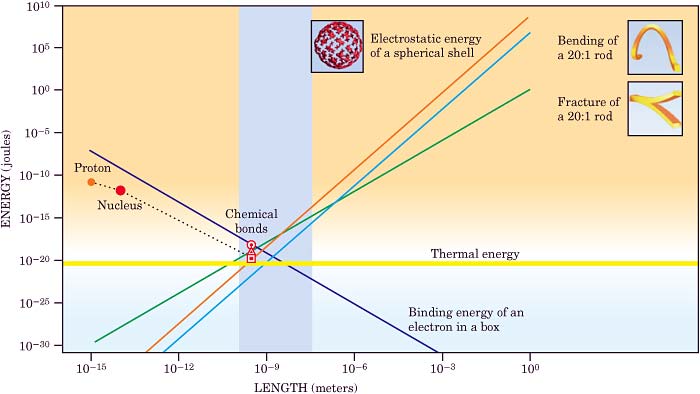
-
Popper's Swamp, Observation Statements, Facts/Interpretations'Perspective' is parasitic on the singularity of the body. It's only contingently true that each body 'plays' just one handle here. It'd maybe be better to have at least two, and to methodically exercise differing approaches with each. As 'a' philosopher, I feel like a team of explorers. But folks are confused if you switch gears/masks to quickly. Folks are maybe too attached also when forced to play a single mask. — jas0n
Two would be enough if we could force folk to be have both a self and anti-self. You would have to show a dialectical self-duality by being jasOn and anti-jasOn .... just like the only Superman plot twist that was worth a damn. :razz:

apokrisis

Start FollowingSend a Message
- Other sites we like
- Social media
- Terms of Service
- Sign In
- Created with PlushForums
- © 2026 The Philosophy Forum