
-
The Nature of Causality and ModalityReality is equally indeterminate at classical scales. — T Clark
It is of course everywhere scaled by h as a constant. But here on Earth, at its average 20 degrees, with its complex planetary materiality, you can say that the nanoscale is the effective semi-classical transition zone between the quantum and the classical.
Biophysicists and chip manufacturers have to take the quantum aspects of biology and electronic circuits seriously. Biologists and car manufacturers not so much. -
The Nature of Causality and ModalityThere are other ways of looking at reality other than the classical Newtonian thermodynamic paradigm. I'm still surprised it has lasted for so long until the modern era. — Shawn
Relativity is also classical. Theories get quantum once they have to include Planck’s constant h in their mechanistic equations. That inserts the indeterminacy into the models. -
The Nature of Causality and ModalityI ask because if indeterminism is at hand and how intuition grapples with indeterminism, then are we at a limit of how to interpret nature? — Shawn
Indeterminism can be true and also merely relative. The full weirdness of "the quantum realm" is never observed, as at every point since the Big Bang, it has been thermally decohered to one degree or another. The weirdness has been constrained towards its classical limit by the Universe becoming a history of past thermal events.
The future is open. But only to the degree that its possibilities haven't already been dissipated in an asymptotically expanding and cooling void. Or what is called the growing block universe model of time.
So yes, indeterminism is a thing. Nonlocality is the new realism. But it is also pretty undramatic when it comes to our practical descriptions of Nature at the level which we typically experience it – the everyday scale of an ontology of "medium-sized dry goods". For all practical purposes, chairs and tables function like the fully determinate objects of classical physics and classical logic.
There is no crisis of contradicting paradigms. Reality runs its gamut from scales where the Cosmos is almost completely undetermined – as in the Big Bang – to scales where it is as thermally decohered and determinate for the difference not to matter a damn. In our everyday world with its everyday notions of causality. -
Wittgenstein, Cognitive Relativism, and "Nested Forms of Life"I might say that our direct aquaintance with our own intelligence is accompanied by an ineffability because it is automatic, unconscious, "brute-fitting". — Apustimelogist
This sounds a little reductionist. Sure, I am all for this kind of predictive/enactive/semiotic understanding of the neurobiology involved. The brain and nervous system are the basis of the modelling relation we call "consciousness". But then on top of neuro-semiosis is stacked socio-semiosis – humans learning how to think and behave at the level of "parts of a larger sociocultural organism".
Socio-semiosis shares all the same general processing principles. The same Darwinian and thermodynamic logic. Yet it is still a further level of "embodied intelligence".
I feel like the emphasis on sociality comes from the feeling that language for insular, private individuals is redundant and unnecessary — Apustimelogist
I would put it the other way around. The requirement for becoming the higher level thing of a social organism is to have a culture that can shape all its individuals into precisely the kind of self-regulating and socially-cooperating agents that would allow such a social organism to exist.
We aren't just born with the qualities of being a rationalising and abstracting self-aware beings equipped with a biographical past and an imaginable future. These are habits of thought shaped by social evolution and encoded in linguistic information. Or more latterly, numeric information as well.
The genetic constraints on human behaviour have become weak in proportion to the sociocultural constraints have taken over.
So that's a critical difference. Although it is also just more of the same in semiotic terms. It is still a story governed by the far more general ecological and environmental constraints of the world at large. We remain creatures exist by entropification. And evolutionary selection has the last say on our relative success at that. -
Is the real world fair and just?P.S. I have a hunch that you might find interesting the Thermal interpretation by Arnold Neumaier. It is an 'ontologically interpretable' interpretation which apparently solves the measurement problem and other issues of other 'realist' interpretations — boundless
Forgot to say that Neumaier indeed argues the same position I take, down to the biosemiotic point about measurement being a matter of imposing metastable mechanical switches on larger patterns of thermal decoherence.
We impose a logic of yes/no on a reality that is always larger or vaguer than that classical binary state. And this is where the epistemic confusion arises. Why the idealists and realists believe they have some real argument going. -
PerceptionSure. Confabulate away. Pretend that colour is covered by "language games" and there is no further mystery to be accounted for. One that deals with the neurobiology rather than the social construction.
-
PerceptionThat's a question about the way the word "red" is used. — Banno
So when you get into an argument with a dichromat and start insisting that what they call green is actually beige, does your personal preference for language games trump their neurodiversity?
Seems a little unwoke and culturally oppressive for you. -
Does physics describe logic?I am not suggesting that, say, a bacterium has a conscious 'purpose').
And IMO that 'something' is crucial. How these kinds of 'proto-intentionalities' appeared in the first places? — boundless
Even an enzyme is proto-intentional. A kinesin or any other molecular motor is proto-intentional. They exist to make things happen in preferred directions.
And intentionality is baked in at every level of structure. A worm has a mouth and sense organs at one end, an anus at the other. Its body plan is set up to plough through the dirt, eating as it goes.
You don’t have to look hard to see functionality in biology. It is there over all scales.
but I think that seeing mind (especially self-consciousness) as a relation structure/process is not enough to 'prove' physicalism so to speak. — boundless
As long as you talk about mind, consciousness, mentation, etc, you are already speaking in an idealist register. All those assumptions about res cogitans, about a mental stuff, about ineffable qualia, float along with you.
Semiotics tries to move us along to a more physically rooted view of life and mind as an informational structure/entropic process - the modelling relation. A kind of dualism if you like. But unmystical as it is closed for causality under its triadic connection.
One view fits traditional cultural practice. The other is grounded in science. You get to pick your side. -
Is self-blame a good thing? Is it the same as accountability? Or is blame just a pointless concept.If we recognize that we are imperfect beings who sometimes make mistakes and inadequate choices, we can roll with challenges and mistakes more readily and improve our approach. — Tom Storm
Why should we frame ourselves in this fashion? Is it anything more than a way of thinking that grew out of the Enlightenment and its Romantic reaction? The modern moral economy.
How could we be actually "imperfect in our being", except as some over the top social judgement? Why do we have to be the one that changes to fit the norms rather than thinking strategically about how we can tip the social game-playing in our own favour?
So what I am saying is that you are just uncritically going along with this idea that it really is all on us as individuals to police our behaviour and strive to find that upright citizen apparently lost somewhere in our inner confusions and emotional turmoil.
This is certainly the game that modern society would like you to play. Socially, and nowadays economically. "If you suck at life, you need to pull yourself together and try a hell of a lot harder, sonny boy."
And how can you ever feel forgiven for failing if you are in fact being socially labelled as just innately "a failure"?
Of course, traditional societies can be far more constraining on the self even if everyone realises that they are just following the cultural norms. Putting on the required masks.
And the modern world can be lived in a guilt-free and openly negotiated fashion. If we live in families or societies that can own up to their mistakes and roll with them, then forgiveness gets easier in both directions.
It becomes the smoothly flowing economy of debts incurred and debts paid. Messages received and new attitudes promised on both sides of the equation. -
Is self-blame a good thing? Is it the same as accountability? Or is blame just a pointless concept.Have you come across Rom Harre’s The Social Construction of Emotions or Catherine Lutz's Unnatural Emotions?
Lutz's study of the Ifaluk especially is a good illustration of how it is really a Western habit of thought to believe that the self-regulation of behaviour is an internal affair rather than an external negotiation carried out within the context of the collective "emotional economy". -
Is self-blame a good thing? Is it the same as accountability? Or is blame just a pointless concept.You did something wrong and thereby incurred a debt, and then the debt was forgiven. That's forgiveness. — Leontiskos
:up: You bring out the essentially social dimension of this neatly. -
PerceptionThe science exists - https://www.ncbi.nlm.nih.gov/pmc/articles/PMC4987397/
The ecological question of whether it is better to be a dichromat or trichromat is a tricky balance. It is easy to delete or add a cone. And across the primate world, there is a shuttling back and forth that appears to boil down to a tale of small comparative advantages.
Perhaps you forage for food that it helps to spot from a distance, then more cones of the same type would help with the computational acuity. Or perhaps you forage for small berries that demand close work with nimble fingers. Then the extra colour pop of the trichromat is favoured as the option which provides more calories for less effort.
So questions about perception are best first addressed in ecological terms. What is a “mind” even for?
If there is anything “philosophical” left unaddressed after that, at least the discussion will be usefully focused. And not another re-run of idealism vs realism. -
PerceptionOne has to wonder what the 8% of “colour blind” males make of this debate. Are they missing out on the glory of the red or green frequencies? Does it seem odd that red and green might just be about shared habits of speech? What can it mean that they can’t seem to see much of a difference between red and browny yellow or green and beige?
A philosophical discussion of colour perception - or better yet, hue discrimination - ought to start with a better understanding of the neurobiology involved. And the ecological relevance. Why hue discrimination even matters in an organism’s construction of its world, it’s Umwelt. -
PerceptionNone of which is to deny the physics of colour. The scientistic view that "there is no colour in the world" is inept, failing to recognise that humans create and maintain a shared world of language and belief. — Banno
Somehow the neurobiology of perception has gone missing here. And some might think that the most salient part of the story. Curious. -
Does physics describe logic?The way I see it, as I said, living organisms, even the most basic ones, seem 'aware' of that they are distinct to their environment, that they are a 'whole', so to speak. Is there a 'global law' (spontaneous symmetry breaking) that describes the emergence of these 'individuals'? — boundless
The best “law” would be Pattee’s notion of the epistemic cut. It sets the divide down at the atomistic level of when a molecule becomes a message. It roots things in the logic of a mechanical switch that regulates an entropy flow for some organismic purpose.
https://casci.binghamton.edu/publications/pattee/pattee.html
Do you think that our mind is algorithmic? If not, how 'machine-like' entities can 'give rise' to a non-algorithmic mind shall have an explanation. I think that our mind are not algorithmic but I don't think that I can make a rationally compelling argument of this point. — boundless
Well it is algorithmic looking down at the neural circuit level. You have processing units like cortical columns. And then it is algorithmic looking at the socially constructed level where we are imposing some kind of rational and grammatical order on our thought patterns, especially when we are “civilised” and have internalised a whole variety of cultural rules and procedures. As in how to behave as a driver or at a formal banquet.
What is not actually algorithmic about any of this is that all the “computation” is about the end outcome of regulating some self-constructing entropy flow. We are turning matter into bodies. And that is not something you associate with computers. That is what makes us organisms and them machines. Or rather our tools, as computers only have use for us when they are woven into our general entropy regulation projects.
So being algorithmic or mechanical is a tricky issue. If we turn a natural river into a system of canals, irrigation ditches and water wheels, is that “algorithmic”?
It isn’t purely organic. But it does display the finality we expect from organismic purpose. The landscape has been shaped by a desire. And this was possible to the degree that an algorithmic form could be imposed in terms of a logic of entailment or a causality based on a mechanics of form.
A complex system of switches was imposed on the river. And that served a holistic entropy-harnessing purpose. This is the self-organising and self-sustaining kind of state of affairs that we would recognise as being organismic. It speaks to the presence of life and mind.
Do you think that a 'proto-proto-awareness' of sorts is there in anything else besides living organisms and biomolecules? — boundless
The mistake here is to speak of awareness as a stuff rather than a process. An inherent property of “mentation” rather than a relational structure that is semiotic. Mind as simply what it is like to be in a regulating modelling relation with the world. -
Does physics describe logic?You say that but I’m inherently distrustful of mechanistic metaphors past a certain point. — Wayfarer
Did you watch the video? A swarm of little machines? Surely that must give you pause. But if your distrust isn’t swayed by evidence…. -
Does physics describe logic?Will read with interest — Wayfarer
On the particular point of “why”, think of it this way. Maths progresses as an inquiry by abstracting away constraints. The physical world develops as the series of topological phase transitions characterising the Big Bang by emergently adding new forms of constraint.
So they are the inverse of each other. What physics adds, maths subtracts. This is why each informs the other at a deep level … if folk are willing to talk across their academic divides.
Which is essentially what could be said about causality and entailment. There is a reason why we should seek the common root so as to understand the whole in better fashion.
But boundary policing is a favourite human pastime. If folk find a synergy between domains is possible, this is not just surprising but verging on “the unreasonable”. :grin: -
Does physics describe logic?it does suggest to me that the cosmos is more mind- than machine-like. — Wayfarer
Remember then that biosemiosis is in fact a surprising story of how machine like is the basis of life and mind. Semiosis is about how informational switches regulate entropic flows. And this is what we find right at the base level of biology where metabolism is no longer the cellular bag of chemical reactions it was in the 1970s. It is now a tale of nanoscale machinery.
-
Does physics describe logic?But since then the “surprise” is how the physics has pushed the maths.
But over the past 30 years a new type of interaction has taken place, probably unique, in which physicists, exploring their new and still speculative theories,have stumbled across a whole range of mathematical “discoveries”. These are derived by physical intuition and heuristic arguments, which are beyond the reach, as yet, of mathematical rigour, but which have withstood the tests of time and alternative methods. There is great intellectual excitement in these mutual exchanges.
The impact of these discoveries on mathematics has been profound and widespread. Areas of mathematics such as topology and algebraic geometry, which lie at the heart of pure mathematics and appear very distant from the physics frontier, have been dramatically affected. The meaning of all this is unclear and one may be tempted to invert Wigner's comment and marvel at “the unreasonable effectiveness of physics in mathematics”.
https://royalsocietypublishing.org/doi/pdf/10.1098/rsta.2009.0227 -
Wittgenstein, Cognitive Relativism, and "Nested Forms of Life"How does this connect to Wittgenstein? — Ludwig V
The point about vagueness in relation to the constraints of nested hierarchies was the OP issue. It was also an accusation quickly thrown at Wittgenstein's general position as – following Russell – vagueness tends to get dismissed as merely missing information. If we dig down, the information could be found.
But from my perspective – based on Peirce, systems science and hierarchy theory – that grounding presumption is quite wrong. Precisification follows instead from sharpening the constraints that limit the scope of our uncertainty. The ground of pragamatic truth becomes this top-down process of limiting our scope to be wrong. The nested hierarchy story where order arises by a relation of subsumption rather than composition.
That deals with epistemic vagueness – the natural structure of our thoughts. We apply schemata to the world in pragmatic fashion. Every division we impose on the world splits it into categories – a dialectical divide being the most informational. But every such division is also grounded in some pragmatic agreement that we "don't have any reason to care" about the details or particulars beyond the arbitrary point where we "lose interest". There are still differences to be found, but they have become the differences that don't make a difference.
Is that a lion or a tiger you ask? It is in fact a liger, I reply. Oh, then is it not more tion looking than liger looking because its mane is quite pronounced and the stripes are quite faded?
Well, I could say, at this point, do either of us really have a reason to give a stuff? The exact ratio can be consigned to a logical vagueness as the truth value for all that we say doesn't particularly matter in that general epistemic fashion.
So in a debate about nested hierarchies as epistemic representations of logical relations, vagueness does change up the game. Russell and Wittgenstein were wrong in dismissing it on the grounds they did.
And then, more interestingly to me, is the continuation of this little logical escapade into metaphysics and ontology.
Perhaps there might really be a reason that Bohr, Heisenberg and other quantum pioneers were concerned with "unsharpness" rather than "uncertainty". Maybe they were already thinking more in terms of missing global constraints rather than missing local information in their speculation about how the world could behave in its fundamental quantum way.
See for example this paper on quantum vagueness....
In classical physics, which is known to describe correctly macroscopic objects (to a hitherto practically unlimited accuracy) when quantum effects are imperceptible, all magnitudes have a definite value at any given time that can in principle be simultaneously known with certainty at that moment by their measurement, even though they may not always then be predicted with certainty; for example, when the classical evolution is chaotic, or may be difficult to measure. Hence, vagueness is considered alien to classical physics.
In the case of microscopic entities to which Quantum Mechanics pertains, there is vagueness the origin of which is substantially different. Vagueness in quantum mechanics appears endemic, arising directly from the indeterminate nature of quantum entities themselves rather than a choice of concepts within a flexible theoretical framework. Indeed, in quantum physics spatial location can be almost entirely indeterminate, such as when the momentum is specified with extremely high precision, say in the case of a free electron.
Unlike the situation of macroscopic entities with vague geographical characteristics, it is not the case that the concept electron is overdetermined in the sense that the criteria for it to have a unique spatial location—or for that matter, for it to be spatially dispersed—cannot be satisfied in principle; nor is the concept of electron underdetermined in the sense that the definitions of its physical properties are insufficiently precise.
In the case of quantum systems, properties can be considered objectively indefinite and sets of propositions regarding them complementary to specific other sets of propositions, so that it becomes impossible to jointly attribute them. Thus, quantum mechanics involves a unique form of vagueness distinct from those considered before. -
Does physics describe logic?As to why this is so effective, that seems to be the source of some bafflement — Wayfarer
Well yes. Until you start to understand the physics of dissipative structure and topological order. The physics of symmetry breaking and emergence. Then it is maths of “that type” which is what is effective, for perfectly natural and unbaffling reasons.
It is all about the holistic constraints that form can impose on matter. Poincaré symmetry imposes its structure on what can even be the case as a relativist spacetime manifold. Gauge symmetry - the Lie algebra story - then does the same thing to produce the particle physics of quantum field theory.
So it is only maths of a particular type. A maths that speaks to the mathematical necessity of topological emergence. There are only certain geometries that Nature could even arrive at as it shakes itself down into its fundamental patterns.
Wigner and Dirac were leaders in just going with that kind of maths even before they could really understand how far it would lead.
It was crazy effective. But not actually baffling anymore.
But on the semiotic and enactivist view, it's really not so baffling, as the structure of experience is in some fundamental respect also the structure of 'the world'. — Wayfarer
But pansemiosis is not biosemiosis as I have been at pains to explain. So really, Poincaré and Lie algebra have little application to the way organisms are self-organised. The maths that is crazy effective there is Bayesian probability perhaps. The maths of predictive modelling. Or the maths of hierarchy theory if we want a more general metaphysical frame that does show some deeper unity between the physics of dissipative structure and the biosemiotics of the modeling relation. -
Does physics describe logic?So, according to him, even the most simple physical objects have a 'mental aspect' so to speak, a very very rudimental ability to 'read' information and meaning, so to speak — boundless
Yep. Once you are stuck with the Cartesian metaphysical division into a mind stuff vs a world stuff, then this kind of wooly Panpsychism is where you must logically end up. It is built into the premises. You can’t think your way beyond the casual trap you have prepared for yourself.
Semiosis or systems thinking is just different. The world is divided at best into an entropic process and an informational process. You have a material world of dissipative structure organised by its emergent topological order. And you have a semiotic world of organisms in an enactive modelling relation with that material world, organised by its Umwelt that is what you would call a first person point of view of a third person version of “the world”.
Our mind is the model of the world as it would be from the point of view as it would be with us acting in it. The modelling relation is anticipatory. When you turn your head, you know it is you that is turning and not the world that is spinning, because your motor commands are fed into your sensory experience in a way to subtract your voluntary motion from your sense of what is happening “out there” in the world.
A first person vs third person contrast is what must arise for the modeling of the world to even function. This is the enactive or embodied argument. This is the trick that is generic to any notion of sentience or intelligent in an organism. Does it subtract its own actions in a way that makes “objective” the state of the world as it is sensed beyond. This is the basic semiotic algorithm that defines an organism with some kind of mind, some level of mentality.
Now one can speak of the physical world as if it is particles reading information. There are versions of pansemiosis where physics is treated as particles in a sign relation with their world as well.
But this is as best metaphoric. Not much maths in it. And really not an explanation in any theoretical sense. More a comforting fairy tale. A way not to be “reductionist”. A placeholder for a better worked out holist account.
However as I argued, biosemiosis now clears up the life and mind side of the equation, leaving the dissipative structure and topological order side much more plainly seen. The new holistic view of fundamental physics. The cosmological view that has to be fundamental as after all, it is all about dissipative structure if reality is that trajectory from a Big Bang to a Heat Death.
And this new semiotic view of reality is mathematically grounded in a statistical mechanics. We actually have a connection between semiosis as modelling and semiosis as dissipation as information theory is reciprocally related to entropy theory. Entropy is missing information. Information is absent entropy.
So both same yet different in a complementary or dichotomistic fashion. Physics puts all the information that specifies a physical system into its holographic boundary. Organisms then do the opposite thing of bringing all its self-regulating information inside its own boundaries as the information it encodes or remembers. Some collection of entropy controlling habits or routines.
Friston’s Bayesian Brain now takes this to the point where the predictive world modelling is expressed in dissipative structure terms and as the differential equations of a new Bayesian mechanics. The semiotic approach has become mathematically formalised as a theory both in terms of life/mind and also - in the de Sitter holographic view - in cosmology.
And why this isn’t widely understood is baffling. It can only be that dyadic Cartesianism still rules the cultural imagination at large. Along with the monisms of realism and idealism as the two ways to reduce what the Cartesian divide has left separated and competing for our social affiliation.
Meanwhile on the other historical track is the holistic metaphysical tradition that saw some kind of triadic relation as being foundational. The threeness that is a dialectical unity of opposites or the substantial being arising out of the hylomorphic pincer movement of material potential and necessitating form.
This way of thought became Peircean semiotics, systems science, hierarchy theory and far from equilbrium thermodynamics. It has gained its mathematical expressions. Yet it is still on the outside looking in as far as the limits of the cultural imagination goes.
It ain’t reflected in our popular notions of causality or logic. It indeed rouses great hostility from defenders of the Cartesian divide, too absorbed in their own ritualistic battles of idealist vs realists and not wanting to start all over having to learn a perspective that is both entirely new and also irreducibly complex. :smile: -
Wittgenstein, Cognitive Relativism, and "Nested Forms of Life"But I'm not sure that "graded" necessarily implies "relativities". The colour spectrum is a series of graded stages in a continuum, all of which is, in a sense, deterministic (definite). — Ludwig V
Not a good example because colour vision is the outcome of three real cones and one virtual one that are dialectically structured into two opponent channel processes. And then mixed further with luminance information.
If we just stuck with the simplicity of luminance – the spectrum between white and black (as in the sun when it is out shining or hidden behind the horizon), then we can see how that becomes the middle ground of any number of shades of grey we find worth specifying.
And now if you want to add back hue, it could be all the reds from whitest pink to blackest scarlet. Or the same for green and blue.
This doesn't convey any clear meaning to me. Perhaps I'm just being dense. — Ludwig V
Its systems science. A system is the hierarchical story of top-down constraints shaping local degrees of freedom, and those local degrees in turn acting bottom-up to (re)construct the globally prevailing state of constraint. So in Peircean jargon, the continuity of global lawful synechism and the discreteness of local tychism or chance events.
Chance and necessity, flux and stasis, are various ways of saying the same thing, capturing the same systems logic, that should be familiar from Greek metaphysics. -
Does physics describe logic?Let's say that 'ontological idealism' means that fundamental reality is mental and every other kind of 'realities' are dependent on that ultimate reality. — boundless
No. I was making an argument completely in a realist register there. No "mind stuff" or "qualia" at all. Our cognition has a physically real structure (or physically realised structure), just as the world has a physical structure too. And the semiotic point is that the cognitive structure is an embodied modelling relation which has the general purpose of regulating an organism's extended environment.
What we "experience" is not a re-presentation of reality, nor some epiphenomenal illusion, but a semiotic Umwelt. Which is what it feels like to be in the flow of living a life from a self-ish point of view.
This is a structuralist metaphysics that stands opposed to the usual materialist story. And it is thus – according to semiotic theory – an irreducibly triadic story, not the usual tale of some fundamental or monistic "stuff".
The triadic relation is the fundamental reality. And while it is easy to talk in a phenomenological register about the mind as being its own separate realm of experience or qualia, we know even from neuroscience that there is no structured experience without our brains being in interaction with an already structured world.
In a sensory deprivation chamber, we soon loose any normal sense of being in a body, and even being in a normal flow of thought. Just to see the world in a stable fashion, we need to jitter our eyeballs and keep "surprising" the photoreceptors with the fact that the boring backdrop that was there an instant ago is still there – and remains ignorable – right now.
So my argument starts from an enactive cognition perspective. There is a brain in a modelling relation with a world, and so already we are talking about the reality of a functional, physically-embodied, process.
After that, in talking about our intellectual modelling of causality and logic, we can assign each to its "realm" in the fashion of the good old Cartesian mind~world divide. This is the conventional socially-constructed way of looking at things which of course was the basis for how humans even added self-awareness, "freewill", complex feelings, and all the rest as sociocultural habits of cognition.
Breaking things into mind and world is physically incorrect (a cognitive neuroscientist would say), but it is also the cultural convention which turns a smart ape into a self-actualising human being.
Sorry, that is a lot of complexity. But it goes to the stress I lay on there being not just a triadic semiotic modelling relation in play, but with the physical reality of life and mind, this dynamic plays out at four key levels of semiotic mechanism – genes, neurons, words and numbers. So in terms of causality vs entailment, I was making a case of how this applies semiotically at the level of human sociocultural organisation once it has become a talk at the level of "pure abstraction" – a symbolism of number systems.
I ask you this because, unless your view is a sort of 'panpsychism' it should be called 'realism' as defined above. — boundless
After my explanation, you can see I am definitely neither arguing for a monistic, nor dyadic, version of panpsychism. But also I am not arguing for a conventional realism.
I wasn't trying to argue a general case at all, just saying something about how – after the ancient Greek "mathematical turn" – logic and causality became their own divergent academic domains. That can be simply described as scholarly convenience. It could be construed as causality speaking to the experiment-restricted physics and entailment speaking to the Platonically soaring maths.
However if you want the full Peircean semiotic position, that says we know life and mind to be biosemiotic. That is just everyday psychology and biology now. It is grounded in biophysics and gives us a consistent account of the structure of human relations with the world through all its four levels of semiotic mechanism.
Controversially on PF, that means all of the humanities fall under the domain of biosemiosis as a general science of meaningful thought and behaviour.
And then also speculatively and controversially, one can go with Peirce and wonder about pansemiosis as a metaphysics of reality in general. The same triadic relational structure could account for the deep causality of the Cosmos as a whole. The Big Bang Universe becomes Peirce's "growth of universal reasonableness". The emergence of hierarchical or topological order from out of a "quantum foam".
You say you did condensed matter physics? Dissipative structure can be seen as this pansemiotic thesis now being realised in physicalist theory.
Peirce's position was that what works as a structure of phenomenology – the givenness of our experience – should work as the structure of logic as the refined product of how we find ourselves thinking and feeling and reasoning. So the first step is from our psychology to our logic.
Then the second step is finding that the world beyond is also structured by the logic that we found in our minds. It too has a causality that is a process of reason – or at least triadically structured in some meaningful way.
Of course Peirce didn't know about genes and so had no concrete model of how there could be an actual machinery of semiosis. So that meant he got a little woo in treating mind and cosmos as being a little too literally the same. But the Universe, as a dissipative structure, lacks an encoding machinery. We only kind of imagine that as the case in now talking about holographic spacetime boundaries and suchlike. A useful metaphor with calculable consequences.
Biosemiosis has since come along to make that difference clear. And that also sparked the conversation about pansemiosis as now being covered by dissipative structure theory.
So it is all a concrete realist project. But one that hopes to ground the sciences of life and mind in the sciences of physics and chemistry, with now an "epistemic cut" to glue the two sides of the divide, and so get rid of the tired old "Cartesian gap".
This is why I take my pragmatist approach in this thread. Logic and causality are both modelling constructs so come from the same place – human matheo-semiosis. They are taken to speak to a Cartesian divided reality, but we should expect them to be pragmatically related by the triadicism of the semiotic modeling relation.
If one seems to deal in entropic relations, the other in informational relations, then well, this is just what a biosemiotician would expect. A biosemiotic story is all about how this division is actually necessary to get to the next thing of its fruitful interaction which is the "living and mindful" point.
I am not saying that your view is wrong but IMO grounding logic in an uncertain knowledge doesn't seem a real 'grounding'. — boundless
Isn't this like being nervous of riding a bicycle as its obviously unstable and only going to get more dangerous the faster you pedal?
A tripod is a firmer base than a single point of contact, no? So just think of how soundly based pragmatism seems when compared to the instability of the folk flipping between whether maths is a free construction or a Platonic truth. Trying to balance the pencil on it tip and wondering why it always falls.
Or another metaphor, calling for a grounding does the very opposite as we find with the "tower of turtles" infinite regress. If we try to find solid ground, it immediately drops endlessly away.
The triadic hierarchical approach instead grounds in the pragmatism of the dialectic. The middle ground is that which is bounded both looking up and looking down.
Looking down, the middle ground dissolves into a blur of smallness. A random jitter of events that just smooths over into one kind of continuum. And likewise, looking up and any differences swell until just one "difference" so completely fills our vision, like the sky, that it becomes a global continuum to match the local one.
So our middle ground is secured by the closure of being the meat in a sandwich of complementary limits. Or in the parlance of cosmology, a de Sitter conformal universe. A global container specified by general relativity with a local contents specified by quantum field theory.
So your instinct is to demand a reduction to a single monistic ground. The Peircean counter-argument is that reality is a hierarchical structure of relations, and that makes it irreducibly triadic.
Reality doesn't come stacked up on an infinite tower of turtles. It instead is a structure of relations that exists by growing in de Sitter fashion. It expands and cools, doubles and halves, in geometric fashion until – as far as any middle-grounders living at the classical scale of medium-sized dry goods knows – any quantum small and hotness dissolves into a lower bound blur, while any relativistic difference smooths over into the large and coldness of a cosmic event horizon. The de Sitter Heat Death void as it becomes at the effective end of time. The ultimate largeness that stretches way past the edges of our merely middle ground scale of view.
If 'semiotic modelling' - I am wrong to call it 'mentation'? - has only been working since a certain point of this universe history, doesn't it lead us to an emergentist view? — boundless
Again, there are two conversations. The first is that life and mind are now explained by the causality/logic of biosemiosis. It is a conventional view in the relevant sciences. We can talk about its mineral beginnings in warm ocean floor sea vents where you had a natural starting point of alkaline vent mixing with acid ocean and setting up a proton gradient across thin vent walls suitably laced with the chemical "enzymes" to start producing complex amino acid crud.
The second is pansemiosis – just dissipative structure before informational mechanism started getting its hands on it. So that covers everything out to the Big Bang as the foundational dissipative event. A hylomorphic mix of its energy potential or quantum indeterminism and the symmetry structures that Platonically lay in wait to shape it topological transformations.
BTW, are you familiar to the late Bohm views on 'active information'. I think that you would find them akin to yours. — boundless
Sort of the same. Everyone is feeling the same elephant once they get fed up enough with reductionism. -
Does physics describe logic?There's a rather awkward neologism I've heard several times of late, 'transjective — Wayfarer
Thanks for the pointer to John Vervaeke. If you skim this review article, you can see he talks about all the same stuff as me. Modelling relations, anticipatory models, enactive cognition. So sits pretty squarely in what has now become the mainstream paradigm of cognitive science.
Vervaeke coins a few of his own terms. All academics have to brand themselves as adding something to the debate.
If I were criticising, I would say he would do better if he could root his general cognitive story in the nitty gritty of the brain's functional anatomy. Close the gap between the psychology and the neurology.
But generally his published papers are coming from the same place. -
Wittgenstein, Cognitive Relativism, and "Nested Forms of Life""ontically" confuses me. — Ludwig V
Can Nature be actually indeterminate and not just always determinate? Is there a state where there is no fact of the matter, and thus not even properly any "state"?
What characterises the future in term of its unexpressed possibilities? What came "before" the Big Bang if the Big Bang was the start of everything, including time and space?
It could be quite useful in metaphysical discussion to have this dialectic of the vague and crisp as then you can see how the actuality of reality is always somewhere on the spectrum that thus exists in-between. Nothing is either completely determinate or completely undetermined. And this offers a different metaphysical frame for how we imagine Nature.
We shift from talking about yes or no absolutes – such as determinism – to graded relativities. That gives us more options that might better fit what we see. To exist can always be some mix of the definitely constrained and the radically free. As in chance and necessity. -
Wittgenstein, Cognitive Relativism, and "Nested Forms of Life"Interestingly enough, Wittgenstein has some interesting things to say about vagueness of concepts. ... Is an indistinct photograph a picture of a person at all? — Richard B
Bertrand Russell took this line in his essay on vagueness.
As a Peircean, one would point out that there is epistemic and ontic versions of the vagueness issue. Russell dismissed the ontic as bad picture of a person could always have been taken with proper lighting, the blurred face in the mirror can always be made clear by giving the mirror a proper polish.
Epistemic vagueness is not really much of an issue. What becomes the interesting issue is whether it is meaningful to describe reality itself as being ontically vague in any proper or useful sense. And a Peircean might rather think it does.
The whole of existence might be rooted in vagueness, and made dialectically crisp only to some pragmatic degree. Potentiality can be constrained into forms and so become substantial. Yet still any substantial state never fully erases its tychic capacity to surprise.
Quantum theory came along and rather illustrated that. We can renormalise the heck out of the quantum field theory representation of a particle. But eventually we must pragmatically "take the limit" and claim the exactness we can't actually demonstrate. -
PerceptionNo, it demonstrates colour vision under selective conditions of observation. — jkop
So not like dawn or dusk? Hmm.
From a neuroscience view, the point of colour vision is not because the world is coloured. Or even because it makes vision aesthetically pleasing. It just evolved to make the shape of objects pop out of the visual clutter. We can instantly compute that an object is an object because it is all "one thing" as betrayed by its light scattering surface.
A ripe fruit pops out of the clutter that is green bush. Mammals had given up and downgraded to two cone vision as that was enough. Primates added back a third cone precisely where it would create a sharp bivalent contrast between red and green in terms of the light frequency being scattered.
Likewise the colour vision "module" in the primate brain is right where you would expect. Part of the shape decoding and object recognition brain pathway.
So we evolved not to see red but to see fruit in a world otherwise many shades of tan and khaki. Trees likewise evolved red fruit to call in the seed dispersal brigade.
That red "looks like something" – ineffable redness – is not nature's point. The point is what red emphatically does not look like. And that is green.
You can see this counterfactuality baked into the circuitry of the opponent channel process of the retina.
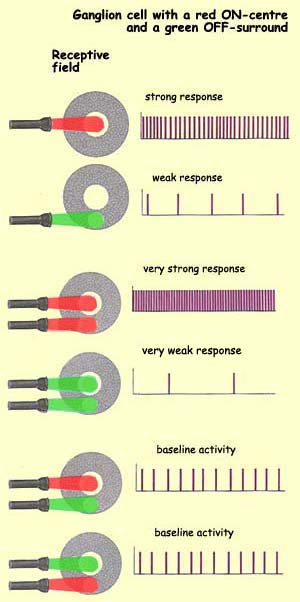
-
Using Artificial Intelligence to help do philosophyI find ChatGPT is less of an independent thinker, and more of a mirror or echo chamber. — Bret Bernhoft
And it has a problem in that the more data it averages over, the more it will bland out and become useless. If it starts consuming its own generated media, that compounds the problem.
So it seems sharpest at a reasonable sized sampling and grows dumber after that.
Of course, every problem has its solutions. But I was around for the AI hype of the early 1980s. Lisp and parallel computers were going to be running your corporation said ICL. IBM snickered into its sleeve as it kept on grinding ICL out of its own home market.
This is a good video on that data issue....
-
Using Artificial Intelligence to help do philosophyAs I've already said, I think AIs must also be embodied (i.e. have synthetic phenomenology that constitutes their "internal models"). — 180 Proof
Yep. Does it flinch as you take back a foot before kicking its cabinet?
IMHO, these machines are still only very very fast GIGO, data-mining, calculators. — 180 Proof
:up:
For anyone interested in why large language models are being forced on us for free, here is the business case back story. AI sells more hardware and operating system licences.
This has been how the computer industry has been thinking since IBM leased mainframe systems in the 1970s. Get the customer on an escalator of data bloat. Promise huge bottom-line productivity improvements and rake in the cash as the customer keeps coming back for more CPU and memory as they chase the productivity mirage.
-
Does physics describe logic?In fact, some kind of intuition of logical principles might be innate. Maybe even animals. — boundless
Yep. Animals can induce or form associations. They can tell the difference between one, two three and many. But deduction, like the counting, or learning grammatical structure, is something no other animal but humans can turn into a fluid skill. So we can make something of that. The mindset behind logical and physical accounts of the world has some neuroantomical basis. We evolved this basic habit of thought that is recursive. We find it easy to think in a nested hierarchical fashion. A calculus of distinctions.
We likely evolved this first over a million years of tool making/using, and then this was further solidified by the development of articulate speech. We needed to think in terms of sequences of construction. Hold a rock and chip it into a desired form. Face the world and turn it into a “who did what to whom” narration.
So there is a pragmatic ground to how we might think reality is optimally decoded. A grammatical instinct. A semiotic system of rules and words, relations and relata, syntax and semantics. A habit of mind that proved itself by its sturdy usefulness over a million years. Even though it was not about the world but about our being able to impose ourself in a mechanical fashion - action sequences leading to desired results - on our world.
Thus there is a ground. But it is neither something of the world or even of our minds. It is a propositional attitude that arose from a semiotic modelling relation with the world. It is neither a pure realism or a pure idealism. It is something that cognitively worked. A tool using hominid could structure its world with a hierarchical order. A grammatical sapiens could impose a further level of still more consciously-distancing narrative structure,
We see then the ancient world where causality continued to have a human-centric narrativism, The animistic and magical thinking where the landscape is alive with spirits and powers. Even at the time of the Hesiod, the Greeks were equally comfortable with causal explanations that “the gods did it” as some more naturalistic account of why a storm blew up or sickness took a child.
Then we get to Anaximander and the first systematic naturalism. We have dialectical reasoning that develops into a variety of causal accounts such as hylomorphism and atomism. We have geometry and arithmetic becoming formalised by the constraints - the closure - of proofs.
What was a logic and causality of narration becomes a logic and causality founded in number rather than words. And this in turn becomes dialectically divided as science and maths. The grammar of physical nature and the grammar of pure ideas.
So yes, logic and causality seem to speak from different spheres today. And we are as comfortable with that as those of the Hesiod era were comfortable mixing the registers of mythical and animistic accounts with more physical and naturalistic accounts.
It seems to work that there is structured speech about the real physics of the world and the true or valid arguments of the mind.
And yet dig down. It all starts and ends in the pragmatism of the semiotic modelling relation we have with the world. What works - and thus what we believe in - is our ability to impose an imagined structuring order on our lived reality.
The foundation of logical and causal thinking is this uneasy thing that is neither properly a realism or an idealism. It is instead a system for constructing dialectical structure - nested hierarchies or recursive pattern - that can fashion the world into ways that conform with our desires.
We use models of logic/causality to constrain nature mechanically. It started with tool-making, then society-making, then civilisation and technology making.
And we are left uneasy - some even claim a foundational crisis - as it is all kind of both weirdly intuitive yet also neither clearly of the world or of the mind.
But, on the other hand, even understanding the concept of 'usefulness' relies on understanding logic. What do you think? — boundless
Self-referentiality is not an issue for a self-organising system. Circularity creates problems. Hierarchies fix them. The disjunction of the dyad becomes the conjunction of the triad.
Let's say that, indeed, logical principles are a 'reflection' of an intelligible structure of the world. How could one 'prove' this view? — boundless
I am taking the Peircean approach here. Truth is what a rational process of inquiry arrives at in the limit.
We hazard a guess, take the risk of assuming a belief, and then discover the pragmatic consequences of doing that. We systematically doubt what we have assumed until we reach a point that further doubt has become useless. Moot. A difference that no longer could make a difference in practice.
Proof seems a really big thing. But it is only important to the deductive phase of Peirce’s three stages in the development of a state of reasonable belief.
We start with the abductive guess. An idea about an explanation. Then we apply a process of deduction that is rigorous in terms of being closed for entailment. We break down our intuition into a set of specific logical expectations. This formal encoding of a proposition - if A, then B, or however we might phrase it - proposes a consequence we can then measure in terms of what actually follows. We can inductively confirm the proposition to the degree that it isn’t being contradicted.
But in order to accept a view or another, it might be needed to be shown that such a view is better than others (or a skeptical approach on the issue). — boundless
If the semiotic modelling relation has been working for life and mind since its biological beginning, and a semiosis founded in number is merely the latest instantiation of this natural story, then that would be a pretty grounded tale I would have thought.
One that is neither stranded in realism or idealism but founded in a lived relation that humans have with their world. -
Does physics describe logic?Perhaps a sharper way to put it. If logic is meant to structure our thoughts and causality to structure the world, why should they not correspond in this way. Why not the pragmatic constraint that optimises the value of both?
The definition of pragmatic is found in the limit of inquiry. When further refinement is agreed to be pointless. A difference that would make no difference.
Every hates effective theory. But what if that is just the nature of both physics and logic? As we discover in our own good time. -
Does physics describe logic?Not a very adventurous reply.
Because, e.g. in order to establish if something is useful you need to have criteria to establish that it is useful, i.e. coherent with the concept of 'useful'. — boundless
What else leaves us satisfied but that something works. It achieves some goal. It is consistent with our aims.
So sure there is a circularity here. But we know how to approach that. Is it impossible to say anything about what we find to be useful about a logic as opposed to a logic that we think of as patently useless?
We routinely apply this constraint to physics. What makes it impossible in logics? Especially given as we do it routinely. To the point that we think we know what has practical bite and what is verging on abstract nonsense.
Also, practical consequences are empirical facts. — boundless
Empirical facts are measurements. So epistemic facts really. Numbers on dials ready to get fed into formulas.
Physics might not be that physical, just as logic ain’t that unphysical when you get down to it. It is a bit of a social construction to claim that logic is some free choice abstract from reality, or indeed an inhabitant of Platonia.
I think that they do have something in common. In order to formulate the concept of 'causality', I think you need entailment as a prerequisite. — boundless
And vice versa. Did logic not arise from causal reasoning about nature? The concept of atomic actions? The concept of transformations but also closure?
How could both logic and physics be idealised in the language of number - of equations and variables, of operations and values - unless they are both birthed from the same deep concept? Global constraints coupled to local degrees of freedom. The dialectical intersection of necessity and chance.
Or structures and morphisms if you must. :wink: -
Does physics describe logic?IMO: logic has no ground at all. — boundless
Why not ground logic in its practical consequences? Like science.
That way entailment and causality might start to look like they have something in common. -
Semiotics and Information TheoryGetting things back on track, you will remember my semiotic point was how language had to evolve to the point (and I mean culturally evolve more than neuroanatomically) where it could sustain a new kind of social Umwelt – the mind that sees its landscape as its world. Every creek, every hillock, freighted with cultural meaning.
Here is a good article that touches on this in terms of what you argued about the San and click languages being somehow a sign of unbroken antiquity.
Human History Written in Stone and Blood – American Scientist
You can see that there was a sharp transition around 70kya. Blombos cave marks early evidence of symbolic culture.
But then if this was neurological, then why was it swiftly followed by a collapse back to cultural simplicity so soon after? Brains didn't devolve. So it had to be a social structure collapse.
The coastal package produced a population boom and so powered a growth in tribal complexity. You had a widespread trading economy emerge in the manner I described. A complexity of language and thought that organised the landscape into an extended network of human contact.
But perhaps the climate changed. Social interactions frayed and populations shrank back to isolated gene pools. Southern Africa was pushed into a lower level of hierarchical development. It only came back again when the "out of africa" mob returned with the level of linguistic and cultural sophistication to fire up things once more.
So the anthropologist has to speculate on the available evidence. But this is the kind of considered story that emerges. The real Rubicon is the way language transforms the experienced world into a shared fabric of social relations.
If you don't have the population, you don't have the interactions that produce the structural complexity. And language is going to be matchingly simplified when it is no longer useful in everyday life.
So we have an evolutionary account that has to include reaching a critical mass in terms of populations and the intensity of social interactions. The crucial shift from living as a band to living as a tribe as I said.
Neuroanatomy isn't even under a selective pressure for a tribal mentality given that even Neanderthals struggled to exist as more than very thinly spread bands of about 10. Grammatical speech and the symbolic thought it enables are a precursor step – a good reason for why sub-Saharan Africa started to see this sapiens offshoot gathering some steam from 200kya.
But then comes the population density to properly spark the human transition to being a socially constructed animal. We mixed in numbers and so formed hierarchical networks across "owned" landscapes. We fought and traded so needed kinships structures and genealogy stories. Chieftains and agreements. Raiding parties. The trading of goods, wives and slaves.
Becoming political and economic creatures created the population growth that fed back into even more intense political and economic activity.
Anyway read the article as it puts the click languages into the larger context of what was going on in the world. Click phonemes may seem all cool and weird, but they don't really tells us anything about archaic language. They are not some primitive linguistic feature as far as I can see. -
Semiotics and Information TheorySo yeah, please feel free to disregard my comments, go back to sleep, and I hope you enjoy living the rest of your life in your comfortable, unchallenging, dream world. — Jaded Scholar
Again, where do you think you get this right to insult me without making any attempt to engage with me? -
Semiotics and Information TheoryIt seems kinda contrary to what you are saying. — Lionino
Perhaps if you haven't properly delved into what I said.
apokrisis

Start FollowingSend a Message
- Other sites we like
- Social media
- Terms of Service
- Sign In
- Created with PlushForums
- © 2026 The Philosophy Forum