
-
Expressing masculinityHunting is one thing, the machine-gun useful for wiping out concert goers is something else. — Bitter Crank
Yes, that seems to be a problem. Do you see some correlation between some pent-up issue related to masculinity and acts of violence? Criminals do it all the time on the streets and inside the jail, where they belong. The even more psychotic types like rapists, gang-bangers, murdering as a sport, and so on seem to take the whole thing to a whole new level, and with that often get labeled as 'lunatics' or 'crazies' or 'nutjobs', which detracts from understanding the complex issue.
Something is obviously being expressed by these 'crazies' (like the Las Vegas shooter who had a squeaky clean criminal record and on face value appeared 'normal' to his family and friends) and such, methinks it has a lot to do with the masculinity of the extreme variety. -
Expressing masculinity
Hence the need to express one's own masculinity. But, philosophers are above these silly interactions based on a unknown unknown or unknown known for the layman or woman. A good life or some sense of satisfaction can never be achieved for the masses. And so it seems to be true. -
Expressing masculinityHumans can never escape dominance hierarchies and the maneuvering that goes on in them whether that be in a philosophy forum, at a bar, or around the dinner table. The truthy stuff is more or less a sideshow. That's not a value judgement by the way just an observation.
(Think about it, if you were just after the truth, you could just go read some books). — Baden
It might take an evolutionary biologist approval for making me agree with the above. I don't think everyone is driven by primitive instincts or levels and responsiveness to testosterone or estrogen.
It's my belief that philosophy kind of requires one to take a more 3'rd person perspective (selfless) than 'I' and 'me' propositional attitudes (what benefits me the most). -
Expressing masculinityIt's probably personality related. We took those big five personality tests recently, and all scored pretty high in openness, which is related with creativity. Men that score high on openness generally are interested in ideas, whereas women that do are generally interested in aesthetics. — Wosret
Ehh, that test was 2-3 minutes worth of time. I highly doubt they were comprehensive enough to elucidate our true levels of neuroticism. -
Expressing masculinityyou're pretty much expressing your masculinity by posting here, when you think about it. — Wosret
I wonder if it's ego driven (justifying certain beliefs even if playing devil's advocate) or in the more pure and noble case rather the pursuit of wisdom and truth? -
Expressing masculinity
This pure comedy. I do recall some funny pictures of you on bodies of professional bodybuilders. Philosophy gives me sanity, take that away from me, and who knows what will happen. Can one have an excess of sanity? -
Expressing masculinity
Yeah, but there are some things that symbolize being 'masculine'. Being a bodybuilder with high testosterone levels, or owning a large car, yacht, guns. That's all for display; but, then there's a need to express it too, no? -
Expressing masculinitySince when are masculinity and femininity "beliefs"? — WISDOMfromPO-MO
I may have used the wrong word. What would you count them as? Social-constructs?
If you are talking about something culturally constructed, I think the word you need is display. — WISDOMfromPO-MO
Is there really a difference between expressing a belief masked as a social construct and on the other hand displaying it? -
'It is what it is', meaning?
I like the phrase because it extends meaning out of the context where it is derived from. It's a statement made when the meaning derived from some object or subject is inadequate or incomplete and needs reexamination, revision, and with that understanding, a new facet of the subject or object can be obtained. -
Expressing masculinity
Well, in an inter-subjective world where meanings are derived from one's position or context within society, expressing and justifying beliefs is a never-ending process. Only a few philosophers, psychologists, and other sociologists know better. Although there aren't many of them unfortunately in positions of power.
Will the philosopher king please stand up already? -
Expressing masculinityI just like it. That's a bedrock belief of mine. The rest are rationalizations.
-
Expressing masculinityNo, most of the time they are just too tied up with themselves trying to please others. — Sir2u
What do you mean by that? I wonder?
You would go down well in muslin countries right now, but a lot of people in the western world look upon them with disfavor. I have a beard and I have it because I like it, don't give a shit whether people think it makes me look masculine or not. — Sir2u
Same here. I don't give two shits about what other people think, so hence my first question to you... Could you be alluding to some sort of neurotic insecurity of the masculine man?
In regards to 'work' as work is the only healthy expression of expressing masculinity in my eyes. The only fields that seem to still entail a healthy sense of masculinity are doctors and engineers to some degree. What I'm saying is that what was once understood as healthy expressions of masculinity or femininity, have lost their meaning due to work only being understood as the process of the accumulation of wealth or money-making. I wish I were wrong on that note though. -
'It is what it is', meaning?And here some my inner Wittgenstein:
The world is the totality of facts not 'I, me, and my and your propositional attitudes; but, rather our propositional attitudes'. -
'It is what it is', meaning?What's done is done, it is what it is, whatever will be will be. — Sapientia
The highly appealing aspect of these 'truisms' is that they're observer independent. Meaning, that they have some universal aspect to where they derive meaning.
I find that comforting in a world obsessed with 'I', 'me', and 'you' propositional attitudes. -
Any Platonists?One thing that has perplexed my mind is the relationship between logic and mathematics. I've read a decent amount on the topic and consider myself a Platonist; but, it still confuses me to no end.
Namely, how can computers, which are by most standards logical entities that create a 'logical space' where their computations become manifest, are able to also model mathematical truths and relationships so accurately?
I also view Godel's Incompleteness Theorems as a sort of limit on the scope of what computers might be able to model or represent logically or mathematically. -
Can an imperative sentence be a proposition?It's a p-attitude. If there's factual evidence then it's a proposition motivated by a p-attitude.
-
The importance of inspiration
The guy was a little off the norm; but, it's hard to find something that would be off-putting about the man. -
Can science be 'guided'?By what, an ideology? — Noble Dust
Tough question. I'm pretty much against that term; but, a political ideology is surely not something that provides any utility in addressing problems that only science can solve. -
Interpretations of ProbabilityI think the discrepancy in interpretations lends itself due to the possibility of hidden variables. Is this something that is considered in probability theory because it goes to the heart of the issue in my opinion?
-
Gettier's Case II Is Bewitchment
Don't think I can trump what has already been said. Anyway, looking forward to reading a paper on it. -
Gettier's Case II Is Bewitchment
I only addressed the OP, where tracking failed. I didn't read the whole thread so I could have missed the memo. Maybe write a paper in academic rigour? -
Philosophical Terminology Question
What's interesting about your questions about philosophical terminology (at least 'being' predominantly) is that there's no ostensive definition available. It's quite a qualia if you ask me. -
A Sketch of the Present
One factor gets's underappreciated, IMO. Such as women entering the workforce in the US more and more. It sounds far-fetched on face value; but, should be a strong contributing factor to, again, inflation. I guess technology really has brought down prices that much. -
Gettier's Case II Is BewitchmentAll you've did is criticise the tracking argument of epistemic closure, no?
-
Does epistemic closure mean certainty?How one comes to know that p and that p entails q is a separate issue entirely. — Michael
Well, it's a common rebuttal of epistemic closure. One that is pertinent to answer my question in regards as to whether certainty is necessary to ensure knowledge of q via entailment ofq by p, p by q. -
Does epistemic closure mean certainty?the problem of course, is that p -> q as axiomatically specified in formal logic does not represent the practical application of modus ponens in practice, where there is always the possibility of inferential disagreement and doubt, due to life being an open system (or a globally uncertain closed system, depending on your cosmic beliefs). — sime
Yes, so it appears that the synthetic-analytic divide dissolves again. -
Does epistemic closure mean certainty?I think you meant to say "What does it mean to say that I know S S knows p. Nicht wahr? — T Clark
The skeptic would argue over what one knows to be true and what one believes is true, I suppose. That seems to be where I was taking my understanding of 'closure' in propositional beliefs. -
Gettier's Case II Is BewitchmentThis seems very relevant:
https://plato.stanford.edu/entries/closure-epistemic/#SkeAnt
Dretske and Nozick focused on a form of skepticism that combines K with the assumption that we do not know that skeptical hypotheses are false. For example, I do not know not-biv: I am not a brain in a vat on a planet far from earth being deceiving by alien scientists. On the strength of these assumptions, skeptics argue that we do not know all sorts of commonsense claims that entail the falsity of skeptical hypotheses. For example, since not-biv is entailed by h, I am in San Antonio, skeptics may argue as follows:
(1) K is true; i.e., if, while knowing p, S believes q because S knows that p entails q, then S knows q.
(2) h entails not-biv.
(3) So if I know h and I believe not-biv because I know it is entailed by h then I know not-biv.
(4) But I do not know not-biv.
(5) Hence I do not know h.
Dretske and Nozick were well aware that this argument can be turned on its head, as follows:
(1) K is true; i.e., if, while knowing p, S believes q because S knows that p entails q, then S knows q.
(2) h entails not-biv.
(3) So if I know h and I believe not-biv because I know it is entailed by h then I know not-biv.
(4)′ I do know h.
(5)′ Hence I do know not-biv.
Turning tables on the skeptic in this way was roughly Moore's (1959) antiskeptical strategy. (Tendentiously, some writers now call this strategy dogmatism). However, instead of K, Moore presupposed the truth of a stronger principle:
PK: If, while knowing p, S believes q because S knows that q is entailed by S's knowing p, then S knows q.
Unlike K, PK underwrites Moore's famous argument: Moore knows he is standing; his knowing that he is standing entails that he is not dreaming; therefore, he knows (or rather is in a position to know) that he is not dreaming. -
A Sketch of the PresentBut speaking realistically, there are always going to be artificial constraints - state intervention - in any market system. States can't in practice stand back and let themselves collapse as good market practice demands. — apokrisis
That's one of the dangers of the Republican laissez-faire economy. That things will take care of themselves despite leveraging the economy for persistent growth.
On a more general note, I believe in Keynesian economics; but, the efforts by the FED to increase growth by pumping money into the money stream and reaping rewards from multiplier effect will increase growth, has become largely ineffective due to keeping those funds in excess reserve funds by major institutions. What's more is that credit seems to have saturated the economy. You can get credit for anything nowadays. Sure, an individual can default due to their own mistakes; but, an entire economy of a state can't really do that. That's a real issue that's being exploited to the detriment of the entire economy from major institutions and banks. -
A Sketch of the PresentIn principle, a free market takes into account all information or self-interest. And most folk are at least modestly concerned at least a generation or two into the future. — apokrisis
That also depends on how informed the rational agent is. I fear, and see, that the population of the US is hopelessly misinformed about current affairs. Again, there's nothing wrong with neoliberalism as long as there aren't artificial constraints imposed on the market to balance out the workings of the economy. There's Adam Smith coming out of me. -
A Sketch of the Present(Well China not so much as its main existential concern is forever going to be preventing the peasants revolting against the centre. It doesn't aspire to a new colonialism, just security and stability within the traditional boundaries of its Imperial Empire.) — apokrisis
And that's something I admire about China. They treat colonialism be it financial or military as a repugnant ideology. I still remember their nuclear tests being demonstrated on the backdrop of an anti-imperialist slogan on a train, which then got obliterated by the nuclear blast.
I've somewhat come to terms with the fact that the US rewards the richest above others than say valuing worker's unions and a thriving middle class. It really is a plutocracy as anyone who reads Chomsky would know. Welfare for the rich as well and thriving along with the board of the FED consisting of most major banking firms that want to keep inflation low while milking the government for more money to keep in reserves. Most people think this is a bad situation; but, where else will these people go to? China is as much as a closed-loop financial market as is the US is. So, even though their large hoards of reserves are held without entering the money stream, that money is still best secured by investment back to the FED.
I have no issues with neo-liberalism, and even have less resentment towards conservative free-market ideology even to the detriment of the population at hand if that means open markets and free trade. The invisible hand might not be infallible (climate change and tragedy of the commons) but it's the best system we've got and the Marxists are limited only to criticising the current system instead of providing a viable alternative. -
A Sketch of the PresentThere's also a reason why wages have stagnated. Due to a multitude of factors. Companies exporting jobs overseas, hiring cheaper labor to come to the US to work in high-tech jobs, the deflationary tendency technology has on purchasing power or most goods, lower oil prices in general, quite low inflation that would normally lead to pressure on wages and prices to rise, higher productivity with fewer hours (part-time vs full-time employment, which is more economical for a company to hire part-time if the job can be done in fewer hours).
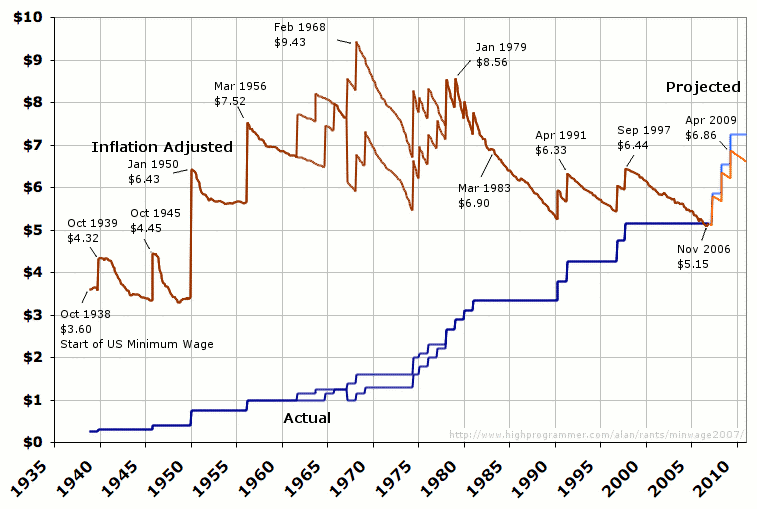
The minimum wage is a poor measure to assess economic prosperity due to never being adjusted for inflation. But, that is an issue for a worker who is stuck in the minimum wage group. You won't be able to ever buy a house on minimum wage even if it was back in 2008 and maintain your standard of living, at least in places with notoriously high mortgage costs like California or New York.

-
Does epistemic closure mean certainty?I'm not sure if this is what you mean, but as I read the definition on Wikipedia, it struck me as a pretty trivial insight. It seems to me that p entails q means that if I know p, I also know q. — T Clark
The epistemological gap is still there. What does it mean to say that I know S, and S knows p entails q, then epistemic closure is tucked into the same argument or 'proof' that it is describing. -
Does epistemic closure mean certainty?Epistemic closure is a property of some belief systems. It is the principle that if a subject S knows p, and S knows that p entails q, then S can thereby come to know q. Most epistemological theories involve a closure principle... — T Clark
My issue is with claiming to know that S knows that p entails q. There seems to be some epistemological gap here in my understanding of how S knows that p entails q. It's a circular argument. S knows that p entails q because S knows that p entails q.
Shawn

Start FollowingSend a Message
- Other sites we like
- Social media
- Terms of Service
- Sign In
- Created with PlushForums
- © 2026 The Philosophy Forum