
-
Reasons for believing in the permanence of the soul?Haha I never denied it! — Lionino
Jajajaja una leche! -
Reasons for believing in the permanence of the soul?You shouldn't, because French is English's mama. — Lionino
And the granny? Latin. :snicker:
Or... West Germanic, in the Indo-European language family? -
Feature requestsWhy not let things as they are? The forum works well, and most of the threads are active.
It is true that there are often some bugs (for example, when the drafts keep appearing even after posting them. This bug used to appear more often, but not so much anymore. Ergo, I understand that it has been fixed.), but it is not a serious problem.
If one day we all have to move to another platform, I will have a huge emotional feeling of melancholia about this forum. :broken: -
War in Guyana? The old story again...Hmm... Maduro, the diplomatic friend. https://www.dailymail.co.uk/news/article-12909253/Britain-warned-dont-mess-Venezuela-President-Maduro-slams-decadent-rotten-ex-empire-UK-sending-Navy-warship-protect-Guyana.html
Britain is warned 'don't mess with Venezuela' as President Maduro slams 'decadent, rotten, ex-empire of the UK' for sending a Navy warship to protect Guyana.
We believe in diplomacy, in dialogue, in peace,' said Maduro.
'BUT no one should threaten Venezuela, no one should mess with Venezuela. We are a people of peace, but we are warriors and this threat is unacceptable for any sovereign country,'
I think one of the main aspects of considering a country a dictatorship is when its President accuses an European country for being imperialist while they are the ones being imperialists here. -
Ukraine CrisisWhat about the surprise to Xi? Maybe that shouldn't have come as a surprise; — jorndoe
True.
I think Xi is thinking about long-term economics. Xi (and the rest of us, absolutely) considers the end of this war as a good point to start in a new era for economic recovery and stability. But it is obvious that Putin will not tolerate being treated as a clown, and he will not surrender to NATO. It is impressive that, even when all the blocks and financial sanctions, Russia is still there, keeping up with the times. They are determined to take themselves to the limit of the cause, and this is the victory of Russia. -
Ukraine CrisisAnalysis: Putin promises Xi to 'fight for five years' in Ukraine
— Katsuji Nakazawa · Nikkei Asia · Dec 28, 2023
↑ some of this is news to me — jorndoe
It is not a big surprise. Now the time goes on the side of Putin and Russia, so they are ready to keep fighting and maintaining a patience which we had never seen previously. Probably I am wrong, but I see this ending as a win for Russia. They will obtain Crimea and some other territories like the Donbas, and all the effort and fund coming from the West will go to the rubbish...
I wonder what would happen to Ukraine afterward. Does anyone really think they deserve to join the EU? -
Currently ReadingAndvake; Olavs draumar; Kveldsvaevd (Trilogien), Jon Fosse.
Excellent. Fosse is not disappointing me and after nearly finishing the first short story of this trilogy, I am very pleased and happy. I understand better now why he considers silence an important part of his literature. I recommend this book to you, @Metaphysician Undercover. It has 160 pages, and it is written in a special method which I had never read until I discovered this author. For example:
My father left, Alida said.
I don’t have siblings, said.
I know you have a sister, said.
Yes, I have a sister and her name is Oline, Asle said
I don’t like her, said.
They remain silent, and they don’t say anything more.
And there are more dialogues similar to the one above where silence is key between Asle and Alida (the main characters), but because I always lack expressing myself correctly, I can’t really explain the beauty of them using just pauses and a silence. -
Are some languages better than others?Which British accent? There are rather a lot! — Beverley
Mancunian, Cockney and Brummie are very cool. I think Geordie and Glasgowian are the most difficult to understand. -
Are some languages better than others?Which suggests Spanish was not only more influenced by Arabic than English but was a major conduit for the influence of Arabic on English. — Baden
Nicely explained! :up: -
Are some languages better than others?@Lionino
Spanish is part of the Ibero-Romance language group. Evolved from the Vulgar Latin of Iberia, the most widely spoken Iberian Romance languages are Spanish, Portuguese, Catalan-Valencian-Balear, and Galician. These languages also have their own regional and local varieties. Based on mutual intelligibility, there are seven language groups: Galician-Portuguese, Spanish, Asturleonese, "Wider"-Aragonese, "Wider"-Catalan, Provençal+Lengadocian, and "Wider"-Gascon.
Once folks have understood that premise, we have to quote the next evidence:
Andalusi Romance, refers to the varieties of Ibero-Romance that developed in Al-Andalus, the parts of the medieval Iberian Peninsula under Islamic control. Romance, or vernacular Late Latin, was the common tongue for the great majority of the Iberian population at the time of the Umayyad conquest in the early eighth century, but over the following centuries,it was gradually superseded by Andalusi Arabic as the main spoken language in the Muslim-controlled south. At the same time, as the northern Christian kingdoms pushed south into Al-Andalus, their respective Romance varieties (especially Castilian) gained ground at the expense of Andalusi Romance as well as Arabic. The final extinction of the former may be estimated to 1300 CE.
Where is England and consequently English language in this historical evidence? Now, it is time to for your arguments, but do not waste my time trolling me. -
Are some languages better than others?Edit: Original post had "You stated that English has more Arabic words than Spanish" (which is 100% true), that is what I am replying to. — Lionino
OK. Where are the evidence of your arguments? Just post some English words which roots are Arabic. I can't even name English towns with Arabic influence. In Spain we have hundreds... Málaga; Almería; Alicante; Jaén; Córdoba; Almaguer; Almagro; Almanzora; Madrid; Alcalá, etc.
Not at all, Arabic speakers were much closer to England than Russians. — Lionino
WHAT THE F*CK.
Dude, The Emirate of Granada was just that, as is shown in the following picture. I hope you are trolling me because nobody with sense believes that a Muslim state has ever occupied England. The Emirate of Granada was the last and only independent Muslim state in Western Europe.
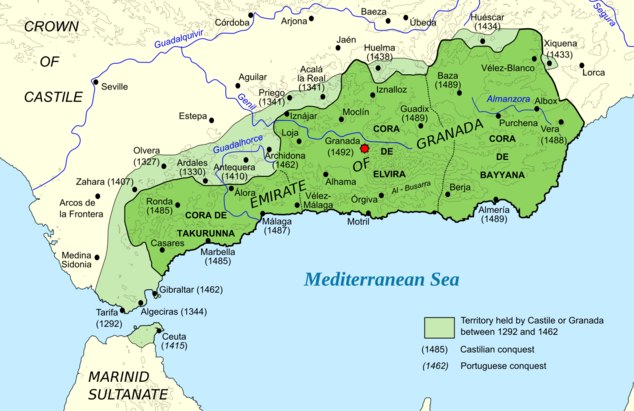
-
Are some languages better than others?How is it possible that English has Russian words if Kievan Rus never went West of the Rhine? — Lionino
This is not related to what you pointed out previously. You stated that English is more Arabic than Spanish, something that is quite impossible because the Arab expansion in the Middle Ages never got into England (Whilst they were here for seven centuries).
Even if English had Russian words, it would sound more reasonable than to have Arabian vocabulary because of the historical and geographical evidence. -
Are some languages better than others?English is more Arabic even than Spanish. — Lionino
How is it possible if the Nasrid dynasty never went beyond the Iberian Peninsula? -
What are you listening to right now?Monday you can fall apart
Tuesday Wednesday break my heart
Thursday doesn’t even start
It’s Friday I’m in love
Saturday wait
And Sunday always comes too late
But Friday never hesitate…
-
Are some languages better than others?Spanish is such a mixture of arabian, germanic and latin, very hard to get a grasp on — Ansiktsburk
I just discovered that my language has Germanic roots...
It is difficult to 'grasp on' exactly what? -
On Fosse's Nobel lecture: 'A Silent Language'Thank you for sharing your explanation on this thread. Norwegian philology looks interesting and unique. Although you stated that you are not familiar with the work of Fosse, I wonder how the silent language is understood, used and commonly established in the truly Norwegian language or Danish-influenced Bokmål. We were discussing this because it is interesting how Fosse distinguishes silence and pauses.
I think that you are Norwegian and that's why you have such an important background and knowledge of both written and spoken Norwegian.
Otherwise, just ignore my comment and merry Christmas! -
The objectively best chocolate barsHa! I knew you would say the kit kat were rubbish, but I decided to put it anyway. :razz:
Ever heard of M&Ms? — Jamal
Yes, and I was in its large store in London, and their taste is like savoring the harvest. Ew! -
The objectively best chocolate barsI've never heard of 'Daim bar,' but chocolate mixed with nuts? Ew! Speaking objectively, a chocolate bar should only have just that: chocolate (and maybe some cookies).
The king of chocolate bars: Kit kat

And a bit of recognition of the national product.

-
On Fosse's Nobel lecture: 'A Silent Language'I would care a lot, Javi. And I'm sure others here would too. You are a valued member here, my friend. — Tom Storm
Thank you so much for your kindness, my friend Tom. :smile:
I am aware that I am respected and cared for here at TPF. Yet, what I attempted to explain to Metaphysician is that I have to deal with another 'reality,' which is very different from my presence in the 'virtual 'world. I promise I am unnoticed in the 'physical' world. -
On Fosse's Nobel lecture: 'A Silent Language'Are you saying that people who see you every day would not even notice if suddenly you were not there? — Metaphysician UndercoverBut what you describe is people who see the whole, crowds of people every day, but do not notice any individuals, like yourself. — Metaphysician Undercover
I think not, and my thoughts are not unjustified. This will be embarrassing to share, but it is a good example of why I state that if I disappeared, people (in my daily life) would not care. Last week we had a Christmas meeting and lunch. We are like 35 people overall. With this small number, you would consider that it is easy to get along with people or at least be noticed, right? Well, it is clearly the opposite. Most of my colleagues already had a strong relationship between them, and it is difficult for me to integrate with them. Honestly, I am very shy, so it is true I never made a big effort to integrate myself, and I don't even feel comfortable doing so.
Well, back to the main point, when I left nobody noticed my absence. I feel I am that kind of person who is unnoticeable to most people. The one who nobody reminds of. The mates of my school and university? No... they probably don't remember (or care) about my existence.
With these premises or 'background', I personally believe that if I committed suicide, people would not care at all. Maybe you are right that they would feel a bit 'shocked' because suicide is something that impresses people... but it will not go beyond just that...
The issue being that one, the one you call the real world is not a social world at all, it is a world of social exclusion, within which you are alone. However, you have also the internet world within which you are socially active. — Metaphysician Undercover
Yes, exactly. I feel more comfortable here than in the 'non-virtual' world. It will be impossible to talk about these topics for me in the latter... -
On Fosse's Nobel lecture: 'A Silent Language'Fair enough, mate. It was an interesting exchange and I appreciate your contributions to my thread. I will be honest: I ran out of ideas and arguments to keep posting and replying to you. So, instead of wasting your time, I think I must stop because I am ending up in a meaningless circle, the victim of my own comments. My only, I promise the last, conclusion (regarding our exchange on the perception of suicide by the receivers) is that if I kill myself, people in the 'real' (outside the internet) world would not care. Maybe you will care cohabiting with me on the world and reality of The Philosophy Forum.
But there is another world, my daily life. The latter is a big difference in terms of socializing and exchanging concerns with the rest, as I do here. Then, my supposed suicide in the real world outside the internet would not have a special impact.
Is it a contradiction or a paradox? I don't know which one to pick up. This is why I used the example of the falling tree. The main point is as it follows: If I were absent for many months here, I think that some of you would wonder and ask what is going on with Javi. If, in this case, you noticed my death, you would care, even if you haven't even seen my face yet. But, paradoxically, it will not have the same impact on the people who see me every day.
My suicide would be like the tree which fell down unnoticed in the physical (non-virtual) world.
I hope I explained myself a bit better this time...
And, as you highlighted, I also want to know with more detail the thoughts of Fosse regarding suicide after reading some of his novels. -
On Fosse's Nobel lecture: 'A Silent Language'This would be a sort of odd behaviour, actively writing to no one, and even intentionally hiding the material to ensure that it was never read. Would this be indicative of mental illness, or can we say that a person who keeps a personal diary, and ensures that no one will ever read it, is acting in a sane way? How can this be reasonable? — Metaphysician Undercover
It is not reasonable, I agree. But we have to remember that a suicidal person loses all kinds of reasonable ways. Maybe they decide to hide or burn their diary or stuff because they don't want to be remembered. What kind of things are inside the brain of a person who wants to end their life? Who knows...
We have to consider that anyone in proximity will be affected by the suicide, in some, usually negative way. — Metaphysician Undercover
But who would be this affected 'anyone'? It could be my parents, but imagine that they are already dead. Could it be my friends? I don't have any. What about the colleagues at work? I don't have a strong relationship of confidence with them, so if I disappear or die, they would not notice it. Hmm, my neighbors? The building porter? Who exactly would miss me if I am extremely isolated? Again, if my suicide would negatively affect someone, the latter had to respect or care about me previously. Not all suicides resonate in the lives of others. A person dies in the silence of a room or jumping from a cliff. This discussion reminds me of the debate on the tree that falls down, but nobody heard or noticed it... -
Are some languages better than others?For me it is clear that languages are different and that if there is a difference then one is to be better than another. — I like sushi
But in what sense is it better or worse? It is obvious that English is more useful overall. All the interesting content is in English. When people from different countries have a meeting, they use English. The internet is more practical and extensive if you use English. So, as a whole, English is more useful than other languages that are rarely used or known.
For example, you will not see people studying Basque or Catalan because they are not that useful for their professional objectives. Maybe we can find some individuals who study those languages because they have a passion for them, and it is amazing. But we have to admit that they are not recognized or valued by many people.
I don't know to what extent English is 'better' than Basque... It is more useful, yes. But I think that 'better' or 'worse' depends on someone's tastes rather than objective measures. -
On Fosse's Nobel lecture: 'A Silent Language'Therefore, as much as the suicidal person is not motivated for "revenge", people close to that person may apprehend this type of meaning through the silent language. The silent language communicates through people's feelings, which is a sort of instinctual reaction, so that the receiver's conscious mind responds according to one's feelings. — Metaphysician Undercover
Understood, why am I to disagree with those good points? Nevertheless, I still think that the receiver is not a key element of suicide. You are treating the receiver as a person who necessarily represents the cause of suicide, and this is not necessarily the main point. We both agreed that there are different causes of suicide. Keep in mind that there are people who commit suicide because they feel lonely. In this case specifically, there is no receiver for communicating the silent language of suicide. Then, this act happens unnoticed. I do not know if you were ever aware of the 'Ministry of Loneliness' in Japan. The University of Tsukuba pointed out important data regarding the main cause of suicide among the Japanese people, and the study states: Researchers from the University of Tsukuba analyzed the degree of influence of social isolation, loneliness, and depression on suicidal ideation during the COVID-19 pandemic using data from a large-scale national questionnaire survey. The results revealed that loneliness had a direct and stronger impact on suicidal ideation than economic hardship and social isolation. It also indirectly affects suicidal ideation through depression. https://www.tsukuba.ac.jp/en/research-news/20230517140000.html
According to this data, lonely individuals tend to be more suicidal than social ones. We can conclude that those suicidal individuals have no receivers for their acts because loneliness is the main cause of this thought.
Note: It is true that the main cause of suicide depends on each country. But Japan has a serious and extensive experience regarding this topic, and I think we can consider their data as reliable.
Here's what I believe are a few key points to consider chronologically. His loneliness was initially not created intentionally, it was the result of his innate personality along with the way that he received the silent language (feelings) of others in his formative youth. He first coped with the loneliness by playing music. In adolescence he turned to writing, and then sought to increase the loneliness because it was highly inspirational, and contributive to his writing. Then he slowly came to realize the incompleteness of the loneliness and how it was the desire for companionship that really inspired the writing. — Metaphysician Undercover
Very interesting what you wrote in this paragraph, and I liked it. But would you consider it a desire rather than just the average transformation we all experience in our lives? I don't know to what extent Fosse desired companionship, but he started to learn more about his life and communicative skills. He began to have a fear of speaking in public, and he ended up reading a lecture in a Nobel ceremony. He just faced his fears. -
On Fosse's Nobel lecture: 'A Silent Language'But why bother go on when not one of those younger selves will ever read me. I can't go on, but I go on anyway, out of spite, or kicks, because at this age I've forgotten how to do anything else. — 180 Proof
I can relate to that frustration. I can't even remember how many times I highlighted this issue while discussing in other threads. One of the main problems of my generation is that most of us (not all, but an important number) don't bother to read something. Social media and cell phones have destroyed the habit of reading a book by ourselves and then forming a personal opinion. I can only say: Sorry for my generation, folks, and thanks for not giving up on writing prose. I think you can feel fulfilled after doing so. -
On Fosse's Nobel lecture: 'A Silent Language'The analysis largely confirms this approach. It is found that matters relating to blame are referred to more frequently than any other issue (87% of notes).
Wow, that data is impressive, because I always thought that a suicide note was written to just explain the cause and say goodbye to the world.
But as social creatures it can also be - again, not necessarily - an act that is in part revenge. Or showing others what they have done. Or showing others that they no longer have the person - 'feel that loss of me' — Bylaw
But this only happens if there is such a controversial relationship between the suicidal and the rest. Yet, it can be the scenario where a suicidal decides to commit suicide because he is bored of life or he feels depressed for some reasons which are not necessarily caused by others. I attempt to explain with these examples that suicide is an individual act that sometimes can affect others... -
On Fosse's Nobel lecture: 'A Silent Language'The suicide note can also be used to increase the hurt. Further, certain suicide techniques can be used to increase the hurt to others, and suicide can be carried out for the purpose of hurting others. I do not see how it is possible to remove the hurtfulness from it. — Metaphysician Undercover
Although I agree that the hurtfulness of suicide cannot be removed, I still don't see why this act (plus the suicide note) can increase the hurt. Whose hurt are we referring to? I can only imagine suicide as a revenge act, but in most cases, this rarely happens. A person with suicidal thoughts starts giving up on life, and this makes him or her not feel motivated by anything, not even revenge.
That's why it is often argued that suicide is extremely selfish. — Metaphysician Undercover
Suicide is only considered selfish if the suicidal person was loved or esteemed by others. Many people die in the pure state of loneliness, and nobody ever remembers them... -
On Fosse's Nobel lecture: 'A Silent Language'Language is also like jewelry or a shiny toy when used with some creativity and vitality. — Tom Storm
:up:
In writing, you can say what you need to say safely and carefully, with time for preparation, in a way that many could never do in person, in conversation. — Tom Storm
I fully agree with this. I think I already discussed it with @Bylaw, but while it would be nearly impossible to express myself with you in real life, I can share my thoughts and feelings here on TPF freely. I even share wonders which I am not confident enough to share with my family. Furthermore, English is not my native language, so I imagine myself suffering from anxiety trying to find the exact words if I needed to communicate myself in spoken language and not in written language. This is why I relate to Fosse that much. Writing is a safe activity and helps people to express themselves. -
On Fosse's Nobel lecture: 'A Silent Language'I think that has resulted in the spoken word influencing how I write. I find a lot of academic writing pointlessly stuffy and long-winded, but a danger of writing more directly is that academics can think you're just stupid — mcdoodle
You are right. Academic criticism of the works of authors is pointless most of the time. I think in most cases they attack directly against the freedom of creativity. Honestly, this is one of the main fears I have of writing short stories or even a novel. If it ends up being read by 'professionals or literature critics' and would receive a lot of negative feedback. I tried to publish some works for a small championship and I didn't like the experience. The only place where I received constructive criticism was here at TPF on the short story activity.
One difficulty in learning from Fosse, as regards philosophical writing, is that silences and pauses are subtle and illuminating in fiction or memoir, but unwise in writing about thought. — mcdoodle
Because if those thoughts are not written or spoken, and remain in silence, they do not exist. Right? -
On Fosse's Nobel lecture: 'A Silent Language'And you can put pauses in literature, but it's not the same thing and it's not more social than the rest of the writing process, which isn't very social. — Bylaw
Notice that what Fosse actually used in the writing process was silence and not pauses. I know that these concepts have more in common than differences, but if silence were a part of drama, he wouldn't have had problems finding something related while writing the plays. Until he didn't discover the use of pauses, he felt anxious about writing drama because he was used to using this expression in written language, but not in spoken language. Nevertheless, you raised an important point here. To what extent is silence (or pauses) dependent upon social interaction? Is silence an individualistic act? Fosse's lecture is making me ask all of these tricky questions... I guess Fosse believed that silence was an individually constructed act, but one of the surprises of his life was discovering this use while writing drama, because people would experience silence in spoken language as well.
Less discipline, less skills, poor time management and so on. Also, I think they were people who needed to be embarrassed or afraid of the teacher. — Bylaw
I have always been afraid of authorities such as teachers. I believe some folks were just pretending they were embarrassed or afraid, but for those who are genuinely afraid of authorities, going to school was a nightmare. I suffered the same fear when Fosse was a kid and he ran away from class because he was afraid of standing in class, with the teacher and the mates looking at him. -
On Fosse's Nobel lecture: 'A Silent Language'If I may also reply to this...I think Fosse is also referring to the musicality of spoken language. In music every pause, and its length, are carefully considered. In 'drama' in the widest sense, pauses provide and transform meaning. In comedy, for instance, timing is everything. The saddest exchanges can be made funny to an audience with the right pauses. — mcdoodle
First of all, you can answer this and comment on the rest of the thread. I fully appreciate your contribution and opinions. Honestly, I haven't thought about the musicality of spoken language, and being more precise, I think I haven't paid attention to it because I was mainly focused on how Fosse went from written language to spoken language. As you explained, there are techniques regarding these methods which are important to write drama. Although I agree that pauses and length are very considered in plays, I start to wonder if written language has musicality or not, or if it is just monotonous...
I've written quite a lot of drama and feel the craft side of Fosse's remarks are on the mark. — mcdoodle
Did you switch from written language (novels, for instance) to drama like him? -
On Fosse's Nobel lecture: 'A Silent Language'Secondary, to the intrinsically hurtful act, there is usually a further communicative act associated, with the suicide act. This may be a suicide note, which may serve to either increase or decrease the hurt, often very intentionally, or the suicide act may be accompanied by a physical assault on others. When the others are designated as enemies, this may elevate the hurtful act to the level of honourable. In this way of looking at suicide, whether it is considered good or bad, depends on how the hurt of the secondary level of meaning, the more explicit meaning, is directed. — Metaphysician Undercover
Although I think I followed your points, I guess I am a bit lost here, particularly regarding the suicide note and whether this act is hurtful for the suicidal. Firstly, a suicide note may serve as a farewell. Culturally speaking, suicide notes were common in the Samurai era in Japan. Before committing seppuku, some Samurai wrote their last words or just a haiku poem. A suicide note can also help the person to underline why he or she is going to commit suicide. A good example of this is Kurt Cobain's death and his famous note found next to his body. If we read his note profoundly, we can understand why he is justifying his decision to end his life.
On the other hand, to what extent do you think suicide is hurtful? I can understand that it could be devastating for the family and friends who are close to the suicidal. But if this person ends up deciding to end their life, it is because suicide would not be more painful than living itself. Most suicidal individuals do this because they find a solution to what bothers them, finally. Are you trying to argue that suicide is also hurtful for the suicidal? -
On Fosse's Nobel lecture: 'A Silent Language'Even here, in a much more direct form of writing communication than in writing a novel, say, where I may get a response in an hour and we can say all sorts of things to each other, even this at the social level is a shadow of a face to face meeting. And it's a lot more direct than a novel. — Bylaw
Do you think our exchange through TPF would be different if we used pictures with our real identity rather than logos?
I do improv (improvisational theater) now, and that's very social. Further when I'm not in the room doing improv, there is no interference when being social with others — Bylaw
I am interested in learning more about your experience in theater. According to Fosse, this art was a big challenge for his career because he switched written language to spoken language. Now, he has started to experience an expression of art where socialisation and interaction are needed. Between the actors or performers, and the public itself. Nonetheless, Fosse highlighted something very important: He started to feel more confident and comfortable writing drama thanks to the use of 'pauses', because he interpreted this as a silent language. Do you agree? How do you improvise pauses in your room or wherever you do this?


javi2541997

Start FollowingSend a Message
- Other sites we like
- Social media
- Terms of Service
- Sign In
- Created with PlushForums
- © 2026 The Philosophy Forum