
-
 Tzeentch
4.4kBut what about when a creature emerges from the swamp and tries to up end the apple cart. To do away with democracy and the rule of law. To become an authoritarian dictator a stride across the global stage hand in hand with the worst authoritarian leaders on the planet, disregarding the real concerns of true allies and his own people. Does that figure in your analysis, can that change the geopolitical drift? — Punshhh
Tzeentch
4.4kBut what about when a creature emerges from the swamp and tries to up end the apple cart. To do away with democracy and the rule of law. To become an authoritarian dictator a stride across the global stage hand in hand with the worst authoritarian leaders on the planet, disregarding the real concerns of true allies and his own people. Does that figure in your analysis, can that change the geopolitical drift? — Punshhh
I hardly factor it into my analysis because it is unlikely to have a significant impact, for three reasons:
The first is that presidents are temporary phenomena, and Trump is too. In all likelihood the next president will be some perfectly inoffensive, milquetoast figure whose job it will be to gather all the frightened sheep back into the fold in what is essentially a geopolitical game of 'good cop, bad cop'; the play practically writes itself, and the clownshow continues.
Second, the US is already a pseudo-democracy where the people have little to no influence on the things that actually matter. Never in the last hundred years or so, have I been able detect any meaningful influence of the American public on US long-term strategy.
Thirdly, even if the US were to turn from a "democracy" to a full-blown authoritarian dictatorship overnight, it is unlikely to meaningfully change US long-term strategy. Such strategies are not selected at leisure, but dictated by the rules and dynamics of power. If the US has any intention of vying for a spot at the top of the pyramid, its strategies, rivals and allies are all but set in stone for the foreseeable future. -
 ssu
9.8k
ssu
9.8k
Really?Never in the last hundred years or so, have I been able detect any meaningful influence of the American public on US long-term strategy. — Tzeentch
How about the opposition to the Vietnam war? I think the Domino-theory was a long-term strategy.
Or the Civil Rights movement? The policy towards blacks in the south was a long-term strategy too. -
 Mikie
7.3k
Mikie
7.3k
It’s a realist perspective. Those that are in government are mostly motivated by security and power concerns, as overarching long-term goals. That seems to be the case, especially when looking at something like defense spending, which has only gone up over the years regardless of what the public thinks, and regardless of political party.
But the public do have influence in the short term, beyond question. I think it’s obvious they have long term effects as well (the very fact that the government has to be more cautious or clandestine is itself an effect), but I guess that’s arguable. -
 AmadeusD
4.2kGood post.
AmadeusD
4.2kGood post.
I think one slight spanner here is that not only do governments change (thinking long term) somewhat radically (in context - not radical in its normal use) this seems to be due to changing times- i.e the voter base also goes through similar (although, not necessarily aligned) changes. This seems to me a quite clear long-term aspect of the US which will (and seems to have, as you and ssu note) continue to cause those in power to adjust - cynically, i would think. -
 RogueAI
3.5kThat seems to be the case, especially when looking at something like defense spending, which has only gone up over the years regardless of what the public thinks, and regardless of political party. — Mikie
RogueAI
3.5kThat seems to be the case, especially when looking at something like defense spending, which has only gone up over the years regardless of what the public thinks, and regardless of political party. — Mikie
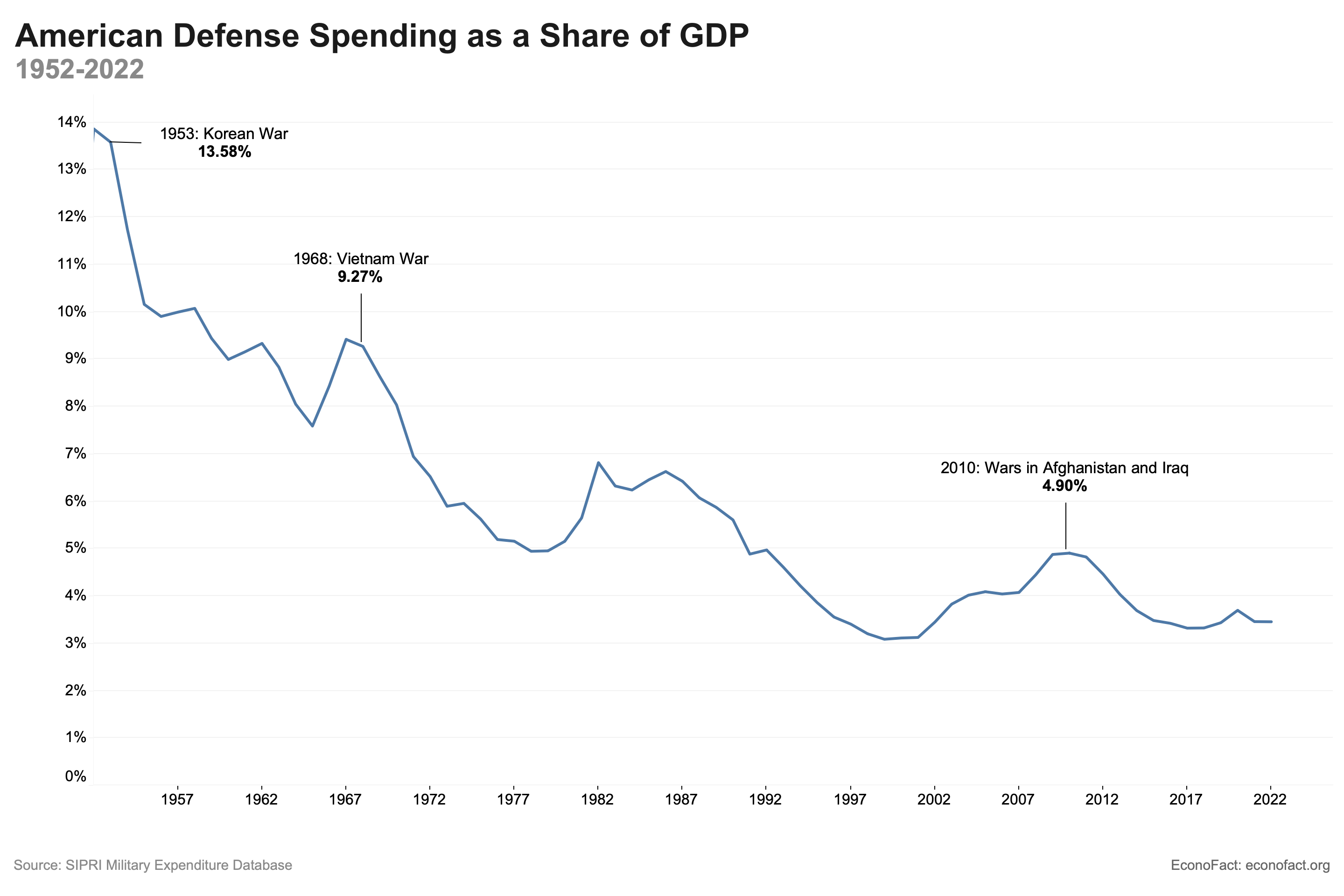
Defense spending, as a share of GDP and of the federal budget, is historically very low right now. -
 Christoffer
2.5kI’m listen to the speech now, he’s lost his mind. — Punshhh
Christoffer
2.5kI’m listen to the speech now, he’s lost his mind. — Punshhh
He never had a mind. He's a mad king and has always been. The only reason we've not seen this is because he had adults around him who slapped him if he misbehaved. Now the bully is roaming free and has his bully friends around him. The population of the US obviously can't do anything to remove him. And if he attacks with violence, if he does something towards allies, well, he's to become an actual enemy and a legitimate target for other nations. If that happens, the US population might want to step aside and let the adults deal with him. -
 Punshhh
3.6kYes, I’m expecting the audience to gradually leave the room until he’s standing there on his own.
Punshhh
3.6kYes, I’m expecting the audience to gradually leave the room until he’s standing there on his own.
He’s just lived up to his nickname of TACO. They just need the men in white coats to come in and lead him away now. -
 BitconnectCarlos
2.8kIt’s a realist perspective.
BitconnectCarlos
2.8kIt’s a realist perspective.
One of the first (and best) books I read on foreign policy was Kissinger's Diplomacy. As a writer and intellectual, I hold Kissinger and his theory of foreign policy with great respect. These days, I struggle with realism or neo-realism. It just seems to be the idea that the state - or rather, the people running the state - are primarily concerned with the national interest and how to attain it. Perhaps I am wrong about this. I agree that there is such a thing as the national interest, but to say that politicians consistently grasp it or pursue it is not borne out by history. If humanity isn't really rational, why must we hold to the view that they all of a sudden become rational when they form state bureaucracies and governance structures?
I get that realism can be a lens with which to view things, but given its lack of interest in internal politics, it shouldn't be the only lens. I would not cling to a lens that routinely dismisses internal politics in favor of international conditions. -
Mikie
7.3k
$850 billion is the highest it’s ever been. It’s only gone up.
It’s a ridiculous sum of money. Given our GDP, it should be 1 or 2%, which would still be more than any other country. To argue it’s somehow “lower” is nutty. Look at inflation adjusted spending. To compare to GDP in attempt to make it something other than a monstrosity is absurd. -
Mikie
7.3kIt just seems to be the idea that the state - or rather, the people running the state - are primarily concerned with the national interest and how to attain it. — BitconnectCarlos
Primarily concerned with security — which makes sense.
I don’t completely agree with realism either, but I’d suggest reading further on it. It’s not as silly as you describe. Most of it is truism. Self preservation is key — although clearly not always rational. -
ssu
9.8kIndeed. Well, he got Iceland and Greenland mixed up. But he promised he won't use force to take Greenland. They way I see it, the US military wouldn't have been so crazy. He just got too excited about the successful Maduro kidnapping perhaps.
Simply put it: Danes have to keep the heads cool. Trump is a demented idiot and people around him will repeat everything what he says, but the US establishment aren't made of demented idiots. It's something we never should forget here.
Let's just wait if Trump really puts on tariffs to Europe in the end of the month ...or he has forgotten it then.
First, there's inflation (as @Tzeentch noted). Secondly, the defense expenditure has been a far higher percentage of the GDP during the Cold War. Let's remember that also the armed forces were back then larger. There were more men, more ships, more aircraft and more ...nuclear weapons. A way lot more.$850 billion is the highest it’s ever been. It’s only gone up. — Mikie
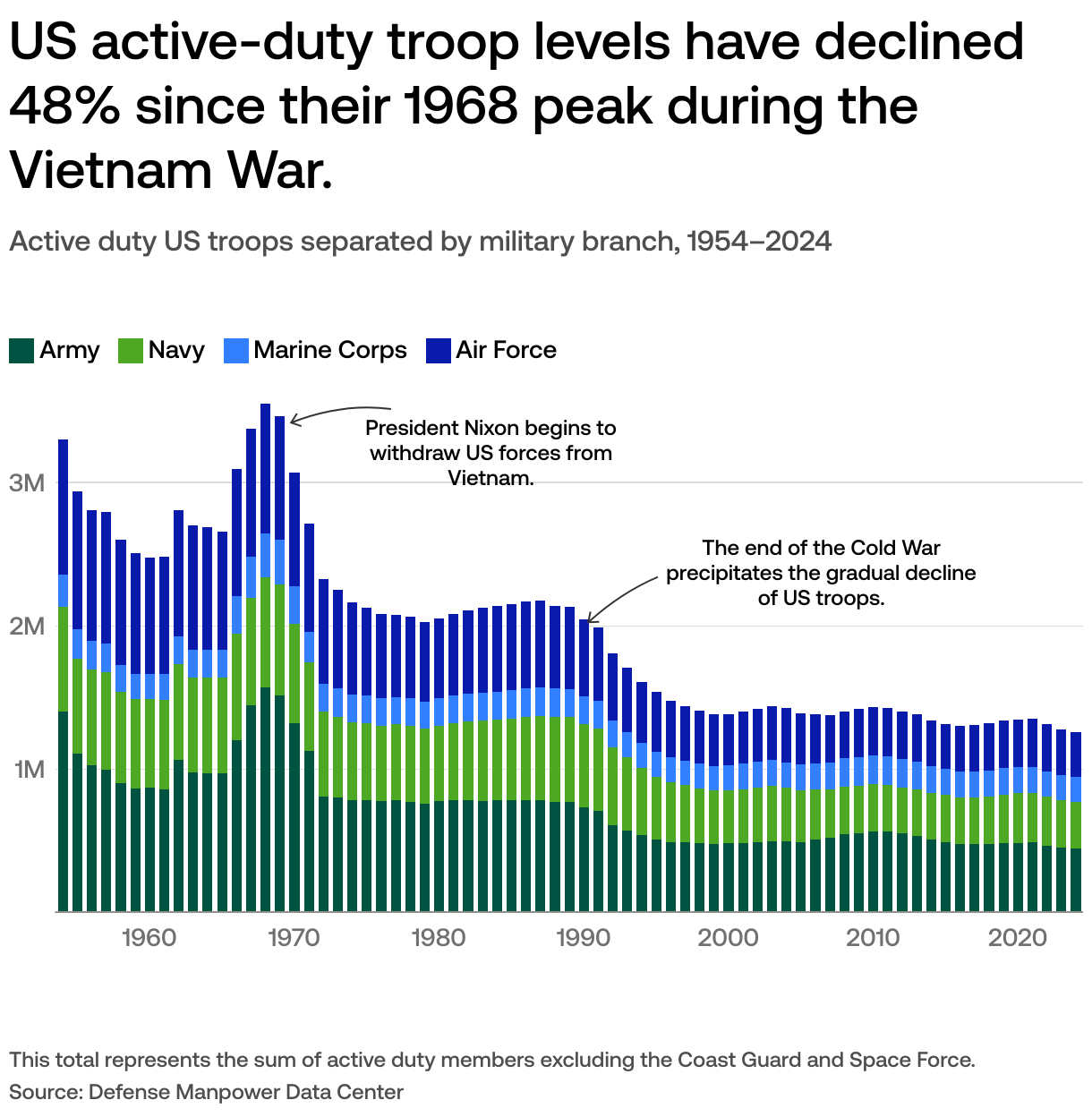

-
BitconnectCarlos
2.8kPrimarily concerned with security — which makes sense.
I don’t completely agree with realism either, but I’d suggest reading further on it. It’s not as silly as you describe. Most of it is truism. Self preservation is key — although clearly not always rational. — Mikie
I don't think realism is silly. I love Kissinger's work.
Yes, self-preservation is key, but what does that even mean anymore? If we took the population of the UK and sent it to India, and brought 70 million Indians over to the UK, and granted them UK citizenship, is that not self-preservation? You have the same number of English citizens before and after - the UK has therefore been preserved. Or is there something perhaps essential to a country? -
Mikie
7.3kSecondly, the defense expenditure has been a far higher percentage of the GDP during the Cold War. Let's remember that also the armed forces were back then larger. There were more men, more ships, more aircraft and more ...nuclear weapons. A way lot more. — ssu
Yes, so what?
And spending has more than kept up with inflation, as I mentioned above.
The United States spending on military is outrageous. The fact that it has been outrageous for decades, or in fact in some ways MORE outrageous in the past (during wars especially), is irrelevant. -
Mikie
7.3kYes, self-preservation is key, but what does that even mean anymore? — BitconnectCarlos
I think it means preserving its sovereignty. But maybe this is a discussion for another thread — my initial point was only to point out the framework that is being used (in part) in approaching these issues. -
BitconnectCarlos
2.8k
I get where you're coming from, but even in the face of threats to a nation's sovereignty, it is often easier to bend the knee and secure one's own safety rather than to take a stand. Humans are first and foremost concerned with themselves and their families' safety — loyalty to the masses comes later. This applies to leaders as well.
But yeah, realism is a lens that has its uses.
EDIT: Perhaps my point is too much on a personal level as opposed to a state/social level, but what is a government if not a collection of people with their various allegiances? Maybe I am missing the sociology of it. -
Punshhh
3.6kLot’s of nice quotes from the speech like this one;
So we want a piece of ice for world protection
He could have followed that with, that’s a nice piece of ice you’ve got there, it would be a shame if something happened to it.
Just like his niece, Mary Trump, said, he’s nothing but a grifter. -
 NOS4A2
10.2k
NOS4A2
10.2k
Simply put it: Danes have to keep the heads cool. Trump is a demented idiot and people around him will repeat everything what he says, but the US establishment aren't made of demented idiots. It's something we never should forget here.
Speaking of idiots, the Danes are sending troops to Greenland, ready to die for their monarchy and the last vestiges of their colonial empire. -
Punshhh
3.6kIt was an excellent way of diverting attention from the Epstein files and the riots in Minneapolis. Also I expect there are lots of MAGA people riding those stock market waves too.
I watched the speech in Davos and expect that no one was listening by about half way through. He was just babbling. I could feel the tension just ebbing away as it became more and more obvious that he’s senile.
He may have come away with a “deal” after his meeting with Mark Rutte and think that everything is settled, everyone’s a winner and he’s done great again. But maybe he wasn’t listening to the speeches before he arrived. European leaders made it clear that the world has changed and the change is permanent. Europe will be decoupling it’s dependencies on the US and securing it’s future independently. -
ssu
9.8k
No.Speaking of idiots, the Danes are sending troops to Greenland, ready to die for their monarchy and the last vestiges of their colonial empire. — NOS4A2
They're hosting NATO exercises, which guarantees the actual safety of Greenland.
Which Trump seems to go with now Rutte.
Your a bit off here. Trump already caved in. For the time, at least... -
ssu
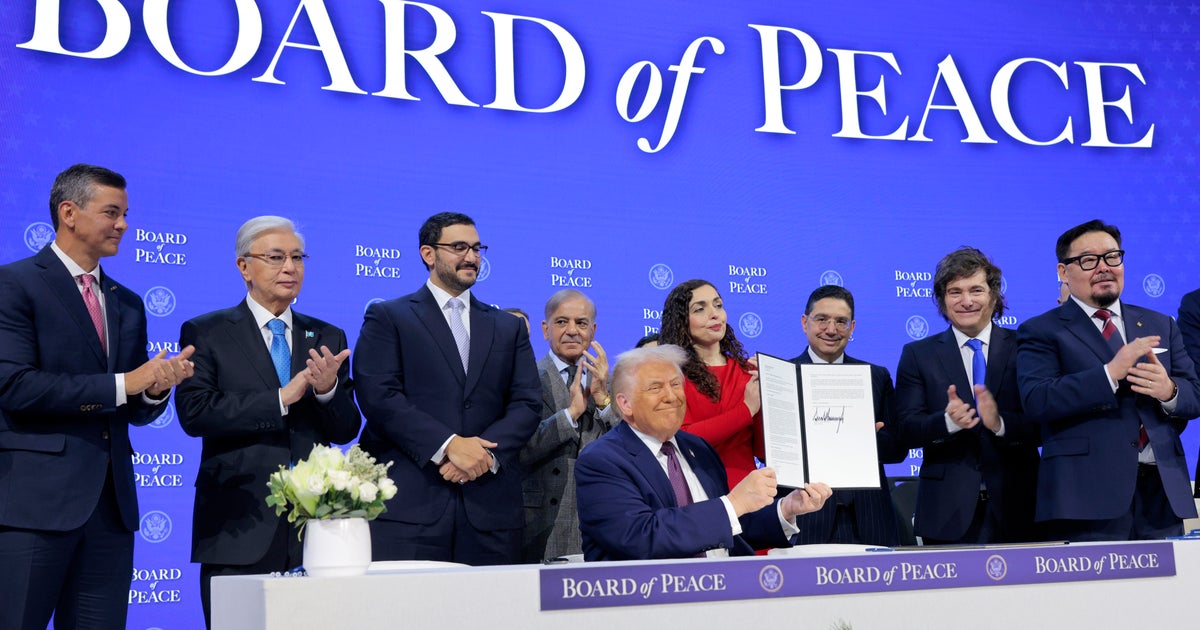
9.8kSo next move from Trump is the "Board of Peace", which he has invited countries and Jared, Witkoff, some billionaires etc. to the executive Board. Of course, Chairman Trump is a member for life.
(with Donald, everything has to be golden)

Wonder how many meme's there are about the spelling.
Shouldn't it be "Bored of Peace?" :wink: -
Tzeentch
4.4kTrump already caved in. — ssu
I think it has nothing to do with Trump 'caving'. He said a couple things (which he does all the time and costs him nothing) and managed to create panic in Europe, leading to them making concessions.
If you think the Europeans 'won', you don't understand the game that is being played. -
 javi2541997
7.2kRutte. — ssu
javi2541997
7.2kRutte. — ssu
I completely dislike him. What a twat.
A thinner version of Donald Trump with a Mickey Mouse face. The way he woo Trump makes me upset. Disgusting at its best.
I guess he forgot he's European when he changed his NL suit for the NATO one. -
ssu
9.8k
Calling Trump "Daddy" and all that... :razz:I completely dislike him. What a twat. — javi2541997
Rutte definitely is always saying that thanks to Trump, NATO countries are increasing their defense expenditure, which is something Trump likes a lot (as Obama wanted also this, but failed).

Well, Denmark might really have increased it's defense spending because of Trump and his actions. But the real reason is naturally Putin's Russia invading Ukraine. That's the obvious reason, which nobody says around Trump. Why get the baby into a tantrum? Just look at what the response was to the Norwegian prime minister, when the baby didn't get hisNobleNobel-peace prize.
Remember what ALL republicans said about Trump, starting from JD Vance or someone like Lindsey Graham before becoming total toadies and yes-men for him. But Republicans just love Trump, just like Americans for some reason unknown to everybody else love to pay the most in the World for health care services and still have a mediocre health care system without universal health care.I guess he forgot he's European when he changed his NL suit for the NATO one. — javi2541997
Yet Rutte has been straightforward: he publicly repeated that he NEVER will take sides if two member states argue, and that he will follow similar actions that secretary generals made to keep the calm between Turkey and Greece.
NATO's article 1 is actually very important. To have all European countries in an military alliance is there to avoid the possibility that Trump put in front of everybody. Just like the EU started from an union that made rearmament difficult, so has NATO also this effect as NATO armies usually operate with each other. And lastly, NATO is actually an US created organization for US objectives, which the orange idiot never has understood (and basically the American establishment seems to have failed to reason to one part of the American public).
As I've said, without NATO there surely would have been after 1945 a war between Turkey and Greece. And now we saw that even the Trump the lunatic didn't go through with taking Greenland.
Hopefully he plays now with his new Mar-a-Lago based "Bored of Peace" -project and has there other country leaders making him feel important and at center stage.
(Donald just loves to be the center focus. Look at that smile.)




Welcome to The Philosophy Forum!
Get involved in philosophical discussions about knowledge, truth, language, consciousness, science, politics, religion, logic and mathematics, art, history, and lots more. No ads, no clutter, and very little agreement — just fascinating conversations.
Categories
- Guest category
- Phil. Writing Challenge - June 2025
- The Lounge
- General Philosophy
- Metaphysics & Epistemology
- Philosophy of Mind
- Ethics
- Political Philosophy
- Philosophy of Art
- Logic & Philosophy of Mathematics
- Philosophy of Religion
- Philosophy of Science
- Philosophy of Language
- Interesting Stuff
- Politics and Current Affairs
- Humanities and Social Sciences
- Science and Technology
- Non-English Discussion
- German Discussion
- Spanish Discussion
- Learning Centre
- Resources
- Books and Papers
- Reading groups
- Questions
- Guest Speakers
- David Pearce
- Massimo Pigliucci
- Debates
- Debate Proposals
- Debate Discussion
- Feedback
- Article submissions
- About TPF
- Help
More Discussions
- Other sites we like
- Social media
- Terms of Service
- Sign In
- Created with PlushForums
- © 2026 The Philosophy Forum