
-
 Wayfarer
26.1k
Wayfarer
26.1k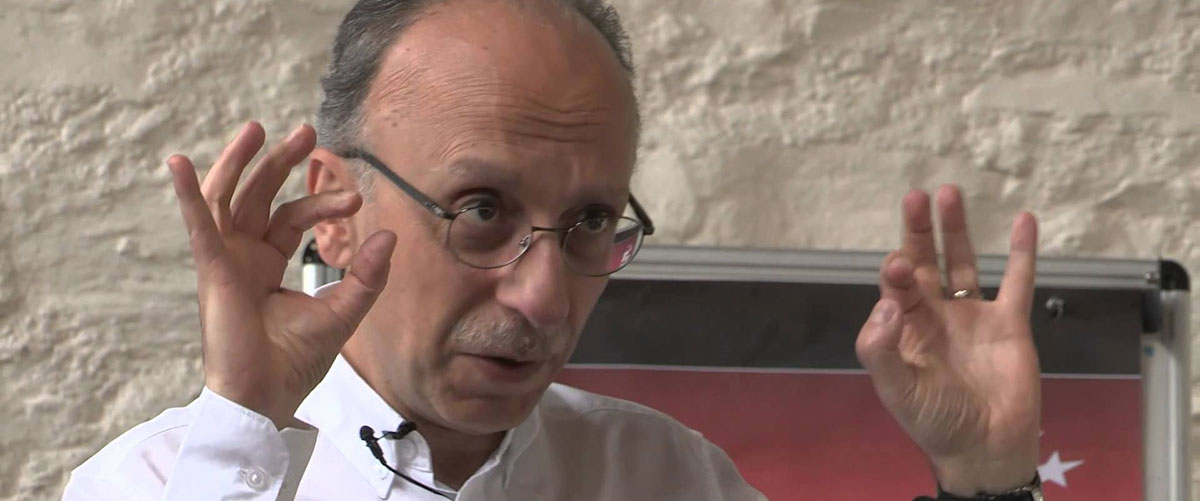
This OP introduces philosopher of science Michel Bitbol (above) through the lens of phenomenology, showing why his work matters for understanding the limits of objectivity and the often–overlooked significance of lived experience in scientific understanding.
Michel Bitbol (b. 1954) is a French philosopher of science whose work bridges quantum physics, phenomenology, and the study of consciousness. Originally trained in medicine and biophysics, he later turned to philosophy and is now Emeritus Researcher at CNRS/Ecole Normale Supérieure, Paris, France. Bitbol is known for his phenomenological interpretation of quantum mechanics, his dialogues with Francisco Varela, and his critiques of reductive materialism. He has participated in the Mind and Life dialogues chaired by the Dalai Lama and has learned Sanskrit to deepen his knowledge of Buddhist philosophy.
The aim of this essay is to introduce Michel Bitbol’s approach to phenomenology in general philosophy.
The Primacy of Consciousness
Michel Bitbol’s approach to the philosophy of mind draws deeply from the phenomenological tradition initiated by Edmund Husserl in the early 20th century — and, further back, from Immanuel Kant’s revolutionary critiques of the nature of knowledge in the 1700's. Phenomenology begins from a simple but far-reaching insight: the reality of first-person consciousness is ineliminable, and any account of the world must ultimately be grounded in the structures of experience as they appear to the subject. The field of “phenomenology” takes its name from the Greek word phainomenon, meaning “that which appears.” This reminds us that its starting point is not hidden entities or abstract theorizing, but rather, the way the world actually shows up in experience. Note that this presupposes an observer to whom things appear.
At its core, phenomenology is the disciplined study of conscious experience from the first-person perspective. Think of it as more an exercise in directed attention. It avoids importing external, third-person explanations of the source of experience — whether physical, biological, or metaphysical — and instead turns attention “to the things themselves”: the world as it is immediately given — in lived experience and prior to conscious interpretation or rationalisation.
Its primary method is the epochē or “bracketing,” in which one suspends the “natural attitude” — the habitual assumption that the world exists just as we take it to do. This suspension is not a denial of the world; it is a way of clarifying the pure content and structure of experience without smuggling in our preconceived notions of what it means. The resemblance between Husserl’s procedure and the Buddhist practice of “bare awareness” in mindfulness meditation is not coincidental.
For Bitbol, phenomenology is the real starting point in the quest to understand consciousness, because it reveals something that scientific objectification systematically brackets out or ignores — namely the observer, the scientist, the one who makes observations, draws conclusions, and decides on the questions to be asked. Yet the point runs deeper than methodological oversight. Scientific objectivity does not merely forget the observer; it presupposes the observer as the one for whom objects appear, measurements make sense, and evidence is meaningful in the first place. Before there can be data, models, or theories, there must be a lived field of experience in which anything like a “fact” can show up at all. Phenomenology begins from this pre-objective dimension, revealing the conditions that make scientific inquiry possible but that science itself cannot capture because they are already assumed in every act of objectification.
What Consciousness is Not
As Bitbol argues in Is Consciousness Primary?* consciousness is not an object among objects, nor a property waiting to be discovered by neuroscience. It is not among the phenomena given to examination by sense–data or empirical observation. If we know what consciousness is, it is because we ourselves are conscious beings, not because it is something we encounter in the natural world. (We may infer that other sentient beings are conscious, but only our own consciousness is immediately given to us.)
Pure experience is beyond the level of being and has no essence… It permeates the show without showing itself — Michel Bitbol
Accordingly, Bitbol considers consciousness to be “self-evidentially absolute”: the one domain of existence that is given fully and indubitably whenever it is present. By contrast, natural objects are always incompletely present, appearing only as partial profiles or “adumbrations,” forever subject to correction by further experience. (“It looked square from that angle, but now I’m nearer, it’s plainly not.”) Accordingly, while the fact of experience is impossible to deny, the conclusions that may be drawn from it are another matter.
This asymmetry leads to Bitbol’s central claim: the attempt to derive consciousness from material processes reverses the real order of priority. Whatever is presumed to exist in the physical world already presupposes consciousness as the field in which such ascriptions occur.
From this perspective, the materialist project of locating consciousness in the brain or in neural processes is not just incomplete; it is conceptually incoherent. Like any empirical analysis, it rests on the presumption that what is real is what can be objectively measured and assessed. (Here I am referring specifically to the empirical sciences — physics, neuroscience, and biology — which construct their claims through measurement and intersubjective verification.)
However, the very notion of the objective world described by the empirical sciences is itself a product of selective abstraction — what Bitbol calls the end-product of the procedure of objectification. Why? Because science methodically brackets out the subjective pole of observation so as to arrive at an intersubjective consensus about the observer-independent attributes of the object. But when this methodology is applied to the question of the nature of consciousness, it turns around and tries to explain conscious experience in terms of that consensus.
The result is not only circular but, he says, will always culminate in the notorious “hard problem”: consciousness treated as if it were something that emerges from structural relations in objectively–existing matter, when in reality it is the precondition for identifying those relations in the first place. In that sense, it is prior to the emergence of both objective and subjective, which themselves rely on distinctions that arise within consciousness.
Not Something, Not Nothing
Bitbol opens his essay with one of the most disarming lines in the philosophy of mind: sensation is “not a something, but not a nothing either”. This deliberate paradox, borrowed from Wittgenstein, is not a rhetorical flourish but the key to Bitbol’s approach. On the one hand, consciousness cannot be treated as an object — something manipulable, measurable, or existing independently of the subject. This is because objects are by definition other to us, and are given only through the sense-data profiles which, as we have seen, are open to correction by further experience.
But if consciousness is not a “something,” it is also not a “nothing.” It is neither a useful fiction, nor a byproduct of neural processes, nor a ghostly residue awaiting physical explanation. Instead, says Bitbol, it is the self-evidential medium within which all knowledge about objects, laws, and physical reality arise (here the convergence with Kant is manifest). Any attempt to treat consciousness as derivative — as some thing that “comes from” matter — therefore reverses the real order of dependence. The world of objects may be doubted, corrected, or revised; but the presence of experience itself, here and now, cannot be disconfirmed. In this sense, consciousness is “absolute,” not as a metaphysical substance (which phenomenology rejects) but as the unavoidable ground of meaning, evidence, and world-hood.
There is no world without consciousness, though consciousness is not a thing in the world — Michel Bitbol
The Framing Problem
From the above, it can be seen that the error of materialism is that it applies categories developed for describing objects in a domain that does not, itself, comprise objects and forces. The vocabulary of physical science — process, function, mechanism, identity, information — presupposes an already existing domain of publicly observable entities and regularities. To say that consciousness is or arises from neural activity is to employ terms that belong to the logic of object-identity: the identity of two things available from the outside.
But consciousness does not appear from the outside. It is the medium within which anything like “outside” and “inside” is first constituted. Trying to subsume it under object-concepts therefore involves a quiet category mistake. It forces consciousness into a conceptual grid that cannot accommodate its defining characteristics — characteristics always assumed, yet rarely noticed. Bitbol’s point is not that materialism is wrong in its domain, but that it becomes inappropriate — and conceptually unstable — when extended to the nature of conscious experience.
It is, in short, a framing problem: a powerful conceptual frame applied to the wrong kind of subject–matter.
Conclusion
Taken together, these considerations establish the central thrust of Bitbol’s phenomenology: the attempt to explain consciousness in terms of a physical world existing independently of the mind rests on a confusion about the order of dependence. Conscious experience is not a phenomenon among others. It is that in and to which the very distinction between “phenomenon” and “object,” “inner” and “outer,” first take shape. The attempt to frame the question in physical terms does not so much deny this as forget it. It applies a conceptual framework designed for analysing public objects to something that is not a public object at all. The resulting puzzles — the Hard Problem most of all — arise not from the mysteriousness of consciousness, but from the misapplication of categories that cannot, by design, encompass them.
Bitbol’s alternative is not a metaphysical theory but a reframing: a return to the primacy of lived experience as the ground of all knowledge, including scientific knowledge. Far from undermining science, this reorientation clarifies its proper domain. Physics, biology, and neuroscience describe the structural, relational, and functional aspects of the world-as-object; they do not, and need not, account for the presence of the world-as-experienced. As such, consciousness is not something over and above the world, nor something inside it. It is the condition for there being a world at all.
This concludes the brief introduction to Michel Bitbol’s phenomenology.
* Originally published on Philosophy Today (Medium) - access via friend link without requiring registration. See Medium version for footnotes and bibliography. -
Wayfarer
26.1kPhenomenology has a role in understanding mental illness by taking proper account of the first-person experiences of subjects. Some references:
Phenomenology as a resource for translational research in mental health
Phenomenology as a resource in mental health
The phenomenological nature of schizophrenia and disorder of selfhood -
 Janus
17.9kRight, consciousness is determined by material conditions, and without material conditions there would be nothing to be conscious of. On the other hand without consciousness there would be no one to be aware of material conditions. So, a conclusion might be that neither is primary, and that they co-arise. On the other hand we can certainly imagine that material conditions were present prior to the advent of consciousness or least prior to consciousness as we understand it. All our scientific evidence points to that conclusion.
Janus
17.9kRight, consciousness is determined by material conditions, and without material conditions there would be nothing to be conscious of. On the other hand without consciousness there would be no one to be aware of material conditions. So, a conclusion might be that neither is primary, and that they co-arise. On the other hand we can certainly imagine that material conditions were present prior to the advent of consciousness or least prior to consciousness as we understand it. All our scientific evidence points to that conclusion. -
Wayfarer
26.1kOn the other hand we can certainly imagine that material conditions were present prior to the advent of consciousness or least prior to consciousness as we understand it. All our scientific evidence points to that conclusion. — Janus
Indeed it does, but outside that imaginative act what remains?
The point of Bitbol's line of criticism, is that both the subject and the objects of scientific analysis are reduced to abstractions in day-to-day thought. But these abstractions are then imbued with an ostensibly fundamental reality - the subject 'bracketed out' of the proceedings, the objective domain taken to be truly existent. But it should be acknowledged, the 'co-arising' of the subjective and objective is very much part of the phenomenological perspective.
I don’t deny the veracity of scientific reconstructions of a pre-conscious world. Bitbol’s point is subtler: such reconstructions are abstractions constituted within present experience, and it is a further step — one that often goes unnoticed — to treat those abstractions as ontologically fundamental while bracketing out the very subjectivity that makes them intelligible. The question isn’t “Did the world exist before consciousness?” but “What does it mean to assert existence independently of the conditions under which existence is ascribed at all?”
Closely related to this is the further assumption that consciousness is the product of those inferred facts — facts which, as facts, already exist within consciousness. There's a subtle but pervasiveness inversion going on here. -
 180 Proof
16.4k:up: :up: Yes, and therefore disembodied ("immaterial") consciousness doesn't make any sense – is just wishful / magical thinking.
180 Proof
16.4k:up: :up: Yes, and therefore disembodied ("immaterial") consciousness doesn't make any sense – is just wishful / magical thinking.
It means 'the map(maker) =/= territory' (i.e. epistemically ascribing has (a) referent(s) ontologically in excess of – anterior-posterior to – the subject ascribing, or episteme).The question isn’t “Did the world exist before consciousness?” but “What does it mean to assert existence independently of the conditions under which existence is ascribed at all?” — Wayfarer -
Janus
17.9kIndeed it does, but outside that imaginative act what remains?
The point of Bitbol's line of criticism, is that both the subject and the objects of scientific analysis are reduced to abstractions in day-to-day thought. But these abstractions are then imbued with an ostensibly fundamental reality - the subject 'bracketed out' of the proceedings, the objective domain taken to be truly existent. But it should be acknowledged, the 'co-arising' of the subjective and objective is very much part of the phenomenological perspective. — Wayfarer
What remains outside of our imaginative acts is whatever there is or was prior to our acting imaginatively.
It can be said that all "day-to-day thought" consists in abstractions―at least that part of it which is linguistically mediated thought. However, our thoughts are not whatever it is we are thinking about, so the things we think about exist prior to our thinking about them, otherwise we would have nothing to think about. It seems to be true that their existence for us is relational―the forms they take in our perceptions are of course in part a functions of our perceptual systems. It doesn't follow that they have no existence apart from that.
“What does it mean to assert existence independently of the conditions under which existence is ascribed at all?” — Wayfarer
That question makes no sense as far as I can tell unless you mean what does it mean to us? If so, I'd say that it means we are being able to think outside of the narrow perspective of our own experience and allow that there is more to the world than just that. It is a kind of humility and a rejection of anthropocentrism.
It means 'the map(maker) =/= territory' (i.e. epistemically ascribing has (a) referent(s) ontologically in excess of – anterior-posterior to – the subject ascribing, or episteme). — 180 Proof
Exactly, we are not the world―the world is more than merely human. -
Wayfarer
26.1kdisembodied ("immaterial") consciousness doesn't make any sense – is just wishful / magical thinking. — 180 Proof
Nothing in the OP, or anything I've said about it, suggests an 'immaterial consciousness', although the fact that it will always be so construed by yourself and Janus is philosophically signficant. -
 Banno
30.5kPhenomenology begins from a simple but far-reaching insight: the reality of first-person consciousness is ineliminable, and any account of the world must ultimately be grounded in the structures of experience as they appear to the subject. — Wayfarer
Banno
30.5kPhenomenology begins from a simple but far-reaching insight: the reality of first-person consciousness is ineliminable, and any account of the world must ultimately be grounded in the structures of experience as they appear to the subject. — Wayfarer
Banno of course would point out that this is muddled, that we are inherently social beasties, and that our place in the world is not that of a homunculus siting inside a head looking out, but of a being already and always embedded in a world that includes others... and so on.
Where Bitbol emphasises first‑person experience as the unavoidable condition of possibility for objectivity, Banno would push back: experience is always already structured by social and intersubjective relations.
Where Bitbol tends toward a version of transcendental dependence in which the world and science is only intelligible within a lived field, Banno would say this is too individualistic if it doesn’t acknowledge that lived experience itself is socially mediated.
Where Bitbol brackets the “natural attitude” to expose pre‑objective experience, Banno would emphasise that the social world is also "pre‑objective" in a different sense: language, norms, cultural practices, shared lifeworlds shape the very way phenomena show up. So consciousness isn’t a solitary medium but a socially inflected field.
Yet Bitbol and Banno would agree that physical reductionism misses something of the utmost import.
But you know Banno would do that, as does ChatGPT, and yet you carry on regardless. :wink: Good for you.
Hope Christmas was enjoyable.
Carry on. -
Wayfarer
26.1kHope Christmas was enjoyable. — Banno
Sort of. Our families are now far-flung and there's not many at the table. But, thanks, and same to you.
Banno of course would point out that this is muddled, that we are inherently social beasties, and that our place in the world is not that of a homunculus siting inside a head looking out, but of a being already and always embedded in a world that includes others... and so on. — Banno
And, not really sure how that cuts against the quoted passage. Phenomenology is most definitely not invoking any kind of homonculus. The key books that I've at least partially absorbed are Husserl's Philosophy as a Rigourous Science, and the Crisis of the European Sciences. The emphasis on the reality of the living subject is precisely to ameliorate the sense of pervasive abstraction that arose out of Cartesian dualism. -
Banno
30.5k
Here:...not really sure how that cuts against the quoted passage. — Wayfarer
It rests consciousness on the distinction between "inner" and "outer "- the homunculus arrises!Conscious experience is not a phenomenon among others. It is that in and to which the very distinction between “phenomenon” and “object,” “inner” and “outer,” first take shape. — Wayfarer
Bitbol wants to make consciousness foundational, but he inadvertently re-inscribes the Cartesian subject, which is exactly what Banno resists. The emphasis on the reality of the living subject hopes to ameliorate the sense of the homunculus that arose out of Cartesian dualism - does it succeed? To be conscious is to be conscious of something, and so is already embedded in what for Bitbol must be outside the mind...
We also had a quite, and quite peaceful day, of music and books and happily much home garden produce, mostly with cream. -
 Tom Storm
10.8kThat's a useful exposition of Mr Bitbol's views. I've enjoyed a couple of his lectures.
Tom Storm
10.8kThat's a useful exposition of Mr Bitbol's views. I've enjoyed a couple of his lectures.
For yourself do you see his work more as a starting point for further work, or as a system/approach that is of itself useful as a philosophical practice?
I have an incomplete understanding of this material but would you say that Bitpol seems to be closer to Kant than other phenomenologists? He views reality as jointly shaped by the observer and the world within certain constraints, rather than seeking ultimate essences or structures that exist independently of how we experience them. Like Kant’s phenomena, these co-constituted realities cannot be understood as things-in-themselves; we can only describe and engage with them as they appear within the constraints of our experience and conceptual frameworks.
Bitbol does not seem to delve as deeply into Being or the essence of experience, and he appears to recognize epistemic limits more explicitly. Do you think this is accurate, and what is the significance of this for philosophy? -
 bert1
2.2kRight, consciousness is determined by material conditions — Janus
bert1
2.2kRight, consciousness is determined by material conditions — Janus
Do you mean the presence and not-presence of consciousness is determined by material conditions (a very strong claim), or that the type or content of consciousness is determined by material conditions (a different weaker claim). I think you probably mean the former. -
Wayfarer
26.1kIt rests consciousness on the distinction between "inner" and "outer "- the homunculus arrises! — Banno
I think you're misreading it, but I won't press the point.
I'm a beginner with Bitbol and much of phenomenology. But it resonates with me on several fronts. I agree that Bitbol is rather neo-Kantian, the first thing I learned from was his lecture on Neils Bohr Bohr's Complementarity and Kant's Epistemology. I've got another draft on his philosophy of science, which I hope will also be published by Philosophy Today.
This is very much a starting point - not a 'manifesto', not a 'system', so much as a reminder. It's very much connected with Heidegger's 'forgetting of being' - we become fixated by and with the objects of perception, the 'objective world' and consequently forget the matrix of being within which everything arises. But then as soon as you begin to say what that is, the point is already lost.
Bitbol does not seem to delve as deeply into Being or the essence of experience, and he appears to recognize epistemic limits more explicitly. Do you think this is accurate, and what is the significance of this for philosophy? — Tom Storm
As said, he's not a system-builder creating some grand all-encompassing scheme. It's more a matter of paying attention to the here-and-now.
I also have an essay planned on his dialogues with Buddhism, and the connection between the phenomenological epochē and Buddhist śūnyatā. (There's an historical connection, too, between Pyrrho of Elis, and the Madhyamaka Buddhists of Gandhara.) -
Janus
17.9kWhat evidence are you thinking of? — bert1
Cosmological, paleontological.
Do you mean the presence and not-presence of consciousness is determined by material conditions (a very strong claim), or that the type or content of consciousness is determined by material conditions (a different weaker claim). I think you probably mean the former. — bert1
We know of no consciousness which is not accompanied by material conditions. It is arguable, in fact it seems unarguably true, that the type or content of consciousness is determined by the material conditions it is conscious of. So, both are indicated.
Nothing in the OP, or anything I've said about it, suggests an 'immaterial consciousness', although the fact that it will always be so construed by yourself and Janus is philosophically signficant. — Wayfarer
The OP says that consciousness is primary against, presumably, the idea that the material is primary. If consciousness is not, according to you, material, or at least a function of, or dependent on, the material, then the implication would be that it is immaterial, and that disembodied consciousness is possible.
Be honest now and say whether you believe disembodied consciousness is possible. I'm betting you won't answer that question. -
Banno
30.5k
I will. I don't see a misreading.I think you're misreading it, but I won't press the point. — Wayfarer
Yet consciousness is a response to the world in which it arrises.Bitbol considers consciousness to be “self-evidentially absolute”: the one domain of existence that is given fully and indubitably whenever it is present. — Wayfarer
There's the Cartesian temptation to choose some one thing as fundamental and derive everything else from it. Then there is the Hegelian move to two things, interacting. But last we have the Wittgensteinian dissipation of an absolute foundation, to different and yet equally valid ways of being and of doing.
Bitbol moves backwards to Descartes. -
bert1
2.2kWe know of no consciousness which is not accompanied by material conditions. — Janus
That's likely true, but that's different from the existential claim:
consciousness is determined by material conditions — Janus
It is arguable, in fact it seems unarguably true, that the type or content of consciousness is determined by the material conditions it is conscious of. — Janus
Yes, I think I agree with that. -
Wayfarer
26.1kBitbol moves backwards to Descartes. — Banno
Descartes is undoubtedly an influence (although I will also mention that this is another example of your 'presentism', that virtually all philosophy before about ten minutes ago has been superseded.) But there's a footnote in the Medium edition, to wit:
This idea has an obvious ancestry in Descartes’ cogito ergo sum, (‘I think therefore I am’) although phenomenology breaks with the Cartesian substance model of mind. Husserl retains the insight that the existence of consciousness is indubitable in the moment of its appearance, but without positing a thinking thing (res cogitans). Bitbol adopts this Husserlian reading rather than the outright dualism of Descartes.
Also notice the reference to Wittgenstein:
Bitbol opens his essay with one of the most disarming lines in the philosophy of mind: sensation is “not a something, but not a nothing either”. This deliberate paradox, borrowed from Wittgenstein, is not a rhetorical flourish but the key to Bitbol’s approach. On the one hand, consciousness cannot be treated as an object — something manipulable, measurable, or existing independently of the subject. This is because objects are by definition other to us, and are given only through the sense-data profiles which, as we have seen, are open to correction by further experience.
But if consciousness is not a “something,” it is also not a “nothing.” It is neither a useful fiction, nor a byproduct of neural processes, nor a ghostly residue awaiting physical explanation.⁴ Instead, says Bitbol, it is the self-evidential medium within which all knowledge about objects, laws, and physical reality arise (here the convergence with Kant is manifest). Any attempt to treat consciousness as derivative — as some thing that “comes from” matter — therefore reverses the real order of dependence. — Wayfarer
So, that is very different from Descartes' 'res cogitans', the 'thinking thing', which I think Husserl recognised as an oxymoron. But even so, Husserl, and all phenomenology, recognise Descartes' role as a precursor of phenomenology, in recognising the apodictic nature of consciousness.
So Bitbol is not saying that 'things are derived from consciousness', which is what you seem to think he is saying. -
Janus
17.9kThat's likely true, but that's different from the existential claim: — bert1
Okay, but if we know of no consciousness which is not accompanied by material conditions, it follows that we cannot really have a grasp of the possibility, even though we can of course say it is logically not impossible. So, the question becomes 'What significance could such a vague possibility have". -
bert1
2.2kOkay, but if we know of no consciousness which is not accompanied by material conditions, it follows that we cannot really have a grasp of the possibility, even though we can of course say it is logically not impossible. So, the question becomes 'What significance could such a vague possibility have". — Janus
Your original claim was that the existence of consciousness (or absence of it) depends on material conditions. That makes material conditions ontologically prior. That's not the same claim as saying that wherever there is consciousness, there are also material conditions. In the latter case, neither consciousness nor material conditions is ontologically prior - they always occur together. -
Banno
30.5kthere is no 'one correct view' being promulgated here — Wayfarer
Yeah, there is - that we must begin with consciousness.
Have you noticed the push-back against Buddhism as it is so often viewed by the west, in the last few weeks? The most recent Philosopher's Zone and Australian Philosophy Review both take issue with the common perspective. Interesting stuff. -
Banno
30.5kNot so much begin with it, as remember that it has been forgotten, and why. — Wayfarer
And this was the point of our walk through the mountains toward the sea - to give an account of how it hasn't been forgotten, but how it is inadequate. The account given by the homunculus is too small. -
Janus
17.9kMaterial conditions are anything that we can detect via the senses. Science tells us there were material conditions prior to humans.
And, as predicted you didn't answer the question I posed re whether you believe that immaterial or disembodied consciousness is possible.


Welcome to The Philosophy Forum!
Get involved in philosophical discussions about knowledge, truth, language, consciousness, science, politics, religion, logic and mathematics, art, history, and lots more. No ads, no clutter, and very little agreement — just fascinating conversations.
Categories
- Guest category
- Phil. Writing Challenge - June 2025
- The Lounge
- General Philosophy
- Metaphysics & Epistemology
- Philosophy of Mind
- Ethics
- Political Philosophy
- Philosophy of Art
- Logic & Philosophy of Mathematics
- Philosophy of Religion
- Philosophy of Science
- Philosophy of Language
- Interesting Stuff
- Politics and Current Affairs
- Humanities and Social Sciences
- Science and Technology
- Non-English Discussion
- German Discussion
- Spanish Discussion
- Learning Centre
- Resources
- Books and Papers
- Reading groups
- Questions
- Guest Speakers
- David Pearce
- Massimo Pigliucci
- Debates
- Debate Proposals
- Debate Discussion
- Feedback
- Article submissions
- About TPF
- Help
More Discussions
- Other sites we like
- Social media
- Terms of Service
- Sign In
- Created with PlushForums
- © 2026 The Philosophy Forum