
-
 ssu
9.8kOr people simply who believe in the Putin-Trump world in their hate of modern democracies and liberalism. It's not about having access to unfettered news outlets, it's what you pick yourself you want to believe in. And you can do it, when you just repeat to yourself that everything is just propaganda.
ssu
9.8kOr people simply who believe in the Putin-Trump world in their hate of modern democracies and liberalism. It's not about having access to unfettered news outlets, it's what you pick yourself you want to believe in. And you can do it, when you just repeat to yourself that everything is just propaganda.
Thus there's a huge amount of people that want to believe in that the US is responsible for this war. Or that Ukraine is an artificial country and ought to be part of Russia...
Something like the truth / actual reality isn't a problem for them. -
 RogueAI
3.5kUkraine is getting a $90bn euro loan. That will fund their war effort for the next 18 months.
RogueAI
3.5kUkraine is getting a $90bn euro loan. That will fund their war effort for the next 18 months.
https://www.ft.com/content/e5691048-696b-44cd-8a0a-50b917e3d62a -
 jorndoe
4.2kSome Russopeople dressed up as Ukrainian Nazis in Austria:
jorndoe
4.2kSome Russopeople dressed up as Ukrainian Nazis in Austria:
Chats: Wie Putin seinen Krieg der Desinformation auf Wiens Straßen führt
Chats: How Putin is waging his war of disinformation on Vienna's streets
— Max Miller · Profil · Dec 12, 2025
Similar stuff has been reported before in other countries.
Some subsequent reports:
Austria Exposes Russian FSB Network Posing as “Ukrainian Nazis” to Sway Public Opinion Against Ukraine
— Roman Kohanets · UNITED24 · Dec 14, 2025
In Austria, an FSB network disguised as "Ukrainian Nazis" was exposed
— SPRAVDI — Stratcom Centre · Dec 14, 2025
Federal Security Service of the Russian Federation Network Posing as ‘Ukrainian Nazis’ Exposed in Austria
— Roman Pryhodko · Militarnyi · Dec 14, 2025
There are a number of other reports on related topics.
The FSB cosplays as evil people and works to sow unrest wherever.
The Kremlin circle is a tad preoccupied with Nazism. -
 boethius
2.7kFor me, these things are not part of the consideration. Sure, there will be rumblings, but who is going to stick their neck out when the world is headed for World War 3? — Tzeentch
boethius
2.7kFor me, these things are not part of the consideration. Sure, there will be rumblings, but who is going to stick their neck out when the world is headed for World War 3? — Tzeentch
The problem is the US does not have enough carrots and sticks to keep the entire world inline and Isolate China.
So you really need to war-game out your scenario to some sort of end point. For example, maybe the US could do a full blockade for a year and then come to a peace agreement with China and get some concessions, in a similar way of the tariffs negotiations. That would obviously be doable from a practical point of view, but it would obviously not really accomplish much in terms of containing China, just a negotiation tactic essentially.
Truly blockading China for years and decades would be really a huge undertaking.
However, we're only differing in projected intensity of the same structural dynamic.
Just like having a limited war in Finland (limited for Europe and Russia but obviously catastrophic for Finland) is a sort of Cold War with "enhancements", the US has already embarked on enhancements on the seas with intercepting Venezuelan and Iranian ships.
Definitely it's possible this is a practice run for a full embargo of China, but my feeling remains that would be simply too difficult and pressuring on the margins with piracy on the high seas is more cost effective: by doing a bit of something you can deploy the leverage of doing the full amount (as you demonstrate you aren't bluffing that you can and will do it) with minimal cost due only doing some demonstrations but then can demand concessions relative the full value of the threat. -
 Tzeentch
4.4kAs we have establised earlier, this is where our views differ the most.
Tzeentch
4.4kAs we have establised earlier, this is where our views differ the most.
US global dominance was established as a result of WW2, and my sense is that the battle to end it will be fought with the same stakes in what in essence will be WW3.
Under such conditions a full, indefinite blockade of China would be child's play. The endgame/end state/victory conditions that would lead to America's success I have already laid out (isolation of China and implosion of its economy) so I won't repeat them again unless you have very specific questions.
You lean more towards the idea that the battle over ending US dominance will remain limited. A perfectly defensible idea also.
As long as we're taking fundamentally different starting points (limited war vs. full-scale war), we will be talking past each other, though. -
boethius
2.7kAs long as we're taking fundamentally different starting points (limited war vs. full-scale war), we will be talking past each other, though. — Tzeentch
I disagree.
There was never a full scale war with the Soviet Union, so we have that already as an example of an alternative geopolitical structure to WWI and WWII.
Whereas in the world wars, each side could defeat the other (especially at the start before the US entry into the war), the dynamics of the cold war was driven by an inability of either side to win, and therefore alternative competition modes had to be sought: propaganda, proxi wars, fomenting dissent, arms races, economic blocks and so on.
What complicates the situation even further is the economic integration with China, producing about a third of global industrial goods, in addition to the rest of East-Asia that maybe also effectively blockaded in the event of a state of war. between the US and China.
Now, if your hypothesis is that a full scale blockade, and thus state of war, between the US and China may occur essentially by accident or miscalculation and then things would get messy from there and the eventual resolution would not be clear and who would ultimately benefit, we agree.
Where I am in a position of criticism is if your hypothesis is that such an act pursues some rational plan with likely net-benefit outcomes for the United States.
You can't just hand wave away the long term strategy China would pursue in inflicting costs on the US for maintaining the blockade as well as alternative trade routes, in addition to the industrial disentanglement problems. Russia prepared intensively for 8 years to cut industrial ties with the rest of Europe and it had the backing of China to accomplish that.
So, is your hypothesis that the US could just flip a switch and not only stop trading with China but potentially the whole of East-Asia? Or then that the US is now pursuing creating full redundancy and that will be ready in X amount of time and then the blockade will occur.
Now, if you don't want to war-game our your own hypothesis, obviously nothing is forcing you, but I can't see good answers to these questions so if you want to fully develop your theory you would need to propose them. -
ssu
9.8k
Do you references to this?Russia prepared intensively for 8 years to cut industrial ties with the rest of Europe and it had the backing of China to accomplish that. — boethius
One sunk US aircraft carrier, or an other major surface combatant sunk, would be enough to give the US a "Pearl Harbour"-moment, and then any economic ties to China are totally irrelevant.So, is your hypothesis that the US could just flip a switch and not only stop trading with China but potentially the whole of East-Asia? Or then that the US is now pursuing creating full redundancy and that will be ready in X amount of time and then the blockade will occur. — boethius
Oh, you don't have the low price gadgets from China? You don't have the latest chips from Taiwan? You have a recession and supply difficulties as international trade shuts down? Big deal. Increased arms manufacturing takes care of the recession. That ordinary people have to tighten their bealts? People have seen and done that, when it's wartime.
Russia gives a great example of this. If a state commits to war, economic hardships don't matter. They start only to matter when there literally isn't enough food around and people starve. The fallacy here is that Americans can get bored about war in Vietnam or in Afghanistan. Yet that's not the same as if they feel that they are attacked by a true rival like China. -
boethius
2.7kDo you references to this? — ssu
Between 2014 and 2022 Russia accumulated more gold (increased reserves over 4 fold), created alternative payment systems, started replacing Western software with open source / domestic in critical systems, even passed the "Sovereign Internet Law" in 2019 (to ensure Russias internet could be disconnected from the global internet), and to cite that example as it's literally a law designed to prepare for war:
The Sovereign Internet Law (Russian: Закон о «суверенном интернете») is the informal name for a set of 2019 amendments to existing Russian legislation that mandate Internet surveillance and grants the Russian government powers to partition Russia from the rest of the Internet, including the creation of a national fork of the Domain Name System. — Sovereign Internet Law, wikipedia
To cite one more material necessities example:
The 2014 devaluation of the rouble and imposition of sanctions spurred domestic production; in 2016, Russia exceeded Soviet Russia's grain production levels, and in that year became the world's largest exporter of wheat.[3] In recent years, Russia once again emerged as a big agricultural power,[3][4] despite also facing various challenges. — Agriculture in Russia, Wikipedia
So there's clearly a intensive effort to prepare for a larger war and break with the West.
One sunk US aircraft carrier, or an other major surface combatant sunk, would be enough to give the US a "Pearl Harbour"-moment, and then any economic ties to China are totally irrelevant. — ssu
Doubtful that China would just go randomly sink a carrier.
If the US imposes a blockade that is a clear act of war and if then China retaliates that would be unlikely to be a "Pearl Harbour" moment but opinion would be mixed, even if a carrier got sunk.
Oh, you don't have the low price gadgets from China? You don't have the latest chips from Taiwan? You have a recession and supply difficulties as international trade shuts down? Big deal. Increased arms manufacturing takes care of the recession. That ordinary people have to tighten their bealts? People have seen and done that, when it's wartime. — ssu
It's a pretty big deal if there are components that cannot be easily substituted for critical infrastructure and various critical machines.
There's a lot of components and materials out there that are produced in incredibly complicated processes that are not easy to replicate, in addition to a lot of components that are super cheap due to immense accumulated capital expenditures in China over decades that cannot so easily be conjured up from nothing.
Russia gives a great example of this. If a state commits to war, economic hardships don't matter. They start only to matter when there literally isn't enough food around and people starve. — ssu
Russia is the example of preparing for 8 years for what would otherwise be economic and industrial pandemonium.
And Russia started that preparation from a relatively easy position of being lower in the value chain of producing commodities and industrial products (including nuclear reactors), and being supported by China that can produce most things. It is actually the higher in the value chain the harder such a break would be. For example, if you're economy was mostly lawyers and tax evasion then you may make immense profits from being that high up in the value chain, but it would be the hardest position to then substitute industrial commodity inputs, as most lawyers and their various flavours of secretaries don't weld all that great. Same for brands (one step lower on the value chain) it's easier for Russia or China to rebrand a commodity they produce than for the brand to start suddenly making the commodity domestically. -
ssu
9.8k
Doubtful that Trump would just go randomly to impose a blockade of China.Doubtful that China would just go randomly sink a carrier.
If the US imposes a blockade that is a clear act of war and if then China retaliates that would be unlikely to be a "Pearl Harbour" moment but opinion would be mixed, even if a carrier got sunk. — boethius
The problem is if China declares a blockade against Taiwan, which it sees as an the renegade province, and then US tries to run it. This is totally realistic, just look at the Mission statement of the US Navy:
The United States is a maritime nation, and the U.S. Navy protects America at sea. Alongside our allies and partners, we defend freedom, preserve economic prosperity, and keep the seas open and free. Our nation is engaged in long-term competition. To defend American interests around the globe, the U.S. Navy must remain prepared to execute our timeless role, as directed by Congress and the President.
The US has a dubious history of giving the wrong signals for countries (just like Saddam's Iraq before it's invasion of Iraq) and hopefully China won't fall for this, even if Trump would send the wrong signals to it (look do whatever you want with Taiwan). And anyway, any kind of blockade has the possibility of things getting out of control and warships being sunk.
This is something that now could happen in Venezuela, where after sinking "narcoterrorist" speed boats the next vessels the US Navy could be sinking are the ships of the Venezuelan Navy now escorting the oil tankers. Then we'll see if the Trump is again the TACO he has been. -
boethius
2.7kDoubtful that Trump would just go randomly to impose a blockade of China. — ssu
Well I agree. I am doubting the hypothesis of full US blockade on China, proactively to maintain hegemony.
The problem is if China declares a blockade against Taiwan, which it sees as an the renegade province, and then US tries to run it. This is totally realistic, just look at the Mission statement of the US Navy: — ssu
This is a different question than the US instigating a blockade, which is @Tzeentch's view will happen (whether under Trump or the next president).
If China instigates by attacking Taiwan, that is an entirely different military and diplomatic situation.
Presumably China's plan would be to rapidly take the Island and then disengage with the US Navy and wait until some diplomatic resolution (obviously where they keep Taiwan).
Of course, could spiral into a full scale war in the Pacific,
The US has a dubious history of giving the wrong signals for countries (just like Saddam's Iraq before it's invasion of Iraq) and hopefully China won't fall for this, even if Trump would send the wrong signals to it (look do whatever you want with Taiwan). And anyway, any kind of blockade has the possibility of things getting out of control and warships being sunk. — ssu
Agreed, blockading China would unlikely to be at zero cost. -
jorndoe
4.2kSomeone applied Techniques of Neutralization to speeches from 1939, Reichstag, and 2025, Kremlin, and found similarities across the 86 years.
Reichstag, 1939: We attempted peaceful proposals, all rejected
Kremlin, 2025: No more wars if you respect us
1. Denial of responsibility. The offender insists that they were victims of circumstance, forced into a situation beyond their control.
Reichstag: We have no choice but to meet force with force
Kremlin: We were forced to use our armed forces
2. Denial of injury. The offender insists that their actions did not cause any harm or damage. "We're not really hurting anyone."
Reichstag: Liberating Germans from Polish oppression
Kremlin: We're liberating, not occupying
3. Denial of the victim. The offender insists that the victim deserved it. "They had it coming."
Reichstag: Germans in Poland are persecuted with bloody terror
Kremlin: The Kyiv regime unleashed war on Russian-speakers
4. Condemnation of the condemners. The offender maintains that those who condemn the offence do so out of spite, or are unfairly shifting the blame off themselves. "We're judged by hypocrites."
Reichstag: Versailles was signed with a pistol at our head
Kremlin: You deceived us with NATO expansion
5. Appeal to higher loyalties. The offender claims the offence is justified by a higher law or higher loyalty such as friendship.
Reichstag: Providence chose Germany to defend civilization
Kremlin: Dying in Ukraine washes away all sins
Playbook'ish. Maybe coincidental. These are the usual dubious justifications. -
 Punshhh
3.6kYes and I would add;
Punshhh
3.6kYes and I would add;
Being a strong leader.
Last week Putin said the European leaders were weak, “piglets”. While laughing at them.
In a setting where he is portrayed as absolute leader. A strong man who will not show weakness.
Then we have his annual address to the nation, where he is depicted as a benevolent leader attending to each citizen’s needs. Any Russian citizen can send in a request, or question and it will be addressed. -
ssu
9.8k
It isn't.Maybe coincidental. — jorndoe
Check how many similarities you find with this speech from an US president in 2003. Do you find:
- The offender insists that they were victims of circumstance, forced into a situation beyond their control.
- The offender insists that their actions did not cause any harm or damage. "We're not really hurting anyone.
- The offender insists that the victim deserved it. "They had it coming."
- The offender maintains that those who condemn the offence do so out of spite, or are unfairly shifting the blame off themselves. "We're judged by hypocrites."
-The offender claims the offence is justified by a higher law or higher loyalty such as friendship.
I think there's a lot in common, even if some things are different.My fellow citizens, at this hour, American and coalition forces are in the early stages of military operations to disarm Iraq, to free its people and to defend the world from grave danger.
On my orders, coalition forces have begun striking selected targets of military importance to undermine Saddam Hussein's ability to wage war. These are opening stages of what will be a broad and concerted campaign. More than 35 countries are giving crucial support -- from the use of naval and air bases, to help with intelligence and logistics, to the deployment of combat units. Every nation in this coalition has chosen to bear the duty and share the honor of serving in our common defense.
To all the men and women of the United States Armed Forces now in the Middle East, the peace of a troubled world and the hopes of an oppressed people now depend on you. That trust is well placed.
The enemies you confront will come to know your skill and bravery. The people you liberate will witness the honorable and decent spirit of the American military. In this conflict, America faces an enemy who has no regard for conventions of war or rules of morality. Saddam Hussein has placed Iraqi troops and equipment in civilian areas, attempting to use innocent men, women and children as shields for his own military -- a final atrocity against his people.
I want Americans and all the world to know that coalition forces will make every effort to spare innocent civilians from harm. A campaign on the harsh terrain of a nation as large as California could be longer and more difficult than some predict. And helping Iraqis achieve a united, stable and free country will require our sustained commitment.
We come to Iraq with respect for its citizens, for their great civilization and for the religious faiths they practice. We have no ambition in Iraq, except to remove a threat and restore control of that country to its own people.
I know that the families of our military are praying that all those who serve will return safely and soon. Millions of Americans are praying with you for the safety of your loved ones and for the protection of the innocent. For your sacrifice, you have the gratitude and respect of the American people. And you can know that our forces will be coming home as soon as their work is done.
Our nation enters this conflict reluctantly -- yet, our purpose is sure. The people of the United States and our friends and allies will not live at the mercy of an outlaw regime that threatens the peace with weapons of mass murder. We will meet that threat now, with our Army, Air Force, Navy, Coast Guard and Marines, so that we do not have to meet it later with armies of fire fighters and police and doctors on the streets of our cities.
Now that conflict has come, the only way to limit its duration is to apply decisive force. And I assure you, this will not be a campaign of half measures, and we will accept no outcome but victory.
My fellow citizens, the dangers to our country and the world will be overcome. We will pass through this time of peril and carry on the work of peace. We will defend our freedom. We will bring freedom to others and we will prevail.
May God bless our country and all who defend her.
It's noteworthy what the above and the declarations of the Reichstag and Russia don't have is the following from George H.W. Bush speech from 1990:
This was the time that the US would use the international rule based order it itself had built after WW2. I think this was the real apogee of US power and afterwards it's been really downhill from that.In the last few days, I've spoken with political leaders from the Middle East, Europe, Asia, and the Americas; and I've met with Prime Minister Thatcher, Prime Minister Mulroney, and NATO Secretary General Woerner. And all agree that Iraq cannot be allowed to benefit from its invasion of Kuwait.
We agree that this is not an American problem or a European problem or a Middle East problem: It is the world's problem. And that's why, soon after the Iraqi invasion, the United Nations Security Council, without dissent, condemned Iraq, calling for the immediate and unconditional withdrawal of its troops from Kuwait. The Arab world, through both the Arab League and the Gulf Cooperation Council, courageously announced its opposition to Iraqi aggression. Japan, the United Kingdom, and France, and other governments around the world have imposed severe sanctions. The Soviet Union and China ended all arms sales to Iraq.
And this past Monday, the United Nations Security Council approved for the first time in 23 years mandatory sanctions under chapter VII of the United Nations Charter. These sanctions, now enshrined in international law, have the potential to deny Iraq the fruits of aggression while sharply limiting its ability to either import or export anything of value, especially oil.
I pledge here today that the United States will do its part to see that these sanctions are effective and to induce Iraq to withdraw without delay from Kuwait. -
Tzeentch
4.4kNow, if your hypothesis is that a full scale blockade, and thus state of war, between the US and China may occur essentially by accident or miscalculation and then things would get messy from there and the eventual resolution would not be clear and who would ultimately benefit, we agree.
Where I am in a position of criticism is if your hypothesis is that such an act pursues some rational plan with likely net-benefit outcomes for the United States. — boethius
Keep in mind this is not just my personal hypothesis. Military academic circles have been openly discussing maritime blockades on China for over a decade, and the Chinese on their part have been actively seeking pre-emptive solutions to this strategy for almost as long.
Now, if you don't want to war-game our your own hypothesis, [...] — boethius
I've been asking you for ideas from the Chinese side, because I simply don't see a feasible strategy that wouldn't amount to total disaster for China and at best marginal losses for the US.
Without feasible strategies there's nothing to wargame.
So, is your hypothesis that the US could just flip a switch and not only stop trading with China but potentially the whole of East-Asia? — boethius
I doubt they'd have to stop trading with all of East-Asia, since the US controls most countries there either directly or indirectly, and the sea lanes.
But the short answer is: yes, they can. The damages would be marginal compared to what's at stake (global domination), and compared to the damage it would do to China.
There exists no strategy that is without cost. Yes, a war with China would obviously hurt the US economically, but it would hurt virtually the entire world and the more apt question to ask is who suffers most and who suffers least.
Compare it with the US dollar's reserve currency status and the giant US debt.
We all know that bubble is going to burst at some point, but the US doesn't have to care because the entire world owns dollars and it will hurt everyone when it does. Same for US inflation - everybody suffers under US moneyprinting, because everyone owns dollars.
Thus, while damaging on paper, in relative terms it hardly harms the US.
Global domination is not about absolute power, but about relative power. So make no mistake, the US would happily accept heavy damage to itself if it meant getting a leg up on its geopolitical competitors. -
jorndoe
4.2kKiure wrote (translated from Lithuanian):
How the Kremlin's military propaganda has changed: from "we were forced" to "we are defending ourselves"
Over the course of almost four years of war, not only the front lines have changed, but also why this war is supposedly happening. More precisely, it's not the reasons that have changed, but the versions of their retelling that have changed.
2022.
US intelligence warns: Russia is preparing for an attack. Putin is almost offended: "Are you completely crazy? We are peaceful people!" A few weeks later, a large-scale invasion begins. The reasons given are the demilitarization of Ukraine, denazification, the "defense" of Donbass, "we were forced", and only somewhere in the background is the promise: "We are not going to occupy Ukrainian territories."
Spring 2022.
Plans fail. Why? No, not because the "second army of the world" turned out to be less powerful. And not because Ukraine suddenly learned to resist. The answer is simpler – the West is to blame. From this moment on, the main narrative changes: "We are not at war with Ukraine, but with NATO and the US. Ukraine is just a mediator, a puppet."
Summer 2022.
A historical layer is added: "We must reclaim our ancestral lands!" So, the reason is no longer "they forced us", but "we came because we can do it and we want to".
Autumn 2022.
Referendums, annexations, and now we are talking about "defending Russia's territorial integrity". The war turns into an alleged "self-defense" regime.
2023–2024.
All these layers cement themselves into a single myth, in which the main enemy is America. Joe Biden becomes almost a metaphysical evil. In Russia, it is no longer politics – it is religion. Ukraine is almost erased from the narrative: "Ukrainians are good, they are brothers, they were just brainwashed."
This is how Ukrainians are deprived of the right to be a subject: the right to have a will, a choice, the right to hate the occupier. Everything is explained away by bio-laboratories, combat mosquitoes, geese and the "inevitable NATO attack".
And then Donald Trump enters the scene, who seems to have "consumed" the same propaganda content as diligently as an ordinary Russian television viewer. "It was Biden who started the war, I will stop everything in 24 hours", he said.
Here comes the moment of truth.
If America is the puppeteer and Ukraine is the puppet, if Washington decides everything, then the new US president should simply press a button and the war would end. But this does not happen. And this is the best spit on the whole tale of "external control".
But the cotton-wool kids, with their propaganda-washed brains, do not notice this. They don't even think about a simple thought: Ukraine has wanted only one thing since 2014 - to be an independent and sovereign state. And that's exactly what Putin can't stand.
The world's position here is simple - and it doesn't change:
In 2014, Russia launched a hybrid war and annexed Crimea.
In 2022, it launched a large-scale war.
The reason is Putin and his decisions.
And more. At first, it was said (this mantra was also repeated by the Russian "opposition" in emigration): this is Putin's war, not all Russians'. Later, it became obvious that a large part of society is not only silent, but also justifies, applauds and supports the war. Therefore, today no one seriously considers that "there is only one human war here". — Vilma Fiokla Kiure (Dec 20, 2025)
Might have come up before. -
jorndoe
4.2kImplications?
Russia ‘intercepts Europe’s key satellites’ placing NATO satellite at risk
— Satnews · Feb 4, 2026
Space Threat Fact Sheet
— US Space Force · Dec 2025 -
 Mikie
7.3k
Mikie
7.3k
No:
1) Ukraine is losing and losing badly.
2) Ukraine will continue to lose lives and land the longer this goes on.
3) Better to negotiate a settlement than continue.
I don’t like and Russia did. But it’s not like they weren’t telegraphing what they are going to do for years if the US kept up their strategy to dominate Eastern Europe. -
ssu
9.8k
If it would be losing badly, I guess Kharkov ought to have fallen and the battles should be fought on the streets of Kyiv and Odessa.1) Ukraine is losing and losing badly. — Mikie
This is the crazy talk kept up by the Trumpsters. Putin isn't negotiating. He feels he can win it all.3) Better to negotiate a settlement than continue. — Mikie
When it's the Ukrainians who are doing the fighting, it's up to them to decide when to surrender. The US has already twice in it's history just left the side that it helped totally on it's own. We Europeans shouldn't do that to Ukraine. -
Mikie
7.3kIf it would be losing badly, I guess Kharkov ought to have fallen and the battles should be fought on the streets of Kyiv and Odessa. — ssu
If one believes Russia wanted to conquer Ukraine— which it never did. That’s a stupid myth perpetuated by the West, of course.
It’s true that Russia has several demands — consistently stated for years. Why stupidly back down from them when you’re already winning?
When it's the Ukrainians who are doing the fighting, it's up to them to decide when to surrender. — ssu
Which they will do eventually, especially without the gargantuan resources being thrown into this — which has gotten nothing except to prolong this war. -
jorndoe
4.2kImplications? — jorndoeNo: — Mikie
Hm?
If one believes Russia wanted to conquer Ukraine— which it never did — Mikie
For the time being, they want Ukraine to become more like Belarus. ap, euronews The Ukrainians said "No". End of story. (you don't have to repeat all the Kremlin tales in the thread)
So, you don't think satellites are in the crosshairs? (Maybe not cables and whatever else, either?) -
Mikie
7.3kyou don't have to repeat all the Kremlin tales in the thread) — jorndoe
Says the guy literally repeating strictly Western talking points.
I think the history is quite clear. Hardly “Kremlin tales.” But believe what you will.
So, you don't think satellites are in the crosshairs? — jorndoe
No, I don’t think so.
Hm? — jorndoe
That’s not the post I was responding to, clearly. -
ssu
9.8k
Wrong. It isn't.If one believes Russia wanted to conquer Ukraine— which it never did. That’s a stupid myth perpetuated by the West, of course. — Mikie
Putin attempted to take Kyiv and failed. The claim that Ukraine was to be "denazified" shows totally and very clearly the sinister objectives of Putin. If the Western part of Ukraine would have been a satellite state or annexed is quite irrelevant: the Ukrainians would have lost their freedom. Besides, if there's nothing to stop them, why not take everything then? The talk of Novorossiya was already there very public when Crimea was annexed. Imperialism never died in Russia.
A map from 2014:
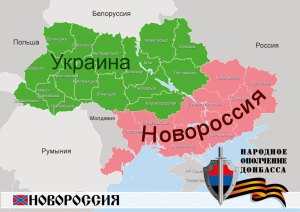
Nope Mikie, this is the lie fed by the Kremlin extremely well to especially Americans. It is swallowed so well because it puts the US at center stage (everything happened because of the US actions). For people who think wars are fought as forever wars just to keep up the military expenditure, it surely might be confusing that Ukrainians do defend their country and are willing to die for it. -
Mikie
7.3k
You say “wrong, there isn’t,” then provide 0 evidence.
The Russians didn’t want to conquer Ukraine. That is a myth, and a stupid one, which you seem to swallow whole. This has been gone over many times. It would not only be strategically stupid, and against the stated goals, but also militarily impossible.
But you go with your direct window into Putin’s soul. -
ssu
9.8kMyth?
You should make the case just why "Russians didn't want to conquer Ukraine", because you don't give any evidence of this, just state that it's a myth. And this is the unfortunate state of the discourse even in a philosophy forum. It's basically ludicrous argument when Russia has already declared that it has annexed parts of Ukraine and demands parts that it doesn't even control. But the actual words and actions of the Russian seem not to matter here.
On the case that Putin wanted a 10 day special military operation to take control of Ukraine:
- The easy success of the military seizure of Crimea and that Ukraine didn't fight at all back then.
- Actual speeches of Putin and all the speech of Ukraine being an "artificial" country.
- That there were Pro-Kremlin Ukrainian politicians then ready to be set up as leaders of the "denazified" Ukraine.
- The attempt on taking Hostomel airport, the follow in troops that were diverted because the airport weren't secured. Along with the other troop movements, it was obvious the Capital was the objective.
- Actual plans and ordered that were taken from killed or surrendered Russian troops and how to treat the Ukrainian.
- The Russification of the people in the occupied Ukrainian lands.
And when it didn't go to plan, then:
- The large firing of those FSB officers responsible for the Ukraine operation prior to the conventional attack. They were the people that were telling Putin that Ukraine would fold easily.
Just like in 2014. Back then the commander of the Ukrainian navy happily took a position of being a Russian admiral, which tells a lot of the situation. If it was so easy then, why would it now be difficult? Above all, the US just had betrayed another of it's allies like in Vietnam, so why not?
Nobody has to know Putin's soul. What he has said and what he has done is far enough. And the above were just examples why this should be totally obvious. It should be you who would be a consistent argument of just why everything is a myth. The annexations, the Russification of the Ukrainians, everything should be an obvious proof of what the intent is, starting from the fact the Putin see's the collapse of the Soviet Union as the biggest catastrophe of the 20th Century, something obviously he tries to get back.
What I'm only aware is the lurid story especially told by Mersheimer and Sachs that doesn't focus at all in the relationship that Russia has with Ukraine, but see everything just as an outcome of US policy and NATO enlargement. This is basically where the extreme navel-gazing that Americans do ends up in, where everything, absolutely everything, evolves around them without any other actors having objectives and agendas of their own. It's worrisome, because it creates a very delusional, fictional understanding of the world. -
jorndoe
4.2kNo, I don’t think so. — Mikie
Does that include cables and whatever else?
Do you deny the sad state of Belarus...? -
Mikie
7.3kYou should make the case just why "Russians didn't want to conquer Ukraine" — ssu
The Russians have been clear about what they’ve wanted. You disregard that— fine. It’s usually best to ignore official state bullshit. Look at the US in Iraq, etc. But it goes beyond that— the US wanted to control the oil in Iraq, and made up a bunch of nonsense trying to capitalize on the 9/11 wave of public deference. They wanted that oil for years.
Russia has likewise been telegraphing this move in Ukraine for years. I don’t like what they did either— you shouldn't invade another country. But if you take a second to try to put yourself in their shoes, given the geopolitical reality of the world, it makes sense. Putin isn’t a moron.
It doesn’t make sense to conquer Ukraine. First, they don’t have the military power to do so. Second, western Ukraine is different from eastern Ukraine, so annexing those regions would be an even costlier endeavor than what they’ve annexed so far — and that’s been a struggle itself and taken several years now. It would also be a waste when you get exactly the same result by doing what they’ve already done. NATO expansion is now off the table.
The myth of an evil Putin bent on conquering Eastern Europe and reestablishing the USSR is justification to absolve the US of their hand in this, and to continue the enormous amount of cash being thrown at this proxy war. The winners? Mostly the arms industry. -
Mikie
7.3kBut the actual words and actions of the Russian seem not to matter here. — ssu
That’s exactly what matters. Notice that they’ve never said they wanted to conquer Ukraine and, unsurprisingly, never tried to.
The only one ignoring that is you. Instead, you cite “true motives and intentions.” But even that fails, because it makes no sense from their point of view. Unless one presupposes the Russians are both evil AND stupid, the idea of conquering Ukraine is absurd. -
Punshhh
3.6k
Putin lies about his actions, the Ukrainians know this. They see him for what he is.Notice that they’ve never said they wanted to conquer Ukraine and, unsurprisingly, never tried to.
The special military operation started with an assault on Kiev, the plan being to overthrow the governmental control quickly, control Kiev. Then install a puppet government and convince the Ukrainians and the world that it was necessary because the Ukraine state had been taken over by Nazi’s. The de-Nazification narrative, which then became the little green man narrative.
The plan went wrong and what we have now is the result of repeated failures by Russia to take control of Ukriane. Resulting in trench warfare, or a meat grinder which they throw young healthy Russian men in their hundreds of thousands. Who are dying in their thousands with only metres of ground being won at any one time.
Now Putin is retreating into his bunker as his country slowly sinks economically. He can’t agree a ceasefire of any kind of truce without losing face and endangering his dictatorship. He is terrified and will sacrifice his country to save his skin.
This works in the West’s favour as Russia had become too strong on oil and gas revenues. Which Europe had become dependent on. Even with a lunatic in the Whitehouse and Europe lacking resources to support Ukraine, Russia can’t make any significant ground. Currently Russia is bleeding out and Europe is rearming. Ukraine may be badly damaged after the war ends, but they will have their freedom and will be helped to rebuild by Europe. Russia will go back into the deep freeze.


Welcome to The Philosophy Forum!
Get involved in philosophical discussions about knowledge, truth, language, consciousness, science, politics, religion, logic and mathematics, art, history, and lots more. No ads, no clutter, and very little agreement — just fascinating conversations.
Categories
- Guest category
- Phil. Writing Challenge - June 2025
- The Lounge
- General Philosophy
- Metaphysics & Epistemology
- Philosophy of Mind
- Ethics
- Political Philosophy
- Philosophy of Art
- Logic & Philosophy of Mathematics
- Philosophy of Religion
- Philosophy of Science
- Philosophy of Language
- Interesting Stuff
- Politics and Current Affairs
- Humanities and Social Sciences
- Science and Technology
- Non-English Discussion
- German Discussion
- Spanish Discussion
- Learning Centre
- Resources
- Books and Papers
- Reading groups
- Questions
- Guest Speakers
- David Pearce
- Massimo Pigliucci
- Debates
- Debate Proposals
- Debate Discussion
- Feedback
- Article submissions
- About TPF
- Help
More Discussions
- Other sites we like
- Social media
- Terms of Service
- Sign In
- Created with PlushForums
- © 2026 The Philosophy Forum