
-
 Philosophim
3.5kThanks for the additional clarification. Your additional comments do a great job of hammering in the logic behind your argument. — Esse Quam Videri
Philosophim
3.5kThanks for the additional clarification. Your additional comments do a great job of hammering in the logic behind your argument. — Esse Quam Videri
Thank you for the polite and well written inquiry! It is rare to not get angry pushback. Not that you have to agree with me as this continues, it is just nice to have a pleasant discussion.
Another way of framing the worry is that explaining each individual item within a contingent series by reference to its predecessor does not explain why there is a contingent series at all. The relations within the series can't be used to explain the existence of the series itself. The response "it just is" seems to arbitrarily terminate inquiry rather than satisfy it. I wouldn't argue that this is incoherent, but I might argue that it is unprincipled. — Esse Quam Videri
A very good approach. Lets imagine for a second that the logic is correct and it is the case that ultimately there is no cause for existence, and thus contingency itself. Does that shut down inquiry, or open new avenues for us to explore?
First, understanding this ultimate end result does not diminish our need to understand as much about the causal universe as possible. Understanding the universe allows us to make wiser choices, and potentially control outcomes favorable to the human race.
Second, proving, "This is the thing that has no causality for its existence," is nigh impossible from a practical standpoint. There is always the question whether we have arrived at 'the end' or simply the end of our capability to understand either through the limitations of knowledge, observation, or instrumentation.
So I do not see it as a discouragement to inquiry and exploration of understanding our universe as much as possible. If it is true that ultimately there is no cause for contingency itself, this would be a discovery of the truth, and therefore a further understanding of the universe. This allows us to push our exploration into realms we had not yet thought possible.
For example, if it is the case that there is no underlying reason for why existence is, besides the fact that it is, we can put forth new ideas that might help us as we continue to explore causal interactions. If there was no reason for existence to be, then there is no reason for any existence not to be. Meaning in the next second, something could appear in reality that wasn't there before. Or something that was there could disappear.
Further it seems that if something could appear in reality, it could be anything. After all, if there is no reason for existence, de facto there are no limitations as to what can exist. There would have to be something which would cause there to be a limitation.
Thus while the conclusion might appear limiting at first, it is actually one of the most freeing to give credence to infinite possibilities. Knowing this can let us look at the universe in a new light. Could we math out what 'anything being possible' would logically entail? I've done a few approaches myself as proposals.
For example, imagine that the universe is an infinite plane and anything could happen at any moment on that plane. We can break the plane down into a theoretical x/y/z. Then we can do a bit of cardinality comparison. If 1, is the smallest space and 'smallest' particle (of course smallest is a limitation, but just go with this for a second) then we have the highest growing infinite series.
First, we must assume that if anything is possible, everything has an equal chance of appearing, disappearing, or being as anything else. In one time unit, every x,y,z portion of the grid could have something happen, or not happen. What's the chance of there being something that is the same from piece to piece? Infintismaly small. But given infinite x,y,z, it will happen. But its likely not going to happen anywhere near another cluster of sameness. Further, even if something happens on this level, if it does affect something around it larger, its going to be imperceptible and nearly negligible. Essentially a random dice roll in the universe that introduces the concept that at a particular level of measurement there is a principle of uncertainty.
Let me stop here. I could continue on with more questions that this raises, but I want to give you a chance to think about this first and potentially come to them yourself. -
 Relativist
3.6kIs there anything that exists contingently?
Relativist
3.6kIs there anything that exists contingently?
I challenge the assumption that we should assume contingency unless proven necessary. I believe there are laws of nature, and that laws entail a necessitation: given a cause, the effect will necessarily follow.
The exception is quantum indeterminacy (most interpretations) but this still entails a necessary probability distribution. Still, it accounts for a restricted source of contingency: any specific quantum collapse could have come out differently. A specific instance of Quantum Collapse causes result X1, but it could have resulted in X2, X3....Xn.
Quantum collapse demonstrates how contingency works: X is contingent iff there is a C such that C accounts for X, but C could have accounted for Y. I.e. C contingently accounts for X. There is no other obvious source of contingency.
So suppose the past is finite. This implies an uncauses initial state (S0): that initial state was not caused and therefore there is no C that contingently accounts for S0. This would justify a claim that God exists necessarily, but it's more general - it doesn't entail a God. Whatever it may be,it exists necessarily. -
 SophistiCat
2.4kThe question of the OP invites a kind of view from nowhere, unconditioned by any framing or assumptions. Is there anything necessary tout court?
SophistiCat
2.4kThe question of the OP invites a kind of view from nowhere, unconditioned by any framing or assumptions. Is there anything necessary tout court?
My contention is that such a question is meaningless. There is no view from nowhere. All meaningful questions about possibility and necessity are "small" questions, as puts it. In other words, they are asked within the context of a particular framing and grounding assumptions. A first-person account implies the existence of the first person. Newtonian physics unfolds against the background of an immutable Euclidean space and an independent time dimension. In these examples, as in all meaningful examples, necessity is contingent, as it were, on how the question is framed.
Is there one ultimate, unconditional, necessary frame that would ground all inquiry? Only in the most general, Kantian sense in which our cognitive faculties are constituted in a certain way, and the way they are constituted conditions how we see and reason about the world. But there is a curious circularity here: we are embedded in and are shaped by that same world, which in turn conditions how we see and reason about it. We are not entirely free to choose our frame of reasoning, because we have always already been framed by the very subject of our inquiry.
I would tentatively answer "yes", and argue that contingency means dependency on conditions. Dependency implies ordered explanatory relations. A structure of ordered explanatory relations ultimately requires an unconditioned (ungrounded) ground. — Esse Quam Videri
I agree with this, with the proviso that the ground is implicit in and contingent on the explanatory structure.
But I think the subsequent discussion of "intelligibility" goes astray, perhaps confusing the map with the territory. I don't know what it would mean for the reality to be intelligible (or necessary, or contingent, for that matter), except in the obvious sense that making the reality intelligible to us is what we as intelligent creatures do. This framing already implies that a world in which intelligent creatures thrive exists, and is perforce intelligible to those creatures. Fair enough. But if we go on to ask whether it is necessary that such a world exists, the question loses its meaning. Necessary in relation to what? What is the framing theory and whence it came from? -
 180 Proof
16.4k
180 Proof
16.4k
Exactly. :up:I take the OP as asking if there are any necessary individuals - things. Not "are there necessary propositions?" or "Are there necessary truths?".
So set aside "Meillassoux's "Absolute" and look at
every existing thing... can be conceived of as not existing... without contradiction (i.e. negating a "necessary thing").
— 180 Proof
...which can be seen as an informal version of my more formal argument. — Banno
Btw, this (implicit) reification fallacy – ergo, substance duality – is merely reminiscent of Plato's question-begging (thereby unparsimonious and proto-Gnostic) "Theory of Forms" that as a consequence is imho more mythical than metaphysical.... metaphysical necessity. The very act of conceiving ~X presupposes a stable intelligible order — Esse Quam Videri -
 RogueAI
3.5kWould you say that absent a necessary being, the universe is a result of either an infinite series of causes or a series terminating in an uncaused cause?
RogueAI
3.5kWould you say that absent a necessary being, the universe is a result of either an infinite series of causes or a series terminating in an uncaused cause? -
Relativist
3.6k
This only esrablishes conceptual possibility, not metaphysical possibility.Only contingency is necessary (Q. Meillassoux's "Absolute") insofar as, without exception, every existing thing / fact (X) can be conceived of as not existing, or not being the case, (~X) without contradiction (i.e. negating a "necessary thing"). — 180 Proof -
180 Proof
16.4k
Please clarify the difference between "conceptual" and "metaphysical" in this context.This only establishes conceptual possibility, not metaphysical possibility. — Relativist
Also consider @Banno's comment here ...
.https://www.theguardian.com/us-news/2025/dec/29/new-orleans-brothers-priest-killing-child-sexual-abuse -
Philosophim
3.5k↪Philosophim Would you say that absent a necessary being, the universe is a result of either an infinite series of causes or a series terminating in an uncaused cause? — RogueAI
Its impossible to know with our current understanding. What I can claim with 100% confidence is that logically, either way, there is no cause which explains why the universe exists at all. -
 Banno
30.6kMeillasoux would resist framing his argument in terms of modal semantics — Esse Quam Videri
Banno
30.6kMeillasoux would resist framing his argument in terms of modal semantics — Esse Quam Videri
A pity, since his argument, and the the question of the OP, have model theoretical answers. We have in possible world semantics a clear and coherent grammar for modal issues. Ignoring it would be folly.
Your account seems to presume "logical necessity" concerns only entailment. Modal logic is not just concerned with mere entailment. It differentiates between and provides tools for considering nomological and metaphysical modality. There is, after all, an explicit distinction between ☐ and ⊢. And to that we can add model theory, including accessibility relations.
While we might agree that truth is not fixed by stipulation, the arguments of metaphysics should be coherent, and so constrained by a framework of logic.
Modal logic does not generate metaphysical necessity, but any claim to metaphysical necessity is accountable to modal logic.
So as I said,
Requiring an individual to exist in all worlds is a stipulated metaphysical condition, not a logical or semantic necessity. — Banno -
 Esse Quam Videri
392Thank you, this helps clarify your position a great deal. You've covered a lot of ground and introduced some interesting and unexpected (in a good way) considerations. I still have a lingering concern, and it turns on one specific inference you’re making.
Esse Quam Videri
392Thank you, this helps clarify your position a great deal. You've covered a lot of ground and introduced some interesting and unexpected (in a good way) considerations. I still have a lingering concern, and it turns on one specific inference you’re making.
First, I agree with your first two points: (1) Accepting a metaphysical limit does not shut down scientific inquiry, and (2) we may never know whether we’ve reached the ultimate explanatory limit.
Where I think the argument possibly breaks down, is here:
If there was no reason for existence to be, then there is no reason for any existence not to be. — Philosophim
The absence of a reason for why anything exists at all does not entail the absence of intelligible constraints within existence. You are moving from “no ultimate explanation” to “no internal intelligibility,” but I'm not sure that follows.
In fact, the model you propose depends on there being constraints. You introduced theoretical constructs such as an infinite plane, spatial dimensions, time units, probability distributions, etc. But these aren't neutral, they already presuppose a highly structured and law-governed reality.
My worry is that if existence were genuinely unconstrained in the way you suggest, then there would literally be no reason for persistency over time, stable entities, probabilistic regularities rather than total chaos, or even the continued existence of the probability space you are modeling.
Furthermore, saying "anything could happen" immediately raises a new question: why in fact does almost nothing happen that could happen? Appealing to brute contingency does not answer these questions, it intensifies them. The stability of reality that we manifestly experience becomes radically inexplicable.
This is why I’ve been insisting on the difference between exhausting causal explanations and providing a metaphysical one. Reaching “the limit of causality” only tells us that a certain kind of explanation has ended. It does not show that what remains is self-explanatory or unconstrained. An infinite regress of contingent explanations, or a probabilistic model of unconstrained possibility, does not explain why there is an intelligible order rather than none. It simply assumes that order while denying any ground for it.
So the issue isn’t whether inquiry continues, I agree that it does. The issue is whether intelligibility itself is ultimately grounded or ultimately accidental. And if intelligibility is accidental, then the success of explanation becomes a coincidence — which undermines the very probabilistic and mathematical reasoning your proposal relies on (and on which science itself is based).
To state my worry more cleanly: can we ground the intelligibility of being in a radically unintelligible foundation without undermining intelligibility itself? -
Banno
30.6k
Necessity is not causation.Another way to look at it is is, "What is the definition of necessary?" Necessary implies some law that if this does not exist, then something which relies on that thing cannot exist. — Philosophim
I wasn't explicit enough yesterday, so I'll bold it, just to be clear.
Aristotle made the distinction. A triangle necessarily has internal angles summing to two right angles—but the triangle is not caused to have them.
The Scholastics blurred the distinction, wanting to suppose that if God wills X, then X necessarily occurs. Necessity started to look like something imposed by a prior condition.
Descartes and Spinoza made it worse, treating necessity as divine decree. Hume and Kant went along with them. The logical positivists more or less agreed, and concluded that necessity was trivial.
Kripke restored metaphysical necessity using the structure of possible worlds. Something is necessary if it occurs in every possible world, possible if it occurs in at least one world, impossible if it occurs in none, and contingent if it occurs in some but not all.
This is far and away the best account we have.
Necessity does not imply some casual law. -
Esse Quam Videri
392Again, I'm not challenging accountability. I'm challenging reducibility. Metaphysical conclusions as to the existence of necessary beings (if there be such) are reached by inquiry and argument, not by stipulation.
-
Esse Quam Videri
392I’m not reifying intelligibility or invoking Platonic Forms. The point is transcendental: conceivability presupposes intelligibility as a condition of judgment, not as a metaphysical entity. That X can be conceived as ~X shows only a lack of logical necessity, not metaphysical contingency. “Only contingency is necessary,” when asserted universally, already relies on the unconditioned intelligibility it claims to exclude.
-
Banno
30.6k
Far too broad. Every metaphysical inquiry stipulates a framework (language, identity conditions, modality), argues within that framework, and is answerable to coherence conditions expressible in logic.Metaphysical conclusions as to the existence of necessary beings (if there be such) are reached by inquiry and argument, not by stipulation. — Esse Quam Videri -
180 Proof
16.4k
In other words, whatever is "asserted ... relies on" grammar (Ludwig W., Freddy N.).“Only contingency is necessary,” when asserted universally, already relies on theunconditionedintelligibility it claims to exclude. — Esse Quam Videri -
Banno
30.6kThat X can be conceived as ~X shows only a lack of logical necessity, not metaphysical contingency. — Esse Quam Videri
That word, "conceived".
What work is it doing here? -
Esse Quam Videri
392I’m not denying that metaphysics requires a framework; I’m denying that metaphysical necessity is itself a framework stipulation (language, logic, modality) rather than an explanatory conclusion.
-
Banno
30.6k
So... we agree that metaphysics requires a framework; but you don't see language and logic as a part of that framework but as the conclusion? I must be misunderstanding you.I’m not denying that metaphysics requires a framework; I’m denying that metaphysical necessity is itself a framework stipulation (language, logic, modality) rather than an explanatory conclusion. — Esse Quam Videri -
Relativist
3.6k
Start with this nested view of logical, metaphysical, and physical modality:
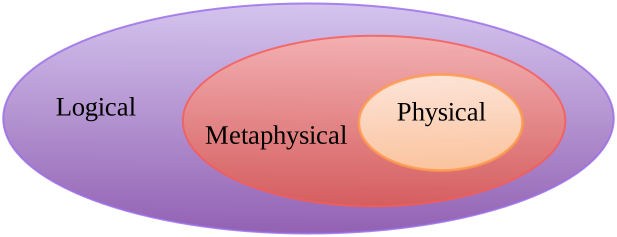
The broadest is logical possibility: anything that doesn't entail a contradiction is logically possible.
The narrowest is physical possibility: only things that are consistent with laws of nature are physically possible.
Between these is metaphysical modality: anything consistent with metaphysical reality ("laws of metaphysics", if there are any). For a physicalist, like me, metaphysical possibility = physical possibility.
Now suppose you are holding an object in your hand at arms length, and you release it (also assume there's no obstructions). It is physically necessary that the object fall to the floor. However, we can conceive of the object floating upward, or vanishing when released. These conceptual possibilities are not physically possible. They are metaphysically possible only if there is some non-physical aspect of reality that can override gravity, or cause the object to vanish. -
Esse Quam Videri
392I must be misunderstanding you. — Banno
Yes, that’s a misunderstanding. I’ve already clarified the distinction I’m making a few times now, so I don’t think there’s much more to add. Thanks for the discussion. -
Esse Quam Videri
392Appealing to grammar doesn’t really answer the point. Grammar explains how judgments are expressed, not what makes them meaningful or truth-apt in the first place. The norms grammar presupposes - correctness, sense, truth - already belong to intelligibility at the level of judgment. My concern isn’t metaphysical hypostatization but the performative fact that universal claims about contingency still rely on those unconditioned norms.
-
Banno
30.6kOk. You are saying something like that metaphysical necessity is not something to assume by a formal framework; it is something to derive from the framework as a conclusion about reality?
That, being so broad, says very little.
So I'll go back to my original answer, and point out that if we define necessity as existence in every accessible world, then whether an individual is necessary is determined by the model’s domains and accessibility — it is stipulated rather than independently derived.
By carefully constructing a modal model, we can make an individual necessary or contingent entirely by stipulation of the framework — doing precisely what Videri says cannot be done. -
Philosophim
3.5kThe absence of a reason for why anything exists at all does not entail the absence of intelligible constraints within existence. You are moving from “no ultimate explanation” to “no internal intelligibility,” but I'm not sure that follows. — Esse Quam Videri
I think I see your issue now. To be clear, my conclusion does not violate the intelligibility of what exists. My conclusion is only noting the full scope. While yes, anything could exist, once it exists it is what it is.
What do I mean by this? An oxygen atom is an oxygen atom because of its composition. An oxygen atom is not a hydrogen atom because its composition is different. When something exists, it by nature has properties that react in particular ways to other properties. Our observation of how 'the atom' is composed, and how 'one oxygen atom' interacts with 'one hydrogen atom' are simple observation of stable structures.
You might say, "If anything can happen, how can we have a stable atom?" Its one of many things that could happen. And if we think about it, atoms can break down and reform, combing with other properties and resulting in new substances.
In fact, the model you propose depends on there being constraints. You introduced theoretical constructs such as an infinite plane, spatial dimensions, time units, probability distributions, etc. But these aren't neutral, they already presuppose a highly structured and law-governed reality. — Esse Quam Videri
The irony is that if anything could start to exist, then there are still limitations given. There must be infinite space, or there would be a constraint. Spatial dimensions we know can exist because we are witness to them. Could there be higher or lower dimensions? Why not? Seems they would be possible. Time is also the relativistic tracking of change between two or more things, not an actual 'force' or 'thing' per say. Finally, while anything could exist without prior cause, we have the universe around us to see what actually appeared and ended up as. All of this lets us establish probabilities that I've noted without issue.
To be clear, the addition that anything can exist without explanation does not necessarily invalidate what has happened with explanation.
My worry is that if existence were genuinely unconstrained in the way you suggest, then there would literally be no reason for persistency over time, stable entities, probabilistic regularities rather than total chaos, or even the continued existence of the probability space you are modeling. — Esse Quam Videri
No, there's not if we are considering all possibilities prior to one happening. But once it happens, it happens. Just as its likely that unstable entities could appear, then cease to exist after 10 seconds, existence could appear for 10 trillion years, then vanish, or even longer. When we encompass actual infinity, its quite possible that our universe that we know of has been what it is for billions of years, and will be what it is billions of years longer. The point to understand that existence can happen without a prior reason is only pertinent if something has not yet existed, or something will unexpectedly cease to exist. In both cases, neither are predictable and would be extremely hard to identify or test for, so for most things it is practical not to consider it.
So the issue isn’t whether inquiry continues, I agree that it does. The issue is whether intelligibility itself is ultimately grounded or ultimately accidental. And if intelligibility is accidental, then the success of explanation becomes a coincidence — which undermines the very probabilistic and mathematical reasoning your proposal relies on (and on which science itself is based). — Esse Quam Videri
Is it cheating if I say both? :) Existence is ultimately accidental, but what exists and co-exists with what does exist is grounded in those experiences. Thus if you have a situation in which a planet forms with all sorts of chemical interactions happening over time, life just happens to emerge from these repeated firings. The miracle of life seems impossible, and even more so its evolution into intelligent beings that can be aware of the universe itself lives in. Yet here we are.
We rely on the stability of the existence around us to continue. Life is in a constant state of trying to exist despite its constant crumbling. It learned to move around and sustain itself. It learned to think and talk using the atmosphere and the other things that formed around it like plants and other animals. Without this stable planet, it cannot exist. Step out into space and entropy takes us. We are an adaptability within a closed macro system with constantly changing microsystems.
Is there any other planet any human could live natively on? There are certain areas of our own planet we cannot live like deep under the ocean. We are a very specific adaptation to our very specific location and the existence which has stayed stable around us. The fact that there is no reason why this planet and everything ultimately existed is irrelevant for this.
Could at all end anytime? Possibly. But is that really that much different from life's daily struggle? Does that stop us from exploring and further trying to understand and adapt to the existence that we are and is around us? No. Maybe it will help us if we do discover a limit. Maybe the speculation on what is possible with math could glean possibilities we had not thought of. And maybe the possibility of endless possibilities, while terrifying, can also be wonderful. I do not see it as an end to discovery, but an opening up of a new avenue to explore.
To state my worry more cleanly: can we ground the intelligibility of being in a radically unintelligible foundation without undermining intelligibility itself? — Esse Quam Videri
I believe we can. But please let me know if I'm being naive and missing something. -
Philosophim
3.5kNecessity is not causation. — Banno
No, causation ultimately leads to a necessary conclusion. My ultimate point is not to claim causation was necessary. In fact the opposite. It is necessary that if we examine the full chain in the scope of causality that ultimately we will arrive at the necessary conclusion that it cannot be caused by anything else.
Kripke restored metaphysical necessity using the structure of possible worlds. Something is necessary if it occurs in every possible world, possible if it occurs in at least one world, impossible if it occurs in none, and contingent if it occurs in some but not all. — Banno
This is fair. Kripke would agree with my conclusion then. It is true for all possible worlds. -
Esse Quam Videri
392But I think the subsequent discussion of "intelligibility" goes astray, perhaps confusing the map with the territory. I don't know what it would mean for the reality to be intelligible (or necessary, or contingent, for that matter), except in the obvious sense that making the reality intelligible to us is what we as intelligent creatures do. This framing already implies that a world in which intelligent creatures thrive exists, and is perforce intelligible to those creatures. Fair enough. But if we go on to ask whether it is necessary that such a world exists, the question loses its meaning. Necessary in relation to what? What is the framing theory and whence it came from? — SophistiCat
Thanks for the incisive reply. To clarify, I don’t mean “intelligibility” as a feature of our representations but as a condition of the possibility of inquiry itself. If reality were not intrinsically intelligible (i.e. constrained independently of our cognitive activity) then the distinction between correct and incorrect explanations would collapse.
When I speak of an unconditioned ground, I’m not asking what is necessary relative to a theory, but whether a totality of conditioned explanations can be intelligible without something unconditioned. A ground that is itself contingent on the explanatory structure is not a ground but another explanandum.
So the issue is not anthropocentric but structural: contingency presupposes intelligibility, and intelligibility cannot be wholly contingent without undermining explanation itself.
I don't know if that fully addresses your questions, but I'd be happy to try to clarify further if necessary. -
Banno
30.6k
Sorry, I think the point was missed again. I would distinguishing modal/metaphysical necessity (what must be the case) from causal dependence (what brings something about).
You appear to treat necessity as something derived from examining causal chains, sliding back into the old mistake: equating necessity with the inevitability of causal sequences.
Necessity does not require a causal history. A triangle has its angles sum to two right angles whether or not any triangle is ever drawn or exists physically. The fact that you can trace a causal chain for some contingent phenomenon does not make the phenomenon itself necessary.
To be sure, some folk posit a reduction of causality into modality - that in some form, "A cause B" means that in every case in which A occurs, B also occurs, and so that B necessarily follows from A. It's a not unproblematic account. And the revers of what is suggested here. -
Philosophim
3.5kSorry, I think the point was missed again. I would distinguishing modal/metaphysical necessity (what must be the case) from causal dependence (what brings something about). — Banno
As am I. You might want to read the paper that I linked in this instance.
You appear to treat necessity as something derived from examining causal chains, sliding back into the old mistake: equating necessity with the inevitability of causal sequences. — Banno
No, that's not what I'm stating. I stated that if we examine the entirety of the causal chains we arrive at a necessary conclusion that there can be nothing outside of it all that caused the entirety of the causal chain.
The fact that you can trace a causal chain for some contingent phenomenon does not make the phenomenon itself necessary. — Banno
I agree, and that's not what I'm saying.
I don't want to derail this thread from the OP about my paper. If you wish to further discuss the conclusions of the paper, it might be better to take it there to reference it directly. Then once we figure it out, we can come back here if you would like. -
Banno
30.6k
That paper relies on treating necessity as causation. It moves from a causal argument about the universe being uncaused to saying nothing is necessary and nothing has “prior meaning”.You might want to read the paper that I linked in this instance. — Philosophim
The paper essentially equates metaphysical necessity with causal self-sufficiency, claiming that because the universe (taken as a whole) has no cause outside itself, there is nothing necessary outside existence.
In other words, it treats uncaused = contingent, and assumes that necessity only arises via causal explanation.


Welcome to The Philosophy Forum!
Get involved in philosophical discussions about knowledge, truth, language, consciousness, science, politics, religion, logic and mathematics, art, history, and lots more. No ads, no clutter, and very little agreement — just fascinating conversations.
Categories
- Guest category
- Phil. Writing Challenge - June 2025
- The Lounge
- General Philosophy
- Metaphysics & Epistemology
- Philosophy of Mind
- Ethics
- Political Philosophy
- Philosophy of Art
- Logic & Philosophy of Mathematics
- Philosophy of Religion
- Philosophy of Science
- Philosophy of Language
- Interesting Stuff
- Politics and Current Affairs
- Humanities and Social Sciences
- Science and Technology
- Non-English Discussion
- German Discussion
- Spanish Discussion
- Learning Centre
- Resources
- Books and Papers
- Reading groups
- Questions
- Guest Speakers
- David Pearce
- Massimo Pigliucci
- Debates
- Debate Proposals
- Debate Discussion
- Feedback
- Article submissions
- About TPF
- Help
More Discussions
- Other sites we like
- Social media
- Terms of Service
- Sign In
- Created with PlushForums
- © 2026 The Philosophy Forum