
-
 Patterner
2k
Patterner
2k
Ah. Yeah. How is it that codons mean amino acids, and strings of codons mean proteins. Sure, everything about them and the whole process of protein synthesis is physics. But that doesn't solve the mystery.Even the activities of cells cannot be understood without introducing the idea of signs (biosemiotics). — Janus -
 boundless
760I'm not disappointed at all. Many people have beliefs of this kind that I do not share. You, in your turn, may be disappointed to learn that I have never been able to sign up to any doctrine of this kind - mostly because I find it too hard to make sense of them. For purposes of classification, I call myself an agnostic. I think we can co-exist. — Ludwig V
boundless
760I'm not disappointed at all. Many people have beliefs of this kind that I do not share. You, in your turn, may be disappointed to learn that I have never been able to sign up to any doctrine of this kind - mostly because I find it too hard to make sense of them. For purposes of classification, I call myself an agnostic. I think we can co-exist. — Ludwig V
I was joking but it seemed to me that your use of adverbs like 'clearly' meant that it was impossible for you that I could be a panentheist :smile:
I don't understand what you are asking for. — Ludwig V
Consider this analogy. Alice every time that plays a lottery, wins. Let's say that this reapeats for 10 times.
Our instinct is: it can't be "just a coincidence". We want an explanation of "what is really going on". Perhaps, we discover that the lottery system is rigged in her favour, with or without her knowledge. And then we discover how it is rigged and we can make an explanation of why she is winning.
However, someone else might just say: "well, it is unlikely but it isn't impossible. The game works as it should, Alice is just very, very, very lucky.".
So, here's the point. If, for instance, the mathematical structure of our physica models doesn't 'reflect' an intelligible structure of the "physical world as it is", our success becomes difficult to explain. We might just be lucky: there is no intelligible structure but somehow we manage to make models that work. Or there is an intelligible structure which is 'reflected' (albeit imperfectly) into our models that allows us to make successful predictions.
"The physical world seems intelligible" means, to me, that we can understand the physical world. You use the word "seems" which suggests that you think that might not be the case. I agree that we do not understand it completely. Is that what you mean? I can't see what it might mean to say that our partial understanding is an complete illusion, as opposed to partly wrong. — Ludwig V
I agree with you here. However, notice that we have no 'guarantee', i.e. no 'absolute certainty', that we understand the world, even imperfectly.
However, if you agree with me and there is an intelligible structure in the physical world, things get interesting.
Conscious beings evolved in the physical world, and evolved the means for understanding that world. If those means had failed to understand the physical world, our species would likely have died out long ago. No? — Ludwig V
Yes, but why should a 'mindless world' be intelligible at all? If conscious beings - and even more rational beings - are completely accidental product of 'blind' processes of a 'mindless world', why would such a world have a structure that can be truly (even if imperfectly) understood by them? -
 Ludwig V
2.5k
Ludwig V
2.5k
I thought you might be. Perhaps my response was clumsy. I must confess I didn't give a thought to your possible religious beliefs. If I offended you, I apologize.I was joking but it seemed to me that your use of adverbs like 'clearly' meant that it was impossible for you that I could be a panentheist :smile: — boundless
Thanks. This is very helpful. Mind you, I'm not entirely sure that we are lucky to be alive. Some people think that life is a bit of a curse.Consider this analogy. Alice every time that plays a lottery, wins. Let's say that this reapeats for 10 times.
Our instinct is: it can't be "just a coincidence". We want an explanation of "what is really going on". Perhaps, we discover that the lottery system is rigged in her favour, with or without her knowledge. And then we discover how it is rigged and we can make an explanation of why she is winning.
However, someone else might just say: "well, it is unlikely but it isn't impossible. The game works as it should, Alice is just very, very, very lucky.". — boundless
I'm finding it very hard to envisage the possibility that there may be no intelligible structure in the world. It seems to me that the fact that we survive and find our way about seems to me to demonstrate that there is. So, for me, there is no "if there is an intelligible structure...", only "Given that there is an intelligible structure..."So, here's the point. If, for instance, the mathematical structure of our physica models doesn't 'reflect' an intelligible structure of the "physical world as it is", our success becomes difficult to explain. We might just be lucky: there is no intelligible structure but somehow we manage to make models that work. Or there is an intelligible structure which is 'reflected' (albeit imperfectly) into our models that allows us to make successful predictions. — boundless
There is the possibility that quantum mechanics demonstrate that, at that level, there is no intelligible structure. But I maintain that the probability laws in quantum mechanics demonstrate that there is some structure in the world, even if there is some chaos. If there was none, there would be no probability laws.
There is an interesting and possibly confusing issue about how much of the structure we perceive in the world is imposed on it by us, and how much of it is recognized by us - i.e. does exist in the world independently of our perception of it. I don't have an answer for that.
Is there such a thing as an unintelligible structure? If there's a structure, it will be intelligible. If it's not intelligible, it won't be a structure.
Why do you think a mindless world might not be intelligible?Yes, but why should a 'mindless world' be intelligible at all? If conscious beings - and even more rational beings - are completely accidental product of 'blind' processes of a 'mindless world', why would such a world have a structure that can be truly (even if imperfectly) understood by them? — boundless
I don't know that we are an "accidental" product of the processes of the world. That presupposes there is some purpose or system at work with a definite aim. I don't think there is. However, given that it was always possible that life would be generated by the world that we inhabit, it is not all that surprising that life did develop.
Your description of "mindless" and "blind" hints that you think there is some impossibility or unlikelihood of that happening by itself, as it were. Am I right? Why do you think that?
Perhaps the probability of life developing is small. But small probability events happen all the time. Ask any lottery winner. Consider the existence of any star.
Finally, given that we evolved to survive and even thrive in this world, it cannot be much of a surprise that we are equipped to understand it. -
 Joshs
6.7k
Joshs
6.7k
the intention behind the arguments is precisely to stake a claim for the reality of consciousness - to put a block in the way of reduction. The arguments have succeeded, I think, in doing that. — Ludwig V
Reduction by itself isnt necessarily a bad thing, but we want to aim for the right kind of reduction. Reducing phenomena to physical processes relying on objective causal mechanisms is concealing kind of reduction since it slaps abstractive idealizations over what we experience, hiding the richness of that experience. Husserlian reduction and Wittgensteinian seeing bracket the flattening generalizations of empiricism so we can notice what is implicated in them but not made explicit.
Part of the problem is encapsulated by the confusion inherent in the idea of the "real world", "reality". The idea that physics captures the reality of an aspect of the world is meant to insist that there is only one world, which is thought of in many ways. These conceptual systems are related to each other in something of the way that different interpretations of a picture are related. They are independent, complete in themselves, yet, in a sense competing with each other, and, in that competition, co-existing. The picture of the duck-rabbit is really a picture of a duck and a picture of a rabbit and it is not possible for it to be both simultaneously; yet there is only one picture. It seems impossible and yet, there it is. — Ludwig V
For both Husserl and Heidegger, but in different ways, ‘reality’ refers back to a canned method which developed between Galileo and Descartes, defining empirical phenomena in geometric terms as bodies at rest or in motion. Husserl reserves the word ‘reality’ for a certain realm of abstractive idealizations that we construct. For instance, the ‘reality’ of the real spatial object is constituted by us when we move from the perception of a flowing, changing nexus of sense data to the constitution of patterns of correlation linking our movements and their kinesthetic feedback with phenomena such that an overall self-similarity obtains. The leap to the concept of ‘real’ is the abstraction we make in which we see such patterned phenomena in terms of ‘this unitary, self-identical object’.
Similarly for Wittgenstein, we get caught up in grammatical confusions when we reify our abstractive generalizations. We can see something as a duck, as a rabbit, or as a picture which functions as a categorical container for both (“there is only one picture”). This leap towards the ‘real’ as a general fact comprising particulars obfuscates the change in grammar we undergo when we move from seeing something as a duck, to seeing something as a rabbit, to seeing something as ‘this categorical ground of a duck and a rabbit’. Each shift in grammar is, in a subtle way, a change of subject. Generalization , inclusion, identification all involve such shifts in grammatical sense, but we tend to conceal from ourselves these qualitative changes in meaning.
And there is a glue which ties together these changes in sense. It is the glue of relevance. The hard problem consists in assuming that relevance , mattering and significance refer to processes associated with an aspect of the world called consciousness or subjectivity. The aspect called physical reality comprises events and objects which in themselves are devoid of affect, relevance and mattering. They simply ‘are’ as neutral facts of the real. Relevance is a gloss we as subjects add to them. -
 Janus
18kYes I can see this, although I would suggest that transcendence can be brought into the mix. But I have noticed a taboo on this forum around transcendence, so won’t push it further unless asked to. — Punshhh
Janus
18kYes I can see this, although I would suggest that transcendence can be brought into the mix. But I have noticed a taboo on this forum around transcendence, so won’t push it further unless asked to. — Punshhh
Why interpret a principled rejection of the idea of transcendence as a "taboo"? It seems that some folk seek to psychologically explain away the holding of views which contradict ideas they hold instead of presenting cogent arguments in support of those ideas.
I don't think in terms of transcendence because the idea of a transcendent realm or reality seems unintelligible to me, or else simply a reification of a conception of this world into another imaginary register, so to speak, and I don't think the idea is at all helpful philosophically.
For me, philosophy calls upon us to come to terms with this world, this life.
I don't recall Wittgenstein's remark about poetry, but I'm prepared to believe it. I seem to remember that he says somewhere that one could write a whole book of philosophy that consisted of nothing by jokes. — Ludwig V
I remember reading his comment about philosophical jokes too. Perhaps the point of both the reference to poetry and jokes was that the overly explicit nature of cold analysis cannot capture what is philosophically important or escape from the befuddling dualism which is inherent in propositional language.
Ah. Yeah. How is it that codons mean amino acids, and strings of codons mean proteins. Sure, everything about them and the whole process of protein synthesis is physics. But that doesn't solve the mystery. — Patterner
The idea that everything is physical does not entail that everything can be explained in terms of physics. The apprehension of the meaning of a poem might be a neural, that is physical, process, but the meaning apprehended cannot be explained in terms of physics. -
 Punshhh
3.6k
Punshhh
3.6k
I was commenting on my observation that no one, that I’ve noticed, includes it in any discussions. I’ve toed the line a bit, because posters just ignore it. It fits the definition of a taboo to me. I don’t know what your objection is, so can’t, or wouldn’t comment.Why interpret a principled rejection of the idea of transcendence as a "taboo"?
That’s fine by me, perhaps what I’m thinking of coincides somewhat with what you describe as immanence.I don't think in terms of transcendence because the idea of a transcendent realm or reality seems unintelligible to me, or else simply a reification of a conception of this world into another imaginary register, so to speak, and I don't think the idea is at all helpful philosophically. -
Patterner
2k
I've been arguing this very thing for the few years I've been here.The idea that everything is physical does not entail that everything can be explained in terms of physics. The apprehension of the meaning of a poem might be a neural, that is physical, process, but the meaning apprehended cannot be explained in terms of physics. — Janus -
Patterner
2k
I claim that the phrase ‘physical world’ is not describing a world that is real in the sense of being real independent of our conscious interaction with it. I believe our consciousness and the physical world cannot be separated. That's what property dualism means. We can't remove the experiential property from particles any more than we can remove mass or charge from them. The bifurcation doesn't exist. But we ignore some properties at times. We don't concern ourselves with charge or consciousness when we calculate the path of a baseball after it leaves the bat. If we want to know why the ball bounces off the bat, we'll have to talk about the negative charge of the election shells. We don't talk about mass or charge when we discuss consciousness.But this makes it sound as though there is more than one real world; that physics effectively captures the reality of an aspect of it (the physical) and we need another explanation alongside of it for something like consciousness. This is dualism, a reification of the hard problem. If instead we claim that the phrase ‘physical world’ is not describing a world that is real in the sense of being real independent of our conscious interaction with it, then we are doing phenomenology. This dissolves the dualism of the hard problem by showing there to be a single underlying process of experiencing accounting for the historical decision to bifurcate the world into concepts like ‘physically real’ and ‘real in other ways’. — Joshs -
boundless
760I thought you might be. Perhaps my response was clumsy. I must confess I didn't give a thought to your possible religious beliefs. If I offended you, I apologize. — Ludwig V
As I said, I was joking. So no offence. No need to worry or apologize. However, unfortunately, it is easy to get misunderstanding in written medias.
Thanks. This is very helpful. Mind you, I'm not entirely sure that we are lucky to be alive. Some people think that life is a bit of a curse. — Ludwig V
I get that. But I was referring to being lucky about the fact that our strategies for survival, scientific models 'work'. But I think you understood.
I'm finding it very hard to envisage the possibility that there may be no intelligible structure in the world. It seems to me that the fact that we survive and find our way about seems to me to demonstrate that there is. So, for me, there is no "if there is an intelligible structure...", only "Given that there is an intelligible structure..." — Ludwig V
Yes, I agree. But note that generally 'metaphysics' is, so to speak, 'chastised' for that. To make a few examples, 'epistemic idealists', 'transcendental idealists', some phenomenologists etc claim that we have no possibility to know "how the world is" because all we know is a representation ordered by our own cognitive apparatus or even deny that the the world has an intelligible structure. How the world 'is' independent from that is unanswerable because we can't get out from our own perspective. I believe that there is a truth in there but at the same time, they overreach. We might have no 'certain knowledge' but I believe we can make 'reasonable speculations'.
Indeed, the fact that our strategies 'work' suggest that we have some knowledge of the 'world independent from us'.
Is there such a thing as an unintelligible structure? If there's a structure, it will be intelligible. If it's not intelligible, it won't be a structure. — Ludwig V
:up: and if there's no structure, how could sentient beings with cognitive apparatuses come into being?
Why do you think a mindless world might not be intelligible? — Ludwig V
Because, it has no reason (I am using this word without any reference to 'purpose' here) to be intelligible, otherwise. It might be intelligible, yes, but I don't think there is any need for that. And yet, it seems that it is. It could be a complete 'chaos' and yet it is ordered. My question is: why is it so?
My own speculative answer is that even what we call 'mindless', 'inanimate' matter has a structure because it derives from a 'Principle' of both 'being' and 'intelligibility' (and this IMO is an 'argument' - speculative argument, not a 'proof' - of the existence of a 'Divine Mind').
Your description of "mindless" and "blind" hints that you think there is some impossibility or unlikelihood of that happening by itself, as it were. Am I right? Why do you think that? — Ludwig V
The fact that the arising of life and our species (i.e. a specie that can use reason) isn't impossible is for me something that is cause of wonder. -
Joshs
6.7k
I claim that the phrase ‘physical world’ is not describing a world that is real in the sense of being real independent of our conscious interaction with it. I believe our consciousness and the physical world cannot be separated. That's what property dualism means. We can't remove the experiential property from particles any more than we can remove mass or charge from them. The bifurcation doesn't exist. But we ignore some properties at times. We don't concern ourselves with charge or consciousness when we calculate the path of a baseball after it leaves the bat — Patterner
On the surface your account sounds as if you are rejecting the inner/outer split, but property dualism usually preserves and stabilizes the hard problem rather than dissolving it. The key issue is where the split is located. Phenomenology dissolves the hard problem by denying that the split between neutral physical reality and affectively laden experience is ontologically basic in the first place. Property dualism, by contrast, typically relocates that split inside the world itself. Instead of two substances, it posits two irreducible kinds of properties, physical and experiential, cohabiting the same entities. That leaves intact the explanatory gap
For instance, you claim that consciousness is a property of particles in the same sense as mass or charge. But once consciousness is treated as a property alongside physical properties, it immediately raises the question: why do certain physical configurations instantiate this additional property at all, and how does it relate to the others? We still have a world described completely in third-person terms, to which experiential properties are added as something extra.
For Husserl and Heidegger, the mistake lies in taking “the physical world” as something already fully constituted as neutral, objective, and affectless, and then asking how consciousness gets added to it. That picture is a theoretical abstraction derived from scientific practice, not a description of the world as it is originally given. The world is first encountered as meaningful, relevant, and affectively structured. Neutral objectivity is a derivative achievement, produced by bracketing relevance, concern, and involvement, not the metaphysical ground floor.
You say that when calculating the trajectory of a baseball, we ignore charge or consciousness. Yes, but phenomenology insists that scientific abstraction does not reveal a consciousness-free world; it selectively suspends certain dimensions of sense in order to achieve specific explanatory aims. Property dualism treats consciousness as a property that is “there anyway,” even when we are not attending to it. But what is the property? Phenomenology tell us that any set of facts about the world, any act of empirical measurement which deals with what is the case, gets its meaning sense and intelligibility fro the qualitative ‘how’ it makes sense as a system of understanding. This underlying ‘how’ is always present as that which guides and organizes the sense of what it means to calculate the trajectory of a baseball. It is there implicitly but not explicitly. This is only a property dualism if we consider the explicit ‘what’ of physical facts and the implicit ‘how’ of their anew and intelligibility to be properties.
Property dualism remains wedded to the hard problem of it accepts a conception of the physical as fully intelligible without reference to the qualitative intelligibility dimension of experience. Once that concession is made, consciousness can only appear as something mysterious, whether localized in brains, spread across particles, or treated as fundamental. The question “Why is there something it is like?” remains unavoidable.
By contrast, the phenomenological move is not to say that consciousness is another property of reality, but that the very distinction between “neutral physical” and “felt subjective” is a theoretical artifact. Worldhood, for Heidegger, is already affectively attuned; intentionality, for Husserl, is already value-laden and sense-bestowing. Affect and mattering are not added to a neutral base; they are conditions under which anything shows up as a base at all. -
Patterner
2kHi. Sorry, I'm crazy busy at work, and can't even read all that you wrote, much less respond to it. But I wanted to just say this...
If the hard problem is how physical things and processes can build/create non-physical consciousness, then those doors not preserve the hp. Consciousness does not arise from the physical. It's there with the physical all along.On the surface your account sounds as if you are rejecting the inner/outer split, but property dualism usually preserves and stabilizes the hard problem rather than dissolving it. — Joshs -
Joshs
6.7k
If a physical description of the behavior of billiard balls involves objectively causal mechanisms of interaction, how should we talk about what it is that is ‘there with the physical all along’? If it is consciousness which is there, what is it doing there? What is it contributing to the physical description? Is it simply contributing some mysterious quality of inner feeling?Consciousness does not arise from the physical. It's there with the physical all along. — Patterner -
Janus
18kBy contrast, the phenomenological move is not to say that consciousness is another property of reality, but that the very distinction between “neutral physical” and “felt subjective” is a theoretical artifact. Worldhood, for Heidegger, is already affectively attuned; intentionality, for Husserl, is already value-laden and sense-bestowing. Affect and mattering are not added to a neutral base; they are conditions under which anything shows up as a base at all. — Joshs
The problem for phenomenology is that all of what is said above is also a "theoretical artefact". Property dualism is discursively inescapable. I think that is why the later Heidegger reverted to poetic language. Dualism is not inherent in lived experience and the primal synthetic apprehension of things, but it is inherent in any and every saying that is the product of analysis. -
Joshs
6.7k
The problem for phenomenology is that all of what is said above is also a "theoretical artefact". Property dualism is discursively inescapable. I think that is why the later Heidegger reverted to poetic language. Dualism is not inherent in lived experience and the primal synthetic apprehension of things, but it is inherent in any and every saying that is the product of analysis. — Janus
That’s right. The ‘theoretical artefact’ can also be called a qualitative stance or value orientation. It is such stances and orientations that are inescapable when we use an objectively causal physical description of an aspect of the world. The world is always objective on the basis of a particular qualitative system of understanding and intelligiblity Is the distinction between a qualitative system of valuation and the causal account which is organized on its basis a dualism? If so, it is only the dualism of implict vs explicit, surface versus depth, abstractive vs primary. It seems to me these aren’t properties so much as dimensions.
If one is a physicalist, one will not notice the way the underlying value framework is indispensable to the direct intelligibility of all physicist accounts. One then will say that values are properties of subjective feeling ‘sprinkled over’ the properties of the physicalist account. That’s dualism, and it doesn’t require the postulation of a supernatural or non-natural realm. -
 Wayfarer
26.2kFor Husserl and Heidegger, the mistake lies in taking “the physical world” as something already fully constituted as neutral, objective, and affectless, and then asking how consciousness gets added to it. That picture is a theoretical abstraction derived from scientific practice, not a description of the world as it is originally given. The world is first encountered as meaningful, relevant, and affectively structured. Neutral objectivity is a derivative achievement, produced by bracketing relevance, concern, and involvement, not the metaphysical ground floor. — Joshs
Wayfarer
26.2kFor Husserl and Heidegger, the mistake lies in taking “the physical world” as something already fully constituted as neutral, objective, and affectless, and then asking how consciousness gets added to it. That picture is a theoretical abstraction derived from scientific practice, not a description of the world as it is originally given. The world is first encountered as meaningful, relevant, and affectively structured. Neutral objectivity is a derivative achievement, produced by bracketing relevance, concern, and involvement, not the metaphysical ground floor. — Joshs
I think this is the key, and that it can be situated historically. This is why Husserl's book The Crisis of the European Sciences is important. He says this is all implicated in 'the scientific worldview' that characterises modernity. Not only is it a different worldview, it is also a different sense of the nature of reality, which insinuates itself into all aspects of culture. This is also very central to Bitbol's work. -
Patterner
2k
All physical configurations, or at least all particles, instantiate the property. Here's my position...But once consciousness is treated as a property alongside physical properties, it immediately raises the question: why do certain physical configurations instantiate this additional property at all — Joshs
This property is what gives everything the ability to subjectively experience. Subjective experience, however, does not mean thinking, awareness, self awareness, emotion, and various other things that are generally labeled as "human consciousness". What we are conscious of is not what consciousness is. self-awareness is not consciousness. Self-awareness is our subjective experience of information processing and feedback loops. Emotions aren't consciousness. Emotions are our subjective experience of things likeneurotransmitters. Memory isn't consciousness. Memory is our subjective experience of stored information being referenced.
The subjective experience of a particle is very different from, and I would say very much less than, the subjective experience of people. Particles do not have any information processing, neurotransmitters or other chemicals, information storage, etc. They do not have sensory apparatus to give them input from the outside world or from within. There is, in fact, no within for a particle. So it's consciousness is of very little. Simple existence.
Not "added as something extra." No more than mass is added as something extra to charge. All properties are there all the time, all doing what they do. The fact there we describe the world in third-person terms in order to understand certain things, and use them to our advantage, is not there world's fault. It is what it is. We might want to think of it, and our place in it, differently.We still have a world described completely in third-person terms, to which experiential properties are added as something extra. — Joshs
That all sounds good to me!For Husserl and Heidegger, the mistake lies in taking “the physical world” as something already fully constituted as neutral, objective, and affectless, and then asking how consciousness gets added to it. That picture is a theoretical abstraction derived from scientific practice, not a description of the world as it is originally given. The world is first encountered as meaningful, relevant, and affectively structured. Neutral objectivity is a derivative achievement, produced by bracketing relevance, concern, and involvement, not the metaphysical ground floor. — Joshs
How can anything be intelligible without an intelligencer experiencing it?Property dualism remains wedded to the hard problem of it accepts a conception of the physical as fully intelligible without reference to the qualitative intelligibility dimension of experience. — Joshs
The answer is, because it is a property of the universe.The question “Why is there something it is like?” remains unavoidable. — Joshs
It seems to me that you insist it all must be viewed in a certain way. I disagree. I think it is all one; the universe experiencing itself all the time. Each part experiencing according its nature. -
Janus
18kIf so, it is only the dualism of implict vs explicit, surface versus depth, abstractive vs primary. It seems to me these aren’t properties so much as dimensions. — Joshs
That makes sense to me.
If one is a physicalist, one will not notice the way the underlying value framework is indispensable to the direct intelligibility of all physicist accounts. One then will say that values are properties of subjective feeling ‘sprinkled over’ the properties of the physicalist account. That’s dualism, and it doesn’t require the postulation of a supernatural or non-natural realm. — Joshs
I don't see why one could not be a (non-eliminative) physicalist without devolving into some form of dualism. One could maintain that subjective feelings are perfectly real events and are also completely physical, and that they only seem non-physical to us on account of the bewitchments of dualistic language.
On this view it would be energy which would be understood to be fundamental and consciousness (or mind, instinct or intelligence) would be included as being an ineliminable aspect of energy insofar as it behaves in a lawlike manner and constitutes the structures and processes we call "things" in an intelligent and intelligible manner. Any quality I can think of seems to be unintelligible if thought of as lacking energy.
This is basically Whitehead's view at least as I understand it. -
Punshhh
3.6k
Apologies for a bad choice of word. I didn’t mean taboo in that sense. I’ve only ever used it in the sense of a quiet, or unspoken, consensus not to go somewhere.It's simple; "taboo" implies a socially conditioned introjection governing responses and the presence of fear.
I see the issue of transcendence as fundamental when we’re looking at the bare bones of consciousness and being. This is also relevant when we’re talking about the Cartesian divide, because prior to the divide transcendence was pivotal to people’s understanding of the world. The Buddhist, vedantic and Abrahamic traditions out of which philosophy and the sciences sprang was steeped in the understanding and implicit acceptance of a transcendent ground of being. I am fortunate enough to be able to visit the gothic cathedrals of Europe. I have recently visited the Notre Dame, Canterbury cathedral, Ely and Norwich Cathedrals. Their walls are plastered with divine iconography in which a transcendent, or divine ground of being is implicitly portrayed. All the iconography of the Buddhist and Hindi religions is similarly depicting people touched by, or participating in the divine realm. Monastic life is about this, prayer and meditation is about this. Any mention, of divinity, God, faith, or belief derived from any of these religions is referring, perhaps not directly, or unknowingly to the principle of a transcendent ground of being.
Perhaps it is time to look at the elephant in the room and include it in discussions of the ground of being. -
 Tom Storm
10.9kAny mention, of divinity, God, faith, or belief derived from any of these religions is referring, perhaps not directly, or unknowingly to the principle of a transcendent ground of being. — Punshhh
Tom Storm
10.9kAny mention, of divinity, God, faith, or belief derived from any of these religions is referring, perhaps not directly, or unknowingly to the principle of a transcendent ground of being. — Punshhh
But what is the transcendent ground of being; God, Brahman, the One, or all of the above? And how could we ever know that such a foundation exists? It is one thing to adopt a phenomenological perspective and seemingly dissolve the mind–body distinction; it is quite another to posit a principle that underlies everything. What if there is no ultimate ground? What if the very idea of a ground is merely a human desire to impose causes and explanations on the world, constructing answers where there may, in fact, be none? Perhaps it is a question without end, an endless recursion where each answer only leads to another question. -
Tom Storm
10.9kI find the implications of phenomenology for the question of dualism interesting but somewhat difficult to understand. I also note that there've been different ways of articulating phenomenology over time.
This is what I think I understand: the mind is not a detached observer, and the body is not merely a machine. They exist together, intertwined within a single field of lived experience. From this perspective, the traditional problem of interaction or dualism might be said to dissolve. Phenomenology does not assume that mind and body are two independent entities that must somehow be connected. Instead, it understands them as co-emerging, inseparable aspects of the way we inhabit and experience the world. Yet it seems to me we can ask whether this really addresses the heart of the mind–body problem, or simply reframes it in a more elegant way, substituting abstract categories like “lived experience” for concrete questions about causality, consciousness, and physical reality that first give rise to the apparent problem.
How do thoughts relate to brain in this model? What would it mean to say a thought is not reducible to a neural process? If phenomenology isn't monist what exactly does co-emergence mean? -
Patterner
2k
I'm not sure what the idea is here. If consciousness is an aspect of the energy, what other aspects does this energy have? What does it do? Do you mean the energy is electromagnetism, and consciousness is an aspect of that? Or some other form of energy?On this view it would be energy which would be understood to be fundamental and consciousness (or mind, instinct or intelligence) would be included as being an ineliminable aspect of energy insofar as it behaves in a lawlike manner and constitutes the structures and processes we call "things" in an intelligent and intelligible manner. Any quality I can think of seems to be unintelligible if thought of as lacking energy. — Janus -
Patterner
2k
Indeed. certainly, mind and body are one, and inseparable. But, for those interested in such things, we still need an explanation.This is what I think I understand: the mind is not a detached observer, and the body is not merely a machine. They exist together, intertwined within a single field of lived experience. From this perspective, the traditional problem of interaction or dualism might be said to dissolve. Phenomenology does not assume that mind and body are two independent entities that must somehow be connected. Instead, it understands them as co-emerging, inseparable aspects of the way we inhabit and experience the world. Yet it seems to me we can ask whether this really addresses the heart of the mind–body problem, or simply reframes it in a more elegant way, substituting abstract categories like “lived experience” for concrete questions about causality, consciousness, and physical reality that first give rise to the apparent problem. — Tom Storm -
Joshs
6.7kI don't see why one could not be a (non-eliminative) physicalist without devolving into some form of dualism. One could maintain that subjective feelings are perfectly real events and are also completely physical, and that they only seem non-physical to us on account of the bewitchments of dualistic language — Janus
Yea, but I’m defining what you’re calling ‘subjective feelings’ as a qualitative system of rationality within which a physical account is intelligible. Imagine we are looking at a picture which can appear as either a duck or a rabbit. The system of rationality (the particular way the lines and curves are defined and organized into a whole gestalt frame of meaning) differs between the duck and the rabbit, and it differs qualitatively, valuatively, as a ‘felt’ sense of meaning . A physicalist will say , yes but we can locate the underlying facts which explain this difference.
The phenomenologist will say that those underlying facts themselves will always require a quantitative , valuative, felt system of rationality to make them intelligible and there is no physical account which can ground it. We can as phenomenologists study the process of constructing qualitative systems of rationality, but this will not lead us to a physicalist explanation, since the physicalist explanation presupposes the developed framework of a qualitative system of rationality. Think of physicalism as dealing with events described on the basis of a logic derived from an axiomatic system, and phenomenology as revealing subject-world interactions as the ground of axiomatization.
There are is no end to the variety of qualitative systems of meaning we can constitute, and physicalism is just one historically produced narrative. It is not the world which is physical, or based on energy, it is a narrative which emerged a few centuries ago and which we have been quite attached to. We are so blinded by the usefulness of that narrative we can’t see through it or beyond it, as though we were all living in The Truman Show. -
Joshs
6.7k
This is what I think I understand: the mind is not a detached observer, and the body is not merely a machine. They exist together, intertwined within a single field of lived experience. From this perspective, the traditional problem of interaction or dualism might be said to dissolve. Phenomenology does not assume that mind and body are two independent entities that must somehow be connected. Instead, it understands them as co-emerging, inseparable aspects of the way we inhabit and experience the world — Tom Storm
I think we need to dissolve or bracket all fixed distinctions between mind and body, and see change, inter-affection, intertwinement and interaction as primary. The body is already minded in itself and the mind embodied. What does this mean? It means that before we solidify processes into entities with pre-assigned laws and properties ( what a body is and does, and what a mind is and does) , we have fields of interacting bits. These bits aren’t defined by any substantial , pre-assigned content , but by what they do, how they affect and are affected by their neighboring bits.
The whole system is in constant change with respect to its prior states, and local patterns of distinctions and differentiations emerge dynamically from out of this total interactive activity. It is not the property of mind to observe but to act, just as the body continues to exist only by acting. To perceive and to know is to be changed. Changed by what? It is changed by a world which is not simply outside of it, as though there were mind here and world
out there. Interaction is prior to the notion of an inside being affected by an outside. To say we experience the world is to say we experience ourselves, make changes in ourselves.
How do thoughts relate to brain in this model? What would it mean to say a thought is not reducible to a neural process? If phenomenology isn't monist what exactly does co-emergence mean? — Tom Storm
Husserlian phenomenology is monist. There is reduction, but not from thought to physical entity. Rather, from physical entity to underlying process generating qualitative systems of rationality. Is this process physical? Spiritual? It is not physical since the physical is one of an infinity of possible narratives that we can construct to navigate and organize events, and saying something is physical doesn’t address the underlying system of rationality which organizes the theory of the physical or the genesis of systems. Where does this underlying system of rationality come from, if not the physical? We can say that the bits comprising mind, body and world are not physical, since the physical presupposes but doesnt explain them. But what does explain them? Or better yet, can we come up with an understanding which avoids ‘explanation’ of a physicalist or causal sort, avoids spiritualist mumbo jumbo, and also grounds physicalism?
It would seem that current neuropsychological models give us much of what we need to ground mental phenomena, since they assume a brain and body in continual change with respect to itself, fields of interacting elements and systems of model making which link mind and world. This is a good start, but from a phenomenologist’s vantage, it still stumbles on remnants of physicalistic reification when it treats mind as mirroring, modeling or representing an outside world. This treats neurons as inner objects shaping themselves to conform to outer objects.
To get rid of the remnants of physicalism, we need to stop talking about the mind, body and world in terms of objects which interact , even objects that exist only very briefly. The bits I have been describing here aren’t tiny objects, they are actions, differences, events, creations, values, vectors. To make this our starting point rather than the concept of neutral , affectless ‘object’ allows us to avoid the hard problem’s dilemma of explaining the relation between value, quantity, affect, feeling, creation, meaning on the one hand and object, fact, identity, thing on the other. It also means that we have to start treating the concept of time seriously, radically, primordially. -
Punshhh
3.6k
We don’t know and may never know. Within the religious traditions, though, it is taught that people were given the knowledge through revelation and by being hosted by heavenly (or use another appropriate term) beings. Also in Hinduism and Buddhism people are said to achieve enlightenment, in which they become aware of this knowledge.But what is the transcendent ground of being; God, Brahman, the One, or all of the above? And how could we ever know that such a foundation exists?
This introduces two questions, is there a ground to the being we find ourselves in? and, is there an ultimate ground.What if there is no ultimate ground?
For the first question, well there must be something, whether it qualifies as a ground of being, or something else. That is part of the debate, presumably. As for the second, that might be a question too far, for now at least.
Yes, something to be aware of and distinguish. This might even require a bracketing out of the intellectual frameworks we are conditioned with and a new system developed. Presumably, theology has addressed many of these questions already.What if the very idea of a ground is merely a human desire to impose causes and explanations on the world
Yes well regression is all around, it’s something we have to accommodate.Perhaps it is a question without end, an endless recursion where each answer only leads to another question. -
Tom Storm
10.9kTo get rid of the remnants of physicalism, we need to stop talking about the mind, body and world in terms of objects which interact , even objects that exist only very briefly. The bits I have been describing here aren’t tiny objects, they are actions, differences, events, creations, values, vectors. To make this our starting point rather than the concept of neutral , affectless ‘object’ allows us to avoid the hard problem’s dilemma of explaining the relation between value, quantity, affect, feeling, creation, meaning on the one hand and object, fact, identity, thing on the other. It also means that we have to start treating the concept of time seriously, radically, primordially. — Joshs
Thanks for your detailed response. It all alludes to a broader perspective and reading than my own on this, so in reading you, it’s a bit like listening to a cell phone call with reception which fades in and out. Bits are recognisable, bits are missing. I’ll sit with it. -
Wayfarer
26.2kTo get rid of the remnants of physicalism, we need to stop talking about the mind, body and world in terms of objects which interact , even objects that exist only very briefly. — Joshs
I can't help be reminded of Buddhist abhidharma in this description. From Merleau Ponty and Buddhism, Gereon Kopf, Jin Y. Park:
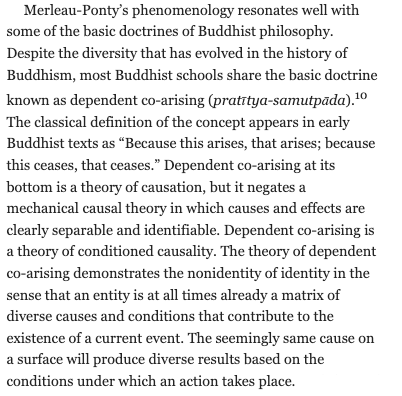
This is why Buddhism is mentioned so frequently in connection with enactivism and embodied cognition. (Although the convergences shouldn't be overstated - the book also says that Buddhism is soteriological in a way that phenomenology is not. But again this is where Michel Bitbol is particularly insightful, he's been a participant in the MindLife Conference which explores parallels between science, philosophy and Buddhism.)
But what is the transcendent ground of being; God, Brahman, the One, or all of the above? And how could we ever know that such a foundation exists? It is one thing to adopt a phenomenological perspective and seemingly dissolve the mind–body distinction; it is quite another to posit a principle that underlies everything. What if there is no ultimate ground? — Tom Storm
Phenomenology was not originally concerned with spiritual or theological matters as such. Its primary task was methodological: clarifying the structures of experience and the grounds of meaning, objectivity, and being. That said, there are certainly existentialist thinkers—Søren Kierkegaard, Gabriel Marcel, Emmanuel Levinas—who engage seriously with questions of transcendence. But they do so in a way that is fully aware of the postmodern situation: the loss of metaphysical guarantees and the rejection of intellectual abstraction as a genuine mode of existence.
In these thinkers, transcendence is not treated as an 'ultimate ground' or cosmic substrate, but as an irreducible implication of lived experience.
It’s also worth recalling the original meaning of the phenomenological epochē, as articulated by Husserl: the suspension of judgement with respect to what is not evident (which it has in common with ancient scepticism.) This suspension does not amount to a denial of the transcendent, nor does it imply that there is no ultimate ground. Rather, it refuses to speculate.
In that sense, phenomenology neither asserts nor rules out a “beyond”; it simply declines to turn what exceeds experience into a theoretical object. There’s something quite Buddhist about this also: a refusal to indulge metaphysical speculation, paired with an insistence on attending carefully to the nature of existence/experience moment-by-moment.


Welcome to The Philosophy Forum!
Get involved in philosophical discussions about knowledge, truth, language, consciousness, science, politics, religion, logic and mathematics, art, history, and lots more. No ads, no clutter, and very little agreement — just fascinating conversations.
Categories
- Guest category
- Phil. Writing Challenge - June 2025
- The Lounge
- General Philosophy
- Metaphysics & Epistemology
- Philosophy of Mind
- Ethics
- Political Philosophy
- Philosophy of Art
- Logic & Philosophy of Mathematics
- Philosophy of Religion
- Philosophy of Science
- Philosophy of Language
- Interesting Stuff
- Politics and Current Affairs
- Humanities and Social Sciences
- Science and Technology
- Non-English Discussion
- German Discussion
- Spanish Discussion
- Learning Centre
- Resources
- Books and Papers
- Reading groups
- Questions
- Guest Speakers
- David Pearce
- Massimo Pigliucci
- Debates
- Debate Proposals
- Debate Discussion
- Feedback
- Article submissions
- About TPF
- Help
More Discussions
- Other sites we like
- Social media
- Terms of Service
- Sign In
- Created with PlushForums
- © 2026 The Philosophy Forum