
Comments
-
The Yeehawist National FrontDespite your abandonment of your people by not being a snazzy dresser, I have remained true to my roots by being frugal at every turn, despite my occasional ability to be otherwise. You will often find me at my local Wal-Mart, shopping among my fellow bargain hunters, with various $15 shirts in my basket along with perhaps an under $20 mix and match lamp base and shade and other discounted odds and ends. I recently bought a $35 vacuum cleaner, which, although fairly limited, cleans my mismatched area rugs fairly well. I also must say that I do enjoy me a steamed White Castle (called Krystals out here) from time to time. A word to the wise: if you're going to buy 5 Krystals with cheese and fries, you'd be better off getting the combo that includes 5 burgers with cheese fries and asking for no cheese on the fries (too rich for my blood). It's actually cheaper to buy it that way.
Yeehawist National Forest. I say that because I wish to remain on topic. -
The Yeehawist National FrontAgain, as others have pointed out, if Muslim extremists or the Black Panthers took over an isolated area, the GOP would be demanding air strikes. So you're really not dealing with the issue of how big a role race plays in this. — Landru Guide Us
Had it been the Black Panthers staging a sit in at a Housing and Urban Development building, refusing to leave until changes were made to policies affecting housing for African Americans, no, there wouldn't have been air strikes. If it were Muslims demanding fair treatment, I'd say the same. Of course, we can tinker with the facts and change the outcome, like if people were being held hostage or if demands were being made that the US accept Islam as its official religion. That is to say that all the variables make a difference, with race only being one of them, and not dispositive of whether there would be air strikes, where the term "air strike" is defined as any sort of over the top crazy response where people get slaughtered.
If the general point is that blacks have it tougher than whites in the US, where if you could pick your skin color, you'd be prudent to choose white, I suppose I could agree. Of course, that revelation is hardly provocative and exciting. If you're asking, though, whether this Oregon situation is proof of anything important, it's really not, other than showing that folks are at the ready to race bait at the drop of a hat. -
The Yeehawist National FrontSo by your own standard, we should be shooting these creeps with snipers while Fox news cheers the shooting on. But of course, they're white guys, so that won't happen. — Landru Guide Us
Another reason it won't happen (although I'm not really conceding the well thought out point that it's only their whiteness that is acting as their shield) is because they took over a shed deep in the wilderness that no one really cares about other than the media and those who see it as an analogy to something great big and important, as opposed to it really just being a shitty old shed in the freezing ass woods of Oregon. -
The Yeehawist National FrontWhat was important to the Established Order was suppressing workers rights. — Bitter Crank
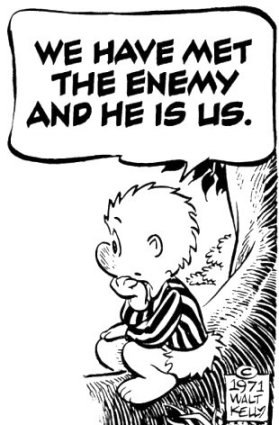
What hurts workers wages and their work conditions isn't an Established Order of Illuminate who control the levers of society. It's not them. It's you. You're the bastard. Look in the mirror and own it.
You want cheaper food, cheaper clothes (just a guess, but I'm thinking you've got a pretty shabby wardrobe), cheaper books, cheaper movies, cheaper everything. Every time prices rise, you scream about your right to a reasonable life at your income level being infringed upon. Every time those prices drop to quell your screeches, the workers start to rise up and offer their screams at their dwindling wages. That the workers screaming has been silenced only means that you've been successful in silencing them.
-
The Yeehawist National FrontThe more interesting thought experiment is the Muslim one. Muslim's are the new "other" in the US at the moment. — Baden
You'll need to complete your thought experiment with some additional facts. Why exactly have these Muslims seized this federal outpost? Are they trying to start a Muslim state, or are they just cattle ranchers who happen to be Muslim? It would seem that if their objective is to start a theocracy in the rugged hills of Oregon, then there'd be a reason to take that threat more seriously (especially in light of ISIS) than a bunch of pissed off ranchers who want better access to grazing land. -
The Yeehawist National FrontThese freaks need to be surrounded and arrested, and if they don't go peacefully, they should be shot dead. They are armed insurrectionists who represent a much greater threat to the US than some ISIS maniacs. These guys threaten the rule of law. — Landru Guide Us
The problem with taking a position that you clearly don't believe in is that no one will take you seriously when you say it, but maybe it was fun to say it anyway.
I think they should kill everyone everywhere. That way, there'll be no more violence. -
The Yeehawist National FrontDo you really believe that this Oregon conflict will end with an air strike? — Moliere
I don't think it will, nor do I think it will end in a deadly inferno like Waco.
The bottom line here is that you likely admit that the danger posed in Ferguson was greater than that in Oregon. That being the case, why complain about the disproportionate response if the dangers are different?
Here's what's fairly obvious to me: The ranchers are upset because their livelihood is being negatively impacted by government action and they feel their way of life is being unfairly jeopardized. It's hardly ideological at its base, but they've tried to turn it into an over-reaching government argument, suggesting that if the government would just let them be, they could live independently. As we've all pointed out, their argument fails. They are just as dependent on the government as others, and their way of life, despite being romantic and rugged, is no more sacred than the hot dog vendor who depends upon his exclusive license to sell at the corner of 42nd and Main.
That their political views aren't terribly consistent makes them pretty much like every other group. Their just mad because it's their ox being gored. They've reacted in a political way (which makes them also pretty much like every other group) by drumming up support from those who idolize the Old West and the individualism it requires. As a group, they aren't terribly dangerous, although there are likely some nut jobs who might actually do something dangerous among them.
Ferguson was a street riot, causing imminent danger to all nearby. It was not a black lives matter movement. There was damage to people, property, and the community. It deserved immediate action. If everyone would ignore the Oregon situation, no person or property would be harmed.
Anyway, following your logic, if "all lives matter" and Ferguson is directly analogous to Oregon and you believe the Ferguson folks were treated too harshly, then the correct response would be to treat the Oregon folks as gently as you believe the Ferguson folks should have been treated. That is, if all lives matter, then neither should be mistreated, not that if you mistreat one group, you should mistreat the other. Your argument ought to be that everyone should be treated fairly, not that if one is treated unfairly then fairness requires the other to be treated unfairly as well. -
The Yeehawist National Front
Yes, I'll take that bet. If they were black or Muslim and in a remote Oregon outpost arguing that some ranchers got unfair treatment, then there would not be a response greater than what we see here. It'd be confusing no doubt given the strange demographics for the region, but I don't see a dissimilar response.This rather misses the point. If some Muslim activists or Black Lives Matters took over an empty federal office with guns, want to make a bet they wouldn't be surrounded by SWAT and federal marshals with an ultimatum to surrender or die? — Landru Guide Us
Here's where you say "it would too be different," and I say "no it wouldn't." We then would go back and forth calling each other out of touch for a little while and then we'd go on talking about something else.
To the extent that you want to change the facts to include an urban area or an argument over some other cause, then we'd have dissimilar, inapplicable facts. -
The Yeehawist National FrontSo, equality in this case wouldn't be an equality of the lowest common denominator. Rather, all people deserve to be treated as if they are human, with the needs and rights that entails. — Moliere
In Ferguson (which seems to be the alluded to other event), a young man stole some stuff from a convenience store, knocked down the store owner, and, when confronted by police, charged at the officer and attacked him through the officer's window. He was shot in what was described as a struggle for the officer's gun.
That death resulted in a number of false reports by witnesses at the scene, all contradicted by the physical evidence. As a result of the death being ruled justified, the citizens threw rocks, fired guns, burned buildings, and looted stores.
So, let's treat everyone equitably, but first explain to me how the two are similar so that we can properly apply precedent. Would you rather be standing in that town in Oregon right now or in Ferguson during the riots? I'd suspect the former (despite it probably being really cold there right now). Why? Could it be that you realize that the former is much safer than the latter. If so, wouldn't the safer place require less police action? Isn't that how it works? -
The Yeehawist National FrontWe don't have to like the crap the Established Order offers, but it is a waste of outrage to complain that a bunch of white guys out in the woods weren't greeted by a SWAT team. — Bitter Crank
I agreed with the first half of your post where you pointed out that varying responses to varying threats made sense, but then you devolved into arguing that really it was all political.
There is a difference between protesting in favor of greater workers rights and physically blocking people from going to work. The first is legal, the second not.
The SWAT team didn't greet the folks in Oregon, not because all the protestors were white, but because, other than the local sheriff and maybe a deputy or two, there is no additional law enforcement there, much less a SWAT team. -
The Yeehawist National FrontHow does the Yeehawist National Front differ from the Yahooist National Front (think Gulliver's Travels, not has-been internet company)? — Bitter Crank
The Yahooists were replaced by the Googlists, both of whom were predated by the AOLists. -
The Yeehawist National FrontGranted, a similar response came out from the state during Occupy Wallstreet, but not during the Tea Party rallies — discoii
The Tea Party didn't camp out in public places. There's a difference between protesting and living in the street.
Regarding the Oregon situation, these folks seized an unoccupied outpost, so it's not like they ousted anyone or confronted anyone. Had the media not shown up, I'm not sure anyone would have known. Who knows, maybe the same thing is going on somewhere in rural Idaho but word hasn't gotten out yet. -
The Yeehawist National FrontWe both know what would have happened if 150 brown people went to some federal building armed with assault rifles and occupied it by force. — discoii
No, I don't know what would have happened if 150 African Americans converged in rural Oregon to protest someone's prison sentence. It'd have been odd, given the demographics of rural Oregon, but I don't expect that there would have been a shootout as you suggest. The location is significant, considering I'd expect a very different response from the government had these protestors (and that's not really what they are: http://www.usatoday.com/story/news/nation/2016/01/03/militia-members-occupy-us-building-in-oregon-after-protest/78226600/) staged a takeover of a federal courthouse in Manhattan, for example. I'd also expect a different response if the protestors took to the streets in an urban area and set fire to police cars.
There is a context here that cannot be overlooked, and the fact that these nuts are far away from civilization fighting for causes that most of us care little about is critical, having little or nothing to do with race. But, for the record, if these folks are all beaten with sticks and taken to jail, you won't get an objection from me. -
What day is your Birthday?Using the Hebrew lunar based calendar, my birthday was on the 2nd day of Sivan, 5726. I'd like a birthday wish each 2nd of Sivan. All else is gentile bullshit.
The sun is stupid. The moon rocks. -
What day is your Birthday?I was born on the 21st day of May in the year of your Lord, nineteen hundred and $ixty $ix.
I say your Lord because I'm Jewish and we started counting when God separated light from darkness, not from when some random dude was born.
I use $ for S because I'm big money, that's why. -
Feature requestsThis is hopelessly unclear. Some will think you were born March 1 and others the 3rd day of January.
-
Reading for January: PollPoint, step, throw: the basics taught during Little League practice to boys and boys alone. That's one reason girls don't throw right.
-
Is my happiness more important than your happiness? (egoism)There's a lot of misinformation around. I trust the WHO statistics that I provided, rather than Hanover's university studies :)
I do admit that Hanover brought up some information which does put in question some of my claims. Is that bad? Not really, no. I don't want to prove my point on this matter - there's no proving as there's too much uncertainties involved - but merely offering you different perspectives :) — Agustino
Even if we accepted the WHO data as gospel (and note that the article I cited performed the same DALY analysis as WHO and achieved very different results), it states, "Data on the relative prevalence of major depression among different ethnic groups have reached no clear consensus. However, the only known study to have covered dysthymia specifically found it to be more common in African and Mexican Americans than in European Americans." This is an indication that the poorer minority groups in the US are driving depression stats up, contrary to your claim that wealth is the cause of depression.
To the specific question of whether those in poverty are more depressed than those not in poverty in the US, the answer is clearly that they are, with a rate double those not in poverty. http://www.gallup.com/poll/158417/poverty-comes-depression-illness.aspx
Why don't you want to prove your point?I don't want to prove my point on this matter — Agustino -
Is my happiness more important than your happiness? (egoism)
This is useless information. I don't mean that in a mean way; it's just that your personal assessment of the folks you've met is pretty irrelevant.Eastern European peasants are some of the most moral (and happy!) people I have ever met. — Agustino
The US isn't in the top 10 among nations with the highest divorce rates. In fact, the top 4 are all Eastern European countries. http://www.mapsofworld.com/world-top-ten/countries-with-highest-divorce-rate-map.html . Divorce in the US is most highly correlated with poverty, lack of education, and early age of marriage. <a href="http://psychcentral.com/lib/the-myth-of-the-high-rate-of-divorce/" target="_blank" rel="nofollow">http://psychcentral.com/lib/the-myth-of-the-high-rate-of-divorce/</a>That's why the US's divorce/marriage ratio is 53%. — Agustino
Do you not have Google on your computer? https://www.washingtonpost.com/news/worldviews/wp/2013/11/07/a-stunning-map-of-depression-rates-around-the-world/ The correlation between depression and poverty appears to be directly related, with Eastern Europe fairing poorly. The US is not on the list of the most depressed nations. Your use of the US as the best example of wealth is also flawed. The Scandanavian nations tend to have higher per capita wealth, yet often fair the best in terms of happiness. You'll note that the happiest nations on this list are all wealthy Western European countries. http://www.businessinsider.com/new-world-happiness-report-2015-2015-4That's why US is the most depressed country in the world. — Agustino
The US is 50th in suicide rate. They are far behind many Eastern European nations, and many non-Western Asian nations. https://en.wikipedia.org/wiki/List_of_countries_by_suicide_rate You're spouting off incorrect figures in an effort to make your dubious claim that there is a relationship between comfort and immorality.That's why suicide rates are at 15 per 100,000 population. — Agustino
Eastern Europe dominates the world in terms of alcohol consumption per capita. https://en.wikipedia.org/wiki/List_of_countries_by_alcohol_consumption_per_capitaComfort is the cause of immorality. When people are comfortable, with all their needs met, they dream the most treacherous of things - the most vain and selfish desires - they desire lots of alcohol, lots of drugs, lots of new highs. — Agustino
All of this is just to point out two things (1) you've done no research and have misstated all the relevant facts related to your argument, and (2) poverty does not lead to morality, happiness, and a good, solid life.
Poverty creates all sorts of challenges, many of which lead to failed relationships, drug and alcohol abuse, crime, violence, teenage pregnancy, reduced education, depression, and general hopelessness. There may be a certain vacuousness to the lives of the rich and famous, but no one really believes that those lives are more difficult than those residing in public housing. -
Is my happiness more important than your happiness? (egoism)OK, then we agree. I think you're right that it's a misconception. Rationality, in this context, seems to boil down to whether or not one acts towards one's interests, whether that be self-interest or altruism. I think we naturally tend to judge others based on our own values, and that that can result in judging the other as foolish if they don't act in accord with our own values, like my initial reaction to someone handing in a valuable lost item, rather than keeping it for themselves. — Sapientia
This assumes an ethical subjectivism, where right and wrong are simply personal preferences. As in, it's ok to take your stuff as long as I don't feel bad about it, and it's wrong to take your stuff it it's going to make me feel bad. If that is your position, then why limit it to the return of lost items? Why not simply say that it's ok to randomly punch someone in the face as long as you can live with your conscience and not ok to do that if it's going to cause you internal grief?
What I'm saying is that the mindless pursuit of self interest is in fact immoral and that showing concern and compassion for others is moral. Whether you want to define doing a moral act as rational or not is another matter, but it's entirely possible that rationality isn't the most critical guiding principle in distinguishing right from wrong. That is, if rape, robbery, and murder is my most rational course in some hypothetical situation, that hardly means I ought to do it from a moral perspective. -
Is my happiness more important than your happiness? (egoism)I'm not arguing that putting the interests of others ahead of one's own is noble or altruistic. I am saying it's a better way to live. It generates calmness and clarity and maturity. Those who are always out to get something for themselves act like children. They are comical, if not absurd. Their life is unexamined. — Landru Guide Us
Amen. -
Is my happiness more important than your happiness? (egoism)15 years later I still feel annoyed about not claiming the $100. — Bitter Crank
Not to moralize here (ahem), but had you kept the $100, it would have been theft. There's a difference between keeping abandoned property (as in the person intentionally or through gross negligence gave the property away) and mislaid property (as in simple forgetfulness), especially where the owner of the mislaid property can be easily identified.
Your perusal of her belongings was a bit suspect as well, not clearly being performed to simply to inventory them, but seemingly to assess their practical value to you.
I can say that had I kept the $100 in your situation, I would have forever felt I had done wrong, not just in violating a general moral principle, but for having taken that person's rightful possession.
Years ago, I left my wallet on top of my car. It was eventually thrown from the car near an interstate exit ramp. I was out of town at the time. Someone saw the wallet as they were driving, stopped, got out in the street and got my wallet. They then called 411 (pre Google days) and found my father's phone number. He then called me at my hotel and we exchanged information and this person drove to my hotel with the wallet. He refused any reward.
Wouldn't you have rather have been that person than the sorry ass person you were when you thought about stealing that poor woman's stuff?
I -
On the (Il)Legality of organisations such as Ashley MadisonI'll weigh in on this: it's wrong to lie, but we shouldn't outlaw lying.
The government need not intervene every time you are wronged. -
No Plan B in ParisThe best way to stop population growth is to improve the living conditions of people. If people are more prosperous, they have less children. At least that has been the case in history. — ssu
People are good. -
American culture thinks that murder is OK
Hyperbole, indeed.So I have come to the conclusion that really American society thinks that murder and suicide are OK. — Wayfarer
hy·per·bo·le
/hīˈpərbəlē/
noun
noun: hyperbole; plural noun: hyperboles
exaggerated statements or claims not meant to be taken literally.
synonyms: exaggeration, overstatement, magnification, embroidery, embellishment, excess, overkill, rhetoric;
No, Americans don't like murder. Even if increased societal gun ownership could be linked to increased murder rates, a refusal to control gun ownership would not logically suggest that the society must like murder. What it would mean (assuming the issue were being democratically determined) is that the society believes that the positive consequences of gun ownership outweigh the negative.
The prevailing view, though, is not that the issue is one of democratic concern, but it is that gun ownership is an inherent right, constitutionally protected. This is not to say that there is not widespread support for gun ownership in the US, but it is to say that even if there weren't, there would be limitations on the regulations that the government could impose on gun ownership.
Aside from pandering to the gun lobby, the Republicans major pastime is launching vexacious litigation against public health, which they describe as 'communism'. — Wayfarer
It's possible that the gun lobby has disproportionate power due to political maneuvering, but I suspect its power really arises from the general sentiment among Republicans that the gun ownership is an inherent right. That is, Republican legislators are not voting in support of gun ownership just to appease the powerful gun lobby, but they are voting that way because that's actually what their constituency is demanding. -
The problem with essentialism
It is irrelevant whether we say "this is what is means to be human" or whether we say "this is what "human" means." In either event, you are attempting to identify a particular metaphysical attribute that is essential for humans (or "humans"). That is, whether we are (1) trying to figure out how we use a term or (2) trying to figure out what certain beings have in common, in either event, we are analyzing for similarities and trying to determine when two things are similar enough to be the same type of thing.No, because rather than saying "this is what it means to be human" I would say "these are the things that we call 'human' and these are some of things that a lot of these things have in common". It's an entirely different approach – and one that doesn't require that there be necessary requirements to qualify as human. Because it's not about qualifying as human but about whether or not describing this thing as human is more-or-less consistent with how we already use the word. — Michael
All of this is to say that your distinctions between actual humans, utterances that describe actual beings, and others' thoughts about human beings make no difference to this analysis. All are equally external objects that possess the same basic material metaphysical existence. Whether we are talking about things or words about things, both are equally metaphysically things.
I don't see why it matters at all whether we say that "all humans have the following similarities" as opposed to our saying "all uses of the term 'human" have the following similarities." -
The problem with essentialismEssentialism only works when we know exactly what it means to be X – e.g. where X is a triangle or a bachelor. But when it comes to something like humanity or personhood then we have to abandon essentialism and accept instead a family resemblance among the things which we – as a matter of convention – designate as "human" or "person". — Michael
I don't see how resorting to family resemblance offers a solution. You are still left with the requirement that for X to be a human (for example) that X have certain attributes, with those attributes being defined as "resemblances."
I would define a human as that entity that has certain a certain set of attributes, with no particular attribute being essential. -
What are you listening to right now?I liked the Cointreau advertisement better than Dylan — Bitter Crank
It's not about Dylan. It's about me being tangled up in blue. -
Less Brains, More Bodies
But this is just to say that the brain is the center of the nervous system with nerves extending out to the legs, with those nerves communicating input back to the brain. Nothing here suggests that thought is occurring outside the brain anymore than it would make sense to say that my thinking of my desk occurs at the desk simply because the light rays have bounced off them and then back to my eye and then my brain. That is, the stimulus is "out there" and it somehow interacts with a sensory organ and then it is processed by the brain. With touch, the sensory organ is the body making contact with the object. With sight, it's the light coming off the object back to the eye.And if there were no environment for a leg to move - to exert pressure against, to be oriented amongst - there would be no such stimulus from the brain. — StreetlightX
But you could think without having any movement outside the brain, as a quadriplegic would. What makes an inanimate object unable to think is the fact that there must be certain matter in motion to bring about thought. The movement that occurs within a rock on the subatomic level is actual movement; it's just not the sort of movement that leads to thought. We could quibble over the term "animate" I suppose, but things like cockroaches, oysters, and worms all move about, but I don't know how much thought we might attribute to them. There are even plants that move, and as I noted there are humans that can't move, so it's hard to relate movement to thought.The body's significance for me has less to do with it's flesh and blood than it's kinesthetics capacities; there's a reason thought is not associated with inanimate objects. It's animation, motility and the ability to engage in encounters that form the basis of thought. — StreetlightX
If for some reason we believed our thought occurred in our feet, it would only mean we would be wrong. Thought occurs in the brain. We can test that theory by first crushing our foot and then crushing our brain and then measuring which resulted in a greater decreased loss of thought.(I sometimes wonder - if by evolutionary chance our mouths were in our feet, would we not 'hear' our 'internal voice' in our feet? — StreetlightX -
Less Brains, More BodiesSome men can't dance because they are too inhibited, and some men suffer from "pelvic lock" which makes it difficult for them to "get down and boogie" so to speak. — Bitter Crank
I don't think it's just lack of inhibition. I think it's lack of natural skill and probably practice and training. The same would hold true of an inability to play tennis or golf. I'm a very uninhibited tennis player, yet I suck just the same. My pelvis gyrates freely as I play, offering a treat for the ladies.
On a few occasions, sufficiently lubricated, I made a stab at it — Bitter Crank
It is important to lubricate before stabbing away. -
Less Brains, More BodiesManning gives an example of this in terms of a certain phenomenology of dance. She writes: “Two dancers take a step forward. [They] begin to feel the dance take over. They feel the openings [of movement] before they recognize them as such, openings for movement that reach toward a dance of the not-yet. As [the dance] takes form, the intensity of moving together translates into a step, this time to the front and around. — StreetlightX
It's fairly clear, though, that the movement of the leg is determined by the stimulus it receives from the brain. If we severed the spinal cord so that the brain couldn't cause the leg to move a certain way, the leg would remain lifeless.
That is, thought does occur in the brain. That seems to be a rudimentary fact.
Regardless, of what significance is this in the metaphysical debate? If we were to determine that thought does occur in other areas of the body (and I think someone once posted a link showing that hunger occurred in the stomach without the brain's assistance or some such), how would that affect the materialist position in any real way? Whether my pain is in my head or my arm, as long as we're limiting it to a physical event, then we're sufficiently materialist to contradict the dualist positions suggesting that the pain occurs in some non-physical realm. -
Is an armed society a polite society?So if all the guns and ammo were to disappear tomorrow, the rate of murder might not change all that much. The white southerners and the black sons of the south living in northern ghettos would continue to kill each other, with knives probably, at the same high rate as they do with guns. At least there would be fewer bystanders killed. — Bitter Crank
I agree with much of what you've said here, but I don't know if I'd apply the same cultural influences to everyone in the South. The Celtic culture has been blamed for the southern violence, which was most notable in Appalachia after the Civil War.
It seems a stretch to blame black violence in the north on their southern roots from hundreds of years prior. It's also hard to associate black violence with the Southern Celtic culture because the Celtic culture and southern black culture were not intertwined. The black population was centered in the plantation regions and not in the poor mountain regions where the Celtic culture was. Appalachia is overwhelmingly white and extremely poor (other than the city folk who have bought vacation mountain cabins).
I also have a problem relating gun violence in rural communities with urban violence in cities. The former arises over exaggerated honor and pride and the latter over money and drugs.
But, I do agree that the South is a particularly violent region, which likely has as much to do with historical educational failings, racial disparity, and poverty than anything else. That being said (and I've not looked at the figures), I would suspect that over time the South's numbers will improve because of major population shifts southward. -
Should fines be levied in proportion to an offenders income?In civil suits, punitive damages are considered by the jury after being told of the wealth of the party being punished. The Supreme Court has held that punitive damages must also bear some correlation to actual damages, with a proportion of greater than 10:1 being suspect. That is, if I cause actual damages of $100, you can't then penalize me $1m. So, yes, the general wealth of the party can be considered, but there are limitations on what is considered constitutionally permissible.
This is not a simple concept, though. Consider the windfall to the injured party when he has the fortune of being injured by a rich guy and not a poor guy. Consider also the fact that those with money are typically insured, meaning they will be covered for their loss. Punish away, but the rich have a whipping boy that will accept their punishment for them.
In the criminal context, fines are usually limited by statute within a range. As a general matter, the wealth of the party is an irrelevant consideration by the court, as justice is supposed to be blind to such matters.
Why is that? Consider the other side of the coin. Should I imprison a rich person for one day considering he would lose a considerable amount of money and reputation, but I should imprison a homeless person for a month for the same crime because his loss of freedom would be of minimal consequence to him? That is to say, if we look upon wealth with a blind eye, then neither the rich nor the poor will receive extra benefit or punishment based upon their status. The rich are not, despite the prevalent view here, inherently bad. -
Doxastic Voluntarism vs DeterminismSuch a term is not often bandied about on these forums, but it effectively states that human beings have the freedom to choose their beliefs. Doxastic determinism claims the reverse: we do not possess the freedom to choose what we believe in. — Thorongil
My very first post at PF was about this, although I didn't know the term "doxastic." It was actually this question that caused me to search for a philosophy forum so that I could post it. I posted on several sites only to either be ignored or to get some pretty worthless responses. The old PF members responded, I stuck around, and the rest is history.
My thoughts were a bit different though. I had long questioned the existence of free will generally, and it was the relationship between free will and knowledge that finally led me to accept the existence of libertarian free will as a necessary given, even if it is problematic (to say the least: the uncaused cause). To deny free will is to deny knowledge and to deny knowledge is to deny reason, and to deny reason is to deny any basis for understanding anything.
If we accept reason, then when we drop a ball, we accept that it will fall based upon our prior observations of it dropping. That is, we are presented with a variety of reasons that might explain our observation, and we exercise judgment based upon those observations, and that judgment leads us to conclusions. A judge who has formed a pre-determined course of action is no judge at all.
On the other hand. if we accept that there is an unbreakable causal chain, then the reason we believe that the ball falls when we drop it may or may not be related to what we have previously seen. That is, we're going to believe the ball falls when we drop it regardless, as that is what the cosmos of causes has caused us to believe. In a deterministic system, we cannot hold that our beliefs are the result of what is observed as true, but we must accept that our beliefs are just things in our heads that could have come about by any prior event. The fact that we believe our beliefs are the products of reason hardly makes it so.
The concept of "persuasion" therefore makes no sense to a determinist. One does not persuade a judge. A judge is forced into making his decision by all the applicable worldly causes, regardless of whether the decision bears any relationship to reality. What you think is persuasion is simply you barking your pre-determined noises toward a judge and the judge then barking his pre-determined response.
Since our beliefs (and therefore our knowlege, K=JTB) to the determinist are not based upon justifications nor truth, but just on whatever happens to bounce into the brain of the decision maker, we have no knowledge at all. That being the case, we can know nothing at all if determinism is true.
Such was my theory years ago, and it remains so. It was at that point that I stopped arguing about free will, as I considered the matter solved. To deny free will is to deny the abilty to speak intelligently about anything at all. If you disagree and claim that determinism and knowlege are compatible, then I'd submit that you're just saying that because you had to. -
How will this site attract new members?I agree, and I actually have opinions that will find more acceptance with the general public than they do here.
-
How will this site attract new members?Regarding whether this site should grow, of course! It is far from unwieldy at the moment, and I look suspiciously upon any suggestion that it remain a tiny, uncompetitive entity. We can worry about being massive and cumbersome at some point in the very distant future.
My suggestion is that a collaborative effort be made to arrive at a meaningful marketing plan outside of public discussion groups. We are no doubt mostly among friends. Mostly, just mostly. -
How will this site attract new members?Your post indicates he was technically found innocent, although that was not my understanding of the articles I read. The matter was civil, not criminal, meaning reference to guilt or innocence entirely mischaracterizes the proceedings.
Of course, I'm just going on what I read, but if you know more, do share.
Now that PF is a for profit company, are you currently on its payroll or do you remain there as a volunteer? -
Reading for October: The Extended MindIf we're simply saying that the mind includes activity outside the brain but we admit that the extra-brain activity is non-cognitive, then the thesis becomes somewhat trivial, simply offering a novel definition of "mind." If, however, we adhere to a definition of "mind" that requires a cognitive (or at least conscious) aspect, then it seems my objection would hold, namely that what occurs outside the brain is fundamentally different than what occurs internally.
Hanover
Start FollowingSend a Message
- Other sites we like
- Social media
- Terms of Service
- Sign In
- Created with PlushForums
- © 2026 The Philosophy Forum