
Comments
-
Nationality and race.
Typically it becomes an issue when the nation state is formed. There are ample examples from history about this.Nationalism becomes a thing when theres dispute over territory and the territory matters to people. — schopenhauer1
Then one basically has to create a national identity. This is the time when the elite, be it political, economic or cultural, typically feel that nationalism is important. If the country has huge problems, poor economy, severe wealth inequality, widespread unemployment, lack of social cohesion, then that nationalism can morph into something extremely ugly. Once the identity of the nation state is widespread among the people, the idea falls into the category of things taken for granted and viewed only negatively.
Far too many academic people think that as a national identity is created/invented, this means that it is totally artificial and easily replaceable and malleable. I don't think this is the case: the collective history of a group of people isn't something artificial and fabricated by an elite.
And of course, one has to remember what happens when people do not feel they have a common identity or the "people" ought not to have an independent "homeland": then one result is that the group assimilates to another and the culture dies. -
Does Anybody In The West Still Want To Be Free?
-
Does Anybody In The West Still Want To Be Free?
Not in my country.Not too long ago, nobody gave a rat's ass what party you belonged to, — synthesis
In fact, the more you go back in time, the deeper and bitter the divide was. In the US it's a bit different, because you have only a right-wing and a centrist-right party. When you would have real leftist parties in your Congress, you would notice the difference.
Some countries do have a problem with corruption, yes.The swamp (although incredible deep by historical standards) has always been in place. — synthesis
Well, if you don't get a seat in the elections, the hassle with lobbyists won't happen either.If you are forking over a great deal of money to a politician, they know EXACTLY what is expected, and if they do not follow-through, then they are through. — synthesis -
Nationality and race.19th Century nationalism was about the nation state, that people sharing a common language, culture and perhaps religion would be the ideal state. When you still had Empires around with their inherent problems, it was quite sensible. Race as the dividing factor actually was far too broad in Europe, just look at for example the Nordic countries. I haven't heard of read from the Swedes (who were quite racist back then) referring to Norwegians being of a different race.
Race has had a far bigger importance in the Americas. -
Abstractions of Gödel Incompleteness
In my view, no.Secondly, doesn't the absence of self-consistency foreshadow, that an intractable crisis permeates the heart of all (conceivable) logical architectures? — Aryamoy Mitra
What Gödel's incompleteness Theorems and other Incompleteness results (Turing, Church) simply show are the limitations of giving a direct proof. And do notice that with giving an indirect proof you cannot say so much as with a direct proof.
Notice that something existing (being logical correct in this case) and something being provable are two different things. This is the basic underlying issue here. -
What if.... (Serial killer)Actually some people would handle the situation by faking that they have no memory of their past deeds.
Would be far easier to go along with the "new start". -
Does Anybody In The West Still Want To Be Free?
I somewhat disagree. I think those who change wildly the parties they vote are actually a minority (even if they are a very important minority).I once asked my father why he was a Democrat and he told me that you are whatever the party in power happens to be. I believe this is how the majority of (successful) people see it. They are going to protect what they worked a lifetime to build. Ideology runs very thin when you get out into the real world (except if you're an academic where it apparently doesn't seem to matter very much). — synthesis
Politicians lie so much that you simply cannot bargain on what they promise to do in favor of you. -
Nationality and race.
Is it easily acceptable?Why is it that nationality talk and Nationalism in particular is so easily acceptable, and race talk and Racism is so difficult and unacceptable? — unenlightened
It's actually telling that people who are critical to the idea of the nation (or nation state) being this common collective entity for us and when referring to people who uphold their country and it's people, talk about nationalism and nationalists and avoid the term patriotism. And of course the better term for the nationalism they refer to would be classic chauvinism or jingoism.
Loving your country, culture and people doesn't mean you would have to hate other countries and their people and cultures. Yet likely all those who do hate say that they are just patriots. And that's the problem. -
What if.... (Serial killer)
Of course. This is the normal procedure. I don't think that there is any moral dilemma in this.If evidence arises linking him to the crimes he committed should he be prosecuted. — Steve Leard -
Does Anybody In The West Still Want To Be Free?And they see that authority protecting their niche in the system. — synthesis
Actually, I think they simply want radical change.
When they are young, they want rapid change. When they are older, they have seen how difficult it is for change to happen and thus they are extremely happy and supportive when the next generation wants radical, rapid changes also. Consensus is a cancer for them. And of course, the hate people saying: "Yeah, I see those problems in our society, but still our society is better than the other option...". Down with the old!!! -
Does Anybody In The West Still Want To Be Free?
I didn't say that only intellectuals support totalitarianism. And do notice that I said "part of the so-called" when referring to the the intellectuals. And who are here these "intellectuals"? Well, they are those who people listen, who journalists interview and ask their views about various issues. It's those who dominate the public discourse and are seen as intellectuals. Usually they have achieved positions in the academia or are successful authors.Given that intellectuals are intelligent, and nobody but the intellectuals suppor totalitarianism, you are saying that it's the dumbfucks only who oppose totalitarianism. — god must be atheist
Our present society makes it easy to live in your bubble by reinforcing it. And actually there are many reasons for the increasing polarization and populism being so widespread in the US. And of course, if those people have been for many months bombarded with saying that the elections will be stolen and then the sitting President that you support urges you to march on Capitol Hill, what would these people do in a crowd?Then how do you explain the Trump phenomenon and the storm of the Bastille Capitol? — god must be atheist
It's directly from the authoritarian populists playbook. Gullible people love authoritarianism. -
Who is FDRAKE and why is this simpleton moderating a philosophy board
The horror, the horror...This nonentity, whoever he is, closed my discussion called Evolution Debunked — Joe0082
Yeah, too bad there are so many that insist on logic, the scientific method and that stuff instead of free-thinking...Philosophy is supposed to be a free-thinking pursuit for individualistic, intellectually-inclined people, not rigid narrow-minded morons. — Joe0082
Bye.Well I am outta here. — Joe0082 -
Does Anybody In The West Still Want To Be Free?
Of course there are smart thinking people who understand how the World is. But rarely are they the ones that set the lines in the public discourse.Does anybody in the West still want to be free? — synthesis
Things that have existed and that can be and are taken for granted are simply unnoticed. And it's typical that especially part of the so-called "intellectuals" in their criticism of the society they live in do not notice how central, how important these things that take for granted truly are.
Hence it's no wonder that historically it has been the intellectuals that have promoted and believed in authoritarianism (communism, fascism etc), because they haven't seen the negative side of it in their lives. -
Are you modern?Bruno Latour posits that we have never been modern. Although there are hybrids of nature and culture –non-human and human, object and subject– and quasi-objects, modernity prefers to purify nature and society as distinct. Latour argues that there have always been hybridizations and quasi-objects in history. — Warren
That definitely sounds like Bruno Latour, the compostmodernist. :grin: -
Are you modern?"compostmodernity". — 180 Proof
Hilarious. Have to use that term when referring to the present day ludicrous compostmodernism. -
The United States Of Adult ChildrenDoes anybody see anything on the horizon that might indicate a reversal this incredibly disturbing trend? — synthesis
Economy is the thing that has an effect on Americans.
Just look at the rapid pace how the time shortens for the US to double it's debt. This 1,9 trillion debt package (the ARP) distributed all along will get the Biden administration to... late summer or fall? Again then? (And do note that this is a global phenomenon...at least in the West)
So this year the US is going from 100% debt to GDP to 110% to GDP and then onward:
See US Stimulus Will Boost Growth at a Cost of Higher Deficits, DebtFederal debt, which recently surpassed 100% of GDP, will approach 109% of GDP in FY 2021, assuming the US Treasury finances part of the upcoming spending from its unusually large cash balance, while general government debt will reach 127% of GDP in 2021, before surpassing 130% by 2023.
You think this will go on perpetually? -
Are you modern?It's the context that defines what we mean by modernity. And oh boy, do we use modern/modernity/post-modern etc. in a huge scope of totally different issues and viewpoints.
-
China spreading communism once the leading economic superpower?
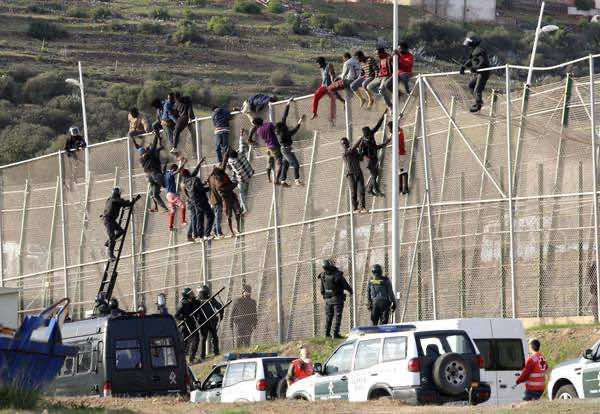
In my view this has improved somewhat: at least when Turkey opened it's borders (just prior the Covid outbreak last year) for the next influx of migrants, Greece shut the border down and the EU stood behind the country. And this is the way to do it: do what the member states first in line want and forget getting those brownie points in your domestic political debate back home. When one country is left alone to face a commen problem, everyone will understand that they too will be left alone, if it would be them on the line.This is why is so funny when some Nordic countries say to Spain, Portugal, Greece and Italy that “we must have more solidarity” really? But how? It is a complex situation having this kind of dangerous frontiers. — javi2541997
In the case of the Mediterranean EU members the big problem in my view is Libya. Morocco, Algeria and Tunis can somehow co-operate with the EU (with a lot of haggling, yes), but the failed state of Libya is the real problem. Or if Algeria or Morocco descends into anarchy, which wouldn't be nice.
(Let's remember that Spain has a land border with Morooco: )
Exactly. EU being US will never work towards Russia policies... — javi2541997
And just to understand the obvious limitations of such a heterogeneous group of countries as the member states of EU should be the actual starting point for the EU. But now it seems that aloof sanctimonious declarations that don't matter when you have a real crisis is the way EU policy is made.
Don't try to build something that won't be, which won't work and be happy on what you have. Start from admitting that EU is basically a confederation of independent states, not an union controlled by a center (in the future). The foreign policy environment is simply too different for your and my countries (Finland and Spain, I guess). Those that push for tighter federalism are the real culprits for why we get populist anti-EU movements. -
MyanmarThose other rebel groups have been fighting the military, the Myanmar government. Some since the independence of Burma.
-
China spreading communism once the leading economic superpower?
And after Mao died, it wasn't an advanced economy. That's the key point. History and where countries start from matter.Yes, Nazi Germany is a much better comparison to modern China than comparing it to Mao's China or Stalin's Soviet Union because Nazi Germany was an advanced capitalistic economy. — Judaka
Now there's a revisionist line!Which ties back into, why did the cold war happen in the first place? Why was the US interested in ensuring China did not become communist? It's because the US is an advanced capitalistic economy, they want markets for their goods, communism threatens that. The US got what they wanted and the price China paid was the abandoning of communism. — Judaka
China was Maoist. Period.
The Koumingtang held only to the island of Taiwan (and some remnants of the army were pushed into Burma among other places). That the US wanted and got China to abandon communism reeks to pure American intellectual hubris: to the idea that everything in this World happens because of everybody at all times follow the fiddle played by the evil Uncle Sam and the capitalists behind him.
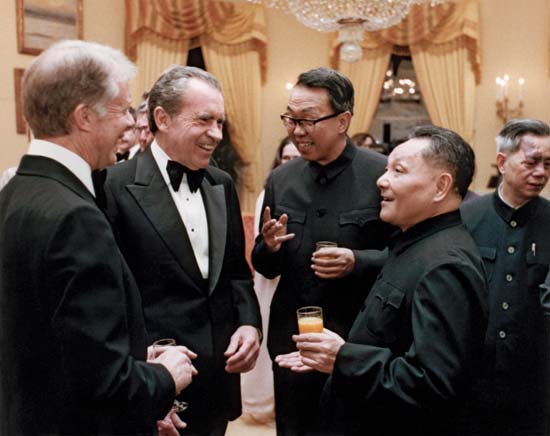
Perhaps Deng Xiaoping first and foremost reason wasn't the US relations, even if those obviously had improved.
That's the worst parts of capitalism? So you mean they ought to be less competitive in the global market or what?Even if China has socialism, the businesses that are owned by the government are highly competitive and profit-driven, it resembles all the worst parts of capitalism that communism was supposed to do away with. — Judaka -
China spreading communism once the leading economic superpower?
Have the US go back from Europe to eat apple pie and have the EU collapse and Russia is the strongest country in Europe. That's why they are so against the EU and hope that the US goes back to it's Continent.As you said one of the big fails was giving the rule of West to politicians that were so mediocrities like Bush senior. But what is pretty interesting here is how Russia is still dominant in Europe. — javi2541997
First of all, there is no European singular policy towards Russia. Only a desperate attempt to have one.I wish a EU more connected with Russia or Kremlin but it looks like hard to reach it and each European country can only make business or diplomatic affairs with Russia by their own. — javi2541997
For Ukraine, Russia is the drunk guy assaulting it. For especially the Baltic States, but also the former Warsaw Pact Countries, it is the violent drunk ex-husband that you simply cannot stand and you fear that he comes to bang your door and will try to get inside. For countries like Sweden and Finland, it's the difficult neighbor with whom you still get along quite OK and have reasonable relations, even if you have a painful history with him. For Central European countries it's a possible trade partner and so actually so far, that you aren't bothered about it's actions. And for countries like Portugal and Spain, they don't care about Russia at all, especially when you have such problematic neighbors on the North African side of the Mediterranean. And Russia? Oh he thinks that everybody is against him and he has to put it up with these hostile neighbors who are always ganging up against him. After all, there was first Napoleon and then Hitler, so no third time.
Hence with so different starting positions, the EU has big problems to create a coherent Russia policy. This also is a prime example why the EU being the US of Europe simply doesn't work. California and North Dakota don't have any separate and/or own issues about the US policy towards Russia. -
Myanmar
They have had now since their independence 73 years of insurgency, so go for it!- why not? — The Opposite
Yes, now for a revolutionary war where they finally get peace. This time it's different!
Kachin...

Karen...

Shan...
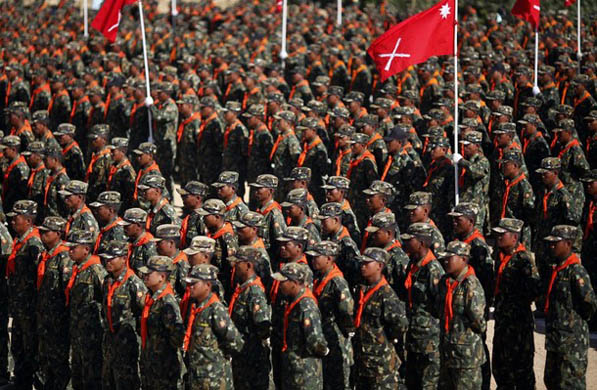
So bring on another rebel army/group to Burma to fight the government in addition to the three above (and others). At least there's support for the war party in PF. At least for a while... -
Combining rationalism & empiricismDon't waste my time. If you don't have a logical, philosophical, reasoned response to give, then you can go give an unreasoned, illogical, baboon mating call to some barn animal instead of wasting my time here. — Dharmi
I think nobody will waste their, sorry, your time.
Besides, we might get blinded by the sheer radiance of your vast knowledge, we ignorant mortals. :snicker: -
China spreading communism once the leading economic superpower?I think far more successful will be the young Americans who so vehemently oppose to everything their country stands for.
Who better to promote communism than those never haven seen or experienced it. :cool: -
MyanmarWhy can't the protesters be armed? Better than them being butchered on the streets like they are right now — The Opposite
YES!!! We need an Asian version of the Syrian civil war! Oh wait, do we have already that in Myanmar/Burma???
The Tatmadaw (the armed forces of Myanmar) with over a half a million soldiers will obviously surrender / retreat if the protesters are armed.
And just how long has there been some kind of armed insurrection against the central authority in Burma? Like from it's independence?

-
Have we really proved the existence of irrational numbers?
Have we really proved the existence of irrational numbers? That's the name of this thread.All proofs of the existence irrational numbers (that I'm aware of) are proofs by contradiction. For example, we assume that √2 can only be 1) a rational number or 2) an irrational number. Since we've proved that √2 is not a rational number we conclude that it's an irrational number. Is it possible that this is a false dichotomy? — Ryan O'Connor
Is this a question people are debating for five pages here??? :snicker: -
China spreading communism once the leading economic superpower?
It's still not so evident. The Belt and Road initiative might be compared to a "Marshall Plan", but China isn't building up an alliance to contain the US. A more logical reason for the "Belt and Road" initiative is to do something with the massive industrial base that has been created to build those hundreds of new cities in order to prevent a huge economy recession.I think Xi Jinping is failing in some points because he is showing how evident China wants to control the world. — javi2541997
Or perhaps once you have been a Superpower, an ordinary "Great Power" status where you still would need to work with your peers as equals simply isn't the thing for you. Putin's Russia thinks it can be a Superpower still and Xi Jingping's China thinks it ought to be a Superpower.. Nevertheless it is interesting how always they avoid "European market" or the Euro itself. They don't want be part of it. This shows how powerful Russia is despite the fall of socialism/communism in 1991. — javi2541997
I've always said that there was a brief window of opportunity when Russia could indeed have been open to join the West, but you would have needed larger than life politicians for that to happen. We hadn't them: we had only George Bush senior, Bill Clinton and Boris Yeltsin, average politicians.
(A fleeing moment in Russian history: The statue of Felix Dzerzinski, the founder of the Soviet secret police, comes down in front of the KGB headquarters as the Soviet Union collapses. Now the prior head of the successor organization of the KGB rules Russia as an autocrat.)
-
China spreading communism once the leading economic superpower?
Exactly.. Deng Xiaoping was clever making this statement. — javi2541997
And just look at the situation from Deng's point of view: When everybody understands what a disaster the Cultural Revolution was (and before that the Great Leap), what can you do as a communist? Saying "This didn't and doesn't work" and disbanding the CCP and perhaps (if before 1975) ask Chiang Kai-Shek come back? Out of the question. The transition to repair the economy and get economic growth going was done without the "Glasnost" and "Perestroika" that Gorbachev tried. And at least here Marx was correct: the economy is most important. Events on Tianamen Square in 1989 showed quite clearly what would happen if the CCP wouldn't get their act together. The Chinese couldn't , as the old Soviet joke went, simply close the curtains on the train and assume that it was going forward when the locomotive had broken down.
And the economic growth has kept the Chinese happy. Not those that had before democracy, the people of Hong Kong, but others. The CCP has successfully gotten the idea through that western type democracy would lead to the collapse of China and create a turmoil. In fact with Xi Jinping we can see that now the CCP is relaxing and thinking they have everything quite well under control and no need for the Western investors anymore. Good time to show what they are really like. -
China spreading communism once the leading economic superpower?
It's typical that you say it resembles Nazi Germany, not that it grew out of something similar to Stalinist Soviet Union, which was close to heart for Mao. The Third Reich emerged from the Weimar Republic, which was capitalist. Modern day China emerged from Maoist China. For some peculiar reason Soviet Union or Marxism-Leninism or the authoritarianism of (Marxist) socialist regimes is all disappeared from the definitions of communism in the 21st Century. How neat.The CCP resembles something like Nazi Germany, an advanced capitalist economy with a totalitarian government. — Judaka

And then again, the Chinese banged their head on the wall enough to understand that the ideologically pure Marxism-Leninism simply didn't work. Hence these authoritarians eased with the ideological central planning (which was a total disaster) and started to use parts of capitalism and Western investment to shorten the technological gap the West has enjoyed. And I remember those European intellectuals who were totally fascinated with the Cultural Revolution and in "their critique" of the West rejoiced the Revolution and Mao. Still have some books which praise the cultural revolution from the 1970's written by Westerners.
So how dare they! -
China spreading communism once the leading economic superpower?And as the US is a mixed economy, one could argue also that it's not a free market capitalist economy. Or (ignoring the propaganda) and looking at the policies of the Biden administration. (As Biden surely would be in favour of free markets and capitalism, when asked about it.) To quote again Xi Jinping, there is no orthodox, immutable version of socialism. And it's obvious that they have had to make a change starting with Deng Xiaoping, or continue with the orthodox Maoism and the cultural revolution, which would have resulted in a similar or worse situation as North Korea.
There is theory and ideology and then there is reality. And Chinese economic growth, starting from a situation where the Chinese economy was smaller than the GDP of the Netherlands and then climbing to where it is, isn't a small feat. You can call whatever you want it: authoritarianism, fascism or capitalism, to make some point of a complex issue, yet that doesn't change China. What the people think there country is does matter, both with China or the US.
Simply put it: the socialism of the CCP does matter. You can see this in a variety of things. One example is how the Chinese billionaires have been crushed right from the start if they have said anything critical about China. China surely will not let independent oligarchs rule or influence politics in China. -
China spreading communism once the leading economic superpower?
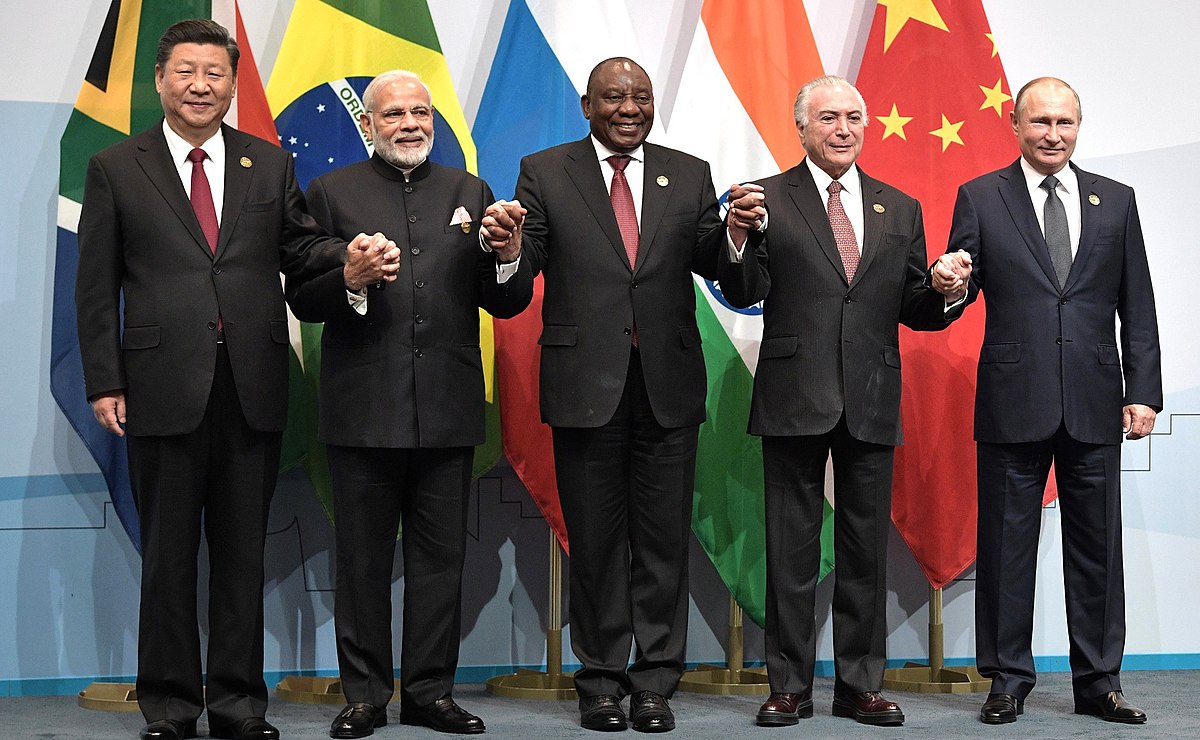
Never heard of the BRIC countries?Not a lot heard about the two cooperating, indeed. — Shawn
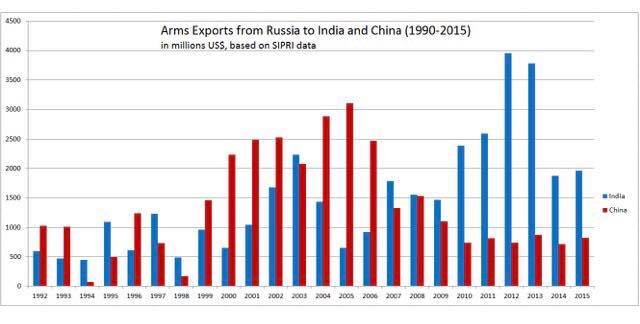
Or that basically Soviet Union and Russia has been a major arms supplier for China, selling to China it's first aircraft carrier, for example. Only now has China had a wide variety of indigenous arms, yet there are a lot copied from Russian and Western counterparts. Only in the last decade has Chinese domestic military industrial complex come to such quality that imports from Russia have gone down:

-
China spreading communism once the leading economic superpower?
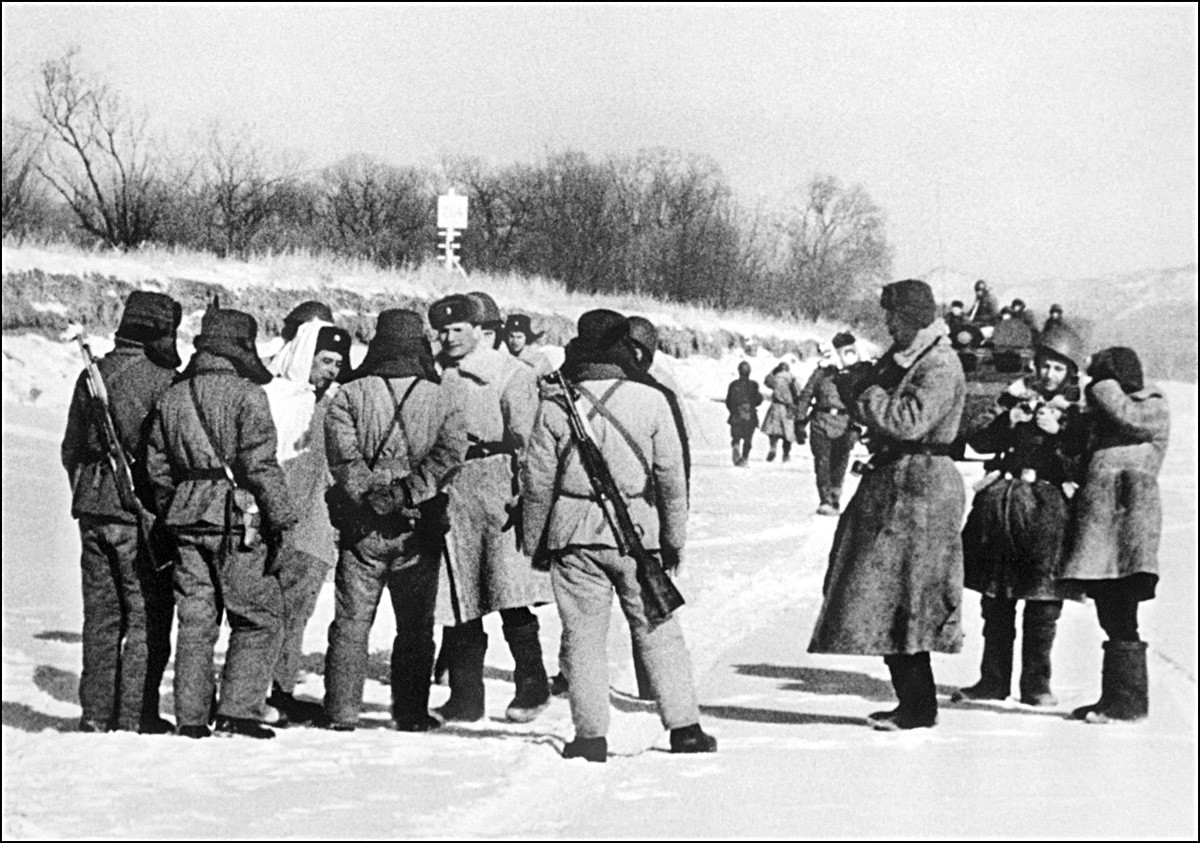
Remember that even the Soviet Union and Communist China had a border conflict in 1969 after the Sino-Soviet Split, starting from things like Mao didn't like that Khrushchev denounced Stalin.I've been surprised by how China and Russia have somewhat cold relations with one another. Although, they plan to go back to the moon soon for scientific reasons. — Shawn
Tensions at the border:
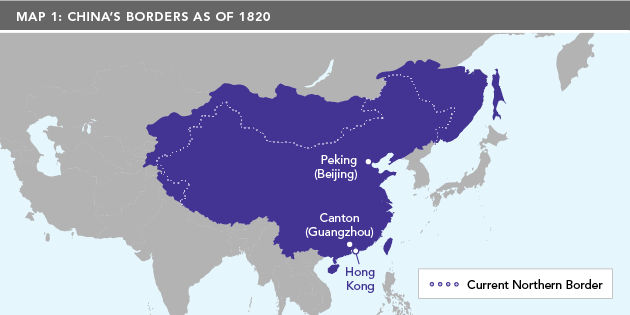
And let's not forget that earlier Russia was one of those Western imperial powers that took chunks of Chinese held lands up until the Russo-Japanese war replaced them in Manchuria and still Russia does hold areas that have been Chinese territory during the Ming dynasty and still in the 19th Century. Those kind of issue do create tensions.
Especially American political commentators are keen on to look at the differences and difficulties that the two countries have, yet I think that their relations are quite OK. Neither of the countries, Russia or China, want to play second fiddle in an alliance, and why upset the US with an alliance? Hence no alliance between them.
We simply don't care what they actually think, if it's not what we think. We judge those that think else than us. And unfortunately, we are getting only worse.What's your take on the West judging whether China is really communist or not? Hilarious or just dumb? — Shawn
Secondly, China being communist or not is a question like "Is US a free market capitalist country or not?", really. A current question especially after now the US government giving a record breaking handouts to it's citizens and large corporations: many could question the "free market" part, just as people question the "communist" part in China. Yet if people really believe that they are for free market capitalism or for Marxism, they take the ideology close to heart, who to judge them and say they are totally wrong, that they are not what they say they are? -
China spreading communism once the leading economic superpower?
Perfect.Those policy points are very clearly and unapologetically authoritarian, which is not only completely contrary to the original (libertarian) socialism, but even contrary to the stated end-goal of Marxism, and is the reason why Marxism(-Leninism) consistently fails to actually achieve socialist ends: — Pfhorrest
What you just said is a prime example of this houlier than thou -attitude so plentiful with Western socialists when it comes to ideology. Western social democracy might not be authoritarian, yet a lot of socialism is de facto authoritarian. And Marxism hasn't been so keen on upholding libertarian values. -
China spreading communism once the leading economic superpower?
This is simply wrong. It's not.China is not communist
— Judaka
:100: :up:
China is the epitome of state capitalism. — Pfhorrest
And I know people here: they don't believe and totally disregard totally those that actually say that they are Marxists and communists... if they are Chinese. In fact, the actual views of the Chinese communists running China are not at all even taken into account and ignored.
Yet if you yourself had experienced Mao's Cultural Revolution, seen how "The Great Leap" failed and seen how the Soviet Union collapsed, you really might think twice before going down that path again. And so have the Chinese communists done. They have had to build their system on that basis and improved their system in reality, not go off into dreaming about a Marxist la-la-land as a way to criticize the Western capitalism here. And they have performed a historical economic growth (even if, well, Taiwan, is more wealthy.)
So let's just look at what the leader of China, Xi Jinping, takes as 14 point policy for Socialism with Chinese Characteristics for a New Era:
1. Ensuring Chinese Communist Party leadership over all forms of work in China.
2. The Chinese Communist Party should take a people-centric approach for the public interest.
3. The continuation of "comprehensive deepening of reforms".
4. Adopting new development ideas based on science and for "innovative, coordinated, green, open and shared development".
5. Following "socialism with Chinese characteristics" with "people as the masters of the country".
6. Governing China with the rule of law.
7. "Practise socialist core values", including Marxism-Leninism, Communism and "socialism with Chinese characteristics".
8. "Improving people's livelihood and well-being is the primary goal of development".
9. Coexist well with nature with "energy conservation and environmental protection" policies and "contribute to global ecological safety".
10. Strengthen national security.
11. The Chinese Communist Party should have "absolute leadership over" China's People's Liberation Army.
12. Promoting the one country, two systems system for Hong Kong and Macau with a future of "complete national reunification"; and to follow the One-China policy and 1992 Consensus for Taiwan.
13. Establish a common destiny between Chinese people and other people around the world with a "peaceful international environment".
14. Improve party discipline in the Chinese Communist Party.
From a speech from Xi Jinping comes clear the attitude of these Marxists:
Scientific socialism is not an immutable dogma. I once said that China’s great social transformation is not a masterplate from which we simply continue our history and culture, nor a pattern from which we mechanically apply the ideas of classic Marxist authors, nor a reprint of the practice of socialism in other countries, nor a duplicate of modernization from abroad. There is no orthodox, immutable version of socialism. It is only by closely linking the basic principles of scientific socialism with a country’s specific realities, history, cultural traditions, and contemporary needs, and by continually conducting inquiries and reviews in the practice of socialism, that a blueprint can become a bright reality.
What works is used, basically. And there is no immutable version of socialism. Hence the totalitarian system evolves. And many non-democratic nations can indeed look to China for an example to copy.
Hence it's basically quite ignorant (and arrogant) to say that China isn't socialist. I think that these people, members of the CCP, genuinely believe that they are socialists and for some Westerners to refute that is simply Western hubris. -
Combining rationalism & empiricism
Really?Not at all. Naturalism is a caricature, a non-position. — Dharmi
Either you ignore or simply dislike Quine. -
Combining rationalism & empiricismRationalism and empiricism. Hmm.
Would naturalism be close to that? The definition of naturalism is something like: the philosophical belief that everything arises from natural properties and causes, and supernatural or spiritual explanations don't matter. At least naturalism uses extensively empiricism in the way of using the scientific method and using empirical study.
Perhaps the writings of Quine would be something that is looking for. -
Is there a race war underway?
It's not that simple even in a small economy.I still don't totally understand why this is. I think it's because it leads to a state of equilibrium between wages and prices so that profit margins become small. Workers are then laid off to try to increase profitability and invite investment for R+D, new facilities and equipment, etc, but that only lowers demand. Now inventory becomes bloated. More workers are laid off. Is this right? — frank
It's obvious here and in for example Sweden.
What it comes down to is that the Nordic system leads to centralization where there are central trade union organizations and a central employer union that decide wage increases, which favors the larger companies and corporations and don't look at how bureaucratic and burdensome the whole system comes to be from a perspective of the small firm or entrepreneur. This kind of corporatism leads to an environment which favors large companies and makes it more difficult for smaller firms. It simply comes down to the ease of negotiation: it's easier to negotiate with the 10 largest corporations than 100 000 entrepreneurs, even if the entrepreneurs are far more important to the economy than the 10 largest companies. Also companies that are working in a booming industry where there is huge demand and little supply of trained specialists, the system prohibits luring people with huge salaries. Brain drain to other countries can happen. Also the system increases red tape and as there are many things in place to protect the employee, it also makes the whole issue far more difficult than in let's say the US. Or especially in China.
Hiring employees can become a huge obstacle: If the employee gets an 100 euro salary, the employer has to pay basically 140 euros in all. If you can buy the service for less than 140 euros, then you have a dilemma. After all, hiring an employee or buying the service from an outside company are the two options and just as you don't have any obligations towards your grocery market (other than to pay what you buy) neither has the company for a service bought. Also a welfare state really does make people think twice before going into a low salary job: if your net income goes only barely increases if you take a low paying job and you then you haven't much spare time anymore, it really is a question. Many do alienate from the society and never hold a job. This causes low self esteem and true apathy. Republican politicians can exaggerate this problem, yet the issue is real if not at all comparable to the problems what a non-existent welfare can produce.
You can easily observe that there are always pros and cons in these issues and people can abuse a system, any system there is. And this makes economics and sociology so complex that these issues cannot really be put into a simple math formula in their entirety. Nuances are important. -
Is there a race war underway?Partly yes.
In a way, governments have lost their power or simply pushed forward an agenda of the most wealthy and corporations. That has happened.
Basically money and investment, capital, was given freedom to cross borders and nobody thought what would happen to labor. I think that there's ample examples of that in the US. Add there that more and more production and even services are done by machines.
Let's take one example: the role of trade unions.
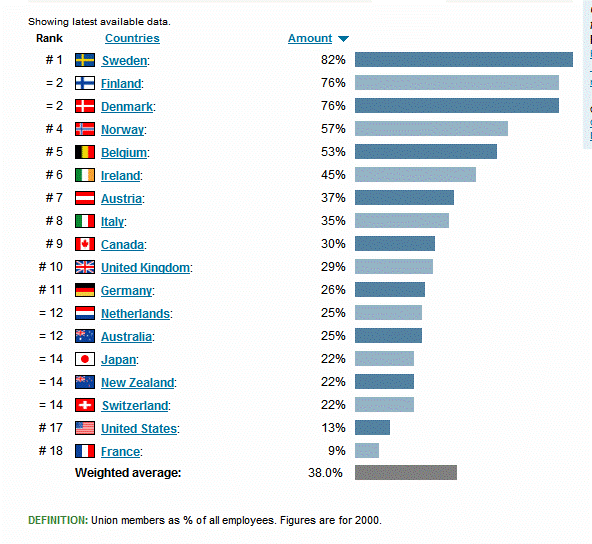
Strong labor unions and government control can indeed lead to a more stagnant economy, yet if trade unions are not powerful and basically unimportant, then what can emerge is totally reckless behavior from the employer side. This can create far larger problems than the negative aspects of a heavily unionized workforce can produce. Sweden has a labor union participation rate of 82% and Finland and Denmark of 76% while with the US this is at 13%. What is missing from this from the below map is Iceland, which has the highest level of the work force participating in labor unions:
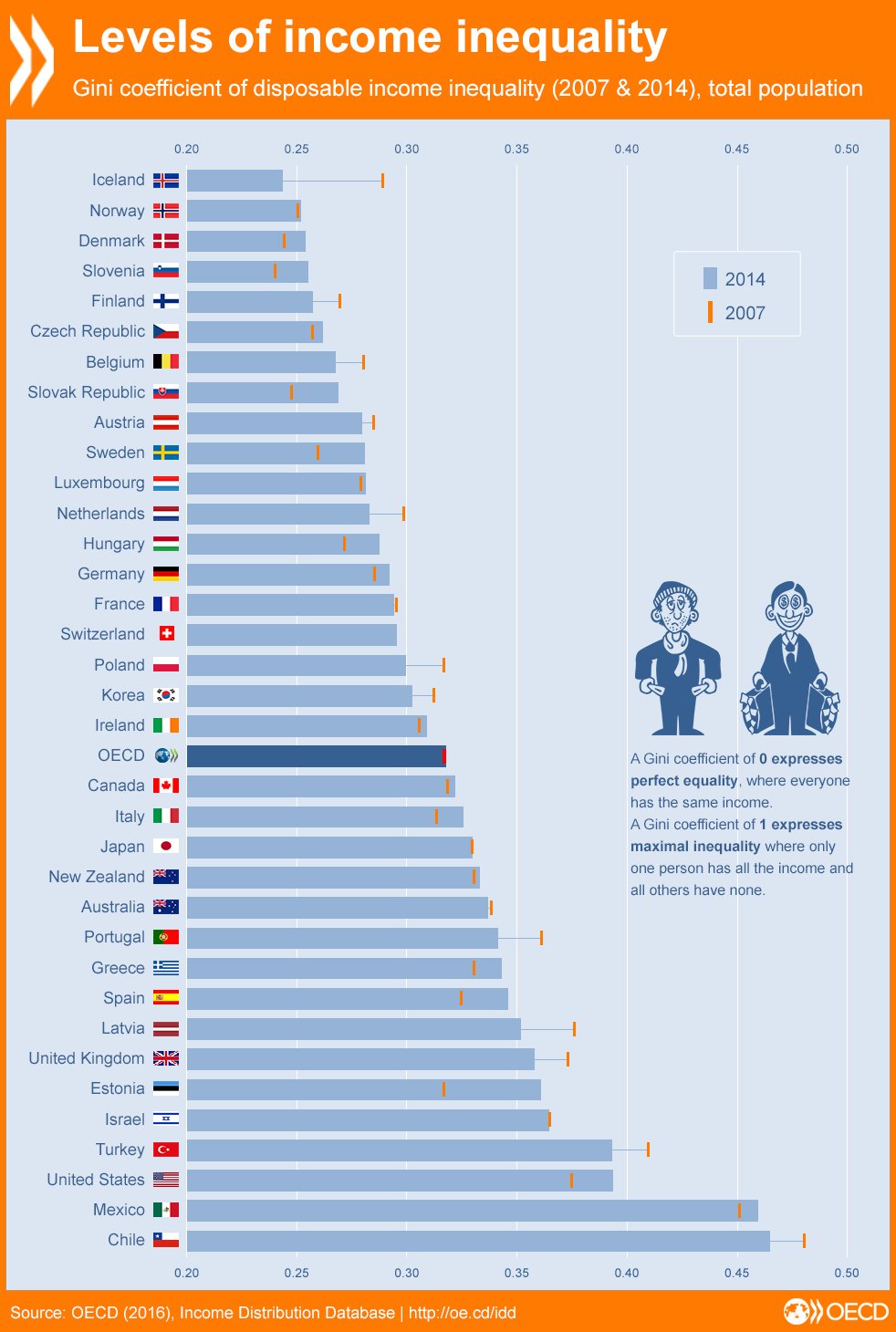
Then lets look at the gini coefficient by country, which measures income inequality. Again in very close order the listing of the countries: the least inequal countries have the highest labor union participation rates.
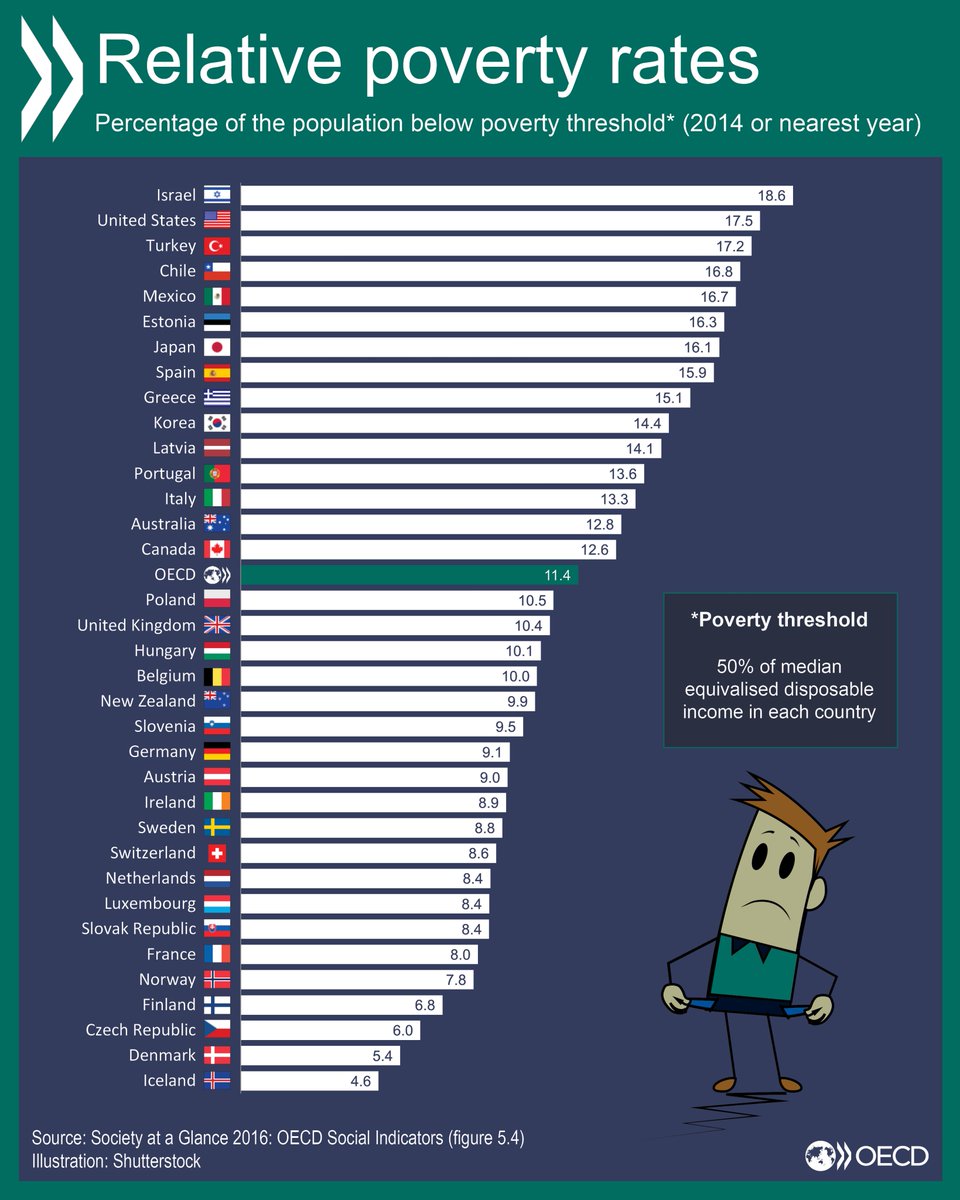
And where do we find the countries when relative povetry is measured? Again far less relative povetry in countries with higher union participation.
Labor unions can also have harmful policies: they can promote trade barriers that make industries totally incapable of competing with other nations in the long run. Or simply be taken over by organized crime. And do note that this isn't a leftist issue: trade unions do not mean that these unions would be made of people on the political left.
Yet the basic simple fact is that workers get a better deal when haggling over salaries on a collective level than as individual workers. And this ought to be totally fine for liberals/libertarians too. But for some, it isn't so.
ssu

Start FollowingSend a Message
- Other sites we like
- Social media
- Terms of Service
- Sign In
- Created with PlushForums
- © 2026 The Philosophy Forum