
Comments
-
Coronavirus
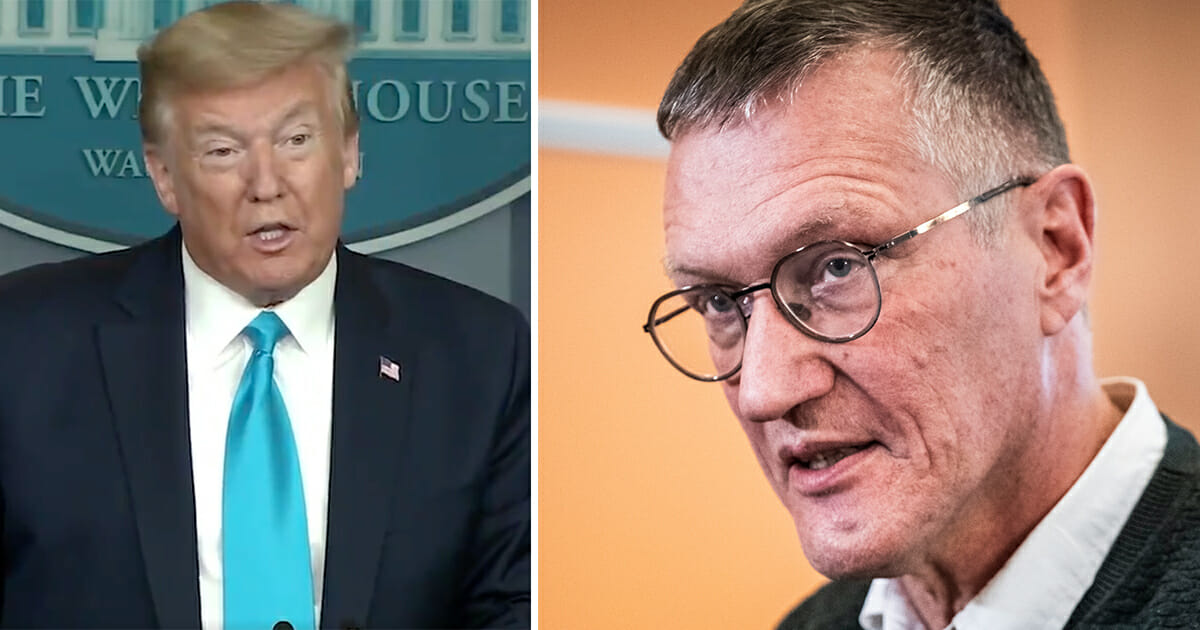
Umm.... surely the architecht, the person responsible of the path the Sweden is positive about it. And Swedes like him btw.Here’s an interview in Nature with epidemiologist Anders Tegnell, who remains positive about the Swedish case. — NOS4A2
I think that Trump would love Anders Tegnell now and would like to replace Fauci with Tegnell.
But really, you will only know how effective the option was only later. I remember one paper saying that perhaps 1/3 of Swedes have endured it. For herd immunity you need 2/3. -
CoronavirusWell, it's a bit difficult just to let a full oil tanker to stay full. Yet Brent crude is still 25$, so it's not anytime soon that that the gas station clerk will give you money when you fill up your old car. (25$ Brent is unbelievable too). But a great time to speculate on oil. Just how is a good question if you aren't customed to options & futures.
Take it as a clear sign that the engine of the economy has halted. Did this pandemic trigger a bad economic depression or what? -
Joe Biden (+General Biden/Harris Administration)That's charitable, and I'll accept it. Maybe ssu will confirm. — tim wood
Boethius got my point, I'll confirm it. You see, far too easily we assume that people are just repeating the talking points of one side. People aren't stereotypes (even if stereotypes tell a lot about people).
One can see that many people who have not and never will vote Trump are critical about Biden. And I think that it's totally normal: anyone using their own head will likely come to the conclusion that they agree with some issues and disagree on others when it comes to one specific politician. -
Joe Biden (+General Biden/Harris Administration)
This is the long term problem with the Democrats and the institutional problem with the US with the two party system. Why on Earth did they choose Hillary? Many people hated the Clintons. Hillary lost to Obama already. So in 2016 it was now "her turn"? Now in a similar fashion the young candidates were brushed aside and the enthusiasm of the Bernie supporters was put aside also. The DNC leadership is old and simply hasn't got the feel to the pulse of the nation. It genuinely lacks vision and understanding of it's voters and the situation. (Neither did the GOP either actually: Trump was just a train wreck that suddenly caught the party by total surprise with even a bigger surprise that he won.) It lacks ability to get people excited.So, why did the establishment choose Joe? Why can't the DNC find a candidate that is centrist but not easily accused of corruption, perhaps legal corruption, but still corruption? — boethius
The DNC has been controlled by the centrists, the "New Democrats" as both of the two latest presidents have come from this group in the DNC (after Hillary lost and Obama went on to become the President, this was the camp that Obama opted for). The conservative wing is dead (I guess) and the progressive wing has been kept out. And nothing is as more counterproductive now than a "third-way" pro-globalization type centrism is the current situation, that will pick the same old faces to run things as during the Clinton and Obama years.
I guess the only way for Joe Biden to win is to pick a progressive vice-president nominee, perhaps Elizabeth Warren or even another geriatric, Bernie. Otherwise they really can loose. -
BrexitEvery country is going now to the unknown. And this changes things a lot. Because for the UK the Brexit was a self induced problem. Just think of it, for how much time has the UK administrations (this one and the previous) have been focused on the Brexit issue? I do assume that there would be other things for the administration to focus on too. Now there's one that has really sidelined Brexit. Or is the TV news talking about Brexit every day there? I assume not.
Anyway, let's remember that the EU was founded as the EEC in 1957 and only in 1973 the UK joined in. The UK never felt to be a team player as it has had the juxtaposition to being the British Isles vs. the European Continent throughout it's history. Only perhaps the Angevin kings had other views about "Continental Europe". And especially with Thatcher it was evident that there was nothing like the French-German axis, no UK lead group in the EU or a possibility that the UK would be the leader of the pack. That would have meant a dramatically different history in the UK to be true. The EEC wasn't a British idea developed in the City of London or in the halls of Oxford or Cambridge and created from a necessity. Yes, there was Churchill with the idea of a Council of Europe, but he adamantly saw the UK as Great Power. Federalism was never a British objective, only the reality of a confederation among independent sovereign states. And that's the sad part of the UK leaving.
Yet just like with Norway or Switzerland, not being a member of the EU isn't so important. You simply cannot make the populist complains about Brussels as we do anymore. (Or you can, but they don't have anything to do with reality.) -
The Road to 2020 - American ElectionsAh! The birthplace and home of the Donald. (Yep, too bad the 2020 election won't be a competition between two born in New York.)
But you do understand that the ideology "my vote won't change things" is quite a dangerous one if everybody starts feeling like that? -
Donald Trump (All General Trump Conversations Here)
Yes. And also give a face to complex problems and the even more abstruse solutions to those problems.Both of which are an evasion from personal responsibility. — javra -
Brexit
I think this is a great time to do your Brexit. It can be possible that nobody will notice anything!Get Covid done. As Machiavelli said, get the nasty stuff done quickly at the beginning of your reign, and then you can be the kind generous leader afterwards to the folks that are left. — unenlightened
The world economy is already collapsing to an economic depression and the reasons aren't solely the pandemic. In fact the pandemic was just a trigger. You simply cannot notice anything happening because of the Brexit now, already there are far bigger transformations happening. There isn't going to be a "V"-shaped recovery from this. Hence to reshuffle your trade with the EU isn't going to be on lips of every voter, they will be far more worried about the dire economic situation even without a Brexit. -
CoronavirusI agree. Especially when there is a understandable desire to keep the numbers of deaths low. Hence what sometimes happens are these sudden upticks in the figures with later studies.
-
Donald Trump (All General Trump Conversations Here)
People want scapegoats and saviors.Did you know that horror generated by evil kings is an expression of the divine child archetype? The evil king (Herod) is the shadow if the divine child (Jesus). — frank -
Joe Biden (+General Biden/Harris Administration)
The basic problem is that far too many people are simply totally partisan, total hypocrites and have absolutely no interest whatsoever to hear what are the points of the other side. Hence every criticism made of Trump is made just by those with Trump derangement syndrome. The other side is portrayed in the worst way. Just pick the most craziest most eccentric view and treat it as being what they all are saying. End result, discussion is meaningless. The Republicans outperform the Democrats in this way, but the democrats aren't so far away, really.The problem is that the right has all sorts of dogmas that excuse Trump's corruption, even make it a good thing. — boethius
It is personal, it is emotional and it won't go away. It's the post-truth world where everything is thought to be just propaganda.
With Trump some of his supporters genuinely wanted a change. But who the f*k cares that actually the left and the right both are opposed to corruption. Both see just the attacks against their side from the other side. And the fact is that Trump supporters have created their own fantasy of Trump. The Trump that is doing great with North Korea. The Trump that is building the wall and making Mexico pay for it. The Trump that is great in handling the pandemic. They simply won't admit that Trump is as inept as everybody said, better just assume he is doing a fine job. Hence with Trump supporters, they don't care what Trump is actually like. And if he's rich and connected? No problem, the elite circles hated the guy. That the liberals and the democrats and the establishment seem to hate Trump is enough for them. He has to be doing a lot of good.
And many people simply don't understand how much hatred there was for Hillary Clinton. For eight years the Republicans attacked Bill Clinton. They impeached him. He is a serial womanizer. And it wasn't just the Republican party that was critical about Clinton. I remember The Economist having it's front cover with the word "just resign". So how do you think the Republicans thought when the wife of this politician waltzes into the candidacy even after having previously lost to Obama?
If it's hard to understand, how do you think after the misery eight years of Donald Trump the democrats will feel when the GOP nominates Ivanka Trump for the Presidential Candidate? Hey, she's a young woman! A mother. Wouldn't it great to have a woman President? And why so upset about the idea, just listen to what Ivanka says and will do... -
Donald Trump (All General Trump Conversations Here)
No. It's you utter inability to understand that people can be critical of BOTH Trump AND the Democrats.What's the point of all of this? All I see is a pathetic attempt to validate Trump by besmirching anything and everything else, just like Trump. — tim wood
If you see that being critical about Obama / Bush is validating Trump, it is simply absurd. It's the common stupidity in juxtapositioning everything. It's genuinely all that you see.
Besides, I think that a President that gives an order to kill an under aged American citizen just because his father (also an American citizen) was a spokesperson for Al Qaeda (after being tortured in an Egyptian prison) is something to be critical about. And as the President has made the decision himself after Bush (as the CIA and the Armed Forces obviously wanted a 'free from jail card' for the extrajudicial killings), it can be said it's his decision. But that doesn't validate Trump at all. He is a weak, inept and likely extremely corrupt leader.
The fact that people opposed Bush in his extrajudicial and secret operations during "The War on Terror" is understandable, but that the same people then fell silent when Obama continued many of the same practices just show how these people had nothing else but partisan politics in their mind. -
Joe Biden (+General Biden/Harris Administration)
That sounds like Trump.A big hot steaming cup of, corruption, of all the power abusers and dis-info agents personalities in society, I believe he is the one. He is who you goto to bully your way up socially.
His ignorant face in power is a disgusting thought. — ztaziz
And since you elected Trump, what's the problem? -
CoronavirusI think this above describes aptly seriousness of the the coronavirus into perspective.

What I'm totally surprised from the chart above is the how low the 1957-1958 Asian flu pandemic is here. That killed at least 1 million people in the World and 116 000 in the US. And the "Asian flu" has been said to have infected as many people as the Spanish flu, but a vaccine, improved health care, and the invention of antibiotics contributed to a lower mortality rate. -
Donald Trump (All General Trump Conversations Here)As to Pakistan, are you quite sure he expanded the war there? Please make your case. Because I'm pretty sure you don't know what you're writing about. — tim wood
In fact they blew up their Pakistani allies by accident. — Benkei
The final straw came when an US air attack targeted and killed Pakistani border guards at Gora Prai. Pakistan refused after that (if I remember correctly) any supply routes going through their country or using their aerospace (and afterwards US forces in Afghanistan were supplied by air from Romania). Yet as this happened in 2008, I guess that it still was Dubya's administration. But these attacks (or incidents) where the US has killed Pakistani troops have continued during the Obama years with the deadliest incident happening in 2011. Between 2008-2012 as many as 42 Pakistani soldiers were killed by the US. -
Coronavirus
Well, someone started a Corona and Stockmarkets... thread, but that may seem far too narrow.is there a better thread I should post in to talk about the economics of this crisis more than the medicine? — Pfhorrest
I think this is just fine. Just like the Trump thread jumps here and there just like the old man himself in scope.
But of course, the huge number of unemployed do have an effect on the economy. And at least initially (before the central banks intervened) the stock market was actually responding to the actual economy, surprisingly. -
Coronavirus
You have two interpretations: a) Melissa wanted the cash from the options immediately. Many who get into the options program don't have any incentive to actually hold on to the stock, but treat it just a bonus like cash. Of course, the other way is to think that b) Melissa knew that the company was totally lost and verge of collapse and has absolutely no faith in the company.Anyone have any insight to this, and whether it's as bad a thing as it looks? — csalisbury -
Donald Trump (All General Trump Conversations Here)
Trump has always been oblivious to a lot of things. Like that the FBI has as one of it's core missions to keep a watch on the actions of hostile foreign intelligence services in US. Who could have known?When a reporter pointedly asked who made the ad, Trump replied that it was made by a few people in his administration, apparently oblivious to the fact that it’s illegal to use public resources for campaign purposes. — praxis -
Coronavirus
Well, let's remember what the definition is of an epidemic:Sweden just recorded it’s highest daily death count since the 6th of April after a slow weekend. This will surely ignite pressure for more draconian measures and put their choices under more scrutiny. I’m still hoping for them because I believe the lives vs. livelihoods approach is a false dichotomy, and that a sustainable balance would be preferable and more sustainable. But if I’m being honest it’s not looking good.
As countries open up I suspect the lives vs. livelihoods approach will loosen—governments cannot task itself with saving lives forever—and a better balance will be sought. — NOS4A2
the occurrence of more cases of disease, injury, or other health condition than expected in a given area or among a specific group of persons during a particular period.
So if still in 2030 this corona virus still kills people, but it's the expected rate, then it's not an epidemic.
But I'm not so sure just what your reasoning is here lives vs livelihoods is here. If we would pretend that the pandemic isn't real we'd not have an economic depression or? :brow: You don't think the health sector collapsing, those mass graves dug and freezer trucks next to hospitals wouldn't make people alter lifestyles or what?
If this hasn't already been shown, it has to be shown here now (again)...
-
CoronavirusThis is precisely what the use of "herd immunity" by politicians was for. It was not used as a statement of the uncontroversial fact that eventually populations will immunise. The fact was used rhetorically as a stalling tactic. Eventually all countries effected which used the rhetoric have responded somehow, because they needed to. - The use of "herd immunity" by politicians was a stalling tactic against every response. — fdrake
I agree with this.
With some politicians. I'm not so sure about Swedish politicians (or the Dutch). When there were two cases in Sweden in the end of February Swedish prime minister Löfven convened a Crisis Management Council that previously had met only in 2018. And right from the start Löfven has consistently followed what the health authorities have purposed and (at least to my knowledge) the prime minister has not given any demeaning or dismissive statements about the corona virus or it's outbreak in China. Trump and I-shake-hands-with-corona-patients Johnson were different.
But I don't agree on that "herd immunity" wouldn't be real and wouldn't be important. And I assume that this isn't your intention.
The best example of this is when you had the greatest "long quarantine" opened in human history: when humans in one continent had been separate from others and hadn't trade with other continents for ages and what happened when you then mixed the people for the first time starting from 1492 onwards. And yes, it was especially those zoonotic diseases from animals that hadn't existed in the continent that were the culprits.
But I think we understand each others points here... -
Coronavirus
I acknowledge that there is the crowd that put basically the economy before anything, but I don't the chief epidemiologist Tegnell in Sweden had (and has) that in mind. Or Wittkowski above. Even my little country, which now has emergency laws and has quarantined the whole Capital region from the rest of the country doesn't have a curfew in place. To argue that people should stay inside their homes and not venture out is dismissed as humbug by doctors here. You can choose something between a) doing nothing and b) having a curfew.The reason "herd immunity" was wrong wasn't because eventually the majority of the population (albeit an ageing one) will adapt and what's the point, it's because people advocating herd immunity explicitly did not want the economic risks of quarantine measures, despite the massive death toll and healthcare system failure that recklessness would have caused. — fdrake
And should be remarked here that people aren't against quarantining those that have the disease, it's simply how drastic quarantine measure of everybody are you talking about.
My old father, who's a professor of viriology, said to me that we'll find out after summer or so if Sweden's option was better or not. Herd immunity isn't a fabrication or nonsense, on the contrary.The reasons people resisted quarantine measures were purely ideological, it isn't just the discourse, it's, unsuprisingly, policy being politically/ideologically motivated rather than just looking to the epidemiologists and scientists for cues on how best to manage the pandemic. — fdrake
There are those who do indeed think from purely ideological stance about this, even in this forum, NOT from an epidemiological view point at all. This I do admit. My only point is that there really is the medical/health policy discourse on the subject, something that you seem to deny.
It wasn't that. It wasn't about implementing quarantine measures, but any kind of response to the pandemic. Basically it was about denying there to be any serious pandemic at all. That's a huge difference.The delays and resistance from our politicians to implementing quarantine measures were ideologically motivated, later they conformed because they realised they must. — fdrake
I'm not saying that the decision wouldn't be political, because it naturally inherently is political. What I'm just arguing is that it is bonkers to think uttering something about herd immunity or that a severe "lock down" wouldn't perhaps be best course of action is just based on ideological stance of a person. That's my point. But for you it seems so when you say: "The reasons people resisted quarantine measures were purely ideological".So it is absolutely bonkers to claim that the issue isn't a political one, when the management of a pandemic is an economic, scientific and political project. — fdrake
So what's the "purely ideological" reason for Swedish social democrats to choose the more lax measures? -
CoronavirusBeing serious about any topic seems to me to require at least three deliberate actions or stances to take wrt to the topic.
1) To learn about it, or be receptive to competent opinion that in itself seems reasonable and knowledgeable.
2) To act in accord with that knowledge, or what seems knowledgeable, wrt & etc.
3) To treat the topic with appropriate respect.
Corollary: To avoid ignorance and applied ignorance (i.e., stupidity), and to try not to be either. — tim wood
The problem is that it now days everything becomes political and too many people see a political / ideological agenda in everything. This is one of the most unfortunate issues as the situation is new for us. Yes, we have had corona-viruses a long time. But we have not responded to anything as we have done now since perhaps the Spanish flu. And this situation is totally different. The "Asian flu" or the "Hong Kong flu" pandemics were not tackled like this. Yes, a big part of it is the present media environment which instantly reports everything. We are also very intolerant to deaths from pandemics. We don't accept that many people die of infectious diseases, when we could avoid them.
The inflamed political environment also makes even the scientific discourse difficult. We know that scientist don't always agree on things and those minority views don't have to be trolls or paid to promote disinformation. Because what to do in the pandemic isn't so evident. The "herd immunity" policy isn't totally crazy and we cannot now just brush aside the path that Sweden has opted with it's chief epidemiologist Anders Tegnell as utterly wrong. Countries cannot stay up to 18 months in lock down and really how it goes when countries ease those lock down measures is the real question. In my view it's likely that countries having "flattened the curve" will opt for the Sweden-lite option. But this we will see only when that time comes. In my view perhaps the best policy is first containment, the lockdown once the containment isn't possible before the first deaths and then once the 'curve is flattened', the Sweden option. But of course I could be wrong.
Here's one those 'contrarian' views, professor Knut Wittkowski, who explains herd immunity and isn't a great from of the mainstream policies against the pandemic. Interview done April 1st and 2nd.
And to give another perspective, here's the more conventional view from Dr John Ioannidis.
To say that one is "right" and the other "wrong" is itself the wrong way to look at it. -
Coronavirus
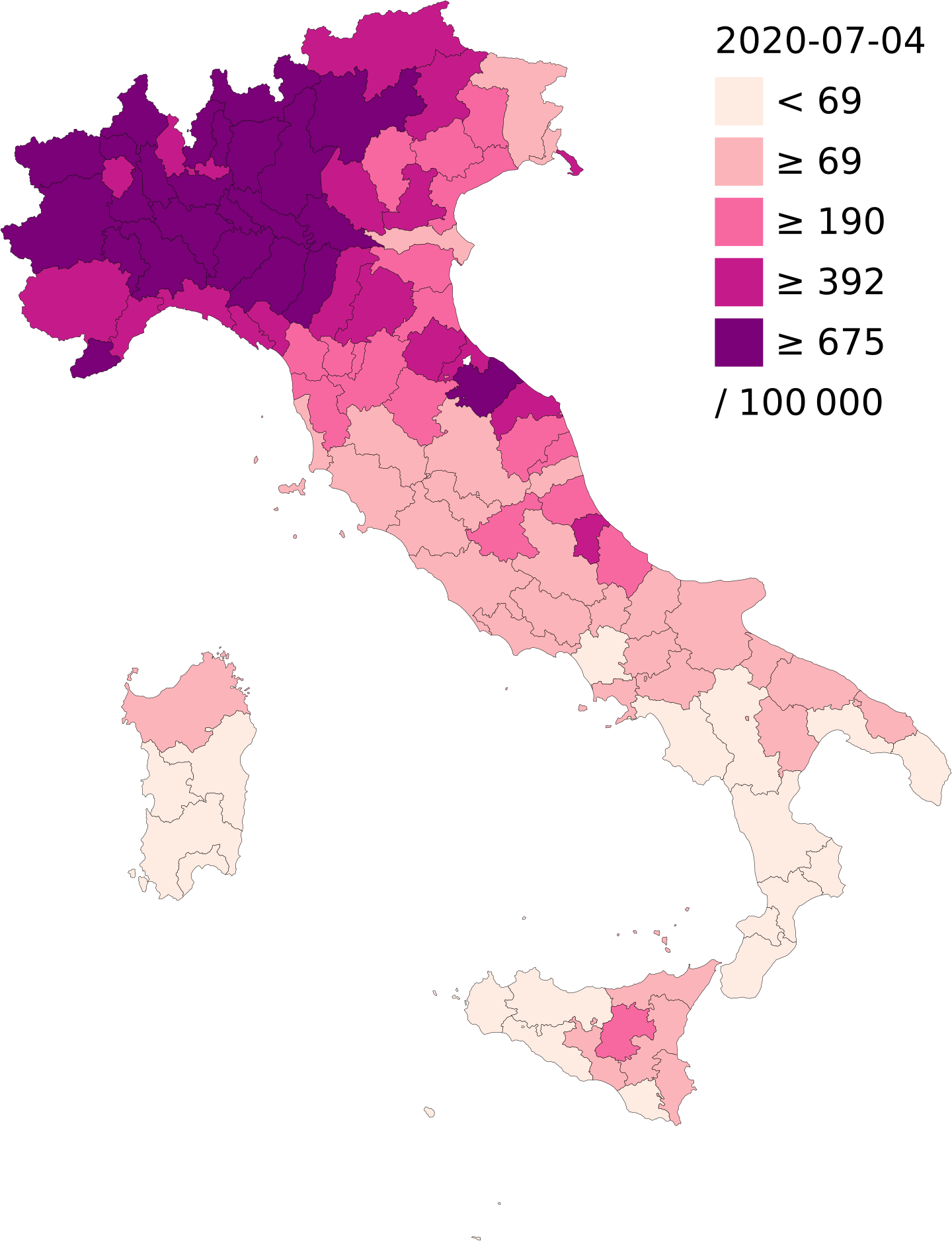
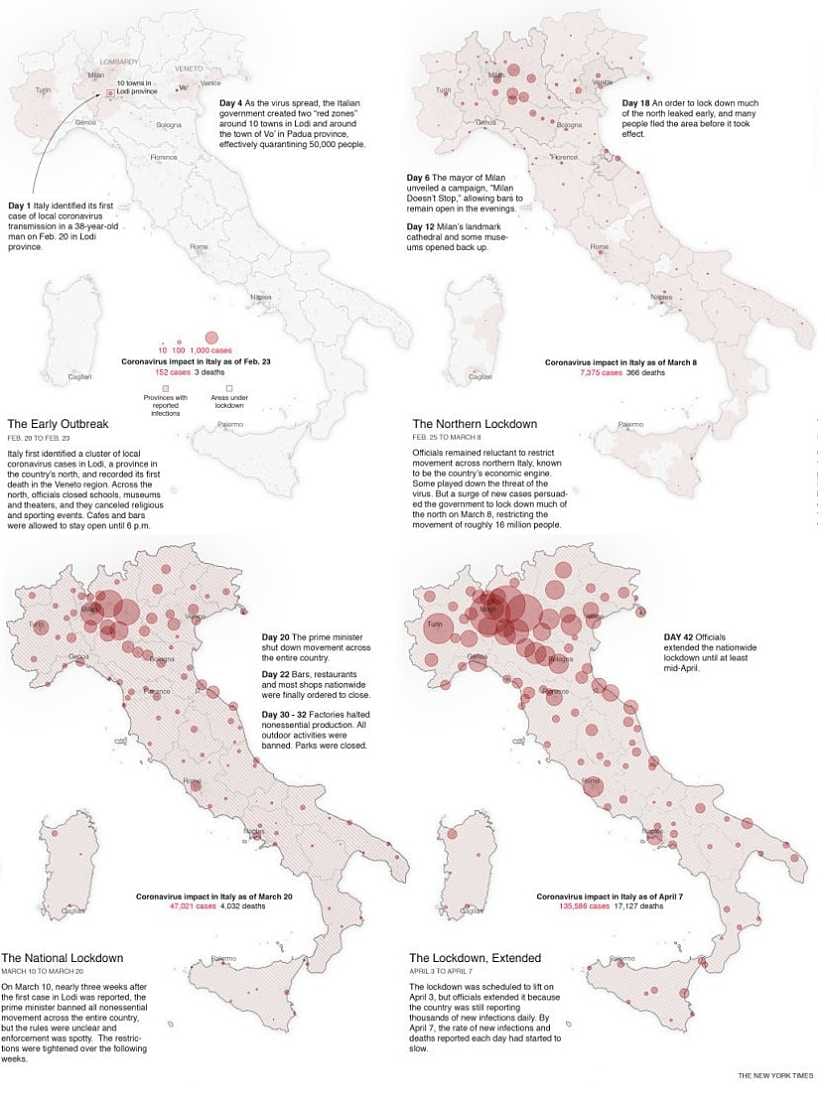
I don't think so. Numbers are declining there. Here no news is good news. And in Italy the worst hit regions have been in the North, not the South. Single glimpse at the maps below and you can see why not much has been reported from Rome, the biggest city in the country.. As I watched Italian reports, it seems that country is truly in a state of devastation — Hanover
(number of cases)
How the pandemic spread in Italy and how the lockdowns were implemented:
-
The Road to 2020 - American ElectionsIT'S HERE ! ! !
The thing I myself and predicted a month ago has happened.
And likely Bernie will do what he did in 2016: give support to Joe as he did the last time with Hillary.
The Good Loser. Same repeat now with Joe coming soon. — ssu
Of course, the physical circumstances were now a bit different, which we didn't anticipate:
So Bernie supporters, excited to vote for Joe now? Don't think how current Bernie's program is at the present, just let that hate of Trump flow and vote Joe and listen to Joe.
Biden's first response: "Well uh, Bernie, I want to thank you, uh, umm..for that, it's it's a big deal, um, and uh, you know, I think that, uh, your endorsement means a great deal, it means a great deal to me, I think that people are going to be surprised that we are apart on some issues but we're offly close on a bunch of others and uh, I think you've made if, if I am the nominee which looks like now you just made me, umm, I uh, I'm going to need you, not just to win the campaign but to govern.
Unfortunately the CNN clip stops there, but I think the above tells a bit about the present Biden. Oh yes sure, he's going to use Bernie. Because their offly close on a bunch of things. -
Coronavirus
People can question government policies, outsourcing, just-on-time logistics and the absence strategic reserves or the health care policies without them referring to the American discourse. As the problems and the discussion is the same as in the States, you might think otherwise. But of course now as the US is at the present epicenter of the pandemic, it's no wonder that the discussion is focused on you.It's true, but I think it's hard for many not to use this crisis to call into question Trump, capitalism, autonomy, and other Americanisms to show it's somehow a failed system. — Hanover
You just assume foreigners hate the US, I guess. In true American form, can there be any other discourse than the American one?But in true American form, Americans really don't care what the world thinks about them. — Hanover -
Coronavirus
People are usually critical of their country's responses. I've been positive but also critical about my country's response. There has been a lot of debate about the policies implemented by Sweden, many of it critical, hence not all is US-centric.I wasn’t dismissing the criticism. I was merely asking why the criticism is US-centric, why other governments, international institutions, and those we pay vast sums of cash to warn us of such threats, are given a pass. — NOS4A2 -
Coronavirus
:smile: Well, that's not my intention. But I have noticed that for quite some a time now it has been difficult especially for Americans to take of those politically tinted glasses off and look at all things without the juxtaposition between pinko-liberal-democrats agenda and the libertarian-right wing-Trumpist-republicans agenda.Yet, you live in Finland, enjoying the fruits of foresight based politics and institutional design, quite comfortable during this crisis without any fear of social dysfunction, and instead of explaining how and why these institutions work, based on ideas worth considering, you prefer to coddle American conservatives (with whom you share only a couple of policy concerns) and help lull them back to sleep and protect them from too many terrifying facts at once. — boethius
Just to recap, policy responses to this pandemic do not follow the line of American politics. Sweden, which also has a population quite devoted to follow it's official line, is run by social democrats. My country is ruled by good looking young women in their 30's, a leftist-centrist administration dubbed to be the "lipstick-administration" here, which actually agreed to the demands of the opposition, which in turn made up of conservatives and the so-called right-wing populists, to choose the lock-down option immediately. And to the administrations amazement, the opposition was happy and has mainly pulled the same line. Furthermore, Germany, UK and France have right wing governments. To find an inherently political/i] divide in the response, with at one side being the right neo-liberals thinking about money and in the left the progressives thinking of the common good isn't what reality is like.
This is true. And in hindsight, it is an effort quite easy to make. It wouldn't be difficult for an US administration to understand that however well it otherwise performs, a lousy response to a huge earthquake, a large hurricane or a pandemic might cost it the next election. And for the government to prepare for those natural disasters before they happen would be beneficial. Armed Forces have always operational plans for war (OPPLANs) guiding their training and peace-time preparations, so in order for other authorities to take similar plans seriously would be easy. You would avoid the part of states bidding against each other to get PPEs and an overall sense of confusion.Also, pandemic prevention is not a huge infrastructure, it's a small investment that has massive cost-benefits, as we're witnessing in real time. — boethius
In general Americans have a distrust about the government, especially when the administration running isn't the party they voted for. It's so simple. The unfortunate thing is that this kind of thinking is closer to people in the Third World than those in the First World.Is it the big bad leftist big brother coming for them from the heart of Trump's white house, pushing the limits of double think. Or are you saying these people are going to be criticizing Trump and Republicans for big brother policies? — boethius
More like that the elite doesn't even think it's their job anymore. They are responsible only to their shareholders, their constituents or themselves and nobody else. Besides, who does anymore think that the "American Empire" is important? Who in the Trump-era thinks that the US is the leader of the Free World? I would say the invasion of Iraq was a real watershed moment, but the downfall has been the Trump presidency, when it should be obvious to everyone that the US doesn't want to lead anymore. And Trump's followers are happy with this. The change in the attitude towards the government is obvious too.So you agree that the American elite have lost the thread, are incapable now of making reasonable decisions even to protect the Empire and their own class interests, and we are witnessing the free fall of the American Empire? — boethius
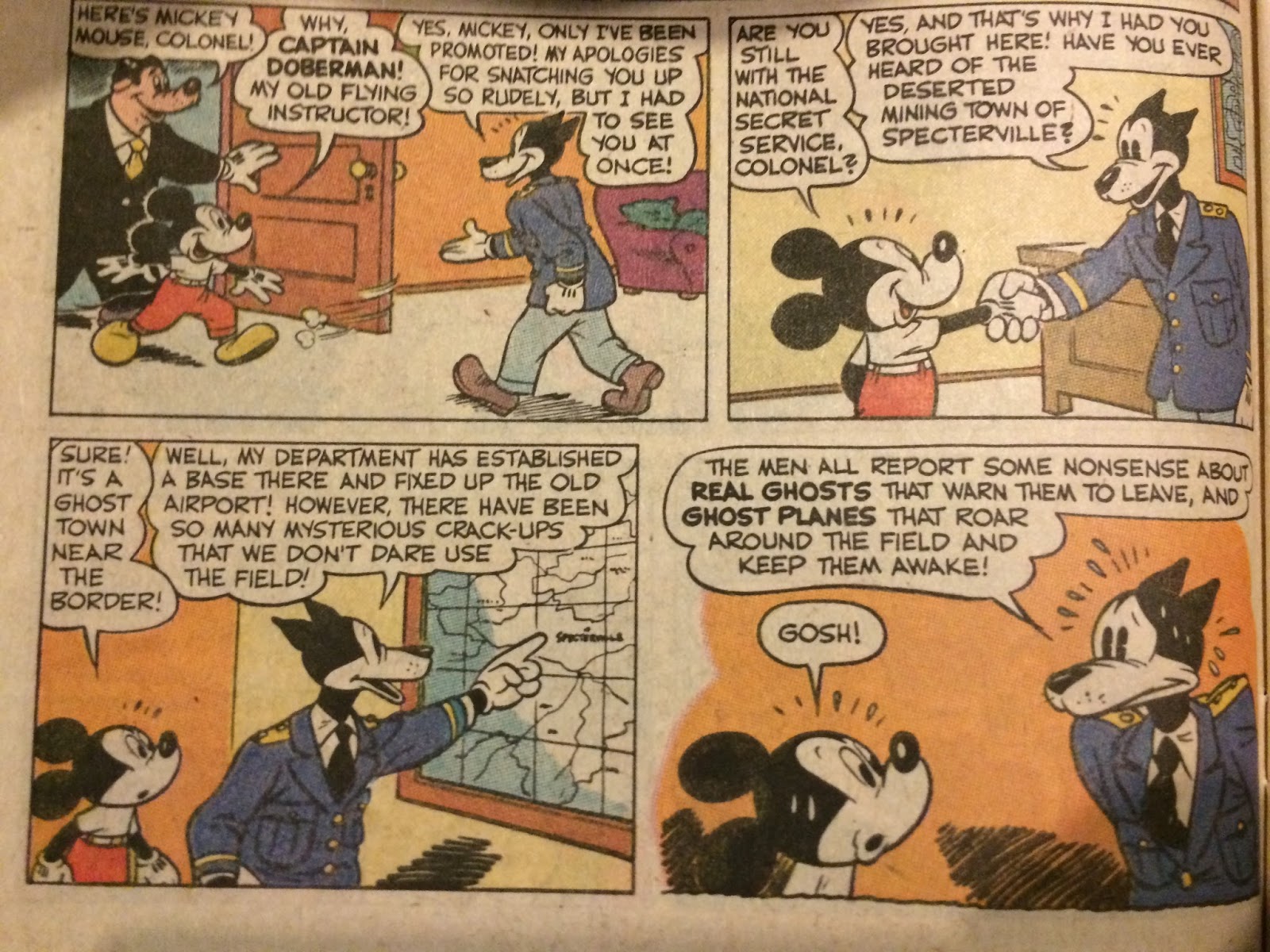
Ages ago even Disney had a character called "Colonel Doberman", an Air Force officer working for the government, that Mickey Mouse helped in his adventures. Not so anymore. Now such unabashed militarism would be frowned upon. The government is the problem, both for the right and for the left (when it's the right in power, that is).
-
Coronavirus
If people would learn from past mistakes, this (competent containment) would likely happen after this pandemic. People would be ready for the next one and likely contain it before the pandemic phase.When I was arguing for competent containment it was to avoid this as a worst case scenario of shutting down the major economies all at once — boethius
Earlier the US would have created a great effective system to stop pandemics and both parties would take it as seriously as stopping Al Qaeda. The US would be a leader that others would follow. Now when I think of it, I'm not so sure about that. That was the US of the past.
You see, it's not Eisenhower's era anymore where a Republican administration would invest in huge infrastructure projects like the Interstate Highway System or start a large vaccination program against polio. This isn't just about Trump ineptness, it's more about how broken the system is and how people distrust the government. You think that all people are willing to take a corona vaccination when it comes around let's say in 2021-2022? Will they want to upload the apps now worked on to track the pandemic? I don't think so. It's big brother with it's sinister plans scheming behind the innocent sounding agenda of "stopping the pandemic".
And then there's the economic recession (depression). Putting then money anywhere else than something that the people can immediately benefit from won't be popular. That will severely hinder the future responses and likely, at least after a decade, the guard will be down again. -
CoronavirusWe won't be in a lock down forever, but whatever. You already seem to know how the pandemic will play out, so I have nothing to add to that then.
-
CoronavirusIt has to do with the fact that Sweden goes with one approach and time will tell how that will work out.
-
CoronavirusThe only thing evident is that those places that made a serious effort on containment or a lock down before the pandemic hit in earnest have avoided the worst. And the worst hit regions are those where the pandemic has spread under the radar before any serious steps were taken. Just compare San Francisco to New York. Bay area implemented the shelter in before the first corona-virus death and the now death toll in San Francisco is 14. A bit lower than in New York.
However, it's not idiotic to think that the shelter in restrictions have to be lifted sometime. So what happens then, if we don't have the vaccine? The disease isn't so deadly that it will kill itself. A second wave might hit in the fall and basically the corona-virus might stay with us just like the common flu. Hence the case for "herd immunity" hasn't been show yet to be totally wrong. It's likely a wrong move at the start, perhaps, but we don't know yet. Just look at how China hasn't gotten over it:
Having largely stamped out domestic transmission of the disease, China has been slowly easing curbs on movement as it tries to get its economy back on track, but there are fears that a rise in imported cases could spark a second wave of COVID-19.
A total of 108 new coronavirus cases were reported in mainland China on Sunday, up from 99 a day earlier, marking the highest daily tally since March 5.
Imported cases accounted for a record 98. Half involved Chinese nationals returning from Russia’s Far Eastern Federal District, home to the city of Vladivostok, who re-entered China through border crossings in Heilongjiang province. -
Coronavirus
Yet the UK, France, Switzerland, Belgium, the Netherlands have more cases and more deaths per million, so Sweden isn't here the hardest hit in Europe by any means. And as has been said a lot of times, you have to look how they perform when the other Nordic countries have to loosen their lock downs. If there comes that second wave.As for Sweden, it is predictably getting utterly fucked — StreetlightX
But it's a genre that some people really like!News of the EU collapsing are grossly exaggerated. — Benkei -
Coronavirus
Yeah, many people have had doubts about the survival of the EU for decades. :groan:I don’t think the union will survive this. I suspect some more exits. — NOS4A2
Last person to say that the EU is at the verge of collapse if it doesn't get it's sh*t together is the Pope.
But hey! It's just an assortment of independent nation states. What else would it be, really? -
Classical vs. Keynesian Economics
In my view an "ethical" price is a marketing ploy and simply hypocrisy.One person's "reasonable" is another person's "unethical". — schopenhauer1
Or what would you declare an "ethical" price? The price that a supplier has to pay for the resources? The price that a supplier has to pay for resources plus a compensation his or her own "work"? (What on Earth is an "ethical" income for one's work?) Or a price that that pays for the resources, the work, and the investments to produce in the future? You may look at this from the perspective that the "supplier" is being the greedy person here, but I can assure you that the buyer can be the "greedy" one too. We are not forced into slavery now days. Every employer buys our work and we have the option to either take their offer or not to take it. Remember that every person is the "supplier" of his or her own work. And behold, once people are talking about the job market, not the market for vegetables or books, everything seems to suddenly change! Still, it's a market just like with everything else.
Now days it's about just who gets the boost. Is it the few rich people or the one's working on the correct market sector, the one's in a labor union that has the ability to pressure the employers? Just what segment of the population get's the benefit? These things are complicated and politics come to the equation always.Yeah agreed. It's what to do about it.. Classical economists would say to ride out any economic difficulties, and Keynesians will say that government should give a boost. — schopenhauer1 -
Classical vs. Keynesian Economics
Ok schopenhauer1, now I can really say that this is economics 1.0. That's why I called it "market mechanism kicks in". When there far more demand than supply, then prices go up. It might not be the individual supplier that raises the prices, it may be the buyer that knows that there's a shortage and simply offers to pay a higher price. Markets are a two way street, you know. It's very naive to think that in a shortage situation it's the suppliers that are raising the prices because of greed.This is basically what I am talking about.. So what does this mean "market mechanisms kicks in and prices rise"? Suppliers raise the prices to invest in more output or because they think they can make an extra buck. THIS causes prices to rise. Again, it is human behavior. Saying things like "market mechanisms" tries to take the human behavioral element out of this. — schopenhauer1
What makes it a "market mechanism" is the amount of people involved making good (or bad) judgements. That's why we talk about aggregate demand and supply, macroeconomics vs. microeconomics. Not everyone makes good choices. But on average, people are reasonable. And before you say it, yes, there are Animal Spirits as Keynes himself said. Hence many times that market predict things wrong.Again, it is human behavior. Saying things like "market mechanisms" tries to take the human behavioral element out of this. — schopenhauer1
Especially now. You see, in the case Weimar Republic and Zimbabwe the government printed money to to pay salaries and direct government purchases. That money goes straight into the economy. This comes public (that the government is printing money to pay it's bills) and the people do understand this and the faith on the currency starts to falter. That causes hyperinflation. That is a different case. In the financial crisis the money went to prop up the banks, basically to pay for the bad loans they had lent. The money didn't hit the economy, hence no inflation.True although wages going up barely happens or happens at the rate of the inflation of prices. — schopenhauer1
Now it's likely that the cash given to people won't affect much prices as there is the economy is plunging. For the moment. It's interesting to see what happens.
Is the economy anytime in an equilibrium? I see it always going somewhere, up or down...Yeah, savings is a factor classical economics doesn't take in making non-equilibrium. — schopenhauer1 -
Classical vs. Keynesian Economics
Actually ordinary people are the last one's in the line.WHY does more money injected cause inflation? Because people will buy more. — schopenhauer1
When the central bank prints more money or devalues it's currency, the first ones to benefit from this are the banks and the large corporations (or in the case of devaluation the companies making exports). They will get more money to spend it first. And when they go after those natural resources etc. that cannot be simply printed more, then market mechanism kicks in and prices rise. This in turn makes things then more costly. Finally the workers notice that their wages aren't keeping up with the prices of goods and they demand a raise, if they are in the position to do so. And once those wages go up, the central bank can then accuse the workers of creating inflation because of their excessive wage demands!
And you are correct that more money injected to the economy doesn't always cause inflation. In the last financial crisis the banks simply used that money to prop up their holdings. And who would take a loan in a time when the natural thing would be to save and be parsimonious? If you are worried that you might loose your job or have lost your job, the last thing people usually do is go and spend more than before. -
Coronavirus
Isn't that something that we can say after the pandemic when we have a vaccine against it? Second wave was worse with the Spanish flu, you know.My point was that the mortality rate has been overestimated. — I like sushi
?Economics isn’t something a paid much attention to until a few years ago. — I like sushi
People adapt. People survive war times too, which are even worse than now. And my point has been that actually there isn't much of a trade off as there aren't actually many options in our time. Without any strict lock downs social distancing would already hurt the economy a lot. Sweden is the best example of this: their economy is hurting too.Either way my concern was for how those living hand to mouth could possibly be expected to sit at home (if they had a home). I am not suggesting that everyone go back to work, but I do ask people to ask themselves horrible questions about trade offs today for tomorrow. — I like sushi -
Classical vs. Keynesian Economics
Classical economics was before Keynes and Keynes himself wasn't so much against classical economics, with the exception of being against Say's law. I think that today many economic schools are against Keynesianism and governments taking on debt, but these are contemporary schools of economic thought. Many in the Austrian school for example don't like Keynes, as you might know.. So why would government spending be bad in classical economics? They think it will cause inflation and worse-off results. Keynesians would say that it does not necessarily cause inflation as it can only target certain sectors and not all at the same time. — schopenhauer1
Even Keynes admitted that government spending has to be in the long term balanced, but who would then at the time of the economic upturn save money for a rainy day? Usually the times of strong economic growth are seen as a goldilocks economy or the "new economy". I remember quite well some time ago before the "Great Recession of 2008" commentators saying that economic fluctuations are a thing of the past. Above all, one should understand that economics is far closer to it's old name, political economy, and politics does play here part. Economists think that they can handle these issues without involving politics into the equation, but it simply isn't so.
Well, I may be here so "old-school" that what you explained still sounds like normal market mechanism working. You can call it demand-pull inflation (or cost-push inflation), but I wouldn't use those terms as it confuses a bit the terms in general. As if anything raising the prices is inflation and anything lowering the prices is deflation. If there's an exceptionally good harvest or a catastrophic harvest failure, I wouldn't call the price decreases or increases a sign of deflation or inflation. But of course you can use the economic terms demand-pull and cost-push inflation.However, there is also demand-pull inflation which causes inflation from government spending (causing debt). - What does raise prices is suppliers anticipating this increase in supply and/or seeing demand rise, and realizing they can make more money by increasing prices. — schopenhauer1
ssu

Start FollowingSend a Message
- Other sites we like
- Social media
- Terms of Service
- Sign In
- Created with PlushForums
- © 2026 The Philosophy Forum