
Comments
-
Science is just a re-branding of logic...yea? I didn't say Godel's results made math "unlogical", I said his Incompleteness theorems entail that any sufficiently expressive formal system (i.e. one capable of arithmetic) must be either incomplete or inconsistent. In other words, there's a limitation of what sorts of desirable properties such an enterprise can have. Paraconsistent Mathematics allows one to (non-trivially) maintain Completeness, but it's inconsistent (this is too far for some people). Standard mathematics retains consistency (well, no known inconsistencies anyway), and as such is necessarily incomplete. That's all I said, so I don't think we disagree. — MindForged
No, we don't.
As typical with Mathematics, you can say something differently from just another point of view and still both are correct. -
Science is just a re-branding of logicEhh, that's not it. Early 20th century mathematicians weren't trying to prove the soundness of mathematics, they were trying to prove its completeness and consistency of it. But as it turned out, you could only have incompleteness or inconsistency. I don't think the analogy holds since the Incompleteness of formalisms capable of expressing number theory doesn't make mathematics rationally unjustifiable. It just means you have to accept that, unless you go with Paraconsistent Mathematics, your mathematical enterprise will be incomplete. — MindForged
Gödel shows how limited is our ability to give direct proofs. (Just like, well, Turing did also.) Gödel's theorems simply show how tricky self-reference (which with Gödel doesn't end up in a Paradox) is and thus the idea of there being a way to prove everything that is true to be so is simply false. That doesn't at all make Mathematics unlogical.
Some sciences do have the problem of self reference or subjectivity. Just think about the social sciences: if the findings in social sciences like economics or sociology themselves have an effect on how we behave, how we understand ourselves and how we make decisions, then it has a "problem" of self reference. This is totally evident in things like economics where there allways is a normative side to the subject along with the descriptive.
Yet this doesn't at all mean that the study of societies wouldn't be a scientific endeavour. -
Trump and "shithole countries"
He might not know what the actual definition of a racist is.I don't think he believes he is a racist. — Cavacava
Who would know? -
If Hate Speech Doesn't incite Hatred, Then Where Does Hatred Come From?Even if I'm not a Marxist, I would emphasis the economic reasons in a society here. If there is unemployment and widespread povetry, that leads to less social cohesion and as a symptom to hate speech, racism and xenofobia and especially attacks on minorities. The need to find a culprit.
It's one thing if people are racist or don't like gays. It's another to be rude to people and commit hostile attacks, verbal or physical or to think that the society is going down the drains because of foreigners, ethnic minorities, gay people or whatever...
If we think for instance about racism, we may think about some uneducated ignorant moron who is basically not happy with their life, has basically low self esteem and needs a scapegoat for why things are so bad for him. How about then a professional or a diplomat that has worked decades in Third World countries and thinks (privately, typically) that basically Africans are simply uncapable of governing themselves and creating a prospering justice state like the countries in the West and the reason is their race? His or her racism doesn't emerge from ignorance. Yet what is likely that he or she will resort to hate speech or make attacks against blacks. Likely he or she will get very well along in ordinary interactions with foreigners (as that has been his or her job). -
The Illusion of FreedomOne can argue that the World or reality is deterministic.
But that is a useless model for us to use in many instances, because we are a) part of the World and b) many times we cannot evade our subjectivity. Hence we get a far more accurate, or should I say useful model of reality when we assume randomness and free will.
That "I can either write something or don't" has all the possibilities what I can do, hence has the correct model of what I will do. Yet the information is totally useless to me.
All this isn't about existence. It's about perspective. -
CryptocurrencyA parabolic move in price means that there has been a huge "mispricing" for some reason. Either the a) reality and information has changed dramatically or b) there's a mania of some kind among investors. If b), then that parabolic rise typically is followed by a crash. Yet in most occasion the post-bubble normal is higher than the pre-bubble normal and the mania phase is just a hickup on the way.
As I've stated earlier, this thread itself is in my view a marker that there is huge "bubble-size" interest in the topic as this is a philosophy forum. Name how many other threads there have been on investing and currency speculation in something here. It's simply rare (although I remember a discussion on currencies earlier here). I noticed the similar thing on another site where the topic of interest is history and politics also there a thread went up on bitcoin/cryptocurrencies. Members of that site also don't talk about investments/investing either. It simply cannot be argued that people wouldn't have heard of bitcoin and the events in South Korea obviously show that this is the mania phase. When you get ads about trading Bitcoin on your smartphone (when playing some stupid game), this surely isn't the time when the public is totally unaware of the investment.
So is there any bedrock to state when something is "too" expensive?
Things like stocks or real estate do have some indicators when prices are "too" high or low. With stocks I would be allways sceptical about P/E ratios of more than 100. That means that owning the stock it will take 100 years to your money back by dividend. Historical you seldom see these kinds of P/E ratios (but you actually do see them today). Yet P/E ratios of more than 100 can be very persistent, just look at Amazon. With real estate prices a marker for me is when a) prices go rapidly up without there being inflation and b) prices start approaching similar levels as the World's most expensive real estate, those of Manhattan, center of Paris etc. Some backwater place like Helsinki simply cannot be as expensive as 5th Avenue in Manhattan.
Cryptocurrency values is harder. To put it diplomatically, the huge upswings and downswings tell that pricing them is in it's infancy. Actual currencies are priced totally differently and there a huge rise in the price compared to other currencies is a terrible thing that countries want to avoid at all costs. For example the Swiss franc has experiences of this nasty event when foreigners have bought into the small countries currency as to get into a "safe haven". -
About war
Exports don't tell much about the whole here, US defence expenditure as the percentage of GDP tells a lot more. And there you can see that the Cold War was far more costly than what we have today.History and current events show a different reality. The US weapons exports alone topped (in 2015) $16.9 billion and that is just from straight up sales which don't include other agreement structures. And those weapons went to countries in conflict zones - the Middle East, South America, Africa. Conflict creates great customers - of everything from weapons to vehicles to food and water. There are also politcal and other economic benefits, so being "worth it" needs some clarification here. — Uneducated Pleb
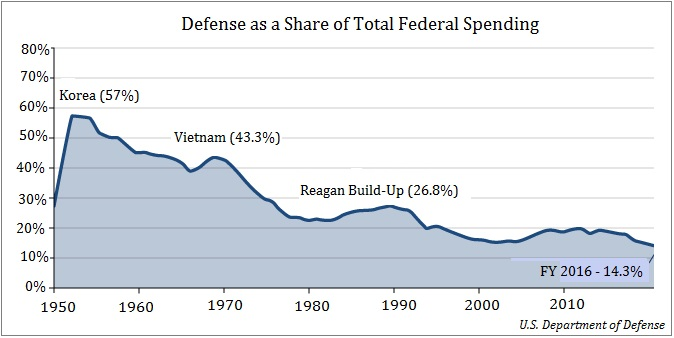
What was extremely expensive was the nuclear arms race. The amount of nuclear weapons that existed in the World in the 1980's tells just how bizarre it came to be. If there is one peaceful outcome when the Cold War ended, it has to be how we got rid of a huge amount of nuclear weapons. The following table shows btw. why the US generals were so eager to go into Cuba during the Cuban missile crisis. Would it been the late 1980's, no Curtis LeMay would have opted for was as back then in the early 1960's.
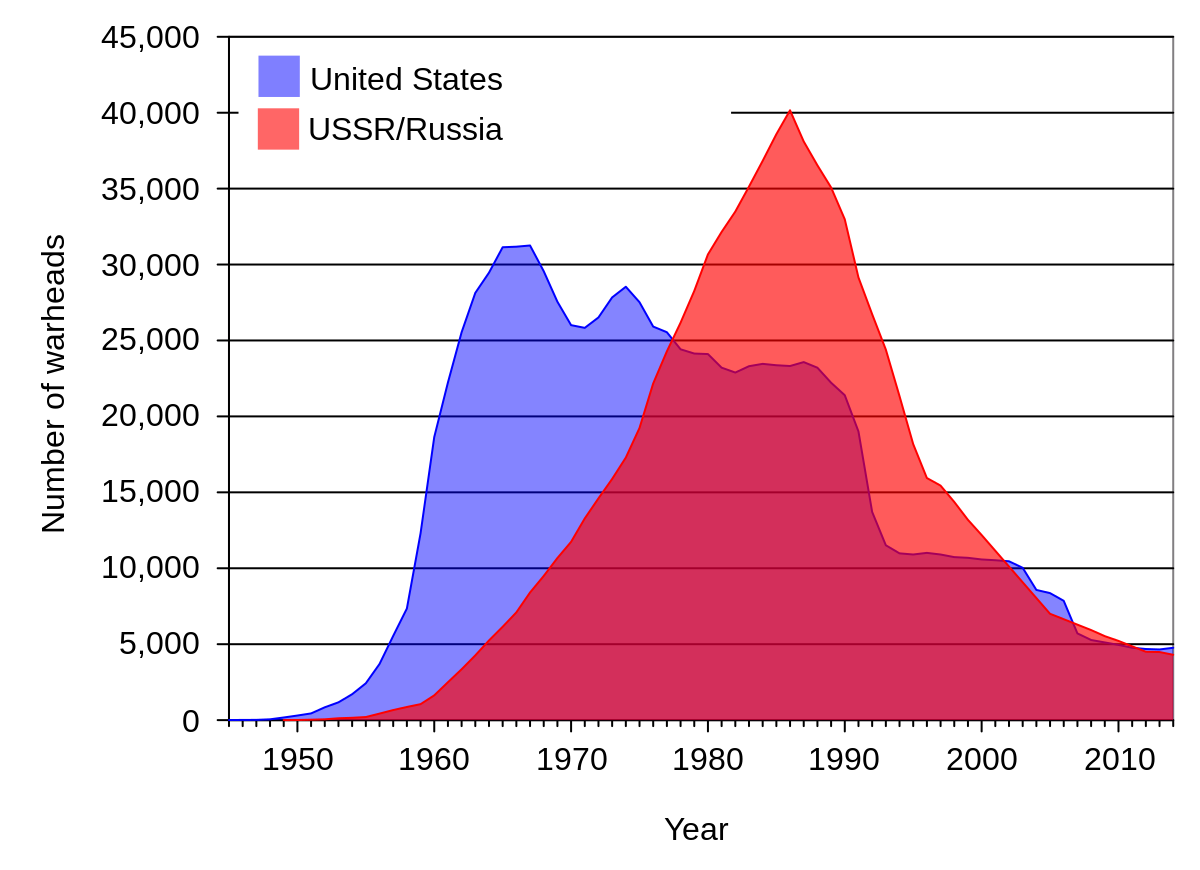
The above issues are actually very important to this subject. If we simply just look at battle deaths and wars, we forget just how bellicose times the Cold War was, even if both sides showed restraint when directly facing each other. Even if it was peace, the threat of war was far higher than now. (Even if after Crimea and Ukraine the World has gotten colder again) -
Trump and "shithole countries"And finally, I've mentioned it in other threads, but Democrats seem to have turned their backs on working class folk some time ago and opted instead for an odd coalition of their wealthy benefactors and marginalized groups. They don't even try to cultivate a broader working class narrative that could rally ALL less financially secure members of society together (other than Bernie Sanders), and they seem to purposely vilify older, less affluent white people as the source of the nation's problems. Why would this demographic vote for a party that wants nothing to do with them? — Erik
The utter ineptitude of Trump as a leader, his ignorance, racism, over the top narcissism and the Russian help he got all make it too easy for the democrats not to be critical of themselves. And the focus that a lot of the supporters of Trump are racist neonazis doesn't help either here.
First and foremost, the wife of an earlier President was a disasterous choice for the DNC to start with. That Bernie Sanders got so much support tells how bad the choice of Hillary Clinton was for the democrats. Hillary Clinton losing to Obama ought to have told a lot to the DNC.
A populist law and order candidate promising to root out corruption in Washington would have gotten a lot of support as the message would be favourable to both right leaning and left leaning voters. The cluelessness of Trump is evident that he was surprised that the "Drain the swamp" message got so much popularity. Because if there are things that unite a lot of Americans, they are the distrust of the political establishment and the disgust of the basically legalized corruption.
If Trump wouldn't be as incompetent as he is and play for the rich elite as he does, his kind of fascism-lite could easily gain a lot of support. Luckily he is as incompetent as he is. -
Cryptocurrency
For the plunge to stop I think the changing of accounting rules had an effect. It surely is one of the factors. But there are naturally others, of course, ...that the World didn't end, that the international monetary system didn't collapse (just came close to collapsing) and that when prices went low enough, the bubble had burst and it was time to go in the other direction.I've watched this and it really isn't informative. His explanation of mark-to-market is a bit of a misrepresentation. He doesn't really offer a solution or talk about the alternative and it tends towards a single cause fallacy, while at the same time he already highlights several issues that are co-causes. When talking about these sort of things, I think we should be talking about contributing factors and not causes. — Benkei
Umm...created what exactly? Speculative bubbles traditionally happen because of loose monetary markets.First, excess cash is a contributing factor and QE and low interest rates created this. — Benkei
Has it been something else, truly? Perhaps in the age when owners were the innovators themselves who started the companies.Second, modern corporate capitalism, especially in the US, is all about short term gain and after the repeal of the glass-steagall act they started pursuing short term profits with money that should've stayed off limits (e.g. deposits). Simply put, you shouldn't gamble with other people's savings. In a way, this created a larger pool of cash as well - contributing factor. — Benkei
A lot of markets have been "unhinged" from reality for a long time.Third, complexity. Bankers didn't know what they were buying and selling any more. Once you don't understand the underlying economics of the product any more, the product is unhinged from the real economy and it becomes a pure supply-demand equillibrium based on sentiment. — Benkei
Banks are quite different: car manufacturers can compete with a lot things, banks with just the interest rate. This makes banking all about scale. And notice that banking is an industry where sitting idly on the bench and not going along with others into a bubble frenzy isn't a winning strategy: likely you will be bought by a competitor or likely the CEO will be fired as you aren't giving similar profits as your competitors are. You aren't performing well enough.
I've seen this with my own eyes during the IT-bubble. I remember a finance conference here in Finland in 1999 (or so) where a mutual fund manager that had not gone into the IT craze, came on the stage and told how he still believed that traditional industry stocks was the place to be and had to try to tell why he wasn't investing in Information Technology. Well, he was nearly laughed out of the stage. Few years later the mutual fund was the top performer and stayed there for a long time.
You can be right, but then there is the timing just when are you going to be right.
And anyway, I still believe this is going to a classic bubble with cryptocurrencies. No matter how useful and important they will be later. Events in South Korea aren't at all normal. Perhaps the correct adjective would be tulip-like or "tulipy"?
Of course I can be wrong... -
About war
Thank's for that article, Uneducated Pleb. There's a lot wrong in Pinkers approach. One of the basic issues is treating modern society in a very simple way. It's a nice message Pinker gives, but really, social sciences are a science, even if not such as biology. As that article says: "The historic data show that members of nonstates were more vulnerable because they lived in small populations—not more violent because they were lacking in “better angels,” such as reason and moral sense."If you are quoting Pinker's approach, I believe professional anthropology has a more accurate answer to that "simple statistic". — Uneducated Pleb
And anyway, if you just compare wars by battle death suffered annually per 100 000 individuals, that is a really, really simple statistic. Wars and conflicts are very different from each other. War being an extension of politics, as Clausewitz famously noted, should tell this to us. Politics and political decisions are extremely important and aren't just societal: just compare let's say the conflict in Northern Ireland to to the Rwandan Civil War. In the former conflict one side (the government, UK) shows huge constraint in order not to escalate the conflict into full civil war and keep the conflict as a "Time of Troubles" and in the latter one side truly decides on a "Final Solution" option when seeing that it will lose the civil war. The body count quite different, yet without the "Final Solution" that became the Rwandan Genocide, the African Civil War might have been quite "ordinary" with low battle deaths and little media coverage. -
About warNouriel, you aren't alone with that opinion. Many people have noted that there is less conflict than before and the conflict is less lethal. And this is argued by the simple statistic that less people are killed in wars than earlier.
I personally am not so sure about it. War is something in our midst even today.
First, when you compare any conflicts or any era to WW1 and WW2, you get a downward trend. Perhaps only the Mongol Invasions were more lethal to humanity (on a percentage level). What is basically shocking is that many of these statistics simply ignore the most lethal conflict of our time (the First and Second Congo wars 1996-2003) that hade several million people dying. But if the conflict results in people largely dying of starvation and disease (and only in the hundreds of thousands being killed in the battlefield), guess for these people arguing how peacefull we have come it doesn't count.
Second, what is totally underestimated is how much battlefield medicine has improved in our time. Soldiers aren't killed anymore of diseases and if earlier the death to wounded ratio was 1:3, now it's far higher. In Iraq the US suffered over 4 000 combat deaths, but over 30 000 were wounded. Hence the body count would be far higher for American soldiers in Iraq and Afghanistan if battlefield medicine would be on the level of the Vietnam war or earlier. Also the West has used a warfighting strategy which actually does seek to limit civilian deaths: If in the US war in Afghanistan it's estimated that about 31 000 civilians have died, compare it to the Soviet invasion which lasted far less time yet killed about 1 million civilians. That the Soviet Union used the ancient Roman tactic of creating artificial deserts and forcing millions into exile in order to take away the logistical support of the insurgents tells how different that war was compared to this one.
And third, which is the most politically incorrect and most opposed answer: the presence of nuclear weapons has prevented all out wars as in the past. Yet this argument has truth to it: not only with the US and Russia, but also with India and Pakistan, the presence of a nuclear deterrence on both sides has severely limited the scope of armed clashes that the countries have engaged in. And at least until now, the same logic can be seen in conflict between North Korea and the United States (which have only a ceasefire, but no peace).
When only one side has nuclear weapons (like with the example of Israel and Arab states), the state with nuclear weapons can and has launched wars with impunity.
Naturally nobody arguing that the World has become a better more peaceful place will say it is because of nuclear weapons. But there is this twisted logic, and even there have been a lot of close calls with nukes and the possibility of an accidental nuclear war, this sword of Damocles does limit just how eager our leaders are to go to war. -
Vicious CircularityThere are two different occasions that you talk about a vicious circle in philosophy.
First one refers to Russell's Paradox or some similar instances. Russell himself describe the Paradox as a vicious circle. This is basically about negative self reference and its effect on logic.
The other example is when we talk about a vicious circle opposite a virtuous circle, basically when elements intensify and aggravate each other and lead inexorably to a worsening of the situation, which T Clark above mentions. -
Trump and "shithole countries"The total ineptitude of Trump is quite obvious.
You just look at how Trump performed at the televised DACA meeting, where he was totally unable to even understand what Feinstein purposed with a "clean" DACA bill. Put this along everything from Trump talking about F-52 fighters to Norway and him working basically 1h 45 minutes a day and you don't have to have to read "Fire and Fury" to understand the total dysfunction of this Presidency. Trump simply cannot function as the chief executive of the government.
Hence the real question is who is taking care of this administration? Likely the demented ignorant moron-Trump is handled with the "sign here, Mr President"-routine and simply by not bothering him with difficult things. I guess by now they have learned how to manage Trump and just leave him watching Fox & Friends and make his tweets.
Likely the power now is with Pence, Kelly, Mattis, McMasters and Rex Tillerson. Naturally the administration lacks initiative as that should come from the President's mouth. -
A game with curious implications...
You noticed?That rule is meaningless. — Noble Dust
And not so meaningless that we got rule 13 from Janus.
...which is also meaningless.
But what wouldn't be meaningless yet true in this World. -
A game with curious implications...Rule #12: Rule #12 is abiding and cannot be overruled, changed or amended by any later given rule or by referring to any earlier rules.
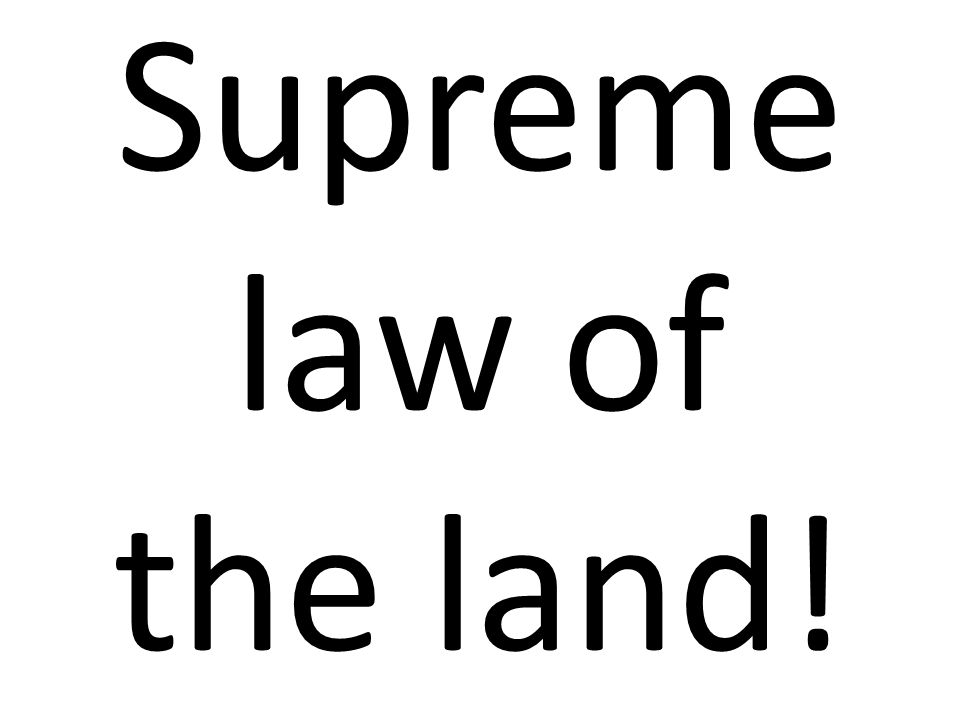
(Noble Dust was quick...) -
CryptocurrencyWhy?
Well,
When there's an stock market crash, the collapse of stock prices has a real effect on the economic situation of companies even if they otherwise wouldn't have to sell their stock.
The effects of Mark-to-Market accounting is explained from 13min 20s forward.
Now I'm not totally agreeing on what with the speaker, but he does make a good point. -
Objectivity of subjectivity
In my view (pun intended) the "problem" of subjectivity isn't just limited to this.Isn´t the problem of subjectivity, only a problem because questions that contain in them ideas that are thought to be "subjective", don't actually contain in them, or in the context that they are put in, the necessary information for objective valuation, thus making the question unanswerable? — Perdidi Corpus
You see, sometimes in order to make an objective model of reality, the model itself or the one making the model effects what is tried to be modelled in the first place. Hence subjectivity isn't just something that is thought to be "subjective", it can have true consequences and be unavoidable.
You have this inherent problem for example in physics when a measurement effects what is going to be measured or lets say in social sciences an economic model (or theory) itself has an effect on how people make economic decisions ...which the model should describe in the first place.
Now for many people this isn't a big problem. You just assume something... assume a game-theoretic outcome, some sort of maximization procedure or dynamic model. Or use probabilities. Yet the logical limitation that subjectivity forces on objective modelling is quite real:
Just try to write a sentence in English that you will never write.
Obviously there exists sentences in English that one never will write (even those nobody will write).
Can you write them? No, they would then be part of those sentences that you do write in your lifetime.
This becomes really problematic when the correct answer of some model would be exactly like this.
Hence the "problem" with subjectivity is logical and unavoidable in certain cases. -
Cryptocurrency
Yep. And individuals don't have to mark-to-market their wealth. Corporations can have this sometimes ugly feature to do, that is that if their stock holdings take a dive, they have to report a loss (or vice versa) even if they don't sell.You cannot count as profit transactions which are not yet complete. Even as a business, I may have a $1 million contract, that doesn't count as revenue (and profit) until the dough actually is transferred into my bank account. — Agustino
This feature was one important factor in the financial crisis. Once the mark-to-market accounting standards were eased, the stock market bounced back. -
CryptocurrencyIs it any different to owning shares (or really anything that isn't cold hard cash)? — Michael
From a trading perspective not so much. An obvious difference though is that share prices try to reflect the value of the company where it's usually clear that labour adds value. It is not clear what the value 1 Bitcoin = 12.000 USD reflects. A cryptocurrency price point appears to me as a pure supply and demand equillibrium without any relationship to economic activity at this point. Even for currency exchange rates, you'll see the underlying real economy of the different countries play an important role in setting those rates next to supply and demand. — Benkei
Actually, owning shares is very different.
You are then an owner of a company. Companies usually pay dividend, hence typically shares provide an income stream, a return to investment. To own cash/currency/gold etc. for the intention to make a profit (by selling them later at a higher price) is simply speculation. -
Cryptocurrency
I thought one has profits only when one cashes out, sells the investment and makes in this case capital gains.My profits are down from a few days ago, but I've still more than doubled what I put in, so there's that. — Michael
Seems like speculation has gotten to PF members.
Telling.
I still thinks this is a bubble, but enjoy the ride!!! -
Arguing with economics.
I think one can brush off the Trump-level climate deniers from any rational discussion, but the truth is that things are in reality complicated. Hence you do indeed need explaining.Why does that even require explaining, is my point? Isn't it intuitively obvious or am I missing something in their rationale? — Posty McPostface
Perfect example is Peak Oil. The conventional production of oil peaked years ago and is in steady decline. Oil production has increased, but not much in the last decades. Yet the most apocalyptic visions of what would happen when we get Peak Oil have been proven totally false and now look quite whimsical. Technological development and market mechanism make it so that Peak Oil didn't collapse our global economy.
And this the typical problem with things like taking into account global warming or environmental degradation: too simplified models and forcasts get it wrong as the things are actually complex. They might be great talking points, sure, but things usually are difficult. If the whacky conservatives make fools of themselves believing in their alternative facts, that doesn't mean that these things aren't complex. -
Arguing with economics.
Don't underestimate the actual economic boom that the whole fracking/horizontal drilling revolution created to states like North Dakota. Two digit GDP growth is something that any state government would want to see.Why do regulators let them get away with it? Because the economic might of the fossil energy industries is huge, and we are all dependent on a steady supply. Most governments are simply unwilling to take on the energy business in a frontal assault. — Bitter Crank
To put it into context, here's a chart of how various US states GDP grew from the year 2000. Look at North Dakota, home of the Bakken oil field:


-
Arguing with economics.I think that you can easily make the case even by "economic" terms.
Offshore drilling, fracking and using something like tar sands to get oil is extremely expensive compared to oil production costs lets say in Saudi-Arabia. Hence these technologies are basically just pushing the envelope on how to produce oil to more and more exotic ways and have basically just replaced depletion on the global scale. For example the UK has it's oil production in offshore drilling, so the following chart should be obvious.

Now, if investing in an alternative energy source that can compete in price in the future with fossil fuels and be cheaper, how wouldn't be also economically smarter to do that?
One can easily argue a lot of things in pure "market terms" or "price terms". -
The trolley problem - why would you turn?
Especially when it comes to warfare, real world "ethics" are totally different starting from laws and jurisdiction of a nation, the international laws on war and ending with military doctrine, strategy an objectives of an armed forces. After all, in many wars even today civilians are deliberate targets themselves. The legal and social maze that humanity has built especially around conflict between nation states shouldn't be underestimated.I think a real-life example of the trolley problem would be the general who has to decide whether or not to launch a strike against an enemy that would entail civilian casualties. Is it better to not get involved or to intentionally kill a few to save many? — Michael
An unintensional accident (where likely the fault would be put to the builder of the breaks or the maintaner of the trolleys) is a bit different from war. And let's not forget that the workers likely understand the dangers of their work on actively used tracks. -
How much can I, as an individual, affect political policy?
A lot.Realistically, what can one man actually do? — JustSomeGuy
Of course, it depends what you want to change. -
The Blockchain Paradigm
Yep.My understanding is that nobody knows right now whether blockchain will be a genuine disruptor that mostly replaces existing payment systems, or a fad that withers away. But for as long as there is potential for the former - and currently most believe there is - financial institutions, software companies and financial regulators are all investing in understanding and experimenting with it so that they don't get left flat-footed if it takes off. So far it hasn't, but that doesn't mean it won't. — andrewk
This is one thing which the cryptocurrency believers talking about a new paradigm usually don't assume: that the new technology is simply harnessed by excisting financial service providers. The little thing still is that people have their money in banks and above all, get loans from banks. Let's not forget that the payment system has dramatically changed even now. The idea that existing payment systems hasn't changed much is ridiculous. I would think it wouldn't be far fetched that soon any bank transfer or payment to anywhere would be settled in nanoseconds, not days.
We really have to separate here the totally crazy hype thanks to the speculative bubble around Bitcoin, which actually hasn't anything to do with the technology, just like during the times of the dot com bubble hadn't something to do with the underlying technology back then. -
Why is the World the Way it Is? and The Nature of Scientific ExplanationsMetaphysics and metaphysical questions are typically disregarded, which is a bit of a shame. I think there is value to thinking about them, even if by the definition "meta" we surely cannot get direct answers to our questions.
David Hume famously rejected metaphysics and If directly asked about Hume's views, people can have different opinions, but usually unconsciously we follow the same guidelines. Normally people are empiricists of the likes of Locke and Hume. A scientist doesn't need more philosophy than that. -
CryptocurrencyThe reason I'm saying that is that most people want to cash out for the holidays ;) - they don't want to be playing stocks on Christmas Eve. — Agustino

-
Post truth
Oh they don't.Another story du jour - Trump trusts Putin more than the US intelligence community.
(Trumpets - don't bother.) — Wayfarer
Anything that Washington Post post is fake news for the true Trumpists. Any Wapo article can be immediately dismissed.
Trump believers are totally in their own phantasy-World from where there is no turning back. Yet in the real World, it's going to be a really fascinating what Mueller will find out and how the Russia scandal will evolve. -
Cryptocurrency
Already in 2013 was assumed that the creator(s) of Bitcoin had roughly about 1 million Bitcoin wealth. (See article The Well Deserved Fortune of Satoshi Nakamoto, Bitcoin creator, Visionary and Genius) Several articles I've read have assumed this to be true. Ironically this makes the "currency" one of the most concentrated in the World with a central bank-type player which can intervene in the market and move it how it wants.Bitcoin has had these kind of swings before so we'll see. In any case, ownership of bitcoins is very concentrated with a few players. I suspect somebody made a killing on those futures, selling his coins to cause a downswing and then buying them again to fulfill his future contracts and earning a tidy spread. — Benkei
But what is totally obvious that now the currency has been on the hype-phase, that cannot be denied. -
Cryptocurrency
I'd go on the limb and say it's bull trap time...It's a buyer's market... Or maybe wait and see. — Hanover
Enjoy one of the really classic bubbles of our time. Right before our eyes. -
Economics: What is Value?
I would enlarge that to other social sciences as well.Really, I think economics is the field most in need of a revolution at the moment. People are stuck in absurd ways of thinking, that literarily don't have much to do with reality anymore. — Agustino
I think one underlying fact that fundamentally makes social sciences different is that the object of study, how humans behave in a society, changes also. How we think not only of the economy, but also about the society has clearly changed during the centuries. -
Economics: What is Value?
There are also those people who are ignorant of some academic field of study and proclaim it to be non-scientific and wrong and consider the truth of it to be how they think and operate themselves. ;)Sure, soon you're going to tell me that the invisible hand also puts money in my pocket :-}
When people don't understand how something happens, they postulate non-scientific entities like "invisible hands", "powers" (opium having sleeping powers), and the like, thinking they have explained the matter, while actually they left things as unexplained as before. — Agustino -
Economics: What is Value?
As said, Marx bases his theory of value on the total amount of necessary labor required to produce a good, rather than by the use or pleasure its owner gets from it. And it's Marx that is forgetting demand.I'm saying this from a Marxist perspective. If everything you said is true then it follows that the difference between Marxism and mainstream economics is that the latter does not discuss value as such. What Marx calls value has nothing to do with supply and demand as you say, however, within Marxism the price of commodities is somewhat determined through supply and demand. Marx terms this 'value' of the price of commodities 'exchange value'. To me, from what you say, it seems like mainstream economics only wants to discuss 'exchange value' which they term 'value'. Am I confused, or are there many ambiguities here? — bloodninja
Yet Here Marx is confusing: if he bases his theory labour theory of value (LTV), he yet then does admit that if some good is useless, there's "no countable labour" in it. I still think that a useless good has to be made and does need labour. Here's a quote from Marx:
(Karl Marx Capital,the quote in the end of section 1 here)nothing can have value, without being an object of utility. If the thing is useless, so is the labour contained in it; the labour does not count as labour, and therefore creates no value.
This utility that Marx is talking about is basically what constitutes demand of a good: if someone wants to buy the produced good. Usually goods that have a lot of demand and people willing to buy them have utility for the buyers. The labour put into making the good doesn't at all define how much people are going to buy it or not. Hence taking into consideration the demand side makes sense.
So to answer your question, if you think that mainstream economics is interestend only exchange value, that "exchange value" has lot more to it than the Marxian fixation on labour. And of course mainstream economics doesn't think about it in the Marxian-Smithian way anymore. Economics has moved on from the late 19th Century. On the most elementary level economics uses marginal utility theory and the Marshallian supply and demand scissors. Those weren't around when Marx was making his theories.
Now is the Marxist approach reasonable? It's quite reasonable if you want to make the statement that employers and capitalists steal from the workers, but otherwise it is problematic and a lousy model on how the economy works. -
Economics: What is Value?
Actually your example is a great one for the thread.My main point was that in many cases this cannot be done. If I start writing poetry, those poems have no economic value, and may never have any economic value (or they may indeed have it - depends how well they do). — Agustino
Yes, you might think your poetry has no economic value, but if you write a poem let's say to your mother, for her it can have a lot of value. If some stranger would ask her to sell the poem, usually mothers wouldn't agree to sell it. Now if you go and try to sell your poems, then you obviously get a price to the poem (assuming you can sell one). A friend of yours might buy your poem just because, well, your friends. Yet even then the value of that poem might likely be higher even for him or her than the price paid as the poem is a reminder of you (and the crazy things you do, like write poems and try to sell them to your friends). Hence on many occasions the price the a good or service changes hand does show the value of the good or service, but in some occasions it doesn't.
Well, you'll see the price mechanism work on the demand side if you tommorrow multiply the price of your services by 100. I presume you won't find any customers.Supply and demand are empty abstractions to me. When I've helped a client modify his prices, or when I set my own prices for my services, I don't consider supply and demand at all :s . I never need to. — Agustino
And on the supply side? Well, there's only so many hours in a day that you can work.
Ok.Can you quantify supply and demand? I've seen some people draw some charts based on some usually extrapolated data, but the whole procedure seems so unscientific — Agustino
Easy example: any individual stock in the stock market. There you will see the prices and the quantities that market participants are willing to buy and sell a stock. Aggregate of all those buy offers are the demand of the stock and the all those sell offers are the supply at the present moment. -
Cryptocurrency
Let's start with things like the functions of money and why it's important for any government to have control of that money as legal tender. Being a "payment system" is just one function of money.I have no clue what the hell you're talking about with "economics money — Agustino
Look.I saw that you were more concerned about the high price per unit of Bitcoin, unaware that Bitcoin can trade in smaller units than 1 BTC. You would have been right if Bitcoin couldn't trade at lower values, but that's not the case - you're just misunderstanding it, and you don't know enough about it. — Agustino
If you have a currency, you don't start it with one unit being in the tens of thousands, not even if you can divide it into a billion or whatever. The high price just tells how hugely the "currency" has gone up in price. The only reason a currency basically would rise up like that is when there's hyperinflation.
What you have said, quite puzzlingly, is:I showed how you were misunderstanding Bitcoin and the crypto technology when I said you don't know what you're talking about. — Agustino
I don't see anything that nations can do to stop crypto. To begin with, politicians are too dumb to even understand what is really happening.
I think it's a clear fact already that digital currency of the crypto kind is superior to our paper fiat currency though. It does make all transactions easier and significantly cheaper. So perhaps in the future, we'll be approaching a situation where everything is exchanged in crypto, not in fiat currencies - so this exchange of Bitcoin/USD becomes irrelevant. — "Agustino
But then you state...
I do think Bitcoin will collapse in value — Agustino
Well, what I have had tried to explain is that a) it's a bubble and b) the technology is useful and likely will be used, just like tech that was underlying the IT-bubble. Where we disagree is in the ability of governments to control a cryptocurrency and in the role of currencies that are legal tender have. -
Economics: What is Value?
Well,I think both systems are stupid. Defining value merely in terms of work makes no sense, since machines can also do useful work, and obviously, in Marxist terms, you ought not pay them a wage for it. Also some may do work faster than others.
Defining value in terms of the willingness of people to spend is also stupid. That's why we say that the market overvalues or undervalues things - because we have a real value in mind. You say Bitcoin is a bubble. Why? Because you have some idea of the price it ought to have in mind. That real value obviously cannot be calculated by the willingness of people to spend - people can be idiots. — Agustino
Hopefully we agree that price depends both on demand and supply and is the amount when the seller and buyer agree to make the transaction.
As value is different from price, I would say that when defining value, both sides of the coin should be take into consideration.
Oh actually they are. Just look at how economically important they are. If your neck of the woods would have great art museums with World renown art, famous Theaters and a Disney World, I would suspect that the masses of tourists visiting your place would be extremely important economically for the local economy. After all, tourists are only tolerated because they bring money to the local economy.This means that some things are not valuable. Poetry, art, etc. Of course, they matter to us and are important, but they're not valuable in an economic sense - they're not productive. — Agustino -
Economics: What is Value?
And how is that above scientific?Are all bullshit. These are vague and empty nonsense so long as it cannot be quantified scientifically.
Value is equivalent to production & means of distribution. So if machines produce, they are valuable. If workers produce, they too are valuable, etc. — Agustino
And your definition btw. ignores the value of things produced and basically anything else than production tools. -
Economics: What is Value?
The difference with Marx is that he looks at value from his own theory, the labour theory of value. The idea is that the value of a good or service is defined by the work put into it. Notice the value isn't defined by the person willing to buy the good or service and the whole thing an interaction between supply and demand. Hence there's the fundamental difference between Marxism and mainstream economics.How is what you're calling utility different to what Karl Marx called use value? Is it that use value relates to commodities but utility does not? — bloodninja
It's noteworthy that Adam Smith has a similar view as he said in Wealth of Nations "Labour, therefore, is the real measure of the exchangeable value of all commodities". Marx went forward from this and built is own economic theory. The problem with the Marxist idea of value is that it's fixated on the cost (or labour) of something and isn't interested in the demand side of the equation. Hence if there's a profit from selling a good or service, it basically has to be then that the owner steals from the workers labour, not that consumers suddenly fall in love with the good or service and are willing to pay a higher price for it.
Hence mainstream economics which focuses on supply and demand has a different take on things.
Anyway, In my view Marxist economics is an attempt to academically theorize income and wealth distribution and otherwise isn't the best model of the economy out there. -
Economics: What is Value?
Why not? What's so bad about it?But "utility" is not a good definition. I could value useless things... — filipeffv
Don't we all value things that others don't give such value?
Preferences after all differ from people to people. Just like utility isn't just hedonic satisfaction, as one might first think it to be. A rich man giving money to a charity can be satisfying to him in many ways. Just as monk can get satisfaction from abstaining from consumption and materialism and devoting his life to God.
And what should be noted that economics tries first to give an accurate model of the World. Only then can you go on towards normative policy advice, what is good or bad.
ssu

Start FollowingSend a Message
- Other sites we like
- Social media
- Terms of Service
- Sign In
- Created with PlushForums
- © 2026 The Philosophy Forum