
Comments
-
Idealism vs. MaterialismI often try and explain things to you, in particular, which is often greeted with 'you haven't answered the question' or 'you're not able to explain yourself'. — Wayfarer
You often respond obliquely--which I think is at least partially on purpose as a defense mechanism, often ignore stuff (I know I do, too, but I do it via ignoring sections of long posts, because they introduce way too many topics/subtopics, and I want us to tackle one thing at a time so we can actually "get somewhere"--this is one big reason that I prefer chatting to message boards), and you have a tendency to respond kind of like a telemarketer--as if you were resorting to a script that gave you canned responses to objections, where the canned responses often involve quoting something that doesn't really address the points that someone brought up (and sometimes that contain ideas that the person just argued against). -
Intentional vs. Material Reality and the Hard Problem
The idea is that physicalism isn't "latched on" to physics, and basically subservient to it, so that it's something like the "marketing team for physics" or "the ideological cheerleading team for physics."
Physics is studying the same stuff (as we posit as physicalists), as is chemistry, geology, meteorology, etc.--all the sciences are studying the same stuff. -
The Prime Mover 2.0It must be the end of time. The only answer is that the first cause was caused by the last effect. Time is circular. The first cause was the Big Bang and that was caused by the last effect; the Big Crunch.
So this version of the Prime Mover has no logical holes in it and it addresses the old chicken and egg problem. — Devans99
All this is really doing is saying that there's no first cause after all. -
Intentional vs. Material Reality and the Hard ProblemMany physicalists argue that reality can be explained by physics, and if physics cannot explain the totality of reality at the present time, it will in the future, as the science of physics advances. Here at TPF, that is often cited as the premise of physicalism, when supporters define "physical" as that which is studied by physics. — Metaphysician Undercover
Yeah, I'm aware of those misguided folks ;-), but I was just pointing out that not all physicalists think that. -
Fallacies of Strawson's Argument vs. Free WillNo. I imagined we were both looking at the same triangle. My idea <this triangle> referenced it. My words, "this triangle" expressed my idea, and so, via that idea reference the same triangle.
It seems that you have a very hard time understanding me because you keep thinking of strange interpretations of what I say. As a result you raise non-issues far removed from the topic. I am wondering if you are doing this purposefully, and if it is worth my time to continue. — Dfpolis
Lol, no I'm not doing it purposefully. I think we maybe have extremely different paradigms that we're working with.
Why would "this triangle" in your usage refer to an idea rather than referring to the triangle we're looking at? The triangle we're looking at isn't an idea. -
Is our dominion over animals unethical?Terrapin - Do you believe everything we know about anything (health, math, logic, ethics, etc...) is all subjective? — chatterbears
First, keep in mind that I use the subjective/objective distinction simply to refer to whether something is mental or extramental, by which I simply mean whether something is a subset of brain phenomena (the mental subset, of course) or whether it occurs in the world outside of that subset of brain phenomena.
Given that, it should be obvious (because otherwise I wouldn't make the distinction that way) that I don't believe that everything is subjective. It depends on whether the thing in question is a mental phenomenon.
We can know about objective things. We can know about automobiles, for example. Automobiles, that is, the actual things we drive around town, aren't mental phenomena.
Knowledge itself, though, is a mental phenomenon. So in the sense that we're referring to knowledge qua knowledge, it is subjective. Propositional knowledge, for example, is justified true belief. Beliefs are mental phenomena. Beliefs are not found in the world outside of mental phenomena. But we can (subjectively) know about objective things.
Re "Normative Health: What is healthy is what is scientifically beneficial to the body." The "beneficial" assessment is subjective. "X is a benefit" only makes sense in a context of someone desiring either x itself or some state that x entails.
And so with, "Applied Health: It is bad to smoke because it is not beneficial to the body," we have two subjective assessments that are about desires/preferences--"bad" and "beneficial."
I'm not saying that what smoking does to one's body is subjective--that's not a mental phenomenon (leaving aside the mental effects of nicotine, etc.). I'm saying that preferring the state of the body sans smoking to the state of the body accompanied by smoking is subjective.
Outside of us thinking about it, outside of us feeling however we feel, desiring whatever we desire, preferring whatever we prefer, there are only possible states for things to be in. There are no preferred states, no better states, etc. outside of us making evaluations based on our dispositions, which are (at least potentially) individually variable. The world outside of us, outside of our minds, couldn't care less whether we smoke or not smoke, whether we're in one physical state versus another, whether we live or die. It's individual humans who desire one state versus another. Different humans (at least potentially) desire different things. We can't get "x is the preferred state" objectively wrong, because there are no objective facts about preferred states to get wrong (except for the objective fact that there are no objectively preferred states).
So re this:
From what Terrapin is suggesting, everything we know about anything, is completely subjective, — chatterbears
The important thing to remember, which is basically a summary of the above, is that knowledge qua knowledge has the ontological property of being subjective (because knowledge is a type of belief), but what the knowledge is about or of can be objective. However, knowledge can't be about something objective when we're talking about something for which there are no objective facts, because it doesn't occur outside of our minds, and moral judgments, moral principles, etc. are some of those things (for which there are no objective facts). -
Is our dominion over animals unethical?If you read above this, there's your example. As Dingo already mentioned, not everybody abides by their feelings in regards to what they describe as "wrong". One person may base an immoral action on whether or not it is an illegal action. Legality is separate from what the person feels, because their feelings do not make the law. Somebody separate from them, makes the law and dictates how the law works. At the metaethical level, yes, they are subjectively assessing the law as a good basis for what is right and wrong. But their normative and applied ethical stances, DO NOT hinge upon what they feel. — chatterbears
The distinction you're trying to make here makes no sense to me. "Just in case x is illegal, then x is immoral" is the view we're proposing. You're saying that "at the metaethical level," that stance is a matter of them feeling a particular way about illegal actions. But then you're saying that . . . I don't know, simply by calling it "normative" or "applied," it's something else? That makes no sense.
One day, the law could say. Gay Marriage is illegal. That person would now think gay marriage is immoral because it is illegal. The next day, Gay Marriage could become legal. That next day, the same person would now think gay marriage is moral, because it is now legal. — chatterbears
Right, because the person in question feels that something being illegal is sufficient for it to be immoral. So how is that not a way they feel just in case we're somehow construing it as normative or applied? -
Fallacies of Strawson's Argument vs. Free WillIt does, but mediated by the elicited concept.
Since there is no triangle to point to, I said "this triangle" to be clear. — Dfpolis
So you're saying "this triangle" as "this concept I'm thinking of"?
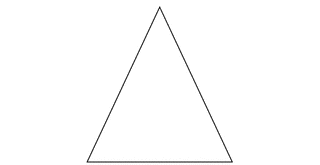
I would normally expect someone to being referring to something like:
This triangle:
-
Is Determinism self-refuting?
Yes. Otherwise his comment/argument wouldn't make sense. If determinism implies that we can't know x, then one has to be saying that freedom is necessary to know x. -
Is our dominion over animals unethical?Ok, I understand the way YOU view those instances but that isnt what you said, you said “everyone” whether they “realize/admit it or not”. I think you can say that about morality being based on some kind of subjectivity/feelings, but it is erroneous to apply that to everyone in all moral instances. As we just discussed, some people are not actually doing that. — DingoJones
Again, I think that people are always doing this with respect to foundational moral stances, and I think there have to be foundational moral stances. (Though it's important to keep in mind that what's foundational for an individual is dynamic, and can vary per situation.) Do you not agree with that? -
So much for free speech and the sexual revolution, Tumblr and Facebook...Do you agree it is natural to experience fear of the unknown? — Athena
Everything that anyone does or experiences is natural in my view. So yes, it's natural to experience fear of the unknown. There are people who experience that.
The stranger is unknown and this can result in fear, right? — Athena
Sure.
Under what conditions is this not true? — Athena
Since it's a statement about possibilities, I think it would be difficult to say conditions under which it wouldn't be true. That doesn't imply that strangers DO result in fear. It's just true that they can. It depends on the people involved, the exact circumstances, etc. -
Arguments for discrete timeHow on earth could you construct a continuum? It requires us to construct an actual infinity of possible positions for particles to occupy. — Devans99
I'd say that the mistake you're making here is that you're thinking of spatial extension as a "construction consisting of possible positions for particles to occupy," You're reifying mathematical ideas. -
Arguments for discrete timeThat's paradoxical. It works ok in the mind but not in reality: If I have a real line length 1 mile, it contains more information than a real line length 1 centimetre. But if they are both continuums then they both contain the same amount of information. Which is impossible. Which is proof by contradiction that continuums do not exist in the real world. — Devans99
Just curious what definition of "information" you're using. -
Intentional vs. Material Reality and the Hard ProblemThe physicalist assumes that these activities could be described by physical description if the sciences advanced to that point. But the fact is that the physical descriptions of these activities remain incomplete. — Metaphysician Undercover
Not this physicalist. Descriptions/explanations and whether they're sufficient etc. are about language, and as language, a large part of that is about meaning/interpretation, which is necessarily subjective. And whether any description/explanation of anything is sufficient, whether it's considered to "actually explain anything" etc. are about individual psychological factors (including and extending beyond language). What's the case ontologically has jackshit to do with anything we do with language (unless we're talking about what's the case ontologically with language, of course). And the whole idea of a "complete description" or "complete explanation" is just nonsensical. It's similar to ideas like "complete knowledge," "complete understanding," etc. Those phrases only reflect ignorance about what descriptions, explanations, knowledge, understanding are. -
"Your honor, I had no free will."Why not? — Wallows
The rest of the post in question already answered why not. -
Fallacies of Strawson's Argument vs. Free WillIt is not a universal concept. It is a particular concept. It is not the thing itself, but a formal sign referring to a specific thing. — Dfpolis
Wait, one thing at a time because this is a complete mess.
Okay, re the above, yet you say that you're not talking about the word itself. That makes no sense if you're talking about the ("formal"--what's the alternative here) sign qua the sign.
Why would we say that "this triangle" isn't referring to the thing itself, by the way? That would be a very odd way to use that phrase. "This triangle" is like "this" alone, just that we're appending "triangle" to it to make it clearer (especially on a message board) what "this" we're pointing at. -
Is Determinism self-refuting?In The Self and Its Brain Popper cites biologist J. B. S. Haldane's argument (later retracted) from 1932: "...if materialism is true, it seems to me that we cannot know that it is true. If my opinions are the result of the chemical processes going on in my brain, they are determined by the laws of chemistry, not of logic." He traces the argument even further back, all the way to Epicurus: "He who says that all things happen of necessity cannot criticize another who says that not all things happen of necessity. For he has to admit that his saying also happened of necessity." ** — SophistiCat
Why isn't it obvious to people that those are horrible arguments, though?
First off, materialism doesn't entail determinism. Secondly, Haldane is just assuming that if determinism is true, then (a) knowledge isn't possible, and (b) logic isn't possible. We would at least need some sort of plausible argument for (a) and (b).
And re the Epicurus quote, obviously in that case (if determinism is true) "criticizing another who says that not all things happen of necessity" also happened of necessity. So rather that it being the case that the first guy cannot criticize the second, it would rather be that the first guy cannot NOT criticize the second.
There are similar problems with the other arguments, too, although at least Jordan's is not so conspicuously stupid.
Such a huge percentage of arguments in philosophy (not just these, not just this topic, but across the entire field in general) strike me as ridiculously bad to an extent where they suggest that the originator is rather dim-witted (albeit with a large or at least esoteric vocabulary). It's really disappointing.
Not that I'm a determinist, by the way, I'm not. But I'm not going to endorse a bad argument just because the conclusion is something I agree with. We could say "If free, rational thought guides these arguments, then that's maybe one of the better endorsements that desiring alternatives could have." ;-) -
Is our dominion over animals unethical?
Right. I fully recognize that someone might have something like "It is wrong to initiate nonconsensual violence" as a foundational moral stance, and then they might say, "Murder is the initiation of nonconsensual violence Therefore it is wrong to murder" on top of that, where they're reaching "It is wrong to murder" as a logical/rational extension or implication of their foundational stance.Well when you said “how I feel about the behavior in question.” I took that to be your feeling in the moment, rather than your feeling when you decide the foundations of your ethics. — DingoJones
By stressing that it's a matter of how one feels about interpersonal behavior (that people consider more significant than etiquette, to spell out another aspect that I don't usually bother spelling out), I'm stressing that any moral stance is going to come down to some feeling-based foundational stance (such as "It is wrong to initiate nonconsensual violence" in this case).
Since I'm not personally fond of principle-oriented approaches, a lot of "applied" stances for me are effectively foundational, by which I simply mean that there are no other moral stances that the "applied" stance in question rests on (as with the example above re a moral stance against murder). -
"Your honor, I had no free will."I don't see free will as necessary for culpability. I see it as similar to say, a cliff over a roadway that tends to have rockslides. The rocks aren't choosing to slide, but nevertheless, they're causally responsible for problems on the roadway, and we're justified in removing or restraining them so that they don't cause more problems.
The person might not have chosen to commit whatever crime, but nevertheless, they're causally responsible and they're the sort of person who'll commit that sort of act, so that's sufficient to control their opportunities to continue to commit the act(s) in question. -
Is our dominion over animals unethical?
Maybe we're misunderstanding each other then. You're not saying that any stance doesn't ultimately rest on moral intuitions/feelings, and I'm not saying that every stance is necessarily foundational and not logically derived from a foundational stance instead. -
Is our dominion over animals unethical?
An example of relying on logic and reason to take a moral stance not directly following from the “feelings” foundation. An example of a moral stance that uses reason and logic alone. -
The Argument from the Scientific Test of Reality1. If science cannot verify the existence of X, then the best evidence tells us that X does not exist. — vulcanlogician
I'm not a moral realist, but I don't buy this first premise.
I'd change it to "If there is no supporting evidence for the existence of x, then there's no good reason to believe that x exists."
There's no supporting evidence for the existence of objective/extramental moral stances. -
Is our dominion over animals unethical?I didnt suggest you should, just that you shouldnt make an erroneous claim about the mechanism “everyone uses, whether they realize/admit it or not”. — DingoJones
It's not at all erroneous, though. That's the foundational approach everyone uses. I'm just not spelling out the full details via a couple paragraphs or so everytime I mention it, because that would be ridiculously laborious. -
Is our dominion over animals unethical?Why would you support a rape victim? — chatterbears
Because I'm morally against rape. That's a foundational stance for me. Not a stance built on another moral stance.
You keep going down to the base level (level 1) when discussing these issues . . And if you say you don't have one, then maybe you need to read a bit more about ethics and the 3 tiers of an ethical system (metaethics, normative ethics, applied ethics) . . . But clearly you still have an idea in your head that governs your ability to discern right from wrong. . — chatterbears
What you're looking for re "an idea in your head that governs your ability to discern right from wrong" is some sort of overarching principle, a la "it is wrong to hurt others" or "it is wrong to cause unnecessary suffering." That's not the way I approach ethics. I don't think those sorts of approaches are a good idea.
Re normative ethics, Encyclopedia Britannica, says, for example, "The central question of normative ethics is determining how basic moral standards are arrived at and justified."
The way that basic moral standards are arrived at is what I keep explaining, and as I noted earlier, I consider justification a category error, basically (at least justification in anything like the conventional epistemological sense of that term).
Re the deontological/teleological (consequentialist)/virtue distinction, I probably usually lean towards teleological stances, but I wouldn't say that I necessarily do--again, dedication to any principle is a misguided approach in my opinion.
And of course re applied ethics, I have many stances, such as "Rape is wrong." -
Is our dominion over animals unethical?I assume you apply the same logic to mentally disabled people, who have the same intelligence level as animals. (depending on how far they are on the spectrum). — chatterbears
I already think that the idea of human intelligence quantification is dubious, forget about intelligence quantification for other animals. -
Is our dominion over animals unethical?
Yeah, I mean re how they feel about foundational ethical stances, and then they can reason on top of that, etc.--I'm just not going to spell all of that out every time I mention it. -
Fallacies of Strawson's Argument vs. Free WillWhen we judge that A is B, it is because what evokes the concept <A> is identically what evokes the concept <B>. For example, when we judge <This triangle is equilateral> — Dfpolis
First, "This triangle" isn't a concept, it's a particular. ("Triangle" is going to be a concept, but "this triangle" conventionally refers to a particular, as a particular.)
If A is a particular and B is a concept, then "A is B" is the case because A fits the concept, B, that someone has in mind. (That is, of course, per their perception of A, per the way they've formulated their concept B, etc.)
Thus, the copula "is" betokens identity — Dfpolis
Not necessarily. It can refer to set membership. That's a different idea than identity. Or at least we need to point out that "identity" is often used to refer to "the very same thing" and not just "a property of this thing."
affirming identity of concept source — Dfpolis
That phrase doesn't read so that it makes grammatical sense to me. Maybe that's partially because of ambiguity over how you're using "identity," though, and also because the source of concepts, on my view, is individuals--more specifically, the way that individuals formulate mental abstractions that range over a number of particulars.
So, the explanation works, because in the actual case, the relevant concepts are all evoked by the same event — Dfpolis
Given what concepts are on my view, then, it's simply a matter of whether the concepts fit per the individual in question, since concepts are an individual phenomenon.
In this example, obviously there's a problem with the concepts fitting, since to Joe, it didn't actually count as an explanation. -
Is our dominion over animals unethical?Ethics/morality is relative. — BrianW
Yes. I'd say it's relative to individuals (as well as cultures re statistical cultural norms). -
Is our dominion over animals unethical?
Of course.Again, how would you respond to your daughter/friend/family member who has just been raped. Would you be supportive? — chatterbears
"That's just the way he feels about interpersonal behavior." That's certainly true, but my feeling about it wouldn't be based on the rapist's feeling about it. My feeling about it is my own disposition, a factor of how my brain works, etc.Or would you say "if he felt right in his action to rape you, that's just his interpersonal behaviors."
What I am trying to get at here, is you must have some sort of mechanism you use to differentiate a good action from a bad action. — chatterbears
Yeah, how I feel about the behavior in question. That's the mechanism that everyone uses, whether they realize/admit it or not.
You may (or may not) believe rape is a bad action, because of Reason A. — chatterbears
Once again, if it's "because of reason A," reason A would have to itself be a moral stance, because moral stances are not derivable from anything that's not a moral stance. I wouldn't say that "rape is bad" is based on another, more foundational, moral stance for me.
Re "I feel it is wrong to cause harm to others," once again, I don't use any sort of overarching principle approach to ethics, and I certainly don't endorse any general proscriptions of "harm," because that's too broad/vague in my view. -
The De Re/De Dicto Distinction
I think you're confusing yourself. This line from the Wikipedia entry about the distinction should help you keep them straight:
"The literal translation of the phrase 'de dicto' is 'about what is said,' whereas 'de re' translates as 'about the thing.'"
In other words, think of de dicto as being about the "proposition itself"--or as I said, about the concepts/conceptual relations of the proposition. For de re, then, it refers to particular things ("in the world"), Or you can kind of think about de dicto "pointing" to the proposition as a proposition, and de re "pointing" to some external thing, not language. -
Is our dominion over animals unethical?I could say you have a ridiculous stance by refuses to take any stance at all in regards to having a normative perspective. — chatterbears
Sure. Different people think that different things are ridiculous (obviously).
So if your son/daughter/friend/relative/etc.... committed murder, and told you about it, you would just say, "Ok no problem. Just make sure you don't get caught because you may encounter social repercussions." - Or what if we changed it from murder to rape? If your son/daughter/friend/relative/etc... raped somebody else, and told you about it, you wouldn't tell them it was 'wrong' to do? — chatterbears
I would tell them my view. Telling someone a moral view doesn't give them that moral view. One can only have a moral view when one feels some way or other about behavior. Telling someone something doesn't make them feel the way that you feel.
Would you tell them, "Well, there's no such thing as right or wrong. — chatterbears
"There's no such thing as right or wrong" isn't actually my view, though. My view is that right and wrong are ways that people feel about interpersonal behavior. There definitely are such things. There definitely are ways that people feel about interpersonal behavior, so I wouldn't deny that there are. -
The De Re/De Dicto Distinction
I don't agree with that about de dicto claims.
Think about this, by the way:
"Someone is a spy" in the de re sense, so that Ralph says it with his neighbor in mind, etc.
Well, it turns out that his neighbor isn't a spy. Which means that it was a counterfactual. Was it not a de re proposition? -
The De Re/De Dicto Distinction
"The lottery" refers to an actual situation though (in the de re version)--the Powerball drawing on October 31, 2018, the ticket I bought from the deli on 35th Street, etc. -
The De Re/De Dicto DistinctionI won the lottery in a possible world. — Wallows
I would say that would be de dicto or de re depending on whether you're thinking about just hitting the lottery in general versus thinking about hitting a particular lottery. Think of the distinction as whether the sentence is about the concepts involved, in a rather general, nonspecific way, versus being about a "real-world" particular.
That's the distinction in the "someone is a spy" example. The de dicto sense is more about the concepts, and it's general, nonspecific. Ralph knows what spies are (concept), and he believes that someone--but he doesn't know who (general, non-specific)--is a spy, based on the concept, based on general info he has about the world, etc.
The de re sense is predicating something of a particular in the real world that Ralph is familiar with--namely, Ralph's neighbor, whom he believes is a spy. He believes that his neighbor has particular properties that make him a spy.
So same thing with the lottery. De dicto--you know what the lottery is, you know that it's possible to win, etc. De re--you have a particular drawing for a particular game in mind, probably a particular day, maybe a particular store you bought the ticket from, etc. -
The De Re/De Dicto Distinction
As far as I recall it is counterfactual. I'm a pretty big Holmes/Doyle fan, by the way. If I remember correctly, Doyle was heavily inspired by Poe's C. Auguste Dupin (I'm a huge Poe fan, too, and in general I'm a big fan of pre 20th century Anglo fiction . . . Poe and Doyle are probably my two favorites), and some Holmes traits were taken from various people that Doyle knew (as is the case for most fictional characters), but it wasn't just one real-world detective who was an inspiration. -
The De Re/De Dicto Distinction
No, I'd say that counterfactuals work just the same way. Say that there's a false belief that A.Conan Doyle based Sherlock Holmes closely on some particular, real detective. So then we have this counterfactual with de dicto and de re interpretations:
"Ralph believes that someone was the real Sherlock Holmes."
de dicto--Ralph believes there was some particular person, but Ralph has no idea whom, that served as the model for Doyle's character.
de re--Ralph believes that 19th century British detective John Smith served as the model for Doyle's character. -
The De Re/De Dicto Distinction
Re your earlier question, wide versus narrow scope is being used to refer to where the quantifier occurs with respect to the propositional attitude.
"Narrow" = the quantifier is after the propositional attitude = Ralph Believes ∃x (...)
"Wide" = the quantifier is before and thus includes the propositional attitude = ∃x (Ralph believes...)
Terrapin Station
Start FollowingSend a Message
- Other sites we like
- Social media
- Terms of Service
- Sign In
- Created with PlushForums
- © 2026 The Philosophy Forum