
Comments
-
Is anyone here a moral objectivist?Some time ago, someone argued that, since we share many or most moral sentiments, those morals are independent of us.
I'm not convinced that holds up.
In analogy, many or most of us have two arms with five fingers each.
However, that does not mean that such "arm+finger'ness" somehow exists independently of the lot with such limbs.
Should an extinction occur, such "limb'ness" may no longer exist (per se), but could re-emerge again.
In such an event, the likes of love and hate may equally have vanished, but could be rediscovered again.
Why would our moral sentiments be exempt?
It seems that morals are by and for and applicable to experiencing minds (at large).
Surely we don't speak of rights (and justice and virtues) for rocks? :)
Much like the other examples, morals can exist independently of any individual, but seemingly not independently of the lot of moral agents.
This does not itself entail that morals are ad hoc, random, arbitrary, discretionary, mere matter of opinion. -
Neil Armstrong's Memory Of The Moon And Physicalism, if he can, then ...? If he can't, then ...?
-
Neil Armstrong's Memory Of The Moon And Physicalism, the brain in a vat thought experiment doesn't involve senses as such, just some sort of sufficient stimuli (say, Matrix-style).
Phantom limbs, hallucinations and a few other things (see below) could perhaps serve as evidence.
Part of the thought experiment (hypothesis) is that the right simulation mechanics/gear could provide Armstrong (or just his gray matter) with sufficient stimuli that it'd be impossible for him to tell the difference, which seems somewhat conceivable (contra Mary's room).
Everything reducible to information and nothing else is another matter, though.
Is the question whether personal experiences and qualia (mind) is reducible to information in some sense?
Brain makes decisions before you even know it (Kerri Smith; Apr 2008)
Neural Decoding of Visual Imagery During Sleep (Horikawa, Tamaki, Miyawaki, Kamitani et al; May 2013)
Brain decoding: Reading minds (Kerri Smith; Oct 2013)
After 15 years in a vegetative state, nerve stimulation restores consciousness (Corazzol, Lio et al; Sep 2017)
Computer system transcribes words users “speak silently” (Larry Hardesty; Apr 2018)
Our brains reveal our choices before we're even aware of them, study finds (Lachlan Gilbert; Mar 2019)
-
Infinite casual chains and the beginning of time?This arbitrariness of "a value" is just further evidence that having the same value does not imply being the same intelligible object. Otherwise I could arbitrarily say that a chair and a table have the same value to me, therefore they are the same intelligible object. — Metaphysician Undercover
A mathematical value is a type of "worth" — Metaphysician Undercover
So you've really managed to confuzzle value up good and well. -
What are your positions on the arguments for God?
I'm fairly confident you didn't miss ...I'm sorry to keep putting you on the hot seat...or maybe you answered them, I couldn't find where you did though... ? — 3017amen
... given the comments you read.Still waiting for you to make your case (to use your verbiage, and mentioned before), or is that not forthcoming? Say, feel free to show how you derive your gods from love. Somehow I get an impression you have a long story to tell. — jorndoe
Passive-aggressive diversion and disguised insults doesn't make your case.Tic toc tic toc, LOL — 3017amen
(as an aside, as far as you can be concerned here, I might believe there are little green men on Mars that possess supernatural magic, Shaivist mysticism, voodoo sorcery or otherwise, i.e. don't attribute something to me personally here that I haven't stated) -
What are your positions on the arguments for God?naive, philosophically — Punshhh
Naïve, uncritical, gullible, malleable, credulous, "seeing faces in the clouds", ..., philosophically or otherwise?
Not sure I understood your comment right, entirely possible I misread, in which case discard: Per earlier, in what way does an adult's non-naïveté (or epistemic attitude) demand that they take into account, incorporate thoughts of, intangible hobs that can control the weather in their lives? (Should their spouse family friends be concerned?) If absent in any way that matters, then in/consistency between epistemic attitude and real life comes-to-the-fore.
humans, who are evolved to [...] — Punshhh
Some of the claimants (including @3017amen if memory serves) have difficulties with biological evolution. :confused:
about universal, or remote origins — Punshhh
Are we talking grandeurs by which the universe pales?
The claimants will typically also have it that their super-beings can hide entirely from us, but we cannot hide from them, which seems mostly like post-rationalization.
A kind of rationalization going on here converges on a particular category of propositions, p, so that both p and ¬p are compatible with attainable evidence. Sometimes by design (intent-to-rescue), sometimes not.
normal rational concerns are mute in answering it — Punshhh
Sometimes by design, immunized from counter/evidence. What's left? Epic experiences, personal revelations, ...?
"And where's Jesus?" :) -
What are your positions on the arguments for God?Now we're talkin'!!!! — 3017amenStill waiting for you to make your case (to use your verbiage, and mentioned before), or is that not forthcoming? Say, feel free to show how you derive your gods from love. Somehow I get an impression you have a long story to tell. — jorndoe
Then we'd be talkin'. (y)
Tic toc tic toc, LOL — 3017amentake your silence, as acquiescence — 3017amen
(there cannot be a separate explanation for existence, since then that explanation would then not exist, but that's peripheral to @3017amen's burden here)I see no reason to suspect that gods MUST EXIST (that at least one god is needed to explain existence) — Frank Apisa -
Neil Armstrong's Memory Of The Moon And Physicalism, even if knowledge was reducible to "information", or qualia was, then that does not entail all is reducible to "information".
There's a whole class of these kinds of thought experiments ... Brain in a vat (Wikipedia), Dream argument (Wikipedia), Simulated reality (Wikipedia), Simulation hypothesis (Wikipedia), The Matrix as Metaphysics (Chalmers), Zhuangzi (book) » "The Butterfly Dream" (Wikipedia), Zhuangzi And That Bloody Butterfly (Tallis), Maya (religion) (Wikipedia), Evil demon (Wikipedia), Veil of Isis (Wikipedia)
Consequences of actions in a simulation would have to be implemented in some thorough way to match up with real life, like suicide, starving (not eating) or slapping your neighbor — not symmetrical. If I remember right, death in The Matrix meant death in real life, which seemed a bit odd, but might make for a more entertaining story.
Oddly enough perhaps, the brain in a vat, simulation thing may run contrary to Mary's room.
Maybe the deus deceptor, simulation type thing, is wholly possible, don't know. In some ways it seems likely.
If we're talking epistemics, then we might as well go all out solipsism, yet in this case at least there's an ethical difference — better treat others as sentient even if they aren't, than treating them as not sentient if they are. Not knowing doesn't make a difference in action.
Guard In Video Game Under Strict Orders To Repeatedly Pace Same Stretch Of Hallway (The Onion) -
Neil Armstrong's Memory Of The Moon And PhysicalismWell, for one, while on his sofa at home remembering back, he wouldn't need an oxygen tank. :)
-
What are your positions on the arguments for God?Suppose some such super-being has really important particulars to tell everyone, perhaps wants to befriend everyone, as claimed by a few out there. Given real-life observations, that sure doesn't seem likely. Unless the being somehow also is deceptive.
There are some examples over here, that comprise reasons for not taking those claims particularly serious.
The more vague that claim, the less specific, the more convergent upon the unknowable ineffable, immunized against counter/evidence, the less particular reason for committing belief therein.
- I see no reason to suspect that intangible hobs that can control the weather CANNOT EXIST
- I see no reason to suspect that intangible hobs that can control the weather MUST EXIST
Yet, I don't recall having made decisions based on them (possibly) being real (along with whatever other such concoctions), don't recall having seriously pondered what they might be up to while doing more important stuff, what I could do to appease them, ... (my better half might get concerned)
If my epistemic attitude somehow was to demand that, then it'd be inconsistent with real life.
But hey, you never know, right...? -
What are your positions on the arguments for God?Are you suggesting [...] — 3017amen
, the suggestions I made were listed in the comment; maybe others made further suggestions that you somehow attribute to me. Still waiting for you to make your case (to use your verbiage, and mentioned before), or is that not forthcoming? Say, feel free to show how you derive your gods from love. Somehow I get an impression you have a long story to tell.
There isn't that much we know exhaustively, and making stuff up won't do. — jorndoe -
What are your positions on the arguments for God?180, Tim, jorndoe and others have yet to make their case — 3017amen
Make what case? Waiting for you to make yours. But then ...
I'm confused — 3017amen
Don't put words in others' mouths. :down: There isn't that much we know exhaustively, and making stuff up won't do. Anyway, suggested elsewhere that there's no particular deductive dis/proof regarding some such likes of ...
The Matrix (or Bostrom's thing perhaps)
Solipsism
Dream thought experiments
Intangible hobs that can control the weather
Applewhite's trans-dimensional super-beings
Last Thursdayism
...
And that's then relevant to Frank Apisa's sort of (non-committal) agnosticism, of which you missed:
I see no reason to suspect that gods MUST EXIST — Frank Apisa -
Infinite casual chains and the beginning of time?it seems very obvious from this thread that many people misunderstand — Metaphysician Undercover
Af far as I can see, you're the only one that don't understand typical use of "value" (e.g., as in variables that may take values, like some/any proposition p in non-contradiction ¬(p ∧ ¬p)). I suppose, if you don't even (want to) try, then so be it. -
Neil Armstrong's Memory Of The Moon And PhysicalismDon't think this works, .
Imagining standing on the Moon ≠ standing on the Moon.
The memory ≠ the remembered (as you also noted). -
What are your positions on the arguments for God?participating in this thread if it's not interesting — 3017amen
What wasn't particularly interesting was noted in the comment, which isn't the same as this thread.

hiding behind ad hominem — 3017amen
Ad hominem would be saying that you're wrong because you're a dumbass. LOL
I'm a Christian Existentialist — 3017amen
s'well, now you just have to justify why you've got it right and others ought believe so as well, that's what might be interesting here (we'll see) -
What are your positions on the arguments for God?interesting — 3017amen
Not really. There really isn't much to it. If you'd read it as-is, that is.
(if anything, it's perhaps more interesting that you see it as another opportunity to launch presumptuous questions and slightly misrepresentative commentary, while still not even attempting to justify your faith sufficiently)
, if I'm understanding you right, the agnosticism you're on about isn't theism. Whatever @3017amen is on about apparently is. -
Infinite casual chains and the beginning of time?A fifth term you've now confuzzled up well and good? :)
There's more than [...] — Metaphysician UndercoverI don't seehow it's relevant— Metaphysician Undercover
There's the English language, and its use of the word "value". Everyone else understanding should tell you something. Yet, your response suggests that you do after all. Odd. By the way, you may also want to think of the word "variable" (as in, variables may take on sets of values, and be represented by symbols). But please don't make this a sixth term. -
What are your positions on the arguments for God?@3017amen, I don't think atheism is in a business of coming up with ad hoc answers to anything, it's just open-ended anything-but theism.
You may harp on about others that don't share your belief, yet until you've justified it sufficiently there isn't anything to respond to here.
Not that it's about you or I, it's about theism. -
Infinite casual chains and the beginning of time?I really can't say I understood it at all. I have absolutely no idea what "the value of a national carbon footprint" is. Examples would not help. As I said, you need a scale of some sort. — Metaphysician Undercover
You can't be serious.
"Based on those samples we calculated an average value of so-and-so."
My young nephew and niece understand what's meant in the English language. If you can't, then you're missing something. -
If Brain States are Mental States...Is it worth mentioning that the mind conundrum (Levine, Chalmers) does not derive a contradiction?
Physicalism (or maybe speculative realism or whatever) and qualia do not contradict, rather neither entails the other, hence the explanatory gap.
More like a sort of partition than a paradox as such, and sometimes a source of substance dualism. The gap is also related to solipsism.
Simply situating qualia (or whatever aspects of mind) as basic/fundamental/irreducible does not explain mind, but rather avoids explanation, thereby disregarding some things we already do know about mind. -
Infinite casual chains and the beginning of time?The use of "value" in the first statement is extremely ambiguous because it is not related (grounded) to anything. — Metaphysician Undercover
Really? And yet you understood it fine? And well enough that you could, say, go look up annual carbon footprints and such...? (I could start listing examples ... maybe another day) -
Infinite casual chains and the beginning of time?, in the interest of avoiding equivocation and ambiguity, can you differentiate the uses of the word "value" in these two sentences? :)
"We calculated the value of the national carbon footprint for last year to so-and-so."
"I greatly value a cold beer on a hot summer night."
I'm guessing the use here is like the former. Contextual reading matters. -
"Turtles all the way down" in physicsif time always existed in some way, shape or form sort-a-speak, then [...] — 3017amen
Isn't that already presupposed in your sentence (regardless of whatever span of time)?
Also, there couldn't have been a time when there wasn't anything, since there would at least have been time (check B Rundle).
Anyway, I'm guessing that whatever spans of time all lead to apparent absurdities because of our intuitive sense of sufficient reason which seems violated. As pointed out by @Banno (I think), J W N Watkins showed that "all-and-some" statements, of which the principle of sufficient reason is one, are both nonfalsifiable and nonverifiable. Might not be unconditionally applicable. In some post somewhere (that I couldn't quickly find), @180 Proof took the consequence of this (without any contradictions). -
What are your positions on the arguments for God?Don't think so, Jorn. — Frank Apisa
Are you telling me what I was on about with my own comment...? Odd. -
Does the mind occupy a space?what determines the allowed values for such factors? — Daniel
Who knows; not exactly a trivial question, certainly not something that can be answered in a couple comments on an Internet forum. :)
We're not omniscient, nor do we have exhaustive self-knowledge (which are questionable notions in the first place).
Some science fiction writers tell stories about uploading a person's mind to digital devices, yet, such particular consciousness and experiences may have inherent dependencies on the (biological) body, who knows. -
Inherent subjectivity of perception.This line of thinking reads (to me) a bit like the perceiver was somehow apart from it all.
Self and other aren't identical, yet both are parts of the same inter-mingling world. -
DefinitionsWe can escape the evil dictionary by pointing at what we're on about.
In some cases anyway, like, say, there aren't any running elephants in the dictionary, but we can show evidence of a stampede.
I guess this would then be a use of "running elephants".
Exemplification teaches use.
In logic/mathematics, axioms are definitions, though; they do have some use.
Then what about non-axiomatic cases when there isn't anything to point at?
For unicorns we can at least point at childrens books and cartoons, which give us uses of the word "unicorn".
Is something like this always the case, though? -
Infinite casual chains and the beginning of time?You're now confusing quantity, predication, measurement, property, ...
To me, your use of [ standard notation that does away with confusion ] is what is making a "wicked mess". — Metaphysician Undercover
Confuzzlement has roughly gotten worse with each comment. :confused: Start over? -
Infinite casual chains and the beginning of time?There is no such thing as quantity, without it being a quantity of something ... — Metaphysician Undercover
... or of anything/whatever, hence the utility of a calculator.
Say, a set of my left ear, that soccer match, the Moon, and the experience of vanilla taste I had the other day when eating icecream, comes to 4 in quantity; kind of trivial to count.
Quantity is a predication. There is no such thing as quantity, without it being a quantity of something. I think that's half the problem here, some people seem to think that quantity is a thing in itself, rather than a predication, as all measurements are. That way, instead of looking at what "2+2" really represents, they just assume that it represents "a quantity". — Metaphysician Undercover
You're now confusing quantity, predication, measurement, ...
Say, a set of you and I comes to a quantity of 2, ; kind of trivial to count.
Say, where = is human (predicate), it so happens that , I assume.
You're making a wicked mess of things. :confused: -
Is space/vacuum a substance?, I'm vaguely familiar.
Hoffman is just re-casting age-old idealism (mental monism) in the image of a couple odd theses of his.
I suppose, if you really think this holds water, then you could put together a concise and short argument in a new opening post. (y)
Keep in mind, if Hoffman wants to raise this stuff to science, then the requisite falsifiability criteria and such applies.
(Can't promise ahead that I can participate much personally, but it seems a relevant topic for the forum.) -
Infinite casual chains and the beginning of time?I don't see how that's relevant. Since you and I are both human beings, we're interchangeable when someone says bring me a human being. It really means very little. — Metaphysician Undercover
Confusing quantity and predication (as well)? Try differentiating, see what happens. -
Is space/vacuum a substance?, regarding Davies, I meant a tad over the top, immoderate, a bit much, on occasion (but certainly not throughout).
Regarding the Information thing (paraphrasing Gamez), by wholesale I meant thorough all-embracing hypostatization, but that wasn't about Davies.
Everyone already know these pitfalls, but, hey, I'm all for speculation as much as the next person over. (y) (not that it's about me) -
What are your positions on the arguments for God?Not on the question "Are there any gods or are there no gods." — Frank Apisa
And hence, by your line of thinking, neither on ...
The Matrix (or Bostrom's thing perhaps)
Solipsism
Dream thought experiments
Intangible hobs that can control the weather
Applewhite's trans-dimensional super-beings
...
But that's fine I guess. -
CoronavirusBut for those who think it's a hoax, we should be worried about them, because they could be asymptomatic carriers. — Gnomon
This.... — Anaxagoras
(y)
Conspiracy theorist died of coronavirus after trying to catch it at Covid party to prove it was a hoax (Jimmy McCloskey, Metro News, Jul 2020)
Darwin Award material? -
Infinite casual chains and the beginning of time?The different expressions represent different things with the same value. "2+2" says something different, it represents something different from what "4" represents, though we say that the two distinct things represented have the same value within the arithmetical system.' I don't really know what you would mean by "different expressions of the same value". That sounds like you are assigning value to the expressions themselves, rather than to the things represented by the expressions. — Metaphysician Undercover
:D
Since 4=2+2, 2+2 and 4 are interchangeable.
Doesn't matter if you write y=3x+2+2 or y=3x+4, though the latter is a bit shorter.
Which, by the way, google plots like so:
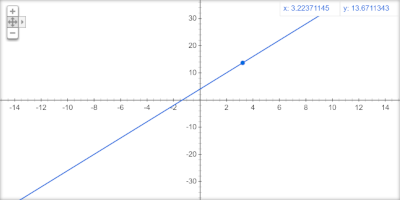
Hopefully it's not too much for you; from memory, it's something like late elementary school / early high-school material. -
Is space/vacuum a substance?Paul Davies goes a wee bit overboard on occasion, . Jus'sayin. :)
Besides, whereas the Information thing (capitalized) is interesting enough to pursue as such of course, to paraphrase Gamez, it's just another sample "all-embracing monstrous metaphysical vision" when taken wholesale. -
Why is there something rather than nothing?Nothingness (Stanford Encyclopedia of Philosophy)
Over 12,000 words. Much ado about nutn' it would seem.
Nothing (Wikipedia)
Just under 2,000 words.
An Essay on Nothing (Sophia Gottfried, Philosophy Now)
Just over 1,000 words. You'd think there wasn't much to talk about, but I guess there is. -
Does the mind occupy a space?, in analogy, driving ≠ the car, walking ≠ the legs, ...
Sure, the car and the legs are involved, but there's a category difference.
Mentioned observations (coherently) suggest similar categories where mind and body are concerned. -
What are your positions on the arguments for God?So it's everything all the way down? — Punshhh
There's something other than everything...? Odd. :)
No known phenomenon has ever been best explained by the gods or supernatural magic — could literally be raised to explain anything and therefore explains nothing, not itself explicable, cannot readily be exemplified (verified), does not derive anything differentiable in particular, has consistently been falsified in the past — literally a non-explanation.
The gods are similar to things we know aren't real and unlike things we know are real; no gods are unambiguously detected by unbiased observers; gods take idealized forms that the person can conceive and hold attitudes and values the believer projects into them.
Every posited god that has things of utmost importance to tell all mankind (perhaps like worship, perhaps the importance of whichever religious scriptures) has failed (not almighty) or is deceptive (not omnibenevolent).
But, hey, ...
Do we always strand on "the unknowable", "the ineffable" or some such (by way of Sagan's procedure)?
jorndoe

Start FollowingSend a Message
- Other sites we like
- Social media
- Terms of Service
- Sign In
- Created with PlushForums
- © 2026 The Philosophy Forum