
Comments
-
Post truthQuote seemed relevant to the thread, e.g.
[...] unable to distinguish between what feels good and what's true — Sagan
The Demon-Haunted World
Sagan got it. :)
Heya creativesoul, hope all is well on your end. -
Categorical non-existence: what it was really aboutConclusion: Therefore, it is not possible for God to categorically not exist (existence is an essential property of God). — Brian A
It seems there are two separate issues here. The first is whether God exists. But the second is that supposing he does exist, is it possible for him to categorically not exist. And to this I say no, since existence is an essential property of God, in the same sense, perhaps, that "having a horn" is the essential property of a unicorn. — Brian A
Some of those snippets could be construed as misuse of language.
Existence is not a predicate
∃ and quiddity
Can't define stuff into existence. -
Objections to the Kalam Cosmological Argument for GodNeed some counter-examples of causal closure.
every physical effect (i.e. caused event) has physical sufficient causes — http://philpapers.org/archive/VICOTC.pdf -
Objections to the Kalam Cosmological Argument for GodFishfry and, I expect most of the others that have responded to your thread, is/are perfectly familiar with Hilbert's Hotel, and why it is not an argument for any statement other than 'aren't infinities interesting?' Ditto for Aristotle's notions of potential and actual infinities. — andrewk
(Y)
Hilbert’s Hotel and Shandy’s Diary, for example, are what we call veridical paradoxes, and do not imply a contradiction, but they do show some counter-intuitive implications of infinites. -
Objections to the Kalam Cosmological Argument for GodSome select objections from the trenches …
- even if sound, the argument does not suggest anything “divine”, sentient, conscious, thinking, caring, loving, warranting worship or prayer, so the argument requires more to be of particular relevance
- if gods/God can be atemporal (changeless, “outside of time”, or something), assuming that makes sense, then we might suppose any such “origin” of the universe
- if there was a definite earliest time (or “time zero”), then anything that existed at that time, began to exist at that time, and that includes any first causes, gods/God, or whatever else
- phrases like “before time” and “a cause of causation” are incoherent, violates identity (the 1st law)
- by contemporary cosmology (e.g. Big Bang) spacetime is an aspect of the universe …
- spatiality and temporality are aspects of the universe
- causation is temporal
- therefore causation is an aspect of the universe, not somehow “outside”
- dichotomistically …
- if some God of theism could create something out of “nothing”, as it were, then nihil fit ex nihilo is already violated, and we might as well dispose of the principle, in which case said God is an extraneous hypothesis
- if some God of theism created the universe from something already existing, then whatever comprise the universe “always” existed, perhaps “eternally” (to the extent that’s meaningful), and we might as well dispose of the extras, including said God
- therefore God is neither implied nor necessary, and may be shaved off and flushed by parsimony
- there are viable alternatives to a definite earliest time, including an infinite past duration (which does not imply a contradiction however counter-intuitive), or a no-boundary, “edge-free” universe (which is not infinite in past duration)
- the 1st premise may be questionable or ambiguous in light of virtual particle pairs, quantum fluctuations, radioactive decay, spacetime foam/turbulence, the “pressure” of vacuum energy, the Casimir effect, Fomin’s quantum cosmogenesis (and successors), etc
- God = not spatiotemporal incorporeal mind ⇒ such an “entity” would “be” no-where and no-when; thinking, decision making, acting, etc, would be impossible; such an entity could not be characterized as “free”
- a supposed supernatural “beyond” is like an explanation that isn’t really much of an explanation to begin with (gaps, creative inventions)
-
Cosmological Arg.: Infinite Causal Chain ImpossibleI still cling old-fashionedly to the notion of 'universe', 'uni' meaning 'one'. — Wayfarer
Hey hey, I don't want to be one with Stalin. Gross. :D -
Categorical non-existence: what it was really aboutWhat do you mean by logical consistency? The principle of non-contradiction? — Thorongil
It was round up in the old The Bare Necessities thread. Possible worlds maintain standard logic by definition:
- identity, x = x, p ⇔ p
- non-contradiction, ¬(p ∧ ¬p)
- the excluded middle, p ∨ ¬p
- double negation (introduction at least), p ⇒ ¬¬p
- modus ponens/tollens
And necessities hold for every possible world (even simple ones), so what do they all have in common? Consistency.
You think God is the principle of non-contradiction? That is incoherent. — Thorongil
I don't think anything in particular, except that defining God as necessary seems to resign God to some sort of triviality, like consistency. Maybe that is incoherent (it's not my definition). As mentioned, it seems "safer" to assert that God is necessary for our world (and call it a day). -
Cosmological Arg.: Infinite Causal Chain Impossible, well, are whatever aspects of our universe anything like a (dense) continuum?
If yes, then there might be infinitudes of different "almost alike" changes among, say, different expansions and/or contractions ('inbreathing and out-breathing of Brahma', as you put it).
Even finite (definite) constraints might allow infinite possibilities; over an infinite duration, no two identical "states" may ever have been.
Anyway, I think these considerations can easily become rather complicated.
Peripherally related: No-cloning theorem -
Categorical non-existence: what it was really about@Thorongil:
1. if God exists, then he exists necessarily (cannot not exist) — Thorongil
2. if any x is (modally) necessary, then x is something like (logical) consistency — The Bare Necessities
3. therefore, if God exists, then God is something like (logical) consistency — 1 and 2
[...] which seems rather different from the more elaborate gods in theism. — jorndoe -
Categorical non-existence: what it was really about@Brian A, @Thorongil, it seems "safer" to assert that God is necessary for our world.
Though of course we don't know exactly what our world is (for that matter, I doubt omniscience is attainable). -
Categorical non-existence: what it was really aboutI don't think that's what he's doing, though. I've struggled with this too, but I think the claim is that if God exists, then he exists necessarily (cannot not exist). The "if" entails composing proofs, and giving a proof is different from merely stipulating a definition. — Thorongil
As per The Bare Necessities, if any x is (modally) necessary, then x is something like (logical) consistency.
Necessities, N, is the conjunction of possibilities for every consistent world:
where P(w) is true propositions for w.
You could chain these together
- if God exists, then he exists necessarily (cannot not exist)
- if any x is (modally) necessary, then x is something like (logical) consistency
But this is just logic.
Things become significantly more complex if we move to nomological (or physical or whatever). -
Cosmological Arg.: Infinite Causal Chain Impossible, I don't think so, at least not logically/mathematically.
Infinites require careful treatment; they're not numbers.
The non-positive integers, {..., -2, -1, 0}, for example, is infinite yet does not contain the number 1.
1. in an infinitude of numbers, there are every kinds of numbers
2. there are infinite whole positive numbers {1, 2, 3, ...}
3. therefore there are negative numbers among them
4. contradiction, 1 is wrong
But it goes further than that.
As it turns out, ∞ is ambiguous if you will; in fact, there are infinite different kinds of ∞, of all things.
Additionally, the rationals and the reals are dense; between any such two different numbers, there's a third number different from both.
On the other hand, if we're talking nomological (or physical), then who knows; things are suddenly much more complex.
Regardless, both an infinite past, and a definite earliest time, have counter-intuitive implications.
EDIT: I read this snippet roughly as "if the universe has an infinite temporal past [...]", which may have been a misinterpretation.
if the universe were eternal [...] — Wayfarer -
Categorical non-existence: what it was really about, I think I'd have to agree.
Non-existence can be linguistic only. -
Categorical non-existence: what it was really aboutThis is a contradiction in terms, according to Aquinas' definition of God: ipsum esse subistens, or the subsistent act of being itself. — Brian A
I don't think you can define something into existence, as it were.
If you define G to be (modally) necessary, then G becomes reduced to something like (logical) consistency, which seems rather different from the more elaborate gods in theism.
The Bare Necessities (old thread on the logical modalities) -
Cosmological Arg.: Infinite Causal Chain Impossible, as far as I can tell it just means that there's no purely logical argument either way, rather it comes down to evidence.
Sure, the evidence we have thus far, which Big Bang (mostly) is based on, suggests that (at least) the observable universe was significantly denser and "smaller" in the distant past, and has been expanding ever since. Supposing a non-infinite past, there are still some options. Whether or not it had a definite earliest time or not is speculation I guess.
The strongest intuitive argument against an infinite past I know of, is allegedly due to Wittgenstein:
However, completing an infinite process is not a matter of starting at a particular time that just happens to be infinitely far to the past and then stopping in the present. It’s to have always been doing something and then stopping. This point is illustrated by a possibly apocryphal story attributed to the philosopher Ludwig Wittgenstein. Imagine meeting a woman in the street who says, “Five, one, four, one, dot, three! Finally finished!” When we ask what is finished, she tells us that she just finished counting down the infinite digits of pi backward. When we ask when she started, she tells us that she never started, she has always been doing it. The point of the story seems to be that impossibility of completing such an infinite process is an illusion created by our insistence that every process has a beginning. — https://books.google.com/books?id=VXEuCgAAQBAJ&lpg=PT197&pg=PT197#v=onepage&q=%22Five,%20one,%20four,%20one,%20dot,%20three!%20Finally%20finished!%22&f=false
There is no logical or conceptual barrier to the notion of infinite past time.
In a lecture Wittgenstein told how he overheard a man saying '...5, 1, 4, 1, 3, finished'. He asked what the man had been doing.
'Reciting the digits of Pi backward' was the reply. 'When did you start?' Puzzled look. 'How could I start. That would mean beginning with the last digit, and there is no such digit. I never started. I've been counting down from all eternity'.
Strange, but not logically impossible. — http://www.philosophypathways.com/questions/answers_47.html#94
There are also counter-intuitive implications of a definite earliest time. -
Cosmological Arg.: Infinite Causal Chain ImpossibleHere are two arguments that an infinite past is logically impossible, and why they’re wrong.
Last Thursdayism:
- assumption (towards reductio ad absurdum): infinite temporal past
- let’s enumerate past days up to and including last Wednesday as: {..., t, ..., -1, 0}
- that is, there exists a bijection among those past days (including Wednesday) and the non-positive integers
- now come Thursday
- observation: {..., t, ..., -1, 0} cannot accommodate Thursday
- let’s re-enumerate the same past days but including Thursday as: {..., t, ..., -1, 0}
- that is, there exists a bijection among those past days (including Thursday) and the non-positive integers
- observation: {..., t, ..., -1, 0} can accommodate Thursday
- the two observations are contradictory, {..., t, ..., -1, 0} both cannot and can accommodate Thursday
- Conclusion: the assumption is wrong, an infinite past is impossible
Note, this argument could equally be applied to infinite causal chains, and nicely lends support to the Omphalos hypothesis (hence why I named it Last Thursdayism). Another thing to notice about the infinite set of integers: Any two numbers are separated by a number. And this number is also a member of the integers. The integers are closed under subtraction and addition. For the analogy with enumerating past days, this means any two events are separated by a number of days. Not infinite, but a particular number of (possibly fractional) days. That’s any two events. To some folk this is counter-intuitive, but, anyway, there you have it.
The first observation is incorrect. Whether or not the set can accommodate Thursday (one more day), is not dependent on one specific bijection (the first selected), rather it is dependent on the existence of some (any such) bijection. A bijection also exists among {..., t, ..., -1, 0} and {..., t, ..., -1, 0, 1}, and the integers, for that matter.
Therefore, the argument is not valid.
The unnumbered now:
- if the universe was temporally infinite, then there was no 1st moment
- if there was no 1st moment (but just some moment), then there was no 2nd moment
- if there was no 2nd moment (but just some other moment), then there was no 3rd moment
- ... and so on and so forth ...
- if there was no 2nd last moment, then there would be no now
- since now exists, we started out wrong, i.e. the universe is not temporally infinite
Seems convincing at a glance?
In short, the argument (merely) shows that, on an infinite temporal past, the now cannot have a definite, specific number, as per 1st, 2nd, 3rd, ..., now. Yet, we already knew this in case of an infinite temporal past, so, by implicitly assuming otherwise, the argument can be charged with petitio principii. That is, the latter (conclusion) is a non sequitur, and the latter two could be expressed more accurately as:
- if there was no 2nd last moment with an absolute number, then there would be no now with an absolute number
- since now exists, we started out wrong, i.e. any now does not have an absolute number
Additionally, note that 1,2,3 refer to non-indexical “absolute” moments (1st, 2nd, 3rd), but the following steps are indexical and contextual (2nd last, now), which is masked by “... and so on and so forth ...”. We already know from elsewhere (originating in linguistics) that such reasoning is problematic.
Still no proof, as some of the religious apologists propose. :-| -
Capital PunishmentI'm admittedly biased against the death penalty (possibly culturally), but tried to round up some pros and cons a while back.
Some pros:
- retribution
- an eye for an eye, punishment fits the crime
- deterrence (except for places where shown ineffective)
- cost (except for places where execution is actually more expensive than alternatives, depends on legal system)
- permanent incapacitation (e.g. prison escape and subsequent recurrence avoided)
- practical
- modern science grants higher certainties (DNA, genetics)
- everyone dies eventually in any case
- closure to victim's family and friends
Some cons:
- wrongful execution, seemingly faced with faceless/anonymous executioners (also see argument con below)
- finality (also see argument con below)
- consistency (also see argument con below)
- slippery slope; plus potentially setting dangerous precedence
- sending wrong messages (why kill people who kill people to show killing people is wrong?); two wrongs don't make a right
- human rights, value of human life, "inhumane" societal action, international trust/acceptance
- execution may be painful and accompanied by emotional anguish
- somewhat "barbaric", "brutal", a "primitive feel", or otherwise uncivilized (two wrongs don't make a right again)
- capital punishment makes it easier to ignore in-depth understanding, e.g. social causes
- edge cases (like mental illness)
- victims cannot be brought back to life in any case
- impact on convict's family and friends
Sample implementations of the death penalty:
- Saudi Arabia is a theocratic monarchy that has a special police force trained to weed out witchcraft and magic, for example. They have put people to death for protesting against the system, criticizing superstition, apostasy and whatever else, and here criticizing means speaking or writing. There's a (summary) process in place, by which "undesirable" elements can be "dealt with".
- Some states in the US has a much better implementation in place. Yet, here determining guilt falls back on a jury and a couple hired lawyers (of whichever experience/skills). An execution is irrevocable, with no uncertain finality. The determination of guilt is clearly less certain. And this discrepancy can put retentionists into the same category as those they may execute.
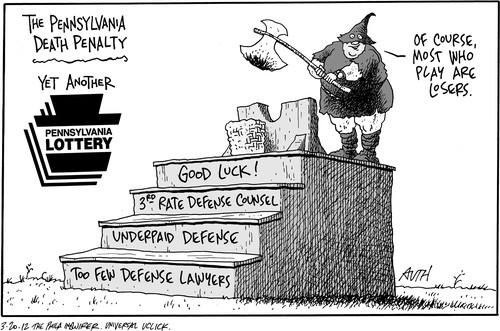
If we're talking morality and justice, where does that leave us? There are examples of abolitionist countries with relatively low crime rates. Might be worthwhile taking a look at their example?
Here's an argument con:
Determining guilt is less accurate, than execution is irreversible, and thus (morally) disproportionate. Hence, given the irrevocability, voters-gone-executioners-gone-killers ought be held accountable and responsible, and face their own music. By appeal to logical consistency:
- wrongful capital punishments are known to have occurred (including youngsters), so who's responsible?
- in such cases, those that endorsed death penalty have (knowingly by their decision) caused wrongful deaths, with the exact same effect as murder
- should those that endorse death penalty hide behind legalities as a means to justify death penalty, comfortably from their chairs?
- in case of wrongful capital punishment, the endorsers should be subject to their own sentiment ("an eye for an eye")
- are you (the retentionist) promptly willing to stake your own life thus?
Aren't we better than this?

-
J. J. C. Smart on SensationsAren't Levine's explanatory gap / Chalmers' mind-body thing usually brought up to complain about this stuff?
It's worth noting, though, that the partitions of such a gap do not contradict, which would be a stronger argument. -
ReincarnationI wasn't summing up SP. I was explaining the circumstances in which the denial of absolute space impacts truth aptness. — Mongrel
Right. Speaking of constant motion typically requires two objects, moving relative to one another. Acceleration does not, since one can determine a force, like gravity, while accelerating. The same holds for rotation. -
Reincarnation
-
ReincarnationSP says that for an object in a void there is no true statement about its motion. Period. — Mongrel
Isn't that Galilean invariance? (SP = special relativity?)
There are a few things, like the equivalence principle and constant light speed, playing roles in relativity. -
ReincarnationThere is nothing natural in quantum. — Rich
Huh? The microworld is unnatural or something? :o
Seven wonders of the quantum world (Michael Brooks, New Scientist) — jorndoe -
ReincarnationI don't get it. Why postulate that such idealism is popular/prevalent/undeniable among academics, when that's just not the case?
Source: https://philpapers.org/surveys/results.plExternal world: idealism, skepticism, or non-skeptical realism? non-skeptical realism · 82% (760/931) other ················· 9% (86/931) skepticism ············ 5% (45/931) idealism ·············· 4% (40/931)
(Here skepticism should perhaps be read as parsimonious skepticism, albeit not radical.)
In an ontological sense, such idealism will have it that the Moon is not actually the Moon, but rather is Moon-experiences. There may be all kinds of chatter about the Moon as if it's real, but, on idealism, I'm led to understand that experiencing the Moon cannot be separated from the experiencer (even in principle), such chatting is like a kind of pretense (maybe even hypostatization), or just linguistic practice perhaps. So there's no mind-independent Moon as such, it's dissipated according to this inquiry, rather it's relata among the experience (e.g. qualia, phenomenological) and the experiencer (the self). All I (the self) can ever know is the experience, and so that's where the road ends, more or less literally. The Moon = those Moon-experiences.
It's been discussed plenty, and remains sort of strangely artificial. OK, maybe "artificial" isn't the right word, but you catch my drift. Sure is self-elevating. I'm not omniscient, since otherwise I'd know that I were. I don't have to experience someone else's self-awareness to take it's independent existence for granted; I don't have to become the Moon to take it's independent existence for granted; I learn of both much the same way, by interaction, observation, whatever.
I'm aware of Hameroff's Orch-OR. Wave-function collapse does not take consciousness. But of course mind is also part of the world per se, whatever exactly it all may be. As mentioned, hijacking quantumatics for idealism is not philosophy, neither scientific.
Is “information is physical” contentful? (Scott Aaronson, Jul 2017)
Seven wonders of the quantum world (Michael Brooks, New Scientist) -
Reincarnation
-
Reincarnation@Rich, hijacking quantumatics for idealism isn't philosophy, it's common in New Age woo though.
Have you discovered a derivation of qualia from quantum mechanics? (I suppose that would be something.)
The observer effect illustrates a difference between causation and interaction.
I haven't come across anything in quantum mechanics that necessitates what we think of a minds, nor derive minds, nor is incompatible with minds; maybe you've come across something otherwise?
You Aren't Living in a Hologram, Even if You Wish You Were (Ryan F Mandelbaum, Gizmodo, Jan 2017) -
The pros and cons of Theism and other religionsI incidentally came across this illustration the other day:
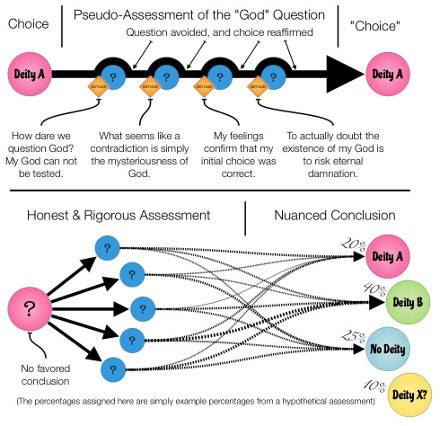
Outsider test (Iron Chariots Wiki article)
Ignosticism (Wikipedia article) -
Existence is not a predicate@Joseph, @fishfry, technically these are well-formed propositions with mixed quantifications:
- ∀x∈S ∃y∈S φ(x,y)
- ∃x∈S ∀y∈S φ(x,y)
I'm not sure anyone wrote up a concise grammar for their syntax in general, but that'd be interesting to take a look at (feel free to point me in their direction if you know any).
In computing there are analogies to be found in comprehensions.
[...] if it's problematic, it's logic that has a problem, not existence. If existence declares that particles are waves or whatever quantum weirdness you care to mention, logic will just have get it's act together about it. — unenlightened
Yep. -
Existence is not a predicateApologies @unenlightened, skim-reading is poor reading, my bad. The two propositions, "existence is not a predicate" and ∃x∈S [ φx ], are sufficiently different that I couldn't formulate the former as an example of the latter.
- ∃ ∉ Φ, where Φ is all φs (no unrestricted comprehension please)
Philosophy and forums? In my own case, also looking for (in)consistencies among different things, e.g. ∃ and quiddity (old post).why should we care about answering this question? — Agustino
In this case, any such meanings (including hypothetical) already exemplifies existence. Seems in some ways, existence is auto-presupposed.Well, what does it mean to exist? — Michael
Anyway, using existence as a predicate can sometimes lead to nonsense, and other times make sense. So, ∃ is not just another φ, except sometimes it is? -
Existence is not a predicate@TheMadFool, how to demarcate fictional and real entities?
If you suppose that a fictional entity exists, then what would it take for it to be real?
It seems like fictional (not real) entities exist as their hypotheses (or definitions) alone.
@unenlightened, according to those pesky objectivists "existence exists", though I think Russell argued otherwise.
Does existence then not exist...? Maybe we should have a poll on that one as well.
How about this one? "There exists an apple in the bowl of apples, so that apple does not exist." :)
There are cases where "existence is a predicate" comes through as nonsense, which makes me think that (generally) "existence is not a predicate".
As far as I can tell, there isn't anything further that "to exist" can reduce to; existence is ground if you will.
Another angle:
We commonly characterize things by predication, quiddity — what those things are.
These are different propositions from merely existing though — that something exists.
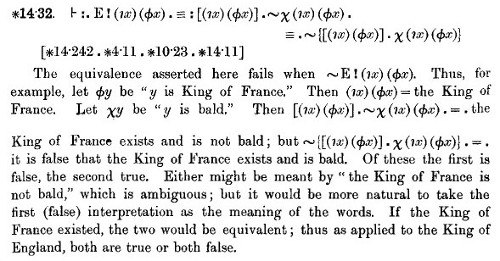
By the way, is the King of France bald or not?
Russell and Whitehead:
-
Climate change and human activitiesIt is hard to filter through all of that, and to ascertain any religious influence that would enable people to become susceptible in believing either for or against such as whether it is apocalyptic in nature or whether it is simply impossible unless deterministically willed otherwise is really hard to tell. I would assume that the large masses of religiously devout who also tend to have conservative leanings fall into a trap of climate change denial because of the political rather than the religious. — TimeLine
Yep.
Though, one of the reasons for posting the poll was that a climate-change-denier elsewhere wrote (paraphrased) "God is in control", "There's nothing we can do", and some others seemingly agreed.
Made me think if such sentiments can have unfortunate consequences, hence the bottom part of the opening post (education, informing). -
Climate change and human activities, yeah, effective regulation is a problem.
That said, you'd hope the ethics is informed by the science, and the politics informed by both.
Worst case could resort to sanctions I suppose, it's been done before anyway albeit with mixed success.
Free-rider problem (Wikipedia article)
Tragedy of the commons (Wikipedia article) -
Climate change and human activities, dang, got me. :)
(Let me just add, Danish cities don't have anything on Amsterdam when it comes to bicycle-rule.) -
ReincarnationOh, sorry, I didn't mean "parallel universes" necessarily like modal realism (possible worlds), many worlds (quantum mechanics), multiverse (e.g. ensemble, M-theory, brane collisions), or whatever.
Just "other realities" that are temporal, as per the previous posts.
Principle of charity (Wikipedia article) -
Reincarnation, the plot thickens. :)
Souls are then defined as parts of us living in parallel universes?
But why, what's all this stuff for, what's it supposed to account for...?
And how would we differentiate it all from fiction? -
ReincarnationA field is a concept based in spacetime. The fact that the position of the particle cannot be determined through the use of the field indicates that there is activity outside of the field (not covered by the field), and quite likely outside of spacetime. — Metaphysician Undercover
An activity outside of spacetime? Activities take time.
Not exactly parsimonious to come up with a parallel universe of sorts. :) -
Are 'facts' observer-dependent?I cannot discuss you without utilizing my perceptions of you. — Rich
Right. What other than perception would you suggest? -
Are 'facts' observer-dependent?It's impossible to discuss the moon without discussing both our perception and the linguistic dynamics of our perceptions and representation of the moon. There may be an object preceding those things, but it's impossible for us to access that except through our perception and language, which are greatly linked. — Thanatos Sand
Let me try to misquote you for the occasion:
It's impossible to discuss jorndoe without discussing both Thanatos Sand's perception and the linguistic dynamics of Thanatos Sand's perceptions and representation of jorndoe. There may be a jorndoe preceding those things, but it's impossible for Thanatos Sand to access that except through Thanatos Sand's perception and language, which are greatly linked.
If anything significant differentiates fictions/fantasies/hallucinations/dreams (which do exist) and perception, then it must be the perceived (the Moon, jorndoe).
Hopefully you wouldn't (rudely) suggest that I'm not self-aware because you cannot experience my self-awareness? :) -
Are 'facts' observer-dependent?Seems like we could discuss ...
• the Moon
• perception of the Moon
• linguistic practices of Moon discussion
They're not the same, so shouldn't we keep them as such? -
Are 'facts' observer-dependent?Thanks for further showing that "round" is just a linguistic concept dependent on other equally non-materially based linguistic concepts as itself. So, use whatever words you want when you chat about the moon. All you'll be doing is using words, not accurately describing the moon itself. — Thanatos Sand
Are you claiming that language is only ever about language? Or about concepts? :o
That doesn't seem right.

jorndoe

Start FollowingSend a Message
- Other sites we like
- Social media
- Terms of Service
- Sign In
- Created with PlushForums
- © 2026 The Philosophy Forum