
Comments
-
Political Spectrum Test
I don't think it's crazy at all. From a pragmatic point of view, there's nothing worse than a traitor. That's why, for example, in Chinese strategy manuals it is advised to kill traitors after you use them, because they are scum, good for nothing, when the world is most dear to you, they will betray you. That's why nobody from a pragmatic point of view likes traitors. Traitors lack commitment. Traitors mean disaster.That's crazy. And no, everyone doesn't. In some cases, many people share my view that they should be lauded for doing the right thing in difficult circumstances. — Sapientia
Nope - the ends don't justify the means.Deception isn't immoral in itself, and in some situations it would form part of a moral act. — Sapientia
Yeah, maybe in another lifetime you bother to actually provide it :-!and especially if there is good reason to reject it (which there is). — Sapientia -
A Simple Argument against Dualism
:-}The soul, having its existence anchored in the non-physical side of the present, has some capacity to control how the physical comes into existence at each moment. Therefore it moves the physical body. — Metaphysician Undercover
Right and this soul goes out of the body upon death and into some other realm right? Where was it before birth? Why don't I remember anything? -
Political Spectrum Test
>:O Like 30% of the questions are sexually related...That moral foundations test is terribly designed. Almost all of the questions are super abstract. It doesn't test how you think about things; it tests how you think, abstractly, about your moral self-image. This one, though clearly low-rent, is way better. It's not great, by any means, but it at least has the virtue of being concrete. — csalisbury
I've done it and.... disaster :P :
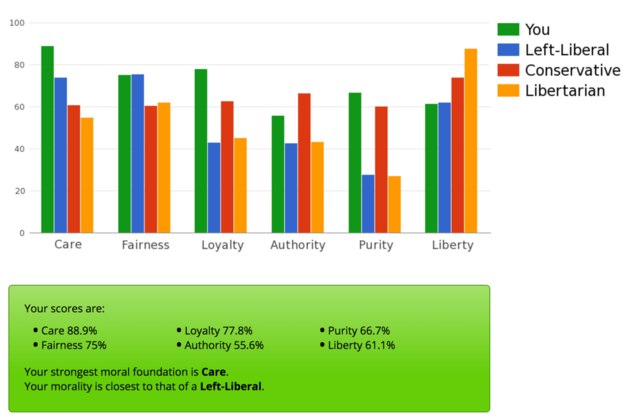
It says I am a Left-Liberal :’( ... What should I do?
>:O
I seem to share more with Left-Liberals on care, fairness and liberty, and more with conservatives on Authority, Loyalty and Purity, even though I out-do the conservatives for the latter two :P -
Political Spectrum Test
No I can't accept that. It wouldn't have been good to betray the Nazis, it would have been good to oppose them. That is different. Everyone hates traitors, even those who benefit from them.It would've been good to betray the Nazis. If you can't accept that, then there's a big problem with your moral foundations. — Sapientia
These are acts of betrayal. There is a difference between betrayal and oppositionwhich you can do without either letting them know beforehand or deceiving them — Sapientia
:-} Deception is still immoral, but maybe necessarily immoral per @Heister Eggcart's usage of the term in such circumstancesAnd anyway, if deception avoids terrible consequences, such as those risked in a hostage situation, then deception is the good option in contrast to bad options. — Sapientia
And this is your personal view as well, not a truth about matters themselves.That's your personal view of character, not a truth about character itself. — Sapientia
If you don't do it in that case, then you are immoral. So it is a need if you want to be moral.Firstly, it isn't about "need" or "has to be". It's about what ought to be. I don't need to do anything. — Sapientia -
Schopenhauer's Transcendental Idealism
So it seems you are denying premise (3) [you can't deny 4, that is a conclusion]. So you think non-empirical objects are perceived empirically. I'd say this is just false. Or alternatively, you think that there can be purely conceptual knowledge, void of any perception, such as the geometric objects which are abstracted from perception a posteriori (this is a denial of [1]). If you deny (1), then you have negated S/K's foundations.Yes, but they are derived empirically, and this is where I part company with K/S — Thorongil
What does being mediated by space entail?what we observe empirically isn't space but objects that are in space, which is to say, objects that are mediated, in part, by space — Thorongil
If you know space a priori, in what does this knowledge and perception consist?That being said, it is still true that we perceive and therefore know space, but this perception and knowledge is a priori. What I mean by a priori is not "based on reason alone," but "logically prior to experience." — Thorongil -
A Simple Argument against Dualism
... How do you conceive of such a thing? Can a foot and a stone be at the very same point in space at the same time? How is that possible?Yes. — The Great Whatever
No, feet and stones have the same nature in that both are composed of one substance - atoms and void 8-)Well, that's obviously false. Feet and stones have different natures, yet a foot can kick a stone. — The Great Whatever
I'm still waiting for you to show me a thought kicking a physical stone. -
Has Wittgenstein changed your life?Yes, TLP has greatly influenced me. There is a reason why I call Wittgenstein my favorite philosopher.
Personally, TLP has taught me a kind of deflationary skepticism - I read Wittgenstein as a Pyrrhonist, dissolving philosophical problems and achieving ataraxia by the suspension of judgement.
Quaint to say for an admirer of Wittgenstein. Wittgenstein was thoroughly anti-Platonic.To me it was almost as if grasping the Platonic form in words, as I am a Platonist for the matter — Question -
Political Spectrum Test
No, it's never good to betray them. Betrayal involves deception, and that's never good. Having character emerges out of loyalty - it is loyalty that structures the character.But it is good to betray bad principles, people, etc., whether you dislike or or not. And having character is not equivalent to loyalty; loyalty is just a single quality or characteristic, whereas having character means more than that. — Sapientia
Yes, but when it exists in its proper form it has to be accorded with the necessary respect, and it would be immoral not to.So authority is secondary. Whatever makes the authority right in its views is primary - and I think that that very often relates to fairness and harm. — Sapientia
YesThere should be, but only when those conditions are met. — Sapientia -
Political Spectrum TestPersonally I found the test better relative to the others. I found that even on those questions where something had to be sacrificed, because of the gradations of answers (slightly agree, moderately agree, strongly agree, etc.) one could answer somewhat satisfactorily.
I answered "slightly disagree" on this one because I'm not exactly proud of my country, nor do I think this is a moral value. At the same time, neither is not being proud of your country a moral value so... Slightly disagree fits the best.I am proud of my country's history — TimeLine
I answered "moderately agree" - I could see exceptions, but for the most part they should be loyal to family. For example if my wife or child steal something, I'll do my best to save them from facing the consequences of it, especially if it was the first time they've done such a thing, and they were compelled by some reasons to do them. Now obviously I'd also try to convince them never to do such a thing again. But then it depends, in some circumstances I wouldn't defend them - say if my child rapes someone, then I wouldn't be loyal to him. So it depends on the gravity of the offence, and on their intentions."People should be loyal to their family members, even when they have done something wrong" — TimeLine
I answered "slightly agree" because you're in the army - you have to obey, for the most part. The only times when you can disobey is when you have (1) tried to convince your commander otherwise, and (2) when what you're being asked to do goes against the interests of the army. For example if the commander orders something that consists in betraying the cause the army is fighting for, then you have grounds to disobey. If the commander proposes a course of action you disagree with, you can try to convince the commander otherwise, but ultimately you must listen to what he says - he's the commander for a reason. Without such principles the army couldn't function, nor could pretty much any other organisation."If I were a soldier and disagreed with my commanding officer's orders, I would obey anyway because that is my duty" — TimeLine -
Political Spectrum TestLoyalty is the most relevant in my opinion. There's probably nothing that I dislike more than betrayal. Having character is equivalent to loyalty - loyalty to principles, people, etc.
And yes, being loyal would indeed lead to immortality, as you yourself say :D
As for authority, it is moral to obey authority when (1) that authority is right in its views and (2) you clearly perceive it is so. To do otherwise is to be immoral. Therefore there needs to be respect for just authority. But yes, if the authority is wrong, then it isn't an authority anymore... Clearly! -
Schopenhauer's Transcendental IdealismYour only option really, is to think with John of a Big Mind which provides the forms of space, time and causality - back to Berkeley.
In Kant/Schopenhauer, knowledge necessarily involves perceptual and conceptual content (since they join both rationalism and empiricism). Geometrical judgements involve a spatial perception a priori (not an empirical perception) structured by the form of space itself. As you yourself note, lines are not material objects. So they can't be perceived empirically. How are they perceived? They are perceived a priori, through the form of space itself. Thus, if they are perceived a priori through the form of space itself, a form in which experience is then given, that means that no unperceivable feature of space can be found in experience, because if it is found, then it should have existed in the intuition to begin with.
So to structure it as an argument:
1. For something to be knowledge, it must contain both perceptual and conceptual content.
2. Geometrical objects and their properties are not empirical objects
3. Only empirical objects are perceived empirically
4. From (2) and (3) it follows that geometrical objects and their properties cannot be perceived empirically.
5. Geometrical objects and their properties are constructed and perceived a priori in the form of space provided by the cognitive faculties
6. Non-Euclideanness is a geometrical property that isn't / can't be perceived a priori in the form of space provided by the cognitive faculties
7. From (6), (5), (4) and (1) it follows that non-Euclideanness isn't a known geometrical property of any geometrical object since it only has conceptual content without any attending perception (rationalism without any empiricism) (it would contradict [1] if it was known) - it is neither perceived a priori (by [6]) neither can it be perceived a posteriori since it is a geometrical object/property (would contradict [5] or it just wouldn't be a geometrical object or a property of one (by [4]).
8. (7) is false
9. Therefore one of the premises is wrong.
Possibly (1), (2), (5), or maybe even (6) - I've seen people arguing that non-Euclideanness can be intuited but that's very rare. (2) can't be attacked since lines can nowhere in nature be perceived. (1) could be attacked, but bye bye to Kant and Schopenhauer's synthesis of rationalism/empiricism. (5) is the only possibility remaining granting (1) and (4), so can't really be attacked. An attack on (6) would just not be granted by most - few would say non-Euclideanness can be perceived a priori. -
Schopenhauer's Transcendental Idealism
But you also presuppose a model of space which individuates. That model of space isn't the space itself... And as space is ideal (as opposed to empirically real), how can something ideal be other than of the same kind a model is?No such thing exists. You're just referencing a mathematical model. That model, whether it's accurate or not, is not and cannot be identical to that which it is a model of, otherwise it would be the thing and not a model. I don't know how many times I need to say this.
If you possess mediate knowledge of something called "Euclidean space," or any other kind of space, that's great, perhaps you possess an extra special kind of cognition. But I don't. — Thorongil
Well I don't doubt the Trinity, because I said I believe it. I just don't understand what that means.I'm pretty sure doubting the Trinity is a big no-no for them. — Thorongil -
Schopenhauer's Transcendental Idealism
The latter is really just a degree of certainty or if not then it's just pure logical plausibility.Isn't it worth distinguishing between believing something to be true, and believing in the potential for something to be true? — Heister Eggcart -
Schopenhauer's Transcendental IdealismThe thing though is that a lot of what you'd see as unorthodox wouldn't be perceived as unorthodox by other orthodox Orthodox Christians :P
-
Schopenhauer's Transcendental Idealism
How would you define believing something then?One can believe something without claiming it to be the truth. — Heister Eggcart -
Schopenhauer's Transcendental Idealism
O:)Perhaps it's true that one can be an unorthodox Orthodox Christian — Thorongil -
Schopenhauer's Transcendental Idealism
Why stop there? The fact that 3D Euclidean space allows for a plurality of objects is true, but Euclidean 1D space doesn't for example. So clearly the individuation and the extent to which it is possible is governed by the geometrical properties of the space in question. So why stop with just those properties that ensure individuation? In fact, you necessarily bring about all the others if you try to do that.Only if by "how" we mean that it determines that things appear in the plural. — Thorongil -
Schopenhauer's Transcendental Idealism
Another thread!! :PHow is it that we know, with a very high degree of certainty, that there is an equal difference between one and two, two and three, three and four, etc.? Where do we derive this idea of equality? It seems that in all empirical observations we see no examples of such absolute equality. However, we seem to know with absolute certainty that there is an absolute equality with respect to the difference between the integers. — Metaphysician Undercover -
Political Spectrum TestYes, knowing your views on ethics I'd definitely class you as libertarian.
-
Schopenhauer's Transcendental Idealism
But amongst philosophers Orthodox Christians can be very different from each other. It's one thing to read Tolstoy, and a different thing to read, for example, Berdyaev. You'd claim that these two are also more heretical than they seem at first, and yet they are both Orthodox Christians.That people ought to take your declarations of being an orthodox Christian with a grain of salt. — Thorongil -
Schopenhauer's Transcendental Idealism
I'm sure it also determines how they appear...So space only determines that things are numerically distinct, not what they are — Thorongil
Yep, never disagreed on this.What determines what they are, i.e. what the essence of things is? The will. What determines what the will is? Nothing, for the will is groundless. — Thorongil
Well Tesla certainly didn't like Non-Euclidean geometry :P - but regardless, whether you call them attributes of space, or properties of space, it's the same thing really.I hold that space cannot be curved, for the simple reason that it can have no properties. It might as well be said that God has properties. He has not, but only attributes and these are of our own making. Of properties we can only speak when dealing with matter filling the space. To say that in the presence of large bodies space becomes curved is equivalent to stating that something can act upon nothing. I, for one, refuse to subscribe to such a view. -
Schopenhauer's Transcendental Idealism
What do you mean? Belief in itself is a truth claim isn't it? To believe something is to think it true.Belief doesn't require a truth claim. — Heister Eggcart -
Schopenhauer's Transcendental Idealism
Well you can be mistaken in both believing or not believing but you have to choose one.I'm laughing because, if I don't understand something, I do not believe it to be true. — Heister Eggcart -
Schopenhauer's Transcendental Idealism
But for example I believe in one substance because all other conceptions are incoherent. So it's not only empirical truths that I believe or those given by scriptural authority. I also believe in rational truths.The logical conclusion of that is that you should believe in nothing that is not either empirically given or given by scriptural authority. In which case, forget all (or at least most) of philosophy. — John -
Schopenhauer's Transcendental Idealism
Yes, as I said, back to Berkeley you goAll this is resolved if one thinks that time, space and causality originate in a Greater Mind and that there characteristics are only partially obvious to us. — John
Because space is an a priori form of our KNOWLEDGE. We know through space, hence space conditions our knowledge.So how can we presuppose that we can know all things about how space structure empirical experience? — John -
Schopenhauer's Transcendental IdealismI think I have performed a Copernican revolution actually to tell you the truth, and replaced the question "what must I know to be religious?" with "how can I still be religious in the absence of knowledge?" O:) :-O
-
Schopenhauer's Transcendental Idealism
>:O meaning?I've determined that Agustino is much more heretical than he appears. — Thorongil -
Schopenhauer's Transcendental Idealism
I think they should stop believing in them then. I believe it simply based on the authority of the Scripture, and recognise that I can't understand it.I haven't read that Tolstoy work. If you believe Christ was "God in spirit, Man in flesh" in a sense that other humans are not, then i can't see how that would not be to believe in the trinity. You say you don't know what your belief means, but what is the problem with that? People believe in the Trinity, or less ambitiously, the noumenal, or monistic substance or mind-independent physical reality or whatever; and I'm quite sure they don't really know what those really mean either. — John -
Schopenhauer's Transcendental Idealism
What allows those axioms to be possible if not space?No. Non/Euclidean geometry's axioms determine such things. Not space. — Thorongil
Why does space allow triangles to exist? Why isn't the nature of space such that triangles are impossible?I'm not sure what you're asking here. Your last question seems to commit the category mistake I listed above. Nothing can "govern" space. — Thorongil
Or a relationship.A possibility is a thing that may happen or be the case, so you're saying that a line is a thing, which is what I said. It is a object, albeit a mental object. — Thorongil
And what determines the possibility of non-euclidean axioms (and Kant and Schopenhauer have both critiqued the notion of axiom actually) if not the nature of space itself? When we postulate axioms, don't we actually refer to a specific kind of space?No. Non/Euclidean geometry's axioms determine such things. Not space. — Thorongil -
Schopenhauer's Transcendental Idealism
Okay but now you've evacuated the whole Kantian concept of a priori space of its meaning as it was given by Kant and Schopenhauer. Space being ideal for them guaranteed the truths of geometry - it made them synthetic a prioris. They applied to any and all experiences simply because the mind structured all experiences within Euclidean space. And it didn't guarantee the truths within the reference frame of Euclidean geometry only, it guaranteed them it terms of their applicability to the empirical world, precisely because the empirical world is structured to be, by the mind, in Euclidean space.You sound like John trying to talk about the thing-in-itself. A priori space is... a priori space: the logical expression of space itself. It doesn't tell us anything about the world and it's not meant to. All it deals is the logic of space.
In the case of Euclidean space, one has the logic of Euclidean space. The question of what's possible in the space doesn't make sense. Logic of Euclidean space doesn't apply outside itself and it doesn't need to. Many other things are possible of course, different logics which are true and may be used, but that doesn't affect Euclidean logic. It just means sometimes we need a different logic to talk about what we want to. — TheWillowOfDarkness -
Schopenhauer's Transcendental Idealism
Why do you think so? Have you read Tolstoy's Gospel in Brief? It was one of Wittgenstein's favorite booksChristianity falls apart without trinitarian theology. — Heister Eggcart
Why are you laughing it's true mate! >:O I'm just being honest>:O >:O >:O — Heister Eggcart -
Schopenhauer's Transcendental Idealism
I personally believe that Jesus is God in Spirit, and Man in flesh. But I wouldn't personally be very aghast at a Tolstoy re-reading of the Gospel as he does it in Gospel in Brief if you know it, where Jesus is just a man, given birth by a woman with an unknown father in the flesh. As I have said however, I believe Jesus is God in Spirit and Man in flesh but fuck if I know what that is supposed to actually mean. I'm a theist ignostic on this point.So Christ was not actually God Incarnate, but just a man, according to you? — John -
Schopenhauer's Transcendental IdealismKant and Schopenhauer both make the mistake of thinking that what we can perceive is all that can exist, and if we can't perceive it, it can't exist. The curvature of space we can't perceive directly - we only notice its effects.
-
Schopenhauer's Transcendental Idealism
No, since space is a form of knowledge - that which makes knowledge and experience possible - there cannot be any spatial knowledge to be gained by experience (hence why geometry is necessarily synthetic a priori and never synthetic a posteriori - Kant was very clear about this). If knowledge of space is gained by experience then that which was supposed to make experience possible in the first place was not known by the very mind which structured experience according to it - that's a contradiction.If there are parts of the empirical that currently lie beyond human experience, which I think Kant would certainly have agreed with, then they must be spatial right? — John
I think if we are loyal to Kant things are much more clear. If we try to see how good that Kantian approach is or can be, that is an entirely different question, and then you can take your interpretations, however unlikely and impossible they actually are for Kant himself, and use them. Indeed that's what pretty much all people who still call themselves Kantian have done.It is the presence of ambiguities like this in Kant , that are due to the enormous conceptual difficulties of the subject matter, that have allowed for the controversies in Kant scholarship about what it is that he actually meant; was he actually a kind of transcendental realist and so on. — John -
Schopenhauer's Transcendental IdealismRight but what is a priori space? A priori space doesn't say anything about the world, but it certainly says something about the possibilities that exist in the world, and this is precisely the problem. Since Kant and Schopenhauer identify a priori space with the Euclidean space given in our intuitions, what is possible in such a space, turns out to be more limited than what is actually possible in space as we encounter it.
-
Schopenhauer's Transcendental IdealismFor example, space being non-Euclidean determines that the angles in a triangle can add up to something different than 180 degrees, and inversely - space being Euclidean determines that the angles in a triangle necessarily add up to 180 degrees. The properties of geometric objects are the properties of space itself
-
Political Spectrum TestAfter you give your credentials to those motheryuckers, you can take it here:
https://www.yourmorals.org/aboutus.php -
Schopenhauer's Transcendental Idealism
They are possibilities which are determined to exist by the nature of space itself - by the properties of space. If space is 1 dimensional, there can be no relationships which we identify as triangles. That space simply doesn't allow them. So space determines, by its properties, what relationships are possible in it (hence what geometrical figures are possible, and what their properties must be).And what, pray tell, is a "pure spatial relation?" For what it's worth, Wikipedia disagrees with you. — Thorongil -
Schopenhauer's Transcendental Idealism
I do but I'm not big on the Trinity at all. I still consider One God to be more significant than the Trinity - the Trinity is a secondary development if you want out of that. Like one substance with multiple attributes.This is the predominant Christian idea of God: Father, Son and Holy Spirit, three-in-one. I'm puzzled that you would say it is nonsense, since I have been under the impression that you considered yourself to be a Christian.
:s — John -
Schopenhauer's Transcendental Idealism
If space has no properties, then how come lines are possible in it? How come circles are possible? How come any geometric figure is possible in it? What governs what is possible in space if not its properties? What governs what space is, if not its properties?No, my main point was that space has no properties. — Thorongil
Agustino

Start FollowingSend a Message
- Other sites we like
- Social media
- Terms of Service
- Sign In
- Created with PlushForums
- © 2026 The Philosophy Forum