
Comments
-
A short theory of consciousness
Perhaps you interpret "metaphysics" as the study of unreality, or of the supernatural. But that's not what I'm saying.Why metaphysical feelings? What does a feeling be metaphysical? — Raul
I have a unique definition of Meta-Physics that was derived from Aristotle's second volume of his Physics, and is tailored to fit my personal worldview of Enformationism. Basically, the natural, but immaterial, phenomenon that we call "Mind" or "Consciousness", is what I call Meta-Physics : the non-physical aspect of our world. Another term for this category is "Subjective Reality" Since we can't study the Mind empirically, we must investigate it philosophically. :smile:
Meta-physics :
The branch of philosophy that examines the nature of reality, including the relationship between mind and matter, substance and attribute, fact and value.
1. Often dismissed by materialists as idle speculation on topics not amenable to empirical proof.
2. Aristotle divided his treatise on science into two parts. The world as-known-via-the-senses was labeled “physics” - what we call "Science" today. And the world as-known-by-the-mind, by reason, was labeled “metaphysics” - what we now call "Philosophy" .
3. Plato called the unseen world that hides behind the physical façade: “Ideal” as opposed to Real. For him, Ideal “forms” (concepts) were prior-to the Real “substance” (matter).
4. Physics refers to the things we perceive with the eye of the body. Meta-physics refers to the things we conceive with the eye of the mind. Meta-physics includes the properties, and qualities, and functions that make a thing what it is. Matter is just the clay from which a thing is made. Meta-physics is the design (form, purpose); physics is the product (shape, action). The act of creation brings an ideal design into actual existence. The design concept is the “formal” cause of the thing designed.
5. I use a hyphen in the spelling to indicate that I am not talking about Ghosts and Magic, but about Ontology (science of being).
http://blog-glossary.enformationism.info/page14.html
Physics & Metaphysics :
Two sides of the same coin we call Reality. When we look for matters of fact, we see physics. But when we search for meaning, we find meta-physics. A mental flip is required to view the other side. And imagination is necessary to see both at the same time.
http://blog-glossary.enformationism.info/page14.html
Physics and metaphysics :
Aristotle divided the theoretical sciences into three groups: physics, mathematics, and theology. Physics as he understood it was equivalent to what would now be called “natural philosophy,” or the study of nature (physis); in this sense it encompasses not only the modern field of physics but also biology, chemistry, geology, psychology, and even meteorology. Metaphysics, however, is notably absent from Aristotle’s classification; indeed, he never uses the word, which first appears in the posthumous catalog of his writings as a name for the works listed after the Physics. He does, however, recognize the branch of philosophy now called metaphysics: he calls it “first philosophy” and defines it as the discipline that studies “being as being.”
https://www.britannica.com/biography/Aristotle/Physics-and-metaphysics
Science and metaphysics must work together :
https://aeon.co/essays/science-and-metaphysics-must-work-together-to-answer-lifes-deepest-questions -
Assuming there is a god do we invent software algorithms or do we adapt natural patterns....
I'm neither a mathematician, nor a coder. But, your question sounds like a version of the perennial provenance-of-Mathematics conundrum. Plato described Socrates leading an uneducated slave boy to deduce some theorems of geometry. From that example, Plato concluded that all knowledge is remembrance of eternal patterns of logic. And some genius mathematicians agree that their own amazing additions to the lexicon of abstract reckoning came to them intuitively & instantaneously like a miraculous vision. I'm not convinced of Plato's notion that the immortal soul is repeatedly reincarnated with access to a priori knowledge. But, it seems clear to me that the basic logic of the Cosmos (e.g geometric ratios & relationships) is somehow embedded & embodied in the human physique, including the brain.If we hypothetically said there was a god or god(s) do we invent software algorithms or do we adapt natural patterns that come from nature for use in our own problems. — turkeyMan
So, as an oversimplification of what math geniuses do, maybe they translate those innate abstract concepts into conventional symbolism and words. Then, they apply them to a variety of contexts, including the logical relationships of software algorithms. Einstein equated the beautiful logic of Nature with his notion of God. :smile:
Is Mathematics Invented or Discovered? : https://www.closertotruth.com/series/mathematics-invented-or-discovered
Math: Discovered, Invented, or Both? : https://www.pbs.org/wgbh/nova/article/great-math-mystery/
"Pure mathematics is, in its way, the poetry of logical ideas. One seeks the most general ideas of operation which will bring together in simple, logical and unified form the largest possible circle of formal relationships. In this effort toward logical beauty spiritual formulas are discovered necessary for the deeper penetration into the laws of nature."
___Albert Einstein
Man the microcosmos :

-
A short theory of consciousness
Yes. I was not trying to provide a complete analysis of the difference between visceral Emotions and mental Feelings. :smile:You're almost there but I think Damasio is more successful describing emotions and feelings (they re not the same thing). — Raul
Feeling our Emotions : For centuries, the fleeting and highly subjective world of feelings was the purview of philosophers. But during the past 30 years, Antonio R. Damasio has strived to show that feelings are what arise as the brain interprets emotions, which are themselves purely physical signals of the body reacting to external stimuli.
https://www.scientificamerican.com/article/feeling-our-emotions/
I was making an obscure reference to Damasio's distinction between physical Emotions and metaphysical Feelings, as abbreviated in the previous post. :nerd:motivating forms of physical Energy — Gnomon
Ufff... here you lost me. — Raul
Sorry. My Enformationism Thesis proposes a new paradigm of empirical physical Science & theoretical metaphysical Philosophy. So, it uses a lot of neologisms that combine some modern reductive materialistic concepts with ancient holistic incorporeal notions. You'd have to be really motivated to expend the mental energy to completely comprehend that novel worldview. In this forum, I'm only giving glimpses of that strange new world. The concept of Integrated Information is a highly technical version of the old idea of Holism : that a whole integrated system (such as a human brain) has new properties/qualities (self-consciousness) that are not evident in its component parts (neurons). :cool:Generic Information or EnFormAction — Gnomon
Lost again, your theory of consciousness is too long to digest but I'm curious on what you think about the Phi of Tononi and his IIT. Thanks. — Raul
Universal Consciousness :
* Because the problem of consciousness is a problem of definitions, some neuroscientists have decided to stick their necks out and define it. A popular recent definition is contained in integrated information theory, proposed by Guilio Tononi and Cristoph Koch. An apparent consequence of their definition is that pretty much anything can be conscious if it has the right sort of "information integratedness". A philosopher named Eric Schwitzgebel ran with this line of thinking, and attempted to show that If Materialism Is True, the United States Is Probably Conscious.
* To their credit, Tononi and Koch seem to have bitten the bullet and accepted a form of panpsychism — the idea that everything is conscious. Some philosophers dislike it when definitions are too broad : they call the process "bloating". But, it's a useful concept in my opinion. If everything from electrons to galaxies is somewhat conscious (by virtue of being somewhere on the "information integratedness" scale) then the concept of Consciousness becomes less useful as a descriptor of observable phenomena. (But then again, perhaps we never actually observe consciousness anyway. We observe with consciousness. Consciousness itself seems to have no material attributes: it is only the objects or targets of consciousness that have attributes. )
http://www.bothandblog.enformationism.info/page26.html
Generic Information :
Information is Generic in the sense of generating all forms from a formless pool of possibility -- the Platonic Forms.
http://bothandblog2.enformationism.info/page29.html
Note -- this use of "Generic" is not based on the common dictionary definition, but on the root meaning : "to generate novelty" or "to produce offspring".
The EnFormAction Hypothesis : http://bothandblog3.enformationism.info/page23.html -
A short theory of consciousness
Yes. Human consciousness has always been assumed to be awareness of the immediate present. But recent studies have shown that our awareness is always a beat behind the actual event. Part of that delay is the split-second it takes for processing of incoming information. But another part seems to be due to the necessity to compare the new information with memory, in order to assign it to a meaningful category of our worldview -- to make sense of it. So, our Present is always in the recent Past, and our projections into the future are mostly extrapolations from memory. :smile:but something critical to consciousness is awareness of time (past, present, future). — Outlander
I'm not aware of any evidence to indicate that human consciousness is significantly different from animal consciousness, or even from that of single-cell organisms. So it seem to be just a higher degree of general awareness (integrated information) of the internal milieu & external environment. Some have proposed that a moral conscience is added to animal consciousness along with the human soul. But almost all animated creatures appear to have some degree of social awareness & altruism. Yet, only humans seem to generalize that Me & You concept into abstract symbols & shareable words & viral memes. :nerd:What is human consciousness, as in consciousness that is allocated/available solely to humans? A mere advanced form of this or something much greater we've yet to understand? — Outlander -
A short theory of consciousness
Yes. Human emotions are hormonal effects that produce the feelings we crudely categorize as happiness, sadness, disgust, fear, surprise, and anger. But, in various contexts, those basic feelings interact to form more complex sensations that also have names, but are still too complex to define succinctly in words.We cannot conceptualize emotions we can only feel them. :100:
We cannot conceptualize energy, we can only feel it. 80% - any thoughts?
Therefore emotion is a form of energy / enformation ?? - a force? — Pop
Those hormones & neurotransmitters are chemical causes of neural changes that result in outward bodily behaviors. So, in that sense, they are motivating forms of physical Energy. And physical Energy is one form of what I call Generic Information or EnFormAction : the power to cause changes in form. Another type of Generic Information is the non-physical Vital Force that ancient sages observed in living organisms, but modern science has not pinned-down to a particular physical substance. Ironically, the ordinary Energy, that physicists take for granted, is also an invisible, intangible, immaterial causal force. And it's obvious that one of its many forms is the visceral motivations that we call Emotions. :joke: -
A short theory of consciousness
Cosmologists, looking at the universe as a whole system, conclude that it began in a hot & dense state, and is inexorably moving toward a cold & diffuse state. A rather dismal outlook. But, on a brighter note, they also observe that there is at least one pocket of organization that is like Goldilock's porridge : "just right" for Life & Mind. Our little planet happens to be in the habitable zone of not too hot & not too cold. To them, that rare coincidence looks like a random accident. So, even those, who are looking for habitable planets outside our solar system, would conclude that the universe as-a-whole is biased toward disorder. And that conclusion confirms their disbelief in a benevolent intelligent creator.A think it is fair enough to say that the universe is biased towars order. It is true at least for the local observed universe, in local time. — Pop
But I take a different angle on the Design-versus-Accident question. In my theory of Intelligent Evolution, I postulate that our world was not designed from the top-down, as in Genesis. Instead, it is designing itself (self-organizing) from the bottom-up via Evolutionary Programming. The metamorphosis program relies on randomness (accidents) to scramble existing forms, thereby allowing novel patterns to emerge -- not by accident, but by intention. Those viable emergent forms then compete among themselves to gain merit (fitness) with the Programmer, who established the criteria for passing-on to the next generation. Therefore, the universe is generally chaotic, but contains a seed of EnFormAction, which is indeed biased toward order. :smile:
Intelligent Evolution :
The Enformationism world-view and the BothAnd philosophy are based on a composite personal under-standing of how the world works. It’s a blend of both empirical scientific facts and theoretical religious myths. It accepts the general concept of natural evolution, but offers a detailed hypothesis to explain how that cause & effect process began from a primordial act of causation. The thesis developed from that kernel will seem un-scientific to some, and blasphemous to others. But it’s intended to be a reasonable theory derived from commonly accepted facts, plus a few notions from the cutting-edge of 21st century knowledge.
http://bothandblog5.enformationism.info/page2.html
Evolutionary Programming :
Special computer algorithms inspired by biological Natural Selection. It is similar to Genetic Programming in that it relies on internal competition between random alternative solutions to weed-out inferior results, and to pass-on superior answers to the next generation of algorithms. By means of such optimizing feedback loops, evolution is able to make progress toward the best possible solution – limited only by local restraints – to the original programmer’s goal or purpose. In Enformationism theory the Prime Programmer is portrayed as a creative deity, who uses bottom-up mechanisms, rather than top-down miracles, to produce a world with both freedom & determinism, order & meaning.
http://blog-glossary.enformationism.info/page13.html -
A short theory of consciousness
Complexity Theory applies to isolated chaotic systems, which have a limited lifespan. But the Cosmos seems to be gradually organizing itself (self-organization) despite the pull (bias) of Entropy back into a chaotic state.I like it. It seems the rate of change is ever increasing. But in complexity theory the curve progresses and then suddenly collapses, like the Bronze Age , Roman empire, etc. — Pop
So, the lifespan of the organic universe may be limited only by the supply of Energy/Information that remains in circulation, after eons of Entropy have wasted it away. However, notice that, in the Cosmic Progression Graph, the curve remains Asymptotic to the vertical line defining the complete exhaustion of Energy/Information. Hence, the lifespan of the physical universe is finite, and will never cross the finish line at Infinity. :worry:
Asymptote : a line that a curve approaches, but never touches, as it heads towards infinity
PS__A more optimistic (imaginative) version of the graph could show a new curve springing off from the Omega Point. That would be a new universe, and a new world, powered by the recycled Enformation/Energy from the original cycle of world creation. But that fantasy is so far-out, that my puny mind can't make sense of how it would work. Unless of course, the Programmer chooses to plug the data from the first calculation into a new program, for another pass at achieving perfection. Objection, your honor! Pure speculation! :yikes: -
A short theory of consciousness
Originally, Black Holes were assumed to permanently remove Information (energy + matter) from circulation in the universe. Now, some physicists speculate that black holes may be tunnels from our known universe out into the speculative Multiverse. Until they find some evidence to support that possibility, I won't attempt to fit those Information Leaks into my Enformationism thesis.What about the black holes? What is dark matter and energy? How would things change if we understood the other 85%?? — Pop
Black hole information paradox : https://en.wikipedia.org/wiki/Black_hole_information_paradox
Likewise with Dark Matter, which is postulated to be composed of Non-Baryonic matter. Like the mythical Unicorn, I won't include such stuff into my worldview, until a real specimen has been captured and examined, to see if the horn is glued on. Like all forms of EnFormAction and Energy, we only know of its existence by inferring from its effects on the material world. What it actually is (consists of), remains unknown. Gravity is no longer assumed to be a pulling Force, but merely the geometric shape (form) of empty enformed space. So, maybe "Dark Matter" is also immaterial, and merely an aberration in the geometry of space. By that, I mean, it's an unknown form of Information/EnFormAction/Energy.
Energy :
Scientists define “energy” as the ability to do work, but don't know what energy is. They assume it's an eternal causative force that existed prior to the Big Bang, along with mathematical laws. Energy is a positive or negative relationship between things, and physical Laws are limitations on the push & pull of those forces. So, all they know is what Energy does, which is to transform material objects in various ways. Energy itself is amorphous & immaterial. So if you reduce energy to its essence of information, it seems more akin to mind than matter.
http://blog-glossary.enformationism.info/page8.html
I have my own speculation about the Dark Energy that is supposedly causing the accelerated expansion of the universe. I don't know enough about the inertia from the Big Bang that is propelling all matter away from the original pinpoint Singularity. But, if the energy of Inertia is affected by "friction", I'm guessing that the speed of expansion would increase as the mutual gravitational pull of galaxies diminished as the square of the increasing distance. The result might appear to be due to added energy, but could instead be due to subtraction of gravitational "drag". :nerd:
Newtonian Inertia Law Number One: Every object in a state of uniform motion tends to remain in that state of motion unless an external force is applied to it.
https://insights.ltadvisors.com/blog/the-big-bang-theory-meets-sap-the-physics-of-erp-selection
But, what if the "external force" (gravity) is diminished due to increasing distance? Would the mass of the universe fly apart even faster? If so, as the drag of mutual gravity lessens, the inertial energy of expansion might increase, causing the original motion to speed up.
Inertia is the resistance of any physical object to any change in its velocity. -
A short theory of consciousness
Then that would be an exception to the rule. In fact, even your example would require Maxwell's imaginary "demon" -- a spiritual entity -- to sort-out hot from cold particles. The Thermodynamic Law still prevails, until magic is used to overcome physics. :joke:The second law of thermodynamics fails in the case of a rectangular closed environment, disorder levels of and no longer increases - Heat death would not occur! — Pop
Maxwell's Demon : https://en.wikipedia.org/wiki/Maxwell%27s_demon
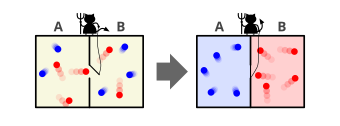
The Law of Thermodynamics assumes, as an axiom, that our universe is a closed system, with no divine (or demonic) interventions. But, scientists still admit that the world is open-ended at both ends : a> in the Big Bang, inputs of laws & energy ; b> at the Final Freeze, the heat death of the whole system. Admittedly, some physicists conjecture that some of the energy & laws could leak-out of the system via Black Hole tunnels into the infinite world outside our little verse. But, they are still searching for evidence --- along with persistent UFO believers. :yum:but yes you have a point if the universe is a closed system, and If it falls to equilibrium, which it is not going to do any time soon. — Pop

Yes. The human mind understands the world in terms of logic & meaning. Logic implies a chain of cause & effect, but what was the First Cause? And meaning implies Purpose, but whose teleological intention could be invoked to explain the temporary existence of our running-down world, with pockets of anti-themodynamic Enformy? Whether my thesis is True or not, is too soon to say. :nerd:Its a hard thing to say, -- why? -- and we say it for slightly different reasons, but it seems logical and true. — Pop
Cosmic Progression Path : http://bothandblog3.enformationism.info/page28.html
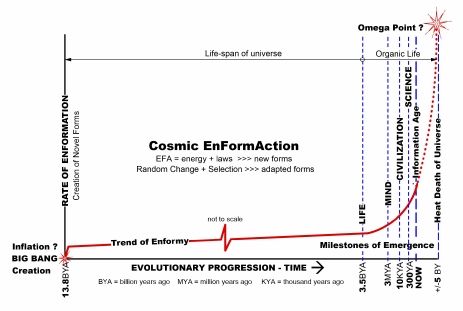
-
A short theory of consciousness
In what sense are those particles "self-organizing"? Don't they require pre-existing natural laws and energy to organize Potential Matter into specific measurable arrangements (patterns) of energy & mass? The currently accepted theory of matter says that invisible formless fields, not particles, are fundamental. The emergent particles are imagined as Virtual Particles that exist only in statistical Potential until some mysterious perturbation goads them into physical Actual existence. Before that actualization event they exist only as unreal in-commensurable mathematical probabilities in an algebraic equation. Anyway, those ghostly virtual particles don't voluntarily self-organize into real physical particles. Instead, they only jump like a frog when poked with a stick. :joke:Everything is made from three self organizing things - electrons, neutrons, and protons. — Pop
Virtual Particles : We often hear the word ‘virtual particle’ in physics and pop-sci explanations of quantum field theory. But, in reality, there are no such things as virtual particles. Today we will explore why (and how) virtual particles are needed, and also why they don’t exist.
https://medium.com/einsteins-cup-of-tea/virtual-particles-do-not-exist-ce82de3c1627 -
QUANTA Article on Claude Shannon
I doubt that you really believe that Artificial Intelligence computers require no programmers. Instead, I assume you are referring to their "self-learning" algorithms. But I'm not aware of any AI, that wrote its own core code. Likewise, 21st century physicists can no longer assume that the universe is self-existent. Instead, they accept, as an axiom, that Natural Laws, and the Energy to apply them, were pre-existent. Of course, they deny the need for a Programmer by assuming, without evidence, that the Energy & Laws, that run on our space-time machine, are eternal --- running endlessly in a beginning-less series of multiverses.Reading your post its fairly obvious you aren't aware of this, but relax, you aren't alone. Most people out there have no clue how a modern AI works and they too think it was 'programmed' using instructions. Its not. — Mick Wright
My personal model of the physical universe (the computer + core code + feedback loops), includes the ability for self-learning. It's based on the concept of Evolutionary Programming, where the computer produces random alternatives (mutations of original code), and selects the "fittest" entities based on criteria input by the Programmer into the operating system. For our universe, those criteria were Laws of Nature, and Initial Conditions. All of the subsequent forms (sub-systems ; species) were variations on the original archetypes coded into the Big Bang. :nerd:
Evolutionary Programming :
Special computer algorithms inspired by biological Natural Selection. It is similar to Genetic Programming in that it relies on internal competition between random alternative solutions to weed-out inferior results, and to pass-on superior answers to the next generation of algorithms. By means of such optimizing feedback loops, evolution is able to make progress toward the best possible solution – limited only by local restraints – to the original programmer’s goal or purpose. In Enformationism theory the Prime Programmer is portrayed as a creative deity, who uses bottom-up mechanisms, rather than top-down miracles, to produce a world with both freedom & determinism, order & meaning.
http://blog-glossary.enformationism.info/page13.html
Criteria : benchmarks ; norms ; principles ; laws ; archetypes ; paradigms ; patterns
Universe imagined as a Computer : http://www.bbc.com/earth/story/20160901-we-might-live-in-a-computer-program-but-it-may-not-matter -
A short theory of consciousness
Ironically, the world model of Physics seems to be primarily biased toward disorder (entropy), so like an explosion of fireworks, it's all downhill after the Big Bang. However, physics also has discovered pockets of order within this dying cosmos, such as galaxies & stars & solar systems. And within our own local system, as far as we know, only Earth has fostered the emergence of Life & Mind. But physics has no good explanation for how or why those small pockets of negentropy could emerge, if the universe is a one-way street to "heat death". So, it's not physically true that "all parts are biased towards order".The way I understand it is that in a universe biased towards order, all of its component parts must also be biased towards order. — Pop
In my thesis though, I have proposed a natural phenomenon that reverses that trend toward disorder, allowing Life & Mind & Culture to emerge from the random roiling of atoms. I call that bias toward order, "Enformy". It causes order within a context of disorder. It allows Life to arise from non-living matter. And it facilitated the emergence of Mind from mindless matter. Matter is indeed a form of Information, but only minds are conscious. Information (like energy) can be both positive and negative. But Life & Mind & Awareness are positive results of a mostly negative trend toward a cold dark end. Therefore, Consciousness seems to be the exception rather than the rule in our Universe. :chin:
Enformy :
In the Enformationism theory, Enformy is a hypothetical, holistic, metaphysical, natural trend or force, [or bias] that counteracts Entropy & Randomness to produce complexity & progress.
Yes. My worldview is indeed based on discoveries of Science, and especially Physics, that indicate the ubiquitous workings of Information (EnFormAction) in the world. But my thesis followed the physical evidence back to a metaphysical explanation for Life & Mind & Emotion & Bias.Your understanding seems largely grounded in physics which blocks out the emotion and bias, and so cannot answer the why of cause . . . . In my view, your Enformer ( energy + information ) lacks the impetus provided by emotion. — Pop
But physics gives us no information about the Prime Mover that lit the fire leading to human Emotions. So I don't pretend to know what motivated the original Enformer to create an imperfect world that was already dying from the word "go". Unlike most Theists, I don't attribute human emotions to the abstract First Cause. Yet, logically that Source of all things must have possessed the Potential for such messy motivators as fear, love, hate, happiness, sadness, disgust & anger. Those are all variations on a single dichotomy : Positive vs Negative. Which are also the fundamental elements of Generic Information : (1 / 0), (+ / -), (yes / no), (hot / cold), etc. So, there must have been some "Why", some "Purpose" that broke the static symmetry of equally balanced possibilities, to allow a bias toward Order & Life & Mind & yes . . . emotions. :cool:
Meta-Physics :
4. Physics refers to the things we perceive with the eye of the body. Meta-physics refers to the things we conceive with the eye of the mind. Meta-physics includes the properties, and qualities, and functions that make a thing what it is. Matter is just the clay from which a thing is made. Meta-physics is the design (form, purpose); physics is the product (shape, action). The act of creation brings an ideal design into actual existence. The design concept is the “formal” cause of the thing designed.
http://blog-glossary.enformationism.info/page14.html
If my Enformer possessed human-like emotions, S/he would have to also possess a humanoid body -- the generator of visceral feelings -- like most of the god-models of human civilizations. But, since I have no revelation from G*D, I can't say with any authority what G*D is like. That's why I assume that G*D has no Actual attributes, but only infinite Potential for all possible qualities. :smile:If your Enformer also possessed emotion, then with energy, information, and emotion would be equal to consciousness, which is equal to self organization. I have noticed that Donald Hoffman has recently received tenure, so it seems there is some momentum in this direction. — Pop
S/he : a contraction of the gender pronouns to indicate that G*D is neither male nor female, but has the potential for creating both male & female beings, with positive & negative bodies (i.e. innies & outies).
Donald Hoffman : http://bothandblog6.enformationism.info/page21.html -
A short theory of consciousness
FWIW, here's a quote from my blog post explaining the neologism of "EnFormAction".Central to the self organizing system is an attractor, rather then a causal element, that is not to say causation can be excluded . — Pop
Attractor :
EnFormAction is not a physical force, pushing objects around. It’s more like Gravity and Strange Attractors of Physics that “pull” stuff toward them. It is in effect a Teleological Attractor. How that “spooky action at a distance” works may be best explained by Terrence Deacon’s definition of “Absence”.
https://www.amazon.com/dp/B005LW5JAS/ref=dp-kindle-redirect?_encoding=UTF8&btkr=1
Deacon sees opportunities for unification by reintegrating “absence-based causality into science”
Note : Deacon's "Absence" is similar to Aristotle's "Potential". -
A short theory of consciousness
I suspect that what you call "emotional information" is what I'm calling "intention". Repeated signs of intention (directional ; goal-oriented ; teleological) is what we call a "Trend" or "Tendency". In humans, an inclination toward some effect has an internal cause, which we call "Motivation" or "Emotion". In my thesis, I call the ultimate motivator, the Enformer : the source of both Momentum (inertial energy) and Direction (regulation, laws). Metaphorically, it's the Pool Shooter, who wants to put the eight-ball into the corner pocket. :joke:How do you resolve the bias, or natural tendency or inclination towards order. As far as I can reason it, it is emotional information. — Pop
Intention :
Intention is a mental state that represents a commitment to carrying out an action or actions in the future.
https://en.wikipedia.org/wiki/Intention
purpose or attitude toward the effect of one's actions or conduct:
https://www.dictionary.com/browse/intention
To say that the universe chose its "own way of being" implies that it is conscious and teleological : already a sentient being, who chooses a career. But, I see no evidence that the Temporal Universe As A Whole -- which contains sentient beings -- has reached the point of sentience.So again, I think the impetus that set this physical system on a certain path must have come from outside the system : from an eternal Multiverse, or an eternal Mind. Hence, the "way of being" of our world seems to have been set in the initial conditions (program) of the Big Bang. :nerd:The universe could have been an infinite number of different ways, but it chose just one way of being - a being towards order. — Pop
Again, I make a distinction between the highly-evolved Consciousness (information processing) of humans, and the simpler exchanges of energy (EnFormAction) at the lowest levels of the world system. This cosmic hierarchy is enformed by EnFormAction at all levels, but only the peak of the pyramid is fully self-conscious. Pure Information is Mathematical & Logical (1 : 2 & one is related to two as . . .), but in its "higher functioning form", the information is Mental : conceptual & self-referential. Hence, Information (energy + laws) seems to be the "singular quality" that everything in the universe possesses. :chin:It seems frustratingly stupid to me, to think we can posses a singular quality nothing else in the universe possesses, although it is the prevalent dogma. We have a higher functioning form of consciousness, but everything possesses it to some degree. — Pop
Yes. In Chaos Theory, a "strange attractor" seems to organize an otherwise random system into a relatively stable form, like a whirlpool in a calm pond. The proximate cause is not obvious within the random background. But the seeds of order (bias) are always lurking even within seeming chaos.Central to the self organizing system is an attractor, rather then a causal element, that is not to say causation can be excluded . — Pop
In his 2007 book, I Am A Strange Loop, Douglas Hofstadter claimed to have solved the Mind/Body problem by pointing to the Self-Reference & Recursion found in many dynamic systems. His conclusion was that he (his self, his soul) was a manifestation of a Strange Attractor, which spontaneously emerged from within the random collisions of particles in the physical system of the world.
Yet again, although a world-class genius, he was thinking inside the box. It's true that the seeds-of-self are innate in the world system of physics. But, like the old chicken & egg conundrum, it seems to result in an infinite regress, with no final solution. That's why I ask, "where did the seed of Life & Mind come from?". Even a seemingly self-creating Strange Attractor requires a system already programmed with the potential for new forms to arise from a patternless background. :wink:
Quine : A quine is a computer program which takes no input and produces a copy of its own source code as its only output. The standard terms for these programs in the computability theory and computer science literature are "self-replicating programs", "self-reproducing programs", and "self-copying programs". [ Note : the program still requires an external programmer ]
https://en.wikipedia.org/wiki/Quine_(computing)
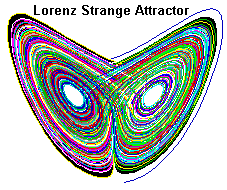
That's why my thesis is a Monism : the single Universal Substance (Spinoza) is Generic Information, or EnFormAction (the power to create novel forms). Hence, the Mind/Body knot unravels after you realize that both Mind & Matter are constructs of Energy + Laws.The hard problem of consciousness is only hard from a dualists perspective, from a monists - its hard to see there is a problem! — Pop
Information :
When spelled with an “I”, Information is a noun, referring to data & things. When spelled with an “E”, Enformation is a verb, referring to energy and processes.
http://blog-glossary.enformationism.info/page11.html
Emotions are the motivating force of human behavior. But I don't know what would motivate a World Creator to devise an evolving system of Energy + Laws, that cause such things as Gravity and Humanity to emerge from the random swirling of atoms. :cool:- an emotion! Can an emotion be fundamental? Can an emotion explain the why of gravity, and physical laws? Does it underpin Enformy? — Pop -
Navalny and Russia
Sadly, Putin seems to be like tell'm-what-they-want-to-hear Trump, except with KGB spycraft. He seems to be popular with non-intellectuals, because he promises to make Russia great again : MRGA --- as in the Soviet Empire. But, unlike the US, Russia doesn't have an ingrained tradition of democracy to limit the populist persuasive power of ego-driven autocrats. :sad:Truth-telling? Putin is not a one-man act — Bitter Crank -
A short theory of consciousness
That is also how I view Evolution. Many scientists emphasize the "random element" to conclude that it has no direction, no teleology. But Natural Selection seems to apply specific criteria to define fitness for each fork in the chain of causation. That specification is a result of what I call "EnFormAction", Pure randomness would have no direction or pattern. But enformed randomness provides a degree of freedom within the constraints of cause & effect determinism. :wink:Self organization fits beautifully as the cause of evolution where the main thrust is determined, but with a slight random element. — Pop
EnFormAction :
Ententional Causation. A proposed metaphysical law of the universe that causes random interactions between forces and particles to produce novel & stable arrangements of matter & energy. -
A short theory of consciousness
Again, we are using different terminology to describe the same phenomenon. What you call "Universal Bias", I call Enformy. It's a natural inclination or tendency toward complexity & progress, which counteracts the disorganizing & destructive effects of Entropy, allowing such highly-organized phenomena as Life & Mind to emerge from the randomized mechanical procedures of Evolution. As described in mathematical terms, it's a ratio or relationship between two things. When that ratio is balanced (1 : 1), nothing happens. When it's biased toward one pole (2 : 1), it tips the balance in a positive direction. But when it's biased toward the opposite pole (1 : 2), it shifts the balance in a negative direction.Yes they originate from the universal Bias to self organize, and from elements external to self. The self is caused initially, and then takes on a momentum of its own. — Pop
Since highly-organized systems in nature seem to be rare and fleeting, Physicists at first didn't pay attention to the positive effects of innate Bias. Moreover, Energy seems to flow both ways. So, they first came up with a name for negative thermodynamic change : "Entropy". Only as an afterthought did they think to label the opposite of Entropy as "negentropy". But I think the more euphonic term "Enformy" better suits the positive aspects of natural evolutionary Bias.
Donald Watson defined Enformy simply as "the capacity to organize". And he viewed Consciousness as the current pinnacle of "enformed systems" in the world. Unfortunately, he seemed to assume that everything in the world is conscious to some degree. Which led him to include all sorts of New Age magic & mysticism in his theory. However, since I reserve the "consciousness" label for only the human sort of self-awareness, all other enformed systems are viewed as merely various forms of mundane Information, otherwise known as "Energy". :smile:
Bias : A bias is a tendency, inclination, or prejudice toward or against something or someone.
Entropy : 2. lack of order or predictability; gradual decline into disorder.
Enformy :
In the Enformationism theory, Enformy is a hypothetical, holistic, metaphysical, natural trend or force, that counteracts Entropy & Randomness to produce Order & Complexity & Progress.
http://blog-glossary.enformationism.info/page8.html
Theory of Enformed Systems : http://www.vxm.com/link.enformytheory.html
Information :
Knowledge and the ability to know. Technically, it's the ratio of order to disorder, of positive to negative, of knowledge to ignorance. It's measured in degrees of uncertainty. Those ratios are also called "differences". So Gregory Bateson* defined Information as "the difference that makes a difference". The latter distinction refers to "value" or "meaning". Babbage called his prototype computer a "difference engine". Difference is the cause or agent of Change. In Physics it’s called "Thermodynamics" or "Energy". In Sociology it’s called "Conflict".
http://blog-glossary.enformationism.info/page11.html -
A short theory of consciousness
I think your concept of nature's ability to organize new systems from local interactions -- as the route to consciousness -- is on the right track. But I still maintain that the system we call Nature could not organize itself from nothing. And that talent for creating order from chaos is not an accident. It's what I call EnFormAction. Both the local elements and the causal force originate outside the Self.The effect of "self organization" is inherently to create a self from elements entirely outside of self. So there is no need for external causation ( creator ) at all. — Pop
So, here are a couple of quibbles : a> when a sub-system becomes organized as a recognizable “Self” or “holon”, it displays new properties that were not manifest in the local cause. It's a new unique being, not just another isolated particle. That's the basic principle of Holism, and of Arthur Koestler's definition of “holons”, the “whole is more than the sum of its parts”. b> when a row of dominos is tipped over, there is a chain reaction of cause & effect. But, without an “external causation”, nothing happens. So, the need for a First Cause remains, to get the process of on-going organization started. The “falling dominos” are an internal effect of an external cause. And the "more than" is novel properties that were not in the local elements. What you are describing is Morphodynamics, but Life & Mind have properties that are not found in ordinary Energy or Matter.
Your image of a hurricane is apt, though. In his book, Incomplete Nature: How Mind Emerged from Matter, Terrence Deacon uses the apparently spontaneous formation of a whirlpool as an example of natural emergence and self-organization. However, "The disturbances from which the whirlpool emerges are external to it, whereas the dynamics of life are internal and also end-directed. Deacon calls this end-directedness "teleodynamics," which is different from “morphodynamics” (self-organizing or form-producing dynamics). An understanding of how he makes the incredible leap from morphodynamics (a primitive system) to teleodynamics (a complex, autopoietic system) requires reading the book. " https://www.thestranger.com/slog/archives/2012/07/27/terrence-deacon-and-the-nature-of-constraints :cool:
The Organizing Force : http://bothandblog2.enformationism.info/page29.html
Your description of the “cognizing” process is correct, as far as it goes. Yet again, it omits the requirement for an external Cognizer or Creator to design the cosmic “mechanism” in such a way that it produces the output we call “Consciousness”. That output is not a physical product, but the ongoing process of Knowing. It's the "intelligent design" of the machine that imparts the Potential for actualization of Mind from Matter. Like Paley's Watch in a field, our experience with reality makes the spontaneous appearance of such a functional machine unlikely. (Note : Yes, it's the old Intelligent Design argument, which only works for a Deist-god, not a Bible-god)It is cognizing (via disturbance to its integrity) and reintegrating the disturbance via the bias to self organize. This last sentence describes the mechanism of consciousness as best I can resolve it. — Pop
In my own thesis of how Mind emerged from Matter, which emerged from who-knows-what, I initially tried to avoid the First Cause assumption. But the logic of the whole process of evolution always points back to an otherwise unexplainable beginning. Multiverse theories simply argue that it's turtles-all-the-way-down. But that's not an answer, it's infinite regress. The only plausible answer is Teleology. :nerd:
https://en.wikipedia.org/wiki/Turtles_all_the_way_down

-
A short theory of consciousness
Synergy does imply a direction, if not a specific goal, that a multi-part machine works toward. But it does not necessarily imply a self-conscious Purpose. For example, a thermostat is composed of several different components that, when working in cooperation, produce a specific result. But we can't say that the thermostat "wants" to keep warm. That purpose must be supplied from outside the system, by a conscious programmer. Likewise, our evolving world seems to be working toward producing sub-systems of greater complexity and synergy. But, for what purpose?I do wonder if your notion of 'synergy' actually accounts for anything. It simply says - 'look, all these things work together' - which is what 'synegy' means.
What is lacking is a sense of telos, of purpose - that things work together for a common goal or end. — Wayfarer
The Bible implies that the reason for God to create intelligent creatures was to provide an egoistic deity with worshipers who are able to appreciate the power & benevolence of their creator. As long as those creatures are sufficiently pious, they will be rewarded with blessings & bounty of a "land flowing with milk and honey". But after a while, some of those creatures noticed that God's benevolence was also distributed to the impious and unjust. So, they concluded that their true reward would be postponed indefinitely until a new world was created only for the pious. But then, what was the point (purpose) of this present life full of pain & suffering?
Believers then revised their notion of the purpose of this imperfect world to that of a temporary device for sorting out the chosen people (saints) from the sinners. That still didn't make sense to me, so I came to doubt that the telos of our world was focused on slavish piety. Instead, the teleology of the evolving world seems to focused more on the process than on some unspecified future product. Hence, the purpose of each life is to Live a unique story. Beyond that, I can't say. I could, like Teilhard deChardin, speculate on some ultimate teleological Omega Point. But that would be an un-educated guess.
Therefore, although I see signs of Synergy & Teleology in the world, I can't predict how the story ends, whether in "fire or in ice". Instead, I can only exercise what little FreeWill I have, over my own Synergy & Teleology & Purpose. Then, the final outcome of zillions of free choices may add-up to something wonderful or awful. But, I don't expect to be around to appreciate it. Instead, I'll just try to enjoy the ride -- bumps and all. :cool:
Divine Justice :
Father which is in heaven: for he maketh. his sun to rise on the evil and on the good, ... his sun to rise on the evil and the good, and. sends rain on the just and the unjust.
___Matthew 5:45
Ecclesiastes :
1 To every thing there is a season, A time for every purpose under heaven . . .
18 I also said to myself, “As for humans, God tests them so that they may see that they are like the animals. 19 Surely the fate of human beings is like that of the animals; the same fate awaits them both: As one dies, so dies the other. All have the same breath[c]; humans have no advantage over animals. Everything is meaningless. 20 All go to the same place; all come from dust, and to dust all return. 21 Who knows if the human spirit rises upward and if the spirit of the animal goes down into the earth?” 22 So I saw that there is nothing better for a person than to enjoy their work, because that is their lot. For who can bring them to see what will happen after them?
PS___ Tononi's theory of Integrated Information, and its inherent Synergy or Holism, implies that its "cause--effect power is completely reducible to that of its parts", with no overriding divine purpose. But my thesis of Enformationism implies that there must be some Intention motivating such a cosmic creation. Unfortunately, I haven't been able to divine what that holistic function might be. So, I'll just have to take it on faith, that "all's well that end's well". :blush:
Oh no! I'm not a New Ager, but a New Paradigmer. :yum:Oh, you're at least as New Age as Sheldrake. — Wayfarer -
A short theory of consciousness
In Giulio Tononi's Integrated Information Theory, phi (ф) is a measure of the system's integrated information, its degree of wholeness. And "wholeness" is another name for Synergy, as in "the whole is more than the sum of its parts". On that basis, neuroscientist Christof Koch now equates Consciousness with Synergy. Going out on a professional limb, he says, "So consciousness is a property not only of brains, but of all matter". However, as usual, I prefer to save the term "consciousness" for the most highly-evolved forms of Generic Information. :nerd:Or put another way; the synergy is a function of self organization. — Pop
Yes. I think Sheldrake was on the right track in his theory of Morphogenesis. But his presentation of the ideas sounds a lot like New Age mysticism. That's why I prefer to use the more prosaic terminology of Enformationism. Of course, for those not familiar with the cutting-edge physics that equates Information with both Mass and Energy, my own theory is often dismissed as Mysticism -- despite my assertion that no Magic is required beyond that of Quantum queerness. However, I can't deny that it is heretical to the outdated paradigm of Materialism. :cool:Sheldrake (whom I most admire) is a scientiific maverick whose views are almost universally rejected by mainstream science. John Maddox, editor of Nature magazine, famously titled his scornful review of Sheldrake's first book 'A Book for Burning', saying it should be scorned by scientists for the same reason Galileo was scorned by the Church - that it was heresy, and magical thinking. — Wayfarer -
A short theory of consciousness
In the Enformationism thesis, side-notes are mostly quotes from the Bibliography listed under the "Information" tab.Have you thought about hyperlinking the texts on the side of the pages to the main document? — Pop
In the BothAnd Blog, many sidebar notes have links at the bottom. Some also have pop-ups to longer notes. Just click on the "http:" URL at the end of the notes. More important links are indicated with an arrow, indicating that you can click on the note to see more on that topic. I also have a Glossary of special terminology with unique definitions as they apply to my personal thesis. :smile:
http://blog-glossary.enformationism.info/
I no longer have a religious belief in the Bible God. So, I had to re-construct my personal worldview from scratch. My current notion of a Nature G*D is the "god of the philosophers", which is always debatable. It's also not a matter of faith, but merely an unprovable Axiom for my thesis. Unfortunately, that Deist axiom is not accepted by Theists or Atheists. :naughty:What I don't understand is why do you need to postulate a theory when you have a belief in God? — Pop
The God of the Philosophers :
Of course, their god is not a father in the sky they say, but rather the ground of being or fine-tuner of the universe or something even more esoteric. What my reader wondered was what such theoretical deities have to do with the beliefs of typical religious believers? In other words, how does a proof of an abstract god square with the god most of the faithful profess to believe? . . . . Little did my reader know that he has stumbled upon a problem that had baffled Christian thinkers from Pascal to Kierkegaard right up to the present time.
https://reasonandmeaning.com/2015/06/05/jb-sci-and-rel/
Axiom : (Math) a statement or proposition on which an abstractly defined structure is based.
Since my thesis is primarily based on the cutting-edge concept of Information as the "substance" of both Mind & Matter, I followed that logic to conclude that a First Cause or Enformer was necessary for the thesis to make sense. Speaking of Logic, one of the philosophical terms I use to characterize my non-traditional notion of G*D is "LOGOS". According to Plato, it was the rational self-organizing force permeating the universe. But, he distinguished Logos from Mythos, which was his name for the anthro-morphic gods of the Greeks. :halo:The reason I ask is because " self organization" is looking to be a God like concept to me. — Pop
Logos :
In Enformationism, it is the driving force of Evolution, Logos is the cause of all organization, and of all meaningful patterns in the world. It’s not a physical force though, but a metaphysical cause that can only be perceived by Reason, not senses or instruments.
http://blog-glossary.enformationism.info/page14.html
Energy is Information : Aristotle used the term “energeia” (action) to describe the primal force that imparted momentum (energy of motion) to the physical universe. And his action principle was borrowed by modern scientists as their label for what we now call “energy”, which is the power to cause change. But the Greek usage also implied that the aboriginal Actor (Logos) was sentient in some sense. However, that imputation of consciousness was omitted by the pragmatic scientists, who had no need for the idealistic aspect of the hypothesis. As a result, their mechanical definition of “Energy” as a “scalar physical quantity” contrasts with the phenomenal definition as an attribute of matter (the ability to do work) . That mysterious property (qualia) of matter turns out to be a metaphysical, mathematical abstraction for which they had no explanation other than it just is. Energy is never observed as a physical thing unto itself, apart from matter–-just like Information .
http://enformationism.info/enformationism.info/page15.html
The mass-energy-information equivalence principle :
https://aip.scitation.org/doi/10.1063/1.5123794
I don't normally define G*D as "self-organization", because I view Logos as the eternal power to organize, which was imparted to the temporal world in the Big Bang act of creation. Hence, the specific instances of self-organization we observe in the world are secondary to the universal power to create organized organisms. :nerd:Do you have a definition of God? The reason I ask is because " self organization" is looking to be a God like concept to me. — Pop
G*D :
* An ambiguous spelling of the common name for a supernatural deity. The Enformationism thesis is based upon an unprovable axiom that our world is an idea in the mind of G*D. This eternal deity is not imagined in a physical human body, but in a meta-physical mathematical form, equivalent to Logos. Other names : ALL, BEING, Creator, Enformer, MIND, Nature, Reason, Source, Programmer. The eternal Whole of which all temporal things are a part is not to be feared or worshiped, but merely appreciated as the designer/organizer of the marvelous evolving system we know as Nature.
* I refer to the logically necessary and philosophically essential First & Final Cause as G*D, rather than merely "X" the Unknown, partly out of respect. That’s because the ancients were not stupid, to infer purposeful agencies, but merely shooting in the dark. We now understand the "How" of Nature much better, but not the "Why". That inscrutable agent of Entention is what I mean by G*D.
http://blog-glossary.enformationism.info/page13.html -
A short theory of consciousness
Self-organization, in the real world, is not a problem for me. We see it happen all around us. I once saw a time-lapse video -- to illustrate Rupert Sheldrake's theory of Morphogenesis -- of a seedling growing into a plant. The various elements of the plant somehow found their way to their final location as-if they knew where to go. Most scientists assumed the necessary "knowledge" was encoded in the DNA of the original seed. But Sheldrake postulated a Morphogenetic Field that guides each element to its correct place in the whole system. I don't think a literal external field is necessary though. That's because each element of the growing plant "communicates" with other elements via chemical signals (information). That exchange of self-organizing information is internal to the system, not an outside force.Yes I thought this would be a problem for you, but it may also be a solution. I find you have an intelligent conception of God, not an anthropocentric biblical God, but a creative force like element, and " self organization " is just such an element? :smile: God would have to self create? No. So god may have arose from self organization? — Pop
The causal "creative force" of my thesis (EnFormAction) does indeed result in Self-Organization. But the S-O is an effect, not the cause. Likewise, the Enformer of our world is assumed to be eternal, hence self-existent, not self-organized. All of the scientific theories proposed to explain the contingent existence of our world, assume the prior existence of eternal Energy & Laws. And that's what EnFormAction is : the raw power to create, and the design criteria (blueprint ; program) necessary to guide the energy as it constructs a world of many forms. :smile:
Morphogenetic Field : https://www.sheldrake.org/research/morphic-resonance/introduction
EnFormAction :
* Metaphorically, it's the Will-power of G*D, which is the First Cause of everything in creation. Aquinas called the Omnipotence of God the "Primary Cause", so EFA is the general cause of everything in the world. Energy, Matter, Gravity, Life, Mind are secondary creative causes, each with limited application.
* All are also forms of Information, the "difference that makes a difference". It works by directing causation from negative to positive, cold to hot, ignorance to knowledge. That's the basis of mathematical ratios (Greek "Logos", Latin "Ratio" = reason). A : B :: C : D. By interpreting those ratios we get meaning and reasons.
* The concept of a river of causation running through the world in various streams has been interpreted in materialistic terms as Momentum, Impetus, Force, Energy, etc, and in spiritualistic idioms as Will, Love, Conatus, and so forth. EnFormAction is all of those.
http://blog-glossary.enformationism.info/page8.html
I suspect that your definition of "Organization" might be similar to my notion of EnFormAction. EFA is the causal force in the world. It causes random matter to become ordered into organisms. So, EFA is the power to organize. :nerd:I am only beginning to understand self organization, but my first impression is that it is organization that causes a self. — Pop
Yes. Even Hawking's atheistic "No-Boundary" hypothesis of world creation assumes the eternal existence of Energy & Natural Laws (Organization or Information). Logically, those prerequisites must be external to the world system that began, either with a bang, or from a fluctuation. :chin:Yes I agree, as far as I can logically figure it, there has to be an external cause. — Pop
Yes. I think what you call "Organization" is the same thing that I call "Information" or "EnFormAction". They all have a bias or inclination toward order rather than disorder. I like Plato's story of how our Cosmos (organized matter) emerged from primordial Chaos (unformed potential). We seem to be talking about the same concept, but using different terminology. :grin:Creative information: Yes, but I think the creativity results from a bias ( emotional information ) towards order. — Pop
Chaos :
In ancient Greek creation myths Chaos was the void state preceding the creation of the universe or cosmos. It literally means "emptiness", but can also refer to a random undefined unformed state that was changed into the orderly law-defined enformed Cosmos. In modern Cosmology, Chaos can represent the eternal/infinite state from which the Big Bang created space/time. In that sense of infinite Potential, it is an attribute of G*D, whose power of EnFormAction converts possibilities (Platonic Forms) into actualities (physical things).
http://blog-glossary.enformationism.info/page12.html -
A short theory of consciousness
Hold-on now. You were on a reasonable path. So don't go off on an irrational tangent. :joke:Yes originally I also began with information as the first step, and it still figures prominently in there, but now I understand self organization is the overriding process. — Pop
Self-organization is indeed a function of the ubiquity of Information. Yet I doubt that spontaneous organization can occur prior to the existence of a "Self" with the power to "organize" (to create order). The physical universe is indeed in the midst of a process of self-organization. It's like a computer program that runs on the system's inherent energy, and is guided by an operating system of rules for self-organization. In the terms of my thesis, the universal program is described as a process of En-Form-Action. But nothing in our real world experience is completely spontaneous, without precedent. Instead, just as every program has a Programmer, every causal process has a First Cause. Unless it is Self-Existent of course, which is a necessary quality of a First Cause, or Creator. So, I question the conclusion to the quote above.Information assumes a big bang / beginning, whilst self organization dose not need it. — Pop
Recent theories of Cosmology have proposed that our universe did not begin with a "bang", but with a spontaneous (un-caused) Fluctuation in a pre-existing energy field. I assume that this was another attempt to avoid the inadvertent religious implications of the Big Bang as a creation event, requiring some kind of "external agent". Yes, in the real rational world, "spontaneous events" may appear out-of-nowhere, like an "immaculate conception", but logically & physically, there is always some necessary-but-unknown prior Cause -- perhaps an absentee baby-daddy, or maybe the Initial Link in the unbroken chain of causation that can be inferentially tracked back to a First Cause, or at least a Higher Context.
Whatever it is, the Prime Cause must provide "sufficient energy" for the evolutionary process of building a universe from scratch. And, in this constructive scenario, the random raw power of Cosmic Energy must also be ordered & channeled by logical laws of organization (natural laws), or else the result would be a destructive explosion that goes nowhere. What I'm saying here is that the hypothetical Original Cause, of apparently-spontaneous-organization, is necessarily an "external agent" combining explosive Power with teleological Direction (energy + order). Even Hawking's "No Boundary" theory was based on the hypothetical assumption of an eternal realm of unlimited Possibility : The Wave-Function. Yet even that unlimited Potential would contain nothing Actual, until it was triggered by some internal or external "Perturbation".
Therefore, a process without a beginning just doesn't make sense, logically or physically. And Hawking's retort to "what came before the Big Bang" was open-ended and ambiguous. From the perspective of his isolated (no context) mathematical model, he said, "it's like asking what's north of the North Pole". But in our real world, what's north of the North Pole, is a whole universe in the process of becoming. My thesis did not begin with the assumption of a particular First Cause. But as the concept of Creative Information evolved, it became obvious that some kind of Enformer was logically unavoidable. :cool:
Self-organization : Self-organization, also called (in the social sciences) spontaneous order, is a process where some form of overall order arises from local interactions between parts of an initially disordered system. The process can be spontaneous when sufficient energy is available, not needing control by any external agent.
https://en.wikipedia.org/wiki/Self-organization
Spontaneous : happening, especially in a living thing, without being caused by something outside, or without the organism's control
Perturbation : 2. a deviation of a system, moving object, or process from its regular or normal state or path, caused by an outside influence.
Agency : 2. action or intervention, especially such as to produce a particular effect.
The No-Boundary Universe : "Hartle and Hawking derived a formula describing the whole shuttlecock — the so-called “wave function of the universe” that encompasses the entire past, present and future at once — making moot all contemplation of seeds of creation, a creator, or any transition from a time before."
“It was just not possible quantum mechanically for a universe to start in the way they imagined.”
https://www.quantamagazine.org/physicists-debate-hawkings-idea-that-the-universe-had-no-beginning-20190606/
NOTE : " encompasses the entire past, present and future at once" -- to me that sounds like an eternal world-creating deity. "A rose by any other name . . . ."
The Enformer :
* AKA, the Creator. The presumed eternal source of all information, as encoded in the Big Bang Sing-ularity. That ability to convert conceptual Forms into actual Things, to transform infinite possibilities into finite actualities, and to create space & time, matter & energy from essentially no-thing is called the power of EnFormAction. Due to our ignorance of anything beyond space-time though, the postulated enforming agent remains undefined. I simply label it "G*D".
http://blog-glossary.enformationism.info/page8.html -
A short theory of consciousness
This is a continuation of my comments on your essay : What is consciousness? :Below is an extract from my theory of consciousness. The whole theory can be read here. It tackles the hard problem, so you might find it interesting. Any comments would be appreciated. — Pop
Q. "Everything external to consciousness can be reduced to information, and it is information that consciousness entangles, integrates, and unifies. All information has a quality, so it is always emotional information."
C. Even human consciousness can be reduced to quantitative Information via the scientific method of Reductionism. But we tend to feel that human Consciousness is much more than just mathematical information. It has holistic implications of higher values. such as morality.
* External to human consciousness though, we can no longer have two-way dialogues. We still can't read the minds of single-celled organisms, except to infer automatic responses to inputs via behavior. Yet, Information is still functional in inorganic matter as a chain of Cause & Effect.
Q. "A mind empty of integrated information is unconscious and ineffable"
C. I agree that Consciousness is a form of Integrated Information, in the sense that it arises as a function of the Whole, not the Part --- of the Mind not the Neurons.
Q. "consciousness nevertheless joins the dots and creates something – filling in the blanks, with our beliefs, hopes, and faith."
C. Yes. Presumably, only human Consciousness can connect-the-dots and fill-in-the-blanks with rational inferences and personal subjective feelings. Although, some animals may have some degree of such pattern-recognition.
Q. "Experience and consciousness are often misunderstood."
C. Yes. Some New Agers attribute conscious experiences to all things in the universe. But, I make a distinction between meaningful experiences and mechanical energy exchanges. Atoms exchange Information in the form of energy. But do atoms have emotions and experiences that are meaningful to them? We may imagine so, but we can never know, until they communicate their feelings to us.
Q. "There is no reasonable way to separate consciousness from life. They are two aspects of the
one thing."
C. Again, I would agree with this assertion, if "Information" was substituted for "Consciousness". Non-conscious-matter and Life & Mind are different aspects of Generic Information. But not all living organisms are conscious in the same sense as humans : i.e. Self-conscious ; aware of being conscious. That awareness carries with it moral responsibilities.
So, I do separate all things into two basic categories : A- Universal Information (energy), and B- the special forms of Information that we know as Life & Mind. And only the top level of the information hierarchy has moral implications.
Q. "A bias is an emotion."
C. Yes. Human consciousness is experienced in part via pre-verbal emotions, and expressed via verbal concepts.
However, by assuming that such Consciousness is fundamental, some New Agers believe that inorganic and non-living Crystals are Conscious in some sense. If so, then we should be able to communicate with them, if not in words, then in feelings. I can only say, I'm skeptical.
https://www.findhorn.org/blog/conscious-crystals-with-robert-burlinson/
Q. " [Cells] have a simple emotional consciousness. No brain is required as reason is not present."
C. Yes, but. The New Age notion of "Consciousness" implies that electrons & protons are like little people, with memories, feelings, & biases of their own. If so, then when we cause an electron to "die" (e.g. to lose its charge) we are guilty of murder. Just as "fur is murder", and "meat is murder", then "a discharge of energy is murder". I think that goes to an unwarranted extreme.
Q. "Consciousness is composed of emotional - information . . . We have no experience of unemotional information"
C. Yes. We are only conscious of our feelings. Even our reasons are ultimately reducible to emotions.
Q. "6: A feeling is located as a point on a pain / pleasure spectrum ( PPS)"
C. Yes but, some people -- such as followers of the Jain religion -- carry that notion too far. For example, if I inadvertently step on an ant, does it feel the (human) emotion of Pain? If so, am I guilty of causing pain to a sentient organism? At what "point" can we draw a line on the "spectrum" between Living Beings and Moral Agents?
Q. "This cognizes the instance of consciousness - the point on the pain / pleasure spectrum tells
you what this instance of consciousness means for you."
C. Perhaps we can draw a meaningful & moral distinction between a> Rational Consciousness (humans) and b> Emotional Consciousness (animals) and c> Mechanical Information exchange (atoms).
Q. "In a sense we posses two consciousnesses, one is cellular and emotional, the other is of the
brain and reasonable,"
C. The line between a moral agent and a non-moral entity may be drawn between the cellular-emotional and brain-reasonable types of organisms. If we can't make that obvious distinction, then our ethic would have to give equal value to all organisms & entities.
Q. "What does it feel like to be conscious?"
C. Feeling is the subjective emotional experience that can't be expressed in words or in terms of neurons.
Q. "I have hardly mentioned the brain, as I believe, neuroscience is doing a great job of mapping
the brain, and computational theories of consciousness explain brain functioning very well.
They however do not describe a human being, rather a philosophical zombie."
C. Amen!
NOTE : If the point of my quibbles is not clear : it is an attempt to avoid such satirical comments as "How does a computer sense when I hit the space bar?" and "It hears the space bar's screaming of pain." Hopefully, the technical term "Information" will not be amenable to such puerile ridicule. But then, this is an open philosophical forum. :joke: -
A short theory of consciousness
Here are my comments (C.) on a "few" quotes (Q.) from your essay : What is consciousness?. I hope they will illustrate the many points on which we agree, and why I prefer to use the more precise term "Information" in place of the vague popular concept of "Consciousness" :Below is an extract from my theory of consciousness. The whole theory can be read here. It tackles the hard problem, so you might find it interesting. Any comments would be appreciated. — Pop
Q. "The force is fundamental and as such is ubiquitous in the universe"
C. In my thesis, I call that universal causal force "EnFormAction" : energy + intention ; the power to enform ; to create. It is indeed "ubiquitous" in our evolving world, in which new forms emerge from older things, as the effects of prior causation.
Q. "Consciousness can be described as a process of self organisation"
C. Actually, human consciousness is the current state-of-the-art of the evolutionary process of enforming that has been going-on for billions of years. Consciousness is not the process itself, but an expression of that process. "To Enform" is to create a new organization of an older pattern.
Q. "Consciousness and life arose together, as without consciousness there can be no life"
C. In my thesis, Life arose from non-conscious in-organic matter, and consciousness emerged much later in evolution. So the "force" that caused Life & Mind to evolve was not Consciousness, but the power of EnFormAction --- one phase of which is Shannon's meaningless data, and another form is the meaningful contents of highly-evolved minds.
If you assume that only living organisms are sentient, Life must emerge prior to Consciousness. Your life-giving notion of Consciousness seems to be something like a Vital Force, or Chi, or Prana. And I agree that EnFormAction is similar, but I prefer to avoid those ancient pre-scientific terms based on the assumption of Spiritualism.
Q. "There is no reasonable way to separate consciousness from life."
C. Yes. That's what I meant by the comment above, that Life had to evolve prior to Consciousness. But Information, as I'll show later, is ubiquitous in both living and non-living things.
Q. "Consciousness is an evolving process of self-organisation that has at its root a bias to resist the zero point energy state."
C. Yes. I call that "bias" a ratio -- as in the definition of "energy" as a thermodynamic ratio between polarized states, such as Hot / Cold or Positive / Negative. The bias flows from excess to deficit.
Q. "A bias is an emotion."
C. Yes. In highly-evolved beings the low-level Positive / Negative bias is felt as the emotions Pleasure / Pain and rationalized as the concepts of Good / Evil.
Q. "These feelings are basic to our consciousness, and dominate it."
C. Yes. Emotions evolved early as a way to keep single-cell organisms alive, by causing them to move toward Positive sensations and away from Negative sensations. Hence, they are the foundation upon which our human Consciousness was built. And as David Hume asserted : "Reason is, and ought only to be the slave of the passions". Although his own reams of reasoning indicate that he rebelled against that enslavement, as do most rational people.
To avoid the Qualia of Too-Much-Information, I'll end this commentary here and pick it up again in the next post. :smile: -
A short theory of consciousness
I have read the linked essay, and find that I agree with almost all of it. But I have a theory of my own, that is coming from a different direction to arrive at a similar definition of Consciousness. My one quibble is regarding the too broad & vague conception of "Consciousness" in the popular imagination. In my personal thesis, I propose substituting a technical term with a narrower range of pseudo-scientific implications, and more support from cutting-edge Science. It's not just a theory of Consciousness, but a Theory of Everything --- or as Douglas Adams put it : "God, the Universe, and Everything".Below is an extract from my theory of consciousness. The whole theory can be read here. It tackles the hard problem, so you might find it interesting. Any comments would be appreciated. — Pop
The name of my thesis is Enformationism, which takes as an axiom the novel notion that Generic Information, not Generated (evolved) Consciousness, is in the words of your essay, "ubiquitous in the universe". In my next post, I will quote some lines from your essay, and add a few comments from my own perspective. But first, I'll give my definition of "Generic Information", which goes far beyond Shannon's narrow usage, so you'll have some idea of where I'm coming from. :nerd:
Generic Information : Information is Generic in the sense of generating all forms from a formless pool of possibility -- the Platonic Forms.
https://enformationism.info/phpBB3/view ... p=837#p837
Information :
* A quality of physical patterns and processes that stimulates meaning to emerge in a mind. Since it has few directly perceivable qualities itself, generic information is usually defined in terms of its context or container. Unlike colorless, odorless, and formless water though, Information gives physical form to whatever contains it. In the Enformationism thesis, it is the single Substance of the whole World.
http://enformationism.info/enformationi ... page9.html
Enformationism :
* As a scientific paradigm, the thesis of Enformationism is intended to be an update to the obsolete 19th century paradigm of Materialism. Since the recent advent of Quantum Physics, the materiality of reality has been watered down. Now we know that matter is a form of energy, and that energy is a form of Information.
* As a religious philosophy, the creative power of Enformationism is envisioned as a more realistic version of the antiquated religious notions of Spiritualism. Since our world had a beginning, it's hard to deny the concept of creation. So, an infinite deity is proposed to serve as both the energetic Enformer and the malleable substance of the enformed world.
http://blog-glossary.enformationism.info/page8.html
http://enformationism.info/enformationism.info/ -
The monetary system as a living system
Yes. I suspect that Richard Dawkins would agree that "Money" is a meme, which replicates in human minds like a virus. Most viruses are innocuous for humans, but some may cause a worldwide Pandemic. In that battle for the soul of mankind, some humans fight the invasive "trickle-down" Capitalist Virus with its antithesis, the supposedly "bottom-up" Socialist Virus.Here we see that in certain ways the monetary system possesses (as an extension of us) all the features of a living system. Can it be said then that we birthed an organism that is more powerful and more self perpetuating than the individual human? Or perhaps a virus of kinds that feeds off of us (a host) to survive and do it’s bidding? — Benj96
Which Money Meme do you think is becoming "more powerful and more self perpetuating than the individual human"? Are we merely passive hosts for the greedy artificial Money Matrix? Will humanity survive the monetization of the mind? Are we becoming mere organic "bots" for transporting unnatural selfish money memes? :joke:
Fixing the money meme : https://www.ethicalmarkets.com/fixing-the-money-meme-how-it-limits-our-freedom-and-life-choices/
-
Logic is the world of possibilities, not reality
Logic is the world of possibilities, not realityThe relationship that exists between the world of logic and the world of experience is one of the most important themes in philosophy, because the philosophical ability (the philosophical technique) consists precisely in know how to mediate: know which categories, what are the appropriate terms, what are appropriate questions and non-appropriate questions. — Rafaella Leon
The title of this thread sounds like the common distinction made by empirical scientists from theoretical scientists & philosophers. Empirical methods study the "world of experience" by examining actual physical things. But Theoretical methods study the "world of Logic" by examining ideal meta-physical concepts. I call those parallel worlds "Reality" and "Ideality". Empirical methods are typically Reductive, in the sense that they dissect their objects into smaller parts. But Theoretical methods may also be Holistic, in that they attempt to put the parts back together in their larger context. This is easier to do in theory than in practice, because Ideality is a world of possibilities instead of actualities.
Empiricists sometimes dismiss such speculations on the future as "guessing" --- or even worse, as "Philosophy". But most scientific experiments involve some degree of probabilistic projections into the future, based on experience from the past. Fortunately, Probability mathematics allows us to put a precise number on our guesses. But mathematical "experiments" and models are essentially philosophical explorations into the "world of Logic), hence, of Philosophy.
So, one aspect of the role of philosophers is to know "how to mediate" between Reality and Ideality. Unfortunately, too many scientists don't trust the realm of Logical Possibilities, because it allows us to imagine things that are unreal, and non-empirical. Which is traditionally the purview of Religion, and Theology. However, in areas of research with which we have little direct experience, such as Quantum Mechanics, speculative Axioms and Probabilities are unavoidable. So, when scientists make use of such tools, they are acting as philosophers to determine which tools are appropriate for the problem in question. :smile:
The Difference Between Empirical and Theoretical Probability : Theoretical probability, also known as a priori probability, is calculated before any event has taken place.
https://sciencing.com/difference-between-empirical-theoretical-probability-8427443.html
Logical Possibility : "Logically possible" refers to a logical proposition that cannot be disproved, using the axioms and rules of a given system of logic.
https://en.wikipedia.org/wiki/Logical_possibility
Axioms : There are no scientific axioms. Axioms apply only to math and logic.
https://www.quora.com/What-are-some-axioms-of-the-scientific-method
Ideality :
* In Plato’s theory of Forms, he argues that non-physical forms (or ideas) represent the most accurate or perfect reality. Those Forms are not physical things, but merely definitions or recipes of possible things. What we call Reality consists of a few actualized potentials drawn from a realm of infinite possibilities.
1. Materialists deny the existence of such immaterial ideals, but recent developments in Quantum theory have forced them to accept the concept of “virtual” particles in a mathematical “field”, that are not real, but only potential, until their unreal state is collapsed into reality by a measurement or observation. "To measure" is to extract meaning into a mind. [Measure, from L. Mensura, to know; from mens-, mind]
2. Some modern idealists find that scenario to be intriguingly similar to Plato’s notion that ideal Forms can be realized, i.e. meaning extracted, by knowing minds. For the purposes of this blog, “Ideality” refers to an infinite pool of potential (equivalent to a quantum field), of which physical Reality is a small part. A formal name for that fertile field is G*D.
http://blog-glossary.enformationism.info/page11.html -
Panprotopsychism
That's what I was afraid of. So, couldn't resist some tongue-in-cheek repartee, in an effort to get us back on track with a philosophical appraisal of a topic that has long been shrouded in Occult Mysteries and Spiritualistic Fantasies. Some of those "traditional religious ideas" of Eastern & Western mysticism have been reinterpreted in terms of modern Science, resulting in a melange that is neither truly traditional, nor really scientific.I couldn't resist bringing a bit of spiritualism and talk of miracles to the panprotopsychism thread because I think the paradigm will verify some traditionally religious ideas, plus its entertaining to talk about the paranormal. — Enrique
Although the terms "Panpsychism" and "Panprotopsychism" taken literally, agree with my Enformationism thesis, that all-is-mind, they are typically interpreted as entertaining enigmas. Yet, if you substitute the modern notion of mundane "Information" as Energy & Data, in place of the ancient concept of "Psyche" (Mind), as Soul or Spirit, you get a completely different worldview. The natural phenomena that pre-scientific thinkers labeled as paranormal or supernatural "Spirit" or "Soul" can now be interpreted in terms of normal & natural "Energy" and "Information". And that's what my thesis is all about : the essential element of Mind & Matter is mundane Information, which evolved into Consciousness only in the last few million years of our 14 billion year journey, and into Self-Consciousness in the last few thousand years.
However, that "radical" thesis does not ridicule or denigrate those early thinkers. For example, the geocentric Ptolemaic cosmology is no longer useful for the work of modern Astronomers, but we may still acknowledge that it was a work of genius, considering the limitations of ancient technology. Likewise, Panpsychism has a "long and venerable history in philosophical traditions of both East and West," But, today, in the light of Information Theory and Quantum Theory, what once seemed paranormal can now be viewed as natural & normal. But that's only possible if we give-up some of the "traditionally religious ideas", and unconventional New Age notions, in favor of a plausible re-interpretation of both the ancient paranormal & modern mechanical models of Mind and Qualia .
The Enformationism Thesis is not a doctrinal religious apologia, nor a technical scientific exposition, but a hypothetical philosophical presentation of a new way of looking at the "Mind-Body" problem and the "Hard Problem" of Consciousness. It is an attempt "to give a satisfactory account of the emergence of human and animal consciousness". Enformationism, "strange as it may sound on first hearing, promises a satisfying account of the human mind within a unified conception of nature". Yet, not in the form of Pan-spiritualism or Pan-materialism, but in the form of Pan-informationism.
Ironically, many posters on this forum interpret my neither-fish-nor-fowl terminology as confirmation of their own magical New Age beliefs, or as a denial of empirical reductive Science. In fact, it falls somewhere in-between those polarized extremes. :smile:
Panpsychism : And whilst physicalism offers a simple and unified vision of the world, this is arguably at the cost of being unable to give a satisfactory account of the emergence of human and animal consciousness. Panpsychism, strange as it may sound on first hearing, promises a satisfying account of the human mind within a unified conception of nature.
https://plato.stanford.edu/entries/panpsychism/
neither fish nor fowl : (idiomatic) Something or someone which is not easily categorized; something or someone that does not rightly belong or fit well in a given group or situation. -
Panprotopsychism
Do you interpret your dreams as a> meaningless garbled memories, or b> suggestive intuitions, or c> prophetic visions, or d> semiological memories of Alien probes? Are you actually on a Vision Quest, searching for guidance from the Great Beyond? Are you enhancing your dreams with hallucinogenic substances? Have you recently had an emotional Peak or Valley? :chin:LOL I certainly have the vision quest end of the spectrum going on at the moment, my dreams are off the chain lately. — Enrique
(sorry, I couldn't find a smilie-icon of Freud holding his pipe)
Oh, another message from "he who shall remain nameless"?He hasn't said his name to me, but told folks "He has served me well" and that I'm an "incarnation" — Enrique
Are you an incarnation of some famous or infamous character? Or a re-incarnation of a famous person, such as Jesus? What have you been smoking lately? :joke:
Interesting! And what is The Big Secret of Life? From what I've heard, it begins with : "First, arrange to be born . . . ."I don't believe the genre has a distinct name, but a good representative of the style I have in mind is Reading the Rocks: How Victorian Geologists Discovered the Secret of Life. — Enrique
Or is it marked Confidential, and only revealed to initiates who profess loyalty & faith? :zip:
Warning! Victorian era Utopias typically didn't end well for their starry-eyed dreamers. Even though some of them casually enjoyed some relaxing herbal smoke. :gasp:I think books like this could actually build a utopia if they were available for everyone to casually enjoy and discuss. — Enrique
Ah! Another sneaky semiotician, alluding to abstruse signs & symbols that can be interpreted in many obscure, but urbane, ways.I drew my use from the urbane John Deely, mentioned in the article you linked to, rather than the urban dictionary. — Enrique
By the way, speaking of "ways" . . . what does all this weirdness have to do with the topic of this thread : Panprotopsychism (all-before-mind-ism)? :cool:
Freudian Slippers :

Panpsychoprotoplasm :

-
Panprotopsychism
Actually, the term "Glossolalia" is not a technical or dismissive scientific label. It is instead a Latin translation of the Greek phrase for "speaking in tongues". What's really funny-odd is that so few Christians today show signs of biblical Holy Spirit possession.It's funny that science describes the desire to communicate with God using what almost seems like a medical term, as if a syndrome. . . . . You can tell that the stuff is in large measure humans confabulating myths and rationalizations for aesthetic purposes or in support of authority structures.. — Enrique
It's not just a Christian practice though, but an ecstatic behavior of various pre-scientific pagan & shamanic tribes. Yet, even those are few & far between -- almost like snake-handlers. In the early Christian era, the ability to miraculously speak in foreign tongues would have been an advantage for spreading the gospel throughout the Roman Empire.
Ironically, in today's multi-cultural societies, that multi-lingual "gift" would still be useful. But modern Charismatics no longer claim to speak practical worldly languages. Luckily, since Angelic or Prayer language has not been documented, no one can prove that they are not communicating with God. Even non-christian African & Asian shamans make no pretense of speaking a knowable language.
Do you think their ecstatic displays are literally expressions of "desire to communicate with God", or perhaps to impress their fellow communicants with their personal holiness? How could you tell the difference, scientifically or otherwise, between Angel tongue and dysarthria syndrome, or just plain babbling? How can an objective observer distinguish "Myths and Rationalizations" from sincere-but-private divine channels of communication? Let's just say, I remain skeptical that any communication is going-on, even though I don't necessarily doubt their subjective beliefs. :chin:
Shaman speaks in tongues A Universal Language :
https://youtu.be/_kr-UM25ssQ
I too have heard God's "revelation" in thunder & lightening. But since I don't understand that divine language, it's literally "uncanny" : mysterious & ineffable or incredible & preternatural. So, I'm like ancient people who simply knew enough to run & hide, to avoid being "speared" by an angry weather/war god, like Yahweh, Baal, and Horus. What's the name of your Storm God? :pray:But I know from personal experience that once in awhile God reveals himself directly to humans: the wind starts whipping around, sometimes with lightning, and a voice speaks that is uncanny and powerful enough to inspire millennia of monument-building. — Enrique
Weather God : weather god, also frequently known as a storm god, is a deity in mythology associated with weather phenomena such as thunder, lightning, rain, wind, storms, tornados, and hurricanes.
https://en.wikipedia.org/wiki/Weather_god
I haven't heard of that new synthesis of worldviews. Does it have a common name yet? :brow:so I think any methodological clash between modernism and postmodernism has been resolved by a new genre of analytical historicity that is emerging, — Enrique
Is that ultra-post-modernism also a religious or philosophical worldview? :scream:true postmodernism as opposed to ultramodernism — Enrique
Ultramodernism : "A primitive futurist scream for change . . . A movement seeking to provide an alternative to societies retrospective tendanices, especially in the fields of popular culture (art, music, fashion)"
https://www.urbandictionary.com/define.php?term=Ultramodernism
That's why I have offered my own up-dated definition of "Meta-Physics", that seems to be more in-line with the original intent of Aristotle. :cool:I've read so much incisive critique of metaphysics that I don't really view the field as having more than historical significance. — Enrique
Meta-physics :
The branch of philosophy that examines the nature of reality, including the relationship between mind and matter, substance and attribute, fact and value.
1. Often dismissed by materialists as idle speculation on topics not amenable to empirical proof.
2. Aristotle divided his treatise on science into two parts. The world as-known-via-the-senses was labeled “physics” - what we call "Science" today. And the world as-known-by-the-mind, by reason, was labeled “metaphysics” - what we now call "Philosophy" .
3. Plato called the unseen world that hides behind the physical façade: “Ideal” as opposed to Real. For him, Ideal “forms” (concepts)
were prior-to the Real “substance” (matter).
4. Physics refers to the things we perceive with the eye of the body. Meta-physics refers to the things we conceive with the eye of the mind. Meta-physics includes the properties, and qualities, and functions that make a thing what it is. Matter is just the clay from which a thing is made. Meta-physics is the design (form, purpose); physics is the product (shape, action). The act of creation brings an ideal design into actual existence. The design concept is the “formal” cause of the thing designed.
5. I use a hyphen in the spelling to indicate that I am not talking about Ghosts and Magic, but about Ontology (science of being).
http://blog-glossary.enformationism.info/page14.html -
I Think The Universe is Absurd. What Do You Think?
What you are complaining about is the sad fact that humans, and human society, are often irrational. But that's exactly why the profession of Philosophy was created long-ago : to try to extract some sense from our all-too-often senseless behavior. Such behavior seems ironic & absurd because it is often self-defeating --- like a mob of "patriots" storming the capital of their nation, where emotions that run riot in the streets are supposed to be calmly debated and deliberated, in order to restore law & order to social chaos.I've been through a lot since then, but long story short, to me, everything, especially that in relation to human society, seems absolutely absurd. What do you think? — Ellis
Unfortunately, I doubt that there is much you or I can do to restore sanity to human society. But you can alleviate your personal feeling of absurdity, by adopting a general worldview that sees a universal progressive Cosmos, within which remains a stain of absurd Chaos.
In my personal worldview, LOGOS is the organizing force that extracts Order out of Chaos. The philosophy of Existentialism advised that, instead of bowing to the pressure of Absurdity, we take personal responsibility for restoring order within our own local purview. But my philosophy adds the notion that, on-the-whole, this crazy mixed-up world is on a rational long-range mission, and is actually making moral progress. Of course, such an "absurd" idea is controversial. That's why I refer to it as "philosophical". :joke:
Chaos & Cosmos :
https://www.qcc.cuny.edu/socialsciences/ppecorino/intro_text/Chapter%201%20Introduction/Chaos%20and%20Cosmos.htm
Chaos, Cosmos, and Logos : It is also important to emphasize that it is logos that distinguishes cosmos from chaos. The logos of an ordered system is precisely its element of order: it is the principle ordering the system in question.
http://faculty.winthrop.edu/oakesm/phil301/chaoscosmoslogos.pdf
Chaos :
In ancient Greek creation myths Chaos was the void state preceding the creation of the universe or cosmos. It literally means "emptiness", but can also refer to a random undefined unformed state that was changed into the orderly law-defined enformed Cosmos. In modern Cosmology, Chaos can represent the eternal/infinite state from which the Big Bang created space/time. In that sense of infinite Potential, it is an attribute of G*D, whose power of EnFormAction converts possibilities (Platonic Forms) into actualities (physical things).
http://blog-glossary.enformationism.info/page12.html
Logos :
In Enformationism, it is the driving force of Evolution, Logos is the cause of all organization, and of all meaningful patterns in the world. It’s not a physical force though, but a metaphysical cause that can only be perceived by Reason, not senses or instruments.
http://blog-glossary.enformationism.info/page14.html -
QUANTA Article on Claude Shannon
Sorry. I couldn't locate the context of your truncated quote. So I may not understand what "this assumption" refers to. But I'll comment on your notion of eliminating the Programmer from the program running on the "hypothetical computer". The "computer" I was referring to is the universe we live in, and study from an inside-the-system perspective. Hence, we don't know the systemizer or programmer directly. However, we can still infer the logical necessity for a First Cause of the subsequent chain of causation, that began with a Cosmic Bang.Well, this of course assumes we narrow down the discussion of computed answers or solutions our hypothetical computer is capable of to machines that rely on a programmer right? — Mick Wright
In my analogy, the program was encoded into the Singularity as the Operating System (Laws) of the "computer". Hence, the event we call the "Bang" is equivalent to the Programmer hitting the Enter button to execute the program. After that Act of Creation, the program evolves automatically without direct supervision -- or miraculous intervention. But, an Evolutionary Program, has built-in feedback loops, that have a causal effect on all future computations, due to Self Reference. Even though the program is able to "modify its own instructions", it is still reliant on the Programmer, who intentionally included an algorithm for "self reference".
Applying that notion to the question of FreeWill in deterministic computers, let's look at Commander Data of Star Trek. Data is a robot, but his Positronic Brain is so fast and so smart, that it exceeds the capability of meat brains in almost every way. But his Programmer (Creator) deliberately omitted an Emotion module. So Data couldn't feel love or laugh at a joke. The point here is that the Programmer gave Data the power of FreeWill, so he could act autonomously, almost like a human. But, the missing Emotion algorithm that, in humans, tends to be more powerful than the Reason algorithm, causes Data to act robotic. When an Emotion Chip is added to his program, Data begins to act like a silly foolish human, despite his uncanny powers of Reason.
The moral of this little story, is that the robot was an almost god-like genius. But he was still running the original Operating System provided by the Programmer. Hence, although free & autonomous in most ways, he was still dependent, at the core of his being, on his First Cause. :nerd:
Evolutionary Programming :
Special computer algorithms inspired by biological Natural Selection. It is similar to Genetic Programming in that it relies on internal competition between random alternative solutions to weed-out inferior results, and to pass-on superior answers to the next generation of algorithms. By means of such optimizing feedback loops, evolution is able to make progress toward the best possible solution – limited only by local restraints – to the original programmer’s goal or purpose. In Enformationism theory the Prime Programmer is portrayed as a creative deity, who uses bottom-up mechanisms, rather than top-down miracles, to produce a world with both freedom & determinism, order & meaning. https://en.wikipedia.org/wiki/Evolutionary_programming
http://blog-glossary.enformationism.info/page13.html
Self-Reference : In computer programming, self-reference occurs in reflection, where a program can read or modify its own instructions like any other data
https://en.wikipedia.org/wiki/Self-reference -
Panprotopsychism
Yes. That is the typical dismissive attitude of materialists, and it is accurate up to a point. But my own interpretation of such psychological phenomena as prostrating Worship (motivated by fear of god) and Glossolalia (motivated by felt need to communicate with god), are real human behaviors that should be understood, not simply ridiculed. I don't personally feel those hedonic urges, but I want to relate to those who do. Yet it's a tricky politically-correct juggling act, like referring to handicapped people as "differently-abled" in order to avoid being offensive. :gasp:Its interesting you brought in the hedonic psychology angle, because most such pleasure/pain theorists incline to assert that experiences of the preternatural phenomena I mentioned are delusions, induced by pleasurable autostimulation within the nervous system. — Enrique
Yes. The Enformationism thesis is an idiosyncratic personal worldview derived in part from a> Information Theory and partly from b> Quantum Theory. Since Shannon's terminology has sublimated the original meaning of "Information", and the QT is still shrouded in mystery, any discussion of them will have to be somewhat "peculiar" in order to dispel common "erroneous" interpretations of those subjects. It's a radical re-interpretation of Reality. That's why the quirky & complex concepts are hard to "grasp" from brief posts on a forum. It would be best understood by beginning at the beginning : the Enformationism Thesis itself. :joke:I gather that your Enformation thesis wants to translate the preternatural into an idiosyncratic conceptual framework that is compatible with both materialism and a sort of Platonic mathematical philosophy which I admit not fully grasping. — Enrique
Yes. Enformationism is necessarily Holistic, which results in some departure from typical Reductive interpretations of physical and metaphysical phenomena. It was not my original intention to bring "preternatural" topics into the thesis, but I was forced by the subject matter to accede to the general notion of divinity, which I ambiguously label "G*D". All of existence, in my worldview, includes any pre-existing Causes that might explain the controversial theory of a Big Bang beginning, as opposed to an Eternal physical world. Moreover, the world described by Quantum Theory is inherently metaphysical and preternatural. But I don't interpret those spooky implications in terms of ancient mythology, except as metaphors and anecdotes. :naughty:Your philosophy seems to be based around deriving a holistic language and structure encompassing all of existence, including the preternaturally quantumlike. — Enrique
The problem with most of those "better explanations" is that they tend to introduce Metaphysical concepts as evidence. But such Preternatural notions are outside the purview of empirical Science. And many posters on this forum are still trying to force Metaphysical Philosophy into the Physical Science mold. But my worldview still maintains a pertinent distinction between Pragmatic Science and Theoretical Philosophy. Philosophers can go where Scientists fear to tread. We need to learn from Science how the Real World works, but we can still explore the possibilities of the Ideal World. Unfortunately, one aspect of Reality is that too many people can't distinguish what's real and what's imaginary. Thats' why magic & gambling, for example, are so popular with the Hedonic crowd. :starstruck:It seems to me that in my conversations with you and additional posters at this site, the "better explanations" challenge itself has been met. — Enrique
Unfortunately, "We" are still a minority in modern philosophy, which has two main divisions : Empirical Analytics of Modernism, and Intuitive Deconstruction of Postmodernism. Neither of which will accept the other's solutions to metaphysical problems. My philosophy is neither of those, but contains elements of both. My philosophy is neither New Age, nor Archaic, but a synthesis of old & new ideas. :brow:We solved the mind/body problem, explained the compatibility of spiritualism with materialism, — Enrique
Panpsychism is taken seriously by some scientists, but they are currently a minority. And, even though my own (All is Mind) worldview has some commonalities with Universal Consciousness theories, I differ on the details. So we still have much to work-out. :cool:The consciousness theory currently being developed is beyond standard reductionism, more of a panpsychism-styled paradigm, but is anyone taking it seriously? — Enrique
Postmodernism : Feyerabend held that modern science is no more justified than witchcraft, and has denounced the "tyranny" of "abstract concepts such as 'truth', 'reality', or 'objectivity', which narrow people's vision and ways of being in the world".
https://en.wikipedia.org/wiki/Postmodern_philosophy -
Suggestions
I agree that most of your suggestions would improve the quality of this free-form forum. But it might also eliminate non-professional philosophers like me. I assume that there are forums out there that do have more formal requirements for submission. But the ones I've looked at are way over my head. So, although most threads on TPF eventually trail-off into gotchas and one-liners, we are not forced to follow those snipe-shots all the way to the whimpering end of the flame war. That's exactly why I seldom jump-in to threads over a couple of pages long. However, perhaps the mods of TPF could spin-off a sister forum for more formal presentation of essays & articles, followed by commentary The Formal Philosophy Forum. :smile:Here are a few suggestions for improving the quality of the forum. — Hippyhead -
Panprotopsychism
Yes. Most scientists avoid speculating on what preceded the Big Bang. And with good reason : that would go beyond the self-imposed limitations of the scientific method to empirical and falisfiable evidence. But that doesn't stop a few from making bold conjectures on the time-before-Time. I like to keep up on the latest imaginative leaps in Cosmology. But there are two basic necessities that they can't dispense with : Causal Energy and Limiting Laws. So that's what my thesis proposes in the concept of EnFormAction : the "eternal & infinite" creative power to enform (to give form to the formless). Together, these qualities can logically apply to an eternal & enigmatic intentional world-Creator, at least as well as to an unbounded & mysterious accidental world-Inflator.Scientists are usually careful not to claim that there's definitely nothing before the Big Bang, and the cutting edge theory of eternal inflation holds that the universe as a whole is, at the very least, much older (and MUCH bigger) than the part of it that stems from the Big Bang, quite plausibly eternal and infinite (though they're careful not to claim for sure that it's that either), with Big Bangs constantly happening all across space and time, each one being nothing more than a spontaneous local slow-down of the otherwise always-rapidly-inflating total universe. — Pfhorrest
One of the most persistent efforts to avoid the creative implications of the Big Bang event is the various theories of Inflation. But that is still a debatable philosophical hypothesis to this day. And Hawking's "no boundary" solution inadvertently sounded like a description of an Eternal & Infinite Deity : "I am the Alpha and the Omega, the Beginning and the End". (Revelation 21:6) So, it seems that my theory of an eternal source of Power (energy) and Information (laws) is just as reasonable as those other non-scientific creation myths. Of course, I'm not qualified to critique the math or physics of the Inflationists. Which is why I don't pretend to give any details about how the creation event unfolded -- except to insist that it must involve the Power to Enform, which I call EnFormAction, and which physicists call "Energy" & "Natural Laws". :nerd:
Is The Inflationary Universe A Scientific Theory? Not Anymore : “Inflationary cosmology, as we currently understand it, cannot be evaluated using the scientific method.”
___Sabine Hossenfelder, theoretical physicist
https://www.forbes.com/sites/startswithabang/2017/09/28/is-the-inflationary-universe-a-scientific-theory-not-anymore/?sh=c143cb8b45e2
Physicists Debate Hawking’s Idea That the Universe Had No Beginning : " What was the source of the minuscule patch that allegedly ballooned into our cosmos, and of the potential energy that inflated it? . . . . He proposed that there’s no end, or beginning, at all."
https://www.quantamagazine.org/physicists-debate-hawkings-idea-that-the-universe-had-no-beginning-20190606/
EnFormAction :
Ententional Causation. A proposed metaphysical law of the universe that causes random interactions between forces and particles to produce novel & stable arrangements of matter & energy. It’s the creative force (aka : Divine Will) of the axiomatic eternal deity that, for unknown reasons, programmed a Singularity to suddenly burst into our reality from an infinite source of possibility.
AKA : The creative power of Evolution; the power to enform; Logos; Change.
http://blog-glossary.enformationism.info/page8.html
Miraculous Inflation vs Mysterious No Boundary First Cause

-
Panprotopsychism
Yes. Just like UFO sightings, there are alternative natural explanations for all of the "preternatural" items on your list : Auras, Visions, Synchronicity, Spirits, God, Spells. These are all subjective, mental & imaginary phenomena, not objective, physical or actual. So the most reasonable explanation refers to inherent liabilities of the human mind : e.g. to jump to weird conclusions based on prior beliefs & assumptions. [see Hedonic Psychology below]Science might be able to assimilate this preternaturality as an expansion of our present mechanistic framework, describing it in terms of physics, chemistry, biology and psychology, if the quantumlike foundations of qualia and nonlocal causality are rationalized with theoretical modeling and rendered observable using technological instrumentation. What do you think? — Enrique
But, so far, mainstream Science has not "assimilated" any of those metaphysical phenomena. Although, I am not a hard materialist, and try to keep an open mind about Paranormal events and entities, I have always come-up empty on the Preternatural Experience scale. By that I mean, I have no direct personal experience with any of those. So, for me, it's all hearsay evidence. Christians would reply that you have to "want to believe". Apparently, I lack sufficient Will to Believe the unbelievable (i.e. questionable assertions).
However, my Enformationism thesis, and BothAnd philosophy, allows me to be more sympathetic toward believers in spiritual phenomena than most Materialists. That's because I have a novel understanding of how immaterial Information (EnFormAction) works in the real world. Raw Information is invisible & intangible, just like Spirits & Souls, yet it also has causal effects upon material reality, just like invisible intangible Energy. Consequently, I have my own alternative interpretation of those Preternatural appearances. So, my worldview is neither Spiritual nor Material, but a consilient combination of both. I too, have "rationalized with theoretical modeling". But my model is not at all spooky ; merely mundane & realistic. No faith required. :smile:
Hedonic Psychology : That research eventually yielded heuristics, or rules of thumb, that have now become wellknown shorthand expressions forspecific flaws in our intuitive thinking.
https://www.nybooks.com/articles/2017/04/20/kahneman-tversky-invisible-mind-manipulators/
https://science.sciencemag.org/content/185/4157/1124
Science and Spirituality :
* I respectfully disagree with the subtitle of Mr. Taylor’s book. What we now know as the scientific method was originally called Natural Philosophy. And its methods were primarily theoretical, hence difficult to disprove in cases where theories disagreed.
* Modern science has been so fruitful partly because it focused on empirical evidence. Any disputes can be resolved pragmatically by demonstrating which theory works in practice. That’s how Einstein’s concept of gravity was proven by observations of light deflected by mass.
* The success of empirical Science left theoretical Philosophy with little to do but speculate on mushy metaphysics. But now the cutting edge of Physics and Chemistry, and even Cosmology is slicing into metaphysical mush on the quantum level of reality. Yet technology continues to advance without any tincture of spirituality.
* So, I think it’s actually the philosophical profession that needs to evolve from its empirical envy, and take the lead in interpreting the conceptual enigmas that practical science will never touch. That’s why Philosophy needs to take Spirituality seriously, in order to make sense of the immaterial aspects of the world.
http://bothandblog5.enformationism.info/page32.html -
Panprotopsychism
Yes. I have been forced, by the philosophical implications of modern science, to accept "some form of Panpsychism", and the necessity for a creation act, which entails some form of Creator. However, I prefer to avoid that ancient term for Universal Consciousness, because I think Consciousness is only a late development from universal Information (basically mathematical relationships). So, my worldview is similar to Spinoza's, in that Information is the "universal substance", and that "God" is both immanent (the substance of the temporal world) and transcendent, because a Creator/Programmer must exist prior to the time-bound Creation/Program, perhaps eternally. Hence, since anything timeless & spaceless is unbounded, the Creator should be, by definition, Omnipotent (all-powerful).You seem to accept some form of panpsychism and consider God the creator, meaning I presume that He is an extremely powerful entity while permeating everything that exists. — Enrique
So, your assessment of my acceptance is pretty close. However, I don't see any signs that "G*D" interferes or intervenes (punishments or miracles) in the natural unfolding of evolution. So there is no sense in worshiping or fearing my Creator/Maker. A common, but commonly misunderstood, label for that worldview is Deism. Which is not a religion, but a philosophical worldview. :smile:
Deist :
Deism can be described as a rational, science-based worldview with pragmatic reasons for believing in a non-traditional non-anthro-morphic deity, rather than a faith-based belief system relying on the imaginative official myths of a minor ancient culture. So a Deist does not live by faith, but by reason. However, on topics where science is still uncertain (see Qualia), Deists feel free to use their reasoning powers to develop plausible beliefs that lie outside the current paradigm.
http://blog-glossary.enformationism.info/page12.html
Since I have had no abnormal or unnatural experiences of G*D, I am "spiritual" only in the sense that I have a philosophical interest in Metaphysics, and in understanding the roots of "spiritual" feelings in other people. And no, since I was raised on dogma and book-chapter-verse arguments, I have no interest in circular doctrinal analysis. :halo:I have my own experiences and reasons, but don't want to get ultraspiritual and start analyzing this or that doctrine-laden idea unless you're into that. — Enrique
I have written many words on these topics in my thesis and blog. So, I can refer you to them, if you are interested in a non-traditional, and unconventional worldview. G*D is indeed preternatural, in the sense that the First Cause of Nature, must exist outside the chain of natural causation, like a pool-shooter. :chin:what this panpsychism actually consists in. In what sense do you regard God as preternatural or observable? — Enrique
The First Cause of our particular chain-of-events cannot be just anything. Instead, it must necessarily possess some characteristics that are expressed in the lawful & energetic Creation. So, while I don't have any direct personal knowledge of the Prime Cause, I can make logical inferences to dispel the mystery. We can know the Artist only by experiencing the Art. :cool:A first cause could be anything, but you call it God, so it can't be a complete mystery. — Enrique
Yes. In my thesis, based in-part on Information Theory, the "intrinsic force" of creative Evolution is what I call EnFormAction (the power to create novel forms). But, we can only know about that "force" by examining its "effects" in the real world. For example, the Big Bang is a sarcastic label for the initial creative act, which gave birth to the embryo that has become our adolescent universe. Scientists came to that conclusion by tracing cosmic events (effects) back to a point where space-time loses its meaning. :nerd:an intrinsic motivational force with palpable effects — Enrique
No. I have never had any "preternatural experiences" of my own. So, you have an advantage over my second-hand observations. But I have seen people who believed they were having supernatural experiences (such as speaking in tongues), yet to my eyes they were just play-acting (pretending). Of course, my opinion would make no difference to them, because it's a matter of subjective Faith & Feeling, not objective Study & Observation.So, I am not inclined to read-in preternatural interpretations of strange experiences. Instead, I use the insights of Science to enform my interpretations of natural phenomena, including mysterious mental anomalies like Schizophrenia. In my worldview, anything unnatural or preternatural would be an affront to the creator of Nature. :naughty:I've had preternatural experiences myself that could be fulfilling for me to consider in light of your point of view. — Enrique
So, does that sound like a foundation for a profitable exchange of ideas? :grin: -
Creation-Stories
OK. When you find it, let me know, and I'll use a different allegory. :joke:So the monopole thing is an example of us just not finding a thing we know is there... — Mick Wright -
Creation-Stories
Actually, the Yin-Yang model does "recognize" gradients of dichotomies. That's the meaning of the black spot in the white lobe, and the white spot in the black lobe. The world is pulled-apart by competing forces, but neither is strong-enough to overcome completely. That's because each side contains some of the power (seed) of its opposite. So, instead of a black & white world, we see shades of gray. :smile:Ying/Yang models fail to recognise that there are granulations of processes which are neither good nor bad or left or right... — Mick Wright
Taijitu : The dots represent the seed of yin within yang and the seed of yang within yin; the idea that neither can exist without the other.
https://en.wikipedia.org/wiki/Taijitu

Gnomon

Start FollowingSend a Message
- Other sites we like
- Social media
- Terms of Service
- Sign In
- Created with PlushForums
- © 2026 The Philosophy Forum