
Comments
-
Duality in the universe
So, you're saying that the universe consists of the duality of, a> what exists, and b> what doesn't exist? What form does that non-existent stuff take? Those are truly opposites, but one takes on material form, and the other immaterial. Could that invisible element be Mind Stuff? :smile:the universe into what exists and what doesn't, — Thinking -
There is definitely consciousness beyond the individual mind
Semiology - Semiotics - Semiosis ; Pragmatism - Pragmaticism ; Synechism - Cynicism ; Structuralism - Deconstructionism ; Semantics -Sheemantics! It's all post-Greek to me. :joke:No. I can't teach anyone to think in terms of Semiology. As I mentioned previously, Semiology is the semiotics of Ferdinand de Saussure, not C.S.Peirce. — Mapping the Medium
In what sense is Semiotics more realistic than Semiology? How are these extremely abstract analyses of Signs & Symbols, and deconstructions of Texts & Meanings applicable to concrete reality? Since I'm rather lazy, I have skipped over these tedious texts in my reading of philosophy. I need a translation into the vernacular to dumb it down to my level. Teach me! :cool:You are correct Saussurean semiotics IS NOT realistic! — Mapping the Medium
Semiology // Semiotics : All believed semiology is the key to unlocking meaning of all things.
https://people.ucalgary.ca/~rseiler/semiolog.htm
linguistics-as-a-science : https://thephilosophyforum.com/discussion/9282/linguistics-as-a-science -
Is life all about competition?
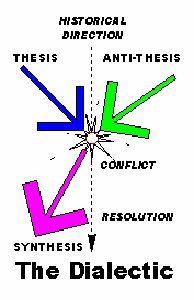
Another way to look at the dualistic competition of Nature is in Hegel's notion of historical Dialectic, which has three prongs : Thesis + Antithesis = Synthesis. I think of the resolution of oppositions as the directional vector of progressive evolution. There are winners & losers in evolution, but the process always succeeds in moving forward. :smile:Natural selection is, fundamentally, a competitive mechanism based on only two outcomes; success and failure. — Benj96
-
There is definitely consciousness beyond the individual mind
What does that "incompleteness" (shortcoming, fallibility) have to do with "modes of existence". The fact that humans are not omniscient, does not deter us from shorthand thinking in terms of True vs False. Is Non-omniscience (human) a different mode from Omniscience (G*D)?Gödel's Incompleteness Theorem — Mapping the Medium
Why doesn't he just call it "Potential", as Aristotle did? I guess Potency must always come before Actuality.Yes. That is Peirce's Firstness (Potential) — Mapping the Medium
Ah! Now I'm beginning to see the sequence.This relates to Peirce's Secondness (Actuality) — Mapping the Medium
How does Chance affect the practical application of theories? We usually assume that to put a theory into practice, either it will work or it won't. But of course, the test may also be inconclusive (incomplete). But why dwell on the Maybes, instead of the Yes or No results? Is there something to be learned from our misses?Your comment also points to Peirce's Pragmaticism,
differing from standard Pragmatism because it includes the addition of chance (Tychism). — Mapping the Medium
I assume that, by "habits", he doesn't mean pre-conceived notions? Perhaps, he means "Patterns", which might fit into the Potential - Actual - Pattern sequence? Some refer to Natural Laws as merely "habits" or "regularities or "tendencies" or "inertia", rather than absolute binding unbreakable Rules handed-down by God. Is Peirce implying that Nature accidentally falls into certain un-planned grooves? Is that the same as Random Chance? Perhaps that's a Non-law, or Law-breaker. In my thesis, I see an important role for Randomness, to allow for some freedom from Determinism, from Destiny. There are meaningful Patterns, even in Random Chaos.Peirce's Thirdness (Law, which also includes habit — Mapping the Medium
Chaos theory helps us to understand patterns in nature. . ... Chaos theory states that, under certain conditions, ordered, regular patterns can be seen to arise out of seemingly random, erratic and turbulent processes.
http://www.patternsinnature.org/Book/Chaos.html
To me, that sounds like Hegel's Dialectic, which synthesizes opposing forces. Two prior vectors are merged into a third vector, which becomes the new "growth direction".We perceive differences in the polarities (opposites). We reach conclusions habitually in inductive reasoning, as we go about our lives on autopilot. It is also the momentum that creates the 'tendency' to take habits, and because of that, it propels evolution forward by taking on that growth direction. — Mapping the Medium
Are you referring to Pierce's three laws as "modes of being". Please elaborate. :smile:understanding these irreducible modes of being — Mapping the Medium -
There is definitely consciousness beyond the individual mind
Ha! I guess you really dislike philosophy forums, which are mostly wrangling about Semantics. Maybe you can teach us to think in terms of Semiology (sign, object, interpretant). Apparently, Semantic meanings differ depending on the "interpretant". Which is why the threads on this forum often go-off in different directions. I haven't read-up on Semiology, partly because most of what I've seen appears more academic than realistic. But, in the Enformationism thesis, words, signs & symbols are not the only "information delivery vessels". :smile:that I really dislike thinking about semantics. :shade:
I'd much rather think about 'information delivery vessels' (semiotics). :grin: — Mapping the Medium
The relation between semantics and semiotics might seem straightforward: semantics is the study of the meaning and reference of linguistic expressions, while semiotics is the general study of signs of all kinds and in all their aspects. Semiotics comprises semantics as a part.
https://www.google.com/search?client=firefox-b-1-d&q=semiology+and+semantics -
There is definitely consciousness beyond the individual mind
In my Enformationism thesis, the common denominator between Energy & Consciousness is Information. As noted in the quote from Bergson, "the elementary unit of information is a difference". In mathematics, a difference is indicated by a colon (X : Y) or a division slash (X / Y). And the difference is interpreted in the human mind as Meaning or Proportion.consciousness is a product of the organization of energetic activity in the brain — Fuckiminthematrix
In Thermodynamics, Energy is a ratio between Inputs & Outputs (100% In / 75% Out ; Difference = 25%). It's the proportional relationship between Hot & Cold. Human senses perceive the difference, and conceive it as meaning. Einstein revealed that invisible & intangible Energy can transform into Matter. (E = mc2). But now it seems that Energy can organize the brain to produce the meaningful process we call "Thinking" or "Mind". And thought processes yield what we call "Consciousness" or "Awareness" (what it's like to think, perceive, and conceive). Energy, Matter & Mind are all emergent properties of Natural Evolution. Emergence is a Phase Transition like water to ice.
One sense of the verb "To Enform" is to organize in a meaningful pattern. So, I view information as both Physical Energy (Causation) and Metaphysical Mind (Knowledge). But, I also distinguish (differentiate) between General Information (power to enform; to evolve), and its most organized (highly evolved) form in the world : Consciousness. Like Energy, Information is everywhere, but Consciousness emerges only at the highest levels of evolution. Hence, no need to assume that energy-exchanging atoms are conscious of "what it's like" to be a fundamental particle of matter. :smile:
Difference : inconsistency, variation, diversity, imbalance, inequality, divergence, contrast, contrariety.
Note -- these synonyms a various ways of looking at relationships between things. In mathematics, it's a Ratio (Rational ; Reason). In Minds, it's a Meaning -- relationship to me.
The Meaning of Diffference : perception is more basic than conception, given that perceptual states are a significant source of information about the world, and conceptions ultimately depend on the information provided by experience in order to get off the ground, but not vice versa.
https://link.springer.com/article/10.1007/s12304-013-9170-z
Is Information Fundamental? : What if the fundamental “stuff” of the universe isn't matter or energy, but information? -
There is definitely consciousness beyond the individual mind
A paradox is also a relationship to external factors : truth and falsity. It asserts that a statement is True, when it is conventionally known to be False. True/False is a polarity. So, is Pierce saying that there's no such polarity as True/False? That all propositions are Maybes? I can see that in Enfernity (eternity/infinity) there is no such polarity as True/False, because everything exists only in Potential. But in the Actual world, we usually assume that all statements can be compared to some verifiable Fact, or axiomatic Truth. :smile:A polarity has external relation influence. A paradox does not. — Mapping the Medium
That sounds like my own BothAnd Principle, which assumes that all Paradoxes are ultimately resolved in Enfernity -- the ideal realm of G*D (imagined as the Whole, of which our world is a Part). But in the real space-time world, for ordinary humans, paradoxes must be resolved by Logic and Data. And we don't usually spend much time contemplating such circular thought-problems as Russell's Paradox, the Liar's Paradox, or Zeno's paradoxes. So, what's the point here? What is the real-world application of "Polarity", as opposed to "Paradox"? :chin:This is a proposition to which the principle of the excluded middle, namely that every symbol must be false or true, does not apply. — Mapping the Medium
Both/And Principle :
* My coinage for the holistic principle of Complementarity, as illustrated in the Yin/Yang symbol. Opposing or contrasting concepts are always part of a greater whole. Conflicts between parts can be reconciled or harmonized by putting them into the context of a whole system.
* The Enformationism worldview entails the principles of Complementarity, Reciprocity & Holism, which are necessary to ofset the negative effects of Fragmentation, Isolation & Reductionism. Analysis into parts is necessary for knowledge of the mechanics of the world, but synthesis of those parts into a whole system is required for the wisdom to integrate the self into the larger system. In a philosophical sense, all opposites in this world (e.g. space/time, good/evil) are ultimately reconciled in Enfernity (eternity & infinity).
* Conceptually, the BothAnd principle is similar to Einstein's theory of Relativity, in that what you see ─ what’s true for you ─ depends on your perspective, and your frame of reference; for example, subjective or objective, religious or scientific, reductive or holistic, pragmatic or romantic, conservative or liberal, earthbound or cosmic. Ultimate or absolute reality (ideality) doesn't change, but your conception of reality does. Opposing views are not right or wrong, but more or less accurate for a particular purpose.
* This principle is also similar to the concept of Superposition in sub-atomic physics. In this ambiguous state a particle has no fixed identity until “observed” by an outside system. For example, in a Quantum Computer, a Qubit has a value of all possible fractions between 1 & 0. Therefore, you could say that it is both 1 and 0.
http://blog-glossary.enformationism.info/page10.html
Yes. That's always a problem in human communication. But usually, we can only infer the "tacit" meaning. Does Peirce's "Polarity" allow us to read minds? :brow:you will see that Peirce also points out that there is a difference between what is explicitly asserted versus what is tacitly asserted. — Mapping the Medium
So, how is that obvious fact, a "mode of existence"? Actor and Reactor are factors in causation. Are those factors the modal difference? Perhaps Positive and Negative modes of existence? How does that distinction affect our understanding of True Reality versus Apparent Reality? :confused:The part of his statement that you are leaving out is "So in the action and reaction of bodies, each body is affected by the other body's motion". — Mapping the Medium
Materialists usually assume that "what is real" is "that which physically exists". So, how does Peirce distinguish those "modes of existence"? :cool:'what is real' and 'what physicallyexists. — Mapping the Medium -
Is there more than matter and mind?
I explain how in the Enformationism thesis, and hundreds of blog posts. Modern physics has now shown that both Matter & Energy are forms of mathematical Information (ratios; relationships). Moreover, long before Shannon's theory, Information has always been associated with the contents of Minds : Knowledge, Meaning, Ideas. So if everything in the world is a form of Information, then subjective concepts such as Qualia would have to be included. That is, unless you accept the notion of "Rational Soul", added to the animal body at conception, to create a human.It seems to me that your theory has exactly the same issue as materialism: how can you create qualia, experiences, consciousness from ''mundane information''? — Eugen
Just as Quantum Theory was an update for Newtonian Physics, Enformationism is intended to be a 21st century update for Ancient Atomism (materialism) and Ancient Spiritualism (idealism). It serves the same functions, without contradicting modern science, and is also compatible with Sub-Quantum Physics, which superceded Atomism. Of course, the subjective (qualia) aspect is dependent on an un-provable Axiom : That this world is essentially an idea in a universal Mind. This notion combines Realism with Idealism. If you don't like PanPsychism, then how about PanInformationism? It's like Quantum theory, in that it includes Classical Physics, but goes beyond into some counter-intuitive terrain.
I referred to it in the post above as "mundane Information" because it is an essential feature or factor or phenomenon of the real world, not just some airy-fairy noumenon. EnFormAction is neither Mind nor Matter, but the power to create both via Evolution. :smile:
Information : the power to enform ; to create novel forms, including Platonic Ideas and Physical Things
Factor : 1 : something that helps produce a result
Information is Fundamental : https://bigthink.com/philip-perry/the-basis-of-the-universe-may-not-be-energy-or-matter-but-information
EnFormAction : Intentional Causation. A proposed metaphysical law of the universe that causes random interactions between forces and particles to produce novel & stable arrangements of matter & energy. It's the creative power of Evolution -- the power to Enform; Logos; Change.
". . . endless forms most beautiful . . ." ___Darwin
Enformationism thesis : http://enformationism.info/enformationism.info/ -
Why is panpsychism popular?
I was referring to Mental quality, not a different kind, or value, of Life.The metaphysical distinction I was making is a Qualitative difference -- a matter of degree -- rather than a Quantitative difference -- two separate things. A Metaphyiscal difference instead of a Physical difference. As a Quale, it is also a matter of opinion. :smile:Neither. I sharply disagree with the part about there being a metaphysical division between humans and all non-human life. — javra
Quale : a quality or property as perceived or experienced by a person. -
There is definitely consciousness beyond the individual mind
I don't know what the point of such a statement might be. What is he really trying to say? That there is no such thing as a paradox? I sometimes say that all paradoxes are resolved in Enfernity (eternity & infinity). But that has nothing to do with the real world. :smile:What some might read as a 'contradiction' when I referred to "(4) the view that to exist in some respect is also to not exist in that respect (CP 7.569); " and you referred to as possibly being a paradox, is actually a 'polarity'. .... — Mapping the Medium
Again, this statement makes no sense to me. Is it referring to "modes of existence" other than reality? What other kinds of existence are there? Do ghosts exist in a parallel universe? Are entangled particles a polarity of different modes of existence? What is the point of such an abstruse assertion? :cool:Peirce asserted that "the continuity of space so acts as to cause an object to be affected by modes of existence not its own, not as participating in them but as being opposite to them. . . . — Mapping the Medium -
Incomplete Nature -- reading group
I suspect that Deacon views the evolution of Information as a directional process. "To Intend" means to be inclined or directed-toward some goal or end. So, he seems to view "Enformation" as the intentional creation of novel forms. "To Enform" means to form, to fashion, to create. So, in a broad sense the process of Information involves future-directed creative change. Of course, he neglects to speculate on the original Intender or Informer. In my own thesis, I interpret the word "information" as both a static noun and an active verb. As a verb, "To Inform" implies the purposeful intention to convey ideas to someone. :smile:I'm on the chapter about the self. What did you think of his assessment of information? I'm not sure it makes sense to say that information is ententional, but I wouldn't put too much energy into wrestling with the question. I'm not sure what the consequences would be either way. — frank
Endless Forms :
“There is a grandeur in this view of life, with its several powers, having been originally breathed into a few forms or into one; and that, whilst this planet has gone cycling on according to the fixed law of gravity, from so simple a beginning endless forms most beautiful and most wonderful have been, and are being evolved." ___Charles Darwin
https://www.goodreads.com/quotes/3895-thus-from-the-war-of-nature-from-famine-and-death
Information :
* Claude Shannon quantified Information not as useful ideas, but as a mathematical ratio between meaningful order (1) and meaningless disorder (0); between knowledge (1) and ignorance (0). So, that meaningful mind-stuff exists in the limbo-land of statistics, producing effects on reality while having no sensory physical properties. We know it exists ideally, only by detecting its effects in the real world.
* For humans, Information has the semantic quality of aboutness , that we interpret as meaning. In computer science though, Information is treated as meaningless, which makes its mathematical value more certain. It becomes meaningful only when a sentient Self interprets it as such.
* When spelled with an “I”, Information is a noun, referring to data & things. When spelled with an “E”, Enformation is a verb, referring to energy and processes.
http://blog-glossary.enformationism.info/page11.html -
Why is panpsychism popular?
Do you disagree with the qualitative difference, or the out-dated notion of a god-given Soul? If the latter, then we may be somewhat in agreement. :smile:Then we sharply disagree. — javra -
Why is panpsychism popular?
I would say that Humanity is "metaphysically divided" from animals as an Aristotelian ten-fold conceptual category. Perhaps number (3) Quality. Christians would call that "quality" a "Soul". But I don't use that terminology. :smile:The question isn't whether human culture should be placed into the same camp as the culture of some lesser animal species or another. The issue is one of whether humans are metaphysically divided from the rest of life, or, else, are a progressive aspect of life in general - this despite the massive punctuated-equilibrium leap which our species has undergone. — javra -
Why is panpsychism popular?
I agree. But I'm not talking about PanPsychism, but about PanEnformationism.Panpsychism is a non-starter for a science-informed metaphysics because "consciousness all the way down" explains nothing and just defers explanation. — apokrisis
See my reply to above. :cool: -
Why is panpsychism popular?
That is the point of my Enformationism thesis. It's not just dumb Information all the way down. Instead, it's the upward evolution of Information over the ages. The information in the Big Bang singularity is imagined as a simple mathematical algorithm. That simple expression must have included self-reference to create feed-back loops in the program.Yet even if we accept a physics which says "everything is an informational process all the way down, rather than a material process all the way up," this same ToE must make a hard distinction between "mindless physical systems" and "mindful living systems". — apokrisis
And that non-linear loop was the beginning of complexification, which has resulted in the current form of Information that we call "Ideas in a Mind". That distinction may not be "hard" enough for you, but it postulates a continuous logical progression of Information processing, as a natural solution to Chalmer's "hard problem". :nerd:
Evolutionary Algorithm : https://en.wikipedia.org/wiki/Evolutionary_algorithm
Do Loops Explain Consciousness? : Review of Douglas Hofstadter's book, I Am a Strange
Loop
https://www.ams.org/notices/200707/tx070700852p.pdf
Evolutionary (Genetic) Programming :
The program does not specify the final outcome. But it does define a “fitness function”, which sets the criteria for acceptable solutions. With-out those limits, the process could go on indefinitely.
We can see that natural evolution is circling around some future state, like a moth to a light. The ultimate fitness point functions like a Strange Attractor to “pull” the present toward that future state.
http://blog-glossary.enformationism.info/page13.html -
Why is panpsychism popular?
Yes. Most of the higher animals have some form of culture, including ants & bees. But I wouldn't put them in the same category with human culture. I'm aware that some people prefer to belittle the accomplishments of humans, in order to avoid the notion that they are something more than mere animals. I assume it's a rejection of the notion of human souls, and a unique "human nature". But that's not what I'm talking about. There's no need for the miraculous addition of a soul to turn a sheep into a shepherd. Evolution does that trick naturally, but it takes time, lots of it. :smile:Haven't read up on dolphins but, as a fun tidbit, chimpanzee cohorts have their own unique cultures (with a small "C"). — javra
Animal Culture : Animal culture involves the current theory of cultural learning in non-human animals, through socially transmitted behaviors. The question as to the existence of culture in non-human societies has been a contentious subject for decades, largely due to the lack of a concise definition for the word "culture".
https://en.wikipedia.org/wiki/Animal_culture
Anti-Humanism : Central to antihumanism is the view that philosophical anthropology and its concepts of "human nature", "man" or "humanity" should be rejected as historically relative, ideological or metaphysical.
https://en.wikipedia.org/wiki/Antihumanism -
Why is panpsychism popular?
Yes. But the categorical difference between our own and chimp/dolphin consciousness, is that human self-awareness has created a whole new form of Evolution : Culture. The evolutionary process has accelerated since humans became the dominant species. Unfortunately, human Morality has difficulty keeping up the pace with Technology. :smile:It may not be anthropocentric to say that human consciousness is categorically different to bee consciousness. A more telling comparison would be a chimp or a dolphin. — Kenosha Kid -
Why is panpsychism popular?...Cosmopsychism, which could be called 'biggism' I suppose. This says we start with the universe as a whole as the primarily conscious entity. — bert1
Tantalising hint from ancient philosophy:
"He penetrates the world "as honey does the honeycomb" (Tertullian, "Adv. Hermogenem", 44), this God so intimately mingled with the world is fire or ignited air; inasmuch as He is the principle controlling the universe, He is called Logos; and inasmuch as He is the germ from which all else develops, He is called the seminal Logos (logos spermatikos)." — Wayfarer
The Stoic worldview quoted above is similar to my own Enformationism thesis, which is based on modern science, rather than ancient philosophical speculations. So, I use mundane metaphors from Quantum Physics and Information Theory instead of poetic notions of honeycombs permeated with the staff-of-life for bees.
I try to avoid the misleading term Panpsychism, due to its implication that bees and atoms are conscious in a manner similar to human awareness. This may sound anthro-centric to some, but human-self-consciousness is in a whole separate category from bee-awareness. There is indeed a continuum of Information complexity from atoms to humans, but it's still a hierarchy, with silly self-important humans on top.
I'm also wary of the label Cosmopsychism for the same reason --- although Phillip Goff's concept is closer to my own. This holistic concept is not the God of the Bible, but it is god-like in function. However, any personal characteristics are completely speculative, and possibly romantic. Instead, it's more like the god of Spinoza, who is "intimately mingled with the world" in the form of the ubiquitous energy of Information (Universal Substance). :smile:
Cosmopsychism : Phillip Goff -- "If we combine holism with panpsychism, we get cosmopsychism: the view that the Universe is conscious",
https://aeon.co/essays/cosmopsychism-explains-why-the-universe-is-fine-tuned-for-life
Cosmopsychism vs Enformationism : “agentive cosmopsychism”
http://www.bothandblog.enformationism.info/page53.html
Spinoza's Universal Substance : https://iep.utm.edu/spinoz-m/
The mass-energy-information equivalence principle : https://aip.scitation.org/doi/10.1063/1.5123794 -
Has science strayed too far into philosophy?
This open question reminds me of Quantum Theory. It began as a reductive search for the philosophical Atom. But, at this moment, it ends with ellipsis . . . . . . .You want a scientific understanding of fear and shame, but one that is not reductionist...? — Banno
That omission of knowledge opens the door for Philosophy to help explain the relation of Human Nature -- Life & Mind & fear & shame -- to physical Nature. Philosophy (and scientific hypotheses) fills-in the blanks (gaps in understanding) with logical speculation. That may be why science has -- inadvertently, but necessarily -- "strayed" into the the purview of Philosophy. :smile:
Quantum paradox points to shaky foundations of reality : https://www.sciencemag.org/news/2020/08/quantum-paradox-points-shaky-foundations-reality
Philosophical Atomism : is a reductive argument, proposing not only that everything is composed of atoms and void, but that nothing they compose really exists: the only things that really exist are atoms ricocheting off each other mechanistically in an otherwise empty void.
https://en.wikipedia.org/wiki/Atomism -
There is definitely consciousness beyond the individual mind
I suspect that a major difference between our worldviews is our jargon. My Enformationism thesis is primarily derived from Physics, and is only secondarily related to Metaphysics. That's one reason I refer to "Information" as "mundane", as opposed to "spiritual" or "otherworldly".I took these excerpts you wrote in another thread because I'd like to touch on our commonalities and differences. — Mapping the Medium
Although I am posting on a philosophical forum, I am not very well-informed about abstract & abstruse modern philosophical worldviews, such as Semiology and Synechism. I am somewhat familiar with ancient philosophy, such as Platonic and Aristotelian views. So, your posts are often like a foreign language to me. For example, "the view that to exist in some respect is also to not exist in that respect", simply sounds like a contradiction. Yet, I suppose that to you it may be merely an apparent paradox, which makes sense in terms of Synechism (Holism??) or Semiology (Semantics??).
I agree. Although I was not familiar with Nominalism, until you brought it up.I think our culture would be much more responsible if these aspects of human understanding had not been neglected in favor of nominalism, dualism, and materialism. — Mapping the Medium
I too, relate to Spinoza's worldview, except that I update it with our current understanding of the Big Bang origin of the world, and the immaterial Quantum foundation of the world.Peirce repeatedly praised Spinoza, saying that they were akin in their works and understanding. — Mapping the Medium -
Has science strayed too far into philosophy?
Yes. The Europeans may have been less committed to the doctrine of Materialism, and more familiar with philosophical Metaphysics. Around the beginning of the 20th century, the United States was changing the focus of higher education, from Philosophy (wisdom) -- as in Phd -- to Pragmatism (practical applications). Apparently, some of the pioneers of Quantum Theory retained some of their philosophical training, even as they discovered that the foundations of the material world are not composed of Physical Matter, in the traditional sense, but something more like Metaphysical Mathematics. Hence, fair game for philosophers. :smile:Many of the pioneers of quantum mechanics were Europeans and deeply philosophical in outlook — Wayfarer
Is quantum mechanics materialist?
Consequently, Einstein's relativity was considered a denial of materialism and objective reality by philosophers and some prominent scientists at the time.
http://socialismtoday.org/archive/127/quantum.html
Quantum: Einstein, Bohr and the great debate about the nature of reality :
In 1958, Heisenberg wrote that the Copenhagen interpretation had "led physicists far away from the simplistic materialist views that prevailed in the natural sciences of the 19th century". Einstein, he said, wished to return to "the idea of an objective, real world", where subatomic particles "exist objectively in the same sense as stones or trees exist, independently of whether or not we observe them". (Physics and Philosophy, pp82-83)
Nominal Mass : in physics, Mass is the metaphysical "essence" of Matter. Mass has no physical properties, it is itself a property -- a Quality. It's the name (L. nomen) for a measure of Matter. (L. mensura ; mens -- mind)
Note : you won't find this definition in Physics textbooks. -
Is there more than matter and mind?
In my Enformationism thesis, that "underlying something" is mundane Information. But not just the uncertain (entropy) Information that Shannon made famous. It's a statistical ratio from 1 (certain), to 0 (uncertain) -- evaluated in terms of Probability percentages. Ironically, Information is also the opposite of destructive Entropy, it's the constructive agency we call "Energy". For humans, Information is Knowledge & Awareness. For me, it's a monism that unites the dualism of Mind & Matter.Neutral Monism is the position that something which is neither mind nor matter gives rise to both. — Marchesk
As you hinted, metaphysical Mathematical Information is defined in terms of ratios and relationships. But the ability to "see" those abstract relationships, and to interpret them as self-oriented Meaning, is rare in the universe. And that highly-evolved form of Information (Ideas; Concepts) seems to occur mostly in human Minds. But physicists have recently discovered that even malleable Matter and active Energy are merely various forms of intangible Information : the ability to cause changes in form; to enform. Hence, Evolution is an algorithm for enforming a world. And the human Mind is a late emergence in that process. Yet, it's all Information, all the way down to the Big Bang Singularity, which may have served as the DNA of the Organism we call "The World". :smile:
Mathematical Metaphysics : http://shelf1.library.cmu.edu/HSS/2015/a1626190.pdf
Information :
* Claude Shannon quantified Information not as useful ideas, but as a mathematical ratio between meaningful order (1) and meaningless disorder (0); between knowledge (1) and ignorance (0). So, that meaningful mind-stuff exists in the limbo-land of statistics, producing effects on reality while having no sensory physical properties. We know it exists ideally, only by detecting its effects in the real world.
* For humans, Information has the semantic quality of aboutness , that we interpret as meaning. In computer science though, Information is treated as meaningless, which makes its mathematical value more certain. It becomes meaningful only when a sentient Self interprets it as such.
* When spelled with an “I”, Information is a noun, referring to data & things. When spelled with an “E”, Enformation is a verb, referring to energy and processes.
http://blog-glossary.enformationism.info/page11.html
Is information the only thing that exists? : https://www.newscientist.com/article/mg23431191-500-inside-knowledge-is-information-the-only-thing-that-exists/
Information as a basic property of the universe : A theory is proposed which considers information to be a basic property of the universe the way matter and energy are.
https://www.sciencedirect.com/science/article/abs/pii/0303264796883687 -
Why is panpsychism popular?
In my Enformationism thesis, I get around that apparent dilemma, by using a more modern understanding of the fundamental element of both Mind and Matter : Information. Panpsychism has typically been interpreted to mean that everything is conscious to some degree. But I substitute the 21st century scientific concept of ubiquitous "Information". From that novel perspective, everything in the world -- Matter. Energy, and Mind -- is a form of Information. In that case, human-like Consciousness ("mental features") is a high-level form of Information -- a late emergence of evolution. And there's no need to assume that a grain of sand is aware of it's environment. Therefore, I would rename that ancient notion as : Pan-enformationism. :smile:"The Presocratics were struck by a dilemma: either mind is an elemental feature of the world, or mind can somehow be reduced to more fundamental elements. If one opts for reductionism, it is incumbent upon one to explain how the reduction happens. On the other hand, if one opts for the panpsychist view that mind is an elemental feature of the world, then one must account for the apparent lack of mental features at the fundamental level." --SEP — frank
Ubiquitous Information : The basis of the universe may not be energy or matter but information . . . . Although this line of thinking emanates from the mid-20th century, it seems to be enjoying a bit of a Renaissance among a sliver of prominent scientists today.
https://bigthink.com/philip-perry/the-basis-of-the-universe-may-not-be-energy-or-matter-but-information
Panpsychism vs Enformationism : The August-September 2017 issue of Philosophy Now magazine explores the revival of a quaint antique worldview, Panpsychism (all is mind), as a way to come to terms with the paradoxes of Quantum Theory. For my own purposes though, I try to avoid the beguiling human-centric implications of “psyche”, and say instead that all is EnFormAction (creative energy, power to enform). Of course, Panpsychism is ridiculed by materialists, partly because proponents use the misleading anthro-morphic human-scale term “consciousness” when referring to the universal mind-like aspect of reality. Which is why I think the more-generic & less-leading term “information” is more appropriate when discussing the basic substance of both Mind & Matter. For example, at levels of low complexity, exchanges of information are merely what physicists call “energy”, which is “doing” without “knowing”. Only at higher levels of intricacy and entanglement do the conscious properties of Mind emerge from Material stuff.
http://www.bothandblog.enformationism.info/page12.html
Information -- Shannon vs Deacon : http://bothandblog4.enformationism.info/page26.html -
Incomplete Nature -- reading group
Yes. Deacon is trying to maintain his credentials as a scientist, even as he crosses the Cartesian line between Soul & Body. But the Matter/Mind "line" is arbitrary, and fair game for Philosophers. That's why, in my Enformationism thesis, "magical" explanations are not necessary. All it takes is a change of perspective, from Physics to Metaphysics. :smile:I was going to say that there's overkill squared in his efforts to put aside the idea of the magically unexplainable, but maybe that's why: the shadow of Descartes. — frank
Special Metaphysics : The philosophical science of Metaphysics is essential to my worldview, because, unlike Physics, it allows us to study the immaterial aspects of our reality, such as Qualia (properties) and Ideas (meanings). Such non-things have no objective manifestation, but they do have subjective significance. The name for this kind of deep thinking originated, fortuitously, from Aristotle's encyclopedia of knowledge published in 4th century BC. He didn't distinguish the intangible topics from science-in-general, but he did separate his treatments on the objective natural world of the senses from those of the subjective artificial world of the mind. The Physics volume dealt primarily with hard-science topics that today we call Physics, Biology, Chemistry, Geology, Astronomy, etc. In the second volume, he dealt with miscellaneous topics that now fall under the generic heading of Philosophy, but also include Psychology, Sociology, History, Ethics, Logic, and so forth.
http://bothandblog2.enformationism.info/page74.html -
A fun puzzle for the forums: The probability of God
Philosophy is indeed a mind-game or personal pastime. And some scientists call philosophers "feckless", because their introverted activities typically make no physical difference in the material world. But philosophical investigations are intended to get us "closer to Truth" about the world --- to change minds, not to change material reality. Philosophy refines Beliefs about the world, and those Beliefs and Intentions have Political and Physical consequences in the world. That's why the philosophical game goes on long after the ninth inning. :smile:So it really is simply a game or pastime. . . . That still leaves me wondering whether (and if so why) it's a priority for my taxes to be spent on professional philosophers and pilosophy teachers continuing to debate the existence or otherwise of a god or gods? This certainly is, as you say, debatable. — Horace
“The philosophers have only interpreted the world, in various ways. The point, however, is to change it." ___Karl Marx.
Note -- Changing the world is the job of Politics, not Philosophy.
Aboutness : In philosophy, intentionality is the power of minds and mental states to be about, to represent, or to stand for, things, properties and states of affairs.
https://plato.stanford.edu/entries/intentionality/
Closer To Truth : presents the world’s greatest thinkers exploring humanity’s deepest questions. Discover fundamental issues of existence. Engage new and diverse ways of thinking. Appreciate intense debates. Share your own opinions. Seek your own answers.
https://www.closertotruth.com/about/overview -
Moral accountability
My comment omitted an important qualifier. It should have said "but not enough to be found legally guilty". So yes, legal responsibility requires objective evidence, and a jury of peers. Moral responsibility is a personal subjective judgment, and others may not agree with that opinion. That's why social accountability requires multiple attestations to the "crime". Personal accountability may be limited to a feeling of guilt, in those so inclined. There may be several contributing causes for suicide, such as depression. But the abusive husband would be the best judge of his own contribution. :smile:Indeed, but isn't there a difference between penal responsability and moral responsability? He can, of course, be seen as a cause of he death, but that would make him only causal responsable. — Matei
Moral Accountability : The Mosaic Law specified that, before anyone could be put to death by stoning, there had to be a trial, and at least two witnesses had to testify: “On the testimony of two or three witnesses a person is to be put to death, but no one is to be put to death on the testimony of only one witness” (Deuteronomy 17:6).
https://www.gotquestions.org/Bible-stoning.html -
A fun puzzle for the forums: The probability of God
Yes. But then, the "God" question is the ultimate philosophical game. Science asks relatively soft "how" questions that are amenable to hard evidence. But the hard questions are always, not "what" or "how, but the childish "why, why, why." Questions about verifiable facts can be proven to the satisfaction of reasonable people. But questions about "Meaning" are always subjective, and debatable.Either way, that still begs my main question, whether effort by philosophers to prove or disprove the existing of god or gods is and endless quest with not hope of a generally agreed proof? — Horace
That the physical world, "in which we live and move and have our being", exists is (almost) beyond question. But why? That my thinking mind exists, is (almost) un-doubtable. But why? Most animals seem to take existence for granted, so death comes as a surprise, except for humans. But why? So, asking "why" questions seems to come with the human genome.
Yet, after several thousand years of philosophizing, these questions remain unanswered, except for those who take the easy-out of Faith. Yet, what else will human questers find to do with their free time? The search for subjective Meaning is an open-ended non-linear multi-player game. Your move. :cool:
https://en.wikipedia.org/wiki/Nonlinear_gameplay -
Incomplete Nature -- reading group
Ironically, Deacon's notion of Purposeful or "Causal Absence" sounds a lot like the ancient notion of "Invisible Spirits" (Animism), which caused real-world effects that could not be explained by pointing to a physical agent. So, I suspect that his detractors will interpret such "absence" as Metaphysical, if not outright Spiritual & Magical. :cool:In Chapter one Deacon affirms his desire to hold to a materialist approach, which he seems to be defining as nonmagical. — frank
The Power of Absence : “I will refer to this [something-that-is-not-a-thing”; elusive character of incompleteness] as an absential feature
. . . A causal role for absence seems to be absent from the natural sciences.” ___Terrence Deacon
http://bothandblog4.enformationism.info/page17.html -
A fun puzzle for the forums: The probability of God
The author of the referenced book seems to agree with you. The existence of anything invisible & intangible must be inferred from circumstantial evidence : Dark Matter, for example. That's why some religious believers reluctantly admit that Faith comes down to an act of will, or of personal experience, not logical or mathematical reasoning. :nerd:It seems to me that given the nature of what Christians and other monotheists call 'God' there just can't be a way to prove or disprove his, her or their existence - or otherwise. — Horace
The Probability of God : "he admits that, according to Catholic doctrine, “it is the human faculty of will, and not reason, that plays the crucial role in achieving faith”. Moreover, “this position is fully consistent with . . . the notion that faith ultimately rests on an accumulation of probabilities”.
http://bothandblog6.enformationism.info/page64.html -
A fun puzzle for the forums: The probability of God
I don't accept the Bible as the "word of God". That's why I was interested in an argument that uses Mathematics, instead of Scripture, as evidence for belief in God. It didn't convince me. But it might work for those who accept the authority of both Scripture and Mathematics. :smile:Consider the theist who takes it to be an obvious given that the Bible is the word of God. — Hippyhead -
There is definitely consciousness beyond the individual mind
I have now. Or at least, the linked synopsis. Ironically, I assume that Nominalists take the fourth method as their guide. But they interpret the intent to mean : reject Ideality. Ideas about reality fall into the Aristotelian category of Metaphysics. So, if they can't see, hear, touch or smell it, it ain't admissible as evidence for the "fixation of belief".Have you read Charles Peirce's The Fixation of Belief? — Mapping the Medium
Unfortunately for them, Philosophy is all about Ideality. It doesn't study real physical objects, but human ideas & opinions about the real world. That's what Aristotle called "First Philosophy". Maybe Pierce should have added a fifth method for confirming beliefs : Reasoning from all forms of evidence to Logical conclusions about Reality. :smile:
Four Methods for Fixing a Belief : 4. Scientific: test your beliefs against reality.
https://users.manchester.edu/Facstaff/SSNaragon/Online/texts/201/05-PeirceClifford.pdf
Note -- Beliefs about Reality are ideas abstracted from sensory information. Beliefs are inherently metaphysical -- ideal, not real. That includes "grounded" Nominalist beliefs.
Reality : the world or the state of things as they actually exist, as opposed to an idealistic or notional idea of them.
Ideality : The mental aspects of Reality. Ideas as contrasted with Objects. Metaphysics, as contrasted with Physics. Mind, as contrasted with Matter. Memes as contrasted with Genes.
Aboutness : Knowledge of relationships. Intentionality.
" Brentano made it the defining feature of the mental. Phenomenologists try to pin down the aboutness-features of particular mental states. Materialists sometimes claim to have grounded aboutness in natural regularities. "
https://press.princeton.edu/books/hardcover/9780691144955/aboutness -
A fun puzzle for the forums: The probability of God
Since it declined into name-calling at the end, I resurrect this thread with trepidation, simply to add my two-cents-worth on the question of gambling odds for God. Apparently, you are placing your bet, based on your calculation of "infinite to one" odds in favor of a Prime Cause. I previously linked to an article reviewing the book by Steven Unwin -- The Probability of God : A Simple Calculation That Proves the Ultimate Truth. The author calculated somewhat more modest 67% odds that our world was created by The Christian God. I must congratulate him on a good try, presented with reason and humor. FWIW, here's my review of the book, posted some time after this faded into infinity. Enjoy! :smile:16. But, if we are to gamble and wonder whether our universe formed without a God as a primary cause, versus a God as a primary cause, it is infinite to 1 that our universe was formed by a God instead of simply forming on its own. — Philosophim
The Probability of God : The Hard Question of Divine Existence
http://bothandblog6.enformationism.info/page60.html
The "Fun Puzzle" continues . . . . for those of us who can discuss "god questions" with a sense of humor and fair play.
PS___I never did find your "flaw" -
Moral accountability
That question is subject to debate, depending on various personal moralities. And that's what a philosophical forum is for.but is he morally responsible for her suicide? — Matei
But, I will note, that in a court of law, the husband could be declared a "contributing cause" to the wife's death. Therefore, culpable to some extent, but not enough to be found legally guilty of murder. Whether he is "morally" responsible, I'd have to say "yes". And he should feel guilty, and remorseful. But that's just my opinion. :smile:
Contributing Cause : A contributing cause is any cause that is not self-sufficient.
https://www.jargondatabase.com/Category/Occupation-and-Profession/Engineering-Jargon/Contributing-Cause -
Human nature?
I assume that the "meaning" of your comments was to go on record that, as a layman, you doubt the opinion of of an "expert" on a topic that he studies professionally. That's OK, you're entitled to your opinion. But I happen to agree with his opinion. Regarding which "perception" is skewed or biased, I have my opinion on that too. 'Nuff said! :joke:All I care is that you understand the meaning of what I’m referencing. — JackBRotten
"The greatest deception men suffer is their own opinions." —Leonardo da Vinci
"Your Right to an Opinion Does Not Make Your Opinion Valid"
https://www.psychologytoday.com/us/blog/naked-truth/201706/your-right-opinion-does-not-make-your-opinion-valid
Defining terms is what distinguishes philosophical dialog from a squabbling argument. :smile:First off, arguing the definition of words is a pointless endeavor as perception oft skews them. — JackBRotten
“The beginning of wisdom is the definition of terms.” ___Socrates? -
Human nature?
Some people use "perception" and "conception" interchangeably. But dictionaries make a key distinction : "Conception" is a mental interpretation of raw sensory "Perception". You seem to be using Perception to mean Prejudice or Bias or Misunderstanding. But that usage is itself biased toward Misconception.Also, a human being saying that the human brain is the most complex thing in the universe is precisely how “biased” is defined. Perception declares it complex. But there is also perceptions that say it’s not. — JackBRotten
In my linked quote about the complexity of the brain, the "human" is an expert in his field. Are you accusing him of being biased toward human superiority? On what basis, other than that it disagrees with your "Perception" of human inferiority or mediocrity? :cool:
Key Difference – Conception vs Perception : Perception is the ability to see, hear, or become aware of something through the senses and conception is the ability to form something in the mind and to develop an understanding. This is the key difference between conception and perception.
https://www.differencebetween.com/difference-between-conception-and-vs-perception/ -
Incomplete Nature -- reading group
Yes. Humans can imagine functions for things unseen. That is why we create new tools for purposes that are not yet doable. :smile:Functionality is contextual only to what we can see and perhaps that could open things up for purpose in things we can't see. — magritte
Tools : A tool is an object used to extend the ability of an individual to modify features of the surrounding environment. Although many animals use simple tools, only human beings, whose use of stone tools dates back hundreds of millennia, have been observed using tools to make other tools.
https://en.wikipedia.org/wiki/Tool -
Human nature?
And how do you account for our greater "perception"?The one thing that truly separates humans from all other life is perception. — JackBRotten
I suspect that you meant "conception". Human perception is widely acknowledged to be inferior to that of most animals. But, our ability to conceive ideas and to make detailed plans, seems to be our primary advantage over even those animals with larger brains and sharper senses. Sometimes size matters. But complexity and coordination make the difference that makes the qualitative difference between human nature and animal nature. :smile:
Perception : the state of being or process of becoming aware of something through the senses.
Conception : the forming or devising of a plan or idea.
the Most Complex Object in the Universe : The human brain contains some 100 billion neurons, which together form a network of Internet-like complexity. Christof Koch, chief scientific officer of the Allen Institute for Brain Science, calls the brain "the most complex object in the known universe," and he's mapping its connections in hopes of discovering the origins of consciousness. -
There is definitely consciousness beyond the individual mind
Sorry to interrupt your exit. Maybe, like a stage performer, you can take a second and third bow. :joke:Not fair, Gnomon. ;-) You know I am trying to bow out. — Mapping the Medium
OK. I'll bite. In what sense are mental Abstractions "real", as opposed to "existent"? I suppose that Pierce intended to reconcile Realism & Idealism in his philosophy. But his explications are so complex and technical, that I get lost in a labyrinth of enigmas. Maybe you can 'splain it to me.Don't you actually mean "In what sense are they real? — Mapping the Medium
In my attempt at a common-sense answer to that query, I simply point-out that our meta-physical ideas are as much a part of our "reality" (our worldview) as our physical sensations. But that doesn't imply that they have the same ontological status. They "exist" in different senses : Objective and Subjective. These distinctions are as old as Philosophy. So, it's not a question of Either/Or, but of BothAnd.
However, the advent of Modern Science began to drive a wedge between objective "Facts", and mere "Beliefs" -- which were banished, to reside in an imaginary never-never-land of Platonic Ideality. That flip-flop of primacy for Facts over Faith made sense when early scientists were seeking to escape from bondage to Church hegemony. But that rebellion never succeeded in completely overthrowing the role of Faith in the popular mind. So, perhaps "hard" Nominalists are still fighting that old revolutionary war against the power of political/religious dominance. But today, even staunch Catholics accept the validity of most empirical facts. Yet, the Cold War of Real vs Ideal may never be over for some.
I assume that a "hard" Nominalist would have to say that Ideas are un-real, so un-important. However, I don't know many people who go that far with their worldview of Materialism. The theory of Evolution is merely an Idea, but is has some physical evidence to support its generalization from specific fossils to an elaborate "myth" of Life's struggle to survive. Yet, the act of synthesis is itself an abstraction from real things to essences.
The human mind abstracts concepts from percepts by "sucking-out" only their logical structure (essence or meaning), and leaving behind the physical husk that our senses detect. So, which is real, and which is ideal? I don't have a problem with making that distinction, when it serves a purpose. That's why my thesis has a technical definition for the term "Ideality" to supplement the usual notion of "Reality". So yes, mental concepts are "nominal" in the sense that they are beliefs about Reality -- not objective reality itself. But without such beliefs, how could humans make sense of the world? :smile:
BothAnd-ism :
An inclusive philosophical perspective that values both Subjective and Objective information; both Feelings and Facts; both Mysteries and Matters-of-fact; both Animal and Human nature. -
Block Universe and experience
I don't think YOU have to worry about experiencing Block Time. In Eternity & Infinity there is no Change, no Time or Space, to be experienced. Our senses only detect differences. Can you feel positive or negative Nothingness? Block Time only applies to abstract mathematics. :joke:Will you stay "frozen" with your last feeling? Won't you experience anything? — Philosophuser
Block Time experience : https://plus.maths.org/content/what-block-time -
Incomplete Nature -- reading group
Yes. Deacon provides many illustrations of meaningful "Absence" in the world. Our understanding of the number "Zero" was long delayed, because the notion of functional absence was counter-intuitive. Now, we take it for granted that an empty orbit in an atom can have a causal effect on other atoms. We are somewhat comfortable with the idea that Negative Space can be attractive, and have positive effects. In many situations, that-which-does-not-exist in a physical sense, still has Potential, in a metaphysical sense. In Taoism, "Wu" (emptiness) is functional Potential. :nerd:I dont know if it diminishes his point, but absence is an aspect of a lot of things, such as a valley or a positive charge which results from atoms that are missing some of the electrons they would need to be neutral. True? — frank
Incomplete Nature : https://en.wikipedia.org/wiki/Incomplete_Nature
What is Wu? : "The thirty spokes unite in the one nave; but it is on the empty space (for the axle), that the use of the wheel depends. Clay is fashioned into vessels; but it is on their empty hollowness, that their use depends. The door and windows are cut out (from the walls) to form an apartment; but it is on the empty space (within), that its use depends. Therefore, what has a (positive) existence serves for profitable adaptation, and what has not that for (actual) usefulness."
https://www.taopage.org/emptiness.html
Functional : of or having a special activity, purpose, or task; relating to the way in which something works or operates.
Gnomon

Start FollowingSend a Message
- Other sites we like
- Social media
- Terms of Service
- Sign In
- Created with PlushForums
- © 2026 The Philosophy Forum