
Comments
-
Anaxagoras
Apparently, you are looking at causation from a different perspective. When I say that Intention is a deterministic cause, I mean that the human Intender had the power to determine a specific effect. That's why most people believe they have enough Freewill to overrule the Common Cause of random events. You may be thinking of determinism in terms of Divine Will. Theists tend to believe in divine fore-ordination, by analogy with human design and programming. That is what we call the First or Primary Causation, which is reflected in the teleology of Natural Causes. Hence, human intentions and creations are secondary causal acts.We cannot say, as you do, that intentional acts are deterministic, because the evidence is that we have freedom of choice. — Metaphysician Undercover
Common Cause vs Special Cause : Common Cause is also known as Chance Cause (natural pattern). Special Cause is a non-random, unpredictable causation, such as an intentional human act (un-natural cause).
https://en.wikipedia.org/wiki/Common_cause_and_special_cause_(statistics)
I've been using the term "Chance" as a shorthand for "Random Probability". So I assume you have some important philosophical reason for denying that natural events are caused by random Chance. Since "Chance" is an ancient notion of natural agency similar to Fate, perhaps we should use the more scientific "Probability". Note, in the definition below, "Chance" refers to Causation that is unpredictable, or random, instead of Intentional. Therefore, when we can't attribute an effect to any particular (special) cause, we say it was "caused" by Chance, meaning a natural random event (or an act of God), instead of an intentional willed effect by human agents. Therefore, our disagreement is not a category error, but merely the failure to properly define our terms for this context. :smile:Likewise, as I already explained, we cannot say that natural occurrences are caused by chance. — Metaphysician Undercover
Chance : the absence of any cause of events that can be predicted, understood, or controlled: often personified or treated as a positive agency:
Probabilistic Causation : https://plato.stanford.edu/entries/causation-probabilistic/
Chance and Causality : http://home.uchicago.edu/~jlmartin/Chance%20and%20Causality.pdf
PS__I forgot how we came to disagree on the use of "Chance" pertaining to natural events. Please describe what difference it makes to your understanding of Causation in general.
PPS__ I may have answered my own question in the next post. -
The web of reality
Are there abstract Ideas in your Real world? If so, then you must accept both Idealism and Realism. If not, then you must repudiate the reality of Ideas. There is no contradiction, only the distinction between Abstract and Concrete. :cool:↪Gnomon
So you can believe both idealism and realism despite the inherent contradictions and no longer need pay attention to logic because quantum. — Banno -
Anaxagoras
My contrast of "Intentional Cause" versus "Accidental Cause" is basically a pragmatic scientific distinction, not an abstract philosophical category. For the practical purposes of Science, all physical events are either Intentional (artificial; experimental) or Accidental (natural; intrinsic). Intentional acts are deterministic & teleological, while Accidental events are random & probabilistic, caused by Chance. But you implied that "chance" means, not calculable mathematical probability, but merely ignorance of the effective Cause . . . a shrug of the shoulders. Then you admitted that an event without a (known or inferred) cause is "unintelligible". So, why place natural Accidents into a separate category from cultural Intentions? That would seem to be a resignation to the incomprehensibility of Nature.I see your definition, but as I explained, philosophically it doesn't refer to anything real. Intention is a cause, and chance is not a cause. So chance and intention are two distinct categories, not opposites. When we say an action is intentional, we mean that it was caused by intention. When we say that an act was by chance, we do not mean that the cause of it was chance, nor do we mean that the act was not caused. We generally mean that we do not know the cause of it. If we assume that a chance event has no cause this is an unintelligible idea, as I explained. — Metaphysician Undercover
Accidents in nature are usually attributed to statistically deterministic Natural Laws as the Cause, which originally referred back to the Will of God as the Prime Cause. Hence, even apparently random events were presumed to be Teleological and Intentional. Scientists still use the term "Law", but dispense with the notion of an intentional Lawgiver. That's because, unlike some philosophers, to admit ignorance of the chain of causation would undermine the validity of their theories. Unfortunately, their logical chain has no beginning, no First Cause --- only infinite ignorance.
According to Hume though, we have no way of knowing for sure that an effect is caused by its precedent. Instead, we merely assume that there is some (lawful) link between the before and after states. In other words, the Cause of an Effect is inferred rationally, but not observed empirically. Is that what you mean by, "it doesn't refer to anything real"? And yet modern Science would not work without Causal Inference, and the term "law" implies a willful deterministic Cause of some kind : perhaps the vague notion of Philosophical Necessity. Chance may not be a clear-cut Cause, where the intention can be ascertained by asking the intender. But, for the purposes of Science, Chance is the causal power of Nature, not some spooky fickle force like Fate. :smile:
Chance :
1, do something by accident or without design.
2. in the most general sense of the word, is the negation of necessity and the opposite of determinism.
3. Probability theory, a branch of mathematics concerned with the analysis of random phenomena. The outcome of a random event cannot be determined before it occurs, but it may be any one of several possible outcomes. The actual outcome is considered to be determined by chance.
Probabilistic Causation : https://en.wikipedia.org/wiki/Probabilistic_causation
Correlation does not imply causation : https://en.wikipedia.org/wiki/Correlation_does_not_imply_causation
Statistical Determinism : https://dictionary.apa.org/statistical-determinism
Transference theory of causation : https://hal.archives-ouvertes.fr/hal-01918271/file/Why_is_the_transference_theory_of_causat.pdf -
Anaxagoras
You must have in mind a different definition of "Intentional". The antonym of Intentional (planned, willed) is given as Accidental or Un-intentional or Un-planned.or Un-willed. Are these definitions not oppositions? Perhaps "Accidental" is not a physical Thing, but as a concept it is the negation of "Intentional", is it not? Or are all actions Intentional in some sense? :smile:I don't see how there is such a thing as the opposite of "intentional". — Metaphysician Undercover
Accidental : 1. happening by chance, unintentionally, or unexpectedly.
Intentional (metaphysics) :
3.a. pertaining to an appearance, phenomenon, or representation in the mind; phenomenal; representational.
b. pertaining to the capacity of the mind to refer to an existent or nonexistent object.
c. pointing beyond itself, as consciousness or a sign.
PS__Sorry, I wasn't aware that "Intentional" had a special metaphysical meaning. -
The web of reality
Are there philosophers who hold that "actual concrete reality" is transcendental? How would you classify neuroscientist Don Hoffman's Model Dependent Realism? As I understand it, the physical phenomena we think we see are merely models in the mind that represent the underlying reality : indirect concepts instead of direct percepts. It's a "symbolic interpretation of the world, yet it is not an illusion, but merely a simplification of the messy reality of the Actual world (true reality vs apparent reality??), most of which we are not aware of. He thinks that evolution prepared our brains to abstract just enough information from the outside world to survive long enough to replicate.An empirical idealism, on the other hand, would hold that the kind of stuff we can observe, phenomena, are just abstract ideas in our minds, and conversely that actual concrete reality is the transcendental, unobservable stuff, the noumena, that underlie those phenomena, and which those phenomena represent to our minds. That's a view that both Kant and I reject. — Pfhorrest
His novel theory may sound crazy at first glance, but the computer screen analogy makes sense to me. Be that as it may, I treat my conceptual percepts as reality, for all practical purposes. Only speculative philosophers, and imaginative neuroscientists, need to entertain the possibility of Transcendental Reality behind the curtain of Phenomenal Reality. I get confused about which is which. "Which is real and which is Memorex"? :smile:
Model Dependent Realism :
“claims that it is meaning-less to talk about the "true reality" of a model as we can never be absolutely certain of anything. The only meaningful thing is the usefulness of the model.”
https://en.wikipedia.org/wiki/Model-dependent_realism
Reality is not what you see : http://bothandblog6.enformationism.info/page21.html -
The web of reality
Does your "explosion theory" take into account the weirdness of Quantum Reality? If so, then statistically your exploding particle can be both P and ~P.. Both here and there, both singular and dual as it passes through a slit. :joke:Well, presumably, since you accept both p and ~p, by the explosion principle it can be any colour. Or not.
But then, because quantum. — Banno
Quantum Weirdness : https://www.newscientist.com/article/mg22730370-500-where-does-quantum-weirdness-end/ -
The web of reality
I don't know. You tell me. It's your subjective theory. :joke:So, the cup that we can't see in the cupboard; what colour is it? — Banno -
The web of reality
Your comment missed the point. From my perspective, the Empirical and Theoretical views are not contradictory, but complementary. Human reason can "transcend" empirical reality, by imagining scenarios that are not visible to the physical eye. This is how Einstein came up with his revolutionary ideas about the ultimate nature of Reality. Of course, it helps if the theories are subject to empirical testing, as some of his were. :cool:So the cup in the cupboard is red, and yet also has has no colour? How to make sense of adopting apparently contradictory views? — Banno
Both/And Principle :
My coinage for the holistic principle of Complementarity, as illustrated in the Yin/Yang symbol. Opposing or contrasting concepts are always part of a greater whole. Conflicts between parts can be reconciled or harmonized by putting them into the context of a whole system.
The Enformationism worldview entails the principles of Complementarity, Reciprocity & Holism, which are necessary to ofset the negative effects of Fragmentation, Isolation & Reductionism. Analysis into parts is necessary for knowledge of the mechanics of the world, but synthesis of those parts into a whole system is required for the wisdom to integrate the self into the larger system. In a philosophical sense, all opposites in this world (e.g. space/time, good/evil) are ultimately reconciled in Enfernity (eternity & infinity).
Conceptually, the BothAnd principle is similar to Einstein's theory of Relativity, in that what you see ─ what’s true for you ─ depends on your perspective, and your frame of reference; for example, subjective or objective, religious or scientific, reductive or holistic, pragmatic or romantic, conservative or liberal, earthbound or cosmic. Ultimate or absolute reality (ideality) doesn't change, but your conception of reality does. Opposing views are not right or wrong, but more or less accurate for a particular purpose.
This principle is also similar to the concept of Superposition in sub-atomic physics. In this ambiguous state a particle has no fixed identity until “observed” by an outside system. For example, in a Quantum Computer, a Qubit has a value of all possible fractions between 1 & 0. Therefore, you could say that it is both 1 and 0.
http://blog-glossary.enformationism.info/page10.html
PS__I apologize for resorting to my peculiar "style" of argumentation, that you are not comfortable with. -
The web of reality
My own worldview is best defined as both Empirical Realism and Transcendental Idealism. That seems to be similar to Kant's position on Reality and Ideality. It's based on the usefulness of both Empirical and Theoretical knowledge. Rational theories can try to fill gaps in Materialistic Science. :smile:My general position on the nature of reality is empirical realism. — Pfhorrest
Kant's Realism : Nonetheless, while Kant is an empirical realist and this is a commendable thing (was it ever in dispute that he wanted to establish the objectivity of science and mathematics?), he remains a transcendental idealist. In short, Kant’s empirical realism only extends as far as the subject and humans. He nonetheless remains committed to the thesis that what objects might be independent of humans, and whether objects exist as our empirical claims portray them, is something that we can never know and which must be carefully excluded from philosophical discussion.
https://larvalsubjects.wordpress.com/2009/12/02/empirical-realism-and-ontological-realism/
Empirical and Theoretical Science :
http://bothandblog2.enformationism.info/page57.html -
Free will and ethics
Yes. Robert Wright, in Why Buddhism is True, used the Matrix movie as an analogy to the state of humans enslaved by their evolutionary programming. He assumes that we have enough freewill to make a choice between genetic programming and self-programming. :smile:But we can be aware that everything we do and say is most likely biased and act accordingly with humility and critical thought. — Roy Davies
Buddhist Meditation : "Wright begins his analysis of Buddhist Mindfulness Meditation by reference to the modern meme of taking the “Red Pill”, as illustrated in the movie The Matrix. The implication is that deluded humans have a choice to wake-up to harsh reality, and take charge of their own lives, or to remain in their illusory dream-state as slaves to outside forces."
http://bothandblog6.enformationism.info/page51.html -
Anaxagoras
No. In this context, "accidental" is the opposite of "intentional". In modern terms, an Accident is caused by random forces, and does not involve the property of Teleology. Aristotle contrasted Accidental change with Substantial change. But that is not what I was talking about.I don't know what you would mean by "Accident" here. Isn't an accident a property of an intentional act? — Metaphysician Undercover
That's what I thought you were referring to. But I was looking at change from the perspective of the First Cause or Creator. I suppose you could still call that Intentional change an act of measurement, in the sense that it is a mental comprehension. But I would hesitate to say that human measurement creates Reality. To me, it's more like the "measurement" is a choice of which aspect of reality the observer wants to see : location or motion. :smile:it is the act of measurement which gives reality. — Metaphysician Undercover -
Are we on the verge of a cultural collapse?
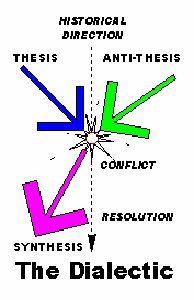
Yes. And Republican vs Democrat. Most of those antipathetic worldviews have ancient roots : Nobles vs Plebians, Conservatives vs Liberals, City Mouse vs Country Mouse, Us vs Them, etc . Those opposing forces in human culture are taken for granted in Hegel's Dialectic diagram of historical progress. But, he seemed to think that there was a directional "spirit" or "force" that constrained the zig-zagging course of history within viable limits. If one side or the other ever gained the upper hand, they would annihilate their opposition. Yet Nature seems to have some inherent balance to keep Viruses from completely eradicating their hosts. :smile:What about Red vs Blue? — Possibility
-
Anaxagoras
Actually, I'm not concerned to have Aristotle validate my notion of Eternal Potential. The Enformationism thesis will have to stand on its own legs. I'm aware that Aristotle was uncomfortable with Plato's "recondite" Ideals, but I find the notion to be necessary for metaphysical discussions, such as general concepts and ultimates.The issue was whether Eternal Potential is consistent with Aristotle and Aquinas, as Gnomon claimed. It is not. The idea of Eternal Potential is what the cosmological argument claims to refute. — Metaphysician Undercover
As an axiom of my thesis, I assume that for something contingent to exist, there must be something non-contingent, and for something temporal to exist, there must be something non-temporal, i.e. Eternal. For me that something is BEING -- the eternal potential to be. :cool:
Cosmological Argument : On the one hand, the argument arises from human curiosity as to why there is something rather than nothing or than something else.
https://plato.stanford.edu/entries/cosmological-argument/
Being Qua Being : So Aristotle's study does not concern some recondite subject matter known as 'being qua being'. Rather it is a study of being, or better, of beings—of things that can be said to be—that studies them in a particular way: as beings, in so far as they are beings.
https://plato.stanford.edu/entries/aristotle-metaphysics/ -
Anaxagoras
Yes. Something must trigger that Potential into an Action to produce an Actual thing. In physics, the prior potential of a cause is taken for granted. But the First Cause must be activated either by Accident or by Intention. For my purposes, I assume that the First Cause is Actual in the sense of eternal BEING (the power to be and to create beings). That makes the creative act both the First and Final cause : both beginning and end of this world. I'm aware that mechanical Physics makes no allowance for Intention in Cause & Effect. But this is all about conceptual Metaphysics.The point is that a potential cannot be a cause, only something actual can cause anything. — Metaphysician Undercover
I'm not sure what you meant by "the reality is given by measurement". That may be the view from a human perspective within the creation. But I was talking about the view from outside this space-time world. The model I use is Plato's notion of eternal Chaos --- which I interpret to be all Potential, nothing Actual : i.e. BEING --- and it's conversion into Actual Cosmos. AFAIK, Plato didn't go into detail about the Demiurge who triggered that transformation from Unreal (Ideal) Possibilities into Real Actualities. So, for the sake of my hypothesis, I assume that the First Cause was an Actor, with the power to convert ideas into actions, and possibilities into realities, i.e. EnFormAction. :nerd:Notice that in your descriptive example, there are supposedly infinite possibilities which collapse into one reality, the reality given by measurement. But that measurement is an act, and the possibilities are not really infinite, it's just a misunderstanding attributable to the mind that measures. — Metaphysician Undercover
Chaos :
In ancient Greek creation myths Chaos was the void state preceding the creation of the universe or cosmos. It literally means "emptiness", but can also refer to a random undefined unformed state that was changed into the orderly law-defined enformed Cosmos. In modern Cosmology, Chaos can represent the eternal/infinite state from which the Big Bang created space/time. In that sense of infinite Potential, it is an attribute of G*D, whose power of EnFormAction converts possibilities (Platonic Forms) into actualities (physical things).
http://blog-glossary.enformationism.info/page12.html
Note : a modern name for the potential of Chaos is the Universal Field : https://en.wikipedia.org/wiki/Unified_field_theory
EnFormAction :
Ententional Causation. A proposed metaphysical law of the universe that causes random interactions between forces and particles to produce novel & stable arrangements of matter & energy. It’s the creative force (aka : Divine Will) of the axiomatic eternal deity that, for unknown reasons, programmed a Singularity to suddenly burst into our reality from an infinite source of possibility. AKA : The creative power of Evolution; the power to enform; Logos; Change.
http://blog-glossary.enformationism.info/page8.html
Demiurge : https://plato.stanford.edu/entries/plato-timaeus/
If you don't like the assumption of an Intentional Being to create our world ---
The Multiverse as Ultimate Being : http://commonsenseatheism.com/?p=835 -
Anaxagoras
Yes. I understand that Aristotle was not comfortable with Plato's Idealism. But my worldview combines Idealism with Realism. For all practical purposes, our world is as real as it gets. But for philosophical theoretical purposes, we must look beyond the material world.A big problem here is that Aristotle's cosmological argument explicitly denies the concept of "Eternal Potential" as an impossibility. This is why the Christian God, and Aquinas' God is Actual. — Metaphysician Undercover
For example, the Big Bang is accepted by most modern scientists as the First Cause of physical reality. But they were discomfited by questions about what came before the Bang? This is equivalent to Atheist challenges asking "who created God?". So, hard materialist scientists were forced to expand their worldview beyond empirical Realty, into the realm of theoretical Ideality, in order to imagine the eternal regression of Bangs that they called the Multiverse. Hence, their expanded worldview combined Realism with Idealism.
I don't know what Aristotle's opinion was on the concept of "Eternal Potential". But his ontology assumed a necessary Non-Contingent Cause. Which I would interpret as a non-physical, non-temporal, eternal potential. This is equivalent to the "Necessary Being" that I call BEING. But my notion of G*D is also Actual, in the sense that our physical world ultimately consists of metaphysical Information, which is the essence of both Matter and Energy. Hence, physical reality consists of non-physical god-stuff : Spinoza's Universal Substance. That may sound weird, but it's no stranger than the Quantum theory of Virtual Particles. :cool:
Ideality :
In Plato’s theory of Forms, he argues that non-physical forms (or ideas) represent the most accurate or perfect reality. Those Forms are not physical things, but merely definitions or recipes of possible things. What we call Reality consists of a few actualized potentials drawn from a realm of infinite possibilities.
1. Materialists deny the existence of such immaterial ideals, but recent developments in Quantum theory have forced them to accept the concept of “virtual” particles in a mathematical “field”, that are not real, but only potential, until their unreal state is collapsed into reality by a measurement or observation. To measure is to extract meaning into a mind. [Measure, from L. Mensura, to know; from mens-, mind]
2. Some modern idealists find that scenario to be intriguingly similar to Plato’s notion that ideal Forms can be realized, i.e. meaning extracted, by knowing minds. For the purposes of this blog, “Ideality” refers to an infinite pool of potential (equivalent to a quantum field), of which physical Reality is a small part. A formal name for that fertile field is G*D.
http://blog-glossary.enformationism.info/page11.html
BEING :
In my own theorizing there is one universal principle that subsumes all others, including Consciousness : essential Ontological Existence. Among those philosophical musings, I refer to the "unit of existence" with the absolute singular term "BEING" as contrasted with the plurality of contingent "beings" and things and properties. By BEING I mean the ultimate “ground of being”, which is simply the power to exist, and the power to create beings.
Note : Real & Ideal are modes of being. BEING, the power to exist, is the source & cause of Reality and Ideality. BEING is eternal, undivided and static, but once divided into Real/Ideal, it becomes our dynamic Reality.
http://blog-glossary.enformationism.info/page10.html
Virtual :
Traditionally, the term "virtual" meant possessing virtues or qualities apart from physical properties. In computer science, "virtual" refers to software apart from hardware. In Physics, "virtual" describes the mathematical or statistical state of a waveform in a field before it is actualized as a particle. A "virtual" particle is defined as . . . not a particle at all. It refers precisely to a disturbance in a field that is not a particle."
The term “Virtual” in physics is analogous to “Spiritual” in meta-physics. In the Enformationism theory, it is equivalent to Qualia, apart from Quanta. The Quantum Mechanics term "Virtual" is equivalent to "Potential" or "Ideal". For example, virtual particles are merely mathmatical definitions with no material instances, until they are Actualized by an observation. Similarly, in Ideality, a Platonic Form has no physical examples until Realized by an intention. In both cases, the will of a mind triggers the transition from nothing to something.
http://blog-glossary.enformationism.info/page20.html -
Are we on the verge of a cultural collapse?
The link in my post investigated the history & validity of the quote, and others like it. Personally, I'm not concerned with what was "actually said" in cuneiform marks on clay tablets. It's the general feeling of exasperation with human nature and our imperfect world that resonates with me. Even so, I remain optimistic about the continuing progression of evolution, with or without homo sapiens. :smile:Very small point: since the Assyrians didn't write books, I wonder what the tablet - if the quote is genuine - actually said. — tim wood
“Ten Notable Apocalypses That (Obviously) Didn’t Happen” : https://www.smithsonianmag.com/history/ten-notable-apocalypses-that-obviously-didnt-happen-9126331/
End of World Prophecies : https://en.wikipedia.org/wiki/List_of_dates_predicted_for_apocalyptic_events
Cataclysms in World Cultural Evolution : https://bioone.org/journals/journal-of-coastal-research/volume-35/issue-6/JCOASTRES-D-19-00035.1/Disaster-Geoarchaeology-and-Natural-Cataclysms-in-World-Cultural-Evolution/10.2112/JCOASTRES-D-19-00035.1.short
"Vanity[a] of vanities, says the Preacher,
vanity of vanities! All is vanity."
___Solomon, Ecclesiastes -
Anaxagoras
Yes. I also don't use the term "Information" is a strict Shannon sense. And my thesis is based on modern Science instead of ancient Philosophy. But it agrees substantially with both Plato's Idealism, and Aristotle's Realism. As it turned-out, my personal worldview is compatible with some elements of both Materialism and Spiritualism. But, I am neither a Materialist, nor a Spiritualist; neither an Atheist, nor a Theist.possible/actual potential. — Gnomon
You don't use these terms in the Aristotelian sense. I can tell. I was trained as a Thomist from an early age. So we are coming from difference perspectives. Hope you have luck with your enterprise :) — Gregory
I was not deliberately copying Aristotle's analysis of Potential & Actual. I was merely following the logic of my insight into Information theory (all is information) where it led me. And I was not raised on Scholastic Theology. Ironically, I am currently reading Aristotle's Revenge, by philosopher Edward Feser. It seems to be a modern update of the Thomistic interpretation of Aristotle's worldview. He immediately gets into an analysis of Actuality and Potentiality. And so far, it seems to fit my own understanding of how Eternal Potential is converted into Temporal Actual. Unlike a lot of philosophical and theological writing, Feser's book is quite easy for an untrained amateur like me to read.
What differences do you see between Aquinas' usage and mine? I was not trying to defend any particular theistic doctrine, but my current view of the hypothetical G*D is deistic. What I call BEING (infinite potential) or LOGOS (the organizing force in evolution) serves as the First Cause and Enformer/Creator of our space-time world. But I remain agnostic about any personal properties. Anything I say about what preceded the Big Bang is speculative. I'm still developing the Enformationism thesis in the blogs. And I'll probably add a post after I finish this book. But it's over 450 pages, so it may take a while. :smile:
G*D :
An ambiguous spelling of the common name for a supernatural deity. The Enformationism thesis is based upon an unprovable axiom that our world is an idea in the mind of G*D. This eternal deity is not imagined in a physical human body, but in a meta-physical mathematical form, equivalent to Logos. Other names : ALL, BEING, Creator, Enformer, MIND, Nature, Reason, Source, Programmer. The eternal Whole of which all temporal things are a part is not to be feared or worshipped, but appreciated like Nature.
I refer to the logically necessary and philosophically essential First & Final Cause as G*D, rather than merely "X" the Unknown, partly out of respect. That’s because the ancients were not stupid, to infer purposeful agencies, but merely shooting in the dark. We now understand the "How" of Nature much better, but not the "Why". That inscrutable agent of Entention is what I mean by G*D.
http://blog-glossary.enformationism.info/page13.html -
Anaxagoras
Yes. In conventional physics, all material things are stable forms of dynamic Energy. But in cutting-edge Information Science, Energy itself is a physical form of metaphysical Information. This new understanding of the physical world is the basis of the Enformationism thesis. It combines some elements of Platonic Idealism with the modern understanding of physical Realism. :nerd:however I believe in the "law of vibration" wherein everything is energy — Gregory
mass-energy-information equivalence : https://aip.scitation.org/doi/10.1063/1.5123794
Energy Matter Information : https://bigthink.com/philip-perry/the-basis-of-the-universe-may-not-be-energy-or-matter-but-information
PS__Energy is indeed imagined as vibrations in empty space, which is a paradox. Instead, I think Energy is an on/off series of possible/actual potential. In reality, it works something like Morse code to convey Information from one place to another. wink-wink :joke:
No. In my view, there is Information in everything. Will and Intellect are emergent functions of highly developed brains. :smile:Maybe there is will and intellect in everything, — Gregory -
Gazzaniga's free will - is it free or not?
The appearance of contradiction is inherent in Paradox.And that is a bit contradictory. — Eugen
No. I find Chance & Possibility & Probability in the mindless Quantum Realm. The human mind is simply a function of the brain, and it is programmed by evolution to seek-out the best option for continuation of life. The brain is a meat computer, with no place for Wisdom. But the human mind is Natural Intelligence, with the flexibility to re-program itself.if you find free will in the quantum realm — Eugen
The "statistical gaps" of the quantum level of reality are merely convenient analogies for philosophers to use in constructing justifications for Freewill. The mind is a Choice Machine, and reality does provide some real options from which to choose. Mythical Fate & Destiny, and Physical Determinism, assume there are no gaps, leaving no room for human choice. But on the Quantum level, physical Change is never Inevitable, but merely Probable. So, the Chance element of our statistical world does allow some freedom for intentional choice.
Mechanical non-human statistics is based on Cause & Effect. But Bayesian statistics makes allowances for human beliefs & intentions to become real world causes. As Hume pointed out, we often assume that Cause is directly linked to Effect. But we can't prove it empirically. All we see physically is a Before & After relationship. Yet the metaphysical mind can "see" opportunities in the intermediate realm of Possibility. From a conventional classical Physics perspective, this kind of argument may sound kind of spooky, but the Enformationism worldview proposes a new way of looking at the Material world, in terms of malleable Information, which is both Matter & Mind. There are more arguments in the Blog, that attempt to make sense of those apparent Paradoxes in natural, yet unconventional, terms.
Yes, as many philosophers have concluded, Ethics & Morality are founded upon the assumption of Freewill, which cannot be proven empirically. If so, the Mind is partly responsible for the consequences of our choices. But only to the extent that it can overcome our evolutionary programming. There's more along these lines in the blog. At the bottom of each page, the Search box will find instances of terms like : "Freewill" or "Free Will". :nerd:or if the mind is responsible, at least partially, for our actions — Eugen -
Are we on the verge of a cultural collapse?
In the US, there are sizable groups of people who are planning, and stockpiling, for a Race War or Civil War. And if Trump loses the presidential election, they may be motivated to use guns rather than ballots to bring about the regressive change they think is necessary : i.e. back to when the superior race, and/or religion, was in control of society. If they succeed, against high odds, the current social & ecological decline may continue for the near future.However, just one thing I will stress is that I was not implying that the pandemic alone could trigger a cultural collapse. But if anything I should be pleased by some reassurance that we are not on the verge of collapse, because that is my fear. — Jack Cummins
But a similar crucial situation occurred in 1861. Yet, although it was a devastating moment in history, and the plantation economy collapsed, civilization as a whole did not fall apart. I can't assure you that hard times are not immanent, but I am confident that human culture will survive. My model of history is similar to Hegel's dialectic of contradictory forces (e.g. Left Wing vs Right Wing worldviews) that are held together by a singular teleological "spirit". Fortunately, most people tend to be moderate & conciliatory in their views, and inclined to favor to the idea of social & cultural progress, rather than regress. Besides, modern societies are too homogeneous to split neatly into Left vs Right, or White vs Black, or Christian vs Islamic.
For those who see no signs of progress in history though, despair may be a rational attitude. But Steven Pinker, in his book, Enlightenment Now, concluded that : “Though I am skittish about any notion of historical inevitability, cosmic forces, or mystical arcs of justice, some kinds of social change really do seem to be carried along by an inevitable tectonic force". Another term for his "tectonic force" is Teleology. I'm inclined to agree that, despite the ups & downs of history, cultural evolution has not yet reached its peak, and the end of the world is not near. :cool:
Tectonic : constructive
Progressophobia : http://bothandblog2.enformationism.info/page9.html
Natural Teleology : http://bothandblog2.enformationism.info/page59.html
End of World : An Assyrian clay tablet dating to around 2800 B.C. bears the inscription: “Our Earth is degenerate in these later days; there are signs that the world is speedily coming to an end; bribery and corruption are common; children no longer obey their parents; every man wants to write a book and the end of the world is evidently approaching.”
https://quoteinvestigator.com/2012/10/22/world-end/ -
What is the purpose of philosophy?
I liked the concept of philosophy as "martial arts for the mind". So I googled it. And sure enough that phrase is being used as a come-on for selling services for corporate training : "get off your butt, and let someone flip you on your butt, to relieve stress".It is much like martial arts for the mind: — Pfhorrest
I think teachers of college philosophy classes might increase their sign-ups, if they advertise the course as "martial arts for the mind". I'd show-up, as long as there is no actual butt-flipping. :smile: -
Are we on the verge of a cultural collapse?
Humanity has been "on the brink" for eons. The Fall of the Roman Empire __Gibbon 1776 ; The Decline of the West __ Spengler 1926. As a species in a wild world, we live dangerously. But so far, we have survived our own follies, and nature's wrath. If history is any guide, we won't be aware of the "Fall" until much later, in retrospect. Plagues come & go, Pandemics rise & fall, but life goes on. Looking backward, pessimists see doom & gloom, while forward-looking optimists see wonderful opportunities. Both are part right and part wrong, but only time will tell which. :smile:Are we at the brink of a collapse or a new, transitional point in culture and human thought? — Jack Cummins -
Free will and ethics
The Buddha disagreed with you. He noted that the average person was not in control of his desires, hence was essentially a zombie driven by evolutionary programming, and thence was suffering the frustration of unfulfilled desires. Of course that's a modern interpretation. But he discovered that he could control his own mind & body simply by focusing his attention inwardly (introspection). So his ethic was based on the possibility of Self-Control, taking personal responsibility for your own actions. Even serious meditators cannot claim to be totally free, though. But they are more aware of their innate programming than others. Which makes them like the one-eyed man in the land of the blind. :smile:I have for now settled with the argument that we cannot control our desires which guide our decisions, thus we are not really free. — Leiton Baynes -
Anaxagoras
I'm not very familiar with "The Axe", but I suspect that his notion of a single creative principle in the world is closer to Plato's "Logos", than to any Theist or Polytheist god-concept; His god-model may be similar to Spinoza's Universal Substance, which was both creative and materialistic. It's also similar to my own definition of EnFormAction as the creative principle of the world. Like many philosophers, we like to have it both ways : natural laws and freewill. :smile:I am confused by his belief in materialism because it seems to contradict his notion of Logos. — Gregory
Anaxagoras :
Because of his focus on this principle, Anaxagoras has been credited both with an advance towards theism, the concept of a personal creator-god involved in human affairs, and with the first steps toward atheism, or the total disbelief in god or gods. In placing nous as the beginning of creation, Anaxagorous paved the way for believing in a single creative force, God. Ironically, his philosophical concept of nous also helped lead to a rejection of all gods, for the beginning of the world and creation could now be explained in scientific terms rather than religious ones.
https://mathshistory.st-andrews.ac.uk/DSB/Anaxagoras.pdf
EnFormAction : http://bothandblog2.enformationism.info/page18.html
“I believe in Spinoza’s god, who reveals Himself in the lawful harmony of the world, not in a god who concerns himself with the fate and the doings of mankind.” ___Einstein -
Gazzaniga's free will - is it free or not?
I haven't read his book, The Ethical Brain. But according to a brief net search, he seems to be trying to have it both ways. As a Neurologist, you would expect him to lean toward physical determinism. But as a Philosopher, he may see that Freewill is a necessary assumption to justify ethical behavior. And that is essentially my own position. But proving it logically and empirically is difficult. Physical determinism is undeniable in classical physics, but it becomes untenable when Quantum physics is considered. That's why I referred to the notion of "Freedom within Determinism" as a seeming Paradox. I'm guessing that Gazzaniga is not a hard-core Epiphenomenalist. Here's a book review that gives one interpretation of his intended meaning. :smile:Do you think he endorses epiphenomenalism? — Eugen
The Ethical Brain : The aim of his Part III is to reconcile the materialist idea that brain activity is determined with the notion of moral responsibility,which normally depends upon the idea that we human beings possess freewill
https://cds.cern.ch/record/1105860/files/978-3-540-72414-8_BookBackMatter.pdf
Freedom within determinism : So, it seems that any self-determination or freedom-from-causation we humans possess must be found in that tiny statistical gap between cause & effect. You might call that an “odds of the gaps” argument.
http://bothandblog5.enformationism.info/page13.html
Paradox : a seemingly absurd or self-contradictory statement or proposition that when investigated or explained may prove to be well founded or true. -
Is Buddhism A Philosophy Or A Religion?
William Shakespeare — 'There is nothing either good or bad, but thinking makes it so.'It seems key to grasp that suffering arises from the nature of thought itself. — Hippyhead -
Gazzaniga's free will - is it free or not?
I wasn't familar with Gazzaniga's opinion on Free Will, but I suppose you are referring to his article : Free Will Is an Illusion, but You’re Still Responsible for Your Actions . In any case, I agree with his compatibility claim, and the role of Emergence. I discussed a similar concept in my blog under the title : The Paradox of Freewill. :smile:Long story short, he uses the concept of strong emergence in order to account for freedom and responsibility, even if he considers everything being determined. This is a compatibilistic view, and the main idea is that we really play a role in the chain of causes. — Eugen
The Paradox of Freewill : http://bothandblog5.enformationism.info/page13.html -
Is Buddhism A Philosophy Or A Religion?
Actually, meditators may also try the "get used to it" method to overcome a personal problem. I once worked with a man who flew-in from California to open a local aerial mapping office. On his first day in town, he realized that he was coming down with the flu. Since he didn't have "time" to treat the symptoms in the usual way --- bed rest, etc --- he decided to meditate on the symptoms themselves. As he related it, he experienced the flu intensely for about an hour. And then, having "gotten used to them", the symptoms abated, so he could get back to work setting-up his new office.One technique employed in psychology is graded exposure in which a person with a phobia is made to face the object of his/her fears in slow incremental steps of intensity. The idea behind this is simply, "get used to it". No arguments are made about the nature of fear itself. Why we fear? is left unanswered. — TheMadFool
He was not a Buddhist, but had been trained in rigorous Erhard Seminars (EST). One of those self-improvement techniques was something similar to Bruce Lee's philosophy, to paraphrase : "don't just passively experience the pain, be the pain". I suppose you could call that a Westernized form of the Buddhist answer to suffering, or simply self-imposed Mind Control. One of the most effective forms of modern psychotherapy is Rational Emotive Behavioral Therapy (REBT), which uses similar inward looking techniques to overcome suffering. These modern therapies don't require any religious commitments, but simply a buy-in to a "philosophical" perspective on suffering, similar to Buddhism and to Stoicism. :smile:
EST : I considered the training to be a brilliantly conceived Zen koan, effectively tricking the mind into seeing itself, and in thus seeing, to be simultaneously aware of who was doing the seeing, a transcendent level of consciousness, a place spacious and undefined, distinct from the tired old story that our minds continuously tell us about who we are, and with which we ordinarily identify.
https://en.wikipedia.org/wiki/Erhard_Seminars_Training
REBT : A fundamental premise of REBT is humans do not get emotionally disturbed by unfortunate circumstances, but by how they construct their views of these circumstances through their language, evaluative beliefs, meanings and philosophies about the world, themselves and others
https://en.wikipedia.org/wiki/Rational_emotive_behavior_therapy -
could reality be simulated?
Such a cosmic computer, and evolutionary program, has already been designed. And you don't need any goggles to see its virtual reality all around you. But it's not a Matrix created by rogue AI machines. Instead, the computer I refer to is the Natural World "wherein we live & breathe and have our being". If you don't believe me, check-out the book below, by Don Hoffman. Of course, your question asks if humans can replicate the program of Reality in a man-made machine. Only time will tell. :joke:My main point of curiosity is whether such a program could be designed, not so much the actual machine outputting the signals or how it connects to the body. — jasonbateman
The Case Against Reality : https://www.amazon.com/dp/B07NMRRJ48/ref=dp-kindle-redirect?_encoding=UTF8&btkr=1
The Evolution of Reality : https://www.quantamagazine.org/the-evolutionary-argument-against-reality-20160421/
Real Virtual Reality : http://bothandblog6.enformationism.info/page21.html -
Is Buddhism A Philosophy Or A Religion?
Buddhism seems to be both a Religion for the masses, and a Philosophy of life for the few. Admonished by his critique of their current decadent society, his earliest followers (Bikkhu) simply withdrew from society to become navel-gazing monks. But over time, some of his disciples became evangelical, and spread the "word" throughout Asia. And that "word" eventually became doctrine and dogma. The Buddha's simple rules for living a good life eventually became entangled with local traditional religious notions, deities, and demons. Thus, a philosophy of individual morality evolved into formalized religious Faith for the general population.actually contain logical arguments aimed at proving Buddhist doctrines — TheMadFool
Christianity also evolved in a similar manner. Jesus preached revival of defunct Jewish traditions & morality to his own people. His "sermon on the mount" teachings were primarily philosophical, in that they were aimed at personal improvement. But again, his disciples generalized his Jewish message of moral redemption, and adapted them to the the religious traditions of Gentiles. The, perhaps unintended, result of such evangelism was to convert his simple moral rules, tailored to a specific vernacular, into a worldwide religious dogma. In the process of institutionalizing Jesus' uplifting message for his own downtrodden people, he was transformed (apotheosis) from a man into a god --- suitable for a world-dominating political religion.
In his recent book, Why Buddhism Is True, Robert Wright notes that the Buddhist message of personal salvation from suffering has now morphed back into a personal philosophy of self-improvement. In its Westernized form, Buddhism now seems to be similar to the Stoic philosophy of the Greeks. It doesn't promise salvation in an afterlife, but merely peace of mind in the midst of the world's evils and suffering. The key to his message was self-reliance, instead of praying to invisible gods for supernatural succor. Of course, the Buddha didn't present syllogistic arguments in the Greek manner of philosophy, but Wright traces the logic of his aphoristic teachings to our modern understanding of human psychology. The rationale of his methods is reflected in the modern secular Rational Emotive Behavioral Therapy. :smile:
Buddhism Is Logical : This book is not recommending conversion to one of the various Asian religions that evolved from the Buddha’s teachings. Instead, he sees secular Meditation as a viable technology for taking command of our lives, and for avoiding or alleviating the psychological suffering — mostly Freudian neuroses — that plague many people today. Wright sees a need for such ancient techniques, even in the light of the European Enlightenment, which was focused mainly on controlling the outer natural world, but not on mastering the personal demons within.
http://bothandblog6.enformationism.info/page51.html -
A diagram about the value of life (re: antinatalism, suicide, etc)
Your diagram illustrates that, in the messy real world, the Good vs Evil conflict is not as simplistic as some would think. This multidimensional concept is borne-out in the history of philosophical and religious revolutions. Each religious founder counter-attacked the evils of his day in locally & temporally specific ways. For example, Jesus sent his disciples out into the world to return Abraham's strays back to the straight & narrow way of Moses' flock. But the Buddha's advice to his disciples was to turn their backs on the corrupt world, "trapped in cycles of Dukkha", and to seek personal salvation within.I was thinking specifically of the common way of talking about goods cancelling out bads, and how they add up that way, and I thought it might be more useful to think of goods and bads, pleasures and pains, enjoyment and suffering, on two orthogonal axes, rather than as unidimensional quantities that can straightforwardly negate each other. — Pfhorrest
The current issue of Philosophy Now magazine also has an article on the topic of Anti-Natalism, which the author calls "Philosophical Misanthropy". He describes four "stances" on the problem of human evil & suffering. Extreme Antinatalists are labeled Enemies, who are not content with suicide, but propose anthro-cide or species-cide, by ending human reproduction. They feel that the world would be better-off without those uppity animals who know the difference between Good & Evil, but still choose to do evil. But the Fugitives, like the Buddha, prefer to abandon civilization, and it's discontents, by becoming hermits or monks, and by retreating into their inner world, which each person can control, to some degree. Then, there are the Activists, like Jesus, who believe that humanity can be saved from its evil ways, and proceed with hope & ambition to convert those who have lost their way. However, some are Quietists, who are characterized by a "spirit of resignation", giving-up hope for the betterment of mankind.
Perhaps, you can locate these "stances" within your diamond diagram. And you might even find a position for optimistic atheists, like Stephen Pinker, in his book The Better Angels of Our Nature, who believe that Homo Sapiens is still in it's infancy, and has potential for moral growth. :smile: -
The Social Dilemma
The Social Dilemma of social media stems from the fact that, as businesses, they are no longer primarily News media dealing in Facts, but Advertising venues dealing in Feelings. Back in 1957, journalist & social critic, Vance Packard reported on a disturbing trend in post-war American media. His book, The Hidden Persuaders, revealed some of the psychological manipulation techniques used by the Mad Men who made advertising such a lucrative field of enterprise. What made these mind tricks so effective was that they were "invisible" to most consumers.The thesis being, in very brief, that the big data machines of google, facebook etc are running thousands of micro experiments in advertising manipulation, and gathering huge amounts of data on individuals. — unenlightened
Over the intervening years, Madison Avenue has perfected the art of Mind Control into a science. And their key tool is Emotional Priming, which by-passes the rational mind and stimulates the emotional centers. In effect, those who partake of modern media are exposing themselves to Mind Control by others who don't have their best interests at heart. These techniques have also made modern political advertising particularly vicious and polarizing, rather than enlightening. The result is that a majority of citizens, who do little critical thinking, are being turned into robots & zombies programmed by their media venue of Choice. :worry:
Invisible Persuaders : https://en.wikipedia.org/wiki/Vance_Packard
Invisible Manipulators : https://getpocket.com/explore/item/invisible-manipulators-of-your-mind?utm_source=pocket-newtab
Emotional Priming : https://medium.com/better-marketing/a-guide-on-the-psychology-of-priming-bbffc6f934d
https://neurofied.com/priming-power-tool-online-marketing/ -
A diagram about the value of life (re: antinatalism, suicide, etc)
I wasn't familiar with the term "antinatalism", meaning "it would be better to never be born, than to live in an immoral & evil world". Apparently, the original reason for such despair was the existence of natural & ethical Evil, that makes living difficult. But a more modern motivation for depression may be the perceived meaninglessness of living in a dis-enchanted dis-spirited atheistic world, as revealed by Enlightenment Science.I was thinking recently about discussions I see here frequently about antinatalism — Pfhorrest
In the current Philosophy Now magazine, Frank Martela "relates how science destroyed the meaning of life, but helps us find meaning in life". He quotes Thomas Carlyle, from Sartor Resartus, "Our life is compassed round with Necessity; yet is the meaning of life itself no other than freedom, than Voluntary Force". In other words, I find the meaning of my life, not in a vain search for something permanent (immortal, such as the Soul), but in the exercise of my personal Free Will. But, if Science also dis-proves that notion, what's left to live for?
The article, discussing Tolstoy's ruminations about suicide, notes that "in a world governed by the mechanistic laws of nature, there is no longer room for purpose". In my personal worldview, I have concluded that there might be some teleological universal Purpose to the universe. But I don't know what that ultimate aim is. Hence, I find myself standing on a stage with others, playing a role that was written by some unknown author, and whose script does not reveal the finale. I don't know for sure where this thing called "Life" is going. So, my only choice is to either exit the stage (e.g suicide), or to play my minor role to the best of my ability.
Your diamond diagram could represent the stage of Life. Is the play a Drama, a Comedy, or a Tragedy? The actors' interpretation of their roles makes all the difference. Regardless of the author's intentions, we have the freedom to invent our character, within the constraints of the script, which -- like your diamond -- contains all of those elements of reality : enjoyment & suffering; joy & tragedy; laughing & crying; positive & negative emotions. The Self may not be immortal, like a Soul, but it has the freedom & flexibility to adapt to changing circumstances -- it doesn't have to just stand there and take whatever Fate decrees.
The article concludes that we make our own meaning in at least two ways : contribution and self-expression. First : "meaning in life is about making yourself meaningful to other people". But, your own meaning stems from the ability to, "follow one's own values, pursue one's own interests, express who one truly is". Without Free Will, as a prisoner in a world of walls, Antinatalism would be a rational choice : to opt out of the play written by someone else. So, If you believe your world is absolutely Deterministic & Mechanistic, what's the point? But, if you feel that you have freedom of self-expression -- to move around within the diamond -- then your purpose may be to explore your "True Self", even as you play by the rules of your "Social Self". The real world, like the abstract diamond, has room for role-play. Enjoy! :cool:
PS__Tolstoy didn't commit suicide. Instead he re-devoted himself to his family (social self), and to his writing (true self).
https://nccppr.org/wp-content/uploads/2017/02/one_mans_journey_out_of_depression.pdf -
Gotcha!
Good point! Many philosophers seem to believe that their purpose in life is to find fault in other people's reasoning --- to be the annoying gadfly. But that attitude is a win-lose game, which serves self-interest without contributing to wisdom in general. If the Athenians has actually listened to Socrates' criticisms, they may have learned something valuable --- including, how to give & take criticism with grace, rather than a grudge.Human beings are not rational beings with emotions. We are emotional beings with rationalizations. — Philosophim
In Architecture school, we had "pin-ups" where our work was publicly criticized by the professor and students. After one particularly harsh critique, by the haughty professor, of a marginal student's work, another student raised his hand and asked, "did he do anything right?" That is a question that we should ask ourselves as we critique other people's rationalizations. Before I point to the "mote" in his eye, I should cast out the "beam" in my own eye. To wit : "What is my motivation?" :smile:
Motivated Reasoning : When Hume says that reason is the slave of passions, he does not say thereby that reason is unimportant. He is saying merely that reason alone does not move one to act. The force that propels one to action is the passion, whether it be love, or anger, or pride, or envy, or fear, or desire.
https://muse.jhu.edu/article/389225 -
Gotcha!
Yes. But that was politics, not philosophy. :smile:Socrates was put to death for a reason. He was, in essence, systematically demolishing all the cherished beliefs of Athenian society. In other words he was being critical rather than charitable and that didn't go down well with the Athenian populace. — TheMadFool -
Gotcha!
Unfortunately, that negative definition of Philosophy ignores the positive contributions of Plato & Aristotle, among others. They were not just Critical (strict; demanding) and analytical (reductive; destructive), but also Complementary (completing; harmonizing) and Synthetical (cooperative; combining; holistic; constructive; creative). Philosophical progress results, not from tearing-down arguments, but from putting them back together in a stronger structure.S/he said something to the effect that philosophy is essentially a negative enterprise in the sense it's raison d'etre is crticism - by and large it's a fact finding mission fault finding mission, an activity that's designed to be destructive rather than constructive. — TheMadFool
Creative Positive philosophy seems to be more difficult than Critical Analytical negation, which may explain why progress in constructive Wisdom is so slow & erratic, while progress in analytical Science has been so rapid. "Gotcha" can mean "I found your fault" or "I apprehend your meaning".
Ooooops! Did I just jump to the opposite opinion? :joke:
Socratic Synthesis : The Socratic method is a form of cooperative argumentative dialogue between individuals, based on asking and answering questions to stimulate critical thinking and to draw out ideas and underlying presuppositions.
https://en.wikipedia.org/wiki/Socratic_method -
Daemonic Sign
It's possible that Socrates was kidding about the daemon, or pandering to popular superstition. But he may have simply used the most common term of the time for an "inner voice". Today we have other ways to describe such inward guidance, such as Intuition or SuperEgo. So, Susan could just tell the psychiatrist that she had a "feeling", not a literal voice.On the other hand, if Susan heard a similar voice some thousands years later, what would she think, if she for example, saw a youtube video on schizophrenia? Would she try to philosophize or look to philosophy or would she believe she is schizophrenic? — telex
Apparently schizophrenics can't distinguish their own "self-talk" from outside voices, because their brains are mis-wired --- perhaps in the module that divides incoming information into internal (self) and external (other) origin. Maybe Socrates knew his inner guide was simply his "conscience", but had no vernacular for such a concept. Anyway, nowadays, we have no need for daemons -- or split brains -- to explain our conflicting motivations. :smile:
Socrates' Daemon : The Platonic Socrates, however, never refers to the daimonion as a daimōn; it was always referred to as an impersonal "something" or "sign".[17] By this term he seems to indicate the true nature of the human soul, his newfound self-consciousness.[18] Paul Shorey sees the daimonion not as an inspiration but as "a kind of spiritual tact checking Socrates from any act opposed to his true moral and intellectual interests
https://en.wikipedia.org/wiki/Daemon_(classical_mythology)
Tact : adroitness; poise, and savoir faire. While all these words mean "skill and grace in dealing with others," tact implies delicate and considerate perception of what is appropriate.
Schizo Causes : Note -- no daemons in the list
Structural changes in the brain. ...
Chemical changes in the brain. ...
Pregnancy or birth complications. ...
Childhood trauma. ...
Previous drug use.
https://www.healthline.com/health/schizophrenia-causes -
The Value of Pleasure
"Value" can be divided into two general categories : positive value (Good) and negative value (Bad). Hence, "Pleasure" is a sub-category under Good, and "Pain" a sub-species of Bad. Then, Pleasure can be further analyzed into a> physical pleasure and b> metaphysical pleasure. Our genes have predisposed us to seek Good and avoid Bad. That inherent motivation is what we call "emotions" (physical) & "feelings" (mental), both of which which have a physical basis in neurotransmitters that sometimes urge us toward "insatiable addictions. But in rational humans, pleasure can also have a metaphysical mental basis (concepts, beliefs), that some call "sublime". Consequently, if you accept the notion that excellent ideals (agape love) can be more perfect than physical reality, then you could say that there is "a value higher than physical pleasure" : Self-seeking Hedonism vs Self-restraint. :smile:Is there a value higher than pleasure? Does pleasure equal hedonism and act more like an insatiable addiction? — Andrew4Handel -
A Philosophy Of Space
There is no path forward. Philosophy is a heuristic search pattern into the unknown. In retrospect though, the trodden "path" looks like Hegel's zig-zag dialectic. :smile:And so I wonder, is philosophy a path towards truth, or a path away? — Hippyhead -
A Philosophy Of Space
Space-Time is a complex issue since Einstein muddied the waters. Until then, our relationship with space was taken for granted, as that which is necessary for motion and change in location. That's a physical relationship. But there may also be meta-physical relationships that philosophers can debate.What I'm trying to explore is this. Almost all of reality is space. What is our relationship with space? Do we see it is a means to some other end? Are we willing to embrace it for itself? — Hippyhead
For example, according to my own Enformationism worldview. space could be viewed as a physical example of not-yet-real statistical Potential (the power to be). And Potential (otherwise known as Possibility) is indeed a means to desired Ends. If you don't have the potential in you, you will never reach your goals. "Potential" bridges the gap (space) between Desire & Object, between Cause & Effect. As a form of Energy, it is Causal Power : the ability to Realize and Actualize.
As for "embracing" space, that would be like "catching the wind in a net". But, I suppose you had some other metaphor in mind. :joke:
Possibility : As nouns the difference between "Potential" and "Possibility"
is that Potential is currently unrealized ability (with the most common adposition being to ) while Possibility is the quality of being possible.
https://wikidiff.com/potential/possibility
BEING : Actual & Potential existence; infinite Possibility
http://blog-glossary.enformationism.info/page10.html
Gnomon

Start FollowingSend a Message
- Other sites we like
- Social media
- Terms of Service
- Sign In
- Created with PlushForums
- © 2026 The Philosophy Forum