
Comments
-
A Philosophy Of Space
I too, in Architecture school, did exercises in visualizing negative space. We learned to view Empty Space not as mere nothingness, but as a potential place for something. Today, some scientists also imagine outer space, not as a Vacuum void of things --- as it appears to the physical eye --- but as a Plenum with the potential for "plenty" --- as it seems to a creative eye. That same notion of positive Potential in negative Space is essential to my philosophical worldview. But, since the "trigger" for converting Potential to Actual is Intention or Impulse, we should look carefully at the source of that outside force. :smile:When I was studying art in school, we were taught to focus as much on the negative space between objects as the objects themselves — Possibility
Potential :
Unrealized or unmanifest creative power. For example the Voltage of an electric battery is its potential for future current flow measured in Amps. Potential is inert until actualized by some trigger, an outside force, an intention.
http://blog-glossary.enformationism.info/page16.html
Zero Point Energy : Many physicists believe that "the vacuum holds the key to a full understanding of nature".
https://en.wikipedia.org/wiki/Zero-point_energy -
All mind, All matter, Dualistic
Yes. In the Enformationism thesis, human "Mind" is defined as the emergent function of human Brain, as it processes Information. But the ultimate "Cosmic Mind", as some call it, is defined as the Enformer or Creator of the whole system that we call "Nature". This is not an anthro-morphic concept, but a philosophical, perhaps mathematical, Principle similar to Plato's metaphorical non-personal rational Logos, and to the Hindu universal principle Brahman. But, since Intention is an emergent property (qualia) of our universe, the creative principle of the universe must necessarily possess the Potential for Intention, which on a local scale we experience as human Will, projecting personal power into the world and into the future. But is our Will free? You are free to decide for yourself.Intentionality is the process that uses information, or values information. The information/meaning is there prior to interacting with intention, and coupled with the process of memory,the process of mind emerges. — Harry Hindu
I have no idea how that future-oriented teleological creative aspect of Logos/Brahman works. But the same necessity applies to the hypothetical Multiverse, which is simply Universe (mind & matter) multiplied by infinity. Both of those explanations for the sudden emergence of our world from a pinpoint of Potential are educated guesses, and both require that the First Cause of the Big Bang must be self-existent. Multiverse proponents must assume as axiomatic that the Laws of Nature, and Nature's enforcer Energy exist eternally. Hence organized Power & Intention are inevitable. Call it "Nature", or "God", or "G*D", or "Brahman", or "Logos", all local processing of Information, and values (meaning) attached to it, can be traced back via cause & effect to the eternal creative power of Intention. :nerd:
Note : "Logos" and "Brahman" have been given many different interpretations over the millennia. Some view them as a> gods themselves, others as b> the servant of gods, and others simply as c> the inherent Causal Principle (organizing, enforming, creating) of Nature, that results in progressive Evolution, including the eventual emergence of rational human minds. Since I have no knowledge of anything outside our world, the latter <c> is my intended meaning. -
All mind, All matter, Dualistic
Actually, a Photon is a hypothetical particle. No one has ever seen or touched an elemental photon. Like Energy, we know that photons exist only by their effects on matter. We know photons by the sixth sense of Reason, not by the five senses of matter. :smile:Is that photons or hypothetical photons. — tim wood
What are photons? Are these particles real or it's a hypothetical particle? : "Mainstream science theories seem to always try to explain things in terms of physical material, even when certain things (like photons) are not physical material."
https://www.quora.com/What-are-photons-Are-these-particles-real-or-its-a-hypothetical-particle
See my reply to Francis above. :nerd:Given the convertibility of matter and energy, one supposes that fundamental reality comprises both. As to mind, potential, information, if they exist, they exist as matter-(energy) - as ideas - which is not to say that's how they're perceived. The idea of potential being in any sense itself actual - well, you have to show me. — tim wood
Why is light not matter? : Now I emphasize, what we call “matter” is a human choice, a lexicographical choice.
https://www.quora.com/Why-is-light-not-matter/answer/Viktor-T-Toth-1?ch=99&share=af0a9a64&srid=ozk3M -
All mind, All matter, Dualistic
Is the term "All" useless or meaningless? Is the term "Whole" too broad for understanding? "Information" originally referred to the meaningful contents of a Mind. Then Claude Shannon applied that term to the 1s & 0s that computers process in the form of containers that can mean anything the programmer wishes. Now physicists and cosmologists are using that same term to describe the immaterial mathematical values (ratios; relationships) that define our reality.Before life ever existed, who was being informed? These theories seem to make the term information so encompassing and broad that it becomes almost useless. — Francis
So, it seems to me that "Information" is a very useful concept. And I have simply extended the essential meaning of Information [en-form-action : the ability to enform, to create order, to create meaning] to include the spooky stuff that ancient thinkers called "Spirit" or "Soul", as analogy with invisible life-giving Breath, and powerful Wind. That's because Information now seems to be the essence of everything in the world, both Matter & Mind, both Body & Soul, both Quanta and Qualia. However, by defining that essence in modern scientific terms, it no longer seems to be so mysterious & magical. Instead, it is simply natural --- Information is the essence of Nature. But, in order to distinguish that all-inclusive meaning from Shannon's particular usage, I spell it "Enformation", where the "E" stands for Energy, which is EnFormAction, and for Essence, which the substance of each thing.
Regarding "who was being enformed", the answer is "everything & everyone". The original Singularity contained only Potential. But from the Information in that Program was created Energy, Matter, Life & Mind. In other words, everything that is included under the heading of "Universe" . . . that's who. :smile:
Mass, Energy, Information equivalence : https://aip.scitation.org/doi/10.1063/1.5123794
Spirit :
1.the nonphysical part of a person which is the seat of emotions and character; the soul.
2. those qualities regarded as forming the definitive or typical elements in the character of a person, nation, or group or in the thought and attitudes of a particular period.
___Wiki
Synonyms for Spirit :
2 life, mind, consciousness, essence.
5 apparition, phantom, shade.
6 goblin, hobgoblin.
7 genius.
14 enthusiasm, energy, zeal, ardor, fire, enterprise.
15 attitude, mood, humor.
17 nature, drift, tenor, gist, essence, sense, complexion.
19 intention, significance, purport.
___https://www.dictionary.com/browse/spirit
As verbs, the difference between inform and enform :
is that Inform is (archaic|transitive) to instruct, train (usually in matters of knowledge) while Enform is (obsolete|transitive) to form; to fashion.
https://wikidiff.com/enform/inform
Note : to fashion (verb) -- construct, create, shape, form -
All mind, All matter, Dualistic
Yes, we can now define Reality in terms of invisible intangible immaterial mental Information. Some physicists now define "reality" in terms of fundamental Fields, from which Energy emerges, and in turn Matter is formed. Matter is the stuff that we know via our physical senses. But the Energy from which matter is made, exists as immaterial potential until it converts into matter. For example, in space, invisible energy (photons) are whizzing past astronauts from every direction. Yet they are unseen until they directly impact the retina, which converts photons into electrons and thence into neural chemistry. Which we then perceive (interpret) as Reality. But Energy -- the essence of matter -- can only be conceived in imagination : Ideality.How, exactly, would any definition of reality that included anything else but matter read? At what point and how does the real either become or be other than real? — tim wood
Those hypothetical invisible energy fields also exist in the dark of space, yet they are nothing but statistical Potential (Virtual Particles, vacuum energy) until a random (stochastic) quantum "fluctuation", for no apparent reason, pops it into actuality. Hence, the Real world is fundamentally made of immaterial Fields ( that I call information fields) that are capable of becoming real Particles. But in their normal "uncertain" Virtual state, they exist as mathematical Probabilities, not as actual matter. And mathematics is the essence of Information. I could go on, but this is just a taste of the New Reality. As physicist John Wheeler asserted : "everything is information". Have you ever seen or touched a particle of Information? And yet, we "read" it as Reality. :nerd:
Virtual : In quantum physics, a virtual state is a very short-lived, unobservable quantum state.
Virtual Particles : "Real particles" are better understood to be excitations of the underlying quantum fields. Virtual particles are also excitations of the underlying fields, but are "temporary" in the sense that they appear in calculations of interactions, but never as asymptotic states or indices to the scattering matrix. The accuracy and use of virtual particles in calculations is firmly established, but as they cannot be detected in experiments, deciding how to precisely describe them is a topic of debate
https://evolutionnews.org/2017/08/is-information-the-basis-for-the-universe/
Information Field : https://en.wikipedia.org/wiki/Information_field_theory
Everything is Information : https://evolutionnews.org/2017/08/is-information-the-basis-for-the-universe/
Everything is : Particles : Fields : Information : https://futurism.com/john-wheelers-participatory-universe -
All mind, All matter, Dualistic
Precisely! But, since Causal Information, or as I call it Enformy, includes both cause & effect, it is responsible for both Mind and Matter. Matter is the result of energy relationships (e.g. E=MC^2; hot/cold), while Mind is the awareness of those relationships (e.g. meaning). So, in answer to the OP, Information is "dualistic" in nature : both Matter and Mind, both Energy and Entropy. But it's much more than that. Information is Matter & Mind & Life, and everything else in the world. :smile:With that said, I think that information is fundamental, and information is the relationship betweencause and effect. — Harry Hindu
Into the Cool : Energy Flow, Thermodynamics, and Life ...
" natural basis of life"
https://books.google.com/books/about/Into_the_Cool.html?id=wXK6R_ygxCgC -
All mind, All matter, Dualistic
I agree. That is the basis of my Enformationism worldview. This is not traditional Panpsychism though, but the cutting-edge concept of Information as the essence of Energy. It's a position held by several notable scientists, but it's still not a mainstream notion. Most people are only familiar with Shannon's narrow definition of Information, as equivalent to Entropy. But physicists have expanded that notion into a causal role in reality. That's what I call Enformy : the power to enform, to create. :smile:Information is absolutely fundamental. — Pop
Is Information Fundamental? : https://www.closertotruth.com/series/information-fundamental -
Theosophy and the Ascended Master
Yes. After I "lost faith" in my "back to the bible" fundamentalist upbringing, I was initially intrigued with the general concept of Theosophy (god wisdom). But, upon closer examination, I found that underneath the rational veneer was that same old Magic & Mysticism of most tribal, traditional, and shamanistic religions. The proof of the pudding in all those Spiritual notions is to demonstrate some divine miracles or psychic powers over the physical world. But all I found was smoke & mirrors. As for "higher realms and ascended masters", don't tell me fantasy fiction, show me the money.While I am not sure that all esoteric systems can be taken literally, . . . Does anyone else apart from me see this an area worth treading and discussing. — Jack Cummins
Nevertheless, I couldn't shake the intuition that there must be something "greater than" the time-bound mundane material world. And I have found a clue to that Holistic notion in Information Theory. From the kernel concept that everything in the world (matter & energy & mind) is a form of logical & causal Information, I have developed a personal worldview. It's a technical thesis, not a faith-based rationale. Therefore, although I am open to un-conventional god-models, I am also skeptical of Incredible Faith and Esoteric/Occult Mysteries. :cool:
Esoteric : intended for or likely to be understood by only a small number of people with a specialized knowledge or interest. Syn -- abstruse, obscure, arcane, recondite, enigmatic.
PS__some people are impressed by ideas they don't understand, assuming if it's hard to grasp it must be secret wisdom. It could also be secret BS. For me, believing is understanding.
PPS__In answer to Tim Woods question, "to what end?", it's philosophical understanding, not the religious feeling of faith. -
Yes, no, and maybe.
Good point! I was in the Agnostic "maybe" category, but developed a Deist god-concept based on the science of Information Theory, and concluded that a First Cause (the Enformer) must exist -- necessarily. But it would be similar to Plato's LOGOS. Since I have no direct revelation from that hypothetical creative deity, I've had to develop my own "system of ethics" from observation of the Creation. That god-model is compatible with something like Spinoza's "god of philosophers", which he called Universal Substance, and I call Information or Enformation. :smile:Not necessarily. Someone could conceive of God in a way outside of the Judeo-Christian-Islamic tradition. Someone could conceive of God as Gaia or some type of universal mind or spirit in which case a systemic of ethics wouldn't automatically follow. — BitconnectCarlos
Ironically, Atheists and Trolls on this forum still lump me into the "Yes" category with traditional
Abrahamic Theists. Perhaps that's because they can't conceive of belief in a logically necessary but non-empirical Principle of Existence.
Although, I practice no religion, and my ethic is essentially Secular Humanism, I do believe that an unknowable First Cause is the only reasonable explanation for the existence of my world. For me, it's not contradictory. :cool:A secular humanist — Torus34 -
Should we care about "reality" beyond reality?
Hi HermitIf we could equate our unconsciousness with reality beyond, should we then care about it? — Eremit
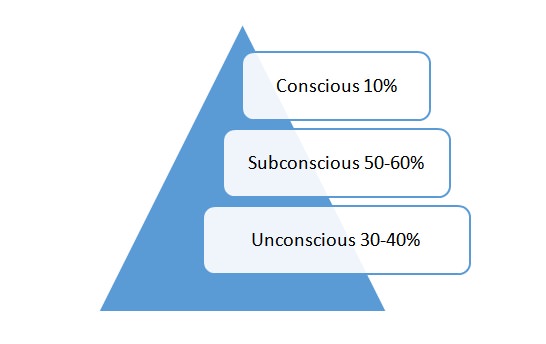
I'm not sure what you mean by equating "unconscious with reality". Freud's term "unconscious" is today more appropriately called "sub-conscious". For each person, there is only one holistic consciousness, but only a tiny fraction is the "awareness" that most of us equate with consciousness (see image below). By far the majority of brain functions are subliminal : below the threshold of awareness. But Jung broadened the concept of Consciousness, and reified it into a mystical Collective Un-consciousness. And others have gone so far as to imagine Consciousness as a latent energy or "The Force" that is out there in the ether, for us to tap into. But that's true only as an as-if fictional metaphor. Although, my own notion of EnFormAction could be mistaken for the fictional Star Wars Force.
If Consciousness (imagined as mind-stuff) is the substance of Reality, then your equation would be correct. I don't take that analogy literally though, but I do think that human consciousness (the function of the brain's information processing) is an evolutionary emergence from the workings of abstract Information (the power to enform). In this application, Information is more like Energy than Awareness. And it's a substance only in the sense of Spinoza's Universal Substance, which he equated with God. In that case, God creates Reality from immaterial mind-stuff. Which is not necessarily aware of anything, but has the creative potential to actualize real things from ideal concepts (Plato's Forms).
I don't expect this BS to make sense to you, because it is based on the unconventional worldview of Enformationism. So, I'm just using this opportunity to apply that theory to your question.
As an extension of my Enformationism thesis, I envision the creation of our Reality metaphorically in Plato's terms : eternal unformed Chaos (infinite Potential) was enformed by Logos into a temporal Cosmos (finite Actuality). The "mind" that converts potential into actual is the hypothetical Mind of G*D. :nerd:Well, I was thinking about something like that pool of potentiality, something that is not, but could be - it is just waiting for some mind to see it and make it real... — Eremit
Chaos : Unformed Randomess
In ancient Greek creation myths Chaos was the void state preceding the creation of the universe or cosmos. It literally means "emptiness", but can also refer to a random undefined unformed state that was changed into the orderly law-defined enformed Cosmos. In modern Cosmology, Chaos can represent the eternal/infinite state from which the Big Bang created space/time. In that sense of infinite Potential, it is an attribute of G*D, whose power of EnFormAction converts possibilities (Platonic Forms) into actualities (physical things).
http://blog-glossary.enformationism.info/page12.html
Cosmos : Order, harmony, beauty, well-formed
Universe means "all existing matter and space considered as a whole; the cosmos." The words can be used as synonym of each other, or you can use cosmos when you are referring to the well-ordered aspect of the universe.
https://english.stackexchange.com/questions/20734/whats-the-difference-between-the-universe-and-the-cosmos
-
Should we care about "reality" beyond reality?
Nothing is "beyond Reason" --- if it is allowed to roam freely, and restrained only by the long leash of Experience. Human Reason is like a dog's Nose : it's always sniffing around for things unseen. Sometimes it bumps into a Porcupine, but more often it leads to tasty "Pork". Both have real consequences.How should we call that which is beyond described reality? Should we call it? Should we care about it? If it's beyond our reason, beyond the world we know and world we live in, why should we care about it? — Eremit
Should we care about anything that is beyond our horizon? Common people are content with their own local reality. But Philosophers & Scientists & Pioneers have always been motivated to go beyond mundane reality to explore the exotic terra incognita over the horizon., where be dragons & mysteries & secrets (potential knowledge). But the question remains : "why should we care" about such "impractical" & "dangerous" things & ideas? Why go to Mars?
In Physics, we call such things "keys to progress". In Metaphysics, we call them "keys to enlightenment". In my own physics/meta-physics thesis, based on the ubiquitous role of Information in the real world and in the imaginary realms, I call "that which is beyond described reality" Ideality. Hard Realists, who disparage ghostly Idealism, may be afraid of the dragons of Myth & Mysticism. But, some of us are driven to explore the unknown in order to make known that which is not, but might be. Such an optimistic & progressive attitude may not appeal to conservatives of both Religion and Science. Some of the dangers of "the beyond reality" may be real, but some turn-out to be imaginary. So, if we proceed with appropriate caution into the Dark, we might stub our toes, but we might also reveal that which was formerly hidden. :cool:
Ideality :
In Plato’s theory of Forms, he argues that non-physical forms (or ideas) represent the most accurate or perfect reality. Those Forms are not physical things, but merely definitions or recipes of possible things. What we call Reality consists of a few actualized potentials drawn from a realm of infinite possibilities.
1. Materialists deny the existence of such immaterial ideals, but recent developments in Quantum Theory have forced them to accept the concept of “virtual” particles in a mathematical “field”, that are not real, but only potential, until their unreal state is collapsed into reality by a measurement or observation. To measure is to extract meaning into a mind. [Measure, from L. Mensura, to know; from mens-, mind]
2. Some modern idealists find the QT scenario to be intriguingly similar to Plato’s notion that ideal Forms can be realized, i.e. meaning extracted, by knowing minds. For the purposes of this blog, “Ideality” refers to an infinite pool of potential (equivalent to a quantum field), of which physical Reality is a small part. Are Dark Matter & Dark Energy real, or ideal?
http://blog-glossary.enformationism.info/page11.html -
The underlying governing dynamics high IQ?
Jersey offered his opinion that Enformy sounds like a "mystical force". So, I'd like to clarify -- not for his edification, but for yours -- that Enformy is simply a neologism coined for my thesis, as a replacement for the awkward scientific term "Negentropy".Yes I agree however it is a chicken and egg argument, I am suggesting that if entropy is the predominant force then enformy is humanities' response to it therefore the underlying dynamics are a consequence of entropy, that is if the predominance of entropy gives it more weight in this discussion and my quote. — Spartacus
So yes, human culture is a product of Enformy, which transforms random Entropy into organized systems, such as Galaxies and Civilizations. The "predominance of entropy" in scientific discourse is merely a result of its analytical & reductive methods. By contrast, Enformy is holistic & creative. :smile:
Negentropy : Negentropy is reverse entropy. It means things becoming more in order. By 'order' is meant organisation, structure and function: the opposite of randomness or chaos. One example of negentropy is a star system such as the Solar System.
https://simple.wikipedia.org/wiki/Negentropy -
The "One" and "God"
The Enformationism thesis is my contribution to the current desire among thoughtful people of good will, to reconcile the metaphysics of Religion with the physics of Science. After the Enlightenment era, the "miracles" of empirical Science gained more & influence over the public mind, even as the "miracles" of ancient Religion faded away. Hence those once-dominant institutions were placed on the defensive. But since the 1960s, the conflict between worldviews of Spirit & Matter has been escalating. Originally, the combat was simply Christianity versus Humanism. But the 60s brought Eastern & Pagan religious ideas into the mix, and resulted in the peace & love attitude of New Age. Since then, fundamentalist Christians declared war on both Scientific and New Age worldviews. In reaction to that politicization of religion, the Four Horsemen of Atheism fired back with Reason vs Emotion. Yet, I think we need both sides of human nature to be whole : Critical Thinking and Innate Feelings.Oh, it is an attempt to stitch together scientific theory, with metaphysical abstraction. That's It? If so, it is really interesting, and in my view, necessary for an eventual intellectual revolution. — Gus Lamarch
Very few people have actually read the full thesis, so they get an incomplete understanding of what it means for both religion and science. The theory began with the scientific insight that everything in our world is a form of Information (energy & matter & mind). But the implication of that notion had philosophical and religious implications, that I'm still working out.I'm going to read it, thank you. — Gus Lamarch
Yes. Philo's "One" is more like Plato's "Logos" : spiritual but not personal. Ancient people had no concept of Energy, so they attributed all natural effects to intentional causes, and imagined those invisible powers in human form. Descendants of the Hebrews eventually abandoned their own history of personal gods (Yahewh was originally a weather god slinging thunderbolts), in favor of the more abstract notion of YHWH who was formless, eternal, and absolute. But the human desire for gods in familiar form, caused idolatry to continue even among the Jews. Later, their Christian descendants, began to imagine the human Jewish Messiah as the super-human Christ, and eventually fragmented the One God of Monotheism into a Polytheistic pantheon : Father, Mother, Son, Holy-Spirit, and a panoply of Saints. So, it's obvious that an abstract absolute unitary notion of deity does not appeal to the average person. That's why I call my hypothetical Enformer by the ambiguous name G*D : it's the "god of the philosophers".The One is not a God in the common sense. — Gus Lamarch
Since I am no longer religious, in any conventional sense, I could accept the Agnostic view of a godless world without any emotional affect or social censure . But, the theory of science-based Enformationism logically requires a First Cause with the creative power to Enform, and the mental intention to create a physical world. So, the thesis describes How the material world evolved from the immaterial Information (program) in the Singularity via series of Phase Transitions --- disorderly random changes (heuristic search) directed by intentional natural selection (algorithms) . But it does not reveal Why this abode of sentient creatures is characterized by both Good & Evil, both Positive & Negative, both Pleasure & Pain, both Cooperation & Competition, both Peace & Conflict. The tribal God of Abraham is often lauded as a loving Father, but is also described as commanding Old Testament genocides, and of planning a post-apocalyptic hell-fire for infidels. Why, why, why???My view is that metaphysics - as you have already said, concepts, abstractions, ideas, etc ... - is being left out in favor of a more intrisicaly causal perceptive answer. — Gus Lamarch
That's why the BothAnd Blog continues to search for answers to ultimate Why questions. :nerd:
BothAnd Blog : http://bothandblog.enformationism.info/page2.html -
The underlying governing dynamics high IQ?
No. It's a philosophical hypothesis, based on cutting-edge science. It's also a person opinion. I'm sorry if novel ideas annoy you. :cool:Sounds to me like you are describing the ministry of thought. Unless you are saying this is some kind of mystical force? — JerseyFlight -
The "One" and "God"
Fear not! There's no cult. There's only little old me. It's a personal philosophical non-religious worldview, based on modern science and reason, not on ancient scriptures and emotions. What's your worldview? :smile:This sounds like a cult to me, something that might come out of Scientology. I mean.... what? — JerseyFlight -
The "One" and "God"
For the purpose of communication with non-philosophers, I sometimes use the term "G*D" with an asterisk to indicate an abstract "deity" as opposed to the traditional anthro-morphic white-bearded prayer-answering Santa Claus king in heaven. Unfortunately, most of them are not interested in the "god of the philosophers" : an unrevealed hypothetical abstract absolute explanation for our actual physical relative existence. :smile:If both are absolutes, what makes them unique when in comparison with each other? — Gus Lamarch -
The "One" and "God"
Enformationism :Enformationism — Gnomon
Interesting, if you'd like, please dm me. I'm really curious about it. — Gus Lamarch
As a scientific paradigm, the thesis of Enformationism is intended to be an update to the obsolete 19th century paradigm of Materialism. Since the recent advent of Quantum Physics, the materiality of reality has been watered down. Now we know that matter is a form of energy, and that energy is a form of Information.
As a religious philosophy, the creative power of Enformationism is envisioned as a more realistic version of the antiquated religious notions of Spiritualism. Since our world had a beginning, it's hard to deny the concept of creation. So, an infinite deity is proposed to serve as both the energetic Enformer and the malleable substance of the enformed world.
http://blog-glossary.enformationism.info/page8.html
Enformationism Thesis : http://enformationism.info/enformationism.info/
No. The unitary world is a composite of physical and metaphysical Information. This won't make sense without a grasp of the Enformationism thesis. But it's similar to Spinoza's "Single Substance" concept of God. Modern science gradually grudgingly coming to the conclusion that everything in our world is a form of Causal Information.The world then would be made of two existences? The physical (material) and the metaphysical (mental)? Correct me if I'm getting it wrong. — Gus Lamarch
Substance Monism : The most distinctive aspect of Spinoza's system is his substance monism; that is, his claim that one infinite substance—God or Nature—is the only substance that exists.
https://iep.utm.edu/spinoz-m/
The Programmer : The notion that our world is a mathematical Program processing information is a novel notion that is gaining traction in Physics and Cosmology.What? — Gus Lamarch
Actually, the BB is a hypothesis. The physical world that emerged from that postulated creative act is the only "material evidence" of a Creator.Perhaps the Big Bang is just the material evidence of the One? I cannot say. — Gus Lamarch
Yes. Modern Science began as a revolt against the dominant metaphysical myths (Theology) of medieval Catholicism. But they inadvertently threw out the metaphysical baby (Mind) with the mythical bathwater (man-made dogma). Even most modern philosophers are uncomfortable with discussing non-empirical metaphysical notions. However, by "metaphysics" I don't mean magic or ghosts or theology, but the important non-physical aspects of Reality : Concepts, Ideas, Theories, Opinions, Beliefs. etc :cool:I feel that we are leaving aside one of the truths of this existence for the sake of the material. Perhaps one needs the other - Metaphysical and Material -? — Gus Lamarch
Meta-Physics :
4. Physics refers to the things we perceive with the eye of the body. Meta-physics refers to the things we conceive with the eye of the mind. Meta-physics includes the properties, and qualities, and functions that make a thing what it is. Matter is just the clay from which a thing is made. Meta-physics is the design (form, purpose); physics is the product (shape, action). The act of creation brings an ideal design into actual existence. The design concept is the “formal” cause of the thing designed.
http://blog-glossary.enformationism.info/page14.html -
The underlying governing dynamics high IQ?
Sorry to butt-in with a low-IQ comment. But the human race is not a consequence of order destroying Entropy. It is instead, in my humble opinion, the work of organizing Enformy. Without the creative power to enform, there is no Macro or micro-cosm. :smile:" The human race is a microcosm of the universal law of entropy " — Spartacus
Enformy : In the Enformationism theory, Enformy is a hypothetical, holistic, metaphysical, natural trend or force, that counteracts Entropy & Randomness to produce complexity & progress.
http://blog-glossary.enformationism.info/page8.html -
The "One" and "God"
My personal worldview, Enformationism, also inferred a necessary abstract hypothetical world creator from the available evidence of the physical & metaphysical creation. Such a postulate is logically necessary because the Big Bang theory*1 describes an effect of some unknown prior cause.It seems to me that the idea presented and described by Plotino, is less about a divine figure that creates existence, but rather an abstraction of the creation of the world from a perfect point before existence, from which existence arose. — Gus Lamarch
I call that non-personal a priori force or power by various names, depending on the context. In an ontological discussion about the question of basic existence vs non-existence, I label the timeless power-to-be-and-to-become as "BEING". This concept is similar in some ways to Plotinus' "The One", which I sometimes call "ALL", or "The Whole". As a creative force, it is also akin to Plato's concept of LOGOS, in the sense of divine Reason, which was responsible for organizing Chaos into the living organism we call home : our physical (material) and metaphysical (mental) universe.
Since this postulated First Cause, "from which existence arose", is beyond the realm of empirical evidence, we can only project current circumstantial evidence back into the time before time, That's merely an extension of the logic by which Cosmologists inferred from the current expansion of space & time that all matter was originally impossibly condensed into a point of pure potential -- that I liken to a computer program. Unfortunately, most philosophical descendants of Abraham identify that Cause with the God of the Bible or Koran or Book of Mormon. But I think of it as more akin to the abstract Brahman (ultimate reality) of Hindu philosophy. However, a more up-to-date name for the creator of our information processing world may be The Programmer. :nerd:
*1. the Singularity, "perfect point", was like a cue ball struck by the cue stick (action) aimed & manipulated by an intentional pool shooter. The arrow of Time is like a rack of balls going in a general direction determined by the aim of the shooter. Their movements may seem random, but we can trace cause & effect back to a single input of force
I think it's due to a physical bias in Science, the belief system of Materialism, which is blind to the power of Mind (Culture, Memes) to influence the material world. I'm not talking about spoon-bending Psychokinesis, but about Energy. Matter is a form of Energy, which in turn is a form of metaphysical EnFormAction (causal information). And this non-physical "non-sense" is derived by a chain of logic in the Enformationism thesis. :cool:Why, then, do people so easily confuse metaphysical concepts related to the absolute? — Gus Lamarch -
Discussions on the internet are failing more and more. We should work on fixing that
The "way of thinking" that emerges in the un-self-censored anonymity of internet forums is what I call the "Either-Or" attitude, which denies any middle position between opinions, and allows for no common ground in discussions. Hence, innocent exchanges of information (opinions) quickly turn into emotional diatribes or win-lose debates. This recent trend reflects a coarsening of culture in the modern era. Yet it's not due to a difference in human nature, but to rapid changes in technology., which have allowed societies to fragment into a variety of interest groups. Mega-Cities, and the Net-connected-world, are becoming un-civilized and dis-connected. If the Us-vs-Them trend continues, we may experience a return to "nature, red in tooth and claw".A much better way would be to identify with our way of thinking instead of our knowledge. Critical thinking skills are becoming more and more crucial in this age of informational floods. And these "tools" with which we can analyse the value of new information should be the centerpiece of our identity. — Hirnstoff
However, the "better way" may have less to do with critical thinking, and more with un-critical feeling (lack of self-censorship). Many people think that they "speak Truth" when they express their feelings directly. Perhaps in ancient tribal societies, when everybody knew their neighbors, and subscribed to the same beliefs, such openness was acceptable. Minor disagreements could be settled with brief bickering, or occasionally with empty-handed violence. But, in today's multi-cultural societies, with lethal weapons at hand, it's often better for all to "hold your tongue" in order to avoid open conflict. And young children have to be taught that lesson, when they blurt-out unfiltered feelings that are socially unacceptable.
Before the internet era, civil discourse was possible due to established rules of polite society. But on the net, we are no longer neighbors, and our philosophical differences are often wide. So, in the interest of facilitating social intercourse, while keeping the peace, we need to re-establish commonly accepted guidelines for interpersonal exchanges. And my modest contribution (my "tool") to a Golden Ruled society, is the "BothAnd Philosophy". It's an attitude adjustment, not a critical analysis. :smile:
Etiquette, that's the ticket : https://en.wikipedia.org/wiki/Etiquette
Netiquette : https://www.verywellmind.com/ten-rules-of-netiquette-22285
BothAnd Philosophy : So in order to understand the whole truth of our existence, we need to look at both sides of every polarized worldview. In the non-fiction world, we don’t always have to choose either Good or Evil, but we can look for a moderate position near the Golden Mean, the sweet spot I call "BothAnd".
http://bothandblog5.enformationism.info/page6.html -
The Reasonableness of Theism/Atheism
The evidence and reasons of believing or disbelieving in a mysterious deity, responsible for the existence of our world, have been bated & debated for eons. And not much common ground has been uncovered. So one author decided to eliminate the ambiguity of human language in order to determine the mathematical probability of what he defines as "God". Using Bayesian statistical methods, he methodically computes a number to represent how certain he can be that his God exists. The book is clearly & humorously written, not too cluttered with equations, and appropriately skeptical of such touchy topics as miracles. Unfortunately, I doubt that many convinced Atheists will be impressed by his mathematical evidence for wizard behind the curtain. :smile:Does this make sense, or is there some relevant literature to this question that you all might recommend? — DPKING
The Probability of God : A Simple Calculation That Proves The Ultimate Truth
____Stephen Unwin, Phd -
The Reasonableness of Theism/Atheism
My Enformationism thesis is qualified by the admission that it is an informal layman's speculation, intended only to serve as the basis for a personal non-theistic worldview. Which is the perspective from which I comment on this forum. However, I think if you were to actually read the thesis (rather than pre-judging it), you would find few contradictions with proven Science. For example, It accepts the heuristic process of Evolution, specifically denies miraculous intervention, and limits its conjectures to the same pre-Big-Bang realm in which some cosmologists imagine a turtles-all-the-way-down Multiverse. Moreover, the eternal world-creating random Multiverse and the eternal world-creating intentional G*D are both reasonable-yet-unprovable explanations for the existence of our contingent world *1. The difference is that the G*D inference can account for the otherwise mysterious metaphysical aspects (Life & Mind) of our world organism, by attributing the Potential for Meaning & Intention to its First Cause. That's why I call it G*D, rather than simply blindly blundering Nature. :cool:Then it is speculation. All that can be sought for in speculation is an internal consistency, and whether it contradicts anything in the world — tim wood
Thanks for asking. Before the Big Bang theory became the only reasonable explanation for the evidence that space is expanding and nature is evolving, most scientists and philosophers assumed it had existed forever. Since that's no longer a viable belief, we must deal with the contingent (not of necessity) existence of physical reality, and look elsewhere for a "necessary Being". The commonly accepted condition for our world is the "creation" event --- accurately, but grudgingly, described as a sudden eruption of something from nothing. Yet, since that sounds too much like a miracle, alternative but equally conditional, scenarios have been conjectured. None are actually plausible unless laws of Being and Becoming were already in place. And that is the role of my hypothetical "natural" force of BEING. :nerd:There may well be things in nature that are conditional, but what does it mean or imply to hold that the existence of nature itself is conditional? — tim wood
Necessary Being : It is commonly accepted that there are two sorts of existent entities: those that exist but could have failed to exist, and those that could not have failed to exist. Entities of the first sort are contingent beings; entities of the second sort are necessary beings.
https://plato.stanford.edu/entries/god-necessary-being/
Metaphysical Necessity : https://en.wikipedia.org/wiki/Metaphysical_necessity
*1 Purely random processes would take 12 forevers to create a single strand of DNA. But randomness plus intentional Selection could do the job in only one forever. :joke: -
The Reasonableness of Theism/Atheism
Apparently, you think that the "reasonableness of Theism" topic is an intra-natural scientific question. But, I am approaching it as a supra-natural philosophical question. If the existence and nature of G*D was a scientific issue --- like the nature of mysterious Dark Matter --- we would be discussing it on a science-related forum. So, why are you insisting on the Baconian scientific method for a question that has no physical evidence --- except the conditional existence of Nature itself? Why are you disparaging philosophical methods on a philosophical forum?You seem to have your own "philosophizing" as about your beliefs. Fine, for your personal entertainment. But to my way of thinking as an approach to any kind of knowledge that's wrong and upside down. You can start with a belief, call it a hypothesis, and subject it to test, a matter of science, which is a kind of thinking. If your science is any good, then you have some knowledge, subject to refinement under further science. — tim wood
Are you a practicing scientist? If not, do you have "good" knowledge? Or are you just believing the current majority opinion of scientists-in-general? For the record, I am not a Theist, and I'm still Agnostic about my hypothetical Creative Force. But my personally entertaining thesis is based on the latest science, including the ubiquitous role of Information in all phases of Nature and Culture. Does your fallible scientific method produce "good" knowledge about cultural questions? Or, do psychological & political & religious issues remain primarily in the domain of Metaphysical Philosophy? :joke:
Philosophical Methodology : Plato said that "philosophy begins in wonder", a view which is echoed by Aristotle: "It was their wonder, astonishment, that first led men to philosophize and still leads them." Philosophizing may begin with some simple doubts about accepted beliefs. The initial impulse to philosophize may arise from suspicion, for example, that we do not fully understand, and have not fully justified, even our most basic beliefs about the world.
https://en.wikipedia.org/wiki/Philosophical_methodology
PS__ I began from "simple doubts" about the beliefs of my religious upbringing. And have boiled-down the "reasonable" evidence for a creator to the otherwise mysterious existence of a world that is not self-existent --- it comes down to BEING. "To be, or not to be", that is the philosophical question relevant to Theism vs Atheism. :cool:
Enformationism :
As a scientific paradigm, the thesis of Enformationism is intended to be an update to the obsolete 19th century paradigm of Materialism. Since the recent advent of Quantum Physics, the materiality of reality has been watered down. Now we know that matter is a form of energy, and that energy is a form of Information.
As a religious philosophy, the creative power of Enformationism is envisioned as a more realistic version of the antiquated religious notions of Spiritualism. Since our world had a beginning, it's hard to deny the concept of creation. So, an infinite deity is proposed to serve as both the energetic Enformer and the malleable Substance of the enformed world.
http://blog-glossary.enformationism.info/page8.html -
The Reasonableness of Theism/Atheism
BEING is a personal neologism, coined to encapsulate the notion of fundamental essential existence that is logically necessary, and not beholden to any traditional belief system --- including Theism and Physicalism. What theory of Reality do you believe in? :joke:is what I call BEING — Gnomon
Great, call it what you like. But on what basis do you say anything about it? And, what answers the question of where the multi-verse came from, or being itself? If we're talking about belief, these are relatively trivial questions. If what is real, not so easy. — tim wood
BEING : In my own theorizing there is one universal principle that subsumes all others, including Consciousness : essential Existence. Among those philosophical musings, I refer to the "unit of existence" with the absolute singular term "BEING" as contrasted with the plurality of contingent "beings" and things and properties. By BEING I mean the ultimate “ground of being”, which is simply the power to exist, and the power to create beings.
http://blog-glossary.enformationism.info/page10.html
NOTE : "So, how about essential BEING as a starting point for reasoning about otherwise open-ended philosophical questions?"
On what basis? : I talk about Ontology on the same basis that all philosophers do, my knowledge of the world, and my personal theory of reality, guided by the traditional rules of Logic.
Why Coin Tech Terms? : http://bothandblog4.enformationism.info/page6.html
What is real? : Reality is the sum or aggregate of all that is real or existent within a system, as opposed to that which is only imaginary
NOTE : Tim, what is your belief system, Materialism, Physicalism? How much of that system is hypothetical, axiomatic, and unproven?
Reality is a Theory : http://bothandblog5.enformationism.info/page15.html
The Case Against Reality : http://bothandblog6.enformationism.info/page21.html -
The Reasonableness of Theism/Atheism
What "alternative theories about existence" did you have in mind? Most atheists seem to just take the existence of "Reality" for granted. Hence, the Multiverse theory is merely an extension of the pre-Big-Bang assumption of an eternal material universe. Variations on that immortal-matter theme were cyclical temporary universes, and ongoing natural creation of matter to replace the stuff lost to Entropy. A recent Hypothesis to fill the gaps in Inflation Theory is Eternal Inflation. Are such turtles-all-the-way-down theories not satisfactory for you?What if it’s not a matter of feeling that a God is necessary, but that alternative theories about existence don't seem to be satisfactory for theists. — DPKING
My primary problem with those alternative theories of a self-existent Reality is that the only example of a real-world we have experience with has been "proven" by scientific evidence to be temporary, with a definite beginning and a fade-out end. For all we know, Time began at the Big Bang. And there is no known mechanism for relighting the fuse after the Big Fizzle. Speculations on Black Holes and Worm Holes and Branes are no more scientific than speculations on creative deities, except that they remain loyal to faith in Materialism/Physicalism. Each new discovery of the overall nature of Nature, requires faith-inspired creative thinking to maintain the modern facade on the ancient dogma of Materialism.
However, my personal dissatisfaction with hypothetical alternatives to intentional creation is that they typically ignore the immaterial and holistic phenomena that have emerged as matter-manipulating powers in our Real world : e.g Life & Mind & Intentions. Without a theory to explain how those world-changing Metaphysical realities emerged from Physical processes, the non-physical aspects of Reality, that are most important to non-scientists, are left out of the recurring reality equation. That's why I have developed my own personal hypothesis, that is not beholden to Biblical or Physical doctrine. It is instead based on the ubiquity of Information, which is both physical & metaphysical, both material & mental. :nerd:
Materialism : the doctrine that nothing exists except matter and its movements and modifications.
Metaphysicalism : Physicalism differs with naturalistic metaphysicalism in at least one specific concept. Physicalism holds that nothing is greater than the sum of its parts.
http://freeassemblage.blogspot.com/2009/01/physicalism-and-metaphysicalism.html
Note -- this site is new to me, but the notion of Metaphysical Naturalism sounds like it might be amenable to my own concept of Enformationism. -
Clothing: is it necessary?
The non-biblical reason for wearing clothing has more to do with climate than with gender. In the jungles of Africa, clothing is optional for those with dark skin. But in the deserts of the Middle East, clothing is necessary to provide shade from the unfiltered sun. Yet, even "half-naked" Africans typically, but not in all cases, wore loin-cloths to hide their genitals --- though not their breasts. In the middle-east, the desert equivalent of a loin-cloth is a Niqab face-covering, in addition to the shapeless body covering.If it is fear that drives the apparent necessity of clothing, then why the moral judgement? — Possibility
So, even where near-nakedness is acceptable, there seems to be some gender-related reason for covering the sex organs. But the original concern was probably not for offending the sensibilities of a sex-fearing god, but to avoid provoking spontaneous sex-acts that might upset the harmony of a tribe. In that case, it's an inter-personal Ethical issue, not a divine-human Moral problem that is being addressed by dressing the body.
Nevetheless, simple pragmatic reasons for cultural adaptations may eventually be translated into arbitrary religious reasons. Sex (jealousy, etc) is a common source of agitation & anxiety in humans, and the resulting Genophobia (fear of sex) may also be attributed to their anthro-morphic gods. Which may explain why local clothing customs would be incorporated into universal moral law. :smile: -
The Reasonableness of Theism/Atheism
Yes. Both Theists and Atheists are reasonable in the sense that they each have reasons to support their pro or con conclusion. The problem is that Atheists don't accept the proposed "evidence" in favor of god-belief (miracles, moral stance, etc). So, it's not the reasoning that makes a difference in conclusions, but the initial motivation, which defines acceptable evidence. The conclusion is inherent in the initial assumption.C – It is reasonable to believe in either atheism or theism — DPKING
For example, Theists tend to feel that a supernatural deity is necessary to explain the very existence of our temporal conditional world. Atheists, though, seem to be un-bothered by the open question of bare existence. Yet in both perspectives, eternal existence of something (God or Multiverse) is, perhaps subconsciously, taken for granted --- as an unproven Axiom. That timeless unconditional fundamental power-to-be is what I call BEING. It's a logical necessity that any reasoning about ultimate questions must build upon. So, how about essential BEING as a starting point for reasoning about otherwise open-ended philosophical questions? :smile: -
What is the Purpose of the Universe?
That "eternal basis" and "permanent something" is the cosmic principle of BEING, that I also call G*D, as a sop to traditional feelings.An Eternal Basis has to be so,
For a lack of anything cannot sow,
Forcing there to be something permanent
And partless, from which composites can grow. — PoeticUniverse
Yes. I don't know the overall Purpose of our temporal Cosmos, so my own local personal purpose will have to suffice for my own personal meaning of life. But, as a philosophically inclined layman, I can speculate on that cosmic Purpose, without fear of contradiction. :joke:(Still no overall purpose, just local ones.) — PoeticUniverse
BEING : http://blog-glossary.enformationism.info/page10.html
G*D : http://blog-glossary.enformationism.info/page13.html -
What is the Purpose of the Universe?
That "chosen" purpose may work for you as an individual, but most people who ask such questions are assuming there must be a higher, more universal Purpose for the Universe. For example, your short-term purpose for posting this question may be to get feedback to see how your narrow concept of Purpose aligns with that of other thinkers. But, your long-term goal may be to develop your reasoning abilities to the point that you can call yourself a rational Philosopher. Yet both of those intentions are motivated by some underlying emotion : e.g. desire to obtain a degree in philosophy, or to become rich in business due to your purposeful wisdom.I'm in the last camp, where I believe I can choose a purpose. — A Ree Zen
However, the Cosmological Purpose question is an attempt to know the mind of god, the "why" of creation, and the "why" of your personal existence. Apparently, you have given-up on the big cosmic fulfillment, and have resolved to be satisfied with a little personal gratification. But many of us are not content with arbitrarily choosing a small "P" purpose. We still want to understand the motive behind such a magnificent undertaking : the creation of a world, from scratch. Although most Astronomers and Cosmologists are motivated by a desire to understand How this marvelous machine works, in their hearts, what they really want to know is Why*1. Why does the world exist, and what cosmic function does it serve for the designer of the "machine"?
Even if our world was created for some arcane reason, we'll never know what that purpose was, unless the creator chooses to communicate directly with us. Not surprisingly, many religious traditions claim to have "revealed" reasons for creation : e.g. to produce childlike "servants" to love & obey the parental deity; but also to provide real-world services that the immaterial deity can't do for themselves -- such as obtaining food & drink, and for sacrificing living beings in honor of their egotistical creator. Those pseudo-psychological rationales may make sense for those who imagine the deity as a humanlike ruler, with emotional needs & desires. But, since those ancient notions seem naively outdated, those of us who view the Big Bang as an act of creation, must look for some more plausible explanation for the existence of our marvelous & fearful world of joy & suffering.
That's why I have produced a non-theological thesis of my own, based on what little scientific and circumstantial evidence is available in the "year of our lord" 2020. Some find the notion of an eternally meandering Multiverse, plausible, but must accept that there is no reason or purpose for our accidental existence beyond the stochastic laws of probability. Yet, I find that desperation speculation to be unacceptable, since pure randomness cannot explain the existence of physical order, not to mention intentional organisms. Therefore, while I don't look to a slave-owner deity for the "purpose" of my own life, I do think that the act of some intentional entity is the only reasonable explanation for the direction of evolution (the arrow of time).
If the Multiverse hypothesis answers your "why" questions, then personal purpose is your only option. But inquiring philosophers typically are not content with just mechanical "how" answers. So, I posit the Axiomatic Deity hypothesis as a foundation for seeking to understand the meaningful "why" questions, such as why our cosmic organism seems to be purposefully pursuing a heuristic (evolutionary) search for some unknown-to-me functional teleological goal. :cool:
*1 On why the universe exists : "If we find the answer to that, it would be the ultimate triumph of human reason—for then we would know the mind of God"
___Stephen Hawking
Designer Universe? : http://bothandblog.enformationism.info/page39.html -
Religion as an evolutionary stable strategy and its implications on the universal truths
History affirms that "belief in god is an evolutionary stable strategy". Cultural evolution, that is. So, faith in gods must provide something that is beneficial to communities. I guess that the cultural usefulness of god concepts is to give human leaders a higher authority to pass the buck to. It's too easy to rebel against mere human leaders with limited troops, but the super-human "Lord of Lords" may have legions of angels at his command. Authoritarian dictatorships tend to be superficially stable, until another general is able to foment a military coup. But how do you mount a coup against an unseen and immortal ruler? I suspect that's not the "strategy" Peterson had in mind? :joke:the belief in god is an evolutionary stable strategy that codifies a heuristic for living life in a way that is beneficial to the community in general. — Malcolm Lett
PS___The moral heuristic may be : “live as-if an all-seeing eye is watching you”.
Religions use that emotional handle (fear of the watcher) to “wrangle” unruly humans into the corral of their particular Tribe (i.e. Church). -
Intellectuals and philosophers, do you ever find it difficult to maintain relationships?
He specifically mentioned Intellectuals and Philosophers, and didn't mention Introversion. If he's not a navel-gazing introvert, then maybe an outwardly charming sociopath or psychopath? :joke:The OP is very clear that the difficulty is not about being an introvert or socially awkward. — jamalrob -
Intellectuals and philosophers, do you ever find it difficult to maintain relationships?
The recent book by Susan Cain addresses that very question. Ironically, she is a lawyer, who gets paid to stand in front of strangers and talk. Innate Introversion is not Destiny, nor an excuse for becoming a cave-dwelling hermit.For the sake of argument, should we express some concern that this leads to a defeatist mindset? In other words, it is too easy for someone to say, "I'm an introvert, therefore I am socially awkward," with the implication that they are unable to choose to be otherwise or to develop social skills? — Pro Hominem
Quiet: The Power of Introverts in a World That Can't Stop Talking : https://en.wikipedia.org/wiki/Quiet:_The_Power_of_Introverts_in_a_World_That_Can%27t_Stop_Talking -
What is "proof?"
One sense of the verb "to prove" is "to probe, investigate, analyze". So it doesn't necessarily imply that absolute Truth has been revealed. In Science, a "proven theory" is one that has produced useful pragmatic results, but may still have room for more "proof" (evidence). For example, Darwinian Evolution was a good theory for its time, but it has been modified as more relevant evidence has been literally dug-up. The "value" of such imperfect "proof" is practical applications, as opposed to theoretical speculations. :smile:In general what is the value behind saying that something was proved? — TiredThinker
Prove : to subject to a test, experiment, comparison, analysis, or the like, to determine quality, amount, acceptability, characteristics, etc. -
Intellectuals and philosophers, do you ever find it difficult to maintain relationships?
Social awkwardness seems to be typical of Intellectuals, and especially Philosophers. Throughout history philosophers (e.g. Socrates) were noted for either never marrying, or for ignoring their families. One explanation for this peculiarity, or uniqueness if you prefer, may be that deep thinkers tend to be Introverts. :nerd:Do you have this difficulty, or is it unique to the individual? — Cobra
Introvert : a person predominantly concerned with their own thoughts and feelings rather than with external things.
4 Reasons Highly Intelligent People Are Often Socially Inept : https://shynesssocialanxiety.com/socially-inept/
Are Introverts Highly Intellectuals? : https://psych2go.net/are-introverts-highly-intellectuals/ -
Buddhism vs Cynicism vs nihilism
The hyper-critical Cynics were the Punk Rockers of their day : act like an animal, "don't give a sh*t about anything". Theirs was an extreme opposite reaction to the prevailing conventional bullsh*t of the day : abandon arbitrary social rules, instead "do it like you feel".I was learning a little bit about Cynicism this morning. To me it sounded like ancient Greek nihilism.. . . . To my Western eyes, Buddhism too seems, as to its practical advice, to say "slither away, be quiet, think no more". — Gregory
I too, was turned-off by the seeming nihilism of Buddhism. But now I realize that the Buddha offered a legitimate philosophical contribution to improving the world, by improving yourself first. Mindfulness Meditation was an early form of modern Rational Cognitive Psychology. I got that last opinion from the book linked below. :smile:
Why Buddhism Is True : https://en.wikipedia.org/wiki/Why_Buddhism_Is_True
Note : the book is not about religious doctrines, but about psychological methods of self-control. -
What happens after you no longer fear death? What comes next?
It took me many years to deprogram my youthful propagandizing to fear death without God's seal of approval. Other than the nagging question of losing a one-way ticket to heaven, I've never been much of a worrier about future events that I have no control over : que sera sera. Instead, my "peace of mind" probably results from an innate attitude toward Life & Death that is similar to Buddhism. I'm not talking about the various Buddhist religions, but the philosophical core of the Buddha's teachings regarding the mysteries & uncertainties of life. His precepts tended to be rational & objective instead of the emotional & subjective approaches of traditional religions. His key to peace on earth is not political activism to gain control over mass government, but to focus on gaining control over your "Self". Toward that end, he recommended the dispassionate notion of "no-self". By observing your inner neurotic feelings of Fear, Anger, and Anxiety objectively, you may learn to manage your irresistible urges and unconscious motivations. When you no longer "suffer" from the self-abuse of out-of-control feelings, you may begin to "experience peace of mind".How has nothing to fear, worry about, or plan for manifested in you? Did/do you also experience the peace of mind? — Cobra
I should point out however, that while I am not religious, I am still "spiritual" in the sense of an interest in the metaphysical aspects of reality. I have developed my own personal worldview, to replace the abandoned religious mindset of my upbringing. And, ironically, the core axiom of that science-based overview of reality is what I call "G*D". That hypothetical Cause of Reality is not imagined as a personal Father-in-heaven or Lord-of-Lords, but as the Abstract Force behind the Creation and upwardly-mobile Evolution of our imperfect, but progressing, natural world. That rational conclusion doesn't inspire chop-licking anticipation of personal salvation for My-Self, but it does contribute a positive rationale for my day-to-day peace-of-mind. :cool:
G*D :
An ambiguous spelling of the common name for a supernatural deity. The Enformationism thesis is based upon an unprovable axiom that our world is an idea in the mind of G*D. This eternal deity is not imagined in a physical human body, but in a meta-physical mathematical form, equivalent to Logos. Other names : ALL, BEING, Creator, Enformer, MIND, Nature, Reason, Source, Programmer. The eternal Whole-of-which-all-temporal-things-are-a-part is not to be feared or worshiped, but appreciated like Nature.
I refer to the logically necessary and philosophically essential First & Final Cause as G*D, rather than merely "X" the Unknown, partly out of respect. That’s because the ancients were not stupid, to infer purposeful agencies, but merely shooting in the dark. We now understand the "How" of Nature much better, but not the "Why". That inscrutable agent of Entention is what I mean by G*D.
http://blog-glossary.enformationism.info/page13.html
Why Buddhism Is True : https://en.wikipedia.org/wiki/Why_Buddhism_Is_True -
What happens after you no longer fear death? What comes next?
What comes next is unknowable, but different religions & cultures have imagined a variety of sequels to our "brief candle", some good, some bad : the grave; gloomy Hades; non-existence; eternal existence in Heaven or Hell; punishment for sins during life; alternative afterlife as ghost; sequential lives in various animal bodies; transference into a new human body; promotion to ruler of a new planet or world; a new role in a parallel world or astral plane; and so on, ad infinitum. Hence, your attitude toward death may depend on how you envision the afterlife. Some may dread eternal torture, or look forward to an afterlife of bliss, or simply accept whatever happens with equanimity.The compulsive thoughts are not due to fear, but instead a loss of what to do next, and a curiosity in the loss of fear to be some sort of abnormality that would effect optimizing function and habits. — Cobra
Regarding "what to do next", I'd say that if you can plan your afterlife like a European Vacation, or Mediterranean Cruise, you should start by making reservations. Or, if you have lived an unworthy life of egregious sin, it's time to "get right with god" --- whatever you conceive that to be. But if the after-death is not under your control, there's no need to worry about it : whatever will be will be. In my case, as I approach The End, I simply assume that the Afterlife will be similar to the Before-life : nothingness. So, I have nothing to worry about, nothing to fear, nothing to plan for. Is that attitude "abnormal"? Since I was raised as a fundamentalist protestant Christian, it is indeed. :smile:
Compulsive Thoughts : https://www.healthline.com/health/mental-health/intrusive-thoughts#causes -
Does Everything Really Flow? Is Becoming an Illusion?
I don't know that there is any authoritative answer to your interesting question. But in my own imagination, I can speculate. First, there is a significant difference between Reality and Ideality. Reality is limited by the laws of nature, while Ideality is limited only by the loose constraints of imagination in a physical body that evolved as an adaptation to physical laws. The human mind has gone way beyond the pragmatic limitations of the physical brain. So, it can create mental models of things that "never were" but could be. Human culture --- architecture, language, technology, etc --- has broken loose from the constraints of Nature, in part by imagining Super-Nature : something better, more ideal. In other words, we are free to create un-real ideas (Utopias, Gods, Virgin Birth, etc), and then to vainly pursue them in reality. Hence, it's possible to analyze wholes into any number of parts, because humans can "see" things that are not there --- in imagination, we have X-ray vision. But, our flights of fancy remain "plausible" to the extent that we can convince others to see them too.My question is, how is it possible to conduct and operate with quite plausible analysis of that hallucinated river using concepts of Beginning, Middle and End, regardless of the truth that any river is not in fact broken into such steps? — SaugB
None of that explains our tendency to divide things into three parts. Since bi-lateral symmetry is an important feature of our world, often related to living things, we may simply be more likely to notice things with a left, right, and axis . And that tripartite imagery may incline us to imagine invisible immaterial processes with Beginning & End boundaries, plus an indefinite Middle or well-defined Axis. Or it may be simply a handy way to think of groups (wholes) that consist of more than one item : solo, duo, trio, quartet, quintet, etc . Or, It may have something to do with brain structure, or it may be simply that the number of parts gets unwieldy when you go beyond Three. The river can be easily imagined as left bank & right bank; or left, middle, & right; or as oxygen & hydrogen, or as all the millions of things swimming or dissolved in water. I'm just riffing here --- what difference does it make to you? :joke:
Bilateral Symmetry with three parts, one imaginary :

-
Does Everything Really Flow? Is Becoming an Illusion?
As you suggest, the mind perceives that physical objects can be broken-down into smaller pieces, and then it conceives (in imagination) that metaphysical processes can be analyzed likewise. Processes (the flow of time) are indeed natural, but they don't have obvious "joints" to guide our cutting. So, we slice & dice them as desired.I think the human mind does not just "analyze" unbroken processes of change into smaller bits, because the eyes can actually 'see' reality [or nature: I use reality and nature interchangeably, if you don't mind] as broken into smaller bits. . . . Your denial of joints in reality/nature has not denied the joints for the eyes, as I see it. — SaugB
You could say that the Planck scale of Time is a "joint", but it's a human creation, not natural. So, my point is that Natural Time is continuous, but Artificial Time is discrete. Yet, no one can deny that Time is imagined by humans in terms of hours, minutes & seconds. But even those increments derived from sun cycles, are relative to our little corner of the universe, and not absolute. Even the standardized frequency of atomic clocks is an arbitrary choice from an infinite range. Beginning, Middle & End and Past, Present, & Future are human concepts, not natural increments. Are you thinking otherwise? Is there some inherent logic to a trilogy? :cool:
Time is a river : Time is a construct with which humans have struggled throughout history. Although physics after Einstein's relativity theory has somewhat taken over conceptualizing time, and generally holds that there is no such thing as that "passage" of time, and that all events are equally real, humans have traditionally seen time as consisting of past, present, and future.
https://www.quora.com/What-is-the-meaning-of-time-is-a-river
Discrete Time : In mathematical dynamics, discrete time and continuous time are two alternative frameworks within which to model variables that evolve over time.
https://en.wikipedia.org/wiki/Discrete_time_and_continuous_time
PS__BothAnd Principle implies that what you "see" depends on how you look at it, not necessarily on how it is essentially. -
Does Everything Really Flow? Is Becoming an Illusion?
Maybe you are questioning how the human mind can analyze seemingly unbroken processes of change into smaller bits. Plato proposed the metaphor of "carving nature at its joints", but in practice, scientists have found those "joints" elusive (as in defining a species). Yet, if you are asking about a metaphysical issue, modern psychology should be able to shed some light on our tendency to divide ongoing processes into arbitrary "beginning, middle & end". Unfortunately, I'm not aware of studies that analyze "analysis". But you might find something on Google if you look beyond the first page.Basically, I am asking why there can be made at the very least three slices to any 'thing,' as this idea of becoming I have in mind seems to have it. — SaugB
If your concern is more physical than metaphysical, then you might profit from reading Into The Cool, by Dorian Sagan. It analyzes how the natural laws of Thermodynamics cause all change in the world. On the macro scale, Energy Flow seems to be continuous, but in our imagination we can zoom-in to look at smaller & smaller pieces of that fluid process. At the very bottom limit of our mechanically-assisted perception though, that flowing stream of causation begins to break-down into the physical bits we call "quanta". At that point, philosophers will ask if reality is inherently continuous or discontinuous. This may sound disingenuous, but I think it's BothAnd. :nerd:
Carving Nature at Its Joints : https://philarchive.org/archive/SLAILF
Into The Cool : Scientists, theologians, and philosophers have all sought to answer the questions of why we are here and where we are going. Finding this natural basis of life has proved elusive, but in the eloquent and creative Into the Cool, Eric D. Schneider and Dorion Sagan look for answers in a surprising place: the second law of thermodynamics. This second law refers to energy's inevitable tendency to change from being concentrated in one place to becoming spread out over time. In this scientific tour de force, Schneider and Sagan show how the second law is behind evolution, ecology,economics, and even life's origin.
https://www.amazon.com/Into-Cool-Energy-Flow-Thermodynamics/dp/0226739376
Continuity and Infinitesimals : https://plato.stanford.edu/entries/continuity/
Gnomon

Start FollowingSend a Message
- Other sites we like
- Social media
- Terms of Service
- Sign In
- Created with PlushForums
- © 2026 The Philosophy Forum