
Comments
-
Beliefs, facts and reality.Sure. But it's not enough. Groups of people can be wrong, too. There's a difference between being at odds with the majority and being wrong.
-
Beliefs, facts and reality.Except that reality doesn't hold up under intense scrutiny... — Pantagruel
Ah, is that so? Is it true?
Drop truth and statements cease to be of any use.
...none of which implies that facts are not true. Quite the contrary.Facts may point towards things, but things are not facts. Facts always exist in a context which implies a perspective. So facts are always going to evolve. — Pantagruel
Again, if you don't differentiate between what you beleive and what is a fact, you can't be wrong.
Ask Trump. -
Beliefs, facts and reality.But are the facts what we know? — Pantagruel
Well, yes. If it's not a fact, then by that very fact you do not know it.
This is no more than the way that these words are used.
And of course some of the things we believe are wrong. They are not facts.
It is well worth making the distinction between what is true and what we believe, so that we can acknowledge that we might be wrong. Sometimes what we believe is not true, but if we deny the distinction between belief and truth, we can't even say this. That's what I find objectionable in the OP. -
A Case for Transcendental Idealism
As I said earlier, metaphysics is inevitable. Analytic philosophy is particularly helpful in showing inconsistencies and lack of clarity in metaphysical suppositions.So can metaphysical investigation, though I know you’re less enamored of that. — J
One of the few useful things I found in studying management was the Cynefin framework, especially the notion of the chaotic context. See this Harvard Business Review article.That would be arguing in a circle, or elaborately begging the question. — J
Metaphysics sets out the background against which the world is ordered, and is as much fiat as observation. One can avoid the circularity by recognising this.In a chaotic context, searching for right answers would be pointless: The relationships between cause and effect are impossible to determine because they shift constantly and no manageable patterns exist—only turbulence...
In the chaotic domain, a leader’s immediate job is not to discover patterns but... first act to establish order... -
Beliefs, facts and reality.
True. But beliefs can sometimes be mistaken, not so, facts. That's an important difference.Facts and beliefs don't really differ much. — Benj96
( already pointed this out.)
And you know more than you think you do. -
A Case for Transcendental IdealismSaw this yesterday: Žižek: his key ideas explained. Your comment reminded me of the stuff there on Ideology.
-
A Case for Transcendental Idealism
That's what they say. I set out a little story on that for you, which we didn't finish chatting about....science assumes the separation of subject and object... — Wayfarer -
A Case for Transcendental IdealismSure. I think it also all too easy to grab a passing answer and take it as verity. Indeed, this is far and away the most common approach - making shite up. Of course, the shite might be right, but who's to say? But I do know that there is bacon ready for the pan, and fresh coleslaw and tomato to go with it. Each to their own verity?
-
A Case for Transcendental Idealism
I've noted your playing at cat-and-mouse on this thread.It's a dirty job, but someone's got to do it. Not me necessarily. — Tom Storm -
A Case for Transcendental IdealismI don't see why we should take any interest in your acts of faith.
-
A Case for Transcendental Idealism
We might be in agreement here, I'm not sure. Some folk would read the above as diminishing the import of verbal disputes. But I suspect that what we are doing in these disputes is choosing between various logics, grammars or language games; stetting up the game, as it were.Traditional metaphysics, in my understanding, isn’t willing to concede that basic ontological questions are verbal disputes. — J
Wittgenstein sets the ground for this way of thinking about metaphysics, but it's seen in Popper, at least via Watkins; and I think Gillian Russell lends it some weight with Logical Nihilism. Midgley is more explicit on much the same point. -
A Case for Transcendental IdealismIt's not the whole of philosophy. It is a part of it. If you want to do Philosophy to earn fame and fortune, good luck to you...
-
A Case for Transcendental Idealism
Wittgenstein's philosophy as remediation, or Midgley's plumbing.Can you say some more about what you mean by 'if you have a choice'? — Tom Storm
You do philosophy when you pick at folk's thinking, trying to get at what is going on underneath. Isn't there something you should be doing instead? Are you just procrastinating, or is reading this really more important? Do you have the feeling that there is something wrong in what is being said, together with a compulsion to put your finger on what, exactly, it is? To show the fly out, to fix the leak.
q.v. -
A Case for Transcendental Idealism
You don't see the cup as having depth? Odd.When I look at a cup, in my mind is a two-dimensional appearance, but science tells me that what I am actually looking at is a set of atoms in a three-dimensional space. — RussellA -
A Case for Transcendental IdealismHave you managed to find Sense and Sensibilia? It would be worth your while to have a look at it.
-
A Case for Transcendental Idealism
No. I meant that if you have a choice, you'd perhaps best not do philosophy.Do you mean to say that we shouldn't bother to pursue philosophy unless we want to? — Janus -
The Indisputable Self
A human is so much more than that. Being aware is so passive.I am awareness itself. — Art48 -
A Case for Transcendental IdealismIt was Arthur Eddington who talked about the ‘two tables’ - the one you sit at, and the one atomic science describes, comprising mostly space strung together with forces. — Wayfarer
Yep. It's a question of preference, of what "parlance" one chooses, but I'll go with there being one table, described in two ways, participating in two language games, and hence that the table one sits at is the space mostly strung together with forces.
Why pursue philosophy? If you have a choice, perhaps best not. -
A Case for Transcendental Idealism
Here? Following on from the OP.What philosopher that seems muddled are you talking about? — Astrophel -
A Case for Transcendental Idealism...rather than just being a physical existent — Janus
Call me credulous, but when I have the tea in my hand, that's what I mean by talk of 'physically existent".
This ordinary language is where we all start, even Kant. Doubt is learned.
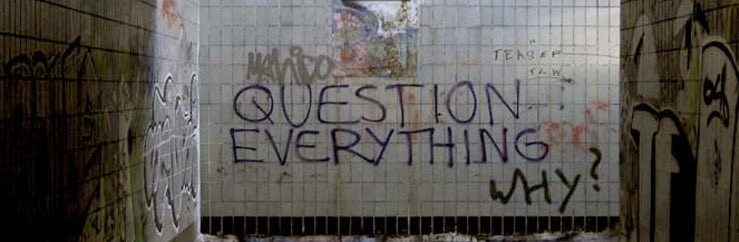
Edit: about the image. Lots of folk get as far as "question everything". It has a huge pop status, a mark of rebellion, sticking it to the man, talking truth to power, and so on. "Why?" goes a step further, asking what grounds our skepticism, when we should doubt and when we are obliged to certainty. Does the one spraying graffiti question the paint can? The wall? What must be taken as granted in order to engage in doubt? — Banno
Well, it's atomic structure is not something I'd call perceptible. Yet I am sure there are folk who know about such things. You want something more than that, I suppose, an acknowledgement not that we don't know everything, but that there are things we cannot know even in principle? Here you are bumping up against paradox: if there are things beyond knowledge, then what can you claim to know about them?I want to acknowledge that there could be things about the cup which are just not perceptible at all. — Janus
I'll admit the possibility and then choose silence. Many a philosopher will wax prosaically at length on this topic. That seems muddled. -
A Case for Transcendental IdealismIs the difference merely a difference of parlance, or is there a deeper issue? — Janus
The difference in parlance is a deeper issue.
Sure, there are things about the cup that are unperceived, and things about the cup that we don't know. But perhaps you want to say something more than that? -
A Case for Transcendental Idealism
-
A Case for Transcendental IdealismSure. Bob wants to use Kant's ideas to build two ontologies - the thing perceived and the thing unperceived.
It's not as if one's ontology can be utterly seperate from one's epistemics. Each informs the other. Indeed, if what we know does not "coincide" with what we know there is, there is a big problem.
This is how philosophy often proceeds; There's an initial conjecture, in this case that there is a something about which we can know nothing. Objections are raised, replies are found, and a protective accretion forms around the initial conjecture. With someone of Kant's vintage, there's a veritable atoll surrounding the initial speculation.
There is a need to go back to the question: how many cups are there? -
Freedom and Process
Well, you can still either put sugar in your coffee, or not.When a scientist tells me that "it's all just chemicals/atoms" and apparently expects me to believe it, what are my options? — baker
Understanding the physics does not remove this choice. -
Speculation: Eternalism and the Problem of Evil
oh, the irony.By ignoring your commitment to semantic atomism (or at best, semantic molecularism) ... — baker -
A Case for Transcendental IdealismGoing back to the two cups,
It is talk of the same ontological thing. I am not saying there are ontologically two worlds: I am saying epistemically there must be two, ontologically one. — Bob Ross
I think Banno is confusing the ontological with the epistemic consideration of the cup (in their hypothetical situation they posited): just because epistemically we must treat the ontological object as two (viz., the thing-in-itself and the thing) does not entail in any manner that there are actually two objects in reality which we are describing. — Bob Ross
That you have to make such sophisticated an argument, sundering ontology from epistemics, what is from what we know, does not bode well.
I suggest, humbly, one cup, about which you and I and others hereabouts may talk, may see, may hold, fill with tea, drink from, put back in the cupboard. Doing such things is evidence enough that there is a cup; we need not doubt that without good reason.
And I rather think that you might agree with me, were it not for the need to hold your own on this forum.
A chemist may talk of the ceramics that go into the making of the cup, a physicist may talk of the interaction of the particles that make up the cup. And both are talking about the cup. The cup need not cease to be a cup by being described in another way.
This ordinary language is where we all start, even Kant. Doubt is learned.
Edit: about the image. Lots of folk get as far as "question everything". It has a huge pop status, a mark of rebellion, sticking it to the man, talking truth to power, and so on. "Why?" goes a step further, asking what grounds our skepticism, when we should doubt and when we are obliged to certainty. Does the one spraying graffiti question the paint can? The wall? What must be taken as granted in order to engage in doubt? -
A Case for Transcendental Idealism
It doesn't.How can the Direct Realist justify that a perception of red in the mind and a wavelength of 700nm in the world are the very same thing? — RussellA
But when we talk about the cup, the pot, the cupboard, we are not talking about our private perception-of-cupboard, or the pot in itself, or one's mental image of a cupboard, but about the cup, cupboard and pot.
This has been pointed out previously. -
Speculation: Eternalism and the Problem of EvilThe term 'who' refers to living persons. — Wayfarer
So "The woman who was mother to the king" does not refer to anyone? No, the relative pronoun is for both the quick and the dead. -
Speculation: Eternalism and the Problem of Evil
Perhaps; I was not her confessor. But whom do you say is in the tomb?I would have thought as a devout Anglican (for that matter, the head of the Anglican Communion) Her Majesty would believe in the immortality of the soul. — Wayfarer -
Speculation: Eternalism and the Problem of Evil
Yep.Was that we say "Elizabeth Windsor" a matter of fiat when she was still living? — Leontiskos -
Speculation: Eternalism and the Problem of EvilHer tomb will read 1926-2022 — Leontiskos
Hmm. Who is in the tomb? I say it is Elizabeth Windsor. What say you?
But moreover, I say that, that we say "Elizabeth Windsor" is a question of convention, of fiat, and we might equally say otherwise. -
A Case for Transcendental Idealism
Not seeing it....that we can and do make such a distinction has had profound consequences for human life — Janus -
A Case for Transcendental IdealismCheers. For my money the dual aspect account amounts to admitting the thing-in-itself is irrelevant, extraneous. So we might well just drop it.
-
A Case for Transcendental Idealism
Very droll. I approve.There are actually n cups my friend, where n = the number of people experiencing, and thus representing the cup. — Count Timothy von Icarus -
A Case for Transcendental Idealism
I really do not much care which account of Kant is the correct one - one world or two. Rather, my point is that, that this is such a bone of contention counts against the utility of the whole Kantian enterprise.I think it is unfair to Kant to claim that we would think there are two cups — Janus
So if poor old @Bob Ross had answered that there were only one cup, I'd have skewer'd him on the other horn of the dilemma, that since there was only one cup there is no difference between observed cups and cups-in-themselves. -
Speculation: Eternalism and the Problem of EvilInteresting, but this account uses an essentialism that, as discussed previously, I don't think can be made to work. In dying, the Queen did not cease to be Elizabeth Windsor. Rather, she remained Elizabeth Windsor, but Elizabeth Windsor is now deceased.
The trouble is the presumption that being this or that individual is a result of having certain attributes, an essence; this leads to some interesting problems. Better, I take it, to instead take individuality to be the result of fiat - this counts as an individual.
Banno

Start FollowingSend a Message
- Other sites we like
- Social media
- Terms of Service
- Sign In
- Created with PlushForums
- © 2026 The Philosophy Forum