
Comments
-
ChoicesI don't really have a clear-cut, well-defined, position on the matter — Agent Smith
For which you should be profoundly thankful. :roll: -
Origin of the Universe Updatedit doesn't answer why there is universe. — SpaceDweller
The various branches of physics seek answers to "how" rather than "why". You philosophers are charged with answering the latter. Good luck. -
If a first cause is logically necessary, what does that entail for the universe's origins?A while back I wrote an argument that a "first cause" was logically necessary. https://thephilosophyforum.com/discussion/12098/a-first-cause-is-logically-necessary/p1 After much debate, I am satisfied that the argument successfully stands — Philosophim
That's good. I'm not convinced, but I'm sure others here are. My experience with mathematical dynamical systems that progress forward or backward in time makes me cautious. -
Reflection schema@TonesInDeepFreeze or @fishfry might be able to help. I was a math prof years ago but can't assist you here. You might send them a message and see if they are interested. Just a thought.
-
Logical Necessity and Physical CausationIs it logically necessary that spacetime must be always the same? — Janus
That's beyond simplistic. Time and length dilation under high velocities should have no effect on applications of logic in respective settings. But I don't think space really changes, just distances between some objects. But what do I know? Virtually nothing about the subject. -
Logical Necessity and Physical CausationI like a truly simplistic explanation: When embedded in spacetime logical necessity becomes physical causation. :nerd:
-
Origin of the Universe UpdatedBedtime reading, for if you can't sleep — Haglund
It's in Cyrillic. Nevertheless math symbols are the same, but to no avail for me - gobblygook. Feynman's path integral is not the functional integral I am familiar with. Playing with Functional Integrals -
Origin of the Universe UpdatedIf you use the search words 'Does expansion create new space' on sites such a quora, physics stack exchange etc. You get many many viewpoints . . . — universeness
It's hard to discern on TPF if a poster really knows what they are talking about, especially topics in physics. I think Haglund does have a graduate degree, and Kenosha Kid has a PhD. There may be one or two more. But a lack of in-depth studies of QM or general relativity is not a deterrent to posting a seemingly knowledgeable and well written statement on the subject. And if you go to a source like Wikipedia you might find confusing arguments and counter-arguments among experts in the talk sections.
One member here suggested a metric used in GR and when I read it on Wiki I could not tell whether a crucial term meant proper time or spacetime. And guess what, neither could a few of the "experts" speaking out in the general TALK discussion. Another instance was my attempt to find out what measure was appropriate for Feynman's path integral. In the article itself its just a brief hand wave, and when I asked about it in TALK I got no response. After a while I deleted my question. -
Origin of the Universe UpdatedMy view is that space does not bend and surely, not break. The immaterial does not bend or stretch, etc. — val p miranda
It does look that way, doesn't it? Confusion arises when 4D spacetime is introduced with a different metric, and said to curve, etc. But space itself does seem to show signs of curvature. Beyond me. -
Origin of the Universe UpdatedThis expansion involves neither space nor objects in space "moving" in a traditional sense
The distance between objects changes in some sense. -
Logical Necessity and Physical CausationLagrangians (excuses for the term used on this forum) — Haglund
Kinetic energy minus potential energy? Or that functional used in path integrals? The term comes up over and over it seems. -
Origin of the Universe UpdatedPerhaps jgill would comment on the maths argument used above. — universeness
The arithmetic of infinities is a subject of axiomatic set theory. IMHO little to do with the real physical world. Others would disagree. As for the "expansion" of space, Wikipedia says it best:
(Wiki)The expansion of the universe is the increase in distance between any two given gravitationally unbound parts of the observable universe with time.[1] It is an intrinsic expansion whereby the scale of space itself changes. The universe does not expand "into" anything and does not require space to exist "outside" it. This expansion involves neither space nor objects in space "moving" in a traditional sense, but rather it is the metric (which governs the size and geometry of spacetime itself) that changes in scale. As the spatial part of the universe's spacetime metric increases in scale, objects become more distant from one another at ever-increasing speeds. -
Question regarding panpsychism
[Eric Schank, SALON] :chin:Those who have experimented with psychedelics often describe a sensation of connectedness with objects around them, things like rocks, trees, or rivers. Sometimes the "connectedness" is more literal, as high doses of psychedelic drugs like LSD may cause users to believe the walls are talking to them. -
Logical Necessity and Physical CausationSo it is wrong to assert that the same shape is to some degree flat, and to some degree curved. — Metaphysician Undercover
Well, there are different metrics involved, but I can see your point. My first grad course in math in 1962 was differential geometry, and it was a puzzling experience, a topic I never found use for in all the intervening years. My view of this issue these days is very superficial: the difference between an ant crawling across the surface of a large sphere and recognizing another dimension above, and an ant somehow embedded and crawling in the same surface and finding it 2-dimensional. Pretty shallow. :roll: -
Mathematical DefinitionsDid you invent those contours eating each other? — Haglund
Just examples of little interest apart from the imagery. -
What is Climate Change?The world is in too much chaos right now to get anything of substance done about climate change. Best to start adapting. For example, the Colorado river supplies water to about 65 million people downstream. And predictions indicate less and less flow. Arizona is already discussing piping in ocean water and desalinizing it. What will Las Vegas do? Desalinization on a large scale takes lots of energy, and hydroelectric is forecast to diminish.
-
Logical Necessity and Physical CausationYou said a thing is flat to the degree that it's not curved, and a thing is curved to the degree that it's not flat — Metaphysician Undercover
Theorema egregium.
(Wiki)The "remarkable", and surprising, feature of this theorem is that although the definition of the Gaussian curvature of a surface S in R3 certainly depends on the way in which the surface is located in space, the end result, the Gaussian curvature itself, is determined by the intrinsic metric of the surface without any further reference to the ambient space: it is an intrinsic invariant -
Mathematical DefinitionsDid residues and contour integration, etc. but this seems new. Or is it a normal thing in the field. Did you turn it into a visual? — Haglund
Coupled Differential Equations
There is a tremendous amount of complex variable theory that is not covered in a typical course (which I taught a number of times). I got into my specialty over a half century ago via complex valued continued fractions, which led to a general study of infinite compositions of complex functions.
Yes, I extracted the visuals. -
Mathematical DefinitionsAt your level you are basically learning about tools and preparation. It has nothing to do with mathematics — I like sushi
In fact, as fundamental tools it has everything to do with mathematics. The algebra and trigonometry and perhaps basic calculus you learn is useful throughout the incredibly diverse realm of mathematics. -
Chaos theory and postmodernismDid you succeed with that Victorian cross (no offense!)? — Haglund
Not more than a fraction of a second. It awaited a smaller, stronger body. -
Is self creation possible?If self creation is coherent, then there can be nothing and then something.
That isn't something from nothing. That's nothing and then something. The cause of teh [the] something is not the nothing, but the something itself. — Bartricks
Moments of clarity like this make a mockery of claims that all that is worthwhile has been mined from philosophy. :chin: -
Multiverse and possible worlds.What's a toity world? Well, it's just a device to make clearer what a toity truth is. — Bartricks
It's refreshing that, having assumed all avenues of original philosophical exploration had been traveled, something novel and appealing bubbles up from spilled beer at the local bar. :strong: -
Chaos theory and postmodernismI guess it pales in the face of your accident about 35 years ago... — Haglund
Sadly that's the strongest part of my body now. :worry:
↪jgill
Looks very Mayan! Perhaps its just the combination of color and the swirling motif. — Agent Smith
Hidden within those intricate folds are the secrets of the universe.
Well, maybe not. :sad: -
Logical Necessity and Physical CausationNot so. He was an officer on the front lines, decorated several times. — jgill
Thanks. I did not know that. — god must be atheist
I knew Lester Germer slightly, as a famous physicist (wave/particle duality) but more as a fellow rock climber. My impression of him grew considerably when I found he had been a fighter pilot in WWI. A multi-dimensional person. -
Logical Necessity and Physical CausationThat was more Kripke — Banno
In Philosophical Investigations §201a Wittgenstein explicitly states the rule-following paradox: "This was our paradox: no course of action could be determined by a rule, because any course of action can be made out to accord with the rule"
Yes, the bizarre addition example. -
Logical Necessity and Physical CausationHe was a complete fuck-up. — god must be atheist
Not so. He was an officer on the front lines, decorated several times.
(But I kind of agree regarding his wondrous rule-following paradox.) -
Chaos theory and postmodernismBegin with a number between 0 and 1 in the first cell. Next cell = previous cell x (1 - previous cell) x some constant between 2 and 4. — Cuthbert
Sound like elementary cellular automata, championed by Wolfram some time ago. I've written programs that show a constant sort of development, then a jump to a weird line or something. Wolfram thought he had come upon a hugely important concept, writing a book with over a thousand pages. I, like most other readers, gave up after a few hundred pages.
Somehow they seem to eat each other. Raw sex in the complex plane... — Haglund
Like Pac-Men. My friend, you need to get out of the house more often. :wink: -
What is metaphysics?But I often find the talk pages on Wikipedia more informative than the articles themselves, especially on philosophical subjects — magritte
I do also. In this case [mathematical physics] the talk section makes one's head spin! -
Logical Necessity and Physical CausationWhere that presents difficulties, is that there is no provision in most people's minds for things to exist in different ways — Wayfarer
If things were not bizarre enough: Rydberg polaritons -
Logical Necessity and Physical Causation
-
Logical Necessity and Physical CausationLaplace's demon has been upgraded with the latest software by David Chalmers — frank
The guy who believes rocks have feelings? -
Logical Necessity and Physical CausationWiki:Laplace's demon was based on the premise of reversibility and classical mechanics; however, Ulanowicz points out that many thermodynamic processes are irreversible.
Gotta move up to the 21st century, buddy. -
Logical Necessity and Physical CausationRandom numbers are generated by a deterministic system. In a computer it's a quartz oscillator — frank
Suppose my random number comes from an observation of unpredictable minute changes in atmospheric pressure? -
Chaos theory and postmodernismHave you written some background on the maths involved? — Banno
Lots of notes/articles as a hobby. Here's an example: Woven Contours
I've written all my computer programs in BASIC. -
Logical Necessity and Physical CausationYou have an algorithm that, once begun, leads to an outcome - thus determined. But halfway through the algorithm is a step requiring the input of a random integer between 0 and 9. Is the outcome determined? Random? Both? Neither?
-
Chaos theory and postmodernismCan you zoom in like in those colored fractal zoomings (where the colors represent a rate of convergence, if Im not mistaken)? — Haglund
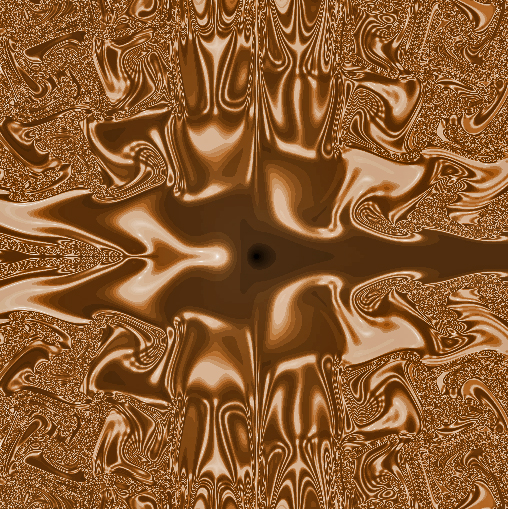
It's not a fractal, but sometimes one can focus on a spot and enlarge it and find additional intricacies. Iterations are done at pixel levels with light shades when the modulus is great and dark shades when it is small. Very simple.
↪jgill
Impressive. This is yours? — Banno
Yes, I've done lots of unpredictable images. Look at my icon on TPF. Here's another I call Reproductive Universe:
-
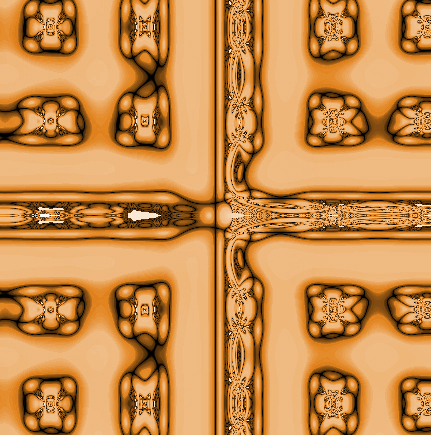
Chaos theory and postmodernismHere is a non-chaotic image arising from an iteration process that involves differing functions rather than a single function. Its' beautiful intricacies might possibly be predictable were an attempt made to do so, but it would take a significant effort. This is a dynamical system in C that rewards its inventor. I call it Dream of Gold.
jgill

Start FollowingSend a Message
- Other sites we like
- Social media
- Terms of Service
- Sign In
- Created with PlushForums
- © 2026 The Philosophy Forum