
Comments
-
Do we genuinely feel thingsThis, or something like it, I know from experience. There are different methods - solitary contemplation works for me; for someone I know who suffers from depression, it's analyzing dreams, or it might be writing poetry or keeping a journal. Basically, the process boils down to: See it, name it, accept it, own it. Then it can't own you. — Vera Mont
Yes, although it's easier to say it than to do it, at least for me. -
Do we genuinely feel thingsAlleged Buddhism expert — Darkneos
Yes, I was being ironic.
But that quote from the Tao Te is more about just letting things happen rather than fight them, which is supported by psychological research. Resisting a negative thought or idea, etc, ends up building a stronger association to it, rather than just letting it come and go. So actively trying to force something out of your mind does the opposite — Darkneos
Yes. -
Do we genuinely feel things
-
Do we genuinely feel thingsWhat 'things' do you feel when meditating that are different from the things you feel when connected to the outside world? — Vera Mont
I'm not a formal meditator and I think my understanding is different from @praxis. I went looking for an Alan Watts quote I think is relevant, but I can't find it. To paraphrase though - Quiet contemplation can help us experience our negative emotions without resistance. If we allow ourselves to feel our grief, sadness, anger, shame, or guilt fully and without trying to avoid them, they lose their power over us. Trying to avoid suffering just makes it last longer and causes additional suffering.
This is a quote from the Tao Te Ching that has always meant a lot to me:
If you want to shrink something,
you must first allow it to expand.
If you want to get rid of something,
you must first allow it to flourish.
If you want to take something,
you must first allow it to be given.
This is called the subtle perception
of the way things are. — Tao Te Ching, Verse 36 - Stephen Mitchell Translation -
Do we genuinely feel thingsYou spend enough time in meditation, you will realize that you never genuinely feel feelings in the first place it is all just cause and effect response
I understand this is not your position, only the one you are questioning. I think it was @Possibility here on the forum who recommended a book - "How Emotions are Made," by Lisa Feldman Barrett. If I understand the book correctly, Barrett believes that the physiological phenomena associated with emotion are not learned, but how those feelings are interpreted is. Children are taught what they mean, how to put them into words.
Looking at it a different way, I've seen animals behaving in a way that it would be ridiculous to call anything other than emotional. They show fear, happiness, anger, affection without the societal expectations your Buddhism expert describes.
Speaking more personally, my emotions are a big part of who I am and how I behave. A Buddhist might say that is a reflection of my illusionary self, but I'm not a Buddhist. -
Aesthetical realism:Can we agree on properties that give beauty or harmony in objects, humans, artworks and phenomena? — Eros1982
No.
If yes, why we see all kind of government/political intrusions into aesthetics: through educating kids, through promoting "artworks" and "artists" who are politically correct, through declaring poets people who are not poets, through staging "plays" that are anything but plays, through turning political agendas into "excellent scripts" for movies, etc.? — Eros1982
I don't see how government or politics, at least in the US, is making significant "intrusions into aesthetics." Do you really object to public education? On aesthetic grounds? What governmental or political institution has promoted artworks and artists who are politically correct in a significant way? Called people who are not poets poets? Staged plays that aren't plays? Turned political agendas into scripts?
Should philosophers and simple humans give up the idea that beauty and ugliness result from certain features and/or properties? — Eros1982
Yes... maybe. -
Shouldn't we want to die?These come to mind.
Cowards die many times before their deaths;
The valiant never taste of death but once.
Of all the wonders that I yet have heard.
It seems to me most strange that men should fear;
Seeing that death, a necessary end,
Will come when it will come. — S. Shakepeare -
I'm not scared of dying
And I don't really care
If it's peace you find in dying
Well, then let the time be near
If it's peace you find in dying
And if dying time is near
Just bundle up my coffin cause
It's cold way down there
I hear that's it's cold way down there
Yeah, crazy cold way down there
And when I die and when I'm gone
There'll be one child born
In this world, carry on, to carry on — Blood, Sweat, and Tears - When I Die
I'd forgotten this was written by Laura Nero. B,S,&T was a great band.
The true men of old
Knew no lust for life,
No dread of death.
Their entrance was without gladness,
Their exit, yonder,
Without resistance.
Easy come, easy go.
They did not forget where from,
Nor ask where to,
Nor drive grimly forward
Fighting their way through life.
They took life as it came, gladly;
Took death as it came, without care;
And went away, yonder — Chuang Tzu
The Master gives himself up
to whatever the moment brings.
He knows that he is going to die,
and her has nothing left to hold on to:
no illusions in his mind,
no resistances in his body.
He doesn't think about his actions;
they flow from the core of his being.
He holds nothing back from life;
therefore he is ready for death,
as a man is ready for sleep
after a good day's work. — Lao Tzu - The Tao Te Ching, Verse 50 (S. Mitchell) -
Shouldn't we want to die?I shouldn't have made an umbrella statement, but have you met someone who is (perhaps you yourself) who is not afraid of death? Maybe it goes with age but as a 25 year old I think about it often. — MojaveMan
I'm 71. I'm not ready to die, I'm having a pretty good time, but I'm not afraid. I'm not the only person like that. Here are some statistics from the web. I didn't check the validity of the source.
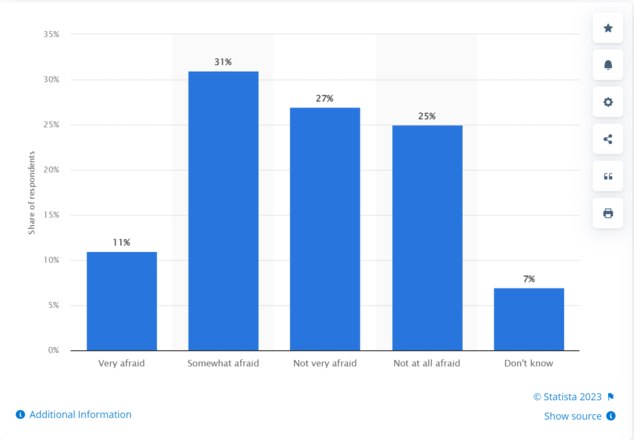
Here's a link:
https://www.statista.com/statistics/959347/fear-of-death-in-the-us/
We should have a poll of forum members.
Also - I forgot to welcome you to the forum. -
Shouldn't we want to die?my own grandmother is close to passing and she is a devout Christian, and I can tell she is absolutely terrified of the end. I believe this is the case for all rational animals, — MojaveMan
This is not true. You're talking to the wrong people. -
Why being an existential animal mattersHumans are an existential animal. That is to say, why we start any endeavor or project (or choose to continue with it or end it) is shaped continually by a deliberative act to do so. — schopenhauer1
In my experience, both of myself and others, this is not true at all. I think this misunderstanding is a consequence of people not being aware of their own motivations and where they come from.
We generate things that might excite us. Or we generate things we feel we "must do" (even though there is never a must, only an anxiety of not doing based on various perceived fears). — schopenhauer1
We've had this conversation before. You and I have a different understanding and experience of what it is like to be a human. I don't think that everyone thinks, feels, and lives the same as I do. It seems as if you think they do. -
The Hard Problem of Consciousness & the Fundamental AbstractionWhile I do not agree with all of what he says, I agree with much of it. — Dfpolis
As I noted, I don't understand all of it, but there's something there. I've spent a lot of time thinking about reductionism, holism, emergence, and that constellation of ideas that includes them. I've got more work to do. -
The Hard Problem of Consciousness & the Fundamental AbstractionI invite comments pro and con. — Dfpolis
Before I start, I want to be clear. I have only an engineer's interested, amateur understanding of cognitive science or philosophy of mind. I also admit to just scanning the linked article. I am not well-read enough to make a line-by-line response to your detailed and careful argument.
To start, it's very well written. Clear and thorough. I don't think I've read a better one here on the forum. But then, I find it flawed and unconvincing. The article states:
I see two sources of difficulty: the post-Cartesian conceptual space, and the Fundamental Abstraction of natural science. — Dfpolis
This indicates the problems with the scientific study of consciousness are philosophical, logical, not scientific. That shows my primary problem with your argument - you have shuffled the decks of philosophy and science together to provide a muddled, makeshift argument. When you deal out a science card you often make blanket pronouncements without support. You make a quick arm-wave to current cognitive scientific study of consciousness without showing you have given them a fair hearing. You talk about a Standard Model of neurophysiology which, as far as I can tell, is a concept you came up with yourself. I can't find any reference to it with a quick web search.
I share your skepticism about a reductionist scientific understanding of consciousness. This is from a paper on Merleau-Ponty's theory of form which I think is relevant. Streetlight provided a link to the paper in a discussion about five years ago.
Merleau-Ponty argues that we cannot understand how knowledge arises within nature unless we abandon the Cartesian view of nature as a machine composed of mutually external and indifferent parts.
If nature is a mechanism then it has no intrinsic meaning or unity. Thus nature could only be meaningful for a constituting consciousness that imposes a meaning on it by synthesizing its disconnected parts into an ideal whole. However, this amounts to denying that we can know nature at all. First, it means that nature can only be known from the outside, from a God’s-eye-view that could comprehend it as an object. But this is not our situation; we find ourselves born into a nature that is older than thought, and indeed gives rise to it—a nature that we can never encompass or transcend. “Nature is an enigmatic object, an object that is not entirely an object; it does not exactly stand before us. It is our soil, not that which faces us, but that which carries us.” It is precisely for this reason that we wish to naturalize epistemology—to understand how knowledge arises within nature. Second, if the only meaning we can find in nature is one that we ourselves put into it, then nature ceases to be an object of knowledge that transcends consciousness and becomes instead an idea within consciousness—a representation or mental construct. — Sense-Making and Symmetry-Breaking
There's a lot more going on in the paper, some of which I admit to not understanding, but the author does not conclude that the study of mind is not accessible to scientific study. -
"Sexist language?" A constructive argument against modern changes in vocabulary
I think there is a valid argument to be made for your position. I do worry some about how our languages are being changed for what I consider trivial or unnecessary reasons. Even so, I don't think you've made your case very well. The two examples you've cited are not really convincing. I don't have strong feelings about "Latinx" but it's pretty early in the controversy. There were similar changes I think have turned out well, e.g. providing "Ms." as an alternative to "Mrs." and "Miss." I understand this example is more important to you since you are Spanish-speaking. As for the apostrophe issue, the etymology you suggest seems pretty far-fetched to me.
Some fiddling with language pisses me off, but some makes sense. An example - I remember reading a non-fiction psychology book I had heard good things about. In the preface, the author indicated he had alternated using "she," and "he;" and "him" and "her" in different sections of the text. I thought it was a stupid and distracting change to make. Then, as I read, I found it really made a difference in how I thought about what he was writing. -
Paradox about Karma and ReincarnationThe problem: given the original scenario, such a person is now equivalent to the Jews in Nazi Germany - they are being persecuted. However, why aren't the people who sent this person into such a life now equivalent to the Nazis - as they are now doing the persecuting? Discuss... — jasonm
This is just another case of what I call "the Paradox Paradox." That's where people call uncertain or ironic circumstances or simple inconsistencies paradoxes.
Also, calling a religious belief paradoxical sort of misses the point. -
BanningsI do agree with you, but it probably also remains an issue for the site in general, where many write such short posts, with one line remarks and emoticons. It isn't an academic site, but, sometimes, there seems to be so much which is shallow and lacking in philosophical depth in discussion. It is so complex on a site which is neither a chit chat one or one of formal academic philosophy, and Agent Smith's contributions may draw attention to this dilemma. — Jack Cummins
I agree with this, but I think the moderators have done a good job making a place where the rules are not so tight or enforced so strictly that they exclude non-standard approaches to philosophical subjects but not so loose as to allow low-quality writing to overwhelm the good stuff. I don't think it's an easy balance. -
Psychology of PhilosophersI don't mean to say that great questions are unimportant or should not be addressed, but I don't think philosophy is useful in addressing them, unless we mean by philosophy art, poetry, meditation and pursuits which evoke rather than seek to explain. Those are pursuits which are better left to those who aren't philosophers. — Ciceronianus
There is important truth in this. -
Psychology of PhilosophersAnd that may be a fool’s errand. I think that’s Neitzsche’s point anyway. I tend to agree. But you did say “to the extent possible,” so I take your point. — Mikie
The effort is the point. It's not where you get, it's how you got there. That's philosophy. -
Donald Trump (All General Trump Conversations Here)Thought people might be interested in this. It's a good AP story including an interview with the foreman of the Georgia special grand jury looking into election fraud. Has some really interesting things to say about the process the grand jury went through, although nothing about the actual testimony, deliberations, decisions, or report.
https://apnews.com/article/politics-new-york-city-only-on-ap-donald-trump-georgia-266e28c4e47e54731b233e0f770f6729 -
Psychology of PhilosophersI think a big part was not simply curiosity, but fear — Mikie
For me, I think it was primarily curiosity. I just want to know how it all fits together. What happens next. It's fun, play.
I look around and notice it with others too. We simply don’t realize that so much of what we think we know, who we listen to, the company we keep, the jobs we do, and how we generally live our lives, is determined by factors beyond our control — the time and place you are born, your genes, your parents and upbringing, your culture and peers, early life experiences, education, etc. — Mikie
That's one of the main points of philosophy - to get beyond those cultural, social, and historical factors to the extent possible. -
"Survival of the Fittest": Its meaning and its implications for our lifeI give the floor to you. — Alkis Piskas
To go off in a bit different direction... I just finished "What Is Life?: How Chemistry Becomes Biology" by Addy Pross. In it, he goes to a lot of trouble to define survival of the fittest in chemical terms as dynamic kinetic stability, which removes a lot of possibly unwanted implications from the process. This is from one of Pross's papers:
Recent developments in the relatively new area of chemistry, systems chemistry have been showing that the reactivity patterns of simple replicating systems may assist in the building of conceptual bridges between the physicochemical (inanimate) and biological (animate)worlds . A key element in that effort has been the ability to specify and characterize a new kind of stability–dynamic kinetic stability (DKS), one that pertains to replicating systems, whether chemical or biological In the ‘regular’ chemical world, stability is normally associated with lack of reactivity. However, in the world of persistent replicating systems, the stability of the system comes about because of its reactivity. The system is stable in the sense of being persistent, by its being able to maintain a continuing presence through on-going replication. Of course, in order to be able to continue to replicate and maintain a presence, the system must be unstable in a thermo-dynamic sense. From that perspective it can be seen that a biological system which is characterized as ‘fit’, can be thought of as stable, but its stability is of that ‘other kind’, rather than exemplifying the more familiar thermodynamic kind. This way of thinking then enables established biological terms, such as ‘fitness’ and ‘maximizing fitness’ to be equated with their chemical equivalents: Fitness = Dynamic kinetic stability (DKS); Maximizing fitness = Drive toward greater DKS. — How Does Biology Emerge from Chemistry?
The linked website also includes a review of the very short article. -
Currently ReadingI think I mentioned that other book, which Apokrisis mentioned. — Wayfarer
I guess you must have recommended it in one of the other branches of the multiverse. -
Currently ReadingJust finished "What is Life?: How Chemistry Becomes Biology," by Addy Pross. I think @Wayfarer recommended it to me, but I can't find the post.
I liked the book. It has interesting detail about how evolution starts, not with life, but with replicative chemistry, which in turn provides the mechanism by which non-living matters becomes living organisms . That's something I was looking for after reading "Life's Ratchet" by Peter Hoffman, which deals more with how life works chemically and mechanically at the cellular level rather than how it began.
The book was a bit too breezy, gee whiz, pop sciencey for my taste. More importantly, Pross had a drum to bang, which he did over and over. His point - biology is chemistry. Reductionism is the right way to look at things. Many times here on the forum I have banged my own drum about reductionism with a reference to "More is Different," an article by P.W Anderson which strongly disputes the reductionist viewpoint. Pross has made me rethink that position, although he hasn't changed my mind. What annoyed me is that I don't see how the dispute is relevant to the information about how life starts that I was really interested in.
Still, worth reading. -
Chinese Balloon and Assorted IncidentsAn interesting article. Looks like the downed balloon in Canada had nothing to do with China.
https://www.rtl-sdr.com/the-us-airforce-may-have-shot-down-an-amateur-radio-pico-balloon-over-canada/ -
Harm reduction and making political decisions?Peter Ziehan (author, The End of the World is Just the Beginning: Mapping the Collapse of Globalization) thinks Russia wants to repossess the Ukraine as part of Russia's long term strategy to establish secure western borders and buffer states between itself and (now, NATO). Interests, again, rather than individual obnoxiousness. — BC
Good post. TIL about the roots of World War I. "TIL" is what all us hip youngsters say instead of "today I learned."
One thing that I keep thinking about during the Ukraine fighting - The US shares culpability for how things have turned out. Once the Soviet Union folded, the US and Europe started allowing, encouraging, former Soviet republics and Warsaw Pact countries to join NATO. Suddenly Russia found itself surrounded by potentially hostile neighbors with military backing instead of subservient client states. I don't blame them for feeling resentful and threatened.
Now I worry we have entered another period like the time before WWI. The lines are drawn, people have chosen sides, nobody will back down, and things are playing out as they will. A little miscalculation could set off very bad things. And then, around the block, there's China which might be heading in the same direction. Frightens me. -
Harm reduction and making political decisions?Are you saying that any time someone is threatened, extorted, or coerced they should give in to avoid harm?
Are you saying that the harm the Ukrainians are currently undergoing is more important than their national independence? -
Two Types of GodsTo me the world seems an amoral and dangerous place (at best). — Tom Storm
I think our different ways of seeing things are probably a matter of temperament, i.e. a way of thinking we're born with rather than the result of learning or experience. I've always seen the world as beautiful and funny. I feel as if I belong here, in spite of some bad things and unhappiness along the way. -
Chinese Balloon and Assorted IncidentsI got my wife a balloon yesterday that said "Happy Valentine's Day. — Hanover
That could explain a lot. Perhaps the Chinese were just wishing us a Happy Valentines Day. -
Chinese Balloon and Assorted IncidentsMy point here is that if the Chinese came up with the grand idea that they were going to hold a camera over Montana and think they were going to see something that airplanes, radar, satellites, Google maps, and passersbys don't already see and that was going to give them some advantage, they aren't quite the threat we thought them to be. — Hanover
It's my understanding that the balloon included antennas for electronic surveillance. Perhaps that's not something that can be done from space. Which isn't to say I don't share your bemusement about the seeming rinky-dinkness of the Chinese balloons.
"Bemusement" is a more intellectual, sophisticated word for "confusion." Alternatively, it is a word for a more intellectual, sophisticated confusion.
"Rinky-dinkness" is a more amusing word for a lack of sophistication. Alternatively, it is a word for a more amusing lack of sophistication. -
The Philosopher will not find GodMakoto Fujimura on Emily Dickinson — Noble Dust
Thanks. Interesting article. I am generally suspicious of articles about poets, poetry, and poems. Writers like to pick them apart and turn them into something else, as if they knew what the poet was trying to do better than she did. This one didn't. It was insightful and respectful. -
Objection to the "Who Designed the Designer?" Question
You started this discussion but haven't participated after the first post. That's considered impolite. -
The Philosopher will not find GodEverything you've argued could also lead to 'so who cares? — Tom Storm
I can understand why someone wouldn't care. I wouldn't care myself except for all the people who hate religion and care very deeply. I don't include you in that group. -
The Philosopher will not find GodEmily Dickinson — Wayfarer
It's always satisfying when poetry does philosophy well. -
The case for scientific reductionismCan you be more specific — Gnomon
It is not true that particles have been superseded. -
Two Types of GodsThere is no evidence It exists or has done anything to deserve your thanks. — universeness
Someone, something, somewhere deserves thanks for this wonderful world.
T Clark
Start FollowingSend a Message
- Other sites we like
- Social media
- Terms of Service
- Sign In
- Created with PlushForums
- © 2026 The Philosophy Forum