
Comments
-
Mind Has No Mass, Physicalism Is FalseI only asked you to provide 4 physical items that includes thoughts as one. :chin: — TheMadFool
I’ve explained why it is a poor question. But....
1) cognition
2) traffic
3) cities
4) weather
5) ecosystems -
Mind Has No Mass, Physicalism Is FalseHah. It would look like a pattern - a pattern of entropy dissipation - of course. Everything physical looks more like a process, a "mindful" flow, if viewed on the right scale to reveal its causal structure.
-
Mind Has No Mass, Physicalism Is FalseThose are physical correlates of thinking and not thoughts themselves. — TheMadFool
The thoughts are causal. The productive interaction is what physically exists as "a self".
I ask tne two of you again the simple question: what are the physical properties of thoughts? — TheMadFool
You simply ask an incoherent question if your notion of physics is as limited as your notion of mind.
Do you think "physics" is the easy part of the problem here? There is a lot to unlearn on that score as well then. -
Mind Has No Mass, Physicalism Is FalseLet's suppose the mind = brain and that physicalism is true. — TheMadFool
But that is not what I said. I said the mind is an informational model of the entropic world. It is a pattern that exists to the degree it can regulate that world as something "external" to it.
But by the same token, it only exists to the degree the world is actually being regulated. So without a physically effective impact, there is no consciousness happening.
What are the physical properties of thoughts? — TheMadFool
They would be the physical results of those thoughts (plus the general but small constant cost of keeping the brain running as the pattern generator).
So did a skyscraper get built on the corner lot? Some architect's vision had a physical impact on the world then.
At the very least, something - thoughts - aren't physical at all. — TheMadFool
The thought results are their physical consequences. The thought process has its standard brain metabolic cost.
The only reason you see no physics here is because you refuse to look. Where is the evidence that thoughts aren't physical "at all" when they are "all about" information patterns that need to be able to manage the physics of the world in real-time?
So yes, there is a division. There is this biological thing of information regulating physical entropy flows.
But you are just re-running the old vitalist argument about living organisms being some great unphysical mystery.
Life and mind are the same kind of deal. One models the world it wants - the metabolic flows that constitute living - using the information held by genes. The other also models the world it wants - the thoughts that regulate the wider environment - using the information held by neurons. -
Mind Has No Mass, Physicalism Is FalseI'm mainly concerned about the brain activity being the same between awake and REM sleep states. If the mind is the brain, we should be conscious on both occasions but we're not. — TheMadFool
If the engine is running, but the gearstick is in neutral, is it a puzzle the car is not going anywhere?
Consciousness isn't something separate from the physical fact of being in the world. It is all about that way of being in the world. It is controlling a car in motion that makes one a driver, not merely sitting in the driver's seat.
When we are awake, the difference is that the brain has physical stimulation that it is responding to in terms of its "pattern fitting". There is a real world problem getting constantly solved.
Your Matrix simulation could only work as it mimics some kind of real physical stimulation, even if you have reduced that to winking LED lights in a set of VR googles, or whatever. And in a VR simulation, you change the view "realistically" by physically moving your head in space. A Matrix world is only convincing to the degree it provides this normal seeming level of interaction with its "physics".
So your arguments rely on your failure to be realistic about what is actually involved in a brain forming a working relationship with the world.
The whole point of the mind is to provide a way of regulating the physics of the world. And it does this by implementing a modelling interaction. Remove the physical half of the equation - as happens when the brain shuts off the normal flow of sensation from the senses at the brainstem level - and we get the confused states of sleep where the brain is just riffing off its own memory patterns.
It is revving the engine, stomping on the accelerator, for sure. But there is no physical response - no challenge of actually having to drive. And hence no feedback to structure the resulting states of experience. -
DefinitionsI half-think you do think that's all I've said. — csalisbury
And yet this is the kind of confused nonsense you feel is some kind of sharp reply.
In a sordid hour, I went and got drinks with a subjectivist and, as you'd expect from a subjectivist, he wanted to talk about literature. After saying 'fuck science' and showing me his grateful dead tattoo, he told me the story of Henry James' Beast in the Jungle. The protagonist, the subjectivist told me, spent his whole life waiting for his apotheosis - for the 'beast' to pop out in a single epic moment. The beast does pop up, toward the end, when the protagonist realizes that in focusing all his energy on this apotheosis, organzing his life around this moment, he's become absent to his actual life. This recognition is the beast, of course, what can you expect? 'Away with you, subjectivist' I yelled, 'this oatmeal-mush displays only your watery will!' — csalisbury
How could this caricature apply to a totalising that is all about living life as it happens and building an ever heightened state of sensitivity and awareness as a result?
I never found life dull. But now I'm old it is ridiculous how many different things I find fascinating.
If your mind is confused, then confusion is all it can discover in life. Beating about the bush and never coming to a point becomes the anti-totalising habit.
Again, if you can make a sharp case against my "way of life", go ahead. In what way is it "wrong"?
You seem angry enough about it. Always bitching. But isn't that all about you in the end? -
DefinitionsI'm saying there is a particular kind of total-surprise-avoidance that I think it best to avoid. — csalisbury
Sure. But here you need to show how that applies to what I actually do, not some mechanical caricature of that.
In all seriousness, though, I've met you in every way, while you've failed to meet me. — csalisbury
You really believe your own bullshit don't you. You haven't produced a coherent argument as yet. But you want to make that problem mine. -
DefinitionsTo reiterate, the 'success' of such an approach appears to me be a 'success' at avoiding any kind of surprise or any encounter with something outside one's grasp. — csalisbury
You don’t get it then. I will repeat. It is by “avoiding surprise” that one is sharpened to discover the greatest surprise.
If your complaint about totalising is that it is rigid and blinkered, then I have explained why that is a false characterisation.
My approach is organic and not mechanical. The integration is what supports the differentiation. -
DefinitionsI guess I'm supposed to be a 'subjectivist' who refuses to 'escape the cartesian dialectic' — csalisbury
Note how you then launch into a long defence of the subjectivist life as the unalienated and colourful alternative. Who would not choose that over the alienated, monochrome, etc, objectivist you ask?
And as I said...
It's funny. Proper metaphysical strength Peircean pragmatism offends the objectivist and the subjectivist alike. — apokrisis
I don’t have to reject one pole to have the other. My way of life is able to incorporate both poles more fully.
For example, the more the world is understood and made predictable, the more surprising and delightful it feels. High contrast between figure and ground equals heightened sensation.
Still, I'm deeply skeptical of the thermodynamics-explain-everything approach — csalisbury
It grounds explanation. It doesn’t explain away. It starts explanation from a deeper level. It is the fertile soil that grows more. -
Evolution of LogicWhat is in question is whether we should count the dog's intuition as a kind of logic, or as logical in a kind of basic sense. — Janus
It seems easy to credit animals with inductive reason and hard to credit them with deductive reason.
The brain is set up to form general rules from particular experiences. These are what habits of though are. They create natural states of expectation based on prior experience. So all animals would be as good at this kind of inductive reason in proportion to their brain size. Humans included.
Deductive reasoning is then the opposite. The ability to derive consequences from general rules. Thus it is the ability to generate non-habitual responses to the problems of life.
That requires the further step of forming that rule as its own notion in the mind and not some unconscious habit of generalisation. You have to know the rule as something "objectively stated" and not just "subjectively acted out", as in applying a inductive habit that generates an expectation.
So - as in pragmatic reason - the full story of the rational mind involves the three steps of abduction or hypothesis forming, deduction or consequence forming, and inductive confirmation or the rule checking that can add it safely to our store of habits.
The fox story doesn't seem a clear enough test of the two alternatives - mere animal induction vs full human reasoning - to answer the question even if it truly happened.
Is seems quite plausible that a fox could be trained to develop this inductive habit. If the same thing happened often enough, the rule would form as an implicit habit. Once you have exhausted other paths, the remaining path has to be the path.
It would seem obvious from accumulated experience rather than because the fox stopped, thought, reasoned it out as a first time exercise in forming a hypothesis, deducting the expected consequence, trotting off and discovering inductively if the expectation matched the new rule just posed.
So the distinction between induction from experience and deduction from hypothesis ought to be a sensitive test of where the line gets drawn in terms of whether a grammar of language is in play.
The situation has to be objectified to be made subject to the empiricism of a rational mindset. That requires a new kind of tool - grammatical speech - to do the job.
But an animal - put into an experimental apparatus like you describe - will also learn to decode the rationality implicit in the situation with enough inductive experience. It will implicitly get the explicit logic that went into the design of an arrangement of three forks and one that is correct.
This is why experiments in animal cognition can seem to show that animals are more capable of deduction than they naturally are. An artificial environment can be used to force the desired outcome. -
Is space/vacuum a substance?I think it's very clearly epistemic... — Metaphysician Undercover
But hidden variables have been experimentally ruled out. If it is epistemic, you are left with a truly pathological metaphysics like MWI as your only refuge.
I'm sticking to the science here. The PNC fails to apply to the internals of the wavefunction. The PNC is an emergent feature of the classical scale where the wavefunction collapse has actualised some concrete possibility and so any remaining indeterminacy certainly is epistemic.
the physicist might not be willing to accept the fact that the apparent vagueness is due to deficiency in the principles. — Metaphysician Undercover
Physicists in fact tried their hardest to avoid ontic vagueness. They invented the MWI as one way not to have to admit defeat.
In the end, the "deficiency" is in the metaphysical reductionism that frames the problem - the framework both you and the MWIers share by insisting ontic vagueness is impossible from a classical viewpoint where everything has counterfactual definiteness from the get-go. -
Disenfranchisement and the Social ContractI remember hearing about the study that showed that the US is an oligarchy. Despite this, I think we can still salvage our country however through the existing, but nearly broken, democratic mechanisms in place. — Aleph Numbers
The problem for the US is that it starts with so many embedded geopolitical advantages that it is almost impossible to sink. It thus lacks the incentives to get its act together.
It has secure borders, the world's best food basket, a balanced demography, abundant energy and other resources, control of the world economy with the dollar as the reserve currency.
So it can run itself badly and still get by in a way most other nations can't.
What is a person to do when the social contract has been broken? Are they justified in tearing down the system? And if they are, are they justified in doing it violently? — Aleph Numbers
The US is insulated against external shocks to its system by all its embedded advantages. So reform would have to come from within.
As you rightly say, the question is why civil disobedience might indeed work better than violent overthrow. Is Chenoweth correct?
It seems commonsensical that tearing things down is easy. Building things up is the hard part.
So forming a steadfast block of citizens with a common clear objective is what has impact in human affairs - if there is any kind of democratic system in place. An angry mob with no such cohesion can be as violent as it likes to little effect. That just justifies an authoritarian crack down.
The problem for the US circles back to the fact that its own citizens know that irresponsibility has low immediate risk because the US system sits on so much geopolitical advantage. They don't need to be disciplined in their complaints in a way that forges that resolute state of civil disobedience.
So change could come if the US were at a tipping point where maybe even a small amount of resolute citizen action might be enough to trigger a shift in desired directions. But it hardly feels like the US is anywhere near that tipping point internally.
It's geopolitical advantages are a huge buffer against a system reform that would confront "the new truths" we might like it to see. -
Is space/vacuum a substance?The "vague potential" we are talking about is ontological indeterminacy, — Metaphysician Undercover
So is the vagueness of a quantum potential ontological or epistemic? Do you believe nature is counterfactual all the way down despite the evidence? -
Is space/vacuum a substance?I realize this is not the topic of the thread, so I apologize for deviating — jgill
That’s OK. I was just confused trying to figure the relevance. -
Evolution of LogicIs not learning a type of thinking? — Harry Hindu
Animals can think in the sense they are conscious and can respond intelligently to situations. But the OP was about the evolution of logic. And my point is that it piggybacks on the new semiotic machinery that is grammatically structured speech.
What makes humans different is all the differences that this new habit of structured thought can make. -
Neil Armstrong's Memory Of The Moon And PhysicalismPragmatism simply bypasses Descartes with a wry smile and no backward glance. The ability to doubt is what it uses to justify belief.
For all practical purposes is a pragmatic approach towards the problem of incompleteness of every scientific theory and the usage of asymptotical approximations - Wiki -
Neil Armstrong's Memory Of The Moon And PhysicalismThat’s pragmatism for you. If your thought experiment specifies that there is no possible evidence that could make a difference then that is what you have specified.
But now you have to do your bit and prove that such a simulation is a realistic exercise. Build the kit that you claim could do this job. Seems like an idle fantasy of someone with minimal scientific understanding to me. A lame plot for a lamer movie. :wink: -
Neil Armstrong's Memory Of The Moon And PhysicalismIf you agree with me then, I agree with you I guess. — TheMadFool
Why guess. Parse what I wrote and find out.
Can Neil Armstrong tell the difference between a mind simulation of the moon and actually being there on the moon? He can't, can he? Doesn't that imply the sameness of the two? — TheMadFool
I thought I said it didn’t imply that. Are you now claiming the physical consequences are identical?
The more interesting question seems to be this: did Neil Armstrong actually go to the moon? — TheMadFool
Maybe the interesting question is why the US didn’t simply stage it all on a Hollywood backlog and save the dough. -
DefinitionsI've been reading William James all week. — csalisbury
William James is a dirty word to the true pragmatist. Peirce was so offended by his disciple that he had to relabel the original as pragmaticism. :rofl:
like you think poems are people saying 'nature' in front of a bulldozer that says 'science — csalisbury
Keep inventing the straw man that is your ideal match up here. :yawn:
respond to the rest in the morning — csalisbury
Is it worth it? Only if you can focus enough to justify your gripes against a totalising discourse that actually produces results, -
Is space/vacuum a substance?So what was the point you hoped to make? How does it relate to the physics of a Big Bang universe? Break it down for me so that I might understand. Give us an example in a physical context.
-
Neil Armstrong's Memory Of The Moon And PhysicalismConsider then the matter of reality simulation. — TheMadFool
Recall my previous reply which says it is correct to think that the brain's experience of reality is "just an information processing model". So sure. Matrix away.
But the brain is still a physical device that needs to be plugged into an energy supply. The cost of doing business - modelling the world - is zeroed, not actually "weightless" and zero. It just means one state of experience physically costs the same as any other state.
The actual real world cost of this experiential modelling is of course that it has to be useful. It has to stop us walking over cliffs or trying to fly off high buildings. We have to be able to sustain a life, and avoid becoming dead.
So the information cost of any brain state is reasonably minuscule - like pumping a few weights. But the consequences of wrong actions resulting from those states can be massive. Terminal. Call in the corpse recycling squad.
In dreams, the brain lives. But its states have no consequences like that. The same in your Matrix simulation. The same in a vegetative coma. The states it forms all weight the same at a neural level, but the results are weightless. They produce neither a gain nor a loss - so long as someone takes over your physical feeding and care if this disconnected state is prolonged. -
Neil Armstrong's Memory Of The Moon And PhysicalismStart by telling me what isn't different. I'm not sure how you think anything is the same.
Besides, the moon landing was faked. It was all shot on a Hollywood backlot and they burnt the set straight after. It's now a golf driving range. -
Is space/vacuum a substance?In the world of pure mathematics, a vector field in the complex plane describing a function F(z) having an "indifferent" fixed point a=F(a) might show the enormous differences of displacement as z=a is "tipped" a tiny bit to one side or the other. — jgill
Yes. But what if this non-linear sensitivity is being regulated by a parameter that is a reciprocal relation such as y=1/x? And so yx = 1?
A tiny tip one way is yoked to a tiny tip that compensates. Unit 1 has been fixed as the identity element, the common departure point. The indifference lies in now giving it any particular value to denote some quantified scale. It is now always just a generalised quality - the way an identity element behaves as a symmetry awaiting its breaking.
Other examples of starting values that emerge as the balances of divergences.
The value of pi - understood as the ratio of a circumference to a diameter - can vary according to the geometry of a plane. Pi = 2 for the closed or negatively curved surface of a sphere. Pi heads for infinity in the opposite case of the positively curved hyperbolic plane.
It is only the special case - the Euclidean plane, where lines can remain parallel to infinity, never converging or diverging - that the ratio is a familiar fixed constant. 3.14159...
Euler’s number or e is perhaps a clearer case in being the constant that emerges from the "self-referential" reciprocal built into a pure model of continuous compounding growth.
That is, f(x) = e^x graphed as a curve which intersects at y = 1; x = 0.
The system is set to the most general initial value - 1 - before any growth has had the time to be added. And then the slope it generates by x = 1 is e - or 2.7182818... The unit 1 picture spits out a pi-like constant - a universal scale factor - for the dynamics of self-compounding growth.
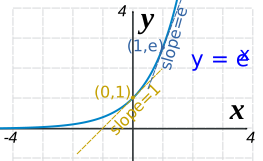
https://www.mathsisfun.com/numbers/e-eulers-number.html
With the Planck scale, the physics wants to run it backwards to recover the "unit 1" reciprocal equation that is the Universe's own universal scale factor. That is the thought motivating this particular game here.
Okun's cube says it must take all three fundamental Planck constants in a relationship to recover that unity. If all three constants - h, G and c - can fit into one theory, then that is the theory of everything.
General relativity unifies two of them - G and c. Quantum field theory unifies another pair - h and c. So unifying all three is about a combined theory of quantum gravity.
At which point everything collapses into confusion as it is a completely self-referential exercise. There is nothing "outside" as the yardstick of measurement. It is all reduced to some internal interplay.
Well, this is why efforts like Loop Quantum Gravity have tried to extract realistic solutions as emergent features from the kind of self-organising reciprocal thinking I describe.
If you frame the quest as getting back to where time and space are coordinates set to zero, then energy density has to be infinite. Neither extreme is a sensible answer to the question.
But if instead the general answer - from a dimensional analysis - is that everything starts from 1, that gives you a fundamental grain to grab hold of. You have a yo-yo balance to swing on. You can extract a log/log powerlaw slope that is the dynamics of an expanding~cooling Cosmos. The energy density thins as the spacetime spreads. The rate of both is yoked together, as scaled by the speed of light - the third side to this "unit 1" Planck story.
So how small and hot was the Universe at the Big Bang? The answer is 1. Or rather so hot and massive that it was as small and curled up as possible in terms of its scale factor. And vice versa. It was so hot and massive it was striving as hard as possible to blow itself apart in every direction. It's spatiotemporal curvature was just as much hyperbolic or positive as it was spherical or negative.
By the Heat Death, the end of time, the scale factor is still "1" but now in an inverse fashion. Everywhere is so cold and empty that the gravitational curvature - the stress tensor of GR - is at its weakest possible value. Almost zero, or 1/G, of what it had been. And the same for h as a measure of the quantum uncertainty or positive hyperbolic curvature wanting to blow things apart. Effectively it has fallen to 1/h or nearly no curvature in that direction either.
So the Universe stays "flat" and follows its unit 1 scale factor trajectory as a spreading~cooling bath of radiation. But that conceals the trauma that is the Big Bang as a state of unresolved tension - the maximum difference in terms of being the "largest" energy density packed into the "smallest" spacetime. And the Heat Death as the evolution towards the calmest expression of that driving tension - its dissipation into its own reciprocal state of being the smallest energy density packed into the largest spacetime.
I'm sure I'm only writing this out for my own amusement. But I just find it a fascinating story.
A different kind of "maths" results from setting your origin to 1,1 rather than 0,0. It constrains any path being traced to something nicely tamed by its own self-referential set-up. -
Does Size Matter?So comparatively, on the whole, an individual human is enormous, and our planet-spanning civilization even bigger still. — Pfhorrest
Interestingly, we - as complexity - arise bang in the middle of the spatiotemporal story of the Cosmos.
Looking down, it is 33 orders of magnitude to reach the Planckscale. Looking up, it is 28 orders of magnitude to reach the edge of the visible Universe - the event horizon which bounds our existence.
So - as brains - not exactly in the middle of space and time. But close. And closer still if we are a planet-spanning civilisation as you say. -
DefinitionsSo the dichotomy between determinism and chance or freedom is false only as long as one insists that nature must be one or the other. Nature shows us both; in varying blends or degrees, or in various contexts or perspectives, I suppose. — Janus
That's it. The trick then is to see how both sides of the dichotomy are equally "good" as each is the creator - the definer - of the other.
We don't want to eliminate indeterminism by speaking of determinism. We don't want to eliminate order by speaking of chance. We want to draw attention to these being the limits in terms of what could be. And how both are needed to then have anything actual at all - as the blended outcome.
That is why the maths of reciprocals captures the logic of the dichotomous relation. It makes the business explicitly dialectic or self-referential. It is all about the reciprocity that connects the apparent dyadic divide.
That is why it is a healing influence in our divided world - a semiotic bridge over all the Cartesian divides.
(Well, not. Everyone hates happy endings apparently. :smile: ) -
Definitionsbut your response was to oppose a correct dichotomy, the right kind, susceptible to triadic reconciliation. I — csalisbury
Yep. That's the trick.
You are against such totalising, even when it is a well proven success. You try to dismiss it as "pragmatic", as if being useful is a dirty word. You will blather on about poetry or feelings or other tribal artefacts of the anti-totalising brigade.
It's funny. Proper metaphysical strength Peircean pragmatism offends the objectivist and the subjectivist alike.
But that is because they are happiest trapped in that Cartesian dialectic. If its dichotomistic inconsistencies were resolved, they would no longer have anything to write poems about, or realist polemics about.
You are down that dark hole. I can hand you the ladder out but I can't make you climb. You have to want to leave the angry gloom that is the anti-totaliser's fate. [ Joking tone adopted ]
But I wasn't impugning your use of time during quarantine (???) though it appears you are impugning mind. To be clear, are you responding to my post by asking if I'm having a rough go of it? — csalisbury
I was responding to your Cliffnotes jest....
There was (a) the Enlightenment where the balance was at least close to correct, then (b) the split where there was set in opposition (i) a focus on the self vs (ii) a focus on the world... and we should then do (c) a harmonious reconciling of the two?
I just found it funny that I had paid some special attention to exactly that as a historical dynamic. Hegel is (in)famous for his dialectical claims about the German state representing an end to history to the degree that it had achieved a natural rational order - a state of Enlightened self-governing.
Neoliberalism felt it had achieved the same natural enlightened state of arriving at the end of history - at least according to Fukuyama.
So the question arises what is the true dichotomy that human history keeps trying to resolve in a synergistically valuable fashion? That was my research topic.
Clearly it is in some sense the balance between the forces of labour and capital - to follow the Marxist analysis. Or free competitive action within the cooperative space of a collective market - the neoliberal story perhaps.
My own answer is thermodynamic - the basic view of natural systems. Humanity stumbled on a fossil fuel bonanza that could be harnessed by industrial age machinery. If we learnt to think like machines - form a mathematical level of semiosis with "reality" - then we could burn through this bonanza at an exponential rate.
So the dichotomy is between extropy (energy available for work) and entropy. Or between a source and its sink. Humanity could be gas guzzling and ride that a rocket-fueled economic curve - escape the mundanity of a life wedded to all being farmers living within the limited means of the daily solar flux.
The unresolved part of that economic dichotomy is the balance is all source, no sink. Burning fossil fuel for useful work produces also all its entropic waste products - mainly heat. That is a problem when you need to dump that heat into deep space but it gets trapped by the atmosphere. You have no sink as part of the equation.
Anyway, you see the Hegelian trajectory I have in mind. The economic system of life was always thus. An entropy gradient from source to sink. An "enlightened" world needs to pay for its sinks as well as its sources to have an economy that can last.
Something like neoliberalism becomes objectively wrong to the degree it doesn't balance the equation in that fashion. We can measure how out of line it is as we have a definition of what could count as creating a system with a long-run future.
So no, its nothing about your "rough go's". I just think its funny that the worst things I could be doing in your eyes - well I will be doing them! -
DefinitionsI don't see dichotomies, I see continuums. — Janus
Dichotomies are the limits to continuums. So they are necessary as the division that provides then the mediating spectrum - the actual world of concrete possibilities that lie inbetween.
Its another intricacy of Peircean logic. Thirdness - as regularised order - enfolds also secondness and firstness. It is all aspects of the one whole.
So you need raw potential, you need a symmetry-breaking that reveals there could be a symmetry, you need then the symmetry that is the globally generalised state of habit - the continuum that is revealed by the emergence of asymmetric limits to the possibilities inherent in mere vague potential.
So dichotomies are the mediating step - secondness or the actualisation of asymmetry. And in revealing those complementary limits, a continuity of all the places inbetween is also revealed. Actuality is measureable in terms of its relative distance from the opposing poles of being.
Is everything a matter of mere chance? Is everything a matter or strict necessity? Nature tells us all actual being is relative to those two bounding extremes.
The false dichotomy lies in having to claim one state is primary. The true dichotomy is the dyad that is resolved triadically rather than monistically. It describes the matching limits on actual existence, and so neither limit itself actually "exists". They mark the end points of a continuum where existence lives. -
DefinitionsThis sounds like a cliffnotes summary of the introduction to 'History of Ideas' by Idea Historian. — csalisbury
That's exactly what I spent my three month lockdown sabbatical on - researching a defence of Hegelian history!
Instead of seeing the world as two cosmic forces in great battle, resolved triadically,... — csalisbury
Yada, yada. If you don't like the idea of synergistic resolutions then I'm sure that a lack of them is the view you build into your every encounter with life.
How's that working for you? -
Does Size Matter?An alternative to size is complexity. What counts as the most complex thing in a generally very simple Universe?
Pound for pound, centimetre for centimetre, even second for second, the human brain probably wins that cosmic contest. Trillions of synapses in precise microsecond coordination, packed into a 1200 cc volume.
So we rule! -
Is space/vacuum a substance?If the constraints are fixed constraints (what the laws of physics are generally believed to describe)... — Metaphysician Undercover
The current approach in cosmology and particle physics would be to see any global regularity in terms of emergent constraints. That is why symmetry and symmetry breaking are at the heart of modern physics. They describe the form of nature in terms of the complementary emergent limits on free actions. A probabilistic view where change is change until change can no longer make a difference. At that point, the system is "stable" and its equilibrium balance can be encode as "a universal law".
Potential is completely incompatible with with the bivalent system, and therefore needs to be represented in a completely different way — Metaphysician Undercover
Yes. That is the distinction I have made all along. Potential would be simply a vagueness. The PNC fails to apply. And possibility is the next step along. A possibility is a concrete option. The PNC applies in that to go in one direction is not to go in its "other" direction.
A possibility is an actuality in that regard. A generalised notion of potentiality in fact. There is now a world, an embedding context or backdrop, where every act is matched by a "reaction". To push is to encounter resistance. To move is to depart.
It is all made actual and concrete by the fact that every possibility is bivalent. A direction is asymmetric as it breaks - and hence reveals - an underlying symmetry.
Vagueness is where there just isn't any such general backdrop to local events or acts. If you are in a canoe in a thick fog on a still lake, do you move or are you still? The PNC can't apply unless there is some context to show that a change is happening, and even not happening.
But when the fog lifts, we have reference points. We are either moving or not moving as the clearly bivalently complementary options now. We have a choice between the two opposed possibilities. The PNC becomes a legitimate rule.
Possibility is something general. If it is reduced to a particular possibility such that we can represent its binary opposite, we are not representing the possibility properly, because possibility always relates to numerous things, not one thing. — Metaphysician Undercover
Yep. You dispute the distinction between vague potential and crisp possibility and then repeat the basic argument.
As Peirce says, the trajectory is from Firstness to Thirdness, from vagueness to generality. Actuality as a set of concrete local possibilities emerges via the contextual regularisaton of a vagueness, a unformed potential, by generalised habits. A prevailing state of global constraints.
The generality of a backdrop is needed as the symmetric reference frame that orientates local possibilities as the bivalent symmetry-breakings, or asymmetries. That is what I have said all along.
And hence you need the further category of vagueness to stand behind this evolutionary development. The generality of a backdrop or symmetry state has to arise out of "something" too.
If actualizing possibility X means not actualizing possibility Y, this does not mean that X is the opposite of Y. — Metaphysician Undercover
It is not X and Y that speaks to bivalence. It is X and not-X.
A possibility does not have the capacity to actualize itself. — Metaphysician Undercover
Sure. In your mechanical model of reality.
The Peircean model says vagueness is only regulated. So there is always chance or spontaneity to affect things. Regulation is asymptotic. It can approach the limit but never actually completely reach it. So infinitesimal chance always remains in the system to tip the balance.
That is why quantum mechanics can work. Or any other form of spontaneous symmetry breaking in physics.
You only need a system to be symmetrically poised between its two directions - the choice over a concrete action. Something is always going to tip the balance. Nature just fluctuates at a fine-grain level and chance will give the poised system its nudge that then actualises the possibility.
It is the old paradox of a ball balanced on the peak of a rounded dome or pencil balanced on its sharp tip.
Newtonian physics says a perfectly balanced ball or pencil could never topple. Nature says that - quantum mechanically - the world is just never that still. There will always be a slightest vibration. And the slightest vibration is all that is needed for the ball or pencil to spontaneously break its symmetry and so actualise a possibility. -
Evolution of LogicThe limitations of these apes seems to be related more with memory capacity and attention span, not necessarily logic. — Harry Hindu
It is partly that. But more generally there is a lack of the necessary “top-downness” in neural control from those highest cortical areas.
The brain is organised hierarchically. So the “logic unit” of the higher brain is Broca’s area, a premotor stage for planning actions and feeding into the rungs of the motor cortex that handle the habitual detail of those acts.
Apes have a smaller and less powerful version of this area. Hominids evolved a steadily larger one, most likely first for tool making and tool use. Then this became a pre-adaption for the ability to make complex structured vocalisations.
Making a flint axe is a process of sequences of precise steps towards a general intent that is much like articulating an idea. And early humans evolved a very un-apelike tongue and vocal tract that was tailor made for articulated noise making. The first reason for a grammar-like ability to make speech-like sound sequences could have been as a form of expressive “singing” - social communication via indexical vocal gestures.
So apes lack key aspects of the neural machinery. A large and evolved Broca’s area - a premotor area that would be involved in the focusing and remembering of complexly structured utterances - would be one.
Humans are good at incredibly complex music patterns. But apes don’t seem so hot with a violin either.
So their problems with forming long chains of reasoning and nested logical concepts is pretty easily explained,
I ought to say that this means of course that logic is not biologically innate. It Is a cultural adaptation.
This goes back to the old debate about whether language or thought comes first. It is believed human rationality had to evolve first to give early humans something that needed saying, But it is the other way around. The development of language as a new level of social-semiosis made it possible to use the brain in entirely new ways. The grammatical structure of speech was a cultural pre-adaptation to inventing a rational style of thinking that followed mathematical strength rules.
It seems to me that it is the opposite - that language piggy backs on the capacity for logic. The law of identity, excluded middle and non-contradictions are the most fundamental rules of logic and language simply couldn't be conceived of prior to these rules being inherent within the mind - like that some identifying mark identifies something else. Establishing correlations and relationships has to be an inherent mental skill if you are to correlate some sound or marking with something else. — Harry Hindu
There you go. Thought before language or language before thought? That is a bit of a chicken and egg question as the two are entangled. But the neurology and evolution of the vocal tract tells us that there must of been other good reasons to move the biology down the path towards the kind of recursive grammar that enables structured speech acts and hence structured thought acts.
The metaphysically extraordinary thing then - as Peirce would tell you - is that the world itself is organised rationally. Reality is itself semiotic. Or rather, the laws of thought as we have framed them, reflect the symmetry breaking structure of a self organising Cosmos.
In truth, the laws of thought only really encode a mechanical or reductionist model of nature’s causality. The laws are not a logic of holism. But that’s fine. Homo sapiens is mostly concerned about being able to mechanically regulate the natural world. So culturally, a reductionist mindset is all we need to teach the little ones. Nature can be treated as a technological problem to be solved.
But anyway, it is clear enough from social history what piggybacks on what. Rationality is a recent human invention.
Modern speech had been around for at least 40,000 years. The sudden emergence of art and decoration as fully symbolic expression speaks to that. And rationality got codified as a particular habit of thought among a small class of the educated In Ancient Greece.
Grammar already provided an analytical tool of sorts - that ability to break the holism of the world into discrete tales of who did what to whom - the enforced sentence structure of subject, verb, object.
But rationality as we understand it now Is next level semiosis in being proto-mathematical. Just pure mechanical syntactic operations. The semantic units are completely general in being notational symbols for operations on values.
So yes, because the ability to handle the laws of thought are so revered in modern western culture, there is this built in expectation that this was the great evolutionary step which separates man from the beasts. Or even white men from more primitive grades of men. That is why it becomes so important for those ape researchers, those researchers in comparative cognition, to settle the argument of whether animals are just as rational, or definitely not rational at all.
But my view focuses on the development of speech as a neurological pre-adaption for vocal “social gesturing” that took about a million years to evolve. That exploded into the far more powerful semiotic tool of full blown symbolic speech and thought about 50,000 years ago - a cultural invention of an actual language. A new kind of software or operating system for the neural hardware that really released its potential as a regulatory tool.
Then after that came the mathematical level of semiosis as semantics was generalised away to leave only the naked mechanical bones of a computational thought style - the ability to reduce the description of reality to a bare grammatical pattern. Logic as a universal abstract template that reveals reality itself as a machine.
Logic itself of course is still in fact under development. Aristotle codified the laws of thought. Peirce set the scene for a holistic reframing of them. But along came AP and the madness of its logical positivism. Then came the actual computer revolution and the madness of the cognitivists who wanted to believe that neurology was just a bad - wet, messy and leaky - implementation of a set of symbol processing logic gates.
The developmental trajectory got shunted sideways. You have to laugh or else you would weep. :grimace:
But anyway, logical thought is a learnt skill. And beyond the familiar mechanical conception of logic, there are still higher levels one can aspire to as ways of usefully encoding reality. It is all an unfolding work in progress. -
Is space/vacuum a substance?Must I don the cape of my favorite philosophical crusader in order to be “worthy” of this forum? — Dan Cage
Things are pretty relaxed on that score - at least as the price of entry. But philosophy is a dialectical contest. So if you say something easy to bash, then expect that gleeful bashing. That is the price of staying. :up:
I am open to anything, but I find very few human thought-inventions compelling. Is there a label for that? — Dan Cage
Depends how many philosophical positions you have actually encounter and whether you made a sufficiently compelling case against them really.
Skeptic would be a good thing to be labelled. It would mean you have mastered the basics of critical thought. -
Is space/vacuum a substance?But I do not recognize the Epistemology label so I have not knowingly subscribed to it. — Dan Cage
That's just what they called the introductory epistemology class back when I was little. Hume, Berkeley, Descartes, Kant. The usual crew. -
Is space/vacuum a substance?
-
Is space/vacuum a substance?True if limited to strictly human thinking — Dan Cage
Does nature offer counter-examples? What are they? -
Is space/vacuum a substance?There exists middle ground where one could be open to all possibilities, not just the binary ones. — Dan Cage
All possibilities are binaries if they are to be clear and not vague. To take a direction, you have to be moving away from whatever is its counterfactual.
Possibilities come in matched pairs. Or to the degree that they don't, then - as a possibility - they are vague. -
Is space/vacuum a substance?It would not be appropriate to refer the "application of constraints" unless there is something which is applying constraints. — Metaphysician Undercover
You are the one referring to the "application". And the obvious answer from my point of view is that the constraints are self-applied. The regularity of habits develops out of nature's own set of possibilities.
Then you proceed into nonsense about self-organizing systems, as if inanimate matter could organize itself to produce its own existence from nothing. — Metaphysician Undercover
Nonsense? Or science?
Cosmolology shows how everything is self-organising back to the Planck scale. I provided you with the hyperbolic curve as a model of how there need be "nothing" before this self-organising was already going.
A habit is the propensity of potential to be actualized in a particular way. What is fundamental to "potential" is that no particular actualization is necessary from any specific state of potential. — Metaphysician Undercover
That is why we are talking about habits developing. At first, everything would try to happen willy-nilly. Then later, things would self organise into an efficient flow.
If someone shouts fire in the cinema and everyone rushes for the same door, lots of bodies trying to do the same thing at once have the effect of cancelling each other out. There is a chaotic jam and nobody gets anywhere.
But if the crowd organise into a flow, then everyone can get out in the fastest way possible.
Rules emerge like this. Just think about how traffic laws emerged to avoid everyone driving like a panicked crowd. Efficient flows always beat inefficient chaos. It is nature's finality. The least action principle.
apokrisis

Start FollowingSend a Message
- Other sites we like
- Social media
- Terms of Service
- Sign In
- Created with PlushForums
- © 2026 The Philosophy Forum