
Comments
-
Emergence is incoherent from physical to mental eventsWhat is this "feel" qua feeling? If you are going to say it is a metaphysical limit that cannot be answered, then does that qualify "feel" as a basic property of the universe like charge or spin? — schopenhauer1
Yeah. Having said let's not start reifying any processes, I would then immediately agree with you about reifying a process.
I talk about "to feel". You want to turn that into "a feeling". Can't you see that your nominalism must have its metaphysical limit?
I've explained that limit in terms of counterfactuality - the limits of intelligible explanation. I've also said that in practice, that epistemic limit is at the very far end of a lifetime's worth of biology, neuroscience and social psychology. Gorge yourself on the knowledge that is available. Stop obsessing with that knowledge running into some ultimate limit. The details we can't know turn out to be insignificant.
Why is red so red, and not instead ... well anything whatsoever? Why do we need to care? Have we already understood the story of colour processing so well that we have arrived at this issue as a scientific matter?
As I say, my view is that people who promote the Hard Problem are generally looking to put down that vast weight of scientific achievement. They want the last laugh - without having to get their hands dirty reading actual neurology textbooks.
So my response is that - knowing all that there is to know about how brains model worlds - why would we say it wouldn't just obviously feel like something to be doing all that?
Of course, if you haven't seriously studied the science, there is going to be no reason it would. That is the other side of the message I hope you can see by now. -
Is 'information' physical?But notice that anything that deviates from what you take to be the correct, scientific approach, is treated with scorn and opprobrium. You can't even discuss it without the spleen rising. My way or the highway, right? — Wayfarer
Note how you turn a rational and science-backed analysis into venom and spleen. You are trying to read emotions into my words so as to explain their message in your own preferred terms.
If we are not communicating, it is because you are misreading me in a deep way. Sure, I use emotional language - an internet forum is that kind of place. I've also published the same basic argument in an academic journal as it happens. So horses for courses, as they say. And surely you have picked up my ironic use of emotion-talk.
I am always laughing when I speak of the "thermodynamic imperative". There may be a serious rational point that I'm making, but where is the fun in putting it dryly? And everyone complains about any use of more technical language anyway.
So I appreciate that this might seem to strike at you personally. It is indeed what makes us "persons" that I am talking about here. My position is that it is our pragmatic webs of social relations, not some supernatural guiding spirit that hides in the shadow of material being.
I actually find it unbelievable that you might believe that you were born alone, will die alone, and must discover any meaning to your existence alone. I never thought of you as that kind of nihilist. So yeah, I will call you out on that. Just as I will be very sorry if I learn that this is in fact how you see things. It is a very self-destructive point of view.
In return, if you want to consider my feelings, you could stop just labelling me as your ideal enemy, the reductionist materialist. The insult itself is water off a duck's back. But I'm somewhat irritated by the way you keep wheeling it out to prove that whatever I say has to be wrong because I'm a signed-up member of Scientism. -
Why Can't the Universe be Contracting?The "empirical facts" are the product of theoretical systems of measurement. So if you want to question them, you actually have to offer a better theory that could question them.
As I say, you are just making half-baked attacks based on your own intuitive beliefs. That is not how science works. It is how psychoceramics works. -
Is 'information' physical?But it is not sufficient simply to understand such truths purely through society and culture, they also have to be understood in one's own heart, mind and experience. — Wayfarer
One of my favourite examples from the social psychology of "higher" emotions is accidie - what it feels like not to be able to believe with the heart. Monks in the middle ages were troubled that the fervour of their belief might be lacking. They might just be going through the motions during their day-long rounds of prayer and contemplation.
These days of course, you can be an Anglican and not have to worry. The outward forms are all that need to be preserved.
So anyway, I think you are completely wrong in burdening yourself with the extra requirement that one has to understand rational truths in some continually beatific and personally uplifting way. It is one of the myths of Romanticism.
Institutionalised religion exists by creating a disconnect between people and their local community. By de-socialising beliefs about origin tales and moral custom, the Church (whether it be Christian, Buddhist, whatever) creates the space in which it can insert itself in people's minds, hearts and experience. The Church gets to take over and run the show.
It is exactly the same as neoliberal globalisation and its exploitation of the romantic myth of the self-made individual. Every person is born an entrepreneur - your sorry standalone story of existence. We have to stand on our own two feet and make something of ourselves economically. When we die, there is only the money to mark our passing.
The name of the game has changed, but institutional religion is institutional religion. You break people apart from their socially-constituted being, their natural fabric of relations, and sign them up to an impossible ideal of self-actualisation which then turns them into puppets being manipulated by a system of interests far beyond their possible control.
That is what gets me here. You are arguing for the very poison that causes the problem. By situating meaning "deep inside the spiritual self", you are just letting yourself get conned by a highly materialistic system. Yesterday it was the Church. Today it is the consumer society.
Never give a sucker an even break, as they say. -
On the transition from non-life to lifeThe first cause of intention of a creator, which is commonly referred to as "final cause", does not produce an infinite regress. — Metaphysician Undercover
Creation by a creator is efficient cause masquerading as something else. It doesn't offer a causal explanation because if creations demand a creator, who creates the creator? The infinite regress is just elevated to a divine plane of being.
And it doesn't even explain how the wishes of a supernatural being can get expressed as material events. Sure, somehow there must be a "miraculous" connection if the story is going to work. But there just isn't that explanation of how it does work.
So anthropomorphic creators fail both to explain their own existence and how they achieve anything material.
Yes, I know that this then gives rise to thickets of theological boilerplate to cover over the essential lack of any explanation. But I'm saying let's cut the bullshit.
But to proceed from this, to the assumption that there was a time when there was not such a reality, is what I see as irrational. — Metaphysician Undercover
So causal stories of development and evolution are irrational. Claims of brute existence are rational. Gotcha.
The "development" of a universe with intelligible order, emerging from no order, does not make any sense without invoking a developer. — Metaphysician Undercover
You mean constraints? Those things which could emerge due to development?
Why revert to talking in terms of efficient cause - the developer - when the missing bit of the puzzle is the source of the finality? You already agreed that efficient causes only result in infinite regress.
The Big Bang theory only demonstrates that current, conventional theories in physics are unable to understand the existence of the universe prior to a certain time. — Metaphysician Undercover
You mean where physics has got to is knowing that a Newtonian notion of time has to be inadequate. That is the new big project. Learning to understand time as a thermal process.
The search for a final theory of quantum gravity is the search for how time and space could emerge as constraints to regulate quantum fluctuations and produce a Universe that is asymptotically classical.
So exactly what I've been arguing. And what Peirce foresaw in his metaphysics.
When our smartest modern metaphysician and the full weight of our highly successful physics community agree on something in terms of ontology, that seems a good reason to take it seriously, don't you think?
(I realise you will reply, nope its irrational, while Augustino eggs you on from the sidelines with some frantic emoticon eye-rolling.) -
On the transition from non-life to lifeAt least you stay focused on the matter at hand. You aren't just seeking to divert the discussion to safe irrelevancies.
We don't have to agree. And where would be the fun if we did? -
On the transition from non-life to lifeYou're not actually interested in having your views questioned and thinking through them honestly. — Agustino
I'm waiting for you to get the ball over the net. I see a lot of swishing and grunting but not much result.
To remind you of the essence of where the argument had got to, your own point about engineering is that it can't trust perfect world maths. Even statistical methods are risky as they still coarse grain over the metaphysical reality.
A linear model of average behaviour is going to be fundamentally inaccurate if the average behaviour is in fact non-linear or powerlaw. At least a Gaussian distribution does have a mean. A powerlaw (or fractal) distribution has exceptions over all scales.
This gets quite critical where engineering has to engage with real-life dissipative systems like plate tectonics. Earthquake building codes and land-use planning really have to do some smart thinking about the true nature of natural hazard risks.
So how engineering papers over the cracks in mathematical modelling is important here. That is a heuristic tale in itself. Eventually even statistical methods become so coarse grained they no longer offer a concrete mean. The central limit theorem no longer applies.
But I was focused on the foundations of the modelling - the starting presumption that there is some definite micro-level of causality. My argument is that it is coarse graining all the way down. What we find as an epistemic necessity is also an ontic necessity.
Now you can argue that the mathematical presumption of micro-level counterfactual definiteness - atomism - is in fact the correct ontology here. Great. But it is mysterious how you don't pick up the contradiction between you saying that the presumptions of maths can't be trusted epistemically, and yet those very same presumptions must be ontologically true.
Your position metaphysically couldn't be more arse about face - the technical description of naive realism.
So really, until you understand just how deeply confused you are about your own argument, it is hard to have much of a discussion. -
On the transition from non-life to lifeNo, I do understand dimensionless quantities quite well, — Agustino
Clearly you just don't.
a dimensionless quantity (or more precisely, a quantity with the dimensions of 1) is a quantity without any physical units and thus a pure number.
You are convincing me it is essentially pointless discussing this with you as you are either just being pig-headed or you lack the necessary understanding of how maths works.
Material accidents are not "uncontrolled fluctuations" :s — Agustino
Just stop a minute and notice how you mostly wind up making simple negative assertions in the fashion of an obstinate child. No it ain't, no it ain't. Then throw in an emoticon as if your personal feelings are what concludes any argument.
I find replying to you quite a chore. You try to close down discussions while pretending to be continuing them with lengthy responses. It is like hoping for a tennis match with someone who just wants to spend forever knocking up.
That would be a methodological limitation of our manufacturing techniques, it would definitely not be an ontological limitation of reality itself... — Agustino
So you claim in unsupported fashion, ignoring the supported argument I just made in the other direction.
Right, so you are willing to accept ontological contradictions. Why aren't you going to accept square circles then, and other contradictions? Maybe at the level of those fluctuations squares and circles aren't all that different anymore - there's some vague square circles — Agustino
And your problem is?
Vagueness is as much circular as it is square. The PNC does not apply. Just like it says on the box.
The point there was simply that any object has to potential to become another - the elephant is made of atoms, as is the chair, now supposing there are sufficient atoms in one as in the other, all it would take would be a rearrangement of them - in other words, a new form. — Agustino
Ah right. Atoms. :s
Oh look, I just disproved your argument with an emoticon.
Get back to me when you have figured out that atoms are a coarse grain notion according to modern physics. -
Why Can't the Universe be Contracting?That is why there are cowards that only choose what seems to make them sound right, and refuse to look at alternatives. — Hachem
Perhaps you could justify your approach based on an actual philosophy of science argument? Science is happy to consider alternatives. But they do need to be scientific ones - some formal proposal, not simply angry arguments aimed at apparent intuitive content.
If you have a formal alternative, I've certainly missed it. But then I quickly gave up reading your posts after responding with care to your first and finding you seemed only interested in manufacturing bizarre interpretations of existing successful models. -
Why Can't the Universe be Contracting?I am not saying it is not. I have no way of knowing that. — Hachem
Well actually you do if the predictions of the models match the experience of the observations.
All my threads attempt to show that this is far from obvious and beyond doubt. — Hachem
That is why they are crackpot in the sense of just not understanding the nature of scientific claims.
You are always aiming your doubts at the apparent intuitive content of scientific theories, when it is only their theoretical structure that counts. That is the very definition of tilting at windmills. -
Why Can't the Universe be Contracting?So, there we have it. Einstein's equation shows that the universe must be expanding, and this expansion has been observed. — Sapientia
That's an over-simplification by Rovelli.
As he does state in his first sentence, general relativity's field equations don't define a direction. The Universe could be expanding or contracting.
And Einstein's first thought was that - because of the Universe's gravitational content - it would naturally be contracting. Einstein believed the Universe ought to be eternal and standing still, so he added an extra term to his GR equation - the cosmological constant - as an extra mystery force required to exactly counteract that gravitational collapse and so allow the Universe to be static.
It was an embarrassing kluge factor. It couldn't even work as this static solution was so unstable that the universe would have to tip over into gravitational collapse with the slightest inhomogeneities in the spread of gravitating matter.
But then it turned out from observation - red-shifted stars - that the Universe was in fact expanding. So that wasn't predicted by anything in Einstein's equations. Although it was certainly allowed. And the Big Bang theory was born, where now there had to be a fantastically accurate balance between the outward force, the kinetic energy, of "an explosion", and the contracting force of any gravitational contents - the total mass of the Universe.
Roll forward and the Universe proved to have only about 30 per cent of the required mass at best. Then observation suggested the solution - dark energy, a repulsive force creating a faint acceleration at every point of space. And now this had to be incredibly balanced or fine-tuned ... due to some quantum explanation so far eluding physics.
So expansion is certainly a reasonable conclusion. It is what we see when we look at the stars and galaxies.
But gravity says basically things ought to be contracting. And then a static Universe - the most "obvious" presumption - is impossible. Eternal existence is ruled out as a maximum improbability.
And if there is the third option of expansion - as there really must be just because it is both what we can see, and what is most probable given the Universe has been around long enough for us to be even wondering - then this expansion must be most remarkably fine-tuned. The expansion - or indeed now, the acceleration - is adjusted to be exactly the amount needed to make the Universe almost perfectly flat and future eternal.
The details are worth going into as this is a cosmic scale whodunnit. It shows how poor our metaphysical intuitions can be. It shows why proper science is actually needed. :)
So MikeL I would credit for at least having a go at being bothered by the basic claim - why is the Universe expanding rather than shrinking?
The actual physics has long moved on. The question now is why is it faintly accelerating by some precisely correct amount to make up for the 70 per cent of "missing mass". There is plenty of speculation about possible answers, but right now it is simply a really big and interesting gap in our scientific knowledge. -
On the transition from non-life to lifeOkay, but I fail to see how this changes anything — Agustino
So you don't understand dimensionless quantities. Cool. https://simple.m.wikipedia.org/wiki/Dimensionless_quantity
So there is an actual cause for why they buckle - just that we cannot pin-point it. It's epistemologically, but not ontologically vague. — Agustino
Whoosh. Ideas just go over your head.
Imperfections are just another name for material accidents or uncontrolled fluctuations. The argument is about why the modellling of reality might be coarse graining all the way down. The reason is that imperfection or fluctuation can only be constrained, not eliminated. Hence this being the ontological conclusion that follows from epistemic observation.
Our models that presume a world that is concrete at base don't work. In real life, we have to have safety margins. Even then, fluctuations of any scale are possible in true non-linear systems with powerlaw statistics. So we can draw our ontological conclusions from a real world failure.
in other words, the radical potentiality for a chair to change into an elephant, as an example. — Agustino
Now you are really just making shit up. -
Is 'information' physical?Well and good, but we’re born alone, and we die alone. The ultimate questions have to be faced alone. — Wayfarer
That's bleak. And nothing like I see it. Pretty much the opposite.
the difference between the world being the expression of timeless ideas, and it being the quickest possible route to maximum disorder, — Wayfarer
But it's both. And while preferences shouldn't dictate answers, I find the alternative - some state of confusion about a world that is divine yet mechanical - unappealing. It Is pleasant to see the entirety of existence as one organic form.
Is this the difference? How can you feel at home in the world if you think you have wound up in the wrong place, stuck in the mechanical realm of physical being when you believe true being is somewhere else? -
Does Art Reflect Reality? - The Real as Surreal in "Twin Peaks: The Return"Yes, absolutely loved every second of it. And have been rewatching the earlier series again.
You are likely right that the main idea, as much as Lynch would be that concrete, is life is more like a dream (or that's a refreshingly different way to understand it).
We spend so much time fitting events into narratives, weaving a life that had some proper plot arc and resolution, that this is the anti-view - life lived with that particular character of dreaming, the anxiety of chasing meaning, apparently even grabbing hold of fleeting meaning, and finding things have morphed, altered, eluded our understanding.
So it is not surrealism as shock and surprise, but surrealism as relief and antidote. -
Is 'information' physical?But how does one break out if the Bubble if "science" is all that is permitted? — Rich
But Rich, first you have to break into it. That's the hard part, eh? :) -
Is 'information' physical?But the issue is, a pre-commitment to scientific methodology narrows the scope of the kinds of answers that will be considered. — Wayfarer
Is that the issue? Really?
Or is scientific reasoning (as Peirce carefully defines it) just remarkably effective at pruning away unnecessary speculation and unfounded belief? We stick with it because it actually works.
In the last 100 years, the advances in understanding absolutely everything have been just incredible. Granted popular understanding may also be 100 years behind that.
Anything that sounds vaguely ‘theistic’ - well that’s knocked right out of the park, before the conversation even starts. — Wayfarer
It's certainly a reasonable strategy. If someone is advancing a theory that is "not even wrong", reject it from the get-go on those grounds. Even if feelings might be hurt.
The decision has already been made as to what might constitute a scientific analysis, and what doesn’t. Entropy is in, telos is out. — Wayfarer
But there you are reacting to the atomistic, reductionist, mechanical, deterministic, etc, metaphysics of Newtonian mechanics. The hot news of 500 years ago.
Boltzmann's thermodynamic proof that atoms must exist - his equipartition argument that “if you can heat it, it has micro-structure” - was the last hurrah of classical mechanics really. So the existence of matter was proved as an informational necessity. Entropy came first, particles second. Many physicists of his time were outraged about the claim atoms were real and not fictions. It got heated, if not vicious.
He had a long-running dispute with the editor of the preeminent German physics journal of his day, who refused to let Boltzmann refer to atoms and molecules as anything other than convenient theoretical constructs. Only a couple of years after Boltzmann's death, Perrin's studies of colloidal suspensions (1908–1909), based on Einstein's theoretical studies of 1905, confirmed the values of Avogadro's number and Boltzmann's constant, and convinced the world that the tiny particles really exist.
https://en.wikipedia.org/wiki/Ludwig_Boltzmann
Then of course quantum mechanics came along and - among other things - showed that Boltzmann's constant of entropy, k, was derivative of Plank's constant h. Or rather, there was a fundamental duality of action and particle. Or better yet, missing information and material uncertainty.
So entropy physics or statistical mechanics was both the end of the old and the start of the new.
To quote Planck, "The logarithmic connection between entropy and probability was first stated by L. Boltzmann in his kinetic theory of gases."
So admittance of Platonic ideas appears to to let ‘a divine foot in the door’, so to speak; it’s the thin end of the wedge, right? — Wayfarer
Again, this is fair enough to the degree that invoking divine feet or supernatural/transcendent causes amounts to a claim that is "not even wrong". A belief must have counterfactual consequences to be justifiable.
If this is the position being taken, then it is a reflective hostility, not an unthinking one.
my interest in philosophy is Platonic in the sense of it being an existential question, — Wayfarer
Yes. I can see there is also the personal question of how to live one's life - now that the choice is being increasingly forced upon us by modern culture.
But my reply on that is to seek the answers at the social level where life actually has to be lived, not in metaphysics. And religions have tended to be pretty wise about how to actually function socially.
So religion can be a great guide on one score, a poor guide on the other. Your spiritual dimension may actually say something about how best to organise society, while failing in its claims regarding the world that is society's context.
Religion seeks some kind of absolute authority for its moral and aesthetic codes. It should chill out and leave that job to objective investigative techniques. It is enough if it works as social practice. The Good does not have to have Platonic existence to still be a pragmatic goal that we might have every reason to cherish.
So my objection is conflating two different things - tales of metaphysical origination and tales of healthy social practice. You don't need divine authority to back up intelligent moral arguments. -
The Universe as a Gas Can – Part I: EntropyHuh? People only began to talk about the Big Bang when the evidence began to build for it. They had to start making the best sense of the observed facts.
Even if you want to pretend to be a strict idealist here, there would still be the same need to account for the structure of our experience. We can't just wish all those red-shifted galaxies to instead be blue-shifted.
So sure, it is important to understand scientific knowledge is socially constructed. But that doesn't mean it's just some fantasy story with no basis in reality. It means that there is in fact a right way to socially construct knowledge if the goal is "objectivity". And that way is ... science. -
Is 'information' physical?And you don't see your performative contradiction in again asserting that it is your ultimate truth we must believe in here?
It is not the existence of ultimate truths that I am questioning. It is about how we go about identifying them and then accepting whatever answer thus emerges. -
Is 'information' physical?The question I keep asking is, how can you preserve the functionality of formal and final causes and top-down causation, if there is no 'top'? Or, in other words, if the final end is mere non-existence? — Wayfarer
It is what it is. I don't think the job of metaphysics or science is to tell us whatever story we find the most reassuring or familiar,
You keep saying you reject a Heat Death as an ultimate goal because you don't like the sound of that conclusion. Your personal preference here ought to be irrelevant.
Besides, my approach does not deny that negentropy is a freedom permitted by the very fact that there is a universal entropy tendency. Indeed, it guarantees the existence of negentropy as the structure required to do any dissipating.
It is just that the top - in terms of negentropic complexity - arises in the middle of time and space.
So again, you should be pleased. Humans are peak negentropy in that regard. We are poised fairly precisely in the middle of creation. We are as far from the Planck scale as we are from the cosmic scale.
The universe revolves around our Being after all. Our existence is as special as it gets. We are the height of creation, at least in the direction labelled peak complexity.
(Is that enough spinning in favour of the thermodynamic imperative yet? ;) ) -
The Universe as a Gas Can – Part I: EntropyAny blinking at all would require the dimensionality that would make it a thing. So the blinking would itself be the first symmetry breaking - a raw first emergence of an action with a direction. Then after that would come the second distinction of actions that conserve rotational symmetry and actions that conserve translational symmetry.
At the Planck scale, rotation and translation would look the same - just a blink, a pulse of action or energy, as you put it. But as soon as space started to grow in scale, there would be these two energy conserving directions in which things could spill.
Spin then gives shape to the particles which are the located excitations. The standard model describes the fundamental gauge symmetries that allow particles to exist. Then translation allows those localised excitations to propagate and disperse.
So one direction of motion produces particles. The other lets them spread and fragment to create an en-mattered void that is running down an entropic gradient. -
The Universe as a Gas Can – Part I: Entropybut that does not mean the unobservables used within the approach actually exist out there. — antinatalautist
You are confused about the philosophy of science. As a method, it is explicit that it simply forms theories of the thing in itself.
Having laid that epistemic foundation, it can then get on with developing theories that have maximal objectivity - ideas that are measurably the most viewpoint invariant. -
On the transition from non-life to lifeFractals always have some size. Even the simplest ones like Koch curve start from some definite size of a simple line segment. — Agustino
Sure. To model, we need to start at some initial scale. My point was that log e, or Euler's number, shows how we can just start with "unit 1" as the place to start things.
It may seem like you always have to start your simulation with some definite value. But actually the maths itself abstracts away this apparent particularity by saying whatever value you start at, that is 1. The analysis is dimensionless rather than dimensioned. Even if we have to "stick in a number" to feed the recursive equation.
You have redefined the terms, but this redefinition does not save you from the requirement that there is a prior act to all potency (using these terms to mean what Aristotle meant by them). — Agustino
Nope. This is the big misunderstanding.
Sure, irregularity being constrained is what produces the now definite possibilities or degrees of freedom. Once a history has got going, vague "anythingness" is no longer possible. Anything that happens is by definition limited and so is characterised by a counterfactually. Spontaneity or change is always now in some general direction.
So there is potential in the sense of material powers or material properties - the things that shaped matter is liable to do (defined counterfactually in terms of what it likewise not going to be doing).
But Aristotle tried to make sense of the bare potential of prime matter. As we know, that didn't work out so well.
Peirce fixes that by a logic of vagueness. Now both formal and material cause are what arise in mutual fashion from bare potential. They are its potencies. Before the birth of concrete possibility - the kind of historically in-formed potential that you have in mind - there was the pure potential which was a pre-dichotomised vagueness.
Prime mover and prime matter are together what would be latent in prime potential. Hence this being a triadic and developmental metaphysics - what Aristotle was shooting for but didn't properly bring off.
It's absurd to have a macro theory that cannot be shown to emerge from the micro level. — Agustino
You keep coming back to a need to believe in a concrete beginning. It is the presumption that you have not yet questioned in the way Peirce says you need to question.
Until you can escape that, you are doomed to repeat the same conclusions. But its your life. As you say, engineering might be good enough for you. Metaphysics and the current frontiers of scientific theory may just not seem very important.
Yes, the phenomenon of buckling is more complicated than our lower bound calculations suggest. — Agustino
But you still do believe there is a concrete bottom level to these non-linear situations right? It's still absurd to suggest the emergent macro theory doesn't rest on a bed of definite micro level particulars?
I mean, drill down, and eventually you will find that you are no longer just coarse-graining the model. You are describing the actual grain on which everything rests?
People say that the storm in Brazil was caused by the flap of a butterfly wing in Maryland. And you accept it was that flap. The disturbance couldn't have been anything smaller, like the way the butterfly stroked its antenna or faintly shifted a leg?
I mean deterministic chaos theory doesn't have to rely on anything like the shadowing lemma to underpin its justification of coarse graining "all the way down"?
In other words, the maths of non-linearity works, to the degree it works, by coping with the reality that there is no actual concrete micro-level on which to rest. And that argues against the picture of physical reality you are trying to uphold.
The beam buckles because of a "fluctuation". Another way of saying "for no discernible reason at all". Anything and everything could have been what tipped the balance. So the PNC fails to apply and we should just accept that your micro-level just describes the vagueness of unformed action.
Actually, real world engineering projects most often are overdeisgned. — Agustino
I wonder why. (Well, I've already said why - creating a "safe" distance from fundamental uncertainty by employing informal or heuristic coarse-graining.)
Real world structures which do collapse or fail likely do so because they involve an upper bound method of calculation, and the lowest failure mechanism wasn't thought about or taken into account. — Agustino
Thanks for the examples, but I know more than a little bit about engineering principles. And you are only confirming my arguments about the reality that engineers must coarse-grain over the best way they can. -
Is 'information' physical?Now I know you might object on the basis of it being 'Platonia'. — Wayfarer
I don't object to Platonia is some sense. And I am specific about that sense.
So yes, mathematical form, and even The Good, captures something essential about nature - its barest level of syntax. There are regularities - symmetries - that are just unavoidable as the deep structure of being. So a very few things qualify for Platonia. There are the ur-forms that become the subject of our metaphysical inquiry.
Semiosis - as a triadic mechanism - was of course the core one uncovered by Peirce. That is what put intelligibility itself - as a meaning making process - at the centre of reality creation. Existence arises as a dissipation of vagueness by hierarchically organised constraints. The Cosmos is rational in that carefully specified sense. It is like a mind in that fashion.
So we can talk about Platonia as the set of forms or ideas that are not merely contingent - accidents of nature, accidents of history - but in fact completely necessary in being completely unavoidable. In trying to do anything and everything, nature would still have to find itself regulated by certain emergent global principles.
Given this stricter definition, Platonia begins to make sense. We don't have to suggest it lies in some unphysical realm of its own or exists in the eternality of a divine intellect. It is just always latent. It is the regularity that simply must always emerge from irregularity itself.
So Platonia is defined by the barest syntax that can be imagined to have historical inevitability. Nature's deep forms. It is about the rules that are immanent in potentiality itself.
Whiteness, horses, men, and a billion other Platonic ideals are simply accidents of history. They are local phenomena that certainly have to express the over-riding deep principles, but also they are the kind of complex developments which freely incorporate accidental elements into their design. They are not the pure syntax that is a Platonic-strength constraint on existence. They are the free variety that can develop within the highly general span of those constraints.
So the usual way to think of Platonic forms is that they completely specify the shape of some entity in informational, point-for-point fashion. Like an architect's blueprint. In other words, the forms are taken to construct material organisation atomistically - a patent contradiction of what forms are really about.
Instead the forms function (pan)semiotically. It only matters that a horse, or a man, or a tree, or a mountain, work as signs of the world that the forms mean to create as an act of regulatory constraint on the irregularity of unformed potential.
Again, information loss. The forms are what arise as the ultimate constraints as they can afford to sweat the least detail. A horse or a man is good enough as an example of an entropy-accelerating agent. All Platonia has to see is this basic box has been ticked - objects A and B are meeting the basic criteria of Being itself, the thermodynamic imperative. They are examples of dissipative structure. Beyond that, Platonia doesn't need to care. Irregularity has been tamed to the degree that makes sense. There is an intelligible material world out there, as can be told from these signs of its being. -
Is 'information' physical?The question I posed was, if the physical representation changes, and the information does not, then how can the information be said to be physical? — Wayfarer
Well, as you say, there is always some physical representation.
But there must also be rules - syntax - to ensure the proper translation of the message from one physical representation to the next.
Then there must be the third thing of some habit of interpretance that can make sense of the syntactically structured signs. The message must be read, understood, acted upon. So there is semantics too.
But note how syntax itself has irreducible semantics. A rule can permit only the one reading. That is how computers implement Boolean logic. Semantics can begin in a machine like and reflexive fashion. Just like the way the chemoreceptors of a bacterium are set up to permit no other choices in terms of behavioural responses.
So semantics evolves from the first hardware syntactical beginnings. In a complex brain, any message can be misread, distorted, doubted, refuted. A complex brain may have its habits - it will just read a message in the accepted way and respond without question - or it also can find endless ways to question that information it appears to be getting. It can imagine the world as being other than what it has just been told.
So it is not that semantics lacks complexity in the human case. There really is an interpreter at work as the interpretation is not in fact completely constrained by the syntax of the sign. However also we can see how that complexity gets built up due to recursive or hierarchical elaboration.
Your OP example depended on the claim of mechanically faithful transmission of a message. And in fact also the unambiguous creation of the original meaning, and its final interpretation. It only ended up talking about syntax, the rules of the game. That is why more complex metrics of information are needed - like self information - to start to model the semantic plasticity that makes life actually interesting. -
On the transition from non-life to lifeThe laws of logic were produced, and developed by human beings. — Metaphysician Undercover
Sure we framed them to explain the world as we have found it. The deeper question is why the existence of that intelligible world? If the laws were merely social constructs, they would hardly hold a foundational place in our methods of reasoning.
. The claim that there was a time when the universe didn't consist of a collection of objects would need to be justified — Metaphysician Undercover
Fer fuck's sakes. If existence isn't eternal, it must have developed or been created. Being created doesn't work as that leads to infinite regress in terms of claims about first causes. So development is the metaphysical option worth exploring - rather than being pig-headed about, as is your wont.
And then cosmology gives good support to that metaphysical reasoning. Look back to the Big Bang and you don't see much evidence for the existence of a collection of objects. -
On the transition from non-life to lifeThe laws of logic are rules of predication, how we attribute predicates to a subject. If your subject is the general notion of a triangle, the rules apply. The subject is identified as the triangle, by the law of identity, and the other two rules of predication apply. — Metaphysician Undercover
You are avoiding the point. Peirce is dealing with how the laws could even develop. You are talking about the laws as they would apply when the world has crisply developed, when everything is mostly a collection of objects, a settled state of affairs, a set of atomistic facts.
So sure, generals can have universality predicated of them. They can be said to cover all instances of some class. They can themselves be regarded as particular subjects. That is what make sense once a world has developed and generals come to be crisply fixed within the context of some evolved state of affairs.
The PNC and LEM rely on the law of identity, the identification of a subject. Until you ,move to identify a particular, it is a foregone conclusion that the laws of logic do not apply. — Metaphysician Undercover
Correct. Except now I'm talking about how crisp particularity itself could develop. It is hylomorphic substantial being. And it develops out of what it is not - vagueness and generality. Peirce's version of prime matter and prime mover.
So the laws of thought don't apply until they start to do. That is what a developmental ontology is claiming. Peirce described the Cosmos as the universal growth of reasonableness. The lawfulness the laws encode are the product of evolution and self organisation.
There is no point you just telling me you don't see the laws as a product of development. I already know that you just presume their natural existence. You have never inquired how the laws might come to be as the result of a larger ur-logical process.
So why not set aside your predudices and actually consider an alternative metaphysics for once? Make a proper effort to understand Peirce rather than simply assert that existence exists and that's the end of it. -
The Universe as a Gas Can – Part I: EntropyThe quantum spin that creates the frequency of the Planck scale temperature, does it still exist or is it conceptual? The rest of the radiation of the universe is the result of the growing expansion of the wheel? — MikeL
This particular part of the story is more my speculative argument. I'm not really aware of any explicit development of it in the literature.
But anyway, the argument would be that spacetime has its two critical symmetries once it is expanded and flat. Rotation and translation are the two inertial forms of motion that are symmetry preserving actions and so not entropic. Any material body can move in a straight line at a constant speed forever. And also rotate in the same spot forever. So even in classical Newtonian mechanics, this duality of translation and rotation is a very deep fact.
And then all the particles of nature are explained as varieties of fundamental spin symmetry. And their spin is complex as a massive particle - one able to be moving slower than the speed of light - could be spinning in three possible directions. A massless particle - which must travel at c - can only spin in two (for the complicated reason you can never accelerate faster than the particle and "reverse its spin" in its forward direction of travel by looking at it from in front.)
So if we start with the Big Bang as a primal fluctuation - just an action and a direction - then it might be both a primal rotation and a primal translation at the same time. (After all, why discriminate by labelling it one kind of action or conserved symmetry rather than the other?) But the translation - a free action involving moving in some straight line - is as small as it ever could be in this first moment. While the rotation is as big as it ever could be already. A full turn is possible in the tightest space.
Then as the Universe expands and cools, you have a swing the other way. Now any remaining translational action can travel as far as its pleases. But all rotational action - in terms if intrinsic quantum spin - is left behind, located in an increasingly shrunken fashion. Translation's gain is rotation's loss.
Radiation - as particles travelling through a void - of course combines translation and rotation. A photon is a wave with a rotating phase. The spin carves a helix along a path. The spin stays constant in size - the quantum spin of a particle just has a number (0, 1/2, 1, 1.5, 2). But the path is being stretched by the expansion of space, and so the helix or wave form is redshifted and loses effective energy.
You can imagine the difference if spin could change its rate. If the spin rate increased to match the stretching effect, then the helix would write the same corkscrew on the universe. It would be like shrinking the rolling circle that creates the sine wave to tighten up the frequency it is losing.
(And if spin could slow, it would be like the rolling circle getting bigger, so delivering the red-shift in a non-expanding universe - the kind of complementary effect you were going for with contracting spatial co-ordinates. Again, the sign that a view is fundamentally right is that it can be inverted and still give you the same essential story. This formal duality principle is the big thing that sparked string theory's second revolution and is why AdS/CFT correspondence in holographic theory is such a big result. So seeking duality is definitely the approved way to think.)
So to sum up, any primal action at all requires also the dimensional container to give it shape. So quantum action and spatiotemporal structure must go hand in hand from the get-go. And the Planck scale encodes that dichotomy in incorporating both the h that scales quantum action and the G that scales gravity (and so defines what counts as a flat container).
Then a second primal dichotomy is the one between rotation and translation as actions that are both conserved due to spacetime symmetries. Both are possible, and thus both are happening, from the get-go of the first Big Bang fluctuation. But rotation starts with the volume turned up to 10 and then gets "lost in space". And translation starts with no room to express itself, but eventually comes to be the dominant mode of action. Particles which then carry both kind of actions (as little rotatable and translatable packets of excitation) carve out helical paths that looked increasing stretched and red-shifted as spatial extent grows while rotational possibility remains rooted right where it started.
Bear in mind that quantum spin is a lot more complicated than I've just described it. I've just stuck to the story of photons as the simplest possible case. -
The Universe as a Gas Can – Part I: EntropyIt would have had a frequency of one meaning it was a line with a point moving vertically up and down it. — MikeL
Think also of the fact that a sine wave is formed by the rotation of the unit circle....
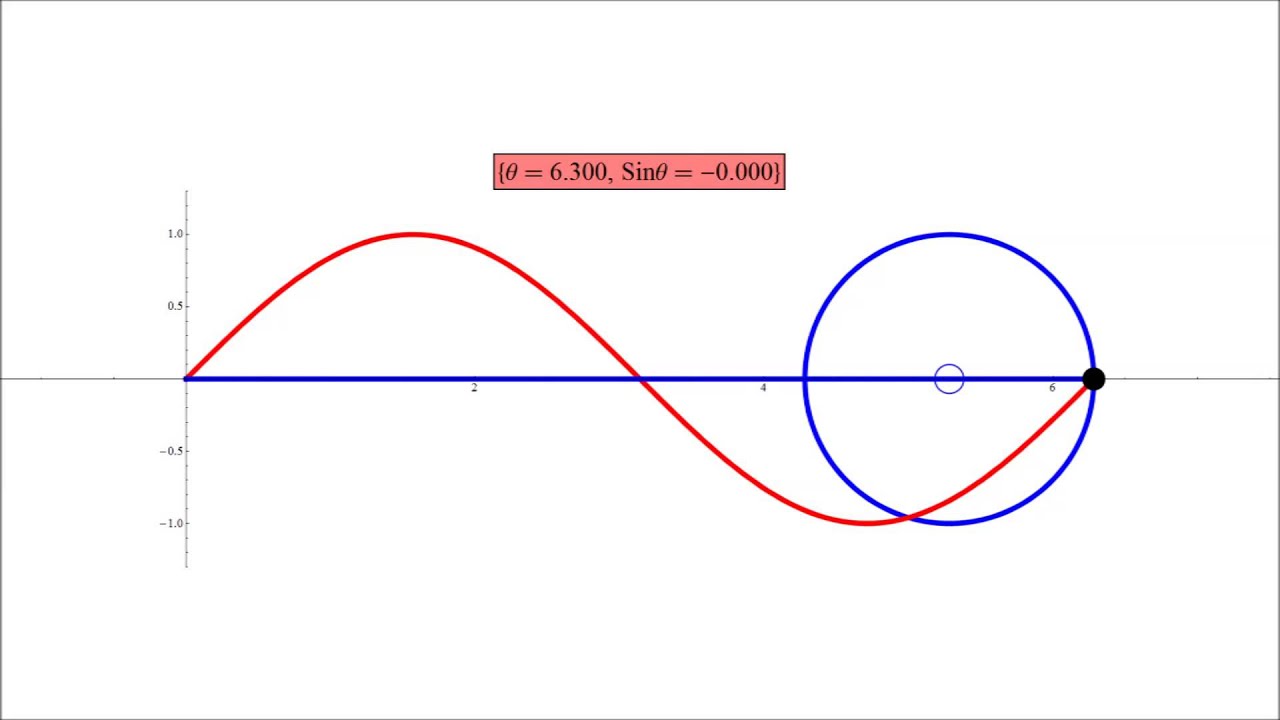
So taking the particle viewpoint - the fundamental U1 symmetry that accounts for the nature of radiation - there is a duality here that explains things. The shortest frequency is also the quantum spin - a rotation with Planck scale.
A limitation to spatial extent - a fundamental smallness - is cashed out in the other direction by a matching largeness of the rotational confinement. Spin starts out with its highest possible value. And so the first sine wave echo to resonate in the Planck-scale cavity is as hot as it gets in being also as curved as it gets. (Spacetime curvature equalling energy density in the general relativity view.)
Once you put the bits and pieces together, you begin to see the pattern of relations that compose the Planck scale. All the aspects of the Cosmos that seem broken apart and unrelated are unified, different ways of looking at the same thing, at the Planck scale.
This has become explicit in the way modern physics has evolved. It is the reason why quantum gravity would count as a final gluing together of the Planckian parts - https://en.wikipedia.org/wiki/CGh_physics -
On the transition from non-life to lifeYou say that any particular triangle, must be one of a number of different types of triangles. Where does the LEM not apply? — Metaphysician Undercover
Of course the LEM applies to any particular triangle. It doesn't apply to the notion of the general triangle.
It doesn't make sense to say that the concept of triangle in general must be a particular type of triangle, — Metaphysician Undercover
Exactly.
It doesn't make sense to attribute a species to the genus, that's a category error, not a failure of the LEM. — Metaphysician Undercover
Yep. The LEM fails to apply. It doesn't even make sense to think it could. It is definitional of generality that it doesn't.
Your claim seems to be that if there is no particular triangle, then this particular triangle the potential triangle, may be both scalene and isosceles. — Metaphysician Undercover
Before a particular triangle has been drawn, it may be scalene or isosceles. That is the potential. And so while still just a potential, it is not contradictory to say this potential triangle is as much one as the other. That is, what it actually will be is right at this moment vague - as defined by the PNC not being applicable and any proposition that pretends otherwise being a logical failure. -
On the transition from non-life to lifeIt's difficult to make sense of what you're trying to say here because you're using words differently from Aristotle it seems to me. — Agustino
Well yes. I must have spent quite a few pages in this thread making it plain that my claim is that prime matter would be an active and not inert principle. Then the prime mover would not be an active principle in the normal sense of effective cause, just "active" in the sense of an emergent limiting constraint on free material action.
There are quite a few difference I would have with a scholastic understanding of Aristotelean metaphysics. That was rather the point.
Matter is inert, it is form which is act, and actualises. So form is imposed on the inert matter (which is potential), and this form would be the fluctuation. But note that form must be independent to and prior to matter. — Agustino
Now you are repeating what I have disputed. And I have provided the rationale for my position. So instead of just citing scholastic aristoteleanism to me, as if that could make a difference, just move on and consider my actual arguments.
Right, so then the mathematical concept of space as infinitely divisible isn't how real space actually is. It's important to see this. — Agustino
It is also important to see that Peirce's mathematical conceptions are based on the duality of generality and vagueness. So you can both have a general continuum limit and also find that it has potential infinity in terms of its divisibility. In fact, you've got to have both.
And funnily enough, real space is like that. Just look at how we have to have the duality of general relativity and quantum mechanics to account for it fully. One describes the global continuity of the constraints, the other, the local infinite potential, the inherent uncertainty that just keeps giving.
Yeah, so reality eliminates all those infinities that are inherent in our mathematical models. Our initial predictions that blackbodies would emit infinite amounts of UV were based on the mistake in our mathematical model of assuming an infinite continuity going all the way down, while the truth is that things are cut off at one point, they become discrete. — Agustino
It amusing that you talk about this as some mathematical mistake.
You are trying to paint yourself as the commonsense engineer that is never going to be fooled by these crazy theoretical types with their dreadful unrealistic mathematical models. And yet an engineer has a metaphysics. He believes in a world of clockwork Newtonian forces. That is the right maths. And on the whole it works because the universe - at the scale at which the engineer operates - is pretty much just "classical". There is no ontic vagueness to speak of.
Of course, the beam will buckle unpredictably. An engineer has to know the practical limits of his classically-inspired mathematical tools. The engineer will say in theory, every micro-cause contributing to the failure of the beam could be modelled by sufficiently complex "non-linear" equations. The issue of coarse graining - the fact that eventually the engineer will insert himself into the modelling as the observer to decide when to just average over the events in each region of space - is brushed off as a necessary heuristic and not an epistemic embarrassment.
Even proof that the model can't be computed in polynomial time won't dent the confidence of "a real engineer". Good enough is close enough. Which is why real world engineering projects fail so regularly.
So forget your engineer's classically-inspired commonsense understanding of maths here. Peirce was after something much deeper, much more metaphysically sophisticated.
Regarding the recursive eq, are you talking about fractal dimensionality? As in log(number copies)/log(scale factor)? — Agustino
Yes. -
The Universe as a Gas Can – Part I: EntropyIf that’s correct, then it would seem to follow that the expansion of space would cease once that figure is reached (the Heat Death is reached) - but I know that the cessation of expansion isn't supposed to happen. This can only mean that the full conversion never happens. — MikeL
This is getting into very tricky to explain areas but we now have evidence of a "dark" energy or positive cosmological constant that is driving the accelerated expansion of the Universe. So that faint extra push in fact ensures a heat death at some future predictable moment in time.
Our corner of the universe is bounded by a still expanding event horizon - what we call the hubble radius that defines the visible universe. So because the universe is expanding spatially, everything towards the edge of our point of view just gets faster and faster until it is effectively going faster than the speed of light. At that point it vanishes from view. It disappears over the horizon of the hubble radius. We can no longer have any interaction with it.
In a universe without an extra dark energy push, a perfectly balanced universe would be coasting to a halt at the end of time. Eventually everything that has been disappearing over the horizon would reappear because the metric expansion would be steadily slowing, running out of steam, and that would give time for even the most distant light to start reaching us again.
But with dark energy, instead the hubble radius/event horizon would still be there. The larger universe would still be super-luminally out of reach for us. However the horizon itself would cease to expand and instead come to a halt at a fixed distance. And that then means the entropy of the visible universe could not physically get any lower. A fixed horizon means as much would entropy would be re-entering as leaving. So the total becomes a final condition.
Think about it as running down an up escalator. At some point, you are running at the same speed as the escalator going the other way and so you just stay in the same place. Despite all the action.
And we can measure where we are in this story using the principle of holographic event horizons.
The existing entropy content of our visible universe is represented by the "container" of an event horizon that has swallowed up 10^122 degrees of freedom. Eventually all the cosmic back ground radiation will add to that, swell the horizon. But only by a surprisingly small amount - a contribution of just 10^88 extra degrees of freedom. That's a round-up error of 34 decimal places.
Even the evaporation of all the super-massive blackholes in our corner of the universe would only add 10^103 degrees of freedom - a clerical adjustment to the 19th decimal place of the total sum.
So we pretty much are at the Heat Death as things stand, even if those super-massive blackholes are going to take about another 10^103 years to fully decay.
Do you know the problem. Is it the wavelength of radiation - can it never become linear and thus disappear back into the initial condition? The exponential curve that never hits zero? Why would it keep expanding do you think? (I don't buy momentum from the Big Bang) — MikeL
The momentum of the Big Bang explains most of the story. The little extra contribution from "dark energy" has become the new mystery. But it could just be a tamed remnant of inflation or the simple product of quantum uncertainty at the vacuum level. There are certainly plausible theories.
The other bit of the new physics is realising that event horizons radiate. That is why the universe would be able to reach some actual final heat death temperature - as the only thing glowing would be the "container" itself. The cosmic event horizon at its fixed position would emit black-body radiation as a normal quantum process. It is just that the photons would be so absolutely cold or stretched that they would have a wavelength the size of the visible universe itself.
Which is what I pointed out about the symmetry between the Big Bang and its Planck scale heat, and the Heat Death, where once again the energy inside the container matches the size of the container in its frequency.
So some new deep connections have been discovered. Even physicists and cosmologists are still trying to figure out a definite meaning for them.
If you are interested, check out Charlie Lineweaver - of your favourite university, ANU. He wrote a good Sci Am piece and has a ton of great papers on his webpage. -
Is 'information' physical?This sounds reasonable, but isn't the surest way to minimize surprise to reduce the information content of your beliefs? — Srap Tasmaner
Hah. Surprisal, or self-information, is one of those more sophisticated measures of information I've been talking about - https://en.m.wikipedia.org/wiki/Surprisal_analysis and https://en.m.wikipedia.org/wiki/Self-information
And the same basic approach underlies the free energy minimising model of the Bayesian brain - https://en.m.wikipedia.org/wiki/Bayesian_approaches_to_brain_function
So the argument is that we attempt to predict our future sensory inputs to minimise our need to actually process anything. And then what we fail to predict is where we retrospectively have to put the further attentional effort in.
So overall, a brain with good habits of prediction will be able to get the most work out of the least effort.
Yes. I see that you are making the sly joke that the way to never be surprised is to in fact just be ignorant. That also works of course - to the degree that it has no real life consequences. -
On the transition from non-life to lifeNote the more subtle point about fractals. As a dichotomous growth process, they directly model this issue of convergence towards a limit that I stressed in earlier posts.
Think about the implications of that for a theory of cosmic origination. It argues that a world that can arise from a symmetry breaking - a going in both its dichotomous directions freely - does in fact have its own natural asymptotic cut off point. The Planck scale Big Bang is not a problem but a prediction. Run a constantly diverging process back in time to recover its initial conditions and you must see it converging at a point at the beginning of time.
This has in fact been argued as a theorem in relation to Linde's fractal spawning multiverse hypothesis. So if inflation happens to be true and our universe is only one of a potential infinity, the maths still says the history of the multiverse must converge at some point at the beginning of time. It is a truly general metaphysical result.
Another way to illustrate this is how we derive the constant of growth itself - e. Run growth backwards and it must converge on some unit 1 process that started doing the growing. Thus what begins things has no actual size. It is always just 1 - the bare potential of whatever fluctuation got things started. So a definite growth constant emerges without needing any starting point more definite than a fleeting one-ness.
So from a variety of mathematical arguments we find that any tale of infinitely diverging processes tells us conversely also the tale of a convergence to some necessary cut-off limit. Run history backwards and we must arrive at a common point. -
On the transition from non-life to lifeSurely it could be a fluctuation I do not care what it is for the purposes of this discussion, but it must be something actual, not an infinite potential, vagueness and the like. — Agustino
As the first fluctuation, it would have as yet no context. History follows the act.
So as I said before, the fluctuation is the birth of both material action and formal direction. But it takes longer for direction to seem firmly established as that requires a history of repetition.
It seems the mistake you keep making is to forget I am arguing for the actualisation of a dichotomy - the birth of matter and form in a first substantial event. You just keep talking about the material half of the equation. -
On the transition from non-life to lifeAha! Exactly. Now we're getting onto something. So the phenomenon is very similar to this. — Agustino
Sure. You get infinite outcomes if your model offers no lower bound cut-off to limit material contributions. So your example illustrates my points quite nicely. Our measurements coarse grain over fractal reality. We are happy to approximate in this fashion. And then even reality itself coarse grains. The possibility of contributions must be definitely truncated at some scale - like the Planck scale - to avoid an ultraviolet catastrophe. Vagueness is required at the base of things to prevent the disaster of infinite actualisation.
Also how much do you understand fractals? Note how they arise from a seed dichotomy, a symmetry breaking or primal fluctuation. That is what the recursive equation with its log/log growth structure represents. -
On the transition from non-life to lifeThere cannot be any primordial chaos, infinite potential, vagueness and the like - some minimal degree of order and act are always required. — Agustino
You mean like a fluctuation?
If there is a fluctuation it seems to me like there is some act already. — Agustino
And a direction too. The degree of order is also minimal, remember.
why would there be any sort of fluctuation in the first place if there is a necessarily inert vagueness in the first place? — Agustino
Why would inertness be necessary? The very fact something exists shows that by necessity it couldn't be.
Of course vagueness doesn't even exist according to your own map of reality. You rely on God to kick things off. Or divine circular motion to swirl things about. Or something equally bizarre. -
On the transition from non-life to lifeI will make an argument once you explain to me how you go from the vagueness in the map to vagueness in the territory. — Agustino
The usual way. Measurement.
For instance, engineers are always telling me that my definite models of reality turn out not to fit the world in vague ways. Quantum wavefunctions still need to be collapsed. Chaos turns out to forget its initial conditions. The way the maps keep failing look to be trying to tell me something deep about the essential spontaneity of the territory. -
Is 'information' physical?I only have to find that my states of belief are reliable in minimising the surprises I encounter in the world.
-
On the transition from non-life to lifeBut I do have an issue if you want to claim that vagueness is ontological, and exists at the level of the terrain, not just of the m — Agustino
Well you would have to make that argument then. So far you have only told me about your own map of the territory. And that turned out to have separated togethernesses. -
Is 'information' physical?Err. Wayfarer had just said Shannon published in the late 1940s. So I was referring to something specifically just mentioned.
apokrisis

Start FollowingSend a Message
- Other sites we like
- Social media
- Terms of Service
- Sign In
- Created with PlushForums
- © 2026 The Philosophy Forum