
Comments
-
PerceptionIn what sense is it "run" by a computer. Messages can be tapped out in morse code on a telegraph wire.
And to the degree that CTM was a stab at a theory of mind, its signal failure was being able to show how symbol manipulation – syntax – ever connected with semantics. The place where messages get understood or at least acted upon in some mindful way.
So it is not that Cartesianism duality works. It is that computationalism steered cognitive science in that extreme direction for a while. A perhaps useful information technology metaphor was turned into the first AI revolution – crushing the more biologically-realistic neural network community for a while. -
Is the real world fair and just?but I also think there are many differences we just don't perceive at all but that nonetheless make a difference to how and what we perceive. — Janus
Erm. What are these and how would we know? -
Does physics describe logic?I don't really have much to say myself at the moment. Just one question, regarding which, where do you think mathematics stands in relation to what you said? — Shawn
Well I sort of said that geometry/topology is where they look to come the closest. Hence why Peirce’s existential graphs and Spencer-Brown’s laws of form are so appealing to some of us. Much less so category theory even it it does actively strive to lay claim to physics. -
PerceptionThat's confusing to me because most theories about cognition are representational, but not Cartesian. — frank
Descartes argued for a separation of hardware and software - a dyadic separation of that kind. And computer science claimed that separability as what technology could then implement and so create AI.
This is a tradition of thought we are talking about. And it led to “global workspace” type models of brain function. There was always this thought the data must be displayed somewhere, and thus also always the homuncular regress this implied. Tactics like eliminativism or supervenience were employed to shut the critics up.
This is a representational system, in fact it involves three different representations, but there's nothing Cartesian about it. See what I mean? — frank
Surely you can see what a bad example that is. When is information actually information in any normal sense? When it is in the post or when it is being written and read? -
Is the real world fair and just?The world is what is the case. — Banno
For whom? And what was their purpose?
Always just half the story. Lumpen realism delivered from an egocentrically fixed view. -
Is the real world fair and just?On the other hand, we can imagine that it is differentiated, that is that it is not amorphous, and the idea that it is differentiated has more explanatory power than the idea that it is amorphous, because if it were amorphous there would be no explanation for how we come to perceive difference. — Janus
I agree with the general point that you are making, but it also has the difficulty that a perceptible world - a perception-enabling world - must come as the dialectical package of cohesion and its incoherences, or differentiations and integrations, its continuities and its discreteness, and so on.
So to see the local thing of some difference, we must also see how it is a difference that makes a difference. And now we get into how we see the globalism or holism that could make a mark meaningful. We seem to see directly the material event - the bruteness of the stone we kick or cup we smash - but not so directly the global organising purpose or finality involved.
It is thus correct to complain about physicalism or even logic that doesn’t make the effort to wrap up both sides of the equation when it comes to the reality that exists in a fashion that does make it rationally perceptible.
That version of physics or logic is idealism promoting in itself. Not deflationary in the fashion it might wish. -
Does physics describe logic?Inductive, abductive, and dialectic "logics" are quite different, and quite contentious. — Banno
Yep. So not at all a dogmatic slumber then. :up: -
PerceptionIt is arguing the same point. Cartesian representationalism is the approach that creates all its own problems. Embodied cognition is saying something different. The question then is how to bottle that as natural philosophy or science.
So when you call Friston “more representationalism”, I would say no, it is different. It has the triadic structure of a semiotic modelling relation.
Sure the mind is a model. But representationalism treats that as meaning a mechanics of “mental display”. To say the mind is instead a modelling relation leads us to the opposite of that. It becomes instead a tale of accumulating “unconscious” habits of action.
You don’t want the nervous system flooding the brain with all this news about the world. Bayesianism is about instead making that news so boringly already predicted that the whole business of “displaying” it can be avoided. The world can be forgotten as quickly as it happens as you have already moved on.
Of course, there must still be the higher level process of attention to mop up the information that couldn’t be automatically assimilated. But that becomes more of the same - still embodied, just over a longer timescale.
We might have to turn our heads, prod with our fingers, shift to one side. We might have to explore to unravel what was unfamiliar or otherwise a momentary source of uncertainty in our world.
But even in half a second, a way to compress the uncertainty and turn it into another forgettable certitude can be achieved by a Bayesian Brain.
So the flip from Cartesian display to the Pragmatic modelling relation is this one. First rule is don’t even display to the degree you can habituate. Then when forced to briefly poke around and figure it out, add that learning to your stock of embodied automaticisms and get back to functioning as “unconsciously” as you can.
What use is awareness after the fact? That is too late. Minds need to be always ahead of the game by doing the Bayesian thing of minimising “surprisal”. -
PerceptionThe one I'm familiar with is a descendant of Heidegger. It's not something a scientist would know what to do with. — frank
Where is yours defined? What theory are you talking about? -
PerceptionIs there an article in Nature about the that? — frank
You mean like this? - https://www.nature.com/articles/nrn2787 -
Does physics describe logic?Logic is just how to talk with some sort of consistency. — Banno
And thus with some sort of differentiation.
So that is indeed the kind of holism that both physics and logic represent. The dialectic of global integration and local differentiation. The universals and their particulars. The laws and their initial conditions. :up: -
PerceptionI would refute by stating that we have agreed to call a specific light frequency as “red” — Mp202020
Just as a data point, colour perception is much more complicated. See colour constancy for a start. What we "see" is the world as we imagine it in a good strong "white" light.
And then what we "see" as red is more about what we have determined to be the contrast of being "not green". See opponent channel processing.
So the step from the physical reality to the cognitive modelling is a slippery one, most especially with colour experience.
That being of course why colour perception becomes the paradigmatic example of folk wanting to argue for an idealist position on phenomenal experience. The science becomes too twisty for the average physicalist to chase them all the way up to that redoubt. The ineffable redness of red seems so detached from the reality that it is meant to represent that cognitive representationalism must be wrong.
Which it is. But cognitive science has moved away from representationalism itself in recent times, thankfully. A more suitably enactive or embodied approach is being taken again. -
Is the real world fair and just?To say that reality is 'irreducibly complex' seems to omit something fundamental to metaphysics, the unconditioned or unmade. — Wayfarer
The triadic structure is now your "unconditioned or unmade". It is the inescapable outcome of anything striving to occur at all.
So rather than starting with some fundamental material, there can only be the vagueness of a "quantum foam" potential. And then that evolves in a natural way by suppressing its own variety to become a well-formed outcome – a state of definite somethingness.
This is reality as encoded by quantum field theory (QFT) as well as Peircean metaphysics or Aristotelean hylomorphism. -
The ethical issue: Does it scale?Could they scale economically and technologically without that resistance? Could they close those gaps in food production factors you identified previously? — T Clark
Imagine your community if there were no Kentucky Fried outlets or supermarkets selling industrial food. And people just had to start digging up their suburban back gardens and running a few sheep in the nearest park or football grounds.
This wouldn't be impossible with the right knowledge and social licence. Just as your friends and neighbours would all be riding around on solar powered electrical bicycles.
It is a stretch to say that a planet of 10 billion could support itself like this. I think the estimates are more about a billion as, especially with climate change, too many people live in the wrong places.
Phoenix is the fastest-growing US city isn't it? But not going to be liveable without its air-conditioning. Or once other states start asserting their rights to the water extraction that grows all those pecans and pistachios.
So what is theoretically doable is different from what is pragmatically doable. As communities close in on themselves, this re-localisation of food production is going to create a lot more losers than winners across the world.
What I'm saying is that permaculture and regenerative agriculture are the eco-smart answers that you would want to know about now that the tech-smart promises don't look like scaling in the way that would save our current globalising world-system demands.
There's a lot of talk these days about the gap between the very rich and the rest of us. Worker's pay hasn't really risen since the 1970s while the richest gather a larger and larger percentage of the wealth. How much of that has to do with globalization? To what extent does globalization lead to improvement in the standard of living for people in Asia, Africa, and South American at the expense of those in North America and Europe? If the only path to a new golden age is the dilution of the western way of life by spreading it around to the rest of the world, what realistic political strategy will lead us in that direction? — T Clark
You have to understand wealth in the context of powerlaw growth. The "fat tail" story. We naturally want to apply a Gaussian bell curve to wealth distribution – everyone bunched in the middle. But a powerlaw is a flat line with no mean. The distribution tends towards what we have been seeing. Most people down at the minimum wage end of the spectrum and a handful ending up owning the larger chunk of everything.
This isn't an inequality story in the sense of unbalanced growth. It is just the statistics of any powerlaw growth. It is the fair outcome of a growth based system. The Matthew Effect.
Political solutions of course can be applied to this reality. That is why social security was needed in the past – to stop the impoverished mob from storming the parliament. Just enough can be allowed to trickle down to put some kind of minimum wage under the whole deal.
Those who understand this wealth dynamic as a scaling issue have been championing a Universal Basic Income for this reason. But that is predicated on Big Tech creating so much efficiency that the world economic system is more at risk of crashing from deflation.
Big Tech is patting itself on the back that it will make all goods and services so cheap across the whole globe that it is imperative to start pushing money into the hands of consumers so as to keep the historical growth trajectory going. -
Does physics describe logic?Do you mean how does causality as imagined by physics relate to causality as imagined by logic? Do they share the same root or are they antithetic?
Is it perhaps like the difference (and connection) between the truths of algebra and geometry? We inquire after entailment as a formal relation. And there is the physical view that is essentially geometric – as spacetime rather matters – or the algebraic view where even geometry can apparently be reduced beyond spacetime ... but then that little tussle re-emerges again when we move up the next level of abstraction, as in topological order?
So when it comes to this tricky relation between physics and logic, I am arguing that a model of causality is the ultimate target. And in reducing reality to causality, one could go "too far" in the reductionism. Spacetime and its material content as a geometry of relations become too much to sacrifice in the attempt to continue on towards the atomistic abstractions of Boolean logic.
Mechanics can only be taken so far before it becomes an unphysical nonsense? -
Is the real world fair and just?The question I want to ask is the sense in which gestalts are irreducible. — Wayfarer
In being holistic, they would be irreducible to atomic events, but perfectly reducible to semiotic structures – the triadic structure of a hierarchical order.
Semiotic logic says reality has irreducible complexity. You can't get simpler than – as Gestalt theory puts it – the relational view that is a figure and its ground. The hierarchical thing of the local mark within its global frame. Each holistically needs the "other" for anything to definitely be. And what exists to be talked about is that there is not just a difference, but a difference that makes a difference as it is a mark made in a way that has its answering interpretive context.
So holisism reduces, just as atomism reduces. But one finds its irreducible foundations at the level of a system of relations, the other at the level of naked actions in voids.
(And a holist will point out that "actions in voids" is still really a dialectical metaphysics. Atomism just likes to brush over this uncomfortable fact.)
And isn’t the so-called ‘wave function collapse’ exactly analogous to the forming of a gestalt where there was previously only an array of probabilities? — Wayfarer
The "collapse" is reductionism jumping to its atomistic conclusion. The wavefunction is an encoding of how a quantum system has the holism of its relational context.
So a gestalt as a brain process does jump to find its atomistic events by equally abruptly turning everything around the event into the discarded information that becomes the "void" which makes the event now stand out in high contrast fashion.
You can actually measure this with electrodes taped to the skull. When a subject suddenly spots a target – in "Where's Wally" fashion – there is a characteristic P300 wave of activity. The brain attends by suddenly suppressing all the background buzz and so zeroing in on Wally where he has been hiding among to crowd. This takes about 300 milliseconds. One instant, you experience a confused sea of faces, the next you are exactly sure there is that bobble hat, specs and striped jumper just behind some random figure.
It must surely be something like that for Wheeler’s diagram, as it was presented in the context of his discussion of his baffling ‘delayed choice’ experiment. — Wayfarer
Delayed choice says that at the quantum level, entanglement is across time as well as space. As you would expect from spacetime. So emergence must rule. In some physical sense, everything is connected in a global contextual fashion that stands "outside" our classically imagined spacetime.
But then, the Cosmos can have its P300 contrast sharpening event and Wally pops out as a collapse of the wavefunction. A particle appears "right here" in terms of some mechanical recording device having its logic state flipped. The particle could have been anywhere – within the context of the bounds imposed by the constraints of relativistic spacetime. But all those other possible places become now concretely suppressed by the fact that energy got dissipate in precisely this one localised event.
Signal is created by noise being discarded. In Gestalt terms, the squiggled R stands out on the blank page as clearly being the mark that matters and requiring our full attention. Wally is plain and present. But what quantum theory says – as does semiotics – is that the making of the blank page is just as much what just happened as the sudden appearance of this distinctive mark. Voids can't be taken for granted. They appear along with the particles that are being manifested.
At the quantum level, the wavefunction greatly narrows the space of possibilities. It already adds enough constraints to roughly define the outcomes in terms of their probabilities. We are already looking for Wally either going through one slit or both slits, depending on how we choose to add our finishing touch in terms of an act of measurement – a final thermal forcing of the situation that completely constrains things.
But then as I just said, preparing a system to the level it is now counterfactually poised between two equally possible outcomes is already a fairly decohered state of reality. Electrons fired at diffraction grating in a laboratory is hardly the same as even trying to find an electron-like action in the Planckscale fireball of the Big Bang.
We exist at a scale where the Big Bang has become almost its Heat Death void. The blank sheet of paper of the atomistic imagination has become pretty much the case as something that is "just there" and being scribbled all over by the marks of atomic events. The void is no longer hot enough to add the uncertainty that would make it hard to tell electrons and protons apart from the spacetime they exist in.
Wheeler's diagram of course is still just making an epistemic point. But given you want to connect to the ontology of quantum theory, this is how that same "holistic gestalt logic" applies to existence as a story of Big Bang decoherence. The emergence of a blank page and its marks from a hot roil of unbounded possibilities where neither could as yet counterfactually exist. -
Limitations of the human mindmagine that we manage to put two fundamental particles in an isolated system we know everything about, and that we're sure nothing else influences the system, would it be possible that we still could not predict their behavior? We would have all the data we need, but it just wouldn't make sense to us, it would appear random. — Skalidris
The basic wrong assumption here is that knowledge is information accumulation rather than information discard. The world is complex. And so the mind seeks to simplify.
That is how science works. It extracts the measurement minimising laws of nature. General equations that can make good enough predictions employing the fewest data points.
One must always make some measurement. But the world is a noisy place. The art is discarding as much of that noise as possible so as to be only left with a high quality signal.
We turn it into an act of us listening for a message to be whispered in our ears. Of all the things going on in some real world system, what is the word we've been waiting for that tells us everything we need to know.
Minds are founded on habits. The ability to act in complex functional ways having reduced our perceived environment to some triggering event. We learn to ignore everything about the world except what tells us what we immediately ought to be doing. A light turns green and so we go.
To me, that scenario is possible because our mind is limited by its building blocks. For example, logic connectors like "and" cannot be broken down into something else. — Skalidris
Logic is a good example of how minds abstract in this fashion. We reduce what we need to know by discounting all else that might lie in-between. Reality becomes for us some atomistic set of switches. If/then causal events. The power of logic is in how much that is vague, ambiguous, too detailed, too broad, too uncertain, too unstable, too irrelevant, too random, etc, etc, is simply ruled out in axiomatic fashion.
And that extreme idealism can also become its defect if you believe in inquiring more deeply into the "reality" of nature – a view a little less dominated by the manic efficiency of the information-discarding and response-automating logical mindset. -
Is the real world fair and just?Why are you trying to put-down this "new law" with nit-picky irrelevant comments? — Gnomon
Degree of function, Ex, is a quantitative measure of a configuration’s ability to perform the function x. In an enzyme, for example, Ex might be defined as the increase in a specific reaction rate that is achieved by the enzyme, whereas for a fluid flowing over a granular medium such as sand, where some form of periodic dune structure emerges, we could define Ex as the minimum perturbation strength required to disrupt the dune structure.
For a given set of parameters, the most persistent dune structure should be that which resists the largest range of perturbations (90, 91). The units of Ex depend on the character of the function under consideration: The catalytic efficiency of an enzyme might be measured as a decrease in activation energy, for example, whereas the function of patterned sand might be to be maximally stable to external flow perturbations (28).
https://www.pnas.org/doi/10.1073/pnas.2310223120#:~:text=Accordingly%252C%2520we%2520propose%2520a%2520%E2%80%9Claw,for%2520one%2520or%2520more%2520functions.
Sure one can equate gene regulated metabolic networks to wind sculpted sand dunes in broad dissipative structure language and then apply Szostak’s notion of functional information to both. But one system actually does have a memory in the semiotic sense, the other doesn’t.
So this becomes another overheated exercise in the Santa Fe tradition where self organising dynamics or topological order are meant to explain everything, and yet they can’t actually explain the key thing of how a molecule becomes a message and so how life and mind arise within the merely physical world.
For astrobiology perhaps especially, this is an amateur hour mistake. -
Is the real world fair and just?Was everything in superposition back then? — boundless
Nope. Enzymes are large mechanical structures. Decohered and classical for all intents and purposes. But they can dip their toe into the quantum realm, exploiting tunneling to jump chemical thresholds.
I posted this general story here - https://thephilosophyforum.com/discussion/comment/679203
*I actually think that we tend to do that also in classical physics. — boundless
I make this same point all the time. :up: -
Is the real world fair and just?Back to abstruse verbosity. — Banno
More spit from you as expected. You asked, I answered, you fled. :kiss: -
Is the real world fair and just?Struth. Just read my thread on is/ought ethics as an exercise in applied systems science.
Local-global bound the thirdness that is their hierarchically-ordered connection. A powerlaw or scalefree network is the mathematical model that describe its equilibrium growth. The balance that is a log/log statistical distribution.
So as an ideal, that is how we find societies organised as scalefree networks of interest. The world looks the same in its human essentials whether you’re in your own home, living in a village, living in a nation, or forced to share the one planet in some orderly fashion.
A fractal world where competition and cooperation, lumping and splitting, integration and differentiation, etc, are present in the same way over all practical scales. If justice is a good, it is being implemented in ways suitably scaled from the toddler to the tantrumming president or nation.
And if anything will do, then nothing has been achieved. — Banno
Take your metabolism as exactly the same kind of dynamic, and one close to your heart.
Your body must have some ability to self-organise to be a body. If it metabolises, it needs a hierarchy that achieves an effective balance across all its scales of integration, from the solitary mitochondria to the whole person. And natural logic says that a sharp dichotomy is the route to allowing this systemic level of regulation. The metabolism must become metabolically switchable - to be crisply counterfactual in terms of its immediate aims - so as to be able to strike then a general balance of any useful kind at all.
And we see this dialectic built into the body’s structure over all its levels. Insulin to signal anabolism, glucagon to signal catabolism. Sympathetic nervous system to turn the knob down, parasympathetic NS to turn it back up.
The whole of biology, and neurology, becomes about understanding the organism in terms of its thermodynamically rooted dichotomies.
If you haven’t realised this about reality yet, you really have missed its essence. You’ve been aboard the wrong logic train. -
Is the real world fair and just?My critique is that dialectic approaches do not fix the nature of the synthesis. So given any thesis and antithesis, any of a number of syntheses are possible. — Banno
Again, this could not be more wrong. Dialectical argument is no use unless it achieves the rigour of a dichotomy – that which arrives at where it is going by showing itself to be "mutually exclusive and jointly exhaustive."
A dichotomous distinction – such as local and global – has to show itself to frame the opposing limits of a reciprocal or inverse relation. How do you define local? As 1/global. How do you define global? As 1/local.
The point is that neither local nor global can exist alone as absolutes – as generalities or unversalities. But they can exist together as opposing limits that then encompass the third thing of the action which is a moving towards one pole that is thus a complementary moving away from the other.
This is your mischaracterised "synthesis" step. Thirdness is where a dichotomy itself has become so generalised as the limits of a system that all the middleground is now a place of concretely-specified possibility.
The world that classical logic merely presumes to exist now in fact emerges due to a self-organising dialectical process of growth.
I've told you this innumerable times. One day I'm sure the penny will drop and you'll be able to happily exclaim: "See, you agreed with me all along!"
No more indigestion as lunchtime lasgna approaches. :ok: -
The ethical issue: Does it scale?I don't see how you can say that growth doesn't have to end, then go on to list the restrictions which will necessitate an end to growth. — Metaphysician Undercover
But I am accepting your distinction that there is internal growth and external growth in some useful sense. And one may be prioritised at the expense of the other. That seems the start of an ethical-strength algorithm.
You want "endless" growth. Well what if we stop a minute to let you define that as some sustainable balance over a long enough term. Let's hear what you really want out of "a life".
We all know that our current political settings are unbalanced. Unlimited junk food today in exchange for unlimited health costs tomorrow. Unlimited working hours today in exchange for the eternal death bed lament of "I wish I spent more time with family and friends, especially the kids."
So if everyone wants to vote for a life of high-entropy consumption, the answer has to be, well wait just a bit until green tech catches up with a world in drastic demographic decline.
Or if instead this is the moment to rewrite the script – in a way that is rationally believable – then let's see what that looks like as a social balancing act. Pragmatically it might mean 90% more time with the family, as you all dig the homestead dirt, and 90% less time consuming stuff so that wealth no longer has that demand side plughole to flush the global ecology down.
Maybe we have your catchy slogan right here: "time to start living off the solar flux". What is the solar flux? — Metaphysician Undercover
Your daily dose of sunshine. The energy that spins the wheels of the thin slick of protoplasm that constitutes the Earth's biosphere. -
Is the real world fair and just?Hegel's logic has generally been dealt with in a category theoretic framework — Count Timothy von Icarus
Thanks for the reminder! I had quite forgotten that Lawvere had found Peirce’s antithesis between generality and vagueness to be a full categorical adjunction between the universal and existential quantifiers.
See Zelamea's Peirce’s Logic of Continuity. P41.
Or as he quotes Peirce on this move from the merely dyadic to the properly triadic:
Looking upon the course of logic as a whole we see that it proceeds from the question to the answer -- from the vague to the definite. And so likewise all the evolution we know of proceeds from the vague to the definite. The indeterminate future becomes the irrevocable past. In Spencer's phrase the undifferentiated differentiates itself. The homogeneous puts on heterogeneity. However it may be in special cases, then, we must suppose that as a rule the continuum has been derived from a more general continuum, a continuum of higher generality.
Digging out the paper, I see Zelamea offers no proper source for this.
But generally speaking, being jogged on the connection is useful. Quantum field theory – as our current nearest candidate to a theory of everything – does set up this tantalising dialectic of free material potential and its necessary emergent topological constraints.
This is an emergent and holistic systems metaphysics. A particle exist in some substantial way as a topological constraint on an excitable field. Reality is hylomorphic. Ontic structuralism is its metaphysics. And our epistemic task is to reduce that to some mathematical model.
Dip into Peirce and you can see where he arrived as his own view of what this looked like and it was his existential graphs. Logic as topological order to be imposed on the vagueness of mere possibility.
And Lawvere on category theory as the follow on to topos theory. I can now see this in the same terms as again a bid to split the world into this dialectic of global topological order – in the thermodynamic sense now entering maths – and the vagueness or firstness of a simple tychic potential. An everythingness that – in its own "sum over histories" contradictions – must organise itself dissipatively and so arrive at some kind of global balance of tensions. An emergent topological order.
Zalamea writes on this in a more recent paper which I need to read – Peirce’s Inversions of the Topological and the Logical.
But really for my current purposes, it is the fact that QFT encodes exactly this relation that matters. The dots are joined by the way gauge symmetry constrains particle physics, and even Poincare invariance constrains relativity, in an ontic structuralist fashion. Topological order is what shapes a world into being out of the vague potential that is what, for want of more precise terms, call the quantum foam. An everythingness that includes spacetime along with its supposed content. -
Is the real world fair and just?I’ve learned, and not all of the scholars in that field are as committed to physicalist principles. — Wayfarer
There you go. Sniffing after the idealist faction and so being able to set it against some realist counter-faction.
Finding the political divides as a distraction from the metaphysical meat. The bit that is the difficult chewing. -
The ethical issue: Does it scale?So we can assign priority to doing what is morally good instead, as a goal which begins where growth ends. — Metaphysician Undercover
But ecologically growth doesn’t have to end. The limits to growth are limits in terms of certain unchecked exponentials. Population. Atmospheric carbon. Ecosystem destruction.
Population is enough connected to everyday life that it has been self-correcting. The problem there is we still must add a few billion, and yet we are slowing reproductive rates so fast that a grey unbalance is it own new exponential problem. A coming glut of centenarians to worry about. A double whammy from having to adjust numbers too fast.
Also it is arguable that given time we could run civilisation much as we know it off the solar flux and a big investment in sensible green tech.
And while we were at, reinvent the world of work and community in ways more to our liking.
So somewhere between how we want to live and what a planet can sustain can be a political setting we seek to optimise. But can that be captured as a snappy slogan or ethical algorithm? That is where the work starts. That would be connecting the is and the ought in some meaningful dialectical way. -
Is the real world fair and just?
I might be insulted if this wasn’t confirming my point.You're an odd fish. — Banno -
Is the real world fair and just?Between the iron posts and the paper maché, you mean? — Wayfarer
What was the Newtonian dream? A single act of measurement - the initial conditions of a logically determined system - would tell its story for all time. Indeed backwards or forwards in time with equal ease.
But then even that encountered the three body problem, the Galilean relativity problem, the spinning bucket problem, etc. The holism missing from the reductionism.
So the reductionist can’t live without the holist to complete their schemes. But the counter logic of the holist is actually intellectually challenging. As a debate, the energy gets diverted into the trivialities of idealism vs realism or other mock-tournaments of metaphysical yore.
Holism means that epistemology and ontology can be divided, and yet they must also remain connected. There must be the two-way interface of the epistemic cut. An Umwelt. A point at which the informational models can do real work in their worlds in a way that is transparent and undeniable in its causal plausibility. That is, in the testable theories of biosemiosis.
In quantum theory, Copenhagen interpretation made the right kind of dialectical start. Decoherence brought in thermodynamics, but not the epistemic cut needed to stop the kind of classical logic splurge banjo is talking about in the way it seemed to entail a Many Worlds interpretation.
I have outlined many times how biosemiosis now adds the epistemic cut to the business of quantum interpretation. As a mechanism, a modelling relation, even our enzymes and respiratory chains are actually doing that - preparing states of coherence with the intention of collapsing them and so ratcheting the entropy flows of a Cosmos guided by the telos of the newly NASA-rediscovered concept of dissipative structure.
But as I agree, none of this is intellectually easy. So much always to be learnt! -
Is the real world fair and just?You fool no-one but yourself with those kinds of comments. Your butt is stinging. :wink:
-
Is the real world fair and just?This latter is shown explicitly in classical logic by the explosion ρ^~ρ⊃ψ, that from a contradiction anything follows. — Banno
Still sticking it to a strawman? Actually read Hegel why don't you.
Here for example an account....
While it is true that Hegel’s speculative philosophy is a systematic unfolding, it is an error to suppose that the Hegelian system operates as a smooth, progressive development, mechanically moving forward in a unidirectional manner.
The Science of Logic is not a simple movement where one term encounters its antithesis and sublates itself. On the contrary, causality engenders a reciprocal action, and is what Hegel calls a double transition or a double movement (gedopplete Bewegung), where the cause determines the effect, and the effect determines the cause.
Sublation is composed of “two factors conditioned by negativity, these being the two modalities of suppression and preservation…both together forming the energy of the negative.”8 It is precisely this energy of the negative that gives Hegel’s negation of negation its power and force. Sublation determines what it sublates. When something is absolutely negated, it isn’t entirely cancelled out, there is a minimal remainder and it is this preservation that transforms the sublated term into something decidedly new.
And so on with of course increasingly less clarity in the attempt to pursue Hegel's essentially right ideas into their ever deeper thickets of prose. Thank goodness an actual logician like Peirce came along to sort things out.
But the point is that even Hegel, obscure that he is, wasn't arguing the kind of caricature of dialectical logic that you accuse him of.
While classical logic might well implode as it does with the Liar's paradox and anything else requiring a more holistic metaphysics, this is why Peirce sought to secure the force of the PNC as the way out of vagueness, not as the door to it.
From a vague potential, anything could possibly follow it might seem. But no in fact. Only dialectical division becomes possible as the self-organising, self-balancing, way to split possibility towards its mutually-opposed limits of being. Reality can be made safe for the counterfactuality of the laws of thought. The Cosmos can be understood by the light of natural reason. The PNC pragmatically works because the dialectic gets us there by locking in bivalence and allowing us to proceed to the third step of Peirce's logical holism. The place where even the general or universal becomes the real and so allows the LEM to pragmatically apply as a logical tool when talking about the particular or contextual.
...and of course, you were always saying this... — Banno
Just as you were always agreeing I guess. :chin: -
Is the real world fair and just?Just as I said. — Wayfarer
But perhaps not clearly? There is still this tendency to slide from an epistemic to ontic position in your choice of words. I add the scare quotes to try to maintain this distinction.
And it all matters. We might be just modellers of the world, but we also do attempt to then remake that world in our own image – a point crucial to my take on the OP. The aim of consciousness is to construct the reality of our dreams. :grin:
So that divides the world into the part that resists our desires and the part which we have made materially conform.
Again the kitchen utensils and household furniture issue, the lumpen realist's examples of choice. The things we make that wouldn't otherwise exist. The unanalysed position where human intention and natural order are conflated in a caricature of metaphysical inquiry.
"Behold! A realm of medium sized dry goods. Chairs, pens, tables, forks, doors, fridges. Puppies that shouldn't be kicked but stones that you freely can."
Nothing of value comes from this kind of cherry-picking where only material objects with the imprint of human intentions are taken as the canonical examples of how reality as a whole operates. It is either intellectually dishonest or puzzlingly ignorant.
Which is why I have stressed that is/ought thinking can't be supported by such arguments. If we have already stamped material reality with our heavy imprint of form then we can't treat that as nature in itself. It is nature as now mediated by a semiotic modelling relation. And attention has to turn to the physical reality of how that works. Enter at this point, a modern sophisticated understanding of the Second Law of Thermodynamics – recently rediscovered by NASA astrobiologists apparently. -
Is the real world fair and just?nstead, I view the area between the red & blue curves in the Entropy graph as Negentropy — Gnomon
But what else did Layzer label it in calling it "negative entropy/possible information".
Negentropy was the term Schrödinger popularised back in the 1940s with his What is Life?.
Did your astrobiologists remember that classic as they restated what has been well known among those who study these things for so many years. -
Is the real world fair and just?No need for the scare quotes around understanding. Which pretty well illustrates the point of the ‘mind-created world’. — Wayfarer
Not so quick. An understanding is an Umwelt. It is the manufacturing, or co-dependent arising, of the subjective and the object, the self and its world, as the one cohesive dialectic.
There is no ontological self that is the seat of consciousness. That is as much a useful epistemic construct as the world in which this self sees itself living within. -
The ethical issue: Does it scale?I guess we could all be subsistence farmers. — T Clark
I would say "all" is an over-estimate. And here is where we would need to contrast the tech green promises vs the harsh ecological realities.
A few years ago, the agricultural idea that was believed to scale was "vertical farming". Converting city warehousing into racks of food growing under efficient LED lights and sensor-based watering and fertilising. A hyperlocal solution for urban communities.
But then reality bit. The staff to run these grow houses had to be paid double your immigrant farm worker. Disease ran rife as it doesn't respect the sterile rules of an artificial environment that lacks natural biodiversity.
Meanwhile other more ecologically-savvy agricultural practices – permaculture and regenerative farming – haven't scaled as they too directly challenge the Big Business status quo. But as things crash, they represent the knowledge that would allow the fortunate survivors to begin over from a more sophisticated level. More mouths could be fed in a more sustainable way.
In the 1970s, we were told that over-population would destroy the world. Now we're told that one of the biggest problems will be not enough workers. — T Clark
Both things can be true. All the young might be in Africa. But all starving. And all the old might be in clapped out Europe and Asia, and also starving.
This seems odd to me, given how much of the world sees the US as an unwelcome influence. Do we still think that US lead globalization is the solution we're looking for, or even a good thing in and of itself? Is globalization the scalable solution? I guess in some sense it has to be. One-world government? Continuing the de-Balkanization of the past 150 years. 500 years. 2,500 years. — T Clark
This is the issue. What ought the goal be? The Enlightenment seemed so right in humanistic principle, but became a victim of its own success. It gained the monopoly position in a world that had been socially diverse. An ethical monoculture was successfully produced with the US taking over from the UK as its self-interested standard bearer.
The 1992 Kyoto Protocol marked some kind of high point on this humanist project, and then that got overtaken by neo-liberal exhuberance – the financialisation of everything. The house was wrecked by the teenagers throwing a block party. The GFC saw Big Money bailed out and the resulting debts serviced by poor. Folk had a look around at where things were at and could predict a coming long stagnation and deglobalisation.
And we're going to run out of fossil fuels while we keep on finding and developing more. — T Clark
And then this. The US choose to continue growth at all costs. It had only propped up world trade and Middle East oil deliveries to get the world out of its cycles of European and Asian wars. US was its own well-resourced and well-populated continental market. It did not need world trade itself. It is uniquely blessed in its geostrategic position.
So if globalisation was collapsing, let it. The US began its post-GFC move towards a retreat behind its own walls. Funny money could fund the shale fracking and oil sands revolutions – so long at the environmental consequences could be kept out of the economic calculus. The US caught everyone out by becoming oil self-sufficient again and so really having no need to protect the world's shipping lanes anymore.
Shift the factories back from China and again a win-win for the US. Domestic jobs bonanza and China left to disappear down its own plughole.
A really big game is being played by the US that no-one ever seems to talk about openly. Under Trump, Biden and whoever is allowed to follow them. The idea is that is scaling is it is time to bunker down as a nation. Canada comes along for its resources, Mexico for its cheap labour. Japan, Taiwan and Korea get to pay to stay in the club. The UK and Australia are useful to a point.
Elon Musk and a relatively few entrepreneurs have changed everything. They took a bet on finding a way to make good environmental sense also make good economic sense. — T Clark
Please don't fall for this horseshit. The Tesla was the final nail in the coffin for any Green hope.
Right at the point where tech seemed to be delivering some kind of liveable future – electric bicycles and rideshare apps – we get Musk and his bloated dreams of how the future ought be. More cars. But now even faster on the acceleration and more toxic in their lithium mining and full lifecycle economics.
Doesn't apokrisis's scaling require central planning? — T Clark
No. Scaling is premised on the opposite. If an idea is "so good" then it will grow organically. It will self-organise its world.
But central planning does have to become some sort of guiding function that emerges as part of the deal.
The evolution of a body requires a devolution of its functions into a set of organs. A department of transport, of sanitation, of energy, of decision making. As things scale, they need to get hierarchically complex.
Planning is generally a good idea in life. And a good idea is what you want your society to be implementing over all its scales. The selling point of liberal democracy was that planning was going to one of those activities taking place over all levels – just as the nervous system might have a brain, but also reaches into every corner to allow all parts to contribute to "the plan". Even the gut turns out to be majorly connected to the brain in two-way relation. -
The ethical issue: Does it scale?It may be time to look at change of place as a primary goal over change of form. — Metaphysician Undercover
You mean you would sign up for Elon's death trip to Mars? Or do you expect warp drive to exist in 20 years? :smile: -
Is the real world fair and just?Refresh my memory. What have you been telling me? — Gnomon
As I say, I am officially baffled about how you deal with information.
For example I made this comment in a post last year.
Without understanding it, Gnomon in fact posted this graph of the creation of the negentropic gap from David Layzer, the cosmologist who saw this back in the 1960s.
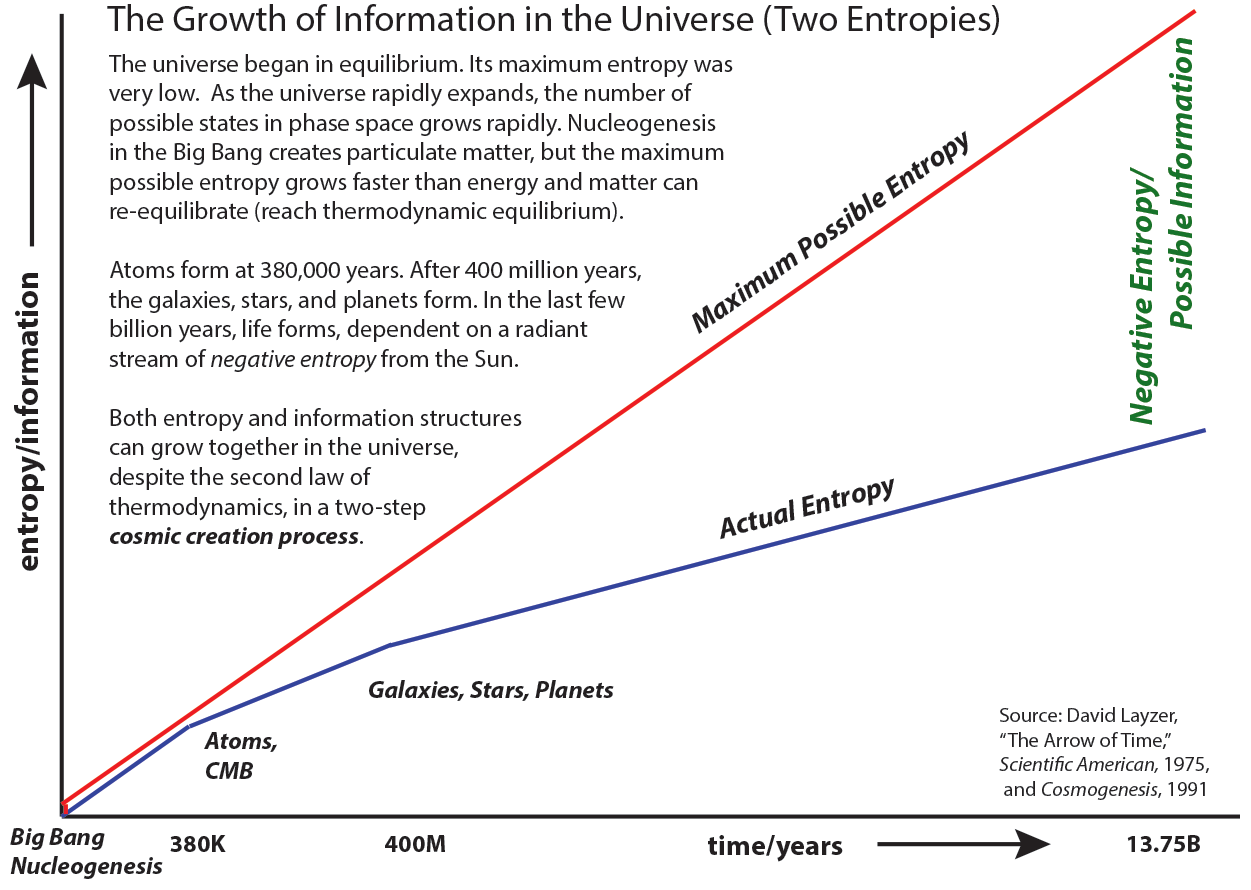
-
Is the real world fair and just?What do you think the point of that simile is? — Wayfarer
The point is epistemic. And it reflects the semiotic fact that the mind must reduce reality to a system of signs. The world is a blooming, buzzing confusion of noise and we must distil that down to some orderly arrangement of information. A set of counterfactuals that impose a dialectical crispness on the vagueness of our experience.
So in Gestalt fashion, we turn sensory confusion into perceived order by homing in on critical features that would distinguish and R from an E or a K. We have to be sensitive to the fact that Rs have this loop that Es leave open. This becomes a rule of interpretation for when we start having to deal with a real world of messy handwriting and wild fonts. We have to see information that was meant to be there according to the rules and so ignore the variation that is also in some actual scribble or fancifully elaborate font.
Our interpretative experience of even the alphabet, let alone the world, has this epistemic character. We must divide the confusion dialectically into global formal necessity and local material accident. That is then how we can “decode” reality. That is how we can construct an “understanding”. -
Is the real world fair and just?We infer others are conscious because I am conscious and other people seem to be like me and do roughly similar things under similar circumstances. — bert1
So for some reason it is OK for you to use commonsense to make inferences about things you can’t directly know, but science as a formal method for making such inferences does not enjoy the same privilege? It is defeated by the zombies in which you don’t believe? Curious.
So what does your commonsense tell you about the consciousness of the chair you are sat on? Given the zombie argument that is so legit, how can you know it is either conscious or not conscious. It might be just keeping very quiet and still. It might be aware but suffering locked in syndrome.
Your commonsense is this magical power that transcends mere scientific inference. Please clear up these deep riddles of Nature. -
Is the real world fair and just?It points out that the pioneers were deep thinkers - cultured Europeans who understood philosophy. — Wayfarer
More than that I would say. I would point to how the logic of the Yin-Yang, co-dependent arising, Aristotelean hylomorphism, Hegelianism, Naturphilosphie, and all the other traditions of dialectical thought made the discovery of the quantum even possible.
Classical logic would seem to forbid one thinking in this fashion. It propels us towards a lumpen realism - a metaphysics of medium sized dry goods. Kitchenware and the like. The least critical mindset.
But a perspective widened by a relational view, a process view, a dialectical view, was necessary for science to make its great leap to discover quantum mechanics. It made the results observed thinkable.
What, you say particle mechanics and wave mechanics both seem to apply? Well as complementary descriptions - a local view vs a global view - maybe that should be no surprise.
apokrisis

Start FollowingSend a Message
- Other sites we like
- Social media
- Terms of Service
- Sign In
- Created with PlushForums
- © 2026 The Philosophy Forum