
Comments
-
Unconditional love does not exist; so why is it so popular?We are enabled with authenticity or genuine love when we experience giving love to another without any return (conditions),... — TimeLine
Singling out an object of love is basically defining a set of conditions. Our feeling may not depend on the object of our affection giving anything in return, but the feeling nevertheless depends on the object remaining true to our limited conception. If it didn't that would only suggest that we're in love with the conception rather than anything in the real world. The feeling also depends on our conception and values remaining relatively constant.
To me, it would make more sense to say that unconditional love has no object or focus, and would be a spiritual sense. -
Do emotions influence my decision makingOf course, indeed simply how hungry we are effects our decision making.
-
Artificial intelligence...a layman's approach.
I noticed that report but as it concerns spending on cancer medications rather than cancer research I kept looking. Not that pharmaceutical companies don't invest in developing new drug treatments. -
Artificial intelligence...a layman's approach.
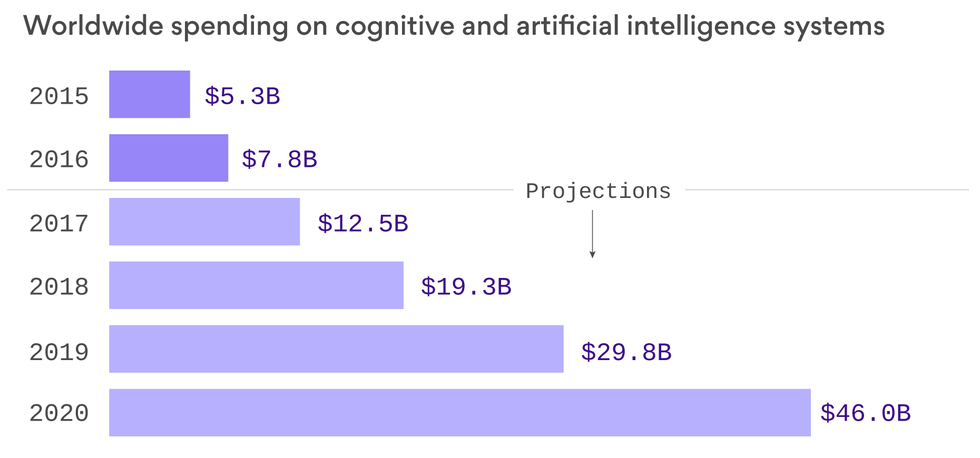
Well, to try putting 12 billion into perspective, Washington funded $4.8 billion in cancer research in the 2013 fiscal year. I couldn't find global numbers. -
Artificial intelligence...a layman's approach.I appreciate that scientists have to make a living, and dreaming up stories that people eat up (like all science fiction writers must do) but I'm really not into it. — Rich
You don't appear to know much about the current theories in AI research, but why would you if it doesn't interest you. Hopefully you don't make a habit of summarily dismissing things that don't interest you or you're ignorant of.
FYI, many AI researchers believe AGI will be archived within a couple of decades. Others believe it will take centuries. Some believe it's not possible. -
Artificial intelligence...a layman's approach.
I'm not playing. Given that, due to humans, we're in the midst of the sixth global extinction event, perhaps life on earth would do much better living with an artificial intelligence that we help create. It could be seen as a continuation of human life. So in this way, it's not a fascination with machines or dehumanization but an evolution of our species. It doesn't look like we have the capability to change ourselves in the time we have left, or at least before things get really ugly. -
Artificial intelligence...a layman's approach.And where does this belief originate from. — Rich
Experience. A microbe, mosquito, or a tree has never tried to give me a hug. Maybe I'm too standoffish? Anyway, I'm not opposed to granting the illustrious title of "life" to an artificial intelligence of some kind. -
Artificial intelligence...a layman's approach.However, it is an entirely different thing to equate a hunk of metal with life, and ignoring the consequences to life simply because one is infatuated with a hunk of metal. That hunk of metal will not care for you, share its journey with you, embrace you when you need to feel loved. — Rich
Considering that most life forms on earth would prefer to consume you in some way rather than give a hug, I don't think that makes a very good distinction for life. -
Artificial intelligence...a layman's approach.
Then why don't we change it? Do we even know how to change it?
Now that I think about it, AI is the epitome of rationalization, with ultimate efficiency and predictability to produce capital gains. And there could be goals that are much worse, goals that employ autonomous weapons, for instance. -
Artificial intelligence...a layman's approach.The really big cultural/societal issue we face is the enormous effort being rolled into education, beginning in elementary school, to dehumanize people. — Rich
If you're taking about rationalization, this is something embedded culturally and not in any way limited to the educational system. -
Unconditional love does not exist; so why is it so popular?Again, and please for pity's sake read this, it is not a constant but an expression and that there are and can be those that express unconditional love. — TimeLine
Of course it's not constant, a feeling of love is fleeting and dependent on particular conditions. The difference between a feeling of love and 'unconditional love' is that the latter implies unconditional future acceptance and support, otherwise it's expressing a meaningless sentiment.
Is unconditional acceptance a good thing? Sure, why not. If the object of our love voted for Trump, for example, we could still accept them for what they are.
Is unconditional support a good thing? If the object of our love turned out to be a sociopath (they can be quite charming) and began a campaign of abuse against us it would be foolish to support them in their abuse. The best thing we could do is get away from them. And though we might be able to accept them for what they are we could in no sense support them. Our support is conditional. -
Unconditional love does not exist; so why is it so popular?I think you are playing word games--the delight of getting people to agree that something unconditional must have conditions. It's an empty exercise. — Bitter Crank
I disagree. Realizing that all things, including love, are conditional, we might better respect those conditions. -
Artificial intelligence...a layman's approach.
Let's see...
AI is a big thing in computer science. They're making headlines and also, for better or for worse, falling short of desired results. — TheMadFool
What are the desired results? A general AI that can achieve any goal that a human can or a super human AGI? Should either of these include a mind with a subjective internal experience or consciouness?
I'm pro-technology, regardless of consequences for humans - I don't care if machines take over the world (should I?). — TheMadFool
I'm pro-tech. but would prefer that the consequences for humans be beneficial. However I don't believe that technology will save our race. We already have the technology to do a lot of good in the world, but we don't use it to do a lot of good. AGI, which I think will be achieved within a few decades, will give enormous power to those that control it, but unfortunately power corrupts, and enormous power will corrupt enormously.
TheMadFool goes on to critique AI research without any real justification for doing so. -
Artificial intelligence...a layman's approach.Before the Rwanda genocide (promoted by France and Belgium), the government began to refer to the Tutsi population (a race invented by the Belgiums) as "cockroaches. — Rich
Right, so where is this sort of thing happening in this topic? I'm not seeing it. -
Artificial intelligence...a layman's approach.Google DeepMind, using a combination of deep artificial neural networks and reinforcement learning.
-
Artificial intelligence...a layman's approach.It is the people who peach that humans are not humans... — Rich
Where are you seeing that in this topic? -
Artificial intelligence...a layman's approach.Dehumanization — Rich
Automation is literally dehumanization, so I guess you're right.
I just finished a book called Life 3.0, written by the founder of the Future of Life Institute. It discusses the many trajectories that AGI may take in the future, and how we should do our best now to control the path of progress so that we have a better chance of ending up with the future that we want. -
Artificial intelligence...a layman's approach.
Actually Themadfool's POV is quite different from the Nazi POV. He's basically saying that he doesn't care if his side loses.
I don't care if machines take over the world (should I?). — TheMadFool -
Artificial intelligence...a layman's approach.Millions upon millions have been murdered as a result of this POV throughout history. — Rich
Just out of curiosity, what exactly is this deadly point of view?
Themadfool could merely be pointing out the very real possibility that super-human AGI could make our species superfluous. -
The Robot Who was Afraid of the Darkif we would want to create a truly aware AI it would have to be emotional. — Nelson
Of course no one has consciousness figured out yet and I'm certainly no expert but I think that I may know enough to caution against making too many assumptions about awareness and emotions. -
Donald Hoffman and Conscious RealismI'm aware that Harris is seen as a hack by many. I'm not a fan and haven't really read any of his work. That was just the first example that came to mind and I thought that you may be aware of his ideas about human values and science. It seems reasonable to me.
-
Donald Hoffman and Conscious RealismI'm not sure; you'd have to unpack that [we inherently (by virtue of our genes) value life]. — Noble Dust
We, like all living things, have inherent values or primal drives encoded in our genes. We might label these drives 'evolutionary hacks', as Hoffman does with the jewel beetle. If it's anthropomorphic to say that the male jewel beetle values things that are dimpled, glossy, and brown, it's because we're applying our evolutionary hack (ability to form abstract concepts, use language, plan and make long range goals, etc.) to them. Beetles don't appear to have a concept of value, though they must have some kind of non-linguistic concept for dimpled, glossy, and brown. Significantly, they also don't appear to have concepts for life, death, self, and suffering. So as far as I can tell it would be just as false to say that jewel beetles value life as it would be to say that a clock values time, neither possessing a self-concept, if nothing else, to reflect meaning. By avoiding danger, maintaining their health by eating and drinking, mating, etc., from our perspective beetles appear to value life, but it may be more accurate to say that they're simply attracted to things that, for example, are what we would distinguish as 'dimpled, glossy, and brown'.
Reflecting on it now I suppose it may be going too far to say that we inherently value life because I don't know if it's possible for a human to be raised in such a way as to not develop concepts for life, death, self, and suffering. These concepts appear to be embedded in every culture that I know of.
I believe that our evolutionary hack or ability to form concepts like life, death, self, and suffering is the fundamental cause of our existential anxiety.
Now to what renunciation actually meant in the context of the cultures that practiced it. In ancient India, where Buddhism originated, there had always been a 'culture of renunciation', whereby individuals leave home and village life for life in the forests as 'sanyasi', or renunciates. The Buddha was an example of the 'forest-dwelling recluse' and is often described as such in the early Buddhist scriptures. The aim of the renunciate life was to escape from endless re-birth in the 'wheel of birth and death' (samsara or maya) and realise the state known as mokṣa (Hinduism) or Nirvāṇa (Buddhism). — Wayfarer
Archetypally speaking, a hero with a thousand faces, the journey ending with the hero's return and a benefit to the community. The benefit, in my opinion, can have both practical value, in strengthening community bonds and unifying goals (increasing odds for survival and gene propagation), and transcendent value by relieving existential anxiety, which we may owe to our 'evolutionary hack'.
if you really think through the philosophical implications of evolutionary theory there is no over-arching raison d'être for human existence. — Wayfarer
Why must there be? Is our predicting, goal seeking minds compelling us to find purpose and meaning in things that exceed our current ability to understand? We can just not know. We can just 'chop wood and carry water'. To paraphrase Alan Watts, life is not a journey, it's a dance.
So Dawkins, here, actually grasps the futility and uselessness of his 'selfish gene' metaphor as a guiding philosophy, and seems to pine for something else - namely, 'pure and disinterested altruism'. But he has spent the whole latter part of his career bollocking religion, which is supposed to embody that very quality! — Wayfarer
My bolding of the keywords "supposed to."
So where he thinks the wellsprings of 'pure and disinterested altruism' might actually be sought, I have no idea - maybe through science, although he ought to know that science is primarily concerned with quantitative analysis and measurement, and not with compassion or altruism. — Wayfarer
To name one example, you're not buying Sam Harris's take on human values and science? -
Donald Hoffman and Conscious RealismIsn't it safe to say that we inherently (by virtue of our genes) value life?
-
Donald Hoffman and Conscious Realism
I have a very high regard for it actually, and I don't believe that understanding the motivation for it in biological terms should make anyone think less of it. Now that I think about it, there are secular forms of renunciation, forms as old as Epicurus and as new as deep ecology.
I still wonder what you believe the motivation for seeking an existentially meaningful truth is.
If anyone else finds the question interesting I'd like to know what you think. -
Donald Hoffman and Conscious Realism
The behavior of the jewel beetle that Hoffman mentions in the TED Talk doesn't make sense in biological terms either. The "evolutionary hack," as Hoffman calls it, is so maladaptive that it could potentially lead to the extinction of the species, but we can easily see that the hack, though efficient, fails in the new circumstances because of its rigidity or narrowness of scope. We can see that the environment changed too abruptly for the beetle to adapt. The hack made perfect sense as long as the beetles environment remained relatively constant. It stoped making sense after the circumstances changed.So renunciation is completely off the radar for that kind of attitude, it makes no sense whatever in biological terms. To try and rationalise it in those terms would be to misunderstand its purpose. — Wayfarer
We also know that the goal of the beetle in this situation is simply to mate and that it's not trying to understand an existentially meaningful truth or anything like that. Assuming that the purpose of the renunciate is to understand an existentially meaningful truth, or to realize such a truth, what motivates them to do so? and might not that motivation be understood in biological terms? and if it can be reductively understood in biological terms, does that present a problem for the renunciate, or rather, have the effect of rendering their purpose less meaningful? -
The Robot Who was Afraid of the DarkI think it's important to acknowledge the fundamental difference in physical structure between human intelligence and AI when considering emotions such as fear. The substrate that AI will be built on is significantly different and that will effect it's development in terms of emotion. The biology associated with human emotion deals with regulating energy and other biologically based needs. General AI doesn't have these requirements. You'd have to go out of your way to simulate these requirements, like going out of your way to simulate flying like a bird, which may be aesthetically pleasing but inefficient. But why would that be a desirable thing to do? Presumably we create AI to help accomplish our goals. If we were to encode a general AI with an imperative to replicate itself and simulate emotions as we experience them, wouldn't that be dangerous and counterproductive to accomplishing our goals?
It seems to me that we should intentionally avoid emotional AI, and perhaps even consciousness, or allow just enough consciousness to learn or adapt so that it can accomplish our goals. -
The Robot Who was Afraid of the Dark
This doesn't appear to be true. Dolphins have this ability. See: http://www.actforlibraries.org/animal-intelligence-how-dolphins-read-symbols/
Also dolphins can recognize themselves in a mirror, which suggests that they have a self concept. -
Donald Hoffman and Conscious RealismFrom this perspective we can apprehend the existence of information at non-spatial, dimensionless points, and the unity of those points through the means of that information. — Metaphysician Undercover
Why would we be compelled to apprehend this unity? -
Donald Hoffman and Conscious Realism
I can’t help drawing a parallel between the non-biological sterility of the renunciate and the Australian jewel beetle that Hoffman mentioins in his TED Talk, and imagining a more evolved being considering which is sillier, the beetle dry humping a beer bottle or a renunciate trying to transcend an imagined disparity between appearance and reality in an effort to cure their existential anxiety. -
Donald Hoffman and Conscious RealismI don't think sociobiology has anything in particular to do with the understanding of the spiritual, psychological or religious motivations behind renunciation. — Wayfarer
I doubt any sociobiologists have studied renunciation specifically.
But as the kinds of people who look at such questions from the perspective of biology, are not well-schooled in other disciplines, such as comparative religion, cultural history or anthropology, then they will invariably try and understand it in those terms. 'If the only tool you have is a hammer', said Abraham Maslow, 'everything looks like a nail.' — Wayfarer
Your point challenged the sociobiological interpretation so naturally it should be taken into account. By excluding it aren't you lightening your toolbox... Anyway, I was just curious if you had investigated the motivation behind renunciation using any tool. -
Donald Hoffman and Conscious Realism
Referring to the selfish gene puts it squarely in a social context, so sociobiology, a field of scientific study based on the hypothesis that social behavior has resulted from evolution would seem a good choice of discipline. There's a large body of work done in the area, including 'inclusive fitness theory' and even a mathematical formula (Hamilton's rule: rB>C) for predicting whether the predisposition towards a given altruistic act is likely to evolve. However it's not clear if renunciate behavior is altruistic, cooperative, or even selfish in nature. I suppose it could be any one of the three in different individuals and circumstances. -
Donald Hoffman and Conscious RealismAs I said above, h. sapiens, by virtue of being a language-using, story-telling, and rational being, is able to understand in modes that are not strictly determined by biology. That is why, for one, the distinction between 'appearance and reality' has such a long provenance in philosophy. Indeed I could argue that part of the intuition of philosophy itself, is to transcend the purely biological, the instinctive side of the organism that is purely concerned with survival and propagation. After all, it was ancient philosophy, first and foremost, which first preached renunciation and celibacy, and that certainly flies in the face of the presumed supremacy of the 'selfish gene'. — Wayfarer
Don't we need to understand the motivations behind renunciation before concluding that it's inconsistent with biology? -
"Misogyny is in fact equally responsible for all gender based issues. Period..."You cannot expect people to wage that uphill battle all the time. — Benkei
We could promote the expectation that they should, and practice it ourselves. -
Has the Enlightenment/modernity resolved anything?Your belief that "ALL things are apparently transitory (fleeting, ephemeral, evanescent) in nature and THEREFORE lack an(y) inherent identity or existence" is a cardinal symptom of NIHILISM and the pervasive realitivism ( moral/ethical, epistemological and metaphysical) and skepticism accompanying it that have now taken a firm hold in contemporary, advanced Industrial Western societies as a result of the crisis of Enlightenment rationalism. — John Gould
It's a simple observation. Can you point out something that is fixed and permanent?
To begin to understand yourself, you must understand , first and foremost that you are a victim of your times - your historical circumstance. That is, you are a victim of the current crisis of rationalism in the West. — John Gould
I am in a sense a product of my culture, as we all are. That doesn't mean that I'm a slave to it. Indeed weren't people more a slave to their culture prior to the enlightenment? We can be the architects of our own development and experience, and perhaps find a way out of this so called iron cage. You, by the way, are in the cage with the rest of us. -
The bitter AmericanIt seems to me that the image of the "Ugly American" has been replaced by the "Bitter American". — szardosszemagad
Trump somehow manages to be an ugly American in America. -
Has the Enlightenment/modernity resolved anything?
I didn't say anything about our true human nature. All things are apparently transitory in nature and therefore lack an inherent identity or existence.
praxis

Start FollowingSend a Message
- Other sites we like
- Social media
- Terms of Service
- Sign In
- Created with PlushForums
- © 2026 The Philosophy Forum