
-
Currently ReadingThe Reefs of Earth by R. A. Lafferty — Jamal
Now a new favourite author. Very odd and very entertaining. Writing that appears at first to be sloppy but is actually masterful. Fun on multiple levels. Superior to most books you see on top 10 science fiction of all time lists, and maybe could be classified as fabulist literary fiction. Also short enough to read in a day.
EDIT: Also, in a spooky coincidence, there's a scam going on in the novel perpetrated by someone described as a Pavel Ivanovich, a reference to Gogol's Dead Souls. -
Currently Reading
Nice.
The title is tricky — javi2541997
Yes. When I read it I thought, why didn't they translate it as "Morel's Invention," since that is the surface meaning. Then I realized it has a double meaning: Morel as he appears has been invented too, in a sense (am I remembering it correctly?). -
Currently ReadingIt's not a crowd-pleaser, but it's strangely engrossing. — SophistiCat
My kind of book!
I get why you say it is non-nihilistic but it changed the shape of my nightmares forever. — Paine
Aye, it's no picnic. -
Currently ReadingYou make a good point. I never felt that War and Peace quite fit the mold of "Russian literature," either. Anna Karenina and the Death of Ivan Iylich do more. Master and the Margarita is another one that, while dark in some ways, breaks the "mold" in being quite playful at times. — Count Timothy von Icarus
Yep.
The bleakest work of Russian literature I've read is probably Life and Fate by Grossman. Or maybe it's harrowing, rather than bleak, since it's fundamentally optimistic and non-nihilistic. Anyway, it's great.
Viktor Pelavin — Count Timothy von Icarus
Cool, I hadn't heard of him. -
What Are You Watching Right Now?I found this analysis of German "guilt pride" fascinating. Moeller applies his concept of profilicity — which I've had my doubts about (probably because I'm stuck in the age of authenticity) — to good effect, I think.
-
Currently ReadingNext, probably one of these:
- The Reefs of Earth by R. A. Lafferty
- We Have Always Lived in the Castle by Shirley Jackson
- Not Wanted on the Voyage by Timothy Findley
- Darconville's Cat by Alexander Theroux
-
Currently ReadingOne of my favorite! — Count Timothy von Icarus
As you can see above, I have mixed feelings about it. I like the Petersburg stories a lot more. -
Currently ReadingThe Obscene Bird of Night by Jose Donoso — SophistiCat
Looks interesting. How is it? -
Currently Reading
All of the above I suspect. But I should give it time; I sometimes misjudge a book in its immediate aftermath. -
Currently ReadingDead Souls by Nikolai Gogol — Jamal
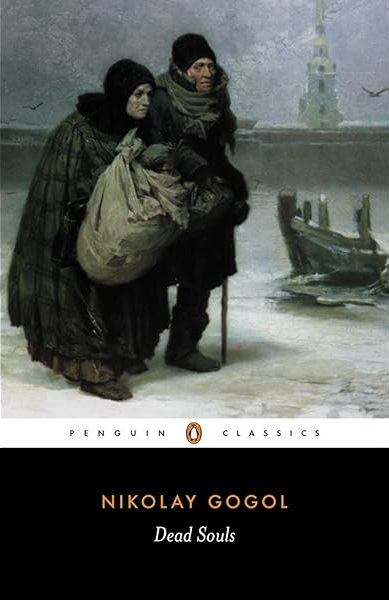
I really think Penguin have done a disservice to Gogol with this cover. It perfectly aligns with the stereotype of Russian literature so often thrown around by people who have read none of it (or have read one or two Dostoevsky novels and feel qualified to speak about the rest). The title, and covers like this, were enough to put me off for a long time.
In fact, Dead Souls is a comic novel, mostly bouncy and light in tone, not ponderous and depressing. The descriptions and similes are exuberantly weird. I particularly liked the apparently undisciplined digressions into irrelevant detail, which would these days be called maximalism. Also fascinating is Gogol's metafictional defence of his own literary style and motivations, within the narration itself. Sometimes it seems that he is writing about writing as much as about the Russian countryside, bureaucracy, hypocrisy, etc.
Ultimately though — and this is where personal taste comes in — I found the sarcasm heavy-handed, the satire obvious, the hyperbole awkward, the characters merely sketched, and the lengthy rhapsodic evocation of "Rus" tedious (even when ironic). This is partly because of the anticlimactic fifty pages of narration after Chichikov has already left town, and partly because much is lost in translation. I expect to come back around to liking it down the line, when I might try a different translation. -
Plato's Republic Book 10
I'm dealing with Thrasymachus, but have been distracted by some novels. I don't know if I'll be posting anything here anyway. -
Plato's Republic Book 10Haven't heard anything from Jamal or any previous participants for a while. — Amity
I'm working through the Republic but I'm still on book 1. I read the whole thing in my youth, and again a few weeks ago, but I'm not thinking about book 10 at the moment. I can't do everything at once, no matter how much you badger me. -
Plato's Republic Book 10@Amity
My statement that Book 10 is weird is based on my own experience with it, and so far this is a quite vague impression. My comment that some people have a low opinion of it is based on my secondary readings (including some of those referred to in your quotation from that dissertation). I am on my second and more thorough read through the Republic after having read it a few weeks ago, and I don't have a stable view either way. But certainly, Book 10 feels different from what has gone before. -
Poets and tyrants in the Republic, Book II think it is the idea of Simonides as an 'ideal poet' in contrast with Homer that I don't understand. — Amity
Cool. The first and third paragraphs in the mixed up quotation are about that. Here they are in order, with the quotations from the Republic removed:
I came across another interesting interpretation in a paper entitled "Socrates on Poetry and the Wisdom of Simonides." The idea is that Plato is not interested in Simonides as a historical figure but is rather making him stand as his ideal poet. This is in contrast to Homer, who by this point in the the conversation with Polemarchus has already been mentioned dismissively
[...]
Again, the crucial thing is that the real Simonides is unimportant. The new element is that because of this he can function as a blank canvas onto which Plato can project his ideal poet, in contrast with Homer, who is problematic. This is quite compelling, and it's actually sort of compatible with the first interpretation, although it does bring the ascription of irony into question (or it would make it an even more complex kind of irony). It doesn't matter what the real Simonides might have said, but it does matter what Homer said, because Homer loomed so large in the culture, and comes in for direct criticism later in the Republic.
This is the alternative, or further developed, interpretation that I mentioned in my post, which I got from this:
Futter, Dylan. (2021). SOCRATES ON POETRY AND THE WISDOM OF SIMONIDES. Akroterion. 65
So it's not my idea and I'm not committed to it, although I do find it quite persuasive. If you're particularly interested in it have a look at that paper, otherwise I wouldn't worry about it. -
Poets and tyrants in the Republic, Book I
You've mixed up the order of the paragraphs, which is important. Maybe that's why you're confused :grin: -
When can something legitimately be blamed on culture?Female circumcision in Muslim countries - is this an expression of their religion or their culture? Or both? Muslim apologists in the West will frequently argue that this phenomenon is not a part of Islam, but a cultural phenomenon. I wonder how easy it is to separate culture from religion. Is American evangelical Christianity a form of Christianity? Or is it an American cultural phenomenon? Or both - a religion reimagined through a cultural milieu. — Tom Storm
Religion is normally thought to be part of culture.
@schopenhauer1 (and in deference to @T Clark): It might be useful to define our terms. Culture is that which...
provides its members with meaningful ways of life across the full range of human activities, including social, educational, religious, recreational and economic life, encompassing both public and private spheres. — SEP: Culture
Or...
the sum total of a given people's beliefs, customs, knowledge and technology. These are learned and constitute a dynamic system. This system exists outside the body and is not inherited through biology. — The Royal Anthropological Institute
But @schopenhauer1 is using it more specifically to mean the cultures of minority groups:
So there are various factors one can attribute the behavior of a subgroup of people within a population. This can be any subgroup- geographic, ethnic, political, religious, etc. — schopenhauer1
Anyway, @Tom Storm, to say that female circumcision is not a part of Islam, but a cultural phenomenon, is probably to say that its status with regard to the religion as such (rather than to actually existing religion as practiced in that local culture) is contested, and varies between cultures that share the same majority religion. The local culture where it is practised is such that Islam in that culture allows or encourages it --- but there is no necessary connection. Which seems obviously true. -
With philosophy, poetry and politics on my mind...
The "books" of the Republic are the chapters, basically. They all belong together and they're all important, although book 10 is weird and some would say adds nothing of much value to the whole work's argument. -
With philosophy, poetry and politics on my mind...I've been enjoying Jamal's discussion and the discovery of 'literary easter eggs'. A different approach or angle to reading the Republic, Book 1. I'm in two minds about it. — Amity
I think the problem with applying the idea of literary Easter eggs is that it usually refers to something inessential, a bonus for certain readers. Symbolic name choices are an example. They're not centrally significant.
But the allusions or allegories in Book 1 of the Republic are woven in with the central themes of the work and contain everything that's to come in microcosm. -
Currently Readingnebulous soon — fdrake
That's exactly when I'm going to read Hegel's Phenomenology. -
Currently ReadingThe Glutton by A. K. Blakemore. — Jamal
8/10. A very good novel. Playful language of often Nabokovian precision and inventiveness. Tragic and fun, beautiful and disgusting, compelling and uncomfortable. I might read her other novel. -
Poets and tyrants in the Republic, Book I
Well, the Republic is full of such Easter eggs. They are hard for us to spot, but audiences in Plato’s day would have been able to. Just to give you one example, again on the very first page. When Polemarchus and Adeimantus and company run into Socrates and Glaucon, Polemarchus makes a joke. He says, “Hey Socrates, do you see how numerous we are compared to you two? You better do as we say and come to my house.”
In other words, he’s making a joke about factionalism. During times of social harmony, such jokes may be funny. But to Plato’s audiences, this is a very dark joke. Because his audience knew, as we discussed last time, that Polemarchus himself, would later become the victim of the kind of factionalism he now makes light of. Plato’s audience would also know that this road from the Piraeus back to Athens is where, decades later, the Thirty Tyrants would be overthrown in a battle (the Battle of Munychia in 403 BC) and their leaders killed.
In response to Polemarchus’ joke, Socrates says, “What if we persuade you to let us go?” To which Polemarchus jests again, saying, “Can you persuade someone who refuses to listen?”
Again, it’s easy to read past this stuff and not think much of it. But how brilliant is this setup? That one question alone, sums up the essence of factional division. How do you persuade someone who refuses to listen? Not only does this Easter egg build up a dark sense of irony, it also subtly broaches the topic of factionalism, which will figure prominently throughout the entire dialogue. There are little Easter eggs like this all over the Republic, and unfortunately we don’t have time to go through them — The Hunt for Justice - Plato's Republic I
Yeah this is good stuff. I didn't think primarily of factionalism so much as power vs persuasion, irrational vs rational, etc., but it's a good example.
In which case, maybe literary Easter eggs is the right concept after all. -
Poets and tyrants in the Republic, Book II'm curious. Does that mean your focus has now turned away from the 'literary easter egg'? — Amity
I think so, because the idea of a literary Easter egg doesn't do justice (no pun intended) to the kind of subtlety that Plato is using. What we have now is literary subtlety in the service of a philosophical theme, rather than a hidden criticism.
I searched for 'literary easter egg' with regards to Plato. And found this podcast and transcript. — Amity
Cool. I'm not surprised that others have had the same idea. -
Poets and tyrants in the Republic, Book II've done some thinking and now I have a slightly different angle. I see that while I started out with a good intuition, it went a bit wrong on its way to conceptual crystallization. @Fooloso4's comments are more relevant than they seemed.
In a nutshell, I think Socrates is saying to Polemarchus something like, "when you repeat that saying, you might as well be quoting one of these bad guys." And that's even if it was in fact said by Simonides. Thus the emphasis is on an independent understanding of the saying rather than who said it, and Socrates is neutral about its factual origin.
This does still mean that his comments in praise of Simonides and the sages are ironic, but it's an irony that is more complex than I thought.
SOCRATES: Well, now, it is not easy to disagree with Simonides, since he is a wise and godlike man — 331e5
SOCRATES: You and I will fight as partners, then, against anyone who tells us that Simonides, Bias, Pittacus, or any of our other wise and blessedly happy men said this. — 335e7
If it's true that Socrates is neutral as to who originated the saying, that it's our understanding of the saying itself that matters, then of course he is open to the possibility that Simonides did in fact say it. This would make the above comments ironic, not exactly because he is sneakily associating Simonides with the injustice of tyrants while saying the opposite, but because he continues to praise Simonides, pretending to believe that he could not have been wrong, while in fact he is neutral as to the wisdom of the real Simonides. It's an exaggerated concession to his reputation, in other words, paying lip service. What matters is to question our reliance on all cultural authorities, including Simonides.
So the targets are people like Polemarchus who ascribe erroneous notions of justice to wise people, something Socrates gets across bluntly by ascribing them instead to bad guys; and generally those who rely on cultural authorities, whether these authorities are poets or sages, without having thought about them deeply.
I came across another interesting interpretation in a paper entitled "Socrates on Poetry and the Wisdom of Simonides." The idea is that Plato is not interested in Simonides as a historical figure but is rather making him stand as his ideal poet. This is in contrast to Homer, who by this point in the the conversation with Polemarchus has already been mentioned dismissively:
It seems, then, that a just person has turned out to be a kind of thief. You probably got that idea from Homer. — 334a9
But Homer is later replaced, as not deserving of Socrates' defence, while Simonides is elevated:
You and I will fight as partners, then, against anyone who tells us that Simonides, Bias, Pittacus, or any of our other wise and blessedly happy men said this. — 335e7
Again, the crucial thing is that the real Simonides is unimportant. The new element is that because of this he can function as a blank canvas onto which Plato can project his ideal poet, in contrast with Homer, who is problematic. This is quite compelling, and it's actually sort of compatible with the first interpretation, although it does bring the ascription of irony into question (or it would make it an even more complex kind of irony). It doesn't matter what the real Simonides might have said, but it does matter what Homer said, because Homer loomed so large in the culture, and comes in for direct criticism later in the Republic.
Notes
Futter, Dylan. (2021). SOCRATES ON POETRY AND THE WISDOM OF SIMONIDES. Akroterion. 65 -
Poets and tyrants in the Republic, Book IThis connection requires textual support. Again, I see the question of origination as secondary to how it is to be understood. The truth or falsity of what is said does not depend on who might have first said it. — Fooloso4
I agree with the second and third sentences here. I was attempting to identify a literary foreshadowing or a literary easter egg. I probably need to break that down, but to me it jumps off the page (if you look at it right).
The criticism that damages my interpretation the most is my own: Simonides is not the only wise man mentioned, and the others were not poets. -
Poets and tyrants in the Republic, Book IWe cannot too quickly conclude that either Simonides is not wise or if wise did not say this. It may be our own wisdom or lack of wisdom that is being called into question. — Fooloso4
Your point is broadly good, but Socrates does on the surface mean to show that Simonides and other wise men could not have --- or at least probably did not --- say it. That this doesn't matter relative to how we are to understand Socrates in the way you explain is fine as far as it goes, but in the OP I took things in a different direction with a view to uncovering a possible covert criticism.
But it has been brought up! Cephalus opinions about such things as justice are shaped by the poets. Consider how frequently the poets are appealed to. — Fooloso4
Yes, Cephalus quotes Pindar. I just meant that poetry as a problem has not explicitly been brought up by Socrates. He does this later.
The other thing he cites is fear of punishment in death. Something that he never took seriously when he was younger. As far as I know we do not know anything about him prior to his old age. We do not know to what extent fear of death might have changed his behavior. — Fooloso4
It's not quite clear, but it's also possible that he is not confessing to his own fears, but is referring to those of the masses:
CEPHALUS: What I have to say probably would not persuade the masses. But you are well aware, Socrates, that when someone thinks his end is near, he becomes frightened and concerned about things he did not fear before. It is then that the stories told about Hades, that a person who has been unjust here must pay the penalty there—stories he used to make fun of—twist his soul this way and that for fear they are true. And whether because of the weakness of old age, or because he is now closer to what happens in Hades and has a clearer view of it, or whatever it is, he is filled with foreboding and fear, and begins to calculate and consider whether he has been unjust to anyone. If he finds many injustices in his life, he often even awakes from sleep in terror, as children do, and lives in anticipation of evils to come. But someone who knows he has not been unjust has sweet good hope as his constant companion [...] — 330d
Cephalus might be suggesting here that unlike many of the masses, he is not "filled with foreboding and fear," because he has not found many injustices in his life. But either way is fine with me; it seems likely that he is familiar with such feelings. In any case there is little indication from the text that he has led an unjust life, and it doesn't matter; what matters is that even if he hasn't, he has not been just in the way that Socrates likes, i.e., able to account for it rationally. This makes him at the very least a useless example to set against Thrasymachus, or a useless partner in an argument against nihilism and cynicism. -
Poets and tyrants in the Republic, Book IHe is, by all appearances, a gentleman. To the extent that he is just, he credits his wealth. — Fooloso4
And his good character. He says that wealth is not enough. -
Poets and tyrants in the Republic, Book I
Sure, but even with all that there's the suggestion of complacency, especially when you take his son's conversation into account too. Thrasymachus is the antagonist; Cephalus & Son are merely too thoughtless to produce any defence against him — not that they're bad guys themselves.
Jamal
Start FollowingSend a Message
- Other sites we like
- Social media
- Terms of Service
- Sign In
- Created with PlushForums
- © 2026 The Philosophy Forum