
-
The Dialectic of Atheism and Theism: An Agnostic's PerspectivePascal's wager is very clear on what one has to do vis-à-vis theism-atheism in a Christian context. — Agent Smith
That was my point. You have to buy into the basic legitimacy of Christianity in order for Pascal to be relevant. If Pascal's point was to get me to be a Christian, his argument will only work if I were already a Christian, so there's no value in his argument to those who don't already believe. -
Feature requestsIn other words, you have a flip phone. — Noble Dust
I heard the flip phone is making a come back. There's nothing cooler than slouching back in your chair, flipping the phone so that it opens up, putting it to your ear, and saying "sup." Nothing. Height of coolness. -
Feature requestsAlso, a question - does the picture show up on other people's mobile version of my posts? — T Clark
It'll probably be easier for you to buy a second phone and see how your uploads work than to get a straight answer out of me. -
The Dialectic of Atheism and Theism: An Agnostic's PerspectiveMy point isn't to identify what is supernatural or not (or even what counts as evidence) just that you can find seemingly reliable people who claim to have had all sorts of bizarre experiences, so there's not much the rest of us can take from a personal experience argument. — Tom Storm
I was being less generous in that regard and I would insist, for example, that if someone's account violates physical laws, then I would discount their account as unreliable. It's why we use photographs, DNA, and all sorts of CSI methods to prove things. We need to do the same in all avenues of our life. So if you say the sea parted, I'd discount it.
This is to say, I'm not willing to give a pass to people who think faith is just a certain type of stubborness that refuses to listen to reason when those reasons aren't consistent with previously held conclusions. It would be nice for me to allow room for those to believe in a 6 day creation, but the truth is that belief is utter bullshit.
Is this right? Surely you are not ruling out the possibility that god could appear empirically to all of us as they have done in stories/scripture? — Tom Storm
I am ruling that out. A corporeal god creates all sorts of theological problems. I think when we start getting into literal interpretations of scripture and anthropomorphic descriptions of God, the atheist ridicule properly applies. If God is somewhere specific, I have the right to ask for his address, put him on a scale and weigh him, take a biopsy, and kick him in the shins. That's what physical means. If you say you saw God, I would say you might have seen a cloud and felt something spiritual, but God wasn't the cloud.I was simply making the common sense observation that most people believe in god because they are brought up that way - groomed by parents, family, culture — Tom Storm
A theist who can't recognize that his beliefs are likely as they are due to his parent's beliefs is hard to take seriously. That has to be dealt with reasonably, which means either you accept there are multiple paths to the same destination and appreciate that your chosen path has something to do with it being paved by those around you, or else be forced to arrive at the incredible conclusion that you found the truth independently and it just coindentally was the exact same thing you were being told your whole life.
I don't see religion as a sanctuary from reason for those needing comfort from reality. If that is what it is, then the atheists are right to scoff at the theists. -
The Dialectic of Atheism and Theism: An Agnostic's PerspectiveI was referring to something along the lines of Pascal's wager. — Agent Smith
Pascal's wager assumes a relationship between belief in God and salvation, an ideosyncratically Christian notion, which just because pervasive does not mean the link is entailed by theism generally.
This is what is often missed in these discussions, that it is assumed theism is a belief system requiring certain fundamental beliefs. But theism is no more a belief system than is atheism. Theism asserts God's existence. Atheism denies it. How you wish to develop those single itemized beliefs into a system is up to the person, but assuming something logically must flow from there is incorrect.
Anyway, that is why I never understood Pascal's wager to be an important argument because my immediate response was to ask how did Pascal know that believing in God is exactly what God didn't want you to do and that is what would lead to punishment. I found that suggestion no more or less absurd than the idea that belief in God would lead to salvation, mostly because I'm not Christian and the concept of salvation based upon belief was entirely foreign to me. -
The Dialectic of Atheism and Theism: An Agnostic's PerspectiveSure. Right now we can probably find many thousands of people who claim to have been abducted by aliens and taken away for a probing... — Tom Storm
Empirical evidence for the supernatural is a contradictory notion because that which is sensed must be by definition natural. That is, if I see a ghost, the ghost must be just a new discovery, like a previously unknown insect in the rain forest.
This draws a distinction between the type of evidence necessary for proof of a non-corporeal God and that of previously undiscovered physical events (like alien abduction, Bigfoot, or a strange new sea creature). If someone claims a miracle, it should be assumed not to have occurred because few things are as empirically established as physical laws. That is, I will find you not guilty of a crime if it were physically impossible for the crime to have occurred as alleged.
What then is left in terms of proof are such things as pragmatics or subjective mystical experiences. The only way I could see empirical evidence as being evidence of God's existence would be in the indirect sense, as is the fact that existence exists points to something creating that existence.
Funny thing is that no sooner does one start to set out god's attributes then one runs into contradictions. — Banno
Of course these conversations have been going on for over a thousand years:
https://www.myjewishlearning.com/article/maimonides-conception-of-god/
think most people believe in god because they are brought up with the idea - evidence and faith are post hoc. Children are taught there is a god and the notion becomes absorbed as part of their socialisation and enculturation. You're much more likely to have an experience of a particular God as an adult if you are properly primed from birth. — Tom Storm
Much time is spent psychoanalyzing the theist, perhaps because he seems so obviously wrong to the atheist that an explanation must be arrived at for why an otherwise intellgent person would take it seriously. But this is me psychoanalyzing the atheist. My guess is that we're both part right and part wrong here.
What is interesting to me is how seriously the atheists take these conversations. You can't seem to have a thread about theism without the atheists being sure to enter the conversation and passionately objecting, some more respectfully than others. Often the conversation turns toward a discussion of childhood trauma dealing with religion, prior episodes of social ostracism arising from religious institutions, and other bad acts of religion. To the extent the driver behind atheism is pain caused by religion, then that does seems like something that needs to be addressed, but I acknowledge a reasonableness to the atheistic position that keeps it from being explained as just reaction to trauma, but it seems part of it for some. -
Ultimatum GameAlso a point about the experimental setup being artificial and unrealistic. That is common to experiments, which try to isolate certain features and exclude confounders. So that in itself is not a good criticism. In this case the idea was to draw a contrast with game theory predictions, and that means creating conditions where the kind of rational self-interest that a game theory solution would take into account would not predict the result. — SophistiCat
Fundamentally, humans are driven to survival, not toward selfish promotion. If it works toward our survival that we abuse one another, we will, and the same holds true for cooperation. But we don't intuit our best survival techniques a priori. We learn through trial and error (natural selection).
So, if you toss me into a dystopia where I am to decide how much to give away to avoid your spite, I'm not fully adapted to such an environment, so I may use my adaptations gained in my normal world to my disadvantage. On the planet I evolved, we have expectations that you share a certain amount with me if you expect mutual respect from me, and consequences result if you violate that norm.
This means that how your test subjects react in this generation will vary in future generations as you continue to expose people to this new adaptation.
This experiment tests adaptations, not inherent human nature. This test just reveals the incompetence of those without the agility to immediately adapt, and as @Banno even noted, some will identify they are being tested and will respond by trying to invalidate the test by offering absurd responses. This too is an evolutionary reaction, trying to eliminate a threat by those who wish to study us as objects. -
Ultimatum GameLet's try and make this experiment a real world situation.
The king (the responder) tells you (the offererer) to pay him his fair tax by giving him a percentage of your crops, and if you don't, he salts your fields.
You've got to guess what fair means. If you're wrong, it's a lose/lose for both you and the king.
Homo economicus tries to be rational, not wanting to end up with nothing, but not wanting to give up most of his labor just to be allowed to keep some scraps.
The king wants to set a price. The subject wants to avoid tyranny.
I get my scenario is different. The offerer here earned his crops and the responder is an arbitrary ruler, but if you don't add a semblance of reality (as in explaining how wealth just appears in someone's hands and why they now must offer some or lose it all), I'm not sure it proves much of anything. -
Ultimatum GameI'm interested in why folk see someone who is giving them money for nothing as fucking them over.
Sure, they get more than you, but you still get something for nothing. — Banno
They're not giving you something for nothing. They're giving you money to buy their right to keep some money. They are buying a favor from you, and in this fucked up scenario, we have created a market that sells favors and pays folks not to randomly deprive money from strangers.
I'm not sure what these experiments really show other than how otherwise normal people might attempt to navigate a world where arbitrary power controls the random distribution of money. I'd suspect that after a few generations of living in such a world, behaviors would become more survival oriented. Fortunately, right now, we'd run around like chickens with their heads cut off, not knowing what makes sense because that's not how the world works. -
Ultimatum Gamen other words, I don't mind punishing another for bad behaviour, if it only costs me a little. And if the amount of bribery is sufficient, and the bad behaviour is rather insignificant, anyone would gladly refrain from punishing. — Metaphysician Undercover
It seemed intuitive to me that if someone offered me say $1,000,000, my answer would be to accept it regardless because it was a very substantial, life changing amount of free money, and I couldn't reject it on some principle that the giver was receiving $9,000,000 and that wasn't fair.
Maybe this is a similar issue, but at work, we constantly have to deal with people feeling cheated when they learn a co-worker makes more than them. The disparities in pay ofter arise just from when they were hired and where the market was at the time so that long time employees might make less than a new hire. I understand the feeling, but we can't raise salaries across the board everytime there is a market fluctuation either. It's also an interesting dynamic where someone will be happy with their rate of pay until they learn someone made more than them. It's as if their pay is satisfactory as long as they are making the most.
You'd almost think that someone would rather make less somewhere else as long as they were the highest paid where they went.
What I tell people is that there is no fairness principle that determines pay and that the salary a person is willing to accept has to be based upon their own personal needs, what they believe they will be able to obtain in the market, and whether other opportunities are overall more attractive, but they're going to drive themselves crazy worrying about how much they make compared to each other person.
Maybe all of this related to what we're talking about here. It seems like it is somehow. -
Ultimatum GameMy sense of fairness is worth more that $1 or even $10. If it were $10,000, that would be a different thing. On the other hand, telling someone to go fry ice when he tries to stiff me for thousands might be worth it. — T Clark
So this strikes me as the real question, particularly whether the rejections are artifacts related to insignificant amounts being offered and whether as actual rewards increase whether rejections decrease.
The experiment has been done many times, in a wide variety of societies. One experiment in Indonesia used the equivalent of two weeks wages, not an insignificant amount, and found much the same result. — Banno
I located the abstract, but couldn't find the complete study.
It stated:
"Implementing the ultimatum game experimentally in Indonesia makes it possible to raise the stakes to three times the monthly expenditure of the average participant. Contrary to predictions in the literature, the results show no evidence of approaching the sub-game perfect, selfish outcomes. Responders seem to be just as willing to reject a given percentage offer at high stakes as at low stakes, and Proposers make slightly less selfish offers as the stakes increase. "
What three times the monthly expenditure is isn't set forth in the abstract.
This site indicates average monthly expenses in Bali to be from $720 to $2,600 (in USD). This number will be lower if rent is shared. But assuming the amount was under $3,000 total, that remains low enough not to fully eliminate the variable of small amounts. https://www.google.com/amp/s/alittleadrift.com/should-you-move-to-bali/amp/
The biggest blow to this whole conversation is found here in this study that I found:
"Our main result is that proportionally equivalent offers are less likely to be rejected with high stakes. In fact, our paper is the first to present evidence that as stakes increase, rejection rates approach zero."
Below is my cite to all the abstracts, and you'll have to scroll through to find them all. As to the one cited just above, it appears in this list, but I've also screen shot it.
https://www.semanticscholar.org/paper/Raising-the-Stakes-in-the-Ultimatum-Game%3A-Evidence-Cameron/675df095394082a09803925c4d2fcaa3cbfff309
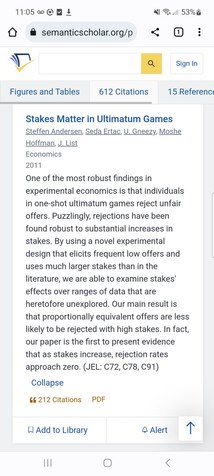
My takeaway from my hour of research here is that as actual dollars increase, rejections decrease, but to the extent we can afford to fuck those who try to fuck us, we will, but there is a limit to how much we will spend on the joy of vindictiveness.
Sounds reasonable. -
R. M. Hare
What I know about him was I had an instructor who was working on his Ph.D. at the time and he mentioned his research related to Hare. This is the anthology he eventually published, which I never read, but I remembered having seen it later. https://www.abebooks.com/Hare-Critics-Essays-Moral-Thinking-Seanor/31274325994/bd
Thanks for the trip down memory lane. More Googling located the author, now a high school teacher at a local private school. -
Chess…and PhilosophersI moved and am awaiting my opponent.
I just wanted to be able to say that one time. -
Is Atheism Significant Only to Theists?Also, many religious people oppose environmental protections because they 1) think God's in charge of creation and has it covered or 2) the rapture is coming, so why worry? — Tom Storm
They also oppose those protections because religious people tend to be politically conservative and they don't want restraint on trade that will reduce the size of the economy.
I've always felt that if there were evidence that burning coal was the best way to preserve the environment, conservatives would be arguing that we should burn coal to save the fragile planet. Not that there's not a way to make the same point about liberals in an opposite way, but it seems to me the real reason for many of these positions relates to whose ox is being gored. -
Chess…and PhilosophersDo you mean this?: Chess Analysis Board — javi2541997
And so how do I get that in the current set up of my board without manually moving the pieces into place? I was wondering if there were an option I could just choose that would put the current position into the analysis board. -
Chess…and PhilosophersOn chess.com, is there a way to go into analysis mode where I can move the pieces around?
-
The Bodies
That you can cite to stats showing a vast increase in mental illness indicates you are able to objectively identify mental illness and objectively identify its increase. If that can be done, then my suggestion isn't insane, but it indicates we should try various treatments and see if those stats you rely upon move in a positive direction.
Also, your solution of treating patients subjectively as opposed to objectively doesn't explain in practice how I am supposed to treat someone, but, it you are able to identify these two competing ways of treatment (the subjective versus the objective), they can be tested against each other to test your theory that objective treatment results in the suffering of damage, as to however damage might be defined. And damage does have to be defined for this to make any sense, which I realize will be by self reporting of some sort, which is a subjective presentation of symptoms, which maybe that's what you're referencing by subjective.
Subjective information can be objectively evaluated for changes over time and for resolution of those reported symptoms, so this doesn't take it outside the realm of medical science any more than tests of medications that might resolve headaches or back pain, all of which can only be subjectively measured. -
The BodiesThe problem with everything you say is that it is unscientific and useless from any practical perspective. Step one is to identify the specific measurable problem you have, step two is to arrive at some theoretically reasonable method for resolving it, step three is to implement that method, and step four is to measure your results to determine if you've been able to resolve the problem identified in step one.
And all of this has to be specific and measurable, not generalized and unknowable. You've not identified the specific psychiatric disorder you wish to eliminate, described how it is measured, nor have you arrived at a reasonably understandable theory for how that measured disorder can be reduced, and we are far from having any understanding how a clinical trial could be conducted to test your vague methods.
Your position isn't particularly anti-psychiatrist. It's non-scientific and useless.
This isn't to say that it has no value perhaps as a philosophical musing about what causes spiritual disharmony or something like that, but leading the article off as if it might stand in opposition to evidence based solutions doesn't get this off the ground. -
Is Atheism Significant Only to Theists?understand the idea was to create an "enclosure" so as to make it permissible to carry stuff outside, in accord with a sabbatical imperative. the point that it is not just "Christians" who "creatively found a way to do away with the law of the OT, but, even there it required some creativity". — Banno
Perhaps it was creative in an effort to make life more livable, or perhaps just the outcome of a hyper-legalistic tradition.
The curiosity of the orthodox is that the faithful increase their religiosity, while the less faithful liberalize.
Like a bad case of OCD, more rules are created over time, which then become standardized and part of the orthodoxy. This law I suppose was derived from the basic notion of being required to rest on the sabbath, which took a whole lot of processing to arrive at rest means don't work means work happens outside in the field means fields are those things without walls means walls are enclosures means enclosures can be made with strings.
You'd have thought "rest" might have meant just sitting down at some point and life wouldn't have involved climbing phone poles with strings.
https://en.m.wikipedia.org/wiki/Eruv -
Is Atheism Significant Only to Theists?And why some Jews hand a string around their neighbourhood. Again with the failure of deontology. — Banno
I don't follow this. The string (eruv) is an orthodoxy, not an attempt to avoid an imperative. -
Is Atheism Significant Only to Theists?But your approach to this is illogical and your reasoning is faulty. — Baden
No, it's not. My comment related to the Chinese government's adherence to atheism and the oppression resulting from it. Your diversion into what the dictates of Marxism are isn't much part of that conversation.
If a question is presented asking for an example of an immoral theistic institution, reference to one that denies the secular principle of a religious inclusion would be cited. The same thing would be referenced if one wanted an example of an atheistic institution.
The argument that you must make, which I disagree with, is that the atheism of China is incidental and insignificant with regard to what makes it oppressive.
This is to say, sometimes when committed atheists convene they oppress the views of others, just like when theists. -
Is Atheism Significant Only to Theists?I'm not sure what would be moral about...well, I don't know what all those commandments are, so you have me at a disadvantage. Does one of them have to do about not eating unclean animals (I'm not trying to be funny or sarcastic). If so, how would refraining from doing so be moral? — Ciceronianus
It's 613 minus those related to acts performed at the temple (since it was destroyed) mostly related to animal sacrifice.
All would be moral commandments. No distinctions is made related to the performamce of God's law.
This is probably in part why Christians creatively found a way to do away with the law of the OT, but, even there it required some creativity. -
Is Atheism Significant Only to Theists?Atheism has no ideology. Thats why you always have to mention communism and marxism etc along with the atheism. Atheism alone has no edicts, no rules, no goals…its merely a position on theism. — DingoJones
It can have an ideology, which might include the supression of theism. By the same token, it's not necessary for a theist to subscribe to a particular ideology.Agreed, but that immorality wouldnt have atheism as its source. — DingoJones
Yes, the source would be atheism.We are talking about atheism, not communism.
Also, Im not saying they just happened to be atheist.
Listen:
Im saying that atheism is not the reason for their immorality. Atheism is not a ethical system, nor a system of belief of any kind. Again, this is why you must attach your criticisms of atheism to communism. — DingoJones
You're acting like you're making a point that isn't heard. The criticisms go both ways. I'm not talking about Christianity, Islam, Judaism, or Hindu. I'm talking about theism. It's just as possible to distill out the simple statement "I believe there is a God" as it is to distill out "I do not believe there is a God" and deny anything negative from either of those distilled out statements. But, if the question is whether a theistic belief has done harm, the answer is yes, just as the question of whether an atheistic belief system has done harm is also yes.
Must atheism be bad? No. Are certain iterations of it bad. Yes. -
Is Atheism Significant Only to Theists?I dunno. That would seem to make ritual tantamount to ethics. According to the One Holy Catholic and Apostolic Church (OHCAC), for example, we ought to partake of or participate in the Sacraments. But I doubt it would consider doing so to be a matter of ethics. — Ciceronianus
As a comparison, in Orthodox Judaism, there are 613 commandments, each of which is a moral imparitive, with no distinction being drawn between the ritualistic and the ethical. All are the law of God and so must be followed.
With modernity, new branches of Judaism formed, most generally referred to as Conservative and Reform, both at least partially on this question as to how to seperate the purely ethical from the ritual. If that distinction could not be drawn, then no theological justification could be reached for why only certain of the moral tenants should be adhered to.
This seems to be @Banno's response, which is how such a distinction can ultimately be drawn, and it remains a challenge for the non-orthodox versions of beliefs systems, but without making them more palatable, they hold more limited appeal. -
Is Atheism Significant Only to Theists?The point you are missing is that an atheist government doesnt do anything based on its atheism. — DingoJones
Of course they do. It's part of their ideology and it's why the offer restrictions on religion. The atheism you find in communist countries isn't just an innocuous mission statement, but it informs the way they control their people and beliefs, and it's also part of their fundamental Marxist ideology.
To which of course you will reply with a reference to the lack of theism being the source of any immorality. — DingoJones
You are taking the tack suggested by @180 Proof which attempts to muddle the distinction between atheism and secularism. The former refers to any person's belief system as it relates to the non-existence of a diety, with no reference to government. The latter references a government that seperates the church from the state.
It is therefore possible (and quite common) for a theist and an atheist to be secularists, meaning they have whatever beliefs they might have, but they don't believe government should involve itself in enforcing those beliefs.
What this means is that I disagree with your comment I quoted above, where you assume what my response to you would be. That is, I do not believe a theocracy can be secular because that is a self-contradictory statement. If a nation has a religious belief system and they use it as law, that would not be secularist, but would be theocratic, and it would be immoral.
By the same token, a government that has taken a formal stance on the issue and determined itself atheistic and then attempted to impose those beliefs on others would be as immoral as the theocracy I described above.
That is, I have provided you the very example you were looking for, which was that of an oppressive atheist. What you are trying to say, which is simply false, is that the communist nations cited just happen to be atheist, just like they may happen to have red flags, and those two facts have nothing to do with their immorality. What I am saying is that I fully understand your distinction between relevant and irrelevant causes of the oppression, and I am saying that the atheism factor looms large as one factor among many in informing the cause of communistic oppression.
To say that the offical atheistic stance of China is irrelevant to the oppression of its people is as incorrect as to say that the official theistic stance of Iran is irrelevant to the oppression of its people. -
Is Atheism Significant Only to Theists?State religions aka "autocracies" (e.g. China, Russia, North Korea) are manifestly indistinguishable from theocracies (e.g. Saudi Arabia, Iran, Afghanistan) also with purges, inquisitions / show trials, invisible enemies, leader-cults, official scapegoats, etc. Secular states, in fact, are anathema to "religious oppression" as policy, unlike sectarian / one party states. — 180 Proof
The manifest disintinction between China and Iran is that the former is atheistic and the latter theistic, which was responsive to the question of what immorality has been committed in the name of atheism.
This response does answer the question.
An atheistic nation need not be secular, which I take to be that which you define as one allowing religious freedom. Obviously, if atheism is defined in such a way as to demand tolerance of all other forms of belief, then there would be no reason for me to seek to answer the question of when atheism has been oppressive to human rights because I'd be arguing from the created tautology. The same would hold true if I denied your every attempt to show an example of a theist denying religious freedom of another by submitting that the definition of theist entailed that the person be religiously tolerant. -
Is Atheism Significant Only to Theists?Some would say unless you subscribe to classical theism, you are an atheist. — HarryHarry
But this is the problem throughout, which is to try to identify "classical" theism, as if there is a standard which we all know of and then there are various fringes that we wonder what to do with them. It comes from the fact that there are certain predominate religions that overwhelm us into thinking that is all there is. To live in the West is to think religion = Chritianity, and so I had this confusing conversation with some atheists where it was explained to me that my theism was based upon fear, and I couldn't for the life of me figure out what they were talking about until it dawned upon me that they must be talking about fear of hell or damnation, things entirely foreign to my belief system. The same holds true for many of these fairly recent fundamentalist belief systems, as if the Bible is literally true. The Gospels are so wildly inconsistent, those views are hard to take seriously, and certainly should not be considered as containing the essential elements of what it means to be theistic. -
Is Atheism Significant Only to Theists?Your case to make. — DingoJones
You can't complain about religious oppression by theocracies and not complain about religious oppressions by atheistic governments. The immorality expressed by both is clear.
https://en.wikipedia.org/wiki/State_atheism
https://www.uscirf.gov/release-statements/uscirf-releases-report-state-controlled-religion-and-religious-freedom
If this argument then turns into an attempted breakdown of which atheists count as true atheists and those not, then the equivalency will be complete because I will then start distinguishing which theists I want you to look at which I don't.
And all of this is to say that what has been done in the name of religion and what has been done in the name of atheism can be called immoral, but nothing in either position is inherently good or bad. -
Is Atheism Significant Only to Theists?The key difference being that an atheist wouldnt be doing it based off of atheism while the theist is basing it on their theism. — DingoJones
Unless the atheist"s lack of morality arises from his atheism, which might characterize some atheists, just as there are some theists whose lack of morality arises from their theism. The equivalency being that neither immorality is inherent in either theism or atheism, but is a characteristic of just certain forms.
Atheistic proselytizing is prevalent. It is typically characterized by attacks on simplified versions of fundamentalist beliefs, equating beliefs with anti-intellectualism, anti-science, and bigotry, with the message being that the light of reason rests with the atheistic ideology and conversion to it will lead to some sort of higher state.
That you have arrived at a reason not to be a Shiite, for example, has very little bearing on the question of the value of theism, but just to a particular form. -
Is Atheism Significant Only to Theists?The problem arises when folk do stuff. Criticism is just words. Refusing choice to women, removing books from schools, teaching children that masturbation causes holes in their brains - these are what counts. — Banno
Sure, not just criticism, but imposing views as well. That would hold for theists and non-theists as well. It's not as if every atheist is non-bigoted, open minded, and a believer in increased human rights. -
Is Atheism Significant Only to Theists?If you are generally tolerant of the views of those who have found personal existential meaning and you have no concern trying to proselytize others to your views, it would seem no one should have any reason to object to that kind of person.
The problem arises when people criticize those sorts of people, both the theist and the atheist. -
Is Atheism Significant Only to Theists?Merely" the Creator of the universe, i.e. one that having done so, does not intervene, is not influenced by worship or prayer--is the First Mover and nothing more; — Ciceronianus
Is that not deism? -
Is Atheism Significant Only to Theists?Theism is significant because too many damn theists proselytize and/or inject magical thinking – superstitions – into their explanations or arguments, even in nonreligious contexts (e.g. politics, commerce, science, ethics). Mostly, atheism is an intrinsic threat to theism because it is always a live option for (thinking) theists like potential defectors from a blinkered, totalitarian regime. — 180 Proof
My response to this is as it always is, and that is the Christian theology you reject isn't the only form of theism. That is, there are plenty of theists who don't proselytize, reject science, or care at all about atheism's potential threats.
If I told my rabbi I were an atheist, he truly would not care.
The idea that theists must convert others, save souls, trust blindly in certain items of literature, reject reason over doctrine, or hold firm to the faith to escape any sort of punishment is something held by a particular religion, but not theism per se. -
What is Aloneness and the Significance of Other Minds?When I was single, I found it very stressful. I used to feel this anxiety of having nothing to do, so I kept compulsively busy, like I couldn't sit still. But then I'd get into a relationship and if I didn't like where it was going, it was worse, and I would feel this huge calm once I broke up, but then the anxiety would start up again as the lonliness prolonged and the cycle would repeat.
But then I found someone, and so am no longer alone and no longer anxious, although prolly not super chill either. In any event, lonliness does give you a chance to really learn about yourself. What I learned was that I was not designed to be alone. Some people are though, but I sometimes wonder if that's just because they never spent a long time attached, so they haven't created that dependence. -
Deaths of DespairI'd propose a far more serious failure, if what you say is true, and that is that people are seeking meaning and virtue from the political theory or leader du jour.
-
Deaths of DespairThe assembly line began long ago, making the artisan no longer needed and leaving the systemitizing to the managers. There will always be boxes to carry, buttons to push, cartons to fill, or whatever. Unemployment is at historic lows where we're unable to find people to bring the food from the kitchen out to the table.
Labor has always been expensive, so the trick has always been how to dumb down the tasks to increase the supply of those who can do it in order to decrease the costs of getting it done.
I've got nothing good to say about Trump, but placing on his shoulders the despair of the common worker gives him too much credit. Workers have been talking about uniting and overthrowing since the great manifesto. Unfortunately, many of those attempts didn't work out so well.
Whatever increase in despair there is, and I've not conceded it without first seeing the data, is probably quite complex and doesn't fit neatly into wherever our biases might lie (the economic system, civil rights violations, guns, drugs, single parent homes, poverty, bullying, etc), but is many of those for some, different from others, and who knows what else.
This isn't to say there aren't some standing on the ledge right now due to feelings of despondency created by skill obselesence and worker alienation, but there are probably more there due to a bad breakup or rejection by family or friends or those very specific things that leave us feeling helpless. -
Life is a competition. There are winners, and there are losers. That's a scary & depressing reality.One of my favorites is the kind that Abraham Lincoln grew up with. It dictated that every person is born for some reason. — frank
And more broadly, everything occurs for a reason.
Hanover

Start FollowingSend a Message
- Other sites we like
- Social media
- Terms of Service
- Sign In
- Created with PlushForums
- © 2026 The Philosophy Forum