
-
Israel killing civilians in Gaza and the West BankThanks for those words, Schopenhauer1!
When we know we agree on those things, we can go further with the topic...
How can it change for the better?
How will it change?
If Bibi is finally ousted and a new pro-peace Israeli government seeks to change course, can it? Is there a possibility of getting out of this rabbit hole?
Can other countries besides the US, Iran, Saudi-Arabia, Egypt, Russia, Turkey etc. play a supportive role towards peace in the Middle-East?
And if so, how can the Palestinians, be it the PA or Hamas or whoever, also approach this? Can they actually make and keep peace with Israel and then face the fact that there's Israel and they have all these problems... -
Israel killing civilians in Gaza and the West Bank
Not only misinformation, but also simple ignorance.The problem is that there's a lot of misinformation out there that is a barrier to a fair and just solution. — Benkei
Just take for example the Israeli nuclear deterrence or it's biological and chemical warfare capability (Israel hasn't ratified the Chemical Weapons Convention, hasn't ratified the Nuclear Non-Proliferation Treaty (NPT) and is not a signatory to the Biological Weapons Convention). Yes, informed people know of existence of Israeli nuclear weapons, but I would argue that many actually do not. That Israel has nuclear weapons alongside other WMD capability puts into another light the reasons of WMD projects of it's neighbors: they have been an attempt to create a deterrence and a balance.
There are the populists, the religious zealots, but behind the bellicose threatening discourse there is logical thinking on both sides (if continuation of a conflict can be logical).
Put it another way, there isn't an urgent need for the US to do anything in this issue and the fact is that far more important to American politicians are the domestic votes in elections and the support of AIPAC and Christian Evangelists than a solution in the Middle East.Peace brokers like the USA aren't good brokers for peace due to the persistent bias existing about Israel's role in the conflict and policy choices where they give billions to Israel. You can't negotiate peace if only one side's security is taken seriously when in fact it's the other side getting killed. — Benkei
For politicians to truly seek peace and to end an active conflict usually happens when the continuation of the conflict is simply unbearable and will likely lead to the downfall of the politicians. How many US politicians face imminent downfall if they continue the line of supporting Israel (and all the Judeo-Christian heritage etc.) and make the nominal peace proposals that benefit one side more than the other?
And not to just single out the US, what other entity cannot continue with the old normal that has basically been going on from 1948? A 73-year conflict means that the conflict is normality for the people. That is the unfortunate thing here. -
Is the Philosophy Forum "Woke" and Politically correct?
The easiness and the outreach of it is crucial.Cancel culture might have been around before, but the internet has given it the ability to amplify its signal and spread out of control. — Count Timothy von Icarus
When you think that earlier one had to get something published in the opinion section of any newspaper, the process and the input that people made then is something totally different to a tweet, that may or may not come viral. The opinion pages were so limited that any paper had to be quite strict in what would get published. Tweeting and social media does have changed the landscape.
Historians are eager to not that political discourse has been many times as vile as it's today, yet things do change. Many things in the end just create noise and the actual issues get lost in it. -
CoronavirusNice to have an opposing view to the lab-leak hypothesis, but have to say that article is truly difficult to read. Yes, and oncologist editor of a site owned by the New England Skeptical Society can indeed know the subject well enough to comment, but there's a lot of quotes of the plain media articles and twitter comments and more of the social media style of commenting (with Godzilla facepalms) that makes it a long difficult read.
Perhaps this tells in short the opinion of the author David Gorski:
If, as I have, you’ve been paying attention to these things for a number of years, you know that, whenever there is a major outbreak, epidemic, or pandemic of infectious disease, one conspiracy theory always—and I do mean always—arises.
And that's the problem. Indeed there has been a conspiracy. The one where China wasn't open and truthful about the epidemic at the first place. And isn't now and won't be truthful in the future. And that was the first conspiracy which likely even Gorski won't deny.
Just to create a viable picture of the events is difficult...thanks to Chinese officials. An article explains this:
See Inside the Early Days of China’s Coronavirus Cover-UpSeasoned journalists in China often say “Cover China as if you were covering Snapchat”—in other words, screenshot everything, under the assumption that any given story could be deleted soon. For the past two and half months, I’ve been trying to screenshot every news article, social media post, and blog post that seems relevant to the coronavirus. In total, I’ve collected nearly 100 censored online posts: 40 published by major news organizations, and close to 60 by ordinary social media users like Yue. In total, the number of Weibo posts censored and WeChat accounts suspended would be virtually uncountable. (Despite numerous attempts, Weibo and WeChat could not be reached for comment.)
Taken together, these deleted posts offer a submerged account of the early days of a global pandemic, and they indicate the contours of what Beijing didn’t want Chinese people to hear or see. Two main kinds of content were targeted for deletion by censors: Journalistic investigations of how the epidemic first started and was kept under wraps in late 2019 and live accounts of the mayhem and suffering inside Wuhan in the early days of the city’s lockdown, as its medical system buckled under the world’s first hammerstrike of patients.
Then there was the way doctors were dealt:
- Physicians were told by hospital heads not to share any information at the beginning of the outbreak.
- Doctors were not allowed first to wear isolation gowns because that might stoke fears.
- Provincial health commission began actively suppressing scientists’ knowledge about the virus as early as January 1.
- By January, according to Caixin (who wrote an article, "Tracing the Gene Sequencing of the Novel Coronavirus: When was the Alarm Sounded?"), a gene sequencing laboratory in Guangzhou had discovered that the novel virus in Wuhan shared a high degree of similarity with the virus that caused the SARS outbreak in 2003; but, according to an anonymous source, Hubei’s health commission promptly demanded that the lab suspend all testing and destroy all samples.
And of then the typical Chinese censorship of anything that could look bad. And journalists etc. have been arrested for covering the pandemic. The usual Chinese stuff.
In all, it's highly doubtful that we can create clear picture of events now. Hope that historians later can do that.
Add to the fact that creating the timeline how a disease broke out would be difficult even without the all above. -
Is the Philosophy Forum "Woke" and Politically correct?
Yet this is the typical, standard line from woke people like Hamilton Nolan who actually cannot even see their own wokeness: How dare anybody even talk about there existing "cancel culture" when there is the corona-pandemic, climate change, wars and conflicts, poverty, INJUSTICE!Succinct article that hits the nail on the head when people haphazardly use terms like "woke", "politically correct", and "cancel culture".
"Meanwhile, things like poverty and inequality and death and disease and climate change and war can all be easily quantified, defined and debated in a meaningful way. When someone instead spends all their time talking about things that seem undefinable, it is probably because they find reality to be an uncomfortable topic" — Maw
And it's great that you did pick a perfect stereotypical example like Hamilton Nolan, Maw. Because let's just take look what Hamilton Nolan writes.
So Hamilton Nolan also writes in that article you refer to:
What does “cancel culture” mean? Does it mean “Being fired from your job for being racist or sexist?” Does it mean “Being criticized in public for saying racist or sexist things?” Does it mean “Things that used to be seen as okay for white people to say now are seen as not okay and I am upset about that because I like to say those things?” It is easy to see how at one end of the spectrum of definitions, “cancel culture” is an extremely narrow, niche problem without any major impact on the general public — and at the other extreme, it is a pernicious force that might come for anyone. If I were making an honest attempt to offer the definition of this term as it is most often used, it would be: “People suffering consequences for things they said, with an overwhelming emphasis on the most goofy or misguided examples that we can find.” By this definition, “cancel culture” is just a rebranding of the ordinary human foibles that accompany the slowly evolving standards of society. Engaging in any debate at all about “cancel culture” without a meticulous definition of terms is to fall into a trap before you have even begun.
Hmm... how about the definition being closer to the cancel culture that Hamilton Nolan personally advocates? The one he explains in an another article:
See article: Remember What They Did - Do not allow the enablers of the Trump administration to rejoin polite society, ever.The current occupants of the White House will leave, and all of their assorted enablers will disperse back into the world like fungus spores floating on the wind, all hoping for a cozy spot to flourish anew. It is our job, as a society, to deny them that. To deny them acceptance, peace, and the unearned sheen of respectability. To always, always, remember what they did.
Stephen Miller should never be able to dine peacefully in a nice restaurant as long as there is one family still experiencing the pain of his border policies. Jared Kushner and Ivanka Trump should not be able to go to fancy New York society events so long as Americans are still feeling the effects of the Trump administration’s class war. Steven Mnuchin should not be able to have a nice day taking in a ballgame, Betsy DeVos should not be able to enjoy a quiet cruise on her yacht, Mitch McConnell should not be able to have a fun outing to the Kentucky Derby. All of these people should be the subject of ridicule, derision and insults when they venture out in public. All of them should experience civil disobedience designed to prevent them from living calm and luxurious lives while millions of other people suffer in myriad ways because of what they have done.
I guess that above is a perfect example of cancel culture and just why it's called cancel culture. But of course, there are more important issues, yet sometimes lesser issues can be discussed too. :nerd:
(The awarded labour columnist Hamilton Nolan...)

-
Israel killing civilians in Gaza and the West Bank
Just ask yourself: How did (West) Europeans find this harmony to try something as crazy as the European Union? Even if it has it's faults, it's pretty different endeavour from the past. How did the militarism and jingoism die in Europe?In any case the approach that I go with is how do we best move forward from where we are now. I think we should be working to bring people from both sides of the fence together. I don't have much faith in Netanyahu, and I have zero in Hamas. I guess I would have to favor a grassroots solutions if that type of thing is at all possible.
The history is what it is. On the Arab account maybe things only begin with the creation of Israel/the "nakba"/ "the great humiliation" - but for the Jews Israel is only the latest chapter in a 3000 year story - the culmination of centuries of struggle and exile. — BitconnectCarlos
As I've said earlier, the answer was two world wars. Basically one way to find peace is when people truly are so sick and tired of war that they don't give a shit what the war-hawks, the religious zealots claim and want. There are simply too many that have died. Total disasters create change. Countries like West Germany truly had to think things over. That is one answer, but surely not the best answer.
A better way would be that you would have the truly courageous leaders that truly would want peace and would not care that the more easier way for a politician to succeed is to be a hawk. Those politicians who make peace agreements in the Middle East have been killed by their own. Not the hawks: they die of old age.
And those in the military (and the political leaders) have to understand that the British way to deal with insurgencies, as also wrote, is the hard long dreary road to some kind of peace. If you uphold things like the Common Law and treat the terrorists as criminals and put them through the legal system, yes, you do bind your military on how they can fight their opponent. You do restrain your fighting men from using "excessive force" and that does hinder their response. And likely that will mean that more of them will end up as casualties. They simply cannot call in an artillery strike or close air support which turns tables quite quickly in an ambush. Yet calling in that artillery strike or fighter bomber likely will create in the long run more insurgents than they kill. Let's not forget that even if it did go for a longer time, the British lost far more soldiers & policemen killed in Northern Ireland (Operation Banner) than in the Falklands war, in Iraq or in Afghanistan combined.
In fact, I think less Israeli soldiers have been killed fighting the Palestinians in the last 40 years than the British lost in Operation Banner. -
Israel killing civilians in Gaza and the West Bank
This is a tactical / operational modus operandi that Israel has.Let's say this is the case:
Israel is unjustified to use the bombings they have been in pursuing "security". — schopenhauer1
It's basically a "Tit-for-tat" strategy added with a larger operation every once in a while when some Israeli leader decides a larger operation would look better. For the Palestinians they only have to survive and exist as a potential force and lob sometimes a few rockets to Israel, because otherwise people would forget that there's a conflict going on. And the "security hawks" like Bibi Netanyahu, one rocket is too much for their ego, because they have claimed that they can fight the insurgency and keep the Jewish people safe. Hence some incident happens, other side counters with either firing rockets (Palestinians) or bombing (Israelis). And when an incident is considered too large, then Israel launches a bigger operation.
Yet this has absolutely nothing to do with solving the conflict. On the contrary: the tactics used only keep the low intensity conflict alive and the conflict going on. Here the case is that one has to understand how insurgencies can be won: they need a political solution. How is this so difficult to understand?
Would you all agree that with this then?
Hamas/Palestinian fighters who use violent means to get their ends are unjustified? — schopenhauer1
What is this obsession/fetish about wars and military actions being justified / unjustified?
As if "the justification" for war is the most important issue. Those who participate in voluntary wars, get themselves involved in others conflicts or start conflicts themselves far away from their own lands might be fixated on "the justification" question. Is it totally inconceivable to fathom that both sides in a conflict could have justified reasons for their action? Both sides would think that they are defending themselves and their people? Why think that for human conflicts there is a moral "righteous justified" reasoning that one side has and the other hasn't? That one side is clearly right and another clearly wrong?
In my view, what is unjustified is to sustain a perpetual conflict without any care or desire to solve it. And, for clarity, a "final solution" type genocide isn't a justified solution. Israel can keep this on as long as they want. Just look at their economic history:
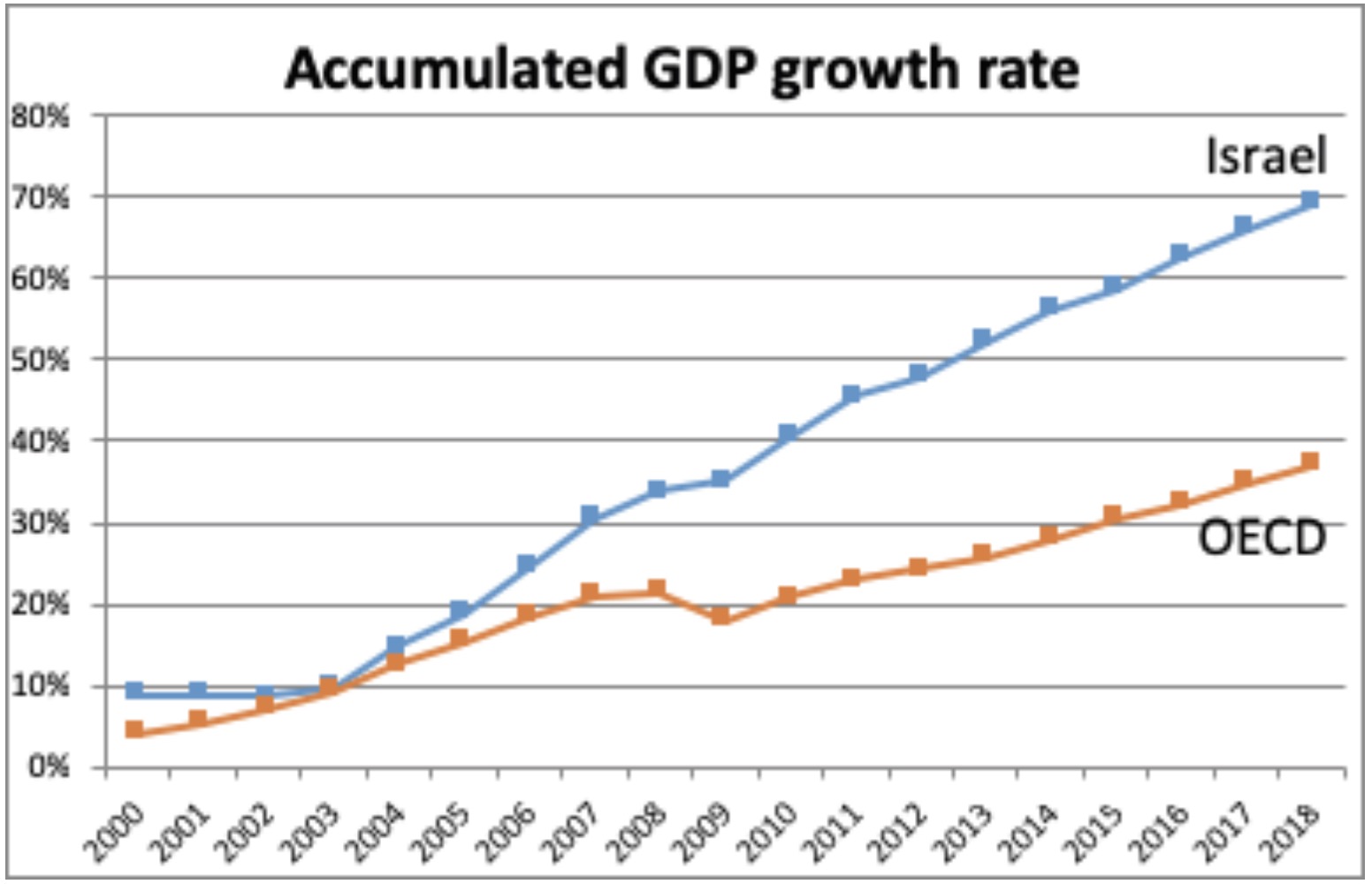
And for that matter, so can the Palestinians. They won't capitulate either. They'll raise the next generation to carry the fight. What else do they have?
Enough people want this conflict to go on. Especially the religious fanatics. People can have this strange discussion of who is morally more justified than the other in a long conflict like this. A better discussion would be how the conflict could be ended. Without the virtue signaling. -
CoronavirusThere won't be any progress on the matter like this. — Benkei
Well, if you consider everything that any intelligence service says to be total propaganda.
I think the real debate ought to be on the safety of the gain of function research, which was earlier prohibited. Then the ban was ended, and now a permanent ban is pushed forward. This research has really been put on and off quite many times.
Let's remember what happened in 2017 with the ending of the gain of function research ban, which specifically was about corona-virus research:
(See The Lancet (February 2018), Ban on gain-of-function studies ends)The US moratorium on gain-of-function experiments has been rescinded, but scientists are split over the benefits—and risks—of such studies. Talha Burki reports.
On Dec 19, 2017, the US National Institutes of Health (NIH) announced that they would resume funding gain-of-function experiments involving influenza, Middle East respiratory syndrome coronavirus, and severe acute respiratory syndrome coronavirus. A moratorium had been in place since October, 2014. At the time, the NIH had stated that the moratorium “will be effective until a robust and broad deliberative process is completed that results in the adoption of a new US Government gain-of-function research policy”. This process has now concluded. It was spearheaded by the National Science Advisory Board for Biosecurity (NSABB) and led to the development of a new framework for assessing funding decisions for research involving pathogens with enhanced pandemic potential. The release of the framework by the Department of Health and Human Services (HHS), of which NIH is part, signalled the end of the funding pause.
The situation has its roots in 2011, when the NSABB suppressed two studies involving H5N1 viruses that had been modified to allow airborne transmission from ferret to ferret. They worried that malign actors could replicate the work to deliberately cause an outbreak in human beings. After much debate, the studies were published in full in 2012. HHS subsequently issued guidelines for funding decisions on experiments likely to result in highly pathogenic H5N1 viruses transmissible from mammal to mammal via respiratory droplets. The guidelines were later expanded to include H7N9 viruses.
In 2014, several breaches of protocol at US government laboratories brought matters to a head. The news that dozens of workers at the Centers for Disease Control and Prevention (CDC) might have been exposed to anthrax, that vials of smallpox virus had been left lying around in an NIH storeroom, and that the CDC had unwittingly sent out samples of ordinary influenza virus contaminated with H5N1, shook faith in the country's biosafety procedures. Over 200 scientists signed the Cambridge Working Group declaration arguing for a cessation of experiments creating potential pandemic pathogens “until there has been a quantitative, objective and credible assessment of the risks, potential benefits, and opportunities for risk mitigation, as well as comparison against safer experimental approaches”.
The debate is focused on a subset of gain-of-function studies that manipulate deadly viruses to increase their transmissibility or virulence. “This is what happens to viruses in the wild”, explains Carrie Wolinetz, head of the NIH Office of Science Policy. “Gain-of-function experiments allow us to understand how pandemic viruses evolve, so that we can make predictions, develop countermeasures, and do disease surveillance”. Although none of the widely publicised mishaps of 2014 involved such work, the NIH decided to suspend funding for gain-of-function studies involving influenza, MERS-CoV, and SARS-CoV.
And what is now happening?
(27th May 2021) The US Senate has passed an amendment by Republican Senator Rand Paul to permanently ban the National Institutes of Health and any other federal agency from funding gain-of-function research in China.
“We don’t know whether the pandemic started in a lab in Wuhan or evolved naturally,” Senator Paul said in a statement.
“While many still deny funding gain-of-function research in Wuhan … the passage of my amendment ensures that this never happens in the future.”
The amendment defined gain-of-function research as “any research project that may be reasonably anticipated to confer attributes to influenza, MERS, or SARS viruses such that the virus would have enhanced pathogenicity or transmissibility in mammals”.
The Senate chamber cheered after the amendment was passed. -
Israel killing civilians in Gaza and the West BankThe Jewsih historian Illan Pappe has a whole book documenting the Ethnic Cleansing of Palestine, which has not stopped to this day. And likely-Prime Minister elect Bennett is on record saying that he wants to annex 60% of the West Bank. So there's that. — StreetlightX
Pappe has gotten some criticism, but I think the main argument that the exodus was planned by the Yishev holds. But then again, parts of Galilee did have a considerable amount of Palestinians. I think Benny Morris has a point when he says:
"In retrospect, it is clear that what occurred in 1948 in Palestine was a variety of ethnic cleansing of Arab areas by Jews. It is impossible to say how many of the 700,000 or so Palestinians who became refugees in 1948 were physically expelled, as distinct from simply fleeing a combat zone."
And there is much debate about Plan Dalet, which Pappe finds crucial here. -
BlackRock and Stakeholder CapitalismI don't remember if I've invested in Black Rocks funds at some point or not. At least it has been an option to invest in some of their funds in my investment portfolio. But the company is well known.
-
Israel killing civilians in Gaza and the West Bank
Well known is the massacre at the village of Deir Yassin:I don't know too much about those smaller massacres, you'll have to enlighten me on the history there. Where and when did these smaller massacres take place and did news then travel to other villages causing mass exodus? Let's go to the history on this one. — BitconnectCarlos
The Deir Yassin massacre took place on April 9, 1948, when around 130 fighters from the Far-right wing Zionist paramilitary groups Irgun and Lehi killed at least 107 Palestinian Arabs, including women and children, in Deir Yassin, a village of roughly 600 people near Jerusalem. The assault occurred as Jewish militia sought to relieve the blockade of Jerusalem during the civil war that preceded the end of British rule in Palestine.
The villagers put up stiffer resistance than the Jewish militias had expected and they suffered casualties. The village fell after house-to-house fighting. Some of the Palestinian Arabs were killed in the course of the battle, others while trying to flee or surrender. A number of prisoners were executed, some after being paraded in West Jerusalem. In addition to the killing and widespread looting, there may have been cases of mutilation and rape. Despite an original boast by the victors that 254 had been killed, modern scholarship puts the death toll at far fewer. Palestinian historian Aref al-Aref counted 117 victims, seven in combat and the rest in their homes. The number of wounded is estimated to between 12 and 50. Five of the attackers were killed and a dozen wounded.
The massacre was condemned by the leadership of the Haganah—the Jewish community's main paramilitary force— by the area's two chief rabbis and famous Jews abroad like Albert Einstein, Jessurun Cardozo, Hannah Arendt, Sidney Hook and others. The Jewish Agency for Israel sent Jordan's King Abdullah a letter of apology, which he rebuffed. He held them responsible for the massacre, and warned about "terrible consequences" if similar incidents occurred elsewhere.
Here's a clip from a documentary explaining Deir Yassin. People from both sides are interviewed. If you look the whole clip, it explains interestingly also how many in the US, Middle-East experts and also Secretary of State George Marshall, were opposed to the idea of Israel and feared (correctly) that it would start a war, but Truman had his way. (video clip 9 min 26s)
There were also the massacres at Lydda and Abu Shusha. And similar events happened, yet the overall number of people killed was rather low.
The basic issue was that civilians fleeing the fighting couldn't get back. I assume that large numbers of Palestinians thought they could come back to their homes once the fighting stops. I think this is debatable how systematic, how planned from the Israeli side the exodus was. But perhaps someone other can shed the light on this. -
Coronavirus
Yes, there was (is) this narrative going on that to utter the Lab-leak hypothesis, you were racist pizzagate-level conspiracist Trump-supporter and only now thanks to "new" information is this is a respectful hypothesis. This is a way for some parts of the media to start looking at the possibility (and forget how they wrote about it in the past). That the hypothesis has always been plausible, just like and others remarks, is denied. Just as talking about the possibility didn't make you a Trump supporter in the first place.The misinformation and censorship regarding the lab theory is quite the scandal. Facebook went so far as to ban any discussion of the theory on its platform, ironically to protect the public from misinformation. And these measures were all based on poor science. One has to wonder what sort of information and evidence has been lost during that time. — NOS4A2
The unfortunate issue is that this isn't going away. Misinformation and disinformation are far too easy to use in this time of age and they are very effective. In fact, a clever actor can quite discreetly gain his objectives without being noticed. My concern is that the whole discourse will simply be smudged over to such level that any person, especially medical professional or academic, won't touch it with a ten foot pole. In order to make an issue simply undebatable, you will have to create the so-called "alternative-facts" and an alternative universe where the opposing narratives simply don't meet. That confuses people. Deny everything and make counteraccusations. That's the way the Chinese likely will respond, because it's an effective response. -
Israel killing civilians in Gaza and the West Bank
It's called now days ethnic cleansing. The Jews didn't perpetrate large massacres, but enough to start the Palestinian exodus. Yet I don't know how biased the history is here.The problem stems from the Independence War of '47-'48 when David Ben-Gurion expelled some of the Arab communities in the area, but not others. — BitconnectCarlos
Not a solution like the Turks had to the "Armenian problem". -
CoronavirusAnd likely will float counter conspiracy theories, which will sink into people as a knife to soft butter. The objective is smudge everything over and confuse people.
As I said, a positive outcome would be that historians later are in agreement what happened in 2019 in Wuhan. -
CoronavirusAnd I have not yet rejected the possibility that it isn't a lab leak.
I can change my views if new information comes to light. -
Coronavirus
Absolutely wrong.The argument seems to be that the possibility can't be excluded, therefore it happened. — Banno
A possibility is a possibility. You are the one making the argument that a person in one article says that it's extremely unlikely, so other people here have no logic.
I genuinely don't understand such rejection of a possibility when the pandemic started from a city with a lab that not only researches coronaviruses, but genetically engineers coronaviruses to attack human cells...and then when we have not found the trace from the market to an animal (as the natural cause).
Bit of a coincidence. And actually gave a great article back from 2012 when Trump wasn't yet in politics etc. Here's a quote about the probabilities of lab leaks happening:
Simple mathematical analysis gives real reason for concern about the handling of these dangerous viruses. Consider the probability for escape from a single lab in a single year to be 0.003 (i.e., 0.3 percent), an estimate that is conservative in light of a variety of government risk assessments for biolabs and actual experience at laboratories studying dangerous pathogens. Calculating from this probability, it would take 536 years for there to be an 80 percent chance of at least one escape from a single lab. But with 42 labs carrying out live PPP research, this basic 0.3 percent probability translates to an 80 percent likelihood of escape from at least one of the 42 labs every 12.8 years, a time interval smaller than those that have separated influenza pandemics in the 20th century. This level of risk is clearly unacceptable. (A detailed analysis, additional arguments, documentation, and mathematical justification for these conclusions can be found in the research report written by one of us, “Sharpening Our Intuition on Man-made Pandemics.”)
Awful as a pandemic brought on by the escape of a variant H5N1 virus might be, it is SARS that now presents the greatest risk. The worry is less about recurrence of a natural SARS outbreak than of yet another escape from a laboratory researching it to help protect against a natural outbreak. SARS already has escaped from laboratories three times since 2003, and one escape resulted in several secondary infections and one death.
What is the likelihood that the virus’s escape could lead to a pandemic? Too high, given the lessons taught by the natural SARS outbreak a decade ago.
But somehow Dominic Dwyer saying that the risk is extremely low, then people ridicule others that say that it still is a possibility. -
Israel killing civilians in Gaza and the West BankI don't think you got my point: If you fear that your own citizens will turn your back on you and go with the enemy, then you obviously have done something wrong: you have failed in creating social cohesion, you have not integrated your citizens or have successfully instilled the idea of your own country to the people living there. Usually these fears what you are talking have been the racist fears in the population and when politicians start pandering to these fears, the outcome is ugly. People who have believed they are full citizens suddenly have to notice that they are viewed as the enemy by their own country. Many times in history these "unreliable" segments of the citizenry, be they a minority or supporters of political movement have been very loyal.
(Arvid Janhunen fought with the Reds during the Finnish Civil War and later he excelled in battle during WW2 getting the highest war medal in Finland (the Mannerheim-cross) fighting in the army he had 21 years earlier fought against. Many former members of the Red Guard also fought in WW2 in the ranks of the Finnish Army and their commitment in the Winter War showed the unity of the country and that the wounds of the civil war had healed. If Finland would have feared a "fifth column", likely national unity wouldn't have been achieved.)

Yes, I do notice that Arab Israelis can go voluntarily to serve. That they don't do so in large numbers does tell something. And this was just one area where these differences by law appear. And the problem is that Israel is for the Jews. Others come later. Any country that treats a part of it's citizenry as a possible "fifth column" has a serious problem. -
CoronavirusI think people here are talking about a hypothesis.
So It's pretty odd replying to @Apollodorus that there is "no logic" in the schema and that the article you linked (see ) has all the answers.
It doesn't.
The simple problem here is that China has already jailed doctors for raising alarm in the pandemic and IS a totalitarian country. mentions more statements that not everything was given. Hence it could be a possibility that the Chinese officials erased or kept any kind of data on the Wuhan lab people having had Covid-symptoms etc. In a country like in the US, similar secrecy likely would backfire. So great, no traces indicated to the WHO team (that had as it's members people who had links to the Wuhan lab and a motivation for not finding a leak). What I find from the article that you linked is only that the author says it's extremely unlikely been a lab-leak (even if they sometime happen). And I guess that is it for you. Yet, even the WHO Director didn't rule out the hypothesis and admits that not everything was given, which does make me think it's a genuine possibility. If it really would be so extremely unlikely, why would he mention it?
So I don't understand your logic here, actually.
What I think is that likely we won't know either ever or for a very long time. Likely the whole discussion will be tried to be tarnished just as propaganda. Smoke and mirrors and accusations... Likely it's only historians a hundred years from now, who might come into agreement on what happened. Not it's too much of a political hot potato. -
Israel killing civilians in Gaza and the West Bank
That's just to show that the issues aren't fabricated, propaganda and actually everything is just fine with the Arab Israelis.You cite 10 different detailed claims which is just too much for me to respond to. — BitconnectCarlos
You said it very well: there is no objective to make the Arab citizens to be part of the nation as "their brethren" are the enemy.Yes, Israel exempts Arab citizens from conscription because Israel does not believe it civil to force Arab Israelis to fight against their own brethren as Israel is often at war. — BitconnectCarlos
Here lies the fundamental problem: Israel views itself as the homeland for jews, and that one group of people have conscription while others have not tells of a problem.
Actually military can be used to integrate people into the nation. It also tells that all citizens are treated equally. -
Israel killing civilians in Gaza and the West BankThis is how apartheid begins to end. — StreetlightX
Nice that you can be an optimist.
I remember a same kind of front made by Time magazine about those killed in the US by firearms:

And what happened to the gun laws? -
CoronavirusI've just read in the news that many scientists are doubting China's official view of events but prefer to remain silent for fear of being associated with "conspiracy theories". — Apollodorus
I think the reason is that one of the leading medical journals, The Lancet, published a condemnation of all "conspiracy theories" of possibility of a lab leak. Of course, the those totally rejecting one hypothesis at that moment when we don't know much, likely have something to hide. From the article Origin of Covid — Following the Clues by Nicholas Wade in New York Times :
From early on, public and media perceptions were shaped in favor of the natural emergence scenario by strong statements from two scientific groups. These statements were not at first examined as critically as they should have been.
“We stand together to strongly condemn conspiracy theories suggesting that COVID-19 does not have a natural origin,” a group of virologists and others wrote in the Lancet on February 19, 2020, when it was really far too soon for anyone to be sure what had happened. Scientists “overwhelmingly conclude that this coronavirus originated in wildlife,” they said, with a stirring rallying call for readers to stand with Chinese colleagues on the frontline of fighting the disease.
Contrary to the letter writers’ assertion, the idea that the virus might have escaped from a lab invoked accident, not conspiracy. It surely needed to be explored, not rejected out of hand. A defining mark of good scientists is that they go to great pains to distinguish between what they know and what they don’t know. By this criterion, the signatories of the Lancet letter were behaving as poor scientists: they were assuring the public of facts they could not know for sure were true.
It later turned out that the Lancet letter had been organized and drafted by Peter Daszak, president of the EcoHealth Alliance of New York. Dr. Daszak’s organization funded coronavirus research at the Wuhan Institute of Virology. If the SARS2 virus had indeed escaped from research he funded, Dr. Daszak would be potentially culpable. This acute conflict of interest was not declared to the Lancet’s readers. To the contrary, the letter concluded, “We declare no competing interests.”
Virologists like Dr. Daszak had much at stake in the assigning of blame for the pandemic. For 20 years, mostly beneath the public’s attention, they had been playing a dangerous game. In their laboratories they routinely created viruses more dangerous than those that exist in nature. They argued they could do so safely, and that by getting ahead of nature they could predict and prevent natural “spillovers,” the cross-over of viruses from an animal host to people. If SARS2 had indeed escaped from such a laboratory experiment, a savage blowback could be expected, and the storm of public indignation would affect virologists everywhere, not just in China. “It would shatter the scientific edifice top to bottom,” an MIT Technology Review editor, Antonio Regalado, said in March 2020.
Yes, there is the letter published in 17 March 2020 in the journal Nature Medicine led by Kristian G. Andersen, that said it's natural. Basically the argument was that because there aren't tell tale signs of cutting and pasting, it had to be natural. Unfortunately newer technologies don't leave those traces. So the article is wrong in ruling out the hypothesis.It's been established the virus is not engineered and I was under the impression the lab was for animal testing? — Benkei
Yep, putting corona-virus into humanized mice. Thanks to the Chinese asking for money from the US, they had to say just what exactly they were going to do. Hence I believe what Nicholas Wade writes in the article is true:I was under the impression the lab was for animal testing? — Benkei
Dr. Baric had developed, and taught Dr. Shi, a general method for engineering bat coronaviruses to attack other species. The specific targets were human cells grown in cultures and humanized mice. These laboratory mice, a cheap and ethical stand-in for human subjects, are genetically engineered to carry the human version of a protein called ACE2 that studs the surface of cells that line the airways.
Dr. Shi returned to her lab at the Wuhan Institute of Virology and resumed the work she had started on genetically engineering coronaviruses to attack human cells. - Dr. Shi set out to create novel coronaviruses with the highest possible infectivity for human cells. Her plan was to take genes that coded for spike proteins possessing a variety of measured affinities for human cells, ranging from high to low. She would insert these spike genes one by one into the backbone of a number of viral genomes (“reverse genetics” and “infectious clone technology”), creating a series of chimeric viruses. These chimeric viruses would then be tested for their ability to attack human cell cultures (“in vitro”) and humanized mice (“in vivo”). And this information would help predict the likelihood of “spillover,” the jump of a coronavirus from bats to people. -
CoronavirusPossible, I suspect the biological weapon hypothesis. Something like flu as a weapon is simply stupid. The Japanese that actually used biological weapons against the Chinese had quite a few of their own soldiers killed by their own "weapons".
(Unit 731: These Japanese were really up to no good during WW2)

More likely alternative is that this is just gain-of-function research, as corona-virus was studied at the Wuhan lab and China has had it share of corona outbreaks before, so it's obvious to prepare for corona outbreaks:
The Wuhan Institute of Virology has studied bat coronaviruses for years and their potential to ultimately infect humans, under the direction of scientist Shi Zhengli, as the Scientific American explained in a June 2020 story. Such zoonotic transfer — meaning transmission of a virus from an animal to a human — of coronaviruses occurred with the SARS and MERS coronaviruses, which led to global outbreaks in 2003 and 2012. Both viruses are thought to have started in bats, and then transferred into humans through intermediate animals — civets and racoon dogs, in the case of SARS, and camels in the case of MERS.
And with a twist that got the US politics involved:
See article hereIn 2014, the NIH awarded a grant to the U.S.-based EcoHealth Alliance to study the risk of the future emergence of coronaviruses from bats. In 2019, the project was renewed for another five years, but it was canceled in April 2020 — three months after the first case of the coronavirus was confirmed in the U.S.
EcoHealth ultimately received $3.7 million over six years from the NIH and distributed nearly $600,000 of that total to China’s Wuhan Institute of Virology, a collaborator on the project, pre-approved by NIH.
The grant cancellation came at a time when then-President Donald Trump and others questioned the U.S. funding to a lab in Wuhan, while exaggerating the amount of federal money involved.
If we just remember that the lab-leak is only a hypothesis, but a very credible one, the most likely issue is totally accidental outbreak, which may even have gone unnoticed. Corona-virus isn't like the bubonic plague: that might too start with a fever, but when those swollen lymph nodes, you know it isn't "just a flew" and for any doctor will observe that. Remember how long lasted period when there was a "strange flew" going on?
Let's say you are a lab worker that has children in the daycare or school and you get a cold and it's flu season, do you first suspect a lab leak? Only when people are dead sure they have gotten infected, will the immediate exclusion start. How would the case number 1. know, if he or she didn't even have symptoms or very mild ones?
And of course there is the Wall Street article:
A Wall Street Journal report on Monday claimed that three researchers from China’s Wuhan Institute of Virology were hospitalised after they were rendered sick in November 2019 “with symptoms consistent with both COVID-19 and common seasonal illness.” The report quoted US intelligence sources. -
CoronavirusSeems that the Lab-leak hypothesis is finally getting some interest in the correct circles:
See Covid: Biden orders investigation into virus origin as lab leak theory debated(BBC) US President Joe Biden has ordered intelligence officials to "redouble" efforts to investigate the origins of Covid-19, including the theory that it came from a laboratory in China.
He said the US intelligence community was split on whether it came from a lab accident or emerged from human contact with an infected animal. Mr Biden asked the groups to report back to him within 90 days.
China has rejected the laboratory theory.
I think a lot of people in the media dismissed too easily the lab leak hypothesis because Trump had floated the idea. Now some media outlets are backpedalling for the hypothesis to be a "genuine possibility". Interesting to see what happens. What is sure is that it won't be an easy case to solve China will deny it in any case. Likely it will end up as a myth and historians perhaps 100 years from now will be in agreement about the issue.
(Perhaps a country like Norway might be so honest that if it would have been their laboratory where the virus broke out, they would would say: "Ooops, sorry about that." And, oh boy, the demands and the trials for compensation from the Norwegian Sovereign Wealth funds!) -
Israel killing civilians in Gaza and the West BankYou are also relying on it being vague and expansive. — fdrake
I think the counterargument to anything here is:
"Israel has the right to defend itself and Hamas wishes to destroy Israel."
And that basically covers everything. Nothing else needed. -
Israel killing civilians in Gaza and the West BankWhat sort of discrimination and who is it coming from? — BitconnectCarlos
Ok, where do we start?
How about the systemic discrimination based upon legislation:
The definition of the State of Israel as a Jewish state, as enshrined in law, allows inequalities to persist and enables state-sanctioned discrimination against Palestinian citizens of Israel. Increasingly, since the election of the right-wing Netanyahu-led government in 2009, coalition members have also introduced a raft of discriminatory legislation. Much of this legislation focuses on “loyalty oaths” to Israel as a Jewish, Zionist and democratic state; the criminalization of speech that challenges the Jewish and/or Zionist nature of the state; the imposition of more restrictions on political participation and even citizenship rights for “breach of loyalty” to the state. Over the last three years, several new laws have been enacted that discriminate against Palestinian Arab citizens of Israel, including legislation in the field of economic, social and cultural rights:
• The Israel Land Administration Law (2009): This law institutes broad land privatization (much of the land owned by the Palestinian refugees and internally displaced persons would be subject to privatization under the law.
• Amendment (2010) to The Land (Acquisition for Public Purposes) Ordinance (1943): This Mandate-era law authorizes the Finance Minster to confiscate land for “public purposes”. The amendment confirms state ownership of a massive amount of Palestinian land confiscated under this law, even where it has not been used to serve the original purpose of its confiscation.
• Absorption of Discharged Soldiers Law (1994) Amendment No. 7: Benefits for Discharged Soldiers (2008): Allows the use of military/national service as a criterion for the allocation of benefits in higher education. The vast majority of Palestinian citizens of Israel are exempted from military service and do not serve in the Israeli army for political and historical reasons.
• The Economic Efficiency Law (Legislative Amendments for Implementing the Economic Plan for 2009-2010) (2009).
a. A section of this law concerns “National Priority Areas” (NPAs). It grants the government sweeping discretion to classify towns, villages and areas as NPAs and to allocate enormous state resources without criteria, in contradiction to the Israeli Supreme Court’s 2006 decision in HCJ 2773/98 and HCJ 11163/03, The High Follow-Up Committee for Arab Citizens in Israel v. Prime Minister of Israel.
b. A further section of this law concerns the distribution of “child allowances.” Under the new law, children who do not receive the vaccinations mandated by the Health Ministry will no longer be provided with financial support. This provision mainly affects Arab Bedouin children living in the Naqab (Negev).
Then of course the downgrade of Arabic being an official language to only have "special status". (Something that would cause a total outrage in a bi-lingual country as mine)
Then there are things like education:
According to a 2001 report by Human Rights Watch, Israel's school systems for Arab and Jewish children are separate and have unequal conditions to the disadvantage of the Arab children who make up one quarter of all students. - Government-run Arab schools are a world apart from government-run Jewish schools. In virtually every respect, Palestinian Arab children get an education inferior to that of Jewish children, and their relatively poor performance in school reflects this.
Then there is the political reality of Arab Israeli political organizations in Israel:
While Israel has several political parties that have historically represented Arab citizens’ interests, none have ever been asked to join a governing coalition.
And then there are the feelings toward Palestinians by the Jewish population:
ACRI poll: "Over two-thirds Israeli teens believe Arabs to be less intelligent, uncultured and violent. Over a third of Israeli teens fear Arabs all together ... The report becomes even grimmer, citing the ACRI's racism poll, taken in March 2007, in which 50% of Israelis taking part said they would not live in the same building as Arabs, will not befriend, or let their children befriend Arabs and would not let Arabs into their homes."
Various polls, including the Israel Democracy Institute's poll, revealed that 62 percent of the Jewish public expects the State to take action to encourage Arab migration from Israel, at the same time, over 90 percent expect the State to encourage Jewish immigration.
And the list continues...on and on.
Perhaps people who discuss institutional racism in the US ought to compare things to Israel. And we are not even talking about the people that lived on the land that Israel annexed later...the "Palestinians", as if these Palestinians were not Palestinians, but just Arabs living in Israel. The idea is simply crazy: the idea that the same people only subjugated in two different wars that were separated only by 19 years creates different people. It's only divide et impera-move and an attempt to apply smoke and mirrors. -
Israel killing civilians in Gaza and the West Bank
And of course the real issue is that these Palestinians, who officially aren't even called Palestinians but Arab israelis, do face discrimination in the country even if being citizens.From a legal standpoint, one is an Israeli citizen entitled to Israeli legal rights and the other is not. — BitconnectCarlos -
Israel killing civilians in Gaza and the West Bank
That's one good way how to think of it.Israel's strategy is baffling except as an attempt to maintain the conflict for as long as possible as cover for expansions of settlements, expulsions, and further encroachments. — Baden
And other thing is that they focus their message on two special audiences: the US and the religious zealots. Perhaps just in the same way that the Arab side focuses their rhetoric on the Arab street, not to other countries and officials. And this makes the discourse in the Middle East so bellicose and utterly aggressive. Also do notice that if anywhere else we discuss security policy, we see sides building deterrences, making moves and countermoves while in the Middle East the other side is portrayed as utterly mad crazies capable of doing anything. End of story: trying to even understand the other side is deplorable, it simply can't because it's evil. Hence if in Europe some developments are found "troubling" or "deeply troubling", equivalent developments in the Middle East are "an existential threat" and "give rise to an imminent war".
And then there are all the armed groups and proxies. Having proxies to fight your wars and / or bombing a proxy of your opponent is totally normal.
What is the actual difference between Palestinians and Israeli Arabs than a passport?
Haste try to divide et impera? -
Israel killing civilians in Gaza and the West BankWe can cut through all the distractions. Is it ok to bomb civilian populations in which so-called terrorist operatives are embedded when these operatives present a threat (though a relatively low-level one compared to said bombings) to civilian lives on the opposing side? If it is, it should be OK in the case of both the IRA and HAMAS and their respective communites of origin. If it's not, it shouldn't, right? — Baden
I think war is morally dubious and those that only look at the moral justifications typically are the culprits for the war in the first place. Bombing civilians isn't an OK thing and counterproductive...if your objective is to find a solution to the conflict, that is. Sometimes that isn't the objective.
IF you want to win a counter-insurgency, you first HAVE TO UNDERSTAND that no matter how successful you are in military operations, to win YOU NEED A POLITICAL SOLUTION in a counter-insurgency. Or then just wish that the other side utterly dismantles itself by alienating it's supporters from the cause. (Or then there's the Algerian example) Sounds simple, but some people really, really, don't get it. They just assume that talking about a political settlement is just political window dressing for liberals or so. They believe the war propaganda. Yet counter-insurgency is totally different from a conventional war where one side might choose a diplomatic settlement if it is clearly loosing. Insurgencies typically don't go that way.
These people who favour a military solution only, usually the so-called "hawks", become fixated on simply the warfare aspect, getting the "murderous" terrorists, creating lists of targets and military sounding objectives. The "no-nonsense" approach in their minds. Largely this is to uphold the "hawk" image typically for domestic reasons. Yet they really think that killing or jailing every member or supporter of the movement will solve the problem. Well, that might succeed if the "terrorists" or the so-called "insurgency" is a small alienated cabal of 17 members of a death cult that is so mental that people cannot understand why the 16 follow the leader. Yet that doesn't apply to an insurgencies we are talking about. Especially when you create the reasons for the insurgency by an apartheid system in the case of Israel. You might kill and jail every leader and activist, but then that leads just to a new generation coming after that.
The reason why this is so difficult to understand is a) people don't think it through or b) they either support one side or are so morally outraged of some action that they cannot fathom a political solution. Hence they think they that the other side can be and ought to be bombed into submission. By dehumanization, you can get people to think like this.
And of course then there are c) those politicians who have as their objective not to stop conflict, but gain power and political success personally by perpetrating the conflict. Their objective is to make any enemy equivalent to the "alienated death cult cabal" or, at worst, to create one, if the insurgency otherwise could find international and domestic support and understanding.
Still in the end, you need a political solution. -
Israel killing civilians in Gaza and the West Bank
On the other hand, the actions of the British Army during "Operation Banner" and the actions of the Israeli Armed Forces toward the Palestinians are also different, one should remember.The cruelty of Palestinian terror far outweighs that used by the IRA. The more research I do into the types of attacks conducted by the IRA vs. Palestinian terror the more these organizations become drastically different. I'm not really into an argument here: The two aren't remotely close. Just look into the 2nd Intifata. — BitconnectCarlos
The British have rare examples of successes in counterinsurgency warfare (Oman, Malaya) and perhaps understand these things better. And it shows in how they dealt with North Ireland.
(British troops in their "Vietnam", during the Malayan emergency. Notice the difference between the whole narrative between the war in Vietnam and the war in Malaysia.)

The failure of Israel to understand this is a political one. It can be seen at best from the failed Lebanon occupation. As one military study puts it aptly:
Israel, a country that had achieved four spectacular military victories
in 1948, 1956, 1967 and 1973, invaded Lebanon out of its belief in the
singular efficacy of military force, a belief borne of its previous experiences
with war. However, Israel’s strategic concept behind the Lebanese debacle
was wrong-headed. Israel believed that in the Palestinians and later in the
Shiite resistance, it faced a military problem that could be resolved through
resort to conventional war. It did not understand, as its opponents did, that
the strategic problems it sought to address could not be resolved without
settling the fundamental underlying political issues that had caused war in
the first place. Neither Palestinians nor Shiite militants ever tried seriously
to mount a conventional military attack against Israeli forces; they never
had the capability even if they had desired to take such action. Both groups
acted to preserve their military forces to the greatest extent possible,
eschewing high-risk attacks to ensure that Israel could never destroy all of
their fighters. And because they were supported, fed, and nurtured by their
peoples, the Palestinian and Shiite fighters created an impossible situation
for Israel. -
Does Counter-Intelligence Violate the Right to the Freedom of Assembly?Look at the bright side: they keep tabs on everybody. Pro-choice and Pro-life groups, right-wing militias, left-wing anarchists. After all, domestic terrorism is a heightened threat!
Just look at how they categorize Domestic Violent Extremists (DVEs):
- Racial hate groups
- Animal rights & Environmental Violent extremists
- Abortion related violent extremists
- Anti-government / anti-authority extremists
- others
(see: https://www.odni.gov/files/ODNI/documents/assessments/UnclassSummaryofDVEAssessment-17MAR21.pdf )
And as the saying goes, the most bellicose member urging people to take drastic action and being the most paranoid is likely the FBI informer (or plant) in any activist group. -
Israel killing civilians in Gaza and the West Bank
Once when just the riot police seems not to have the situation under control, then there is the next step. And this isn't limited to "other races". It genuinely can happen. We are just so hypocrite, self-righteous and full of ourselves when we say that "it could not happen here". But where is that "there" compared to "here"?So, the point remains unanswered, why is it inconceivable to us that white western civilians be subject to heavy military artillery bombardments as part of defensive actions against so-called terrorists while perfectly natural that brown non-westerners should be? — Baden
Are (or were) the Yugoslavs, like Slovenes, Croats or Serbs etc. white western civilians or not?
(The civil war started in Slovenia. Tanks & were used)

How about the Greeks? They had their Civil War after WW2. And had a hideous military junta afterwards.
(Artillery used in the Greek Civil War)

Or Ukrainians?
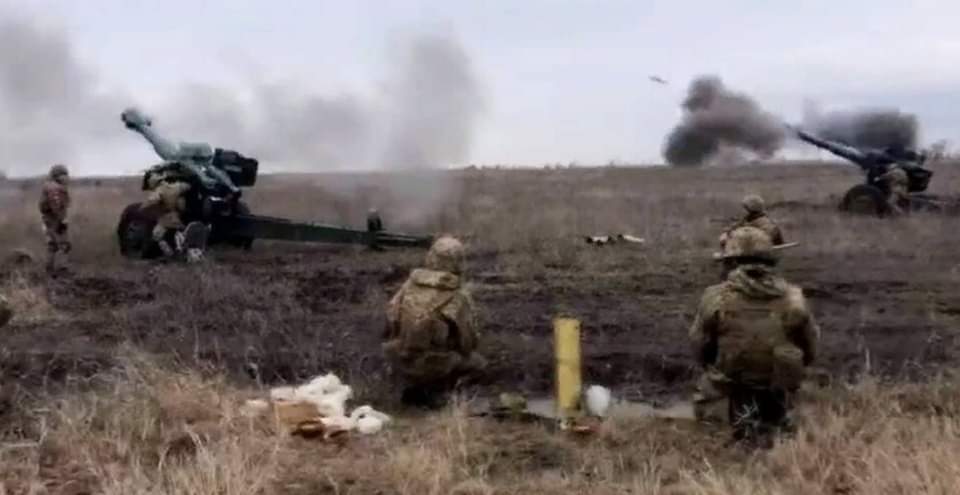
Russians? (Yeltsin using tanks in Moscow against the Parliament...and protesters)
Basically if any government feels so much under distress that it rolls out armour on to it's own streets, then there is a possibility of those vehicles using their firepower. That's why it's usually the last thing to do as nothing provokes a crowd more than a tracked armoured artillery pillbox. The possibility that things get out of control is there. Hence it isn't inconceivable that these kinds of tragedies could happen.
(French tanks guarding the Assemblee Nationale during the Algiers Putsch. in Paris, 1961.)
Even in Catalonia in 2017 military units were deployed to assist the riot police, hence the slippery slope was there. It's even more dangerous when the armed forces haven't trained to operate in a state of political upheaval. In an anti-EU protest the Danish military had to resort to live rounds as they didn't have any rubber bullets or other equipment etc. Luckily only few were injured (and good luck trying to find that in a Google search, as nobody wants to remember that an anti-EU demonstration in Denmark got live bullets fired at it!) We have now seen from the developments in Ukraine and Georgia that a Yugoslav-style civil war breakup of the Soviet Union was totally possible. So this isn't something only limited to the Middle East. -
Israel killing civilians in Gaza and the West Bank
You think the Palestinian conflict is only about Israel and Hamas?The IRA does not strike me as morally comparable to Hamas with both the methods and general hatred coming from Hamas running much deeper. — BitconnectCarlos
BC, do you know what the objective was of the "Peace for Galilee" operation? What was the main objective of that war and who were the Israelis going after? Let me quote Prime minister Menachem Begin's speech about the reasons why Israel opted to attack it's neighbor with the operation "Peace for Galilee":You drew an example from the Lebanon conflict earlier, but Lebanon was an actual war as opposed to dealing with the Palestinians. — BitconnectCarlos
As for Operation Peace for Galilee, it does not really belong to the category of wars of no alternative. We could have gone on seeing our civilians injured in Metulla or Qiryat Shimona or Nahariya. We could have gone on counting those killed by explosive charges left in a Jerusalem supermarket, or a Petah Tikvah bus stop. All the orders to carry out these acts of murder and sabotage came from Beirut. Should we have reconciled ourselves to the ceaseless killing of civilians, even after the agreement ending hostilities reached last summer, which the terrorists interpreted as an agreement permitting them to strike at us from every side, besides southern Lebanon? 'Not One Month of Quiet'
There are slanderers who say that a full year of quiet has passed between us and the terrorists. Nonsense. There was not even one month of quiet. The newspapers and communications media, including The New York Times and The Washington Post, did not publish even one line about our capturing the gang of murderers that crossed the Jordan in order to commandeer a bus and murder its passengers.
True, such actions were not a threat to the existence of the state. But they did threaten the lives of civilians whose number we cannot estimate, day after day, week after week, month after month.
During the past nine weeks, we have, in effect, destroyed the combat potential of 20,000 terrorists. We hold 9,000 in a prison camp. Between 2,000 and 3,000 were killed and between 7,000 and 9,000 have been captured and cut off in Beirut. They have decided to leave there only because they have no possiblity of remaining there. The problem will be solved.
I - we - can already look beyond the fighting. It will soon be over, we hope, and then I believe, indeed I know, we will have a long period of peace. There is no other country around us that is capable of attacking us.
He is not referring to the Syrians as being the terrorists, but the PLO. It was all about the Palestinian conflict.
And for the facts about how much "peace" this invasion got? The the massacres at Shabra and Shatila refugee camps didn't help (even if perpetrated by Israeli allies, the IDF ordering them to clear the refugee camps of PLO fighters was not a great move). Israel withdrew from Southern Lebanon only in the year 2000 and basically fought a low intensity war all that time there, for 18 years. The so-called "Southern Lebanese Army", the Israeli proxy, collapsed immediately and the area wasn't taken over by the Lebanese Army, but by Hezbollah, which had fought a long time the Israeli occupiers. And after six years Israel fought another war in Lebanon in 2006, which didn't go so well, actually.
So "Peace for Galilee" indeed, as the Likud Prime minister foresaw and "knew".
But anyway, it's a perpetual war and those in power in Israel totally fine with it. Why seek peace when this off and on -conflict isn't threatening the state? -
Israel killing civilians in Gaza and the West Bank
Baden, we in Europe were just fine with Yugoslav's killing well over 100 000 of each other. And in that conflict there were catholics, orthodox and yes, also muslims. When it comes to the Middle East, we simply just tell ourselves that that part of the World is a violent place and these people have been killing each other for ages. Period. If the Swiss would be having an ethnic conflict, we'd have "specialists" giving a multitude of reasons just why the Swiss cannot live in peace with each other and just why it has come to a civil war. And we'd be fine with that: It's just the Swiss, they are so bellicose to each other. And they have so many languages and ethnicities...The opposing sides in the troubles hated each other but there wasn't the same level of dehumanization. It would have been absolutely inconceivable for the British to have sent warplanes in and bombed Catholic neighbourhoods due to them harboring IRA suspects while the US and other western nations blithely pontificated, over the bodies of dismembered children, about Britain's right to defend itself. No, the Western world would have been in uproar because white Catholics are considered human whereas the Palestinians have yet to reach that level, as demonstrated aptly in this thread. Conclusion: racism is the primary driver behind the defenders of the recent civilian massacres in Gaza. — Baden
Yet I would make an emphasis on the crucial point you made: Basically the British government put it's soldiers and policemen into danger without heavy fire-support. It didn't minimize it's own losses and maximize losses of the other side. Every British government understood that tanks using their cannons, artillery firing shells or the Royal Air Force giving air support to the troops by bombs or rocket fire would mean that everything WOULD BE OVER. The British government could not then deny that there is a war going on. The television pictures would show it. The British government would get criticism and condemnation from European countries (and naturally the Soviet Union and the Eastern Bloc). It would have the British pop scene making groovy anti-war pop songs and the voters being fed up of the whole mess. Likely the British administration in power would have fallen. It would be just a part in the British malaise would have ended up in something more humiliating than the Suez crisis. Yet the PIRA laid down it's arms and some kind of peace has prevailed in Northern Ireland.
Just to understand how different this was from the present, here's a weekly documentary from 1972. What is telling is how different the interview with a higher ranking officer by the TV journalists is compared to these times. Now we live in an age of classic propaganda where such honest answers wouldn't be given and such questions wouldn't be even asked.
And this is not something only related to the UK. If the Spanish government would have sent the Spanish military into Catalonia with tanks and bombed Barcelona from the air, I think there would be a lot of support for Catalan Independence and widespread condemnation of the Spanish government. But if it would have come to that (or will come to that), in the end after the condemnations we'll just remark "There the Spanish go again...with another civil war of theirs".
So I don't think it's much about racism. We just adapt to people being crazy. Anywhere. -
Israel killing civilians in Gaza and the West Bank
Don't forget President Anwar Sadat of Egypt. He was killed after making a peace agreement with Israel (and getting back the Sinai) in an military victory parade in 1981. By the usual suspects (religious terrorists, who else?). I do remember a ton of bombings on Palestinian side and assassination of Rabin on the Israeli side the closer the two sides got to a real agreement. I remember this. Do you? — schopenhauer1

-
Israel killing civilians in Gaza and the West Bank
Yet those standard operational procedures (SOPs in general) do matter a lot. It starts from things like is fighting a terrorist group a police matter or a military matter? Do you mimic the Wehrmachts approach fighting partizans in Russia during WW2 or the approach of the Bundespolizei "fighting" the Red Army Fraction terrorists? Operational procedures or what kind of war you fight does matter. One of the most striking differences can be seen when you look at how the Soviet Union fought the Mujaddehin and the US has fought basically the same people for far longer. During the Soviet invasion at least half a million and up to two million civilians died. Now during the twenty years the US has fought in the same country about 40 000 civilians have died. That's the difference between SOPs.I certainly agree that Israel should take steps to make its operational procedures more humanitarian, but I refuse a moral equivalence between the standard operating procedures of the IDF and those of Hamas and other terrorist groups. — BitconnectCarlos
You seem to concentrate on the Hamas, yet conflict is far larger than one group among the Palestinians and Israel's actions towards it. One real issue is that now the more protesters have been the Palestinian citizens of Israel, the so-called "Arab Israelis" who aren't living either in the West Bank or the Gaza concentration camp. To say that every nation has the right to defend itself from attacks is true, but that doesn't give a carte blanche.
Why would they? That they nearly killed Prime minister Thatcher in Brighton in 1984 tells about the capability of the PIRA besides the "positive" kill ratio and the ability to survive to a political agreement, whereas similar knife attacks have even happened even here (and not by Hamas, but your local islamist terrorist wannabe ...and he was put down, not shot dead).I haven't studied the IRA conflict in detail, but have IRA members ever ran through London stabbing other people indiscriminately until they were eventually shot? — BitconnectCarlos
(Prime minister Thatcher with her husband and a personal aide being evacuated after the bomb attack. The facial expressions tell something.)

Yet the conflict in Ireland, not just in Northern Ireland but the whole history from the Irish revolt and the IRA, to Irish Independence and then "The Troubles" in Northern Ireland is quite comparable to the Palestinian conflict, if we separate from this the wars that Israel has fought with it's neighbors. In both in Ireland and in Palestine you actually have the British involved and in both occasions the fighting was a low intensity conflict. The fact is that Northern Ireland is rather peaceful now and the political agreement, the Good Friday agreement of 1998, has held should make people think what did the British do differently? Because in my view they did fight a low intensity conflict differently. Starting from the fact that nobody in the media called it a war or even an insurgency.

-
Israel killing civilians in Gaza and the West Bank
I doubt you would.If it can be demonstrated that Israel's response is considerably worse or out of line then I would reconsider my position. — BitconnectCarlos
One impartial observing side have been the blue berets in the Middle East, especially in Lebanon. I know a few reservists here who have made a stint in Lebanon and seen how the Israelis operate. And usually they are quite cynical about both sides. Some of them have made memoirs that accurately depicted the low intensity conflict before Israeli withdrawal from Lebanon. Nobody questions the abilities of the Israeli army. But many notice the the heavy handedness how they approach the conflict. So how does the Israeli army operate?
A small example. One way to counter the threat of ambushes is to simply shoot while driving through places which are suitable for ambushes. So when there is an orchard directly next to the road and you don't have good visibility, then just fire blindly to the orchard with the mounted machine gun to pin down anybody that is there. Israeli patrols used this approach in Lebanon. If then a small 5-year old girl who just happens to be in her family's own orchard is killed by this random shooting, just announce it that a "Palestinian terrorist" was killed that day.
In West Bank and Gaza Israeli military has taken a more "humane" approach: just simply cut down every orchard or forest next to the road that could make an ambush spot. Solution to the problem.
You can compare to other armed forces that operate in an low-intensity environment. I think the British Armed Forces in Northern Ireland are the best example of taking another strategy. Even today Police Stations in Northern Ireland are like miniature military fortresses.
Since 1960 the British military has killed 307 people in Northern Ireland of whom half have been Provisional IRA terrorist. Yet it has lost over 700 soldiers in the conflict. Hence in fact the Provisional IRA has killed far more British soldiers and policemen than they have suffered losses. The perpetrators of the bloodiest attack against British forces were caught immediately, but released because there wasn't enough evidence to convict them. Once released, the other one of these was killed while making another bomb, but the other lived as a free man. That you do have PIRA members still living in the UK tells something about how the UK handled the conflict with it's Good Friday agreement etc.
There you can note the difference how a democratic country fights terrorism: with the laws implemented and treating the terrorists as other criminals. Above all, trying to treat the issue as a police matter.
Of course Israel can say that it follows it's own laws. And here's the basic problem: the Apartheid system starts from it's citizens being in different categories. -
In praise of science.
The proponents of scientism define science to be so different from political or economic investigations. Yet one can be objective, trying to observe reality without any personal or ideological agenda and do this from the viewpoint of politics, economy, even looking at the religious aspects using the same methods as in scientific research.I wish to discuss science as an understanding of reality - relative to a religious, political and economic ideological understanding of reality. Do they describe different things? — counterpunch
ssu

Start FollowingSend a Message
- Other sites we like
- Social media
- Terms of Service
- Sign In
- Created with PlushForums
- © 2026 The Philosophy Forum