
-
The Long-Term Consequences of Covid-19I gather that nationals and residents can cross the border, but for example some in Mexico cannot now come to Finland as there aren't any direct flights from there. Reason? Problem coming to France/Germany/Spain etc. and then getting a domestic flight. And oh btw. when they are residents of Finland, the local Embassy isn't so desperate to help them.
-
The Long-Term Consequences of Covid-19
That's the way it goes.It’s more a race to the top. Ever since China entered the WTO their manufacturing costs have been rising along with their wages and standard of living. There is still rampant poverty, but the rate at which it has been reduced is nothing short of a miracle. As such it gets more and more expensive to do business there. So we look for cheaper manufacturing costs in maybe Vietnam or Bangladesh. Eventually their wages and standard of living will rise as well. — NOS4A2
First it was cheap labor, then as the labor gets more expensive, it has to be more productive and the industries change. Then it becomes a service economy. At start the clothing industry was mainly in the First World. Then the clothing industry migrated to Southeast Asia and China. From there it will migrate to Africa, if everything would go as earlier.
Well, it'starting to be really difficult. Air traffic is shutting down and if one your way to your destination is a country that has closed it's borders, it's a bit difficult.What gives you that idea? I can still travel from the Netherlands to other EU countries without problems provided that I meet the requirements of a lock down in any receiving State. — Benkei -
Corona and Stockmarkets...Now we genuinely and totally openly have Helicopter-money.
The Federal Reserve just pledged asset purchases with no limit to support markets
Remember this picture from the financial crisis with Fed Chairman Ben Bernanke? At least now they are open about it!
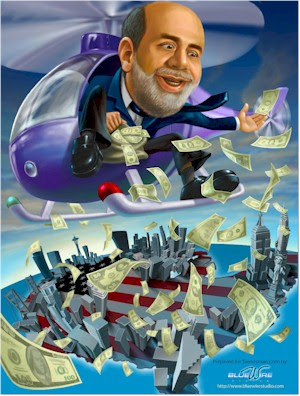
So now we have the chance perhaps for that monetary crisis afterwards... -
Coronavirus
Seriously speaking, this macabre example does tell us something:
There is a genuine incentive not to be open with the numbers of infected and especially with the deaths.
The less you test, the less dire the situation looks and if deaths aren't piling up and the health system isn't overwhelmed, things look better! And far easier simply for the officials say that this old person perished to the common flu. Or simply not to report them. Iran is the best example of this where nobody thinks that the official statistics are anywhere close to the real ones. And just how many died we may not know.
Then of course is the question just when you stop counting? If corona-virus isn't just for a year with us, but for longer time. Viruses like the Ebola are so deadly that they usually kill themselves quickly, but this covid-19 might stay far longer or simply mutate to be covid-21 or covid-29. -
CoronavirusYou have to have quite a long memory for this "games" to be played out, because the actual death toll will likely be only known much later as people do extensive study just who died of the corona-virus. If an old person doesn't go to the hospital and dies at home, you think they will check all the people for corona-virus? Or was it the flu? Hence you have at first quite a wild range of numbers only for history later to correct it.
That happened with swineflu epidemic of 2009. Report from 2013, four years later:
The swine-flu pandemic of 2009 may have killed up to 203,000 people worldwide—10 times higher than the first estimates based on the number of cases confirmed by lab tests, according to a new analysis by an international group of scientists.
The researchers also found almost 20-fold higher rates of respiratory deaths in some countries in the Americas than in Europe. Looking only at deaths from pneumonia that may have been caused by the flu, they found that Mexico, Argentina and Brazil had the highest death rates from the pandemic in the world. The toll was far lower in New Zealand, Australia and most parts of Europe, according to the study, published today (Nov. 26) in the journal PLOS Medicine.
The new estimates are in line with a previous study published last year that used a different statistical strategy to evaluate the impact of the pandemic caused by the H1N1 virus. However, that study, which was done before countries' data on overall death rates in 2009 had become available, found that the majority of deaths occurred in Africa and Southeast Asia.
The new analysis "confirms that the H1N1 virus killed many more people globally than originally believed," said study author Lone Simonsen, a research professor at The George Washington University in Washington, D.C. "We also found that the mortality burden of this pandemic fell most heavily on younger people and those living in certain parts of the Americas." -
Coronavirus
This really goes down to things like the common sense and how people take authorities and orders from the government.
For example, cafes and restaurants haven't been closed here, but they have seen a loss of 90% of their customers. And people do keep the distance when walking. The simple fact is that when you have only 1 death in the country it's hard to issue very draconian regulations. And if the vast majority will obey, is that enough to curb the peak and have the health sector functioning? After all, the reason for the lockdown is to have it effect the people in a longer time period. Time will tell. -
The Strange Case Of The Cardinal's Order and the FootraceDid I get you right or are you proposing that instead of us now saying that the javelins went 10 feet, 20 ft, 30ft and 40 ft we would say the contestants threw -10ft, -20ft, -30ft and -40ft with the last one being the winner?
-
The Long-Term Consequences of Covid-19
It's not only the aviation industry. All service sector jobs have severely been effected. Hence what is very likely is that there will be an economic depression, not just a brief recession.The aviation industry: anyone reading the news knows that the economy is going into a complete freewill, with the airline industry especially effected. — Dogar
The real question is if we make this permanent: If every time there is an outbreak somewhere in the World, are we ready to hit the breaks if it comes to our continent / country? When will there be an all clear sign given? With 9/11 it didn't happen. Even killing Bin Laden wasn't the end. -
Coronavirus
That order of "You are not allowed to go out for a walk for fresh air" is simply stupid. (Especially when your annoying neighbor with an ugly dog can go.)Coming soon to a sane government near you. — Baden
The only logical reason would be that Spaniards don't give a damn about regulations and hence it's easier for the police to break up people socializing in the park or whatever. Yet making the rules more draconian that "as people disobey them partly" would be enough is simply doesn't work. -
Coronavirus
Because everybody understands if a person dies to Covid-19, the reason is the pandemic.Teams of experts could easily be assembled to tell the headless chickens what to do about climate change. What gives one crisis traction and the other none? — frank
If climate change ruins the Egyptian harvest and the economic recession makes it that the government cannot prevent famine, which then turns into a civil war, how are you going to put the reason for masses of Egyptians killed like in Syria now on climate change? You can't. Can you blame climate policy on the deaths of the next Katrina type hurricane hitting Central America? Nope.
That's the reason. -
CoronavirusYeah, China fights back the meme that it was a "Chinese" disease. Blame the Italians!!! (If Trump & Fox News can do it, so can the Chinese and CGTN. Both are administration propaganda machines.)
-
Coronavirus
Countries that have had the outbreak earlier are good forecasts for later epidemic areas.I'm not insisting things will continue to grow exponentially in Italy, I'm saying it's not ruled out by the current data.
17% daily growth rate this week could mean 17% growth rate next week and the week after that and the week after that, until 50% of the population is infected and growth rate reduces due to running out of hosts.
Or, it could indeed mean 5% growth rate next week and then approaching 0% growth rate week after that.
Since we don't know which scenario we are in (precisely because we cannot know for sure all the mechanisms of transmission and how many need to be cut to approach 0% growth rate), is why, once this situation is reached the risk management conclusion quickly becomes "maybe what we're doing now is enough ... but we can no longer risk being wrong, so we need to do even more social distancing and enforce compliance with the military". — boethius
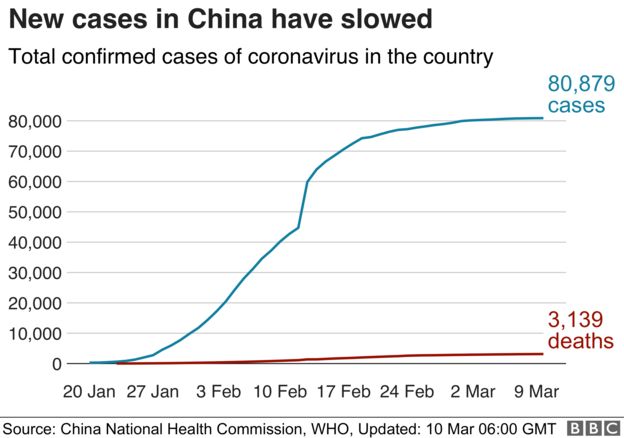
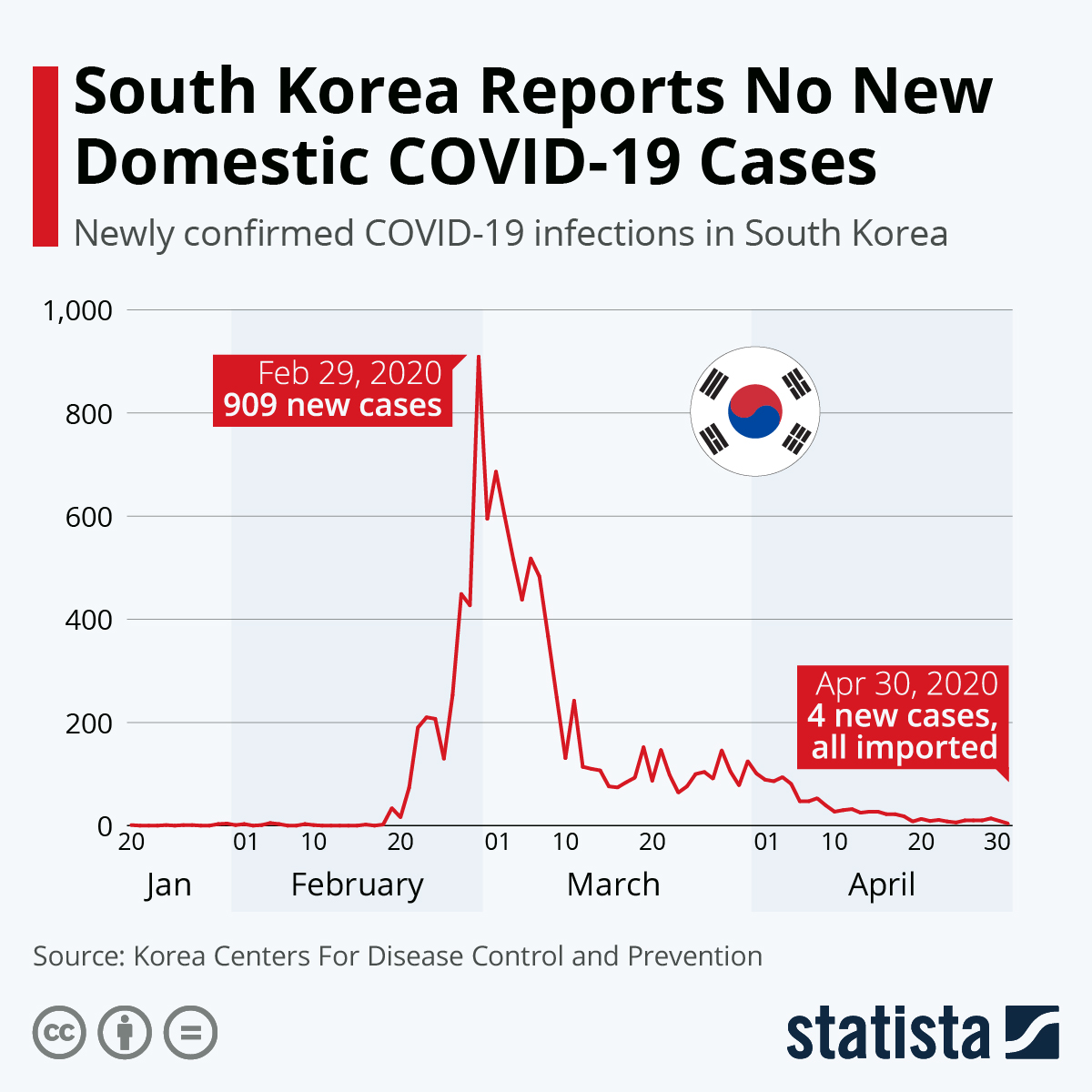
Italy with being earliest hit and where the containment of the outbreak was lost (and likely the pandemic spread without notice at first) is the worst case scenario. China with imposing draconian measures and South Korea responding quite well to a serious pandemic are other good forecast. They have not continued exponential on growth. Let's remember that IF the situation in China to be as bad as in Italy would mean that over 114 000 would have died of the virus. It hasn't. If it can hide double or triple the amount of actual deaths, not even a police state like China can repress over 100 000 deaths in our time of internet. Lockdowns do work.
(A bit old stats, but they show the trend in China)

South Korea:
With the US that has only few states implementing a lockdown, but general social distancing has taken effect so I assume that the US forecast is a bit similar to Italy, but less explosive growth than in Italy. Add the inefficiency of the Trump administration, the size of the country and my forecast is that it will still be bad. To be as bad as in Italy it's now, about 25 000 Americans have to die of the pandemic.
Hence if you make forecasts, I'd make the estimate that on some level will the growth stop and start to plateau. When? Well, Italy will be the example. And of course, the only way for Republicans to get into their thick head that one should invest in a global effort to prevent pandemics is that it will be bad, unfortunately.
Still I'll bet that well less than one million in the World will die from the corona-virus. -
Business Ethics and Coronavirus
At least here I think matter basically would be the boss vs. the State and the Constitution. State and the Constitution will likely be the way which a judge will go by.I agree on all this, but it can be happening. Remember, the scenario is can't be more than 10, so technically the manager is not breaking the rules. — schopenhauer1
Here the boss will goes against Government Decree that "people for whom it's possible to stay home will stay home". I guess a lawyer would look at the question from what the powers are in a state of emergency that the officials have. And believe me, they basically have quite a lot of power. Even in normal times if the fire fighters decide, they can for example stop you when driving on the road, order you out from your car and order and put you to fight a forest fire (if they see that's the only possible option to do). That rarely if ever happens, but there is the legal possibility for that. If you start quarreling like a libertarian that they cannot give you such an order WRONG ANSWER! They are right and you are wrong.
Here the Constitution gives the following waiver in state of emergency or wartime:
Section 23 -Basic rights and liberties in situations of emergency (1112/2011, entry into force 1.3.2012).
Such provisional exceptions to basic rights and liberties that are compatible with Finland's international human rights obligations and that are deemed necessary in the case of an armed attack against Finland or in the event of other situations of emergency, as provided by an Act, which pose a serious threat to the nation may be provided by an Act or by a Government Decree to be issued on the basis of authorisation given in an Act for a special reason and sub ject to a precisely circumscribed scope of application.
This is the attitude of a small country where in the Constitution it's says:
Every Finnish citizen is obligated to participate or assist in national defence, as provided by an Act -
Coronavirus
Rounded, right.The data I posted in a post above showed 0% (rounded, it wasn't 0 in actual cases) of current cases were severe. That's the data. — Hanover
Ever thought being critical about data? Especially one that simply doesn't add up? You really think NOBODY is hospitalized or in intensive care in the US for corona-virus??? Or just less than 0,5% of those observed to be infected need hospital treatment.
It's not like people are stopped on the street and made corona-virus tests in the US. Or they would come knocking on your home door to make the test. -
Corona and Stockmarkets...Then there's no reason to argue with you how governments work.
But why at least I am suspicious:
Now, which politicians have that information first?US intelligence officials reportedly warned President Donald Trump and Congress about the threats posed by the novel coronavirus beginning in early January — weeks before the White House and lawmakers began implementing stringent public health measures -
Business Ethics and Coronavirus
Ok, let's take the example.Darn, I'm surprised this isn't getting any attention being this is probably one of the most relevant topics, if you are from a country implementing social distancing... — schopenhauer1
There can be a cranky individual of a boss of a small company that does this, but I think it's rare. Likely it's that the company really doesn't have the simple tools to work from home even if the work is done by computer at the workplace. Having the ability connect to the workplace system from outside is an investment, you know. So if the accounting is done with a floppy disc computer back from the 1990's, because who gives a sh*t about accounting otherwise that it's done...In the midst of the Corona crisis, the business does not allow workers to work remotely, even though the functions of the job can be done from home. — schopenhauer1
But to the example where it would be possible to work from home, but the boss wants to hold your hand at work. Well, in a country where the vast majority of the workforce belong to a labor union and you have to have by law someone taking care of the health and security of the personnel, this is a no-brainer. The situation described in OP would simply go against prevailing laws. The employee or the (employee's labor unions lawyers) simply could take the issue to court and likely win. After all, going against emergency powers legislation isn't smart. As it is now in place, an observant libertarian might argue that my country doesn't have all the freedoms as before. -
Corona and Stockmarkets...
Well, it's a law. But who cares in this administration...if it's not Joe Biden etc.
And it goes on, but I think anyone interested gets the picture...Public Law 112–105 112th Congress
An Act
To prohibit Members of Congress and employees of Congress from using nonpublic
information derived from their official positions for personal benefit, and for
other purposes.
Be it enacted by the Senate and House of Representatives of
the United States of America in Congress assembled,
SECTION 1. SHORT TITLE.
This Act may be cited as the ‘‘Stop Trading on Congressional
Knowledge Act of 2012’’ or the ‘‘STOCK Act’’.
* * *
SEC. 3. PROHIBITION OF THE USE OF NONPUBLIC INFORMATION FOR
PRIVATE PROFIT.
The Select Committee on Ethics of the Senate and the Committee on Ethics of the House of Representatives shall issue interpretive guidance of the relevant rules of each chamber,
including rules on conflicts of interest and gifts, clarifying that a Member of Congress and an employee of Congress may not use nonpublic information derived from such person’s position as
a Member of Congress or employee of Congress or gained from the performance of such person’s official responsibilities as a means for making a private profit.
SEC. 4. PROHIBITION OF INSIDER TRADING.
(a) AFFIRMATION OF NONEXEMPTION.—Members of Congress and employees of Congress are not exempt from the insider trading prohibitions arising under the securities laws, including section 10(b) of the Securities Exchange Act of 1934 and Rule 10b–5 thereunder. -
Coronavirus
Would be even greater if there wouldn't have been patient 31. This tells just how much things are prone to the butterfly effect:South Korea is also a great example of what competence looks like. — boethius
Actually now 8799 cases and 102 deaths and counting.In South Korea, where the virus first appeared on Jan. 20, public officials said the situation was largely under control for the first several weeks, as the first 30 infected people adhered to strict containment strategies.
But patient 31 changed everything. “The situation here was not really serious until mid-February,” said Hwang Seung-sik, a spatio-temporal epidemiologist at Seoul National University, in an interview with Al-Jazeera. “It began to get very serious starting with patient 31.”
Patient 31 traveled extensively through South Korea, even after doctors had suggested she isolate herself due to a high likelihood that she had been infected. The Korean Center for Disease Control found that she ultimately had contact with approximately 1,160 people. There are now more than 7,800 confirmed cases in South Korea, and more than 60 people have died. -
Coronavirus
This is true, but there is also the crucial moment measured in days just when the pandemic got rolling on. When it started in Italy, Europe or the West hadn't got the pandemic hysteria. Now when it has truly started in the US, the population takes action.Yes, I would expect those things to have an effect. But as we've seen elsewhere, those effects may not register in the figures for up to 2 weeks — Andrew M
And just how successful that "social distancing"? If we take into consideration that China has roughly about 24 more times people than Italy, then it wouldn't be that China has less deaths. Yet month ago when the epidemic started in Italy and when there were only a handful of deaths the actions were taken only regionally. The CNN journalist one month ago were reporting from a Venice quite full with tourists going around. -
Coronavirus
And that is a great looking logarithmic scale growth to extrapolate from.I'm extrapolating purely from the reported US case numbers in the table here. — Andrew M
But notice that the information itself has an effect here. When you get greater numbers, you get greater panic and more drastic measures. That will have an effect on the forecast and the extrapolation may need what in economics and statistic is called a Dummy variable.
For example, now New York City has 43+ deaths from corona virus. What do you think the effect would be if it would be in few weeks it would be 400 or 4 000? I figure the amount wouldn't be quite high when the lockdown and the curfew will be enforce by police and the national guard, which will stop people walking in the street. -
Corona and Stockmarkets...
Perhaps politicians know what they will do and can understand the consequences. And that isn't public information. That's the point.How is that corrupt? Corruption is when one acts on inside information, private to the company. Coronavirus was public information, and if some savvy individuals could foresee problems coming for specific types of companies, and sold, you cannot call that corruption. The market was extremely high anyway, and it was obviously time to sell, if you are inclined toward making money off the market. — Metaphysician Undercover
This actually isn't about Trump. Note the party of Dianne Feinstein.And despite the fact that Trump insisted it was not a problem, — Metaphysician Undercover
Yeah, and any finance minister and central banker will insist that they won't devalue their currency (if it's a fixed rate) until they do. But of course, you could then argue that "Everybody know that the economy was in a bad shape". You see, it is about timing. -
Donald Trump (All General Trump Conversations Here)
Art of Bullshit, baby. Bullshit.Art of the deal, baby. — NOS4A2
Just like the Wall paid by Mexico, the deal with North Korea AND NEARLY EVERYTHING ELSE...
Of course, nothing of those happened as promised, but who cares? It's art of the deal. Just like "Art of the Deal" was written by a ghostwriter. As we know, Trump is incapable of writing himself something as long as a book. But who cares? It's all quite fake and that's Trump.
Just think about it: how whimsical it is for a President who's party is at first in control of BOTH houses of Congress and then to get what through? One tax break! Yeah, great work.
So let's me get this straight. Trumps wants to make cuts. Finally the CDC does make the cuts, but AFTERWARDS understanding that this is their core area to operate, the CDC wiggles with base appropriations (thanks to Congress) and transfers then them to sustain things. And knowing Trump, the CDC has an reason to paint everything with roses as not to make this President angry. Just like after the "taboo words" debacle. Oh no, Trump administration surely didn't do it!You’re wrong, actually. — NOS4A2 -
Coronavirus
Italians are Italians.I have heard unconfirmed reports that despite the situation in Italy, Quarantine still isn't strictly observed there by everyone. People are still meeting in Cafes and the like. Boggles the mind. — Echarmion
Chinese Red Cross Vice President Sun Shuopeng warned Italians that they were risking lives by not adhering to the novel coronavirus lockdown. He made the comments after visiting Milan in the hardest-hit region of Italy, which has recorded 41,035 cases and 3,405 deaths. “Here in Milan, the hardest-hit area by COVID-19, the lockdown measures are very lax,” the veteran of the Wuhan epidemic fight said Thursday. “I can see public transport is still running, people are still moving around, having gatherings in hotels and they are not wearing masks.” Sun warned that the resistance to the lockdown will prove deadly. “I don’t know what people here are thinking. We really have to stop our usual economic activities and our usual human interactions. We have to stay at home and make every effort to save lives. It is worth putting every cost we have into saving lives.” -
Coronavirus
Do you take into account the effect of "social distancing" and the lock downs?Any thoughts on why our math differs here? Perhaps you have a longer doubling period? Anyone else want to check the numbers? — Andrew M
You see for a logarithmic scale to continue, you would need to have people mingle as they did few weeks ago. Or put it another way. Why are there less new infections than before in China. Surely there would have to be tens if not hundreds of thousands dead by now. So is the Chinese authorities just covering up everything? Do you think that is possible in our time? -
CoronavirusThat's sad to hear, especially that fathers don't participate. And it's true what you say about the effects of an economic depression on people. I remember vividly when my country had a big recession in the 1990's an economist working in the Central Bank told us students plainly and directly: "The unemployed don't revolt. It won't happen. Unemployment is seen as a personal stigma." He was right, they didn't revolt. For example those 50 000 construction workers here that were pushed out permanently were out from the workforce forever. Likely after 25 years many of them are just "pensioners". That's how it goes.
Hopefully in the end everything goes well with this pandemic. And there's reason to believe so. Even if Covid-19 is a killer like the H1N1 virus of the Spanish Flu, the precautions already taken DO have an effect. Let's not forget that the Spanish Flu got it's name from Spain only because the country didn't have cencorship, which obviously made the pandemic worse. Or those hundreds of thousands of soldiers coming back home from the epidemic area of the battlefields.
That China has had so few deaths tells really that modern medicine and drastic measures work. I still believe that likely we don't get to the numbers of fatalities of the 1968/69 Hong Kong-flu pandemic which killed 1 million around the World. But the economic recession is real, unfortunately. -
Coronavirus
Like just where in Europe there isn't a lockdown in one form or another? Sweden and the UK?It's like asking whether Europe should go into lockdown. It sort of depends where. — Hanover
Lockdown is starting to be curfew. Bavaria has already implemented this. Whole of Germany might be following...
In fact similar rules are already here...without police yet giving huge fines. So I don't know what the really differences are.In Bavaria the only exceptions are to the curfew will be going to work, necessary shopping, visits to doctors and pharmacies, assisting others, visits from partners - and also exercise outside, but only alone or with other household members.
Visits to hospitals are also now forbidden in most circumstances and Söder urged employers to allow people to work from home. "The police will monitor and check all of this...anyone who breaks the rules can expect huge fines."
The German government warned on Friday that it may have to impose a country-wide curfew on its 83 million citizens if they do not abide by social distancing over the weekend.
(Schools out! A pupil celebrating that gymnasium is over in Finland. Perhaps interested in studying medicine in the university?)

-
Donald Trump (All General Trump Conversations Here)Fake fake news from NOS4A2!
You're wrong, actually. The utter inability of Trump to get anything done is the reason why, thanks to the Congress, the budget wasn't slashed as dramatically as Trump wanted. Yet fighting possible pandemics was slashed: The global presence was indeed reduced because of cuts.Trump dissolved the pandemic response team, cut funding for the CDC, and reduced the CDC presence around the globe. — NOS4A2
And Trump did really want cut the CDC budget. I remember that years ago. It was one of those irresponsible bullshit moves that Trump was doing that I remember well. Luckily for us, he FAILED just like he usually does in his policy decisions. Just as he does in many things starting from the Mexican paid wall and the deal with North Korea.
See Former Obama administration officials blast Trump's proposed health budget cuts from May 23rd 2017The budget, which was released Tuesday, takes drastic spending cuts to agencies within the Department of Health and Human Services. Almost immediately, the proposed budget drew criticism, including from former heads of those agencies.
Here are some of the biggest cuts the agencies within the HHS are facing:
Centers for Disease Control and Prevention - 17%
The CDC, which is in charge of public health and disease prevention, would see its budget cut by $1.2 billion. Dr. Tom Frieden, who was director of the agency until 2017, went off on the proposed cuts on Twitter on Monday, saying Americans would be "less safe," and that the cuts "would increase illness, death, risks to Americans, and health care costs."
See President’s 2018 budget devastating to public health: Cuts to prevention, research, programs from May 2017. If CDC had to absorb the kinds of combined cuts supported by the White House as of late March — a total cut of nearly one-third — Holubowich said it could “completely erode the safety net system — you’re looking at a tidal wave of need that would completely subsume the system.” On the proposal to block grant CDC’s budget, she predicted the funds would come from reallocating existing resources.
John Auerbach, MBA, president and CEO of Trust for America’s Health, said if CDC actually experienced the combined cuts it faced as of March, it would impact virtually all areas of public health, from responding to emerging disease outbreaks to partnering with hospitals to reduce health care-associated infections. He said turning CDC’s budget into a block grant would likely result in much less funding support for state and local public health. On the proposal for a new emergency response fund for outbreak response, Auerbach said it would certainly be “advantageous” to have a pot of money for crises like Zika and Ebola. However, he is concerned that money for the fund would be pulled from other public health programs.
Yet let's look what happened:
However, while Trump has attempted to cut funding to the CDC, overall funding to the agency has increased under the Trump administration.
Since assuming office in 2017, Trump has sent four budget proposals to Congress. Each one requested a decrease in funding for the CDC—you can view the budget numbers here: 2018, 2019, 2020, 2021. Congress has not yet passed a budget for this year, but Trump has signed a budget that increased funding for the CDC every year he’s been in office.
And what is true is this:
See https://factcheck.thedispatch.com/p/did-donald-trump-cut-the-cdc-budgetthe CDC “cut back on this program of overseas vigilance.” The CDC decided to end epidemic prevention activities in 39 out of the 49 foreign countries it was active in due to a predicted absence of funding for the programs, even as funding for other CDC activities increased.
And more clearly from 2018:
CDC Rolls Back Disease Prevention Programs Due to Budget ShortageThe Centers for Disease Control and Prevention (CDC) is cutting back its epidemic prevention programs in 39 of the 49 countries it serves due to a funding shortfall, reported The Washington Post on Friday.The CDC programs are largely responsible for strengthening outbreak emergency response systems and training front-line workers to detect outbreaks before they occur. - The rollback in prevention programs is primarily in response to the dwindling funds provided by an emergency five-year aid package approved by Congress in 2014. The package included $600 million to help countries prevent infectious disease epidemics such as the 2014 Ebola outbreak in West Africa. Only $150 million is left and is set to run out by September of next year, a senior government official told The Washington Post.
Republican Presidents have this obsession not to be prepared for the next crisis. I remember Bush at first didn't care a shit about terrorism or the prevention of terrorism. For Trump it was preparations for countering pandemics. -
Coronavirus
Well, this is the perfect time when people can see that. And as I said, it's this obligatory introduction to home schooling. That needs a lot of effort from the parents.I am afraid our technological society lacks awareness of how important our relationships are to being human and everything we do. — Athena
After this 'ordeal' nobody can hype the benefits of working from home as earlier as nearly everybody has now experienced this. They will see the pros and cons and what is possible and what isn't. Above all, soon people will realize what this kind of shutdown means when 80% of the GDP of the US is made of the service sector and that the vast majority of employment is in the service sector. Now, a vast portion of it is simply shut down.

You are looking at an economic depression likely worse than during the last financial crisis. -
Coronavirus
What we'll learn is finally is to work from home and have net conferences. Talk about a truly collective learning experience.I have hope that we will come out of this pandemic a better nation. We might be interring a new age that will better than our past. — Athena
Just think how many elementary and lower secondary school teachers everywhere have suddenly had to start using the internet to get to their pupils. For higher level education it isn't a great change, for lower levels it is. I have two children with one being a first grader and another a 6th grader and both are now living this eternal Sunday. Both of their class teachers were struggling to get the school work into net, but managed in couple of days to make it work. The frantic improvisation and their joy when getting their pupils online and working makes me smile. Yep, obviously no plans were made for this kind of event by the education system here, hence multitude of approaches by individual schools (which may be actually a good thing). Also, in country where home schooling is very rare, now something new.
The corona-virus is likely the best thing every to happen to the internet companies and service providers. It's so good for them that likely someone will come up with a conspiracy theory that Microsoft and Google were behind the outbreak in China. After all, even after some time has gone, the officials will still say "Use precaution" and "stay at home if you can". So how about that work that you can do from home? Any tin foil hats going with that one? -
Corona and Stockmarkets...What would be glaring is if they don't even get a slap on the wrist.
-
Corona and Stockmarkets...Now the ugly side of just how corrupt and sleazy politicians are:
Senate Intelligence Committee Chairman Richard Burr, R-N.C., sold as much as $1.7 million in stocks just before the market dropped in February amid fears about the coronavirus epidemic.
Senate records show that Burr and his wife sold between roughly $600,000 and $1.7 million in more than 30 separate transactions in late January and mid-February, just before the market began to fall and as government health officials began to issue stark warnings about the effects of the virus. Several of the stocks were in companies that own hotels.
And of course, Burr isn't the only one, across party lines...
Sens. Dianne Feinstein and Jim Inhofe sold as much as $6.4 million worth of stock in the weeks before panic about the coronavirus sparked a worldwide selloff, according to disclosure filings first reported by the New York Times. -
No News is Good News, Most News is Bad News
Again a great day as nuclear war between the US and Russia or between other countries hasn't happened!!!? Why are we, literally, begging for bad news? I'm no psychologist but aren't people who're drawn to bad events and people diagnosed as having some kind of mental pathology? — TheMadFool
Hooray for Mutual Assured Destruction, which has kept us from starting WW3! :up:
(Also today and yesterday she and others didn't turn the key. Even if she's ready to do it!)

-
Coronavirus
The simple fact is that now in the 21st Century we simply don't tolerate vast amounts of people to die in epidemics. We take preventive steps even if there is just the possibility of vast amounts of people to die. That's it. Earlier we tolerated that people die from epidemic diseases. And you be the judge what is "vast amounts of people".I have not seen any data that would have ever led me to the response I see now, but what I instead see is an illness that is mild in the vast (>90%) number of cases and is fatal only among the already very compromised. The cure we've arrived at, to the extent it at all represents a cure, is far worse than the disease. — Hanover
This "safety-culture" is quite universal and is present everywhere, it's not only that technology and science has improved, but also our attitudes have changed.
As I've said, if we could forecast earthquakes, we wouldn't tolerate people dying in earthquakes. Same thing. Polticians would have to do the utmost to save people from earthquakes. Even if you Hanover and NOS4A2 wouldn't want to leave your home and would be just fine to face the incoming earthquake estimated being 8 on the richter scale, many people would leave and not call it an "infraction of their rights".
Or just think about the response to 9/11. All the increased security and everything. Assume what would have happened if things would have been left totally the same, if Americans would have truly thought that "Terrorist attacks are unfortunate, but limiting personal freedoms would be worse". They didn't do that. And things would have been as before starting from security at domestic flights being a joke (that they were)? Well, just a few more strikes would have been successful and perhaps only some hundreds more of Americans would have died. So what's the big deal there? -
Coronavirus
Might be worse than thought. Or it have already mutated.Herd immunity might not be a thing ... — unenlightened
Another example from last month:
(27.2.2020) People who have gotten the new coronavirus and recovered can get it again in the future, health authorities say — the body does not become immune after infection.
On Wednesday, Japanese authorities reported the first confirmed case of reinfection. A tour guide in Osaka first tested positive for the coronavirus in late January, then was discharged from the hospital three weeks ago after showing signs of recovery. But she returned to the hospital after developing a sore throat and chest pain and tested positive for the coronavirus once again. -
How long can Rome survive without circuses?
Well, social distancing is the trendy cordial thing to do.Well that all makes sense. but to flip perspectives, as someone who is often uncomfortable in social situations and definitely has some personal space issues, "social distancing" just means I am no longer rude when I step back from a close talker :smile: — ZhouBoTong
For us Finns this is very easy to do. Our way to greet has only been a handshake before and at times like this it's normal and very easy to avoid that. Societies where cheek kissing is normal it would sad if the way fades away. Or in the Catholic Church in the sermon of shaking hands with people next to you. Asians do have the nice gesture of bowing, but that unlikely won't be used or become anytime popular (it would be that ugly cultural appropriation).
The likely outcome is that we are simply even more rude than now.
That missing handshake actual does make a difference. If every interaction with a service personnel, in a bank or office will be done with a person behind a glass window and speaking to microphone, at least I am usually not as friendly with those people and keep it to the bare minimum. Now it's the border guard or the public transport ticket seller who is confined like that and it's obvious that the situation isn't intended for any small talk, but rapid transfer of masses of people. I'd never have any tolerance to listen someone giving a sales pitch like that. And it's no surprise that one of the most hated and least respected jobs in the World is a telemarketer. -
How long can Rome survive without circuses?
I'm not suggesting anything here and likely diseases won't go away. What I'm just saying that precautions can have some effect on our manners, which I think has also negative consequences.. Are you suggesting the current quickness to shut everything down will go away? — ZhouBoTong -
Coronavirus
In the Nordic countries Sweden looks to have opted for a somewhat different approach than Norway, Denmark and Finland.It's all about the curve. Voluntary and enforced social distancing worked in China and now, looking at today's figures, seems to be working in Italy. Pretty simple folks, shut up and copy what works. — Baden
It has kept it's schools and borders open (although it has urged against non-essential travel) and is more thinking of that "herd immunity" option. As people are already taking precautions, I think the effect on the actual epidemic may not differ so much, but the economic impact might differ. (From the historical viewpoint, Sweden usually has took a lot more care of it's economy than my country.)
ssu

Start FollowingSend a Message
- Other sites we like
- Social media
- Terms of Service
- Sign In
- Created with PlushForums
- © 2026 The Philosophy Forum