
-
Microcosm and Macrocosm
Even scientists who accept the Big Bang Birth as the origin of our universe, also accept the old adage that something never comes from nothing, hence some kind of thing must always exist. That's why they have proposed the (hypothetical) Multiverse : a self-existent physical process without beginning or end.I do think that it's weird how something could just not exist, but then again, it's probly because i don't know how it is not to exist. — Brian the wise
But that description could also fit some myths of a creator god. For the purposes of my Enformationism thesis, I refer to that mysterious metaphysical World-Mother as the Enformer, or the Programmer. That's because everything in the universe --- matter, energy, mind, math, ideas --- is a form of generative Information, which I call EnFormAction. :nerd:
Information :
Knowledge and the ability to know. Technically, it's the ratio of order to disorder, of positive to negative, of knowledge to ignorance. It's measured in degrees of uncertainty. Those ratios are also called "differences". So Gregory Bateson* defined Information as "the difference that makes a difference". The latter distinction refers to "value" or "meaning". Babbage called his prototype computer a "difference engine". Difference is the cause or agent of Change. In Physics it’s called "Thermodynamics" or "Energy". In Sociology it’s called "Conflict".
http://blog-glossary.enformationism.info/page11.html
EnFormAction :
Ententional Causation. A proposed metaphysical law of the universe that causes random interactions between forces and particles to produce novel & stable arrangements of matter & energy. It’s the creative force of the axiomatic eternal deity that, for unknown reasons, programmed a Singularity to suddenly burst into our reality from an infinite source of possibility. AKA : The creative power of Evolution; the power to enform; Logos; Change.
http://blog-glossary.enformationism.info/page8.html
PS__To a materialist, Enformationism will sound like madness. So be careful who you mention this to. At least, on a philosophical forum, strange ideas are food for thought. -
Free will to do God's will. Any philosophical arguments for or against this statement?
An Eastern version of Freewill within Natural Constraints is found in Taoism. "Tao" is often translated as "the Way", or "the paved Path", and is essentially a moral code of adherence to "the natural order", as contrasted with the laws of men . In modern terminology, The Tao is equivalent to "Natural Law". And in Western thought, God's Will is often supposed to be encoded in the Laws of Nature. That's what we mean by calling a natural event "an act of God". So, if there is no human to blame, we can always hold God responsible for negative consequences.What is the point of free will if it doesn't have a moral code attached to it through the existential life we lead?
If one doesn't adhere to God's will then one has to face the consequence and, of course, God gets blamed for those consequences. It is ironic to blame God rather than analyse how the consequence came about - all due to not adhering to God's will. — david plumb
It's obvious that humans are not free to violate the laws of Nature, or Nature's God. Yet human laws are inconsistently enforced, so we have some leeway to do bad things. But, the only true freedom we have is to act both morally and naturally, by following "the path of righteousness". In other words, we can choose to follow either the "strait and narrow path", or the broad way" that leadeth to destruction". The only problem with that notion, is how to predict the consequences of minor actions that are not obviously good or bad. That's why most ancient sages, such as Lao Tse and Confucius, advised the development of moral character in children, so "righteous" behavior comes naturally, or instinctively. :smile:
Taoism : The Tao is what gives Taoism its English name, in both its philosophical and religious forms. The Tao is the fundamental and central concept of these schools of thought. Taoism perceives the Tao as a natural order underlying the substance and activity of the Universe.
https://en.wikipedia.org/wiki/Tao -
Microcosm and Macrocosm
I can relate to the analogy of the physical universe imagined as the brain of a cosmic Mind. That may be how Pythagoras viewed his mystical mathematical world. Of course, his worldview was more poetic than scientific, so I wouldn't take his musical metaphors literally. But, there may have been some wisdom in his "madness". His mathematical theorems are still taught in schools today. :nerd:it might sound like madness. . . . . I thought about the universe being just one big brain for a more advanced being. — Brian the wise
Pythagoras : Another belief attributed to Pythagoras was that of the "harmony of the spheres", which maintained that the planets and stars move according to mathematical equations, which correspond to musical notes and thus produce an inaudible symphony.
https://en.wikipedia.org/wiki/Pythagoras
I too, have entertained the notion of the Big Bang as a birthing event. But then, who was the Mother of our world? :cool:The big bang could be the shock that a child usually experiences when it's just born — Brian the wise -
The Practice of the Presence
I am also a non-practitioner of Buddhist Meditation. But I think the practice of present-mindedness is a good thing, especially for those who are not normally inclined to introspection. Here's some links to a couple of recent converts --- not to Buddhism, but to methodical Introspection. They found feckless meditation to be practical and useful. :smile:I come at this with the expertise of a non-practitioner and mere observer and comparer of texts and traditions - expecting this to be mainly an exercise in futility. — unenlightened
Buddhist Critic : https://blogs.scientificamerican.com/cross-check/a-buddhism-critic-goes-on-a-silent-buddhist-retreat/
Why Buddhism is Enlightening : http://bothandblog6.enformationism.info/page51.html -
Microcosm and Macrocosm
No. The simple observation of common mathematical proportions at large & small scales is just a trivial fact. But those who make a big deal of it, follow the implication that a single mathematical mind is responsible for the whole universe. Some imagine that "mind" as a creator god, but some imagine the cosmic geometry merely as a universal energy source, similar to "The Force" of Star Wars. So the meaning of the trivial fact depends on how you interpret its significance for you personally. I assume that your "convenient" was meant sarcastically. Yes?I do think it's very convenient that everything in the universe can be explained with just playing around with some numbers. So we are similar because there are proportions in the universe and in ourselves? — Brian the wise
For me personally, the ubiquity of Information, which includes mathematics & geometry & mind & matter, is more indicative of a creative cosmic mind. But that's just my interpretation, not a proven scientific fact. I think it's interesting that Nature, as a whole system, has some parallels with the human mind as an information processor. But I'm not inclined to worship the Great Mathematician. And I don't have any experience with such things as Crystal Power, or Chi Force. So, I'm not a Mystic or New Ager. Not that there's anything wrong with that . . . their respect for Nature as a living organism seems appropriate. :joke:
Sacred Geometry : Many teachings have described Sacred Geometry as the blueprint of creation and the genesis, the origin of all form. Sacred geometry is considered an ancient science that explores and explains the energy patterns that create and unify all things and reveals the precise way that the energy of creation organizes itself. It is said that every natural pattern of growth or movement comes back to one or more geometric shapes.
The molecules of our DNA, the cornea of our eye, snowflakes, flower petals, crystals, a shell, the stars, the galaxy we spiral within, the air we breathe, and all life forms are created out of geometric codes.
https://destinationdeluxe.com/sacred-geometry-explained-healing-benefits/
Information :
Knowledge and the ability to know. Technically, it's the ratio of order to disorder, of positive to negative, of knowledge to ignorance. It's measured in degrees of uncertainty. Those ratios & proportions are also called "differences". So Gregory Bateson defined Information as "the difference that makes a difference". The latter distinction refers to "value" or "meaning". Babbage called his prototype computer a "difference engine". Difference is the cause or agent of Change. In Physics it’s called "Thermodynamics" or "Energy". In Sociology it’s called "Conflict".
http://blog-glossary.enformationism.info/page11.html -
Microcosm and Macrocosm
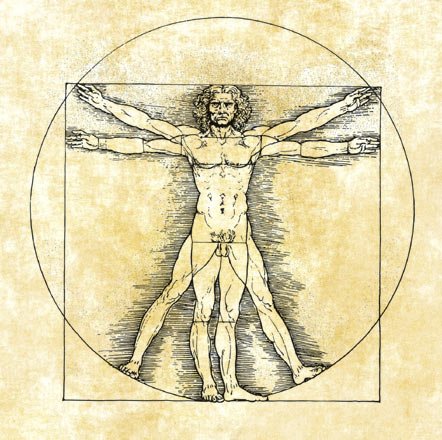
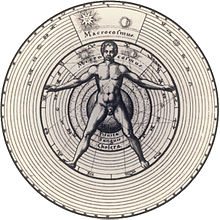
That concept probably originated with Pythagoras about 2500 years ago. He was a sort of mathematical mystic, and numerologist. In his mathematical studies, he noticed that many of the same proportions found in nature were similar to those found in the human body. Hence, the part is like the whole in terms of ideal proportions.i'd like to know how we , as humans and a Microcosm, are similar to our Macrocosm, the universe? — Brian the wise
Leonardo Da Vinci embodied the notion of Man the Microcosm in his drawing of the Vitruvian Man, Later, Robert Fludd created his own drawing of a man (microcosmos) surrounded by the Macrocosmos. That same poetic notion is still found in modern versions of Astrology, Alchemy and Sacred Geometry. Even some scientists are intrigued by the idea of cosmic proportions found in mundane nature, such as the Golden Ratio in spiral galaxies and in the seeds of a Sunflower.

-
Do any philosophies or philosophers refute the "all is mind" position?
Ironically, Aristotle's definition of "Substance" combined the mental (metaphysical) and material (physical) elements : Form + Matter. But Materialists only recognize the sensory stuff as "real", and ignore the invisible structure or "essence" of reality, that is apparent only to Reason. It's true that human minds cannot "make substance" (matter) directly, but they can and do Enform matter to Conform to imaginary concepts (information) in the mind of the designer.To refute 'All is Mind', one needs to show that there is substance, which I'd say includes forces/energy acting as substance, plus that Mind cannot make substance, plus that there can't be a kind of a movie going on through Mind in which everything operates exactly as if there were substance and its laws, and that if there is this perfect movie going on that a difference in the message between the faux and the true substance is not a difference that makes no difference. — PoeticUniverse
Poets express intangible concepts by presenting them clothed in familiar forms (material things). As an architect myself, I often imagine unreal things (such as proposed buildings on empty lots) that eventually become real. Of course, that is only a pale imitation of the creativity of a World Enformer. Creation of something that did not exist before, in any form, is the ultimate Difference that makes a meaningful distinction : i.e Information. That's not a religious belief, but a scientific concept, that an ancient pagan philosopher could accept. :cool:
Substance : According to Aristotle, the being of any individual thing is primarily defined by what it is, i.e. by its substance. Substance is both essence (form) and substratum (matter), and may combine form and matter. Substance constitutes the reality of individual things.
http://www.angelfire.com/md2/timewarp/firstphilosophy.html
Enform : to form, fashion, create new forms of things.
e.g. A sculptor enforms a block of marble into the form of a human body.
Concept :
1. an abstract idea; a general notion.
2. a plan or intention; a conception.
Information :
Knowledge and the ability to know. Technically, it's the ratio of order to disorder, of positive to negative, of knowledge to ignorance. It's measured in degrees of uncertainty. Those ratios are also called "differences".
http://blog-glossary.enformationism.info/page11.html
The Enformer :
AKA, the Creator. The presumed eternal source of all information, as encoded in the Big Bang Sing-ularity. That ability to convert conceptual Forms into actual Things, to transform infinite possibilities into finite actualities, and to create space & time, matter & energy from essentially no-thing is called the power of EnFormAction. Due to our ignorance of anything beyond space-time though, the postulated enforming agent remains undefined. I simply label it "G*D". But Materialists call it "Multiverse".
http://blog-glossary.enformationism.info/page8.html
PS__In a poem, which is the faux, and which the true substance? Does poetry make any meaningful difference in the world? -
Wondering about free will and consequentialism
Excerpt from blog post : The Paradox of FreeWillAnyway, my question - does anyone have a way that free will and morality go together in a non-arbitrary way? I would add I'm not sceptical about morality - I just think that the straightforward story connecting it to free will doesn't seem to be the whole picture. — RolandTyme
I summarize my personal hypothesis of FreeWill Within Determinism as follows : Freewill is the ability of self-conscious beings to choose preferred options from among those that destiny (or subconscious) presents. In the complex (non-linear) network of cause & effect, a node with self-awareness is a causal agent. With multiple Pre-determined inputs, and many Potential outputs, the Self can choose from a wide range of Possibilities, creating local novelty within a globally-deterministic system. So, for an omniscient Creator, or an omnipotent Cause, to allow FreeWill (to fulfill personal wants & wishes) would require a side-road of statistical Chance to provide options and detours from strict Determinism. In that case, morally responsible free-agency is compatible with divine creation, but not with predestination. It is compatible with the weirdness of Quantum Indeterminacy, but not with the logical necessity of Quantum Mechanics. You might say that the “Laws” of Physics (and of Evolution) are interpreted according to the “Rules” of Randomness. Therefore, if you want to believe that you are a moral agent, feel free.
http://bothandblog5.enformationism.info/page13.html
“Determinism is a long chain of cause & effect, with no missing links.
Freewill is when one of those links is smart enough to absorb a cause and modify it before passing it along. In other words, a self-conscious link is a causal agent---a transformer, not just a dumb transmitter. And each intentional causation changes the course of deterministic history to some small degree.”
___Yehya
http://bothandblog2.enformationism.info/page68.html
Rational Moral Progress : http://bothandblog2.enformationism.info/page63.html -
The issue with atheism vs. theism
Yes. Before the advent of the Big Bang theory, many philosophers and scientists assumed that the ever-changing physical universe itself actually eternal, and cyclical (steady state). But the BB theory implied that the knowable universe is temporal and conditional. Which means that the BB could be interpreted as a creation event : perhaps, something from nothing. However, in an attempt to avoid the special creation implication, some scientists have produced a new Eternal Inflationary Universe Theory. In that case, the physical universe is self-existent, and had no need for a creator --- just an ever-inflating balloon that never pops.The common ground would be that the All can be shown to have to be eternal. — PoeticUniverse
Therefore, it seems that even Atheist scientists must logically assume that our knowable temporary world is not all there is. For a temporal universe to exist, there must be an external eternal realm of some kind. Exactly what that (non-empirical; unknowable) "kind" may be, is subject to imagination and personal preferences : eternally evolving or recycling Matter, or the timeless infinite potential of immaterial Mind. So, for both Theists and Atheists, Eternity & Infinity must encompass ALL possibilities. And, "The ALL" is one common descriptor of God. Hence, as the OP asked : "Is universe the correct word? Or is god the correct word? Is there even a difference?" :cool:
The All : The All (also called The One, The Absolute, The Great One, The Creator, The Supreme Mind, The Supreme Good, The Father, and The All Mother) is the Hermetic, pantheistic, pandeistic or panentheistic (and thus also panpsychism/monopsychism/unus mundus/anima mundi) view of God, which is that everything that is, or at least that can be experienced, collectively makes up The All.
https://en.wikipedia.org/wiki/The_All
Eternal Inflation : Alan Guth's 2007 paper, "Eternal inflation and its implications",[3] states that under reasonable assumptions "Although inflation is generically eternal into the future, it is not eternal into the past."
https://en.wikipedia.org/wiki/Eternal_inflation
A Refutation of Time : The 20th century Argentine writer, Jorge Luis Borges, was intrigued by such paradoxes as Time within Eternity.
http://bothandblog5.enformationism.info/page23.html
An Eternal and Uncreated Universe or the Big Bang? : https://medium.com/amazing-science/an-eternal-and-uncreated-universe-or-the-big-bang-12f5ccf7c4fd -
What are the best arguments for and especially against mysterianism?
One of the smartest people ever, was mathematical genius Martin Gardner. He called himself a Mysterian, but he didn't present a philosophical argument for his position of intellectual humility. I suspect he would answer "probably not" to your question. :smile:my question could have been ''can we understand everything understandable?' — Eugen
Martin Gardner : I belong to a group of thinkers known as the 'mysterians.' It includes Roger Penrose, Thomas Nagel, John Searle, Noam Chomsky, Colin McGinn, and many others who believe that no computer, of the kind we know how to build, will ever become self-aware and acquire the creative powers of the human mind. I believe there is a deep mystery about how consciousness emerged as brains became more complex, and that neuroscientists are a long long way from understanding how they work."
http://martin-gardner.org/MYSTERIAN.html -
Help coping with Solipsism
Maybe what you need is not a philosopher, but a psychiatrist or doctor. If you are literally, rather than figuratively depressed, you may have some physical or chemical glitch in the brain. If so, that can be treated with a prescription. Solipsism syndrome may be a form of pathological doubt. And the inherent uncertainty of philosophy could make it worse. :nerd:I'm just looking for help. The prospect of being cosmically alone is really depressing. — Darkneos
Solipsism Depression : Solipsism syndrome is not currently recognized as a psychiatric disorder by the American Psychiatric Association, though it shares similarities with depersonalization disorder, which is recognized. Solipsism syndrome is distinct from solipsism, which is not a psychological state but rather a philosophical position, namely that nothing exists or can be known to exist outside of one's own mind;
https://en.wikipedia.org/wiki/Solipsism_syndrome
PS__If you ask a person to pinch you, and you feel the pain, that's a pretty good indication that you are not alone. Unless, of course, you are in the habit of hurting yourself. Which again suggests that you need some non-philosophical counseling, and/or a prescription. -
Daniel Garber on Descartes
Philosopher Edward Feser, in his Aristotle's Revenge, comments on this key feature of modern science : monistic Materialism. He says, "most scientists tend to take for granted the commonsense belief in material objects". Yet, Descartes' dualism also included metaphysical "objects", which he called res cogitans by contrast with res extensa. Over time, materialists began to dismiss the reality of mental objects, such as ideas; believing that even our mentality can be reduced to material objects. They are still looking for empirical evidence to support that assumption.Garber said -- "Descartes’ thought must be understood in the context of the attempt to reject Aristotelian physics, and replace it with a different kind of physics, one grounded in a mechanistic conception of nature".
Feser raises the theory of mental Representationalism, in which the mind models its concepts in terms of Intentionality : what a thing means to me, which is essential to "what it's like to be me". In that regard, Feser discusses the distinction between <1> physical objects, and <2> the mental representations (symbols) of them. "Descartes, of course, put this dualism forward as an ontological thesis, carving the world into the material and the immaterial, res extensa and res cogitans. Materialists reject this aspect of the Cartesian picture, holding that the representations ought to be identified instead with some subset of the denizens of the material world (such as brain processes) construed mechanistically. Since, on the mechanistic construal, matter is devoid of teleology and secondary qualities, this leaves the materialist with the problem of explaining how the intentionality and qualia that characterize these representations could be properties of matter so defined. . . . representationalism generated the modern 'mind-body' problem".
Representationalism as a theory is above my philosophical pay grade. But the solution to the "mind-body" enigma that appeals to me is to substitute the concept of Universal Information for the notion of Universal Consciousness or Universal Atomism. Since cutting-edge science has equated Matter & Energy with Information, it would seem to qualify as the relevant "substrate of the material world". Being found in both Mental and Material forms, Information is the essence of both Mind and Body. So, there is no Cartesian gap between them. Res Extensa is directly connected to Res Cogitans. And this worldview seems to agree with Aristotle's conception of human nature in terms of a living organism, rather than a meat robot. :smile:
Representationalism : An intentional state represents an object, real or unreal
https://plato.stanford.edu/entries/consciousness-representational/
Aristotle's Revenge: The Metaphysical Foundations of Physical and Biological Science : "the central argument of this book is that Aristotelian metaphysics is not only compatible with modern science, but is implicitly presupposed by modern science"
In-form-ation & Matter : Aristotle famously contends that every physical object is a compound of matter and form.
https://www.google.com/search?client=firefox-b-1-d&q=aristotle+forms+and+matter
Everything is Information : https://bigthink.com/philip-perry/the-basis-of-the-universe-may-not-be-energy-or-matter-but-information
Reality is not what you see : http://bothandblog6.enformationism.info/page21.html -
Is there a religion or doctrine that has no rules to be obeyed?
Unlike some philosophers, I don't think it's my duty to undermine the faith of other people. But since you noted that you are not well-read in literary works, I don't think you should say that Jesus' "revelations" are "unlike any other man throughout history". Instead, they are simply "natural truths".due to lack of reading other's literary works . . . .
all the natural truths that Jesus, unlike any other man throughout history, has revealed clearly — KerimF
I agree that Jesus taught some good lessons to his followers. But much of what is recorded in the Sermon on the Mount, for example, came from ancient Jewish Wisdom Literature, such as those collected by the Essenes, a sort of reclusive monastic order. Parts of their collection have been discovered in modern times, and labeled the Dead Sea Scrolls. Of course a lot of imaginative speculation has filled-in the gaps in their secretive history. But, due to some parallels between their beliefs, and those of Jesus, several scholars guess that Jesus may have studied with them, during the "lost years" between the ages of 12 and 33. I don't know if that is true, but it's clear that most of Jesus' moral & escatological teachings can be found in the ancient literature of the Israelites and Jews.
I won't belabor that point, but the essence of Jesus' moral teachings is the Golden Rule, which is also characteristic of moral instructions of many cultural traditions. So, I don't think Jesus was unique in his analysis of human immorality and suffering. And his promise that the kingdom of heaven would come "soon", to bring an end to the suffering of the Jews, has still not been fulfilled 20 centuries later. So, I wouldn't believe everything you read in Christian Literature. :smile:
The Golden Rule : https://en.wikipedia.org/wiki/Golden_Rule -
Investigating mind and matter primacy
Yes. Both options are correct. But the first Mind is universal or cosmic, while the second is plain old human mentality that emerged from a long sequence of evolutionary events. The Mind of G*D, so to speak, had the idea of Matter, and designed a process for making malleable matter from amorphous energy, which is a dynamic form of Information. Then, eventually, that process created rational minds that can "see" invisible "forms" in the structure of the natural world. Any more questions? :cool:Did the mind come up with the idea of matter?
Or did matter come up with the idea of mind? — Yohan -
Investigating mind and matter primacy
Yes. Information is the form or structure of every aspect of the world, both Physical and Metaphysical, both Matter and Mind. Unfortunately, reaching that non-mainstream worldview requires a mind-flip from Classical Physics to Quantum Physics. Abandoning modesty, I can say that my Enformationism thesis website is the best step-by-step argument I'm aware of, to lead you to the understanding that "all is Information". But then, that's another patience-trying link with lots of technical mumbo-jumbo.I'm a little confused about how matter is a type of information. When I hear the word 'information' I think of form or structure. — Yohan
The origin of the "all is information" concept may be in quantum physicist John Wheeler's observation that all physical objects are macro-scale forms of sub-quantum information. As a simple summary of that weird notion, he quipped "It From Bit", meaning that Things (its) are composed of Information (bits). It's a mind-bending concept, but several serious scientists are pursuing the ramifications of that notion. The Santa Fe Institute in New Mexico is especially focused on adding details to that general concept. I could go on, but that might strain your patience and credulity. :nerd:
It from bit theory : Wheeler said the universe had three parts: First, “Everything is Particles,” second, “Everything is Fields,” and third, “Everything is information.” In the 1980s, he began exploring possible connections between information theory and quantum mechanics. It was during this period he coined the phrase “It from bit.” The idea is that the universe emanates from the information inherent within it. Each it or particle is a bit. It from bit.
https://bigthink.com/philip-perry/the-basis-of-the-universe-may-not-be-energy-or-matter-but-information
Digital Physics : https://en.wikipedia.org/wiki/Digital_physics
Enformationism : http://enformationism.info/enformationism.info/ -
Afterlife & "Soul Contract"
Yes. That's why I called it "insurance", which is mostly an Anglo-American concept. Ironically, the modern form of commercial insurance may have emerged in British dominated India. You pay for future debts in advance. :smile:I agree that Hinduism does think that there is planning for the soul but I am not sure that the idea of soul debt is exactly the same as a soul contract. — Jack Cummins
https://en.wikipedia.org/wiki/Insurance_in_India -
Do any philosophies or philosophers refute the "all is mind" position?
I agree that immaterial Mind is the function of Brain matter. But, do you know of a viable theory to explain how Mind & Consciousness & Meaning are "derived from" from mindless Matter, such as neural networks? Where is the latent potential for mental properties located in brain matter? How does that latency transform into manifest mental behavior? :smile:I’m not doubting consciousness, only that it derives from “mind” as opposed to brain. — Pinprick -
Do any philosophies or philosophers refute the "all is mind" position?
It just occurred to me that my All Is Mind reply above, may have inadvertently explained the essence of Poetry : it expresses immaterial qualities & subjective feelings in real-world concrete terms, thereby giving substance to the insubstantial, and objective form to subjective imagination . 'Poet' comes from a Greek word meaning "to make." Perhaps poetry makes Ideal concepts Real, so others can experience them. N'cest pas? :nerd:
"Like Information and Energy, all of our experiences are with the material containers of properties, qualities, and Information." -
Investigating mind and matter primacy
FWIW, I'll introduce you to the notion that everything in this world consists of immaterial mental Information (ideas), including Matter. Neuroscientist Don Hoffman has produced an update of Kant's idealism. And my own thesis of Enformationism concludes that both Energy and Matter are forms of universal Information. :smile:Is matter an idea, and ideas are made of matter? — Yohan
Transcendental Idealism : In his doctrine of Transcendental Idealism, 18th century philosopher, Immanuel Kant argued that our perception of reality is limited to constructs created in our own minds to represent the invisible and intangible ultimate reality that he mysteriously labeled “ding an sich” [things-in-essence, as opposed to things-as-we-know-them]. In other words, what we think we see, is not absolute reality but our own ideas about reality.
http://bothandblog6.enformationism.info/page21.html
Information Realism : https://blogs.scientificamerican.com/observations/physics-is-pointing-inexorably-to-mind/ -
Afterlife & "Soul Contract"
The legalistic terminology may be relatively new, but the concept of planning now for the future of your soul seems to be inherent in the Hindu/New Age doctrine of Karma. If you buy into the notion of reincarnation, and its associated "Soul Debt", then such an Insurance Policy might make sense to you. :cool:Is this a new idea? — TiredThinker
Soul Contract : https://medium.com/@amandawright_26393/our-life-soul-contract-ed40c75c5d13 -
Is there a religion or doctrine that has no rules to be obeyed?
Are you familiar with the Jefferson Bible? Thomas Jefferson was the third president of the United States, and a Deist. He distilled his own copy of the New Testament down into a small book, he called The Life and Morals of Jesus of Nazareth. :smile:So after filtering the Gospel, the one I have in the least and concerning Jesus sayings and life only, — KerimF
Jefferson Bible : "In extracting the pure principles which he taught, we should have to strip off the artificial vestments in which they have been muffled by priests, who have travestied them into various forms, as instruments of riches and power to themselves."
https://en.wikipedia.org/wiki/Jefferson_Bible
https://en.wikipedia.org/wiki/Religious_views_of_Thomas_Jefferson -
Anaxagoras
Thanks. But some people on this forum think my thesis is airy-fairy religious nonsense. And others think it's quantum-weirdness atheistic nonsense. But, if anything makes sense in this world, it should be the Information that forms meaning in your mind. :nerd:Your ideas are interesting and consistent — Gregory
Information :
Knowledge and the ability to know. Technically, it's the ratio of order to disorder, of positive to negative, of knowledge to ignorance. It's measured in degrees of uncertainty. Those ratios are also called "differences". So Gregory Bateson defined Information as "the difference that makes a difference". That comparative distinction refers to "value" or "meaning". Babbage called his prototype computer a "difference engine". Difference is the cause or agent of Change. In Physics it’s called "Thermodynamics" or "Energy". In Sociology it’s called "Conflict".
http://blog-glossary.enformationism.info/page11.html -
Is there a religion or doctrine that has no rules to be obeyed?
Unfortunately, I learned the hard way, that the Gospels are not the words of Jesus, but a compilation of ancient writings from various anonymous sources, edited and redacted by the Imperial Roman Church in order to reconcile the incompatible beliefs of Jesus' followers throughout the empire.But please note that I can't say I am Christian because a Christian in any Church/Denomination around the world is supposed to listen to his Church's teachings, not to Jesus ones (on the Gospel) in case they are different or opposite. — KerimF
So, although I appreciate some of the teachings of Jesus, I can't accept the Catholic Bible as the genuine and authoritative Word of God. Hence, I no longer call myself a Christian. Nevertheless, as a Deist I still can't deny that the world shows evidence of being suddenly created from who knows what, when, or where. So, I'm not exactly godless. But the only book written by my G*D is the natural world "in which we live, move, and have our being". (Acts 17:28) :smile: -
Anaxagoras
No, I'm suggesting that since reductive Quantum scientists have sliced the material world down to nothingness, and never found the holy grail of a final foundational uncuttable Atom (Leucippus), the understructure of reality may not be made of solid Matter. That immaterial bedrock of reality now appears to be the same stuff that creates ideas in your mind, and calculates mathematical answers in computers. Information may superficially appear to "not be anything", but it is the substance of everything.Are you saying THE WORLD is corporeal consciousness or simply information? We might not be anything — Gregory
Raw Information is not corporeal, but it is capable of becoming solid bodies. To wit : Quantum Fields are described as pure mathematical Potential (virtual particles) that are capable of becoming Actual (physical particles). Mathematics consists of Ratios & Relationships, and all Meaning in a Rational Mind is likewise relational Information.
What color is the number Four? No answer?What options to be have of interpreting Enformation apart from mathematics? Plato tried to refute this by saying that the question "is 4 big?" has no answer and therefore there is something prior to math — Gregory
Yes, there is something "prior to math" : the unformed cosmic Potential that I call BEING . . . or G*D, if you prefer.
If you are a high level mathematician, go ahead and interpret Enformationism. I'm not. So I resort to carefully chosen words, and even some coinages of my own. Tegmark is not alone in his interpretation of Reality as ultimately Mathematical, hence, for all practical purposes : Mental. My thesis came to a similar conclusion from philosophical reasoning, rather than abstruse mathematical calculations. But they are both in agreement that Information is the best current candidate for the long sought invisible & indivisible Atom. :smile:
Mathematical Universe hypothesis : In physics and cosmology, the mathematical universe hypothesis (MUH), also known as the ultimate ensemble theory, is a speculative "theory of everything" (TOE) proposed by cosmologist Max Tegmark
https://en.wikipedia.org/wiki/Mathematical_universe_hypothesis -
Is old age a desirable condition?
I'm 75 years old. So, I'd say that old age can be good or bad, but personally it's what you make of it. :smile:Is this justifiable? Is old age a blessing or a curse for the elderly? — David Mo -
Do any philosophies or philosophers refute the "all is mind" position?
Yes. I came to the "all is mind" conclusion from the evidence of Quantum and Information theories. The "hard problem" of how Mind and Consciousness emerged from insentient Matter and amorphous Energy can be explained by applying information theory to Evolution. This is not a religious belief, but a philosophical theory, based on cutting edge science.The idea that an idea has to be proven wrong in order to be wrong is wrong. In order for an idea to even be considered plausible, or worth considering, it must have some justified explanatory power. Can “all is mind” justify its premises? — Pinprick
If the essence of Energy & Matter is abstract Information, as several physicists have concluded, then we may infer that our world was Enformed by some kind of Mind, and actualized in the Big Bang. My thesis resulted from following such evidence to the conclusion that our Real world is essentially an Idea. But then, a materialistic mind-set cannot "see" essences with the body's eye, so will be incredulous of such nonsense, as "seen" by the mind's eye. :nerd:
To Enform : to give meaningful form to; to create -- as a sculpture from clay or marble
Integrated information theory : https://en.wikipedia.org/wiki/Integrated_information_theory
Reality is not what you see : http://bothandblog6.enformationism.info/page21.html -
Do any philosophies or philosophers refute the "all is mind" position?
Stove's "Gem" is a bit over my head. But how does he accommodate Einstein's Relativity ?''The most direct refutation remains Stove's Gem. — Banno
Relatvity and Reality : We take our own personal orientation for granted most of the time, (especially when we are overseeing an abstract equation or model of everythingness), but to model everythingness absolutely faithfully, we would need to include this very strange, but very ordinary state of affairs that we know as ‘being here’, or ‘our presence’; consciousness. . . .
It is for this very reason, that purely mathematical approaches to understanding the universe as a whole and consciousness are ultimately doomed. Their rigidity arises from a reference frame which is intrinsically incompatible with the floridly eidetic and creative frame of human privacy.
https://multisenserealism.com/thesis/7-space-time/relativity/
Note : this site is also above my pay-grade. -
Is there a religion or doctrine that has no rules to be obeyed?
The key point in my concept of Deism, is that it is an individual understanding of the world, not a collective belief system. As personal Beliefs are merged into group Faiths, some kind of imposed structure is necessary to hold differences of opinion together. That structure is both the strength of Religion and its weakness. Religious doctrines, over time, tend to fossilize into rigid dogmas. But Deists remain free to change their opinions as their personal experience matures.If I understood you well, to your knowledge too there is no well-known group of believers (of a religion or religious doctrine) whose God (or whatever the name is) has no rules to be obeyed (as in the army). — KerimF
The weakness of Deism is that each believer stands alone in his private belief system. That's why many Deists eventually seek to bind themselves into a communal faith system : a religion. When they do, they give-up some of their personal freewill, in exchange for collective security and stability. In small groups, the trade-off may be worthwhile. But as the collective expands its numbers, as in armies and global religions, each person becomes a robot bound to a central command center : like the Borg of Star Trek. :smile:
Religion : from latin re- (back), and -ligare (to bind)
PS__Armies are bound to earthly commanders, but Religions tend to "pass the buck" of responsibility up to an un-earthly commander. Unfortunately, the chain of command still flows through fallible humans down to the individual. Hence, your faith must be applied to each link in the chain. And Faith's weakness is at the weakest link in the revelation from above. -
Anaxagoras
Quaint indeed! Berkeley's Idealism was, in part, a justification of Christian Catholic theology --- yet, influenced by ancient Pagan Platonism. My own thesis is similar to Plato's Idealism, but it is grounded in the strange conclusions of modern Quantum theory, that the foundation of material reality is immaterial. As one physicist exclaimed, "A quantum particle is nothing but Information"! He was referring to the frustrating fact that the localized particles they hope to study tend to vanish into a fog of non-local mathematical waveforms --- neither here not there, but floating aimlessly in a Field of probabilistic Potential.Here is a specific audio video you might find quaint. Long before computers.. — Gregory
However, most scientists are not comfortable with the notion that the foggy foundation of our material world is actually mathematical, instead of material. Yet, since Mathematics has no physical properties, but only mental qualities (ratios, proportions, equalities), I --- along with physicists Tegmark, Davies & Lloyd --- conclude that the world is essentially mental. But then, the question arises, whose mind : the local observer or the universal observer? Hence the poem about the tree in the quad.
Personally, I don't go to the extreme of Tegmark's Mathematical Universe. And I don't dismiss "immediate experience as unreal". Instead, I think that, for all practical purposes, the mental picture of the world, in the mind of each observer, is as real as it gets. However, for impractical philosophical purposes, we can imagine what our world would look like to an observer outside of reality. It might look something like Plato's Ideal world of abstract potential Forms. Now, isn't that Quaint? :joke:
Quaint : having an old-fashioned attractiveness or charm; oddly picturesque: a quaint old house. strange, peculiar, or unusual in an interesting, pleasing, or amusing way
Mathematical Universe : the physical universe is not merely described by mathematics, but is mathematics (specifically, a mathematical structure). Mathematical existence equals physical existence, and all structures that exist mathematically exist physically as well. Observers, including humans, are "self-aware substructures (SASs)". In any mathematical structure complex enough to contain such substructures, they "will subjectively perceive themselves as existing in a physically 'real' world".
https://en.wikipedia.org/wiki/Mathematical_universe_hypothesis
Mathematics & Reality : The easiest way to see what is wrong with this extreme mathematical realism is to examine actual examples of mathematical physics. . . .
The challenge of metaphysics must be to see how these different kinds of truths relate. This does not mean either on the one hand siding with the deliverances of immediate experience against those of mathematical physics, or on the other hand dismissing immediate experience as unreal.
https://philosophynow.org/issues/102/Mathematics_and_Reality -
Anaxagoras
Yes. That infinite source of Possibilities is what I call BEING (General Potential; the power to be). My imaginary creation scenario has Chaos (random possibilities) merging with Logos (Reason & Order) to create Cosmos (an organized process of becoming).The source of novelty need not be randomness, it only needs to be possibility. — Metaphysician Undercover
Yes. I suspect that many scientists tend to think of pure Randomness (Chance) as the source of creativity in Evolution. But, without the organizing choices of Natural Selection, random changes (mutations) would go nowhere. So it's the combination of Chance & Choice that makes the world go around, so to speak. Consequently, we need to figure out how the Darwinian process of Evolution came to have the power to choose its direction into the future. That's why the notion of a Cosmic Program appeals to me. :smile:You use it as somewhat synonymous with possibility. — Metaphysician Undercover -
Anaxagoras
My Enformationism thesis does have some parallels with Whitehead's Process Philosophy. Unfortunately, I had difficulty following his arguments in Process and Reality. Besides, my theory was pretty well developed before I heard of Whitehead.You are obviously a process philosopher — Gregory
My worldview is not a Christian theology in any sense. And I find The Physics of Immortality, by Tipler, to be even more far-out than my own out-of-this-world speculations. I am agnostic about immortality. :cool: -
Anaxagoras
What would the Idealists think about a world composed of Bits of Information? Maybe all those zillions of bits add up to one really big Idea. :joke:If we found that instead of strings, there were tiny photons that rule the world, I think the German idealists and romantics would sing from their graves — Gregory -
Anaxagoras
Enformationism does imply PanEnTheism. Yet it's not about pixels, but Bits of meaning. :smile:However, Enformation seems to me to be either pantheistic or panentheistic digitalism, as if pixels have replaced string theory — Gregory
Bit : the smallest increment of information, of meaning
It from Bit : https://www.brainpickings.org/2016/09/02/it-from-bit-wheeler/ -
Anaxagoras
I still view Randomness as a necessary source of novelty, which supplies open possibilities, for Selection to choose from.Yes, I think you have answered the question in the next post. Chance is not actually a cause at all, in evolution, natural selection is the cause. — Metaphysician Undercover
That's where we differ. "Chance" also means Opportunity. Choice may have its reasons, but Chance supplies the substance to be rationalized --- the objects to be ordered."Chance" is the word that we use to describe the situation when we apprehend no particular reason for one outcome or another. — Metaphysician Undercover
Yes. But Choice (the power to choose) without a Menu (options) is impotent.You demonstrate a logical intuition, to say that this does not make sense to you. — Metaphysician Undercover
PS__That description of Evolution as a Menu of options for thinking beings to choose from, may mean that humans have Freewill, but that our choices are limited to those that Serendipity presents. In other words, we can't choose our choices. :cool: -
Anaxagoras
Yes. I emphasized "Natural" selection, because scientists, and many philosophers, are uncomfortable with the idea of "Super-natural" selection. But then, who or what programmed the rules for Selection Criteria into the the evolutionary algorithm? As I said before, randomness alone is destructive, so we must somehow account for the creative powers of our universe. Science says "Chance did it", while Religion says "God did it". But, my alternative to Intelligent Design is Intelligent Evolution, imagined as an information processing computer program. But even that begs the question of a Programmer.In the regular uncapitalized natural selection, it is the 'selection' that is the scientific alternate to ID, meaning, too, that evolution doesn't work by chance, which is the same as you said about chance not being able to drive it. — PoeticUniverse
For many years I was agnostic about the supernatural powers that were taken for granted in my religious raising. But as I matured, and began to study philosophical concepts, in addition to scientific theories, I began to realize that some kind of Pre-Natural First Cause is a necessary assumption. And since Evolution now seems to be equivalent to a computer program, I can't deny the implications for a Programmer. So, in my current worldview, this world is a combination of Chaos (randomness) and Cosmos (organization). "Chaos" is imagined as an infinite source of Un-Actualized Potential (possibilities), while "Cosmos" plays the role of the Intender or Selector or Logos or Craftsman, who Chooses which possibility to actualize.
I'm still agnostic about the exact "nature" of a Pre-Natural First Cause. But, even a material Multiverse would have to possess some god-like powers in order to create a world of random atoms, swirling in the void, from which Life & Mind, and accelerating human Culture emerged. :cool:
Pre-Natural : before the Big Bang
Intelligent Evolution : http://bothandblog5.enformationism.info/page2.html
Designed To Evolve : http://bothandblog5.enformationism.info/page8.html
Atheist First Cause : http://commonsenseatheism.com/?p=835
PS__I apologize for all the capitals. It's just my little quirk for stressing certain words that might otherwise be overlooked (due to preconceptions) on the way to extracting the meaning of a sentence. -
Do any philosophies or philosophers refute the "all is mind" position?
Technically, you are correct, but I was not speaking as a physicist. Mass is indeed an inferred immaterial property or essence of Matter. But humans never experience raw Mass. Like Information and Energy, all of our experiences are with the material containers of properties, qualities, and Information. :joke:Good on the equivalence, but more correct to substitute 'mass' for 'matter'. In e=mcc, 'm' is 'mass' and the equation is indeed showing equivalence, not that mass makes energy or vice-versa. — PoeticUniverse -
Is there a religion or doctrine that has no rules to be obeyed?
Deism is sometimes called a "religious philosophy or worldview", but it has no dogma or rules. Each person is free to determine how a created world impacts her life. One of those personal meanings is a Cosmic reason for moral behavior : to align oneself with the Tao, so to speak. :smile:I didn’t have the chance hearing of a religion (or religious doctrine) that doesn’t have rules to be obeyed by believers/its followers. — KerimF
Note : By "Deism" I don't mean belief in a do-nothing deity. Instead, it's a do-everything First Cause creator that allows He/r own creation to evolve without interference. Rewards & Punishments are built-into the system. But Justice is a cultural ideal, not a natural fact. -
Do any philosophies or philosophers refute the "all is mind" position?
I came to the conclusion that "all is mind" by inference from the modern scientific theory that "all is Information". Einstein determined by theoretical reasoning that Matter is a form of Energy. Then Shannon determined mathematically that Information content can be measured by its degree of Entropy (negative energy). Which means that "Information" is equivalent to positive Energy. Therefore Information = Energy = Matter. Ironically though, the term "Information", prior to the 20th century referred only to the contents of minds, i.e. knowledge & concepts. Hence : Information = Mind.I feel like the "all is mind" position is a cop out position or even just laziness. — Chaz
Unfortunately, the new common usage in high tech has caused many people to forget that "Information" is actually Mind Stuff : ideas, thoughts, imagination, intention, etc. Nevertheless, some cutting-edge scientists have concluded that everything in the universe, both Energy & Matter, is a form of Information. This is not yet a mainstream theory, but it makes sense to me. And it may help to explain how Minds evolved from Energy and Matter.
Years ago, one early quantum physicist exclaimed in surprise, that on the quantum level of reality, particles are "nothing but Information" (i.e mathematical). Look into the works of physicists Paul Davies and Seth Lloyd to see if their conclusions sound like "cop-outs" or new insights into reality. :nerd:
Origin of information :
First recorded in 1350–1400; Middle English infformacion, informacyon “instruction, teaching, a forming of the mind,” from Middle French, Old French informacion, information “criminal inquiry,” from Late Latin informātiō “teaching, instruction,” from Latin: “sketch, first draft; idea, conception”; see inform1, -ation
https://www.dictionary.com/browse/information
Everything is Mind Stuff? : So here's the deep question: Is information the ultimate constituent from which the cosmos is constructed?
https://www.space.com/29477-did-information-create-the-cosmos.html
Is it possible that everything is made of information? : Yes. Some influential physicists, mathematicians, philosophers, strongly theorize that the entire universe is comprised of bits of information.
https://www.quora.com/Is-it-possible-that-everything-is-made-of-information
Why information can't be the basis of reality : A growing number of scientists, Gleick writes, are beginning to wonder whether information "may be primary: more fundamental than matter itself." . . . But the everything-is-information meme violates common sense.
https://blogs.scientificamerican.com/cross-check/why-information-cant-be-the-basis-of-reality/
Note : Science is not based on Common Sense, but on Extraordinary & Exceptional Reasoning. -
Anaxagoras
By "faulty" do you mean imperfect? One essential "imperfection" in the evolutionary program is that it may permit self-reference. Which allows causal feedback loops. But that apparent "fault" may be the secret to evolving intelligent beings from dumb matter : the ability to learn from experience and feed that information back into the ongoing process. :nerd:I think all algorithm's are strange loops and are as such faulty — Gregory
The Baldwin effect : . . . . in evolutionary developmental biology literature as a scenario in which a character or trait change occurring in an organism as a result of its interaction with its environment becomes gradually assimilated into its developmental genetic or epigenetic repertoire.
https://en.wikipedia.org/wiki/Baldwin_effect
Strange loops in learning and evolution : Scientific theories typically make sense of phenomena at a given level of explanation. Occasionally, phenomena that seem to belong to one level unexpectedly influence an entirely different one. These interactions are strange loops.
https://homes.luddy.indiana.edu/rocha/publications/embrob/wiles.html -
Anaxagoras
I should clarify my statement to include "Natural Selection", which is the complement to "Random Chance" as the Cause of Natural Evolutionary Change. By itself, randomness is destructive, so you are correct to say my shorthand assertion is not true. Yet, combined with Selection, Chance can be creative. Moreover, so-called "Natural Selection" covertly implies a Selector, or Intender, or Creative Agent, who created the program of progressive evolutionary change.But, for the purposes of Science, Chance is the causal power of Nature, not some spooky fickle force like Fate. — Gnomon
This is not true at all. — Metaphysician Undercover
Since most scientists deny the necessity for a First Cause of the subsequent sequence of natural events, they put the emphasis on Randomness as the creative power behind the upward arc of Evolution. But that doesn't make sense to me. So I assume that Nature functions like a computer program, which was designed to reach some ultimate solution via a heuristic searching algorithm. I don't know what that teleological goal is, but increasing Intelligence seems to be a stepping stone on the path to the Big Finale. Will the output of the program be an ideal world?? Maybe; maybe not. :cool:
Natural Selection Algorithm : There is a form of evolution, called a genetic algorithm, that takes place in a computer
https://go.gale.com/ps/anonymous?id=GALE%7CA14217688&sid=googleScholar&v=2.1&it=r&linkaccess=abs&issn=00368075&p=AONE&sw=w
PS__What I refer to as "The Programmer", may be a modern term for Anaxagoras' notion of the rational power of Logos, which causes dumb matter to evolve into thinking beings.
Gnomon

Start FollowingSend a Message
- Other sites we like
- Social media
- Terms of Service
- Sign In
- Created with PlushForums
- © 2026 The Philosophy Forum