
-
My Kind Of Atheism
If it ends up with things veering far too off topic, the off topic replies can be split into a thread of their own. Forgot we had a split function too! -
My Kind Of Atheism
I can't undo it, nor would I if I could. The two threads were examining different definitions of atheism. You can continue talking just as before. -
How do you feel about religion?Now that you're all talking about the same thing as before I'm going to merge this thread with 'How do you feel about religion?'. Comments from @BrianW apology thread have been merged here.
The OP was:
This is a personal and general apology for our misconduct especially expressed in the Atheism vs Theism threads. I/We should know better, and do better.
It may be fun to play debate at a philosophy forum but, if our objectives are not clearly defined, we may undermine the fundamental of it. It may end up being a witch hunt for mistakes and loopholes that can be used against a person instead of trying to understand what is being expressed. Without such understanding, how can we claim our arguments to be reasonable? Philosophy has to be more than just arguments reflecting people's biased opinions. It has to be more than a self-assertion that it is logical for any personal perspective to reflect absolute truth to any significant degree and to the communal human experience. It has to be more than a play at logic when we don't fully appreciate what it means to think or possess facts. We should not misrepresent our limitations as impossibilities; or use ignorance to validate any possibility. We should not stack up imaginary probabilities and statistics to beef up our hypotheses. When we don't know, it's because we are ignorant. The best we can do is learn. And above all, we should know our limits, beyond which, we can offer no significant contribution.
My point is that we don't know the first principles of existence. We don't know how it all started. No declaration or study can give a definite answer. All there is, is speculation. Therefore, it is wrong to deny others what you ask of them in return -> a speculative endeavour. In this way, myself and others have been wrong. If science, religion, metaphysics, or other, is your way of speculating and seeking insight into the mystery of where it all began or what it all is or what it all means, then have at it. It is your right. And, with respect to that, we should conduct ourselves with greater understanding, if not empathy or sympathy. For, we are all alike in that respect.
Therefore,
1.) Does any deity/deities exist? - I don't know. I haven't any proof. However, I have my choice of whether to believe or disbelieve in their existence.
2.) Is it reasonable/unreasonable to believe or disbelieve in deity/deities? - No. The common reference to deistic belief is based on choice, not logic. And if logic were to be the basis, there is still the problem of ignorance or lack of facts. However, there is no sanction against the use of reason to justify, to a relative capacity, the basis of such belief/disbelief.
3.) Is it acceptable to question belief? - Yes. But, it is uncivil to attack a person for it, especially when you do not understand its provenance.
4.) Should we accept all beliefs? - Yes, but only if those beliefs do not contribute to harm of self or others. Every human has a right to their own beliefs.
I would greatly appreciate any contribution, so please add a comment, correction or improvement with respect to civility in the discussions. My hope is that, further on, we will take better care to respect each other and the philosophical undertaking which defines our collective commitment on this forum. -
Growing up in a CultI think most of the posters in this thread, @Akanthinos, @LD Saunders, are mistaking the reasons people who grow up in cults believe, or more generally are troubled by, whatever beliefs the cult have as engaging neutrally with an intellectual position. Coming into rational conflict with the beliefs of your cult certainly goes some way to distancing yourself from it, but by then a lot of the damage is done.
People here also seem quite ignorant of the ways cults maintain the belief of their participants. One example specifically from scientology is that it fosters a conspiracy against scientology and has a list of 'suppressive persons' (of which my brother and I are proud to be on) which are denounced as inhuman. You can see someone suffering under such indoctrination here. Scientologists of a certain level are invited to ask 'What are your crimes?' to protestors.
People get baptised (figuratively) into scientology through public demonstrations of the technique in dianetics called 'auditing'. Auditing is a procedure where a person is invited to relive traumas and horrific memories, to blame themselves for any lingering sense of shame, in a manner similar to particularly vindictive psychic medium cold readers. The procedure is framed as scientific, and a person holds a modified wheatstone bridge called an E-meter, it measures changes in electrical conductivity of the skin; which usually changes, in those vulnerable or troubled enough to be prey, in response to heightened sweating when being invited to dwell in your darkest memories and fears. Not coincidentally, spikes in electrical conductivity are interpreted as bad. This is when they are offered more auditing. Accept and you're well on your way to serving the interests of the vampires that run this thing.
Most of the people in this pyramid scheme built on trauma do not deserve contempt, they do not deserve to be called idiots. They deserve compassion from falling prey to a predatory pyramid scheme trying to hit them where they are most vulnerable. Even more so if they're born into a traumatising clusterfuck.
Moral of the story: don't treat cults as philosophical positions, treat them as social institutions. -
What are the most important moral and ethical values to teach children?It seems to have reappeared @Dexter
-
How do you feel about religion?Merged from 'Why would a god want people to argue for his existence?' Op from @Purple Pond:
There are many attempts throughout history of people trying to argue for the existence of God through reasoned discussion. What are these apologists trying to achieve? Suppose for argument sake that the arguments for the existence of God were sound. What type of people are going to be convinced by logical sound arguments? Those who's intelligence are capable of understanding theistic arguments and are rational enough to except them, of course. So you have intelligent and rational people accepting the existence of God by the mere fact they possess the qualities of being intelligent and rational. But what about those people who don't possess those qualities and are not smart enough to understand and accept theistic arguments. Is it their fault that they cannot grasp them? Isn't God being unfair? I mean it's not my fault if I can't grasp theistic arguments for the existence of God.
It's only fair that everyone get's the chance to discover God, and not those who are lucky to posses certain qualities. Is God unfair? -
How do you feel about religion?Merged from 'Challenging Comfort', OP from @gnat:
We subconsciously uphold a particular belief as a means of comfort, to provide structure in the face uncertainty. In our attempt to maintain comfort, we welcome confirmation bias into our reasoning. I argue that idolizing comfort restricts our capacity to reason. Therefore, we must consider the concepts we find comfort in with a skeptical attitude in order to think more rationally. To symbolize the potential toxicity of comfort, I propose this analogy:
Let’s say Tracy has been in a dating relationship with Jordan for twenty years. The history she has accumulated with her partner over this time period has fostered a deep familiarity and comfort between the two of them. However, Jordan emotionally and physically abuses Tracy. Tracy doesn’t break up with Jordan because of the comfort she feels in their shared history and because she’s afraid of the unknown. The most beneficial decision for Tracy is to end the relationship with Jordan because she stops the abuse, but instead her desire for comfort traps her in abuse. Tracy repeatedly enforces an irrational belief to protect her comfort.
Religion is a common belief system used for comfort because it provides structure to existence and explains purpose in existing. The validity of those beliefs must be assessed because prioritizing comfort poses a threat to rationality. In Tracy’s case, she abandoned reason for the sake of comfort. Without reason, potential for growth is limited. Therefore, we must be wary regarding beliefs that bring us comfort because philosophical complacency and ignorance may follow. -
My Kind Of AtheismWe had 2 threads currently debating the definition of atheism, so I merged them. OP was from @SnoringKitten:
Hi, the following seems long winded but it's actually one simple statement repeated & fleshed out, before it returns back to the one simple statement.
PROBLEM:
There is a lot of confusion today between the terms Atheism / Agnosticism / Theism.
We now see people who are Agnostic Atheists, Agostic Christians, Atheist Agnostics and that's just the beginning.
I'm not sure what the dictionaries state on the matter but l'd like to cut through all the confusion.
FACT #1: Our beliefs fluctuate, as the Muslims believe: Faith (Iman) goes up and down.
Therefore: Labels addressing our thoughts in toto, are not useful, as we hold manycontradictory internal beliefs. Those contradictory beliefs are a good thing because it means we have an internal dialogue going on, it means we have reasoned our faith.
FACT #2: Atheism, Agnosticism, Theism - these labels are NOT meaningless.
Deep inside, we know what each of these things is. We just know.
SOLUTION (= middle way between Fact #1 & #2, & the carnival of chimaeric appellations arising from the three labels Atheist, Agnostic, Theist): Let each of these terms relate to what the lips profess, regardless of the backend operations in the mind, the arguments to-and-fro in the backs of our minds. The label "Atheist" / "Agnostic" / "Theist" relate to the end conclusion of our bourgeoning internal dialogue on the matter with its many concessions to atheism & theism - the label is the END product of ALL that:
Atheist thus means: "I acknowledge the arguments either way, & am willing to indulge more, but for NOW, l SAY there definitely is no God"
Agnostic thus means: "I acknowledge the arguments either way, & am willing to indulge more, but for NOW, l SAY the arguments are stacked perefectly equal either way, hence l stand mute on the matter"
Theist thus means: "I acknowledge the arguments either way, & am willing to indulge more, but for NOW, l SAY there is a God." Note that, at least in Islam, the religious adherents are called "Believers" ("Moomins" like in the children's TV show). Thus even though Atheism / Theism are unfalsifiable, the Theist is actually defined as a Believer not a Knower and is thus right with science.
NOTES:
* Agnosticism thus becomes unthinkable for a sentient being, a human with higher faculties intact. How can we, as creatures of refined aesthetic, be so perfectly on the fence between two rival beliefs? Have we no aesthetic inclination either way, at the very least?
Also how can two rival beliefs be so perfectly matched as to justify Agnosticism as a permanent camp?
* Agnostic Atheism = intellectual dishonesty. Atheists know that they cannot scientifically dismiss God, as God / Atheism are unfalsifiable. Therefore, they sit on the fence. Yet devoid of aesthetic (such that they cannot even feel preference for one camp over the other), they try to voice their materialism in a simultaneous declaration of Atheism, which totally contradicts the entire point of Agnosticism in my scheme.
* Therefore l feel we can now do away with "Agnosticism" + "Agnostic Atheism". This leaves just Atheism and Theism. Therefore my solution is elegant.
CONCLUSION:
Atheism, Agnosticism, and Theism are now redefined as what the lips actually profess, not the mind in toto.
It follows that Agnosticism as such doesn't exist.
It also follows that Agnostic Atheism is intellectually dishonest.
I would also like to make the charge of intellectual dishonesty against Atheism because God/No-God are unfalsifiable concepts, and as l've explained: Muslims at least consider the religious to be Believers, not Knowers, hence you cannot accuse them of being unscientific in violating unfalsifiability. I'm happy to leave that for another discussion though.
Feel free to argue but l'd like to state: Beyond page 1 of this debate, l will likely switch off as will most other casual visitors.
Please read this OP thoroughly before raising a point that has already been covered. I believe this OP is watertight. It's imperative that we adopt these new definitions of Atheism / Agnosticism / Theism. -
The Fine-Tuning ArgumentComments merged from other thread dealing with the same essay in the OP. OP fron @Brillig was:
This discussion is in reaction to Robin Collins' 1998 essay "The Fine-Tuning Design Argument: A Scientific Argument for the Existence of God," but I do not think you need to have read it to engage with the ideas (any quotations below come from that essay). I'd like to take issue with the notion that the argument from design has changed much since Paley and Hume wrote about it, simply because we have new information about how the universe began. Collins seems to think that careful analysis of the initial conditions of the universe will reveal ample support for an intelligent designer. His argument goes something like this:
1) "Whenever we are considering two competing hypotheses, an observation counts as evidence in favor of the hypothesis under which the observation has the highest probability." If two hypotheses compete, and we observe something, that observation is evidence of the hypothesis that says it is more likely to happen.
2) The conditions of the beginning of the universe must either count as evidence for theism or atheism (competing hypotheses).
3) "Almost everything about the basic structure of the universe--for example, the fundamental laws and parameters of physics and the initial distribution of matter and energy--is balanced on a razor's edge for life to occur." Many elements of physics need to occur just so in order for human life to exist (observation).
4) It is more likely that an intelligent entity willed physics to behave like this than that it occurred spontaneously or by some other unknown means.
5) Fine-tuning provides strong evidence for preferring theism to atheism.
Saying that the conditions of the Big Bang were just precise enough for life to occur seems backwards. The Big Bang came first. We should not think in terms of our existence requiring the Big Bang to occur in a certain fashion. We should instead consider that the way the Big Bang did occur simply caused life to develop as it did. Collins uses the principle of indifference to calculate the probability of human life existing. I think he neglects to consider that we should be indifferent to these statistics at all. I am not saying that the principle of indifference does not apply when calculating probability; I am saying that, for the purposes of this argument, there is little use in calculating probabilities.
Imagine that a different kind of big bang occurred in a different kind of universe that currently does not exist. In this big bang, the laws of physics as we know them are different, such that there is a nearly 100% chance that human life (or something like it) will develop. We can remember all the forces that Collins considers, and imagine them like this: If the initial explosion had differed in strength by 500%, it wouldn't have affected the end result. Differences in the strong nuclear force, or gravity, or the mass of a proton or neutron would also not have impacted the existence of humans.
Under these conditions, humans spring up. They begin to question the purposes for their existence, as humans seem fond of doing. Some say there is a God, and some say there was no reason. They do research, and understand the information I laid out above as their observation and evidence in this argument. It's at this point that, with completely different evidence, we can easily construct similar arguments that already surround this debate (ex. 3). Theists could claim that the universe seemed tailor made for humans, which must have required forethought and will. Atheists could claim that one designer would require another designer, so it's more probable that the universe is simply what we see.
What's important here is not so much the math, but the idea that numbers and probabilities concerning very theoretical problems can always be interpreted in a variety of ways. When we stop considering these numbers, we are left with the same old regress of explanation and faulty analogy. Collins' biosphere on Mars sounds very like a watch to me. So despite all this new information from astrophysics, the argument for a creative designer (or a "fine tuner") has not changed much since the 18th century.
In the interest of full amnesty, I am not an astrophysicist, and do not fully understand the concepts that support many of these theories. Perhaps this argument comes out of some critical ignorance of mine, but currently, these are my thoughts. Do you agree? Do you disagree? Let's talk about it. -
Re: Kavanaugh and FordMerged comment from @boethius
Of course there are "politics at play" in the situation.
Who leaked Ford's accusations to the press is unknown. It could be the democrats in their political calculus, it could be Ford's friends as some are suggesting, it could even be a republican politician or staffer who intentionally (to undermine Trumps goals which would fit the pattern of many past leaks) or unintentionally by some offhand remark to someone who told someone who told a journalist (a la, this whole think could totally explode if this professor from Yale goes public). In any case, the hypothecial that the Democrats springing this last moment as a political play is ethical is also a legitimate political philosophical debate, but doesn't by extension somehow mean the accusations can be reasonably ignored.
Kavanaug and R senators seem made the point several times that democrats playing politics, which they assert as fact not one of several possibilities, should essentially disqualify the accusation, going so far as to claim the whole thing is a joke. Neither Kavanaug or the R senators elaborated on how this argument actually works. So first questions to supporters of Kavanaug is whether the claim democrats did sit on the allegations and leaked last minute is the most plausible and second, assuming democrats did purposefully "delay and spring it on Kavanaug last moment", should such a politic play override the credibility of the accusations (i.e. is playing politics somehow undermine the accusations as such or somehow mean they are not irrelevant to the hearing), and third does this square with instances where Republicans "played politics" to achieve a political goal (such as simply never having a hearing for Obama's SCOTUS nominee).
So are there good arguments for the above?
If not, the fact that Kavanaug made it very clear he feels victim of a "political play" is then undermining his ability to weigh evidence and come to reasonable conclusions based on that evidence. I.e. if there's not sufficient evidence to support the idea a democrat political play happened, presumably it's not a good demonstration of a judge's abilities; likewise, even if it's given the democrats made this political play, it's not straightforward that the accusations should then not be heard or are less relevant the hearing (including the other accusations other than form); it may not be "nice" to Kavanaug but it's not illegal to play politics (politicians do it all the time) and again simply jumping to convenient conclusions is presumably something to be avoided in a Supreme Justice.
Now, conservative media is not claiming there's some rational connection between these things, simply that "it's not fair for Kavanaug, boohoo, everyone's made mistakes". However, do forum participants actually view the above reasoning steps of Kavanaug and R senators as credible?
Likewise, Kavanaug claimed polygraphs are irrelevant as not accepted in federal trials, but himself ruled that they are relevant for government hiring purposes. How is this not blatant hypocrisy? If he's not aware that he's contradicting his own ruling and trying the muddy the waters with reference to a trial context that he clearly understands is insufficient to render other uses of polygraphs irrelevant or illegal (as that's exactly his own ruling) then this seems pretty incompetent, if he is aware then he's engaging in propaganda to avoid the truth coming to light -- does his personally benefiting from his own propaganda somehow irrelevant or desirable qualities in a supreme court nominee?
Then there's the playing with words about drinking and counter accusing the questioning senators if they ever blacked out and very tenuous explanations of "Devil's triangle and Renate Alumni". The evidence seems overwhelming these are boldface lies as well as lies of omission and question avoidance and behaviour Kavanaug is very unlikely to allow as a standard for his own courtroom (not to mention the whole calendar thing). Is it totally reasonable for Kavanaug to not apply his own standard of under-oath-testimony he'd expect in testimony in his own court? Or is there good reasons to believe that's his standard on display?
Now, supporters of Kavanaug that accept he significantly undermined his credibility and he's no longer at the standard that is desirable in a supreme justice candidate ... but R senators should confirm him anyway to lock down the SCOTUS, what reasoning supports this view? -
Re: Kavanaugh and FordHer claims are already vindicated by her credible testimony. Has any Senator accused her of lying? Even Trump didn't do that after her testimony (although he did BEFORE the testimony). Kavanaugh has even said that he's not questioning that she had been assaulted, he just denies being the one. (rank and file folks calling her a liar just reflect on their own partisanship, not on a careful evaluation of evidence). — Relativist
I meant vindicated by the standards of her detractors. -
Marx's Value Theory
Ask the giant face frying hole in the sky or the Cheetos packets in the Marianna trench, or the deforested areas expanding the floodplains, people who can't afford a cup from the Starbucks on their factory dormitory's street while working 14 hours a day, militias being bribed to kill Coca Cola unionisers, more empty homes than homeless, enough wealth to end world poverty overnight if redistributed... Ask all of those problems what they think about the efficiency of the market in satisfying the needs of humanity. -
Marx's Value TheorySo what do you think was his goal in his works? What does a better society for Marx look like? — schopenhauer1
He is notoriously silent on the matter. Perhaps he thought that the people who bring about communism should decide what it looks like. Clearly he approved of measures which make socialism and communism more likely, and clearly wanted production to be tailored for need, desire and communal access rather than profit and privation. He also definitely wanted workers to harness the increased productivity from automation to direct it for the benefit of all. -
Marx's Value TheoryI don't mean to downplay the power of volunteer and not-for-profit work to make commons, just to say they remain relatively disempowered despite their universal appeal due to being... not-for-profit organisations.
-
Re: Kavanaugh and FordWere there time (were time made... assholes) for more comprehensive analysis she'd probably have her claims vindicated. Assuming of course all the others involved didn't weave a sufficiently consistent tapestry of lies. One of the worst fucking things about the debate IMO was that they tried to paint Ford as conspiring with the democrats through whatever relations her legal counsel had with congress; but those fucking lizards obviously collaborated to get their stories straight. Kavanaugh's statement showed clear knowledge of the questions that Ford was asked. Hypocrisy on hypocrisy, power showing it doesn't give a fuck.
-
Re: Kavanaugh and Ford
1 week is hardly enough. Especially considering how hard it is to establish sufficient evidence for 'beyond reasonable doubt' in cases like these. Congress would not have given the concession were it likely at all to do anything but prove Ford's allegations as unprovable. It looks like a concession for fairness, and it manages the optics a little, but there's no way it would have been granted were it not almost certainly going to exonerate that dumpster mouthed lizard and his rat bastard coworkers. -
Marx's Value TheorySo Marx' solution is to have the state own property so that values return to use value rather than profit value? — schopenhauer1
I don't think Marx had a solution, or viewed any one social movement or intervention as sufficient for the removal of capitalism. He took a very pragmatic approach in his letters and support of political movements of his time. Regardless, you can see a few things which make social tensions appear in his analysis of capital.
The only ones we've covered so far are the distinctions between value and price, and the distinction between use and exchange values. Values coming untethered from prices makes room for all kind of pathologies (most of which we haven't met yet in the book). The distinction between use and exchange value means that production typically isn't for the social good or the good of the commons; or even to provide a commons; it's to make more money. When capital goes out of its way to satisfy a common need purely to satisfy it it's either an affectation like charity or a concession to an organised group.
Marx's works on labour and species-being are complementary to this. We'll see alienation later if I get to it. :) -
Marx's Value TheoryMarx continues, drawing out this connection between the ability for commodities to count as each other and as their equivalence under the sortal 'are congelations of human labour in the abstract. The paragraph is quite dense, so I'll spend some time charting it.
If we say that, as values, commodities are mere congelations of human labour, we reduce them by our analysis, it is true, to the abstraction, value; but we ascribe to this value no form apart from their bodily form. It is otherwise in the value relation of one commodity to another. Here, the one stands forth in its character of value by reason of its relation to the other.
Under the aspect of value, commodities are nothing but human labour embodied in goods. But this is an abstraction; an insubstantial relation between goods. Dissecting the goods will not reveal an atom of value, nevertheless the value persists in them to the extent they partake in the structure of value. Marx sees it as important to highlight that 'this value has no form apart from (the commodities) bodily form'. Value is immaterial, but it nevertheless partially constitutes every commodity. This harkens back to my first post detailing the nature of real abstractions. Commodities should be understood as real abstractions; dynamic, interlinking corpuscles which partake in multiple ontological registers.
In terms of the value relation, only the relative value of commodities is revealed - only the value form operates on commodities; under other aspects (such as the satisfaction of wants or needs), other aspects like specific use values emerge. It is prescient to note that this insistence on the non-bodily nature of value comes right after an example with a similar structure; of the equation of chemicals under the aspect of chemical formulae. The chemical formula is 'in' the chemicals in precisely the same sense that value is 'in' commodities. The analysis of the value form is the analysis of the logical structure of value in commodities, but also an analysis of how that form inheres in the material structure of commodities. Ultimately, this comes down to material structures counting as value alone under certain social processes; like purchase, exchange, investment and so on.
By making the coat the equivalent of the linen, we equate the labour embodied in the former to that in the latter. Now, it is true that the tailoring, which makes the coat, is concrete labour of a different sort from the weaving which makes the linen. But the act of equating it to the weaving, reduces the tailoring to that which is really equal in the two kinds of labour, to their common character of human labour. In this roundabout way, then, the fact is expressed, that weaving also, in so far as it weaves value, has nothing to distinguish it from tailoring, and, consequently, is abstract human labour. It is the expression of equivalence between different sorts of commodities that alone brings into relief the specific character of value-creating labour, and this it does by actually reducing the different varieties of labour embodied in the different kinds of commodities to their common quality of human labour in the abstract.
Marx restates himself, the equation of commodities with different production processes under the equality of value deforms human labour to value creating labour; that is, abstract (social) labour. All labours are the same in terms of value creation. This references the homogeneity of human labour in the abstract as previously discussed, and so is mostly old ground. The only new thing here is rephrasing 'human labour in the abstract' as 'value creating labour'.
But, there is another subtlety, Marx makes a claim about the reality of this value form in exchange.
It is the expression of equivalence between different sorts of commodities that alone brings into relief the specific character of value-creating labour, and this it does by actually reducing the different varieties of labour embodied in the different kinds of commodities to their common quality of human labour in the abstract.[
While it is possible in the realm of intellectual abstractions to reduce commodities to the general features of labour embodied in them, Marx claims that such a reduction isn't simply one performed by an intellectual in an armchair, he claims that the reduction of concrete labour to abstract labour really does occur as part of the process of valuation. Whenever we take two commodities as equivalent in value, the equivalence is not just a numerical equivalence, it is the social circumstances which render those commodities as commensurable and equivalent. Ultimately, this comes back to the nature of capital; of the production of commodities for exchange rather than use. The 'perspective' of capital sees commodities as opportunities for profit already, so this reduction to values alone has 'always-already' occurred. It's an a-priori structure of value which is reproduced socially through the production of items for their values rather than their use values. Society already sacrifices utility on the altar of profit. -
Marx's Value TheoryMoving onto the next section:
Subsection 2: The relative form of value.
Subsubsection (a): (a.) The nature and import of this form
The overall thrust of this section is to provide a deeper description of the relative form of value referenced in the previous section. Marx deals with how definite quantities of use values can be considered equal in value, then considers various quantitative operations on the relative value of commodities and how they work in the relative form of value.
In order to discover how the elementary expression of the value of a commodity lies hidden in the value relation of two commodities, we must, in the first place, consider the latter entirely apart from its quantitative aspect. The usual mode of procedure is generally the reverse, and in the value relation nothing is seen but the proportion between definite quantities of two different sorts of commodities that are considered equal to each other. It is apt to be forgotten that the magnitudes of different things can be compared quantitatively, only when those magnitudes are expressed in terms of the same unit. It is only as expressions of such a unit that they are of the same denomination, and therefore commensurable.
Marx begins; if we were to consider that 1 coat is worth 1 pair of trousers, what is it that allows the equation of the two commodities? Marx spurns the idea that the number of coats and the number of trousers suffices for an explanation of their equivalence in value because these numbers are dimensionless. The equation 1 = 1 in terms of 'coat units' and 'trouser units' tells us nothing about what about 1 coat and what about 1 pair of trousers renders them of equivalent worth. The comparison of raw quantities of coats and trousers requires a common unit under which the two are indeed comparable before can can be deemed equivalent.
A common example of this is the claim that "1+1=2". This is usually (and rightly) understood as the natural number 1 plus the natural number 1 is numerically equal to the natural number 2. However "1+1=2" can be false depending on the context. If these numbers corresponded to measurements on the decibel scale, 1dB+1dB=4dB, so "1+1=4" in this context. Thus, the context of the numbers must be understood in order to do these calculations. If our context is that of the dimensionless naturals, 1+1=2, if our context is that of the decibel scale, 1+1=4. The commensurability of numbers depends on their scale (or their joint absence of a scale).
The common unit under which 1 coat and 1 trousers can be seen as equivalent is that of either time or the monetary expression of time; socially necessary labour time or direct price. Note that if we already contextualise 1 coat = 1 pair of trousers in terms of real price, we can say that 1 coat 'is the same price as' 1 pair of trousers, but this does not provide an account of why they are commensurable in terms of prices in the first place. Marx summarises it like this:
Whether 20 yards of linen = 1 coat or = 20 coats or = x coats – that is, whether a given quantity of linen is worth few or many coats, every such statement implies that the linen and coats, as magnitudes of value, are expressions of the same unit, things of the same kind. Linen = coat is the basis of the equation.
and proceeds to give a clever example of the contextual basis of equality of quantities:
But the two commodities whose identity of quality is thus assumed, do not play the same part. It is only the value of the linen that is expressed. And how? By its reference to the coat as its equivalent, as something that can be exchanged for it. In this relation the coat is the mode of existence of value, is value embodied, for only as such is it the same as the linen. On the other hand, the linen’s own value comes to the front, receives independent expression, for it is only as being value that it is comparable with the coat as a thing of equal value, or exchangeable with the coat. To borrow an illustration from chemistry, butyric acid is a different substance from propyl formate. Yet both are made up of the same chemical substances, carbon (C), hydrogen (H), and oxygen (O), and that, too, in like proportions – namely, C4H8O2. If now we equate butyric acid to propyl formate, then, in the first place, propyl formate would be, in this relation, merely a form of existence of C4H8O2; and in the second place, we should be stating that butyric acid also consists of C4H8O2. Therefore, by thus equating the two substances, expression would be given to their chemical composition, while their different physical forms would be neglected.
To clear this up, if 'x is worth y', then x is playing the part of the relative form, and y is playing the part of the equivalent form. This means 'x is worth y' is a statement which expresses the value of x in terms of y. So when Marx says:
But the two commodities whose identity of quality is thus assumed, do not play the same part. It is only the value of the linen that is expressed. And how? By its reference to the coat as its equivalent, as something that can be exchanged for it. In this relation the coat is the mode of existence of value, is value embodied, for only as such is it the same as the linen. On the other hand, the linen’s own value comes to the front, receives independent expression, for it is only as being value that it is comparable with the coat as a thing of equal value, or exchangeable with the coat.
"It is only the value of linen that is expressed", he is restating that linen in the equation of x linen = y coats is in its relative form. There is a little subtlety in the account here; Marx is putting in a lot of effort to exhibit an asymmetry between the relative and equivalent form, nevertheless x is worth y implies y is worth x, so what's the point of this pedantry?
Underlying the numerical equality of "x coats is worth y pairs of trousers" is a sortal determination of equality; the origin of 'commensurability' of coats and linen. "x coats' has to be able to count as "y pairs of trousers" in order for the equation "x coats = y pairs of trousers" to hold. This counts as is echoed by the requirement that x coats and y pair of trousers share a common unit in which the two are equivalent, and the 'counts as' must be able to be applied to 'x coats' and 'y pairs of trousers' individually as they are just examples of the 'is worth' relation which takes two things which can count as each other in determinate quantities of labour; as units with the same magnitude on the same scale. And just as before with the notion of shapes as equivalent under the equality of areas, whatever makes x coats worth y pairs of trousers must be a property of both coats and trousers which has a magnitude. Because the example was arbitrary, the sortal which renders coats equivalent to trousers; as commensurable quantities, as numerical values; has to exceed both items in its capacity for application.
Another feature of this sortal application is that it filters out properties which are not relevant for the sortal: in Marx's example, two substances have the same chemical formula but different molecular geometries; we can say they are equal in terms of chemical formula to the extent we ignore the properties irrelevant to the sortal of chemical formulae on compounds, atoms and molecules. -
Re: Kavanaugh and Ford
The list does little to change the plausibility of Ford's claims, which should have triggered a criminal investigation. The items in the list were in play. It's extremely clear that the items on the list do nothing to remove the plausibility of Ford's claims, and that such plausibility should have triggered a criminal investigation (which would have included the suppressed witnesses).
So: the items on the list are bullshit. They're bullshit extremely clearly. Nevertheless they were in play in the hearing and much of the media coverage of the hearing I've seen. All they do is muddy the waters and try to embed Ford into a bunch of delegitimising or irrelevant stories; to make us doubt, forget and engender passive contemplation of a 'complicated web of interlocking issues'. They did the same thing to Ford in the hearing (as the 'female assistant'/sexual assault prosecutor highlighted with obvious frustration towards the end of Ford's account).
The 'spectacle' operating as usual is exemplified in the second paragraph. Focussing on the interplay of that 'complicated web of interlocking issues' is an intellectual paralysis engendered by the spectacle. Which isn't to say that we shouldn't think carefully about it, on the contrary, it's to say we should think extremely carefully about what the narrative around the hearing serves, what it leaves out, and how it disconnects Ford from the reality she's lived and even the plausibility of her words. To the extent we are invited to see her as an actor in a vast drama we are also invited to forget the truth she spoke.
There's more than sufficient reason for there to be a criminal investigation and trial here. At the very least congress should have had an FBI investigation and subpoenaed all the relevant witnesses. Nevertheless anyone making these points can be drawn into the 'partisan politics' narrative as it disfavours the conduct of the republican congresspeople (which I'm sure Kavanaugh knew, as he used the trope in his defence so much).
The way things are seen is not the way things are; seemings and impressions should connect to what's real, not just stories about it. I mean, here's Debord again:
One cannot abstractly contrast the spectacle to actual social activity: such a division is itself divided. The spectacle which inverts the real is in fact produced. Lived reality is materially invaded by the contemplation of the spectacle while simultaneously absorbing the spectacular order, giving it positive cohesiveness. Objective reality is present on both sides. Every notion fixed this way has no other basis than its passage into the opposite: reality rises up within the spectacle, and the spectacle is real. This reciprocal alienation is the essence and the support of the existing society.
So reality presents itself within the spectacle, it always shows itself somehow. but:
The spectacle presents itself as something enormously positive, indisputable and inaccessible. It says nothing more than “that which appears is good, that which is good appears. The attitude which it demands in principle is passive acceptance which in fact it already obtained by its manner of appearing without reply, by its monopoly of appearance.
You end up in a state of 'passive acceptance' if your analysis is solely levied on the level of optics. This is because you grant the framing devices in the spectacle the lion's share of what counts as real. Doing so then means buying a whole bunch of bullshit.
Hell, even the discussion of Society of the Spectacle in this context is largely irrelevant. I just got annoyed at the disconnection you showed from the events; retreating into criticism rather than approaching the event with open arms. Especially on the back of an analyst who hated that move so much he wrote a book about it. -
Re: Kavanaugh and Ford
It's pretty easy to forget that someone suffered a trauma at the hands of someone else, who in all probability was the person they accused, amid the infinite recession of representations and narratives. Maybe she didn't get sexually assaulted because:
(1) it was a Democrat conspiracy
(2) her memory is shoddy of things besides the event
(3) Kavanaugh was a good boy at school
(4) Kavanaugh lifted weights
(5) Kavanugh put some events he attended on his calendar.
(6) Ford wouldn't present the polygraph results or that bit of counselling
(7) No witnesses were subpoenaed but their testimony was filed on 'on record'.
(8) she spoke to her lawyers at some point while writing her testimony
(9) it's just partisan politics at its finest
(10) won't somebody think of Kavanaugh's children
but really, come on, you can't surrender your critical agency to deal solely with optics in schism from reality. All of these things don't mean a jot, the only salient facts here are that Ford's allegations are plausible and should have triggered a criminal investigation and formal trial.
Unwiring yourself from the sea of representations, bobbing your head above water to scream truth from your vantage. That's exactly what Debord was trying to make room for; how to orient yourself towards the real when everything around you is false, even your own image colonised tongue.
He says it right at the beginning of the book:
The images detached from every aspect of life fuse in a common stream in which the unity of this life can no longer be reestablished. Reality considered partially unfolds, in its own general unity, as a pseudo-world apart, an object of mere contemplation. The specialization of images of the world is completed in the world of the autonomous image, where the liar has lied to himself. The spectacle in general, as the concrete inversion of life, is the autonomous movement of the non-living.
As a critic you're supposed to swim against the current, not drown in the representation. -
Re: Kavanaugh and FordThis isn't fair. I have so many male friends and I have been romantically involved with all of them!
-
Marx's Value TheorySo to go back to the question which spurred all the algebra:
Does this hold:
If
(1) 1 coat is worth 1 pair of trousers
(2) 1 yard of linen is worth 1 suit jacket
then
(3) 1 coat + 1 yard of linen is worth 1 pair of trousers + 1 suit jacket
and what happens if it does hold?
When it holds, and always holds, you end up with the following implication on T:
Addition:
If:
(A) xTy and aTb
then
(B) (x+a)T(y+b)
If you augment this with the multiplication and subtraction structures you also get:
Multiplication:
If
(C) xTy
then
(D) (a)xT(a)y (where a is an element consistent with the amount structure of x and y)
(1 coat is worth 1 pair of trousers <=> 2 coats are worth 2 pairs of trousers)
Subtraction:
If
(E) xTy
then
(F) (x-a)T(y-a)
this lets the algebraic structure above interact with the relation in a sensible way. It also will lead to a characterisation result later when we bring in the mapping to values (probably). Observe that the thing which violated the intuition of preserving value through trade above was that we could trade 1 yard of linen for 2 yards of linen above. If we could obtain 1 yard of linen and 1 coat for 1 yard of linen, this would be precisely the same violation conceptually and differ only in the accounting. So we have that:
"T preserves numerical equality of value"
iff
For no commodities a,b aT(a+b).
iff
0Tb (subtract a from both sides and use the commutativity of addition to rearrange the right side to b+a, then (b+a)-a=b+(a-a)=b+0=b.
which is quite nice - the elementary form 'preserves the numerical equality of value' if and only if 'you can't trade something for nothing'. To me that's quite convincing that I'm on the right track.
edit: Preserving the numerical equality of value can also be stated in terms of the ordering on C through subtraction. "T preserves the numerical equality of value" iff "for no a,b such that b>a aTb", and this is equivalent to the above equivalences. This is because b>=a iff a-b=0 (remember the subtraction axiom S4). -
Re: Kavanaugh and Ford
I don't know how these lizards can maintain the voice of righteous indignation and fairness while simultaneously implying 'You should be grateful that we had a hearing for this' and brushing the other women that came forth even more under the carpet. -
Re: Kavanaugh and Ford
Hearing then. It's what it looks like, so I forgot that it's not one and that there was no formal investigation appropriate for the crime... -
Re: Kavanaugh and FordI just got to the bit with the polygraph. Jesus fucking Christ these fucking lizards denied Ford's case the ability to admit some evidence before the trial then tried to frame her case as lacking for not admitting that evidence.
-
Re: Kavanaugh and FordIt disturbs me to think that there are people watching it thinking she's got crocodile tears and the event itself doesn't matter because she wasn't 'properly raped'. People don't get intrusive memory episodes and longterm anxiety issues from their own imagination, Jesus.
-
Marx's Value TheorySo I (think I) ironed out the difficulties with subtraction and a primitive ordering on C. The following axioms describe the structure, consider first for a single commodity - say , with amount structure .
Additive component, operation denoted +:
Multiplicative component, operation denoted .:
Subtractive component, operation denoted -;
Additive's interaction with multiplicative:
Additive's interaction with subtractive:
It can be seen that the subtractive 0 interacts with multiplication in the following way:
0.a=(a-a).a=a.a-a.a=0
and the additive 0 and the subtractive 0 are equal, 0S is subtractive 0:
x+0S=x+(x-x)=(x-x)+x=0S+x
since 0S satisfies (A3) 0S is also the additive 0.
I'll call this total structure the algebraic structure of . This iterates over all discrete commodities in C. Grouping together all commodities with a discrete amount structure D, the algebraic structures are then all . This facilitates the definition of a module like structure of C over D which satisfies the following axioms, for r,s,t in C and a,b,c,x,y in D:
this list is probably incomplete, but it shows how all the operations interact. Regardless, all it is saying is that (combinations of) operations on commodities, like 2*(1BM+0.5SM)-(1BM+0.5SM), are to be resolved in terms of the pre-established algebra (A1->AS2) on the components, like (2-1)BM+(1-0.5)SM, irrelevant of how many components there are. And also that it doesn't matter what order components (like SM and BM) are written down. Note however that multiplication of commodities is not defined.
All the commodities with the discrete amount structure have the same behaviour of coefficients. All the commodities with the continuous amount structure have the same behaviour of coefficients. Formally, the procedure above should be done again for the continuous amount structure, but it's essentially the same. The only thing which changes is that the multiplicative part without 0 has inverses.
The final construction, being able to deal with lists of commodities with different amount structures, is obtained by gluing the aggregated discrete one above to the one with minor modifications for continuous commodities. Conceptually it looks like this:
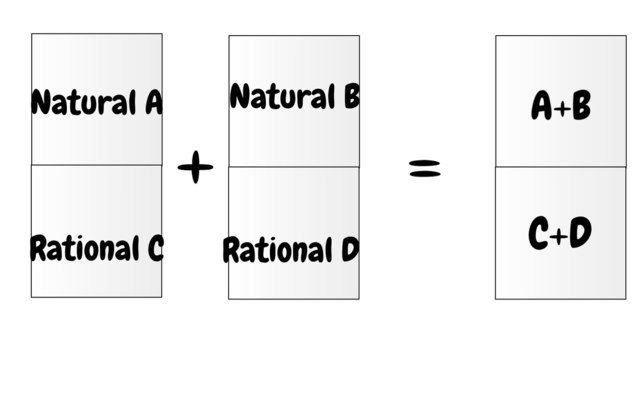
it's just a vector space with different algebras on each component (no longer coefficients from a field).
The last thing to note here is that the subtraction operator allows an order to be defined on the structure of commodities. We can say that 1 list of commodities is greater than another when the second is equal to the first minus some amount of each commodity. So A>=B <=> B-A=0. It inherits this order from each algebraic structure and holds when the inequality holds for all coefficients. So this lets us say things like (1BM+0.5SM)>(1BM+0.25SM). Note, however, that this 'order on the amount of stuff' does not necessarily respect the elementary form of value insofar as 'strictly more goods' can be traded for 'strictly less' and vice versa (go from 2z->z instead here through the trade network). -
Marx's Value TheoryAfter a few days of trial and error and searching I found a paper that deals with remaining part of the algebraic structure of commodities above - specifically defining a sense of subtraction. So things like (1.5SM + 0.5BM)-(1.3SM + 0.1BM)=0.2SM + 0.4BM make sense.
One of the reasons this was difficult is because if you allow subtraction in usual sense of additive inverse, you 'zero out' the whole structure. Ideally what's needed is some way of allowing calculations like the above, but dealing with things like (1.5 SM) - (1.6 SM) = ? in a manner which keeps the structure closed. If you have 0-x=0 for all x, then add x to both sides, then x=0... So the whole thing is zero.
Another reason this doesn't work in the naive way is: say we have x lots of SM, and want to subtract off (x+1) lots of SM - x and x+1 are both positive amounts of stuff so they are valid elements of the structure.
This gives (x) - (x-1)=0, but by associativity and -ve*-ve=+ve, x-(x-1) = (x-x)+1=1, so 1=0. This is a contradiction.
The right strategy for defining it is to define subtraction (-) as (in principle) an independent operation of addition, then model the links between them in the structure (C,+,*,-) afterwards. -
Marx's Value Theory
Mixing metaphors, I think Marx is really sensitive to how the material processes carry along/are driven by the abstractions. To me it feels like the kind of thing Heidegger should've done more, looking at how a body Daseins. Re-inscribing the transcendental in the material, or something like that. -
Marx's Value Theory
I'm stealing vocabulary from as many places as I need to try and convey the ideas. So yeah, I borrowed conditions of the possibility for that bit. The really interesting thing about that space of questions, methodologically at least, is that the condition for the possibility isn't 'condition for the possibility of conception' alone, it's also 'condition for the possibility of working as is'. I view these kind of questions as providing something like synthetic a-priori knowledge of social structures, but Marx always ends up reading the a-priori structure back into the phenomena to... I don't know, something like 'see things in their motion'. Like collapsing the most developed value form into the money commodity so he can look at circulation of commodities.
There's a real metaphysical thoroughness in his ideas, and a lot of... alchemy of ontological strata. -
Marx's Value TheoryOne last note before continuing on with the section on the relative form of value. As I showed before, the elementary form of value by itself can allow 1 coat to be exchanged for 2 coats; so any notion of ordering in terms of commodity amounts isn't compatible with this form of value, and if for some specific realisation of the elementary form it is consistent with such an ordering, it is so by logical coincidence. But there is a real incentive for a social organisation to constrain the value form more; so that trades of equivalent worth don't allow the alteration of value (instantaneously).
-
Marx's Value TheoryIf I call the set of commodities C whose components are generated by (DC,+,*) and (CC,+,*) then glued together through + (C,+), this facilitates setting up the elementary form of value on C. It works essentially the same as I discussed before but with a few minor alterations:
(1)batches of commodities can be compared to batches of commodities.
(2) if two expressions in (C,+) evaluate equally then they should be treated the same. This is to say that, say, 2SM+1BM=2*(SM+0.5BM) and so 2SM+1BM is worth 2*(SM+0.5BM) and vice versa.
This means, unfortunately, that an equivalence relation should be defined on (C,+) - so that sentences in (C,+) which evaluate equally are substitutable for each other. EG since 2SM + 1BM is the same as 2*(SM+0.5BM), if (2SM+1BM) T (1 coat), then ( 2*(SM+0.5BM) ) T (1 coat). This is so that T respects equality in (C,+). So, formally, T becomes defined on equivalence classes of (C,+) under the relation of equality of expressions. Just like I referenced before with the fractions - different ways of writing down the same thing should be treated the same. And also just like with the fractions, this mathematical detail can largely be forgotten since we know how to substitute anyway.
fdrake

Start FollowingSend a Message
- Other sites we like
- Social media
- Terms of Service
- Sign In
- Created with PlushForums
- © 2025 The Philosophy Forum