
-
Foundational Questions of Physics & MetaphysicsIn the July/August issue of Skeptical Inquirer magazine, philosopher of science Massimo Pigliucci, asks, "What Does It Mean To 'Interpret' Quantum Mechanics?" In the early days of Quantum Theory, some Hard-line scientists have been known to claim that there's no need to "make sense" of quantum queerness, as long as the mathematical models work reliably. Hence, they denigrated any rational or metaphorical attempts "to attach physical interpretations to the equations : the math is all there is, the rest is a waste of time . Philosophy, if you will".
But, over the years, that professional smugness seems to have been shaken by their inability to reconcile QT with Classical Physics. A 2017 international survey of physicist's attitudes on "foundational issues" *1 revealed that "the shut-up and calculate school is in the minority, at only 23 percent". — Gnomon
Here is a graph summarizing the results of a survey of physicist's opinions of the correct interpretation of quantum mechanics:
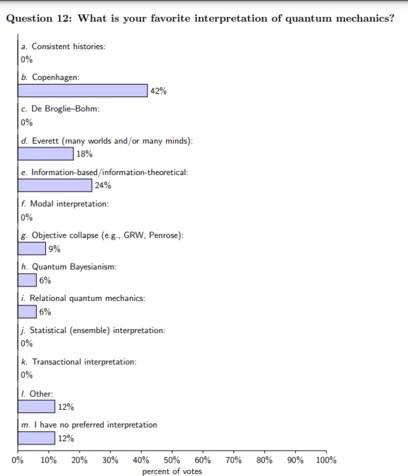
This is from "A Snapshot of Foundational Attitudes Toward Quantum Mechanics" published in 2013. The results are very similar to the article you referenced. Here's a link to the article:
https://phys.org/news/2013-01-survey-physicists-fundamental-quantum-mechanics.html
The graph shows that the Copenhagen interpretation was chosen by 42% of the physicists surveyed. Generally, the Copenhagen interpretation is considered equivalent to the shut-up-and-calculate one, although I guess there is some lack of clarity on that. No other interpretation comes close. That doesn't mean it's the correct interpretation, but I think you misrepresented what physicists think in your post.
Then he says "Let that sink in : there is no way to empirically tell apart different interpretations of quantum mechanics. One might even suspect that this isn't really science. It smells more like . . . metaphysics". — Gnomon
For me, this is the heart of the matter. I have always thought this is a good way of looking QM, with one difference. In my view, if it's true that there is no empirical way of selecting among the interpretations, then the interpretations are either metaphysics or they are meaningless. If an interpretation adds value, if it is useful, then it is metaphysics. If it doesn't, if it isn't, it's meaningless. For me, adding value or being useful means that the interpretation clarifies existing science, gives insight into possible fruitful new science, or raises important questions. If all it does is make us feel good or reduce our anxiety, then it's meaningless.
Maybe, it's good that I have no professional credentials to be sullied when I express personal opinions on an internet forum. — Gnomon
That seems like a pretty facile statement. Having no professional credentials might also mean your opinions are not credible on this subject. -
The hell dome and the heaven domeWhich group if either do you believe are most likely to try to "break free". — Benj96
You don't need a far-fetched thought experiment to get your answer. Just look at the world. People leave places where they are suffering from starvation, oppression and poverty to go to places they think will be better all the time. For examples see the US's southern border, the border between Russia and Kazakhstan, and the Mediterranean Sea between northern Africa and Europe. -
Listening to arguments rather than peopleQuestion: Should we listen to arguments rather than people?
Background information: An “Argument” is where one or more premises (supporting propositions) provide reasons to believe a conclusion (main proposition). A “Proposition” is a truth-bearing statement (that is, a statement that bears truth and falsity). Examples of propositions include: "All men are mortal" or "Socrates is a man." These propositions form the following argument: (premise 1) “All men are mortal.”; (premise 2) “Socrates is a man.”; and (conclusion) “Therefore, Socrates is a mortal.” — Cartesian trigger-puppets
What you've described isn't, and shouldn't be, the typical form that an argument takes on the forum. If I say "I hold this truth to be self-evident - all people are created equal," there is no simple logical road that gets us to a resolution. It's an essay question, not true/false or even multiple choice.
If a person makes the statement “A bachelor is an unmarried man”, the person’s characteristics (e.g., dishonesty, ignorance of marriage, immoral behavior, etc.) bring nothing to bear on whether or not the statement is true or false. The truth or falsity of the statement remains the same nonetheless, despite the characteristics of the person is making it. — Cartesian trigger-puppets
This would be true except that most questions require knowledge and understanding of the relevant facts and conditions. For that reason, the credibility of those in the argument is an important consideration. For example, there are members of the forum who make technical scientific claims that are inconsistent with current science. In such a situation, it doesn't make sense to criticize the details of a long, involved, and unsupported argument. One good solution is to avoid the discussion. On the other hand, criticizing the credibility of the person making the claim is not irrelevant. -
Is "evolutionary humanism" a contradiction in terms ?If by "survivability" what is meant is adaptivity, then, as far as I can tell, this deflation of "truth" is spot on. — 180 Proof
Hey!!! You changed my text.
Anyway - I'm ok with adaptivity for survivability. I'm not sure of the difference in this context. -
Is "evolutionary humanism" a contradiction in terms ?I think the takeaway message is that for many people certainty or truth, even the possibility of intelligibility itself must rest upon a transcendental foundation (idealism/will/theism/deism/Tao). — Tom Storm
Well, it's clear to me that truth, certainty, intelligibility, belief, and all the rest are concepts and reflect values created by our imperfect human minds. That makes it a circular argument. -
Is "evolutionary humanism" a contradiction in terms ?The argument (and there are philosophers like Donald Hoffman who take this view too) is that the process of evolution does not require truth, only survivability. — Tom Storm
Another way of saying that survivability is what matters is to say the truth is what works. That's the battle cry of the pragmatist. As far as we can tell, the theory of evolution by natural selection works. It helps us predict the future. Predicting the future makes it easier for us to survive. -
Is "evolutionary humanism" a contradiction in terms ?The evolutionary argument against naturalism seems to be a nice companion this.
https://en.wikipedia.org/wiki/Evolutionary_argument_against_naturalism#:~:text=The%20evolutionary%20argument%20against%20naturalism,evolution%20and%20philosophical%20naturalism%20simultaneously.
My glib response is there are lots of things people will argue can't be done and yet they are done. — Tom Storm
The argument, to the extent I can understand from the article you linked, seems to be that without outside guidance, evolution could never develop reliable rational intelligence and without reliable rational intelligence no human belief, including in evolution, can be trusted. Seems a lot like the fine tuning argument. -
Is "evolutionary humanism" a contradiction in terms ?Here's a question for those who would deny that such a qualitative gap exists: imagine a herd a migrating wildebeests somewhere in Africa. They cross a river and 50 of them drown. Now image a group a migrating humans, and 50 of them drown while trying to cross the Mediterranean or the Rio Grande. Is there a difference in value between the two accidents? The first incident is just something that happens every day in nature; animals are born, they survive, they die. But the death of 50 human migrants is not something in the category "things happen": is a tragedy. Because of special human dignity.
To sum it up: The evolution theory says: no special role / special position for the H.sapiens . Humanism says: yes, because only the human being, regardless of his abilities, has a special dignity.
Therefore the "evolutionary humanism" is a philosophical impossibility, the attempt of a squaring of the circle. — Matias
But atheist humanists like MSS have great problems to explain what their 'humanum' is supposed to be that makes the human animal so special. They are unable to explain human dignity. That's the basic flaw of their theory — Matias
I have always thought of humanism as a perspective that sees the world from the viewpoint of human values. If that's a valid definition of humanism, and I think it is, then there is no contradiction.
A philosophy that can be summed up by "We are all together on this boat; so let's be nice to each other" does not need a pretentious name like "humanism" — Matias
I do agree with this. -
Western Classical v Eastern MysticalI don’t believe so but accept the argument that you cannot possibly understand the Eastern philosophy unless you have submerged yourself or of course are brought up with the language and heritage. — David S
I think Lao Tzu disagrees with you:
On the decline of the great Tao,
There are humanity (jen) and righteousness (i).
When intelligence (hui) and knowledge (chih) appear,
There is great artificiality (wei). — Tao Te Ching, from Verse 18 - Ellen Marie Chen Translation
Eliminate sagacity (sheng), discard knowledge (chih),
People will be profited (li) a hundredfold. — Tao Te Ching, from Verse 19 - Ellen Marie Chen Translation
One who knows (chih) does not accumulate knowledge,
One who accumulates knowledge (po) does not know. — Tao Te Ching, from Verse 81 - Ellen Marie Chen Translation -
Western Classical v Eastern MysticalAgreed. But we have to consider the fact that we in the West have interpreted Tao Te Ching or Confucianism according to our "culture". I mean, those translated works are adjusted to the Western world criteria.
Probably if we read it in the original version/language we would get confused because we wouldn't understand it — javi2541997
I think we've had this discussion before. I disagree. In my understanding, the Tao Te Ching is about the experience Lao Tzu is trying to help us encounter, not what he wants us to understand. The experience speaks for itself in whatever language you understand. -
Western Classical v Eastern MysticalI'm for making things up as I go, and happy to steal the odd idea from wherever if it looks like that idea can help. — Tom Storm
And that's what I call "pragmatism" - whatever works. -
Western Classical v Eastern MysticalWestern Classical Philosophy v Eastern Mystery Traditions — David S
For me, the difference between western and eastern philosophies is the focus. Western philosophies generally focus on reason, eastern on experience and awareness. To me, it feels like western philosophies focus on one small aspect of our reality while philosophical Taoism and other similar religions and philosophies try to encompass everything. I find Taoism much more satisfying than other approaches. As far as western philosophies go, you can probably call me a pragmatist. Taoism is the most pragmatic way of knowing the world I can think of. -
Gender is meaninglessThat's why ssu's question of "what does it mean to be a man or a woman" isn't resolved by explaining that people can just call themselves whatever they want. There needs to be a general discussion to understand this so that we can decide how someone who isn't biologically male could assume a "male" identity, what the rules are for that and how it might work etc. — Judaka
Good response. -
How Different are Men and Women?I view 'human nature' more as tendencies we humans have when we're not in control. — Tzeentch
You and I have very different understandings of human nature. -
How Different are Men and Women?Men almost never become pregnant. — unenlightened
Do you believe that's the only significant difference? -
How Different are Men and Women?I have already given you personal testimony that people cannot always 'obviously' distinguish the sexes. This is why they have tests in sport, and why we had a female pope. Some species do have clear markers for sex of size, or plumage or shape, but humans do not. Manboobs are generally smaller than womanboobs, but small womanboobs can be smaller than merely medium manboobs.That is to say, the boobs thing is a statistical difference. Nor does one sex have colourful plumage or horns. — unenlightened
The fact that there are strong, aggressive women and physically weaker, less assertive men is no evidence at all that there are not significant biological differences between men and women. I've heard that some people eat peas with their knives. That doesn't make me think that there is no difference between a knife and a fork. I personally usually eat them with a spoon. -
How Different are Men and Women?What is the need to differentiate the sexes by dress and hairstyle, then? — unenlightened
Why can't it be both - biology and society? -
Excessive thinking in modern societyI'm not that proficient in the English language as a means of communication so can only hope having made the above text readable and understandable enough to communicate the gist of what I propose. — Seeker
Forgot to mention - your English is fine. Clear and easy to understand. -
Excessive thinking in modern societyExcessive thinking habits are a leftover from our past. From an evolutionairy point of view excessive thinking makes sense as it enabled us to outsmart all our predators (and eachother) while manipulating and shaping our surroundings to work for us. It serves us as long as there's a (valid) outlet for it. It brought us unrivaled problem solving capabilities enabling us not only to outsmart 'the rest' but to become the dominant species as well. In a manner of speaking nature just forgot to add the mechanism to dumb it down again once we were safe, atleast not in all of us. — Seeker
As @Christoffer wrote, that's not how evolution works. There's not a one to one relationship between genes, traits, and evolutionary benefits. God or Darwin gave us brains, nervous systems, and whole bodies that work as a unified whole. Rationales for why particular traits came to be dominant are oversimplifications if not just wrong.
Beyond that, I don't see any reason to believe that we need our cognitive abilities less now than we did in the past. -
How Different are Men and Women?If that were the case, there would be no need to differentiate them by artificial means such as designated clothing, hairstyles etc. — unenlightened
I don't think that's true. I don't deny there are social pressures to conform to accepted sexual behaviors, but that's clearly, to me at least, not all there is to it. -
How Different are Men and Women?The whole interplay between gender and racism in power is important as well as the way in which stereotypes impact on life. This involves the concept of otherness. — Jack Cummins
I think overemphasizing the parallel between racial oppression and sexual discrimination is a mistake. The situations are different. -
How Different are Men and Women?Do you mean to say that your soul, acting alone, based upon its nature, decided without constraint? Are you not then really just arguing that nature (as opposed to nurture) made you act as you did, meaning, basically, "you were born that way." — Hanover
I agree with much of what you say, but I don't think @Tzeentch's position requires that we be completely ruled by our nature. I think it would have to mean that our true self, our soul, comes from somewhere outside of either nature or nurture. -
How Different are Men and Women?Thinking about the nature of biological differences and the political aspects of this has been an important area. It has led to people querying gender essentialism. It is likely that in the aftermath of postmodernism, there are still a lot of questions, especially the interplay of biology, culture and politics. — Jack Cummins
I think what you write is true, but that doesn't mean that those "querying gender essentialism" have got it right. Denying who we irrefutably are for political purposes is not liberation, it's foolishness. -
How Different are Men and Women?Culture exaggerates sexual differences where they statistically occur, and invents them everywhere else. — unenlightened
I don't think biological sexual differences are just "statistical." I think they are obvious and significant. To deny this is to ignore the evidence of your senses. That doesn't mean we are destined and condemned to living out societal expectations, but it's not some trivial artifact of our troglodyte past.
Always good to be able to use "troglodyte" in a post. -
How Different are Men and Women?I suppose you could view it as a radical free choice position. — Tzeentch
I believe one can only explore that which is truly authentic to the self when one is free of external pressures on the mind. That includes both nature and nurture, and thus societally-constructed gender identities, whether they're traditional or trans.
In terms of identity men and women or trans do not exist. Those terms are societal shorthand - useful tools to make communicating a bit easier. But all that exists are unique individuals. The second the individual starts to accept these generalizations as actually defining them, the soul loses its wings. — Tzeentch
In order for there to be "radical free choice" or anything near it, there would have to be no human nature. Nothing built in. We would have to be born as blank slates. -
Gender is meaninglessthis is a prime example of someone who isn't patient enough to read carefully. — Susu
I did read carefully, but I don't agree with you. I think making a big deal out of gender identity as something different from biological sex is potentially dangerous for impressionable and vulnerable young people. Once you are grown up, you can do whatever you want, call yourself whatever you want, but I don't think society necessarily has any obligation to go along with your self-designation if it is disruptive.
One of my sister's children started identifying as non-binary when they were in high school. I only see them once or twice a year. I hug them with all the rest of the family. I use their new name. I try to be careful about pronouns. They're my family. I love them. On the other hand, it's been a hard few years for my sister and her husband. -
Gender is meaninglessSo really what is a man and what is a woman? — Susu
I am not unsympathetic to people who have gender dysphoria and I have no trouble with them identifying themselves differently. For the rest of us - males have penises and testicles and females have vaginas and ovaries, among other things. Healthy adult females can bear children.
Most importantly - children should not be encouraged to modify their bodies by surgery or hormonal treatments. Only in extraordinary circumstances should they be allowed. -
How Different are Men and Women?And that last line captures my feelings about this topic; when the individual simply accepts biological drives as facts of life, or accepts being put into a box by societal pressures, it's like the soul loses its wings - it loses a part of its essence, that part which in Plato's terms could be called divine and immortal. — Tzeentch
We've laid out three metaphors here, all of which are a bit off. I don't think the horse controlled by his rider works. I don't see my body's physical aspect as something that has to be wrestled into compliance. Then there's Plato's winged horse of the soul losing it's wings and falling to the ground to be shackled to the limitations of it's body. Putting the soul as our "true" self and our body as a fallen remnant doesn't make sense to me. Even though I like it, my metaphor of the wave isn't quite right either. It could only work if I am the wave. -
How Different are Men and Women?Biology is destiny for those who do not develop the capacity to understand and control their biological makeup and instinctual and subconscoius drives. As Plato argues, the reasoning faculty of man should be in firm control over the temperamental and desiring parts of the mind. — Tzeentch
What you've written makes a lot of sense to me, although I think the position taken in the above quoted text is greatly overstated. If we control our biological makeup, it is the way a surfer controls a wave, not the way a rider controls a horse. -
Do Human Morals require a source or are they inherent to humanity and it’s evolution?
A few weeks ago, we had a thread about mental processes that included discussion of Pinker's "The Language Instinct." Two explanations for how language develops in humans were discussed 1) Pinker's contention that there are genetically established brain locations and functions that code a universal grammar common to all humans and 2) A view that sees language as one expression of a more general cognitive ability. Both approaches include a major role for learning from experience, but the second puts a much heavier emphasis on empirical learning.
Seems to me the discussion we are having here runs parallel to that one. Here, I am at least a tentative spokesman for the first view as it applies to moral behavior and you support one that is similar to the second view.
You quote Karen Wynn:
The early emergence of the evaluation of social actions—present already by 3 months of age—suggests that this capacity cannot result entirely from experience in particular cultural environments or exposure to specific linguistic practices, and it suggests that there are innate bases that ground some components of our moral cognition. — Karen Wynn
I see this as a very moderate expression of an argument for a genetic component to moral behavior. She doesn't make any definitive statement. She says her results suggest a genetic component. She says "...there are innate bases that ground some components of our moral cognition." That doesn't seem like any great leap to take from her studies. You, on the other hand, seem to reject even that moderate claim out of hand. You point out some hypothetical reasons why it might not be true, but don't provide any substantive refutation. I find that an unconvincing argument.
Currently I am uncertain of the relative contribution of inherited abilities and learning to human moral behavior, but Wynn's claim that her results are suggestive of a genetic component makes sense to me. -
Universal Mind/Consciousness?Here are a couple of clips from past @Wayfarer posts I think are relevant to your OP:
The God-realised being - Ramana Maharishi, another Indian sage, died 1960, was the archetype - realises that only God is real, and says that the apparent world of multiplicity and strife is actually māyā, an illusion, with which the mind has become entanged through avidya, ignorance. — Wayfarer
This idea is not dissimilar to one in many of Alan Watt's books. For example The Book: on the Taboo against Knowing who you Are, which 'delves into the cause and cure of the illusion that the self is a separate ego. Modernizes and restates the ancient Hindu philosophy of Vedanta and brings out the full force of realizing that the self is in fact the root and ground of the universe.' Watts does bring an element of the 'divine play', the game that Brahman plays by manifesting as the multiplicity, each part of which then 'forgets' its relation to the whole. Which actually dovetails nicely with some elements of Platonism, i.e. the 'unforgetting' (anamnesis) of the state of omniscience that obtained prior to 'falling' in to carnal existence. Note well however the mention of 'taboo' in the title. — Wayfarer -
Do Human Morals require a source or are they inherent to humanity and it’s evolution?I think she begins with unexamined assumptions concerning concepts such as compassion , altruism and empathy. The question is , what is it about the way we think about certain aspects of human behavior that lead us to conclude from the fact that they are displayed in very young infants that they are ‘innate’? — Joshs
I checked the transcript. Altruism and empathy were not mentioned. Compassion was mentioned twice by an outside commentator, not Wynn. The video focused on children's behavior, not concepts. True, Wynn and others did indicate they thought the behaviors were innate. That doesn't seem like such a jump to me.
Do we leap to such conclusions concerning perceptual achievements of infants, or do we first look to see in what ways exposure to environmental stimulation in the womb and out of it may lead to the infant’s construction of perceptual skills? I dont think so, and I think the reason has to do with our woefully poor understanding of the relation between affective phenomena and perceptual-cognitive skills. — Joshs
Again, the report doesn't mention affect or emotion. The focus is on behavior. Why would you jump to the conclusion that the behavior we see is related to events in the womb? These are very young children. They don't have language yet. Do you really think they were taught the behaviors they act out?
the only aspect of morality humans inherit is the capacity , and need, to construe meaningful pattens in events. — Joshs
And the evidence for this is....?
This is learned, not innate. — Joshs
Sez you. Not Wynn. I'm not saying every question is answered, but you haven't provided much to work with. -
The Mold Theory of Person GodsDo you agree the correlation I describe exists? — hypericin
I don't know and I don't think you do either, but that's beside the point. As I noted, even if it exists, it isn't evidence for your position. -
The Mold Theory of Person GodsOh? Great. Why don't you elaborate? — hypericin
I don't see any necessary connection between the conditions you describe and the results you claim. -
The Mold Theory of Person GodsDo you have any idea how an experience of a non-person God could translate into accepting a religion with person Gods? — Art48
I described my personal experience and how I might interpret it. Other people could experience and interpret it differently. As I noted, I don't make any claim to certainty. -
Do Human Morals require a source or are they inherent to humanity and it’s evolution?
Forgot to say - in order to notify someone that you have responded, you have to either use the @ function (see top of response box) or type @T Clark with double quotes (") on each side of the name. If you don't do that, people won't know you responded. -
Do Human Morals require a source or are they inherent to humanity and it’s evolution?It is not really a moral code but an inborn instinct. — David S
Speaking of language, in "The Descent of Man," Charles Darwin wrote:
Human language is an instinctive tendency to acquire an art. It certainly is not a true instinct, for every language has to be learned. It differs, however, widely from all ordinary arts, for man has an instinctive tendency to speak, as we see in the babble of our young children; while no child has an instinctive tendency to brew, bake, or write.
I think something similar could be true for moral understanding. In "What is an Instinct" William James wrote:
Nothing is commoner than the remark that Man differs from lower creatures by the almost total absence of instincts, and the assumption of their work in him by “reason.”...[But] the facts of the case are really tolerably plain! Man has a far greater variety of impulses than any lower animal; and any one of these impulses, taken in itself, is as “blind” as the lowest instinct can be; but, owing to man’s memory, power of reflection, and power of inference, they come each one to be felt by him, after he has once yielded to them and experienced their results, in connection with a foresight of those results…
…It is plain then that, no matter how well endowed an animal may originally be in the way of instincts, his resultant actions will be much modified if the instincts combine with experience, if in addition to impulses he have memories, associations, inferences, and expectations, on any considerable scale…
…there is no material antagonism between instinct and reason… -
Cracks in the Matrix
I just remembered this. A possible scientific explanation for ESP and a worrisome sign for the future.
T Clark
Start FollowingSend a Message
- Other sites we like
- Social media
- Terms of Service
- Sign In
- Created with PlushForums
- © 2026 The Philosophy Forum