
-
BeliefI can't distunguish for you the external object from the phenomenal state, so I can hardly parse out the phenomenal state itself into raw presence sense data and preexisting interpretative data like beliefs. — Hanover
Huh. So you can't distinguish anything from anything else, there's just the endless unified flow of Hanover's experience. Nothing special about beliefs-- they're part of your stream of consciousness like everything else, like me, and rocks.
Bored now. If I had known this is where we were headed, I wouldn't have bothered. -
Belief
Our beliefs, in part, shape our experience. Sure. Why do you think that's the same thing as saying beliefs are experiences, or are an aspect of experience?
My height, in part, shapes my experience. But my height is a physical fact about me. I experience being the height that I am, sure, but that doesn't make my height just an aspect of my phenomenal mental life. -
~Bp <=> B~p (disbelief in something is the belief of the absence of that thing).
If only I could upvote you! Thank you, my friend. -
BeliefA belief is an experience — Hanover
Is it? Where's the argument for this?
When you're done eating popcorn the experience is over, but the belief that you were eating popcorn persists indefinitely. Recalling that you were eating popcorn is also an experience, but not the same as eating popcorn, and neither is the belief that you were eating popcorn.
The process of acquiring a belief may be an experience, or it may be something you can have an experience of, but really the differences between beliefs and experiences are so numerous, I can't imagine why you you'd think beliefs are experiences (rather than, say, like a good empiricist, thinking they have their origin in experience) except that you think they are both mental somethings. -
~Bp <=> B~p (disbelief in something is the belief of the absence of that thing).I don't believe the present king of France is bald.
<ducks> -
BeliefI don't just experience a bird as a single raw image, devoid of beliefs, ideas, anxiety about work, hunger from not having breakfast, etc. A phenomenal qualitative state is an entire experience presenting however it does. It's my internal state at a given time. — Hanover
Sure, but here you're not saying the phenomenal state is the belief, or that having a certain belief means being in or having been in a certain phenomenal state.
Taking a step back here: phenomenal states are complex and fleeting; beliefs on the other hand can be simple and persistent. They don't look like the same sort of thing, do they? It's one thing to say that our phenomenal experience is generally accompanied by beliefs, but quite another to say our beliefs are those experiences. -
Beliefbecause I have the same reasons to believe it when I'm thinking about it even when I'm not — Hanover
Even if you're not thinking about those reasons? And is holding a belief the same as having reasons for holding it? Are you still talking about the belief existing in different senses, some phenomenal some not? -
BeliefIt exists in a different sense when I am thinking about than when I'm not, but to the extent the same data and rationality exists over time that causes me to believe I live in Georgia, I continue to have that same belief in some sense even when I'm not actually presently experiencing that belief. — Hanover
I'm not following this at all. -
BeliefThree ways of making the wrong move:
1. When I pushed that pawn, I was kicking myself because I knew I had to move my king first.
2. When I pushed that pawn, I was thinking you had to capture. Totally missed that check in-between.
3. When I pushed that pawn, I was thinking about that girl I saw at the bookstore today.
In chess, there's a strong sense in which these are all the same move and the differences are only a matter of curiosity. Interesting maybe, but irrelevant to the game itself. I lose in every case.
Is talking like this? How much or how little like this? -
Non-Organic Evolution (Sub specie Evolutionis)Might be helpful to use a word like "development" for changes an individual undergoes during its lifespan, and reserve "evolution" for populations.
-
The Gettier problem
I think I'm largely with you here, with the proviso that we do have experiences that falsify our beliefs sometimes. (And of course science sets out to produce just such experiences.) So while self-contradiction might rule out a possibility, contradicting some belief or beliefs of ours does not.
And I come back also to the sense of an epistemic community with shared norms of evidence and rationality. Those are, similarly, not absolute. -
The Gettier problem
I think you're being too casual with the word "probability" there, is all.
If there are 500 million government-issued ID cards in the US, and an additional, say, 200,000 fake IDs, does that mean the odds of any given ID being a fake are about 3.8%? No, of course not. Because IDs don't randomly appear. The driver's license in my wallet came directly from the Georgia Department of Transportation; I don't have to wonder if it might be a fake.
But if you're the owner of a bar, and some kid presents you with an ID showing that they're of legal drinking age, then you might have a responsibility to look closely at that ID. As with counterfeit, that's a situation where people are known to present a fake ID and we know why they do it.
EDIT: dropped some 0's, but never mind that. -
The Gettier problem
No I'm inclined to agree with you, because I take the justification to be a practical thing. It's a matter of applying your knowledge of circumstances in the way members of your epistemic community do. In retail, for instance, you exercise slightly more caution accepting large bills than you do as the customer at a bank because it's a known fact that people try to pass counterfeit bills at stores. If you have no reason to think someone's ID is fake, and if members of your epistemic community would as a rule see no reason to think the ID is fake, then I think you're justified in assuming the ID is genuine, even though you know there is a non-zero chance that it's not. -
The Gettier problem
What about the person who just knows they have the winning ticket?
Have you ever seen the game show "Deal or No Deal?" Fascinating exercise in probability which in its heyday sparked long math debates on the internet. You could always see someone on there turning down hundreds of thousands of dollars because they just knew they had picked the case with a million dollars in it.
Those people drove me nuts. Only time I was tempted to yell at the television. "No you don't! You don't know any such thing! It's random! Take the money!"
The more we talk about this example, the more I'm inclined to agree with @Metaphysician Undercover that you are no more justified in claiming that a given ticket will not win than you would be in claiming that a given ticket will.
In the lottery case, the urge to say "Just do the math" is almost overwhelming. 1 in 3.2 billion is a small number but it's not 0. It's just not, and saying that it is is just wrong.
What about the chair I'm sitting in? Is there a vanishingly small but non-zero chance it will disappear as I sit here, or turn into pudding, or whatever? Maybe? The difference is that knowing how lotteries and probability work, we know the mechanism responsible for uncertainty. Even if I'm a good Humean and accept that my knowledge of this chair is only probable, I think we should still call my beliefs about it justified because an unknown mechanism having unforeseeable consequences can have no place in our reasoning. Only probable, yes, but still justified because the only factors I have not taken into account are factors I cannot possibly know anything about.
Gettier cases frequently rely on coincidence. We all have lots of experience of coincidence, but no experience predicting the occurrence of a coincidence. Hence, the subjects in Gettier cases have beliefs that are indeed only probable, but still justified. -
The Gettier problemIt's true that you're not justified in believing that the entire sample of tickets loses, and I think that shows that justification isn't necessarily inherited — Michael
Wait -- does it? I think in this case, it's that the inference that would preserve justification is faulty. (You just can't go from "each individually" to "all taken together" like that. It's like the Logic 101 example of inferring there's someone everyone loves from everyone loving someone.) -
The Gettier problem
Right, I had forgotten about this.
My hot take is still that this is a muddle that arises from ambiguity over what constitutes a trial. The closure principle relied on here is no substitute for doing the math right. That can mean the math seems counterintuitive (e.g., the Monty Hall problem), and that's interesting as a fact about our epistemic biases but nothing more.
Maybe @fdrake could chime in.
I'll think about it some more... -
The Gettier problemA particular counterexample is that of a lottery. Given the high odds, I am justified in believing that any given ticket won't win. But I am not justified in believing that no ticket will win, even though that no ticket will win follows from the conjunction of each given ticket not winning. — Michael
Hmmmm.
1. Is there a hidden premise here that some ticket will win? Because the way the big lotteries work here in the States, it's quite common for no ticket to win for months, and that's how the jackpot grows into hundreds of millions.
2. Given some such premise, you just have to be careful with quantifiers and sums, I think. If you have ye olde urn of a hundred marbles, 99 white and 1 black, the chances of having drawn a black marble are 1/100 for as many individual trials as you'd like, but obviously if you draw more marbles per trial your chances are better, right up to guaranteed success if you draw all of them. I don't think there's a problem here.
((Btw, this slippage from individual to collective can be really interesting. It's thought one of the earliest examples of a game-theoretical problem is a story somewhere in Plato about a soldier who reasons thus: we're either going to win or lose this battle; my participation can't make much difference to the outcome and I run the risk of dying; therefore I should desert. The reasoning isn't bad for an individual, but doesn't scale up very nicely.)) -
The Gettier problemMy claim is that it is impossible to believe that a conclusion drawn from a belief which is believed to be false, is a justified conclusion. — Metaphysician Undercover
What about just the premise?
Is it possible (whatever you mean by "possible") for me to believe that your claim is reasonable but wrong? -
BeliefI'm increasingly convinced that beliefs are a folk-psychological back-construct; that they are an invention that serves, however poorly, our attempts to explain what we do; but which does not correspond to anything real. — Banno
I'm deeply sympathetic to this view, Banno. I'm not sure though that I'd want to say beliefs are not real, or that concepts aren't real. They're just not, you know, objects. I think they're more in the space of habits or rules, the sort of thing Ryle leaned on with all his talk of dispositions.
If you like, you can say that I believed the chair I was about to sit in would not disappear, and that as I sit here typing I continue to believe it. I've been believing it all day. There's just no call for saying this. It's an explanation in search of a problem, but otherwise not different in kind from belief ascriptions that do serve a purpose.
[Edited, left out "no".] -
The Gettier problemI think you'll have to lay out for me what you mean by "material implication". — Metaphysician Undercover
Just the usual. I think Gettier actually talks about "entailment" but it's not clear whether he means something special by that. We can come back to this.
Your example of a conditional is irrelevant because it doesn't utilize a false premise. — Metaphysician Undercover
Let's start there. How do you know the premise isn't false?
All I said was "IF I have good reason to believe my keys are in the kitchen, THEN I have good reason to believe they're in my house." I think this conditional is true whether or not I do in fact have good reason to believe my keys are in the kitchen. Do you disagree?
Let's vary the example slightly. Suppose I remember leaving my keys in the same place I always do, and that memory is veridical, I really did that. There's my reason for believing they're where they usually are. Now I could be wrong -- maybe I'm forgetting that later I put them in my coat pocket when I went out. I still have reason to believe they're where I usually leave them, just not conclusive reason. Does that reason suddenly become conclusive if I didn't move them later? Do you see anything here, in either case, you'd consider me justified believing?
The Gettier version would be this: you grab my keys to head out, recognize your mistake and put them back, all unbeknownst to me. Now I have that original reason to believe the keys are where I left them, and they are, but now my belief about where my keys are is true by luck. -
The Gettier problemThe issue I take against Gettier is that he seems to be arguing that an unsound (because it's based in a false premise) conclusion, may be a justified conclusion. I think that's contradictory nonsense. — Metaphysician Undercover
He doesn't argue for this position; he asks us to accept it as a premise. You don't.
The word "justified" is really not particularly important here -- you can substitute any epistemic virtue you like. What Gettier discovered is that if we assume, what seems reasonable, that material implication preserves epistemic virtue in much the same way it preserves truth, then it is trivial to construct counterexamples where our intuition is that the conclusion is not known even though it is believed, true, and has whatever virtue it inherited from the premise (that it is reasonable, rationally believed, that we have warrant to believe it, that we are justified in believing it, whatever). What the conclusion doesn't inherit from the premise is truth -- that it usually gets somewhere else.
If you can honestly state that the conclusion is unsound then you cannot honestly state that it is a justified conclusion. — Metaphysician Undercover
In the Gettier literature this is the "no false lemmas" view, I believe. So you would say that material implication only preserves epistemic virtue when the premise is true. I'm inclined to disagree. If I have good reason to believe my keys are in the kitchen, then I have good reason to believe they're in my house. If I can't say that sort of thing, of what use is material implication? -
The Gettier problemIf someone is going to use a falsity to support a conclusion, they''ll probably use one which supports it well — Metaphysician Undercover
Hmmm.
Here's another way to look at the issue. The word "reason" is ambiguous in an interesting way: we reason from our knowledge of effects to their causes and call those beliefs about effects our "reasons" for our belief about their causes; on the other hand, the cause is the "reason" for the effects. That I can see an iceberg is my reason for believing it's right in front of me; that an iceberg is right in front of me is the reason I can see it. We strive to perfect our conditionals, to believe that we can see iceberg right in front of us if, and only if, it's right in front of us. Thus our reasoning would be not a groping about in the dark, but our way of discovering the true structure of the universe, the real connections between things. We want to believe the universe is itself rational, has a rational structure, a structure we can come to understand through reasoning, a process of matching the movements of our minds to the movements of the universe without.
The interesting case is when we hold reasonable beliefs but derive from them a conclusion that turns out to be false. What has gone wrong? We have a choice: we could give up the vision sketched above, draw in our horns a bit, and take reason to be something we do, setting aside faith in the rational structure of the universe; or we could say that we must've failed, that reasoning that reaches a false conclusion cannot be "true reasoning" -- that the premises must only appear to support the conclusion but could not really support it.
Responses to Gettier along the lines of, "Well, he had a false belief -- garbage in, garbage out," rather miss the point, I think. Do we allow falsehoods to have real connections? Traditional logic says yes, valid but unsound, But how can this be? If our reasoning mirrors the rationality of the universe, those connections must also be only seemings, conditionals that cannot ever be perfected, for there is no truth underlying them. -
The Gettier problem"She looks twenty," is indeed a reason to believe she's of the age of consent, but maybe not a very good reason.
-
The Gettier problemSo you're saying that if a person has reasons for one's belief, even if those reasons involve falsities, then that belief is reasonable? — Metaphysician Undercover
It's a soundness/validity kind of thing. Reasons that actually support the conclusion, if imperfectly, are what we want, not just any old stuff.
We distinguish between how well a claim supports a conclusion and whether that claim is itself factual.
Do you not understand the distinction, or do you reject it for some reason? -
Drops of GratitudeHonored to be on that list, but we both know I learned more from you than you did from me.
-
Is 'information' physical?
I hoist a flag that means "three-masted ship". You see the flag and write down "three-masted ship". Because i can convey the idea of a three-masted ship with a flag and you can write down the idea of a three-masted ship with ink, the idea of a three-masted ship is not physical. The flag and the marks in ink on paper are physical representations of something, an idea, that is not itself physical. This is the argument, yes?
If I draw a picture of my house, the picture is a physical representation of a physical object. If I draw another picture of my house, I have another physical representation of the same physical object. Having two distinct physical representations of something does not entail that what is represented is not itself physical, not even if those representations are dissimilar in some way, if, say, I use pencil for one drawing and charcoal for the other, of if one is a drawing and the other a photograph.
So, in your argument, it is not that there are multiple representations in different media that leads to the conclusion that what is represented is not physical; it is that what is represented is said to be an idea, not a particular three-masted ship, but a generic object, any member of the class "three-masted ships".
Thus in your scenario I am not conveying a single piece of information, but at least two: by hoisting a flag at all, any flag, I indicate that some object exists; by hoisting the particular flag I do, I indicate that the object is a member of a particular class. More particularly, flags indicate ships, and even more particularly, ships that I can see. I am not to raise a flag hypothetically.
Is the raising of a flag a physical representation of a ship the way a drawing I might make would be a physical representation of my house? Well, it's not a picture of the ship. If anything, it seems more natural to take it as a representation of my state of seeing-a-ship. Is it a picture of that? Hmm. It would seem not. Is it a representation at all? Well, it's certainly a symbol: my hoisting a flag indicates that I am in such a state. I don't think that's exactly what we usually mean by "representation", but I suppose we could make that work by defining our terms suitably.
What hoisting a flag has in common with hoisting a particular flag is that it too is generic: I do not have a flag for each particular ship I might see, and hoisting a flag does not indicate that I am seeing some particular ship, but that I am seeing some ship or other, again, a generic member of the class "ships". Similarly, I am in the state of seeing a particular ship, but what I indicate is that my state is a member of this class, seeing some member of the class "ships".
Thus my flag hoisting conveys two claims of class membership: one about my state, and one about the object that brought about that state. Agreed? -
Is 'information' physical?
There's all this "grasping" in your approach, as if this explains things. Grasping is what you do to an object. I'm saying there's no immaterial object to immaterially grasp. -
Is 'information' physical?
If I ask you to draw a house, I'm asking you to draw a picture of a house. (Only Harold can draw an actual house.)
If you draw a triangle, are you actually drawing a picture of a triangle? No. Here are two equilateral triangles:
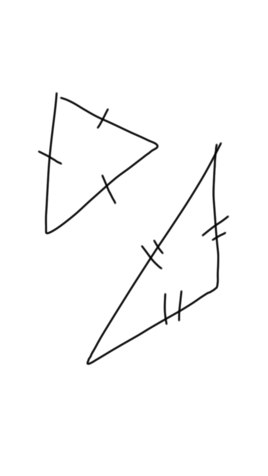
When you draw a triangle, you're not really drawing a picture, i.e., a picture of some object that happens to be immaterial. What you're drawing is a diagram, a graphical presentation of your knowledge. And this knowledge is primarily procedural, starting with the definition of "triangle", which is after all stipulative.
You can describe it as knowledge of an abstract object if you like, but what really matters here is knowing how to proceed. The triangles above have equal sides because I say they do. You can say this is a property of these triangles, but the point is that in using these triangles you know to treat their sides as equal. That stipulation gives you a rule to follow. -
Networks, Evolution, and the Question of Life
Got it. I believe I am following you, and sometime tomorrow I will move on to thinking about it. -
Is 'information' physical?you appear to dismiss semantics. Although perhaps I'm misunderstanding. — Wayfarer
Why would I dismiss semantics? What does that even mean? I think it's safe to say you have misunderstood.
Maybe this would we a good point for us to take a breather. Work and reading call. -
Is 'information' physical?Speaking of Chomsky, he gives a reason why animal and human communications are basically different, which I thought I had already mentioned earlier - it has to do with the fact that 'human language involves the capacity to generate, by a recursive procedure, an unlimited number of hierarchically structured sentences', which rely on syntactical order to indicate meaning. — Wayfarer
Are you even reading my posts?
Chomsky's work has always suggested that the key difference between human language and signaling is recursive, hierarchical, generative syntax. — Srap Tasmaner -
Is 'information' physical?So the ability of bees to dance and baby chicks to duck hawk shadows, doesn't say anything about semantics in the sense that it applies to language. — Wayfarer
I think it does. I think the shadow means hawk to them in the same way it would mean hawk to us, and that the sense (!) in which the word "hawk" means [[hawk]] is derivative of exactly this "natural meaning". At least that's my working hypothesis. We'll see.
for naturalism, it is an embarrassing question — Wayfarer
No it's not. -
Is 'information' physical?By the way, I think it is impossible for us to conceive a new colour, for the same reasons. — Samuel Lacrampe
-
Is 'information' physical?
I will speak unguardedly for a moment:
Semantics seems to be the big mystery. How do we symbolize? How can something mean something? And there's a view, the sort of thing we associate with Searle, to the effect that machines are merely syntactical, that they can manipulate symbols but not know what they mean.
So here's humanity standing above the rest of creation. We have meaning, but machines only have syntax. We have language, but other living things have signaling at best. It's tempting to identify the two hierarchies, to say that animals must have only syntax but no meaning.
But I think this is a mistake. Chomsky's work has always suggested that the key difference between human language and signaling is recursive, hierarchical, generative syntax. Semantics is not what distinguishes us from other critters, but syntax. It may very well be that "having semantics" is coextensive with "living", or at least with "having sense(s)".
It may feel like Landauer's claim that information is physical is part of an attempted reduction of semantics to syntax, to treating living things like computers, but is it really?
Srap Tasmaner

Start FollowingSend a Message
- Other sites we like
- Social media
- Terms of Service
- Sign In
- Created with PlushForums
- © 2026 The Philosophy Forum