
-
 J
2.5kThat we have the illusion is not itself an illusion. — Janus
J
2.5kThat we have the illusion is not itself an illusion. — Janus
That's a great way of putting it. (And we see again how binaries like illusion/reality can rapidly become so equivocal as to be unhelpful. "Are illusions real?" "Well, yes and no . . . stipulate how you want to use the terms!")
I doubt whether a complete account of the world we encounter is possible — Janus
I kind of do too, but it feels important to hold it up as a desideratum. Even unreachable goals can be motivating, and express something aspirational about the overall human project of knowledge.
life is being, but it is not merely being in the sense of sheer mere existence. — Janus
"Life is meaningless" is surely a mood everyone has felt at some time. How can we fall into such a mood? (other than reading Sartre's Nausea :smile: ). Usually by noticing, often with horror, that the values we hold, and organize our lives around, cannot be discovered in the world in the same way we discover what Heidegger called (in Manheim's translation) "essents" -- rocks and birds and math problems and everything else that has being but not being-there-for-us (Dasein, more or less). But as you say, living as a human is more than that, or at least so some of us believe. -
 Janus
18kI kind of do too, but it feels important to hold it up as a desideratum. Even unreachable goals can be motivating, and express something aspirational about the overall human project of knowledge. — J
Janus
18kI kind of do too, but it feels important to hold it up as a desideratum. Even unreachable goals can be motivating, and express something aspirational about the overall human project of knowledge. — J
Totally agree. I'm with Peirce on the idea of metaphysical and scientific truth as something asymptotically approached by the community of enquirers.
"Life is meaningless" is surely a mood everyone has felt at some time. How can we fall into such a mood? (other than reading Sartre's Nausea :smile: ). Usually by noticing, often with horror, that the values we hold, and organize our lives around, cannot be discovered in the world in the same way we discover what Heidegger called (in Manheim's translation) "essents" -- rocks and birds and math problems and everything else that has being but not being-there-for-us (Dasein, more or less). But as you say, living as a human is more than that, or at least so some of us believe. — J
Right, Heidegger captures that mood nicely in his idea of Vorhandenheit translated as 'present-at-hand" in its contrast with Zuhandenheit, translated as 'ready-to-hand. When we are dealing seamlessly with the world the ready to hand becomes transparent, and the meaning of things is found in their use as "affordances". The hammer and nails "disappear" when we are in that 'flow' state, and it's when something goes wrong and we suddenly become aware of the hammer as just a brute object, a bare existent, without meaning other than to be analyzed into its components, that we fall into a state of "rootlessness" (my word, not Heidegger's) wherein things become meaningless objects.
As a musician you would be aware of that meaningful flow state. Meaning is found in feeling, if we attempt analyze it, it disappears. For me, to live fully is to live a life of intense feeling, with the intellectual concerns informed by, not separate to, that life. I tried reading Nausea once—I wasn't able to get far with it. On the other hand I love Camus' works, which are explicitly about finding the deepest meaning without the need for transcendence. -
J
2.5kI tried reading Nausea once—I wasn't able to get far with it. — Janus
It isn't very good, as a work of art. But it does capture that "draining life of meaning" feeling.
For me, to live fully is to live a life of intense feeling, with the intellectual concerns informed by, not separate to, that life. — Janus
It's a problem for philosophers, isn't it? We tend to overdevelop the intellect, maybe especially in the moral sphere. You can read volumes and volumes about ethics and never find a discussion of what compassion is, and why it's central to our lives. -
 Wayfarer
26.2kAccording to phenomenology, consciousness is no thing or property that may exist or not exist. “Consciousness” is the misleading name we give to the precondition for any ascription of existence or inexistence. What makes this remark obvious for phenomenologists and almost incomprehensible for physicalists, is that phenomenologists are settled in the first-person standpoint, whereas physicalist researchers explore everything from a third-person standpoint. From a first-person standpoint, anything that exists (thing or property) is given as a phenomenal content of consciousness. Therefore, consciousness de facto comes before any ascription of existence. — Michel Bitbol
Wayfarer
26.2kAccording to phenomenology, consciousness is no thing or property that may exist or not exist. “Consciousness” is the misleading name we give to the precondition for any ascription of existence or inexistence. What makes this remark obvious for phenomenologists and almost incomprehensible for physicalists, is that phenomenologists are settled in the first-person standpoint, whereas physicalist researchers explore everything from a third-person standpoint. From a first-person standpoint, anything that exists (thing or property) is given as a phenomenal content of consciousness. Therefore, consciousness de facto comes before any ascription of existence. — Michel Bitbol
@Relativist @Apustimelogist - interested in your reactions to this. (It's in a paper I'm writing an article about, 'The Roles Ascribed to Consciousness in Quantum Physics'). I think it goes to the heart of the disagreements or should I say the incommensurability of our respective viewpoints. -
 Relativist
3.6kI agree that consciousness is neither a thing nor a property: it is a process.
Relativist
3.6kI agree that consciousness is neither a thing nor a property: it is a process.
If it's a process, then it isn't some "misleading name we give to the precondition for any ascription of existence or inexistence."
"phenomenologists are settled in the first-person standpoint, whereas physicalist researchers explore everything from a third-person standpoint. "
Sure. But the 1st person standpoint is not analyzable. It just treats 1st person-ness as a primitive.
"From a first-person standpoint, anything that exists (thing or property) is given as a phenomenal content of consciousness. Therefore, consciousness de facto comes before any ascription of existence."
OK, but does this lead anywhere? Other than the fact of one's own existence, what else can one infer? (by deduction, induction, or abduction) -
Wayfarer
26.2kIf it's a process, then it isn't some "misleading name we give to the precondition for any ascription of existence or inexistence." — Relativist
Bitbol says it's 'misleading' precisely because it is reifying to designate 'consciousness' as an object of any kind, even an 'objective process'. To 'reify' is to 'make into a thing', when consicousness is not a thing or an object of any kind.
He's saying, before we can say anything about 'what exists', we must first be conscious. Or, put another way, consciousness is that in which and for which the experienced world arises. It is the pre-condition for any knowledge whatever.
After the quoted passage, he goes on:
from a third-person standpoint, nothing else than objects of perception and handling is to be taken seriously. Now, the behavioral or neurobiological correlates of consciousness are possible objects of perception and handling. They can be said to exist (if a subject is alive and awake) or not to exist (in other cases). Then, from this standpoint, saying that the neural correlate of consciousness (often taken as its “neural basis”) may exist or not exist, amounts to saying that consciousness itself may exist or not exist in the same sense.
So, here he's saying, that from the customary, 'third-person' perspective of naturalism and natural science, only 'objects of perception' are philosophically significant - what is objectively the case. So from this viewpoint, consciousness can be said to exist (or not exist) insofar as it can be described as correlate or product of such objectively-existing processes (the 'neural basis').
Other than the fact of one's own existence, what else can one infer? — Relativist
Basically, you're asking 'so what?' Which is what thought you'd say. But this kind of point is, basically, the division between Continental and English-speaking philosophy, in a nutshell. Phenomenology and the existentialism that grew out of it, are not concerned with scientific objectivism, but with lived existence and meaning, as providing the context within which the objective sciences need to be interpreted.
(I've recently had a Medium essay published in Philosophy Today, which you can access here, if you're interested. It's a brief intro to this philosopher, Michel Bitbol. ) -
Relativist
3.6k
The quote you asked me to respond to did not mention process. He alleged consciousness isn't "comprehensible". My position is that it IS comprehensible in terms it being a process. A process is not an existent. "Runs" are processes, not things.If it's a process, then it isn't some "misleading name we give to the precondition for any ascription of existence or inexistence."
— Relativist
Bitbol says it's 'misleading' precisely because it is reifying to designate 'consciousness' as an object of any kind, even an 'objective process'. To 'reify' is to 'make into a thing', when consicousness is not a thing or an object of any kind. — Wayfarer
This seems trivially true. Only conscious beings "say" anything; What you mean by "the experienced world" is more precisely: conscious experience of the world; so again: trivially true (consciousness is needed to have conscious experiences).He's saying, before we can say anything about 'what exists', we must first be conscious. Or, put another way, consciousness is that in which and for which the experienced world arises. It is the pre-condition for any knowledge whatever. — Wayfarer
"Exist" is the wrong word for process. "Occur" or "take place" are more precise. Neural processes take place, and may very well account for consciousness. IMO, the only real difficulty is accounting for feelings. Given feelings, consciousness entails processes guided by feelings, and producing feelings.saying that the neural correlate of consciousness (often taken as its “neural basis”) may exist or not exist, amounts to saying that consciousness itself may exist or not exist in the same sense.
It's perfectly fine to concern oneself with "lived existence and meaning", but it doesn't falsify a "3rd person" approach.Phenomenology and the existentialism that grew out of it, are not concerned with scientific objectivism, but with lived existence and meaning, as providing the context within which the objective sciences need to be interpreted. — Wayfarer -
Wayfarer
26.2kThis seems trivially true — Relativist
Not when consciousness is treated as an object (per Materialist Theory of Mind) :brow:
It’s not about falsifying the third person perspective, but pointing out its implicit limitations. -
Relativist
3.6k
Materialist theory of mind does not entail reifying the process of consciousness- considering it a thing.This seems trivially true
— Relativist
Not when consciousness is treated as an object (per Materialist Theory of Mind) :brow: — Wayfarer
I brought up the limitation of the 1st person perspective, by asking you:It’s not about falsifying the third person perspective, but pointing out its implicit limitations — Wayfarer
I don't see how you can even satisfy yourself that solipsism is false. On the other hand, analysis from a third person perspective has been fruitful.Other than the fact of one's own existence, what else can one infer? (by deduction, induction, or abduction) — Relativist
We can learn more about the nature of consciousness (including accounting for first-person-ness) from this third-person approach than we can by pure, first-person introspection. -
Wayfarer
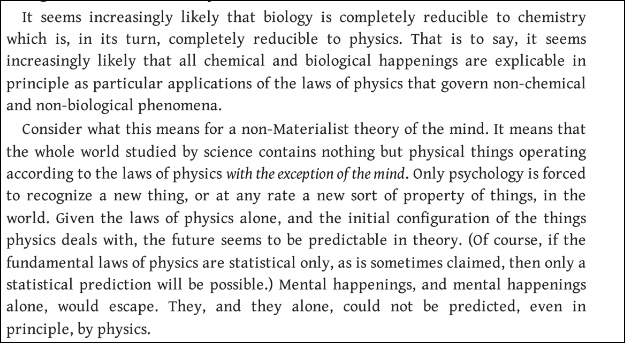
26.2kMaterialist theory of mind does not entail reifying the process of consciousness- considering it a thing. — Relativist
That is exactly what this does. and when I posted it, you agreed with it.
-
J
2.5kif you cannot tell the semantic difference between an illusion and reality when discussing them, I don't think the problem is the terms. They are almost always unambiguous. — AmadeusD
Yes, almost always. But philosophy is one context in which they are not. Consider the context of the discussion you quoted: We're trying to decide whether an illusion -- a mirage, say -- ought to be counted as part of "reality," understood as the totality of all that happens to us. In one sense, no, of course not, because the mirage appears to be one thing -- an object in the world -- when in fact it is something utterly different -- a brain glitch. But in another sense, we can't leave it out of the account of our experience of the world. It has to be explained, just as much as any other item of experience. So there is justification for applying this word "real" to all genuine events, regardless of whether they are what they seem to be.
And this is why I'm so down on terms like "real" -- you have to take precious time spelling out in which sense you're using them. -
Relativist
3.6kMaterialist theory of mind does not entail reifying the process of consciousness- considering it a thing.
— Relativist
That is exactly what this does. and when I posted it, you agreed with it. — Wayfarer
You are misrepresenting what I said. Here it is:
I agree that consciousness is neither a thing nor a property: it is a process. — Relativist
I have consistently said that processes are not things (objects). That's why I agreed consciousness is not a thing
Physicalism entails that mental activity (including consciousness) is produced by physical things.
Reminder: I do not insist that every aspect of the natural world is discoverable through science. It may very well be that there are aspects of mental activity that are partly grounded in components of world that are otherwise undiscoverable. This is worst case, but it is more plausible than non-physical alternatives. -
Wayfarer
26.2kI do not insist that every aspect of the natural world is discoverable through science. It may very well be that there are aspects of mental activity that are partly grounded in components of world that are otherwise undiscoverable. This is worst case, but it is more plausible than non-physical alternatives. — Relativist
I’m well aware. But I have also repeatedly shown why the treatment of mind or consciousness as an objective phenomenon (even if described as a process) is itself a problem. Notice in the Armstrong quote that the complaint is, why should consciousness not be regarded as amenable to the same methods that have been so successfully deployed in physics and chemistry? Why should it require ‘special treatment’? Your response is to concede that consciousness may indeed imply ‘something non-physical’ - but this also misses the crucial point of phenomenology. This is that consciousness in never something we are outside of or apart from. Until that basic fact of existence is understood we’ll continue to talk past one another. -
Relativist
3.6k
I didn't say, "non-physical", I said it may be partly due to "components of world that are otherwise undiscoverable."Your response is to concede that consciousness may indeed imply ‘something non-physical’ ... — Wayfarer
You haven't established that this is a problem, just that there's something unique about first-person-ness that third-person description cannot capture.....but this also misses the crucial point of phenomenology. This that consciousness in never mething we are outside of or apart from. Until that basic fact of existence is understood we’ll continue to talk past one another.
I suggest that this uniqueness is due to there being aspects of consciousness that are not describable in words: there are non-semantic mental attitudes (dispositions, beliefs, feelings...). So it's a "Mary's room" issue: one can't convey redness in words, nor can one convey particular pains, or feelings of anxiety, or many other things.
It's also complicated by the complexity : the brain is doing many things concurrently (processing input from each of the senses, bodily sensations - pains, hunger, triggering of memories, autonomic functions,....), and nearly everything can affect everything else, in a feedback loop that never ends. We're all unique: we start out with physical differences, and we are changed (uniquely) by every experience we have.
All this is enough to explain why I can never know what it's like to be you (or a bat). So this uniqueness of each individual's first-person-ness seems a red herring. What is relevant to judging physicalism is considering whether or not some identifiable mental process is consistent with a plausibly physical functionality. As a former software guy, I look at in terms of whether it is programable. Most things seem to be, but feelings do not- and I freely admit this is a weakness. But it is not sufficient to defeat my judgement that physicalism best explains all facts I'm aware of. -
Wayfarer
26.2kThe problem isn’t that some mental states are hard to describe, or that brains are complicated. What’s at issue is something much simpler and deeper:
Every third-person account you appeal to is already framed from a first-person point of view.
A description of the brain is still a description to a conscious subject. Nothing in that description — however detailed or computable — entails that there is anything subjectively real arising from the material facts.
That’s the point physicalism doesn’t touch. It doesn’t matter how much complexity you add or how programmable the processes may be. A functional specification is not the same thing as the reality of existence — and existence is the philosopher’s concern, not the engineer’s abstraction.
So this isn’t a “Mary’s room” or communicability issue. It’s the basic fact that:
• third-person descriptions are always about objects
• consciousness is the condition for any object to appear
Until that is accounted for, saying physicalism “best explains all the facts” simply assumes what is in question. And as a software guy, you must recognise the impossibility of writing a true functional specification for the unconscious and preconscious dimensions of mind — without which consciousness would not be what it is. As Penrose notes, subjective understanding is not algorithmically compressible.
But since you continue to defer to your preferred “best explanation,” this will be my final word to you on the subject. At least we’ve made it clear where the difference lies. -
 AmadeusD
4.3kYes, almost always. ....using them. — J
AmadeusD
4.3kYes, almost always. ....using them. — J
Hmm, okay i grok.
I guess I'm not finding it hard to grasp the problem. If someone told me "illusions are real" i would simply say "no they aren't" because that's not what "real" means. "illusions occur in reality" makes sense to me. illusions are real" is an oxymoron to me. I understand though, that this is then an argument about my use of 'real' there :P So, fair enough. -
J
2.5kGlad it makes some sense. This is a nice coincidence, because I'm trying to finish up an OP about this very thing. "What X means" is not a straightforward matter in philosophy, and it's so easy for any of us to get pulled into a dispute about terms when we'd rather talk about something more substantive. As you just pointed out, it's a disappointing result when the argument then seems to hinge on "how I use X" vs. "how you use X." Theodore Sider has some excellent things to say about this, which I'll try to lay out.
-
 PoeticUniverse
1.7kI've recently had a Medium essay published in Philosophy Today, which you can access here, if you're interested. It's a brief intro to this philosopher, Michel Bitbol. — Wayfarer
PoeticUniverse
1.7kI've recently had a Medium essay published in Philosophy Today, which you can access here, if you're interested. It's a brief intro to this philosopher, Michel Bitbol. — Wayfarer
Good essay!
So, we don't do consciousness; consciousness does us. We are scripted actors in a play? Seems like a material universe would do the same, in a way, as quantum fields making us. Of course, consciousness as primary would make the quantum fields and their physics. -
Relativist
3.6k
You miss the point. If the processes can be programmed, then an artificial "mind" could actually be built that had 1st person experiences. You conflating the specification with the actual execution of the program. That's analogous to conflating the bits in a jpg file with the image that it helps convey.That’s the point physicalism doesn’t touch. It doesn’t matter how much complexity you add or how programmable the processes may be. A functional specification is not the same thing as the reality of existence — and existence is the philosopher’s concern, not the engineer’s abstraction. — Wayfarer
You have identified no facts that can't be explained.Until that is accounted for, saying physicalism “best explains all the facts” simply assumes what is in question. — Wayfarer
What makes you think the background mental processing couldn't be programmed? It's algorthimically complex, involving multiple parallel paths, and perhaps some self-modifying programs. But in principle, it Seems straightforward. .As I said, feelings are the only thing problematic.And as a software guy, you must recognise the impossibility of writing a true functional specification for the unconscious and preconscious dimensions of mind — without which consciousness would not be what it is. — Wayfarer -
Janus
18kIf the processes can be programmed, then an artificial "mind" could actually be built that had 1st person experiences. — Relativist
What makes you think the background mental processing couldn't be programmed? It's algorthimically complex, involving multiple parallel paths, and perhaps some self-modifying programs. But in principle, it Seems straightforward. .As I said, feelings are the only thing problematic. — Relativist
I generally agree with your argument and find Wayfarers stipulative point about the fact that all attitudes are first person attitudes to be either irrelevant or trivial.
That said the one thing I wonder about with your saying that an artificial mind could be built that has first person experiences coupled with your saying that feelings are the only problematics is whether it would be possible to have first person experiences sans feelings. -
Wayfarer
26.2kGood essay!
So, we don't do consciousness; consciousness does us — PoeticUniverse
Thanks! But I'd be very careful with interpretation. That essay took quite a lot of reading of Bitbol, and he's very careful in the way he expresses himself. The expression 'the primacy of consciousness' doesn't really imply that consciousness is causal. It's more that before anything can be given, there must be a subject to whom it is disclosed. The resemblance to Descartes is clear, although in a footnote I point out that Husserl and Bitbol break with the 'substance' idea of Descartes. -
Wayfarer
26.2kAs I said, feelings are the only thing problematic. — Relativist
You say 'feelings are the only thing problematic' as if that's a minor footnote, but feelings - qualia, first-person experience - is the whole point at issue! So, why keep saying I'm the one 'missing the point', when this is the point? The very thing you constantly minimize, deprecate, even while acknowledging that it can't be explained - central to the entire debate. 'Oh, that doesn't matter. It's only a minor detail.' Like, 'hey, nice dog you got there!' 'Yeah, shame it's dead' :rofl: -
 Ludwig V
2.5k
Ludwig V
2.5k
I guess you are right. But I didn't think of it in those terms. It was simply an observation about the conceptual (and engineering) resources we have available.one has nonetheless said something metaphysically fundamental! -- indeed, something of great importance. — J
People often speak as if actually experiencing something gave one some knowledge that was not available to anyone who had not had the same experience - Mary's room. There's supposed to be a puzzle about whether that knowledge is of the same kind as third person knowledge or not. I think it is not, and only dubiously described as knowledge. However, actually experiencing something can make it real in a way that nothing else can. That's not an addition to third person knowledge, but something quite different.And yes, we can “understand subjectivity.” But we can only ever be one subject; the only instance of subjectivity we directly know is our own, and that by being it, not by knowing it objectively. — Wayfarer
There's a story, possible apocryphal, about WW2. When the US entered the war, a lot of people who had absolutely no experience of the sea or ships were drafted into the Navy. There were problems with sea-sickness. The scientists said that nothing could be done. So a number of them were put on board a ship and taken across the Atlantic, in bad weather. Six months later, there were sea-sickness pills.
I'm not sure that calling consciousness a precondition for acts of consciousness like "ascription" helps very much. Surely consciousness can only exist when acts of consciousness are possible. But what might it mean to ascribe a motive to someone unless there are other people. How can even ascriptions of motives to myself be meaningful unless they can also be ascribed to others?According to phenomenology, consciousness is no thing or property that may exist or not exist. “Consciousness” is the misleading name we give to the precondition for any ascription of existence or inexistence. What makes this remark obvious for phenomenologists and almost incomprehensible for physicalists, is that phenomenologists are settled in the first-person standpoint, whereas physicalist researchers explore everything from a third-person standpoint. — Wayfarer
It is a puzzle. Third person and first person stand-points seem incommensurable, yet inter-dependent.
You (Bitbol) are trapping yourselves in a binary choice, which does not exhaust the possibilities. In fact, it makes a lot more sense to me to think of consciousness and its (intentional) objects as co-arising.The expression 'the primacy of consciousness' doesn't really imply that consciousness is causal. It's more that before anything can be given, there must be a subject to whom it is disclosed. — Wayfarer
Yes, of course that's true. We don't necessarily get it from scientific or other theoretical stances, since it is a methodological decision to treat the world as meaningless; theoretical and scientific projects are not set up to answer such questions. So the experience of meaninglessness is just a part, or a phase, in the meaning of our lives."Life is meaningless" is surely a mood everyone has felt at some time. How can we fall into such a mood? (other than reading Sartre's Nausea :smile: ). Usually by noticing, often with horror, that the values we hold, and organize our lives around, cannot be discovered in the world in the same way we discover what Heidegger called (in Manheim's translation) "essents" -- rocks and birds and math problems and everything else that has being but not being-there-for-us (Dasein, more or less). But as you say, living as a human is more than that, or at least so some of us believe. — J
This is a part of Heidegger that I can get my head around, and I think he is quite right.Right, Heidegger captures that mood nicely in his idea of Vorhandenheit translated as 'present-at-hand" in its contrast with Zuhandenheit, translated as 'ready-to-hand. When we are dealing seamlessly with the world the ready to hand becomes transparent, and the meaning of things is found in their use as "affordances". The hammer and nails "disappear" when we are in that 'flow' state, and it's when something goes wrong and we suddenly become aware of the hammer as just a brute object, a bare existent, without meaning other than to be analyzed into its components, that we fall into a state of "rootlessness" (my word, not Heidegger's) wherein things become meaningless objects. — Janus
It is a methodological decision to represent our mental processes on the model of the information technology that we already understand. Nothing wrong with that. But it means that feelings can't be represented. They require, it seems to me, a different methodology.What makes you think the background mental processing couldn't be programmed? It's algorthimically complex, involving multiple parallel paths, and perhaps some self-modifying programs. But in principle, it Seems straightforward. .As I said, feelings are the only thing problematic. — Relativist -
 Patterner
2k
Patterner
2k
I'm very interested in this. Can you explain? If a component is physical, why would it be undiscoverable?It may very well be that there are aspects of mental activity that are partly grounded in components of world that are otherwise undiscoverable. This is worst case, but it is more plausible than non-physical alternatives. — Relativist -
Relativist
3.6k
To be discoverable, there needs to be some measurable influence on known things. So there could be particles, or properties, that have no measureable influence on particles or waves we can detect. String theory may true, but there seems to be no means of verifying that. If it IS true. there could be any number of vibrational states of strings that have no direct measurable affect on anything else.If a component is physical, why would it be undiscoverable? — Patterner -
Relativist
3.6k
Fair point, but until we have such a methodology, this comprises an explanatory gap. IMO, it's a narrower explanatory gap than alternative theories - so I justify accepting physicalism as an inference to best explanation.It is a methodological decision to represent our mental processes on the model of the information technology that we already understand. Nothing wrong with that. But it means that feelings can't be represented. They require, it seems to me, a different methodology. — Ludwig V -
Relativist
3.6k
It's a point I've acknowledged from the very beginning of our conversation, months ago. As I've repeatedly pointed out, every theory of mind has explanatory gaps. I accept physicalism as inference to best explanation - it accounts for all known facts, more parsimoniously than alternatives, with the fewest ad hoc assumptions.You say 'feelings are the only thing problematic' as if that's a minor footnote, but feelings - qualia, first-person experience - is the whole point at issue! So, why keep saying I'm the one 'missing the point', when this is the point? — Wayfarer
Critically, qualia do not falsify physicalism. I've provided two ways they could be accounted for:
-illusionism (see this): the notion that, although qualia have a causal effect (i.e. they aren't epiphenomenal) the "experience" of a quale is illusion.
-there is some aspect of reality that manifests only as qualia, and is therefore undetectable. As I've mentioned to you before, Michael Tye proposes such a theory in "Vagueness and the Evolution of Consciousness".
You have neither falsified physicalism nor proposed a theory that is arguably a better explanation, so you have given me no reason to change my view.
I think one could reasonably reject physicalism because of the explanatory gap, but then he should reject any theory of mind that has an explanatory gap - which is all of them (i.e. reserve judgement). -
 180 Proof
16.5k
180 Proof
16.5k
:up: :up:I accept physicalism as inference to best explanation - it accounts for all known facts, more parsimoniously than alternatives, with the fewest ad hoc assumptions ... You [@Wayfarer] have neither falsified physicalism nor proposed a theory that is arguably a better explanation, so you have given me no reason to change my view. — Relativist -
Wayfarer
26.2kyou have given me no reason to change my view. — Relativist
No, and I fully expect that nothing ever will. It’s not the kind of view which is amendable to falsification, as it is a metaphysical belief.
You will notice, incidentally, that I do not advance a ‘theory of mind’.


Welcome to The Philosophy Forum!
Get involved in philosophical discussions about knowledge, truth, language, consciousness, science, politics, religion, logic and mathematics, art, history, and lots more. No ads, no clutter, and very little agreement — just fascinating conversations.
Categories
- Guest category
- Phil. Writing Challenge - June 2025
- The Lounge
- General Philosophy
- Metaphysics & Epistemology
- Philosophy of Mind
- Ethics
- Political Philosophy
- Philosophy of Art
- Logic & Philosophy of Mathematics
- Philosophy of Religion
- Philosophy of Science
- Philosophy of Language
- Interesting Stuff
- Politics and Current Affairs
- Humanities and Social Sciences
- Science and Technology
- Non-English Discussion
- German Discussion
- Spanish Discussion
- Learning Centre
- Resources
- Books and Papers
- Reading groups
- Questions
- Guest Speakers
- David Pearce
- Massimo Pigliucci
- Debates
- Debate Proposals
- Debate Discussion
- Feedback
- Article submissions
- About TPF
- Help
More Discussions
- Other sites we like
- Social media
- Terms of Service
- Sign In
- Created with PlushForums
- © 2026 The Philosophy Forum