
Comments
-
Rittenhouse verdictI'm sure Rittenhouse was very sad about that fact. — Benkei
What evidence do you have of that? -
Rittenhouse verdictHe was hunting black people! — Benkei
Yet he only killed white people.
Rittenhouse was acquitted from carrying an AR. Noice! — Benkei
The judge threw the charge out before it got to the jury because the law didn't apply to the facts. The State makes the laws. It could have written it however it wanted, but it chose to write it how it did.
19 white jurors and 1 Hispanic. Based on demopgraphics alone at least 1 juror should've been black. — Benkei
Do you have any facts supportive of a juror being excused on the basis of race or are suggesting that there be a quota system where they disqualify a jury if they can't get exact statistical correlation to the population in general?
Anyone who doesn't think this wasn't about race again is just looking for excuses to not see the forest for the trees. — Benkei
The protestors were rallying as part of the Black Lives Matter movement, so that part dealt with race. His acquittal had nothing to do with his being white that I can see, unless you've seen some evidence I haven't. I don't see how the facts as presented, and they really weren't contested, could have led to a conviction. -
The Strange Belief in an Unknowable "External World" (A Mere Lawyer's Take)I don’t know if any of this factors into it, but for me the locus of perception is the entire organism — NOS4A2
That's just scientifically incorrect. My nose doesn't see things, nor does my pancreas.
You do in fact, regardless of how messy it makes philosophical analysis, have a part or parts of your brain that perceive. The perception occurs when that faculty receives sensory input, either through impulses from your sensory organs, artificial electrodes in the brain, drug abuse, psychological disturbance, damage to the brain, or even through purely internal processes like dreams.
That's just the way it works. If it's easier to think it another way, do that, but it'll be wrong and you'll need to stay a philosopher, as opposed to a doctor. -
The Strange Belief in an Unknowable "External World" (A Mere Lawyer's Take)If a wall stands between an observer and a flower, we no longer perceive the flower, we perceive the wall — NOS4A2
I think you overlook a serious problem here. If you admit that the presence of Y between object X and perceiver Z distorts, modifies, or alters the perception, then you admit to indirect realism as X is no longer what you perceive, but it's instead the conglomerate of everything between X and Z, including all biological processes prior to being perceived.
The wall example is just too obvious to deny, but it's no different in principle than any other impediment to direct perception. That is, it's not as if there is a vacuum of nothingness between the flower and your final perception. You simply don't see a flower. You see all sorts of walls, some in the environment and some in you. -
The Strange Belief in an Unknowable "External World" (A Mere Lawyer's Take)my understanding of direct realism there are no differing representations of the flower to present and there is no observer beyond the lens to present them to. I think at the very least indirect realists need to prove that there is some sort of barrier between observer and observed. — NOS4A2
If the flower is 100 feet away, there's that barrier, especially if it's foggy outside or if a tree is in the way, and then there's the lens of the eye and then nerves and such along the way, any of which if you alter, so you'll alter the perception of the flower. Stick an electrode in the brain and that too will alter the perception, and actually could create the perception with no flower at all.
But everyone knows this, so I don't know why I'm having to recite it.
The perception is manipulated by all different parts of me, but not all. The flower looks the same with or without my gall bladder and I can sneeze out all sorts of internal mucus and the flower is the same.
The perception faculty, wherever it may be within me, is somewhere, but I'm not sure exactly where, but it seems like a bullet to the brain would stop the perceiving, so I'm thinking it's there somewhere.
If I wore rose colored glasses, you'd understand that my claim that the world is rose colored is mediated by my glasses. For some reason though if you sewed the glasses to my face so that it was part of me, you'd have to deny there was a homunculus waiting for the light to shine upon the optic nerve and insist the perception of the flower was unmediated.
Let me ask this: if there's a flower behind a 100 foot wall, would you agree that that barrier alters my perception of the flower? If yes, then we've established that what is between my perception faculty and the flower determines what I perceive. If not, then what's the difference between staring at a wall and looking at a flower? -
The Strange Belief in an Unknowable "External World" (A Mere Lawyer's Take)There's not one flower for us, another for the bee. — Ciceronianus
If the perception of the bee of the flower is blue and the perception of the flower to me is red, what color is the flower? -
The Strange Belief in an Unknowable "External World" (A Mere Lawyer's Take)See how this assumes an external world? — Banno
"External world" simply references an object external to perception, which I assume you agree with, given your prior objection to solipsism. -
The Strange Belief in an Unknowable "External World" (A Mere Lawyer's Take)There's no reason to think it becomes something different depending on whether a human or bee is involved in the interaction. There's no reason to think it is something different than what we interact with and what a bee interacts with. There's not one flower for us, another for the bee. — Ciceronianus
Of course there's a reason to think it's a different for us and for the bee. The lens of the bee presents it in an entirely different way. There's also reason to believe a bee presents differently to me than a bat, considering I don't have echolocation.
I also don't know where pollen is instinctively, yet a bee seems to, so our behavioral differences make me believe the bee sees the flower differently from me.
Does your position require that I actually believe bees and humans perceive in the same way? If it does, I think your position just fails to scientific evidence. -
The Strange Belief in an Unknowable "External World" (A Mere Lawyer's Take)So you think the thread about the external world is not about the external world. — Banno
I think the question in this thread is how we know what the external world is (which was the part of the survey I referred to) and to a lesser extent as to whether there is an external world to begin with (which is the part of the survey you referred to).
Overwhelmingly, there is agreement that there is an external world. The highest percentage of philosophers believe the external world is known through representations of reality, which I take to be indirect realism.
I'm not sure what percentage of philosophers agree with what the survey means. Maybe they need to vote on what their vote meant. -
The Strange Belief in an Unknowable "External World" (A Mere Lawyer's Take)As soon as we insert "the way something sees" (the flower as a blinking light, for example) in between seer and seen we presuppose indirect realism. So I think the question is somewhat loaded. — NOS4A2
But there's no question that this happens in real life. I look at the eye chart to take my eye exam. There are the letters that are there and there are the letters I see. How can we speak of perceptual errors if there is no distinction between the object and the perception of the object? -
The Strange Belief in an Unknowable "External World" (A Mere Lawyer's Take)It's a tough question. I might be off here, but I would think direct realism would permit that different creatures, with differing biologies, see the same thing and that the experience is always veridical. — NOS4A2
Yeah, but you left out a key word here. Fill in the blank:
"I would think direct realism would permit that different creatures, with differing biologies, see the same thing _________ and that the experience is always veridical."
A. Similarly
B. Differently
If B, then what is veridical is not what is perceived but is something else, and you no longer have direct realism. What is "the thing" in this scenario?
If A, you're making a scientific claim about how varying species make observations, which means your theory of direct realism fails if the science contradicts you. If I can show that bee lenses could not possibly present flowers as human lenses do, does that defeat direct realism? -
The Reason for Expressing OpinionsI cannot see how anyone can hold any opinion if there is nothing for it to conflict with. — I like sushi
I can't see how there can be any proposition that cannot be negated. That is, for any proposition A, there is a proposition not A. That would hold true for all propositions, those of opinion, those of fact, those of desire, hope and wish, or any proposition of any kind.
When we express an opinion or argument it is because we are annoyed/angry with something that causes us distress. We don't 'know' to what degree our view is right but we believe it to be better than other views posed. — I like sushi
It is my opinion that dark gray and black cars look the best. If you think light colored cars are better, that really wouldn't matter to me. -
The Strange Belief in an Unknowable "External World" (A Mere Lawyer's Take)Indeed, idealism reduces to solipsism. — Banno
And realism, once we strip it of its subjectivity, reduces to idealism. All slippery slopes lead to solipsism. -
The Strange Belief in an Unknowable "External World" (A Mere Lawyer's Take)The trick in dealing with the noumenal is to understand that it makes no difference to anything you might choose to do. — Banno
The trick in dealing with the phenomenal is to understand that it makes a significant difference whether the phenomenal correlates to reality.
There is reality and then there is the perception of reality. How they correspond, I'm not sure, but I'm committed to the idea that they do, else we wouldn't continually try to get better and better perspectives of reality through the crude lenses we've been afforded. -
The Strange Belief in an Unknowable "External World" (A Mere Lawyer's Take)The fact so many are enamored by the thought of being brains in vats is disturbing, as it seems to amount to a rejection of the world in which we live. — Ciceronianus
Yet Descartes didn't reject the world in which we live, so that must not have been the implication of the evil demon thought experiment. -
The Strange Belief in an Unknowable "External World" (A Mere Lawyer's Take)This seems to be to simply beg the question. Why should we assume the blinking light is all we see? — Ciceronianus
This misunderstands the analogy. We don't see the blinking light. We see the flower. The car sees the passing car and a blinking light is activated.
Direct realism holds that the flower and the perception are indistinct. What you see is what there is.
Under direct realism, when I see a flower, the flower is whatever I see. We don't distinguish between "flowers" and "perceptions of flowers" as that would lead us down the path of having to explain which part of the flower is real and which is subjectively created. We also don't bother with things like qualia, as that would ask us to explain the difference between cognitive substance and external physical substance and it might suggest there are two flowers (the real and the perceived).
Now to my car:
The car sees a passing vehicle. Under direct realism, its response isn't to interpret the passing car, but to simply perceive it. Perceptual events aren't mysterious events, but they are simply behavioral responses offering direct impressions of objects. So, a car sees a passing car and it offers a behavioral response to it, namely to blink a light. The passing car, under direct realism, to my car, is a blinking light.
If passing cars are not blinking lights, but are something far more substantial, and include doors, windows, and seats and you know this because you've seen them, then my question is why your behavioral responses can be said to be accurate, but not the car's.
Back to bees and flowers:
Is the flower the way I see it or the way the bee sees it? If some creature sees it as a blinking light, is it a blinking light? -
The dark room problemIf we adapt to environment A, we will avoid B if we're not adapted to it because we'll not compete well there. That's why tigers don't find a nice warm cave to compete with the bats.
-
The dark room problemThe article was too long, but am I correct in interpreting that it says an experiment with mice showed the mice tried to avoid surprise, so that finding was theorized to be the driving force for all animal behavior, but when they looked at how animals actually behaved in the world, their theory proved shitworthy?
-
The Strange Belief in an Unknowable "External World" (A Mere Lawyer's Take)And if there is disagreement about what those properties are? — baker
I get @Banno's comment, suggesting that if all properties are subjectively imposed, then how can we speak of those properties of the thing in itself. The noumenal is by definition unknowable, so I'd agree that we can't know what those properties are, but realize that a property free entity is nothing at all.
My only non-Kantian response is to say that the object is whatever creates the experience, but I don't know what that is. To state otherwise must result in an idealism or anti-realism.
So, if we're realists here, we need to start allowing for this "external" talk, else we slip into a purely imaginative world. It would be ironic if the direct realist who prides himself as having the common sense approach ends up denying external reality. -
Rittenhouse verdictThis will set a precedent for young male vigilantes, if it did not already exist. — _db
Self help is the predictable consequence of failed law enforcement. The decision of law enforcement to respond to street violence (whether justified protests or not) in a passive way, has to gain acceptance in all communities or some will feel justified to take the law into their own hands.
Busting heads and taking names won't stop looting and violent protests, nor will it stop the counter protestors. Big problems need big leadership, which we didn't see from Trumo and not seeing from Biden. -
The Strange Belief in an Unknowable "External World" (A Mere Lawyer's Take)When I see a flower, I don't see a perception of a flower. I see a flower. Do you claim I see something else? — Ciceronianus
My car has this feature that causes a light on the side mirror to light up when another vehicle passes into my blind spot. Unless you wish to speak if qualia, which I understand you don't, the car's perception of the passing car elicits the behavior of a light blinking on.
My question is whether the blinking light is the passing car.
To clarify my analogy: the flower is the passing car and my internal experience is the blinking light. That is, a flower elicits a physical response and it is my phenomenal experience. Is that experience the flower? I'd say no, unless you're willing to commit to the idea that the side blinking light is a passing car? -
The Strange Belief in an Unknowable "External World" (A Mere Lawyer's Take)Idealism doesn't seem to provide any explanation as to how the flower I see can be the same flower you see, hence it doesn't cohere with everyday experience, which seems to show that we can both look at, smell, and touch particular flowers (among many other wonderful things which I won't mention here for the sake of brevity and decorum).. — Janus
Idealism wouldn't require anything external to the mind, so I'm not sure it's worried about other minds and what they see.
In any event, if your basis for realism is to provide an external causative object so that we'll have an explanation for consistency of perception from person to person, that object need not bear any resemblance to the perception. It need only be some noumenal whatever. The flower, for example, could be an algorithm that causes such perceptions in that scenario and nothing more. -
The Strange Belief in an Unknowable "External World" (A Mere Lawyer's Take)Is idealism coherent? What about my perception of the flower, or the bees? Being different how can they all be the same flower — Janus
There's a flower in your head and you're asking about the bee in your head. Idealism is strange, but not incoherent. -
The Strange Belief in an Unknowable "External World" (A Mere Lawyer's Take)suppose you are right. Hanover appears to be fixated on the picture that he is a homunculus looking out at a seperate, external world, and hence thinks all there are, are perceptions, and hence that perceptions are what has properties. — Banno
No, objects have properties. -
The Strange Belief in an Unknowable "External World" (A Mere Lawyer's Take)Words are multiplying unnecessarily here and causing you some confusion it seems. Your perception of the flower is neither a representation of the flower nor is it the flower. You perceive the flower, you don't perceive a representation of the flower. The flower is presented to your perception, is present in your perception, not represented by it. It is your thought or talk about the flower that represents the flower, if anything does. — Janus
If my perception and the flower are the same thing, that's idealism. There is no external to speak of, so you can eliminate that word as well. -
The Strange Belief in an Unknowable "External World" (A Mere Lawyer's Take)If we accept we're part of the universe along with everything else, how does the question whether there's an "external world" even arise? — Ciceronianus
"Uni" verse means one. It means everything that there is. That something is "external" could not mean external to the universe. If it did, the universe would only be part of what there is. This distinction you make is not one that needed to be made because no one argues otherwise.
That the blender is separate from the cupboard is separate from the coffee maker is entirely possible even if all the world is the kitchen.
When I say there are objects external to me, I don't mean external to the universe because that, well, wouldn't make a whole lotta sense.
Knowing this now, I say there is me, and then there are flowers and I have a perception of the flower. The question then is whether my perception represents the flower or is the flower. If the former, we're not direct realists. If the latter, we are. The latter makes no sense to me. -
Rittenhouse verdictHe was trying to get R's gun off him after R had just threatened a crowd and shot a man, yes. R's defense was that he fel — Kenosha Kid
"KENOSHA, Wis. (AP) — The first man shot by Kyle Rittenhouse on the streets of Kenosha was “hyperaggressive” that night, threatened to kill Rittenhouse and later lunged for his rifle just before the 17-year-old fired, witnesses testified Thursday.
The testimony at Rittenhouse’s murder trial came from two witnesses who had been called to the stand by the prosecution but gave accounts often more favorable to the defense in the politically polarizing case."
https://apnews.com/article/kyle-rittenhouse-wisconsin-shootings-george-floyd-kenosha-3b74864f491347cfdd09cfc22ffdf557
These witnesses were prosecution witnesses. This evidence is not in controversy.
It's entirely possible to admit that there are serious problems with the US judicial system as it pertains to racial disparity AND acknowledge the Rittenhouse trial isn't evidence of it. -
Rittenhouse verdictTwo violent criminals are dead. I'd say the world is better off for his presence that day. Who knows what other violent crimes those two would have committed in their lives. Just look at the Wisconsin parade killer. — Harry Hindu
No, neither deserved death if justice were served in a deliberate way. That is, had they not been shot, they would have faced some charges, not none deserving terribly long sentences, and certainly not death.
Saying the self defense was justified is not equivalent to saying he got his just dessert. -
Rittenhouse verdictThat he took a machine gun to a protest against police murdering black people? That the group he approached with said gun was largely black? That said, I did cause a mispeak in my edit. I originally wrote "shoot people". So to clarify, he "did shoot people — Kenosha Kid
This conversation would be more meaningful if you read the facts. Instead it's just a continual correction of your factual errors.
What data do you have that the Kenosha protest was mostly black?

Kenosha is 80% white.
It wasn't a machine gun. Are you now arguing he was spraying the crowd with an automatic rifle, as if those are actual legal? -
Rittenhouse verdictI was talking about his second victim. — Kenosha Kid
The second person had knocked him to the ground, beating him in the neck with a skateboard and was wrestling his gun away when shot. -
Rittenhouse verdictYes, I shot an unarmed man, but only because I was worried he'd take the gun I brought to threaten him with off me and shoot me with it." — Kenosha Kid
Bullets has just been fired, so your insistence that R just opened fire on a peaceful civil rights crowd doesn't reference this case. They were also trying to stomp his face in.
Again, R's arrival as a counter protestor before a volatile mob brandishing a military grade firearm in order to protect the streets was stupid as shit and it cost lives, and almost his own. The world is worse off for his presence that day.
An apt analogy would be if I choose to wander the poorest gritiest part of town drunk wearing a Rolex, money falling from my pockets and then complaining I got robbed. Sure, robbery is robbery, and I acted legally and they acted illegally, but I'm a screaming dumb ass. -
Rittenhouse verdict. It seems fairly obvious (to this non-American, at least) that verdicts like this one are an inevitable byproduct of a society which has normalised both the carrying of guns and the ideology that the right to guns for self-defence is inalienable. I mean the constitution literally talks about the need for militias. So why surprise when a 17 year old wants to playact being in a militia and ends up shooting people? — coolazice
The protestors were armed as well. The first guy who got shot was next to a person who shot a handgun as they charged him and the third guy who got shot admitted on the stand he has his pistol pointed at R's head when he got shot. The other person shot was wrestling him for his gun on the ground.
There was insanity on the streets to be sure (literally, actually, as the 2 dead had histories of mental illness), but R didn't commit a crime. He's an idiot no doubt though.
. Less obvious and perhaps more technical is that the prosecution didn't have to go after a murder charge here and could conceivably have pinned Rittenhouse on a lesser offence. Once witness testimony began to poke big holes in the prosecution's case, there was too much doubt to convict. Prosecutors overcharged and underproved. — coolazice
The jury did consider lesser charges.
https://www.politico.com/news/2021/11/12/jury-rittenhouse-lesser-charges-521226 -
The Strange Belief in an Unknowable "External World" (A Mere Lawyer's Take)Trite, I know, but there is this:
External world: idealism, skepticism, or non-skeptical realism?
Accept or lean toward: non-skeptical realism 760 / 931 (81.6%)
Other 86 / 931 (9.2%)
Accept or lean toward: skepticism 45 / 931 (4.8%)
Accept or lean toward: idealism 40 / 931 (4.3%)
— PhilPapers Survey — Banno
This isn't the survey result that applies to the questions within this thread. From the same survey:
See #21.
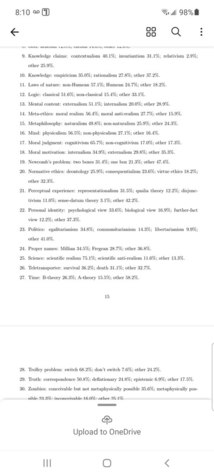
-
Rittenhouse verdictThe first shot fired was by a pursuer and Rittenhouse shot back 2.5 seconds later. It was entirely self defense.
— Hanover
That doesn't even match Rittenhouse's testimony. — Kenosha Kid
https://www.google.com/amp/s/thehill.com/homenews/state-watch/580073-detective-shot-fired-before-rittenhouse-began-shooting%3famp -
Rittenhouse verdictThat Rittenhouse got off scotch free is bullshit, underage possession of a firearm + reckless endangerment should have been maintained — _db
The Wisconsin law allows a minor to possess a rifle as long as it's a certain length, so he violated no law there.
The first shot fired was by a pursuer and Rittenhouse shot back 2.5 seconds later. It was entirely self defense. -
The Strange Belief in an Unknowable "External World" (A Mere Lawyer's Take)I'm just puzzled as to how you know that both bees and people perceive flowers, even if differently, and yet you also know that what flowers are is unknowable. — Banno
Well, that is the Kantian position.
I tend to believe a causative link between the thing and the experience. So, if the flower is knowable, it can only be knowable from an analysis of all perspectives, recognizing that each of our perspectives is mediated by our peculiar filters. This is precisely how we all navigate the world by the way. Science requires we eliminate subjective bias.
Whatever objections persist related to indirect realism or subjectivism, they at least avoid the incoherent position of the OP. It argues for a holism, yet it describes seperate entities, but then insists because there is just one universe, all must be one. As if -
The Strange Belief in an Unknowable "External World" (A Mere Lawyer's Take)The world" cannot be "external" to – ontologically separate from – itself, which includes its constitutents (Spinoza). To wit: — 180 Proof
None of this makes much sense. That nothing can exist external to the world is tautological, considering "the world" is being referred to as all that is in this context. Even in Spinoza speak, objects have attributes, which makes them distinct within the universe. Bees, flowers, people, and even thoughts of bees, flowers, and people are things with different attributes and can discussed as separate entities, all within the world, even if we hold there is some mega underlying monism.
The universe is one, as the prefix "uni" demands, but that says nothing about what a flower is. If I conceive a flower as X and you as Y, what is the truth value of the proposition "the flower is Y"?
Can someone answer the bolded question? -
The Strange Belief in an Unknowable "External World" (A Mere Lawyer's Take)Odd. Not sure what the point is. — Banno
Must you be able to do something with the truth for it to be true? -
The Strange Belief in an Unknowable "External World" (A Mere Lawyer's Take)The flower is knowable in a multitude of ways, or in other words, via a multitude of different kinds and instances of encounter. It is not exhaustively knowable, but that does not entail that it is unknowable. — Janus
Very well, what is the flower in and of itself? -
The Strange Belief in an Unknowable "External World" (A Mere Lawyer's Take)There are many constituents of the world. Some are human, some are bees, some are flowers. None of them exist in an "external world" apart from anything else. None of them is an "external object" in that sense. There is no "thing" called a perception which exists somewhere inside of us. — Ciceronianus
I'm open to understanding this, but I really don't follow what's being proposed. If a "constituent" is a part, it is distinct from other parts, which logically demands that bees, flowers, and people are apart from each other. By "apart" I mean not a part of, which means it's separate from me, thus being external.
It is my experience that my perceptions cease upon my unconsciousness, yet it seems the object of my perception is unaffected by unconsciousness. Do you believe otherwise? When I sleep, does my bed cease to exist now that I no longer perceive it?
This is slipping into pure idealism. Is that an accurate description of your position?
Hanover
Start FollowingSend a Message
- Other sites we like
- Social media
- Terms of Service
- Sign In
- Created with PlushForums
- © 2026 The Philosophy Forum