
Comments
-
Nothingness and quantum mechanics.
Spinors are way over my pay grade. But, it seems that they are merely Vectors that rotate under certain circumstances. And Vectors are not real things, but Virtual representations of potentials. They are mathematical notions with no "physical instantiation". We can imagine them as geometric concepts, but -- like magnetic fields -- we only "see" them by inference from their effects on matter. :smile:Speaking of the line between virtual and physical instantiation, you guys should look into spinors. — Enrique -
Nothingness and quantum mechanics.
Like all forms of energy, you can see the effects of fields, but not the fields themselves. They exist as immaterial mathematical statistical relationship patterns, that tend to organize matter into certain physical patterns. The field lines in iron filings are "representations" of the field, not the field itself. We see the material form, but not the Enformer. :smile:Not quite, we can see the form of magnetic field lines using iron fillings. That's how fields came to be part of physics in the first place. — Marchesk
Magnetic field lines are a visual tool used to represent magnetic fields.
https://brilliant.org/wiki/magnetic-field-lines/ -
Nothingness and quantum mechanics.
I don't think the pioneers of Quantum Theory intended their "standard" Copenhagen Interpretation to be a smoke & mirrors explanation. But even the powerful imagination of Einstein concluded that Non-local Entanglement sounded like "spooky action at a distance". He also objected to the notion that particles could exist only statistically, rather than physically : "God does not play dice". Ironically, Isaac Newton, as a scientist, was concerned that his notion of Gravity sounded like mysterious action at a distance, which could only be explained as an act of God. But, as a Christian, he was OK with that.a Virtual Thing is as close to Nothing as we can get in the Real world — Gnomon
It all looks a bit slight of hand. — Brett
So, although Quantum Theory is generally considered to be a reliable explanation for how things work on the quantum scale, why they work that way is still a mystery. In my personal worldview, Enformationism, I find that a broader universal definition of "Information" can dispel some of that spookiness in physics, by seeing that it exists in both Physical (matter) and Meta-physical (energy ; power to enform) states. :nerd:
spooky action : https://en.wikipedia.org/wiki/Action_at_a_distance
NEWTON, GOD, AND GRAVITY : https://www.uh.edu/engines/epi3012.htm
What Does Quantum Theory Actually Tell Us about Reality? : Nearly a century after its founding, physicists and philosophers still don’t know—but they’re working on it
https://blogs.scientificamerican.com/observations/what-does-quantum-theory-actually-tell-us-about-reality/
Information :
* Claude Shannon quantified Information not as useful ideas, but as a mathematical ratio between meaningful order (1) and meaningless disorder (0); between knowledge (1) and ignorance (0). So, that meaningful mind-stuff exists in the limbo-land of statistics, producing effects on reality while having no sensory physical properties. We know it exists ideally, only by detecting its effects in the real world.
* For humans, Information has the semantic quality of aboutness , that we interpret as meaning. In computer science though, Information is treated as meaningless, which makes its mathematical value more certain. It becomes meaningful only when a sentient Self interprets it as such.
http://blog-glossary.enformationism.info/page11.html -
Cultural Relativism: Science, Religion and Truth?
I just learned that there is such a thing as a Logotherapist. Maybe that would be a job opportunity for someone philosophically inclined. I don't know anything about its efficacy, but its emphasis on finding meaning in life, sounds like a novel approach to depression and ennui. :smile:I did wish to become an art therapist or a psychotherapist. However, there are very few jobs in this field. — Jack Cummins
Logotherapist : Logotherapy was developed by neurologist and psychiatrist Viktor Frankl, on a concept based on the premise that the primary motivational force of an individual is to find a meaning in life.
https://en.wikipedia.org/wiki/Logotherapy
https://themeaningseeker.org/logotherapy-training/ -
Cultural Relativism: Science, Religion and Truth?
When my exploration found that Theosophy was mostly Sophistry, I abandoned that path, and went-on to explore more fruitful concepts. Blavatsky & Steiner were very convincing to those who were Mystically inclined. But I'm more Practically inclined --- more like an engineer than an artist. :cool:I was interested that you explored the area of theosophy. — Jack Cummins
Sophistry (Rhetoric) : "Sophists did, however, have one important thing in common: whatever else they did or did not claim to know, they characteristically had a great understanding of what words would entertain or impress or persuade an audience."
The works of Plato and Aristotle have had much influence on the modern view of the "sophist" as a greedy instructor who uses rhetorical sleight-of-hand and ambiguities of language in order to deceive, or to support fallacious reasoning.
https://en.wikipedia.org/wiki/Sophist
Note -- I view the 20th century "linguistic turn" of philosophy as mostly a return to Sophistry, wherein confusing word-play is used to obfuscate rather than to illuminate; to sound smart, rather than to be wise.
Yes. Capra's synthesis of Western Science and Eastern Philosophy was more suitable to my taste. I've read several of his books. He may be considered fringey by some of his peers, but his ideas are more practical than most mystical notions. My personal worldview is intended to be a "Systems View" of life :smile:I find the systems view of life, advocated by Fritjof Capra to be extremely helpful as it is holistic and a good basis for drawing upon a variety of other, divergent perspectives. — Jack Cummins -
Nothingness and quantum mechanics.
I don't know what your friend means by "nothing", but Quantum Theory seems to have dispensed with the ancient Atomic theory, with its irreducible solid particles as the fundamental "things" of the world. In place of atoms, QT now postulates amorphous "Fields" containing "Virtual" particles. The Fields are merely mathematical concepts with no actual physical properties -- only the potential for real things to emerge when activated by a mysterious "disturbance".A friend of mine is trying to explain his theory of “nothing” through quantum mechanics. My feeling is that the very nature of quantum mechanics precludes it from doing this and that we can only approach it through philosophy. — Brett
Even the dimensionless Points that make-up the invisible Field pattern are nothing-but mathematical definitions. So scientists and philosophers argue about their realness. To me, Virtual Particles are not Things in the sense of actual physical objects. Instead, they are merely statistical potentials (probabilities) that have the power to exist (in a future state) under certain conditions. Some would call that "Potential" a form of Energy, that has not yet been Actualized into Matter.
So, are mathematical concepts Real? Are statistical probabilities physical Things? Both definitely "exist" in the form of mental concepts. But in what sense is that a real Thing? I would answer that Potential particles are Real only in a Metaphysical sense. Hence, I agree that discussions of "Fields" and "Virtual Particles" have crossed-over from empirical Science into the domain of theoretical Philosophy. So, a Virtual Thing is as close to Nothing as we can get in the Real world. :smile:
Virtual Particles : Thus virtual particles exist only in the mathematics of the model used to describe the measurements of real particles . To coin a word, virtual particles are particlemorphic, having a form like particle but not a particle.
https://physics.stackexchange.com/questions/185110/do-virtual-particles-actually-physically-exist
Are Quantum Fields Real? : It means that the electron isn't a particle at all. It's not something you can put your finger on and declare, "the electron is here, moving with this particular speed in this particular direction." You can only state what the overall properties are, on average, of the space in which the electron exists.
https://www.forbes.com/sites/startswithabang/2018/11/17/ask-ethan-are-quantum-fields-real/?sh=24a458a6777a
Aristotle on Potential : Aristotle describes potentiality and actuality, or potency and action, as one of several distinctions between things that exist or do not exist. In a sense, a thing that exists potentially does not exist, but the potential does exist.
https://en.wikipedia.org/wiki/Potentiality_and_actuality
Virtual :
* Traditionally, the term "virtual" meant possessing virtues or qualities apart from physical properties. In computer science, "virtual" refers to software apart from hardware. In Physics, "virtual" describes the mathematical or statistical state of a waveform in a field before it is actualized as a particle. A "virtual" particle is defined as . . . not a particle at all. It refers precisely to a disturbance in a field that is not a particle."
* The term “Virtual” in physics is analogous to “Spiritual” in meta-physics. In the Enformationism theory, it is equivalent to Qualia, apart from Quanta. The Quantum Mechanics term "Virtual" is equivalent to "Potential" or "Ideal". For example, virtual particles are merely mathmatical definitions with no material instances, until they are Actualized by an observation. Similarly, in Ideality, a Platonic Form has no physical examples until Realized by an intention. In both cases, the will of a mind triggers the transition from nothing to something.
http://blog-glossary.enformationism.info/page20.html -
Cultural Relativism: Science, Religion and Truth?
True. Typically, scientists don't claim to reveal absolute Truths, but merely useful facts that we can rely on for practical applications. But many Western religions make bold assertions of divine revelations of Eternal Truth. That is the root of the Science vs Religion controversy. I agree that religions would be less socially divisive, if they promoted the character trait of honest appraisal (self-skepticism) of one's own beliefs, with as much enthusiasm as they promote skepticism toward the unorthodox doctrines of other sects. :smile:The problem is that science doesn't really give us truth, as per my discussion with Jack above. What gives us truth is a particular attitude of honesty, and it is probably the case that religion would be better suited toward culturing this attitude. Science gives us useful principles, hypotheses, but truth being associated with correspondence, involves how we employ those principles. — Metaphysician Undercover
Science Does Not Reveal Truth : https://www.forbes.com/sites/paulmsutter/2019/10/27/science-does-not-reveal-truth/?sh=5609bca038c3
Eternal Truth : Truth, eternal truth, is the groundwork of the Christian's hope: it is the only sure rock on which he can build.
https://www.churchofjesuschrist.org/study/manual/teachings-john-taylor/chapter-23?lang=eng -
Cultural Relativism: Science, Religion and Truth?
I think the appeal of Science (Engineering; Technology) is primarily to those who think Abstractly & Reductively, while the appeal of Mysticism (Spiritualism, Religion) is to those who think Concretely & Holistically. That may be an over-simplification of a complex topic, but it helps me to understand how & why reasonable people can hold such divergent worldviews.I have to admit that even though I try to hold onto the objectivity of science the poetry of mysticism is my real language. — Jack Cummins
Physics is the most abstract & reductive of the sciences, while Biology & Chemistry necessarily deal with more concrete subjects, but they still dissect their subjects into isolated parts. Meanwhile, Metaphysics -- the subject of Philosophy and Poetry -- covers those aspects of reality that cannot be seen or touched or cut, hence must be inferred, and can only be expressed in terms of analogies & metaphors : concrete comparisons. Imitating scientists, some philosophers try to use analytical scalpels for metaphysical topics, but the abstruse results of their dismemberment tend to lie lifeless, like vivisected frogs.
People seem to be born with innate tendencies toward one end or the other of the Reductive/Holistic spectrum. But most of us are somewhere in the middle. Famous mystics may see the world through rose-colored romantic holistic glasses, while famous scientists view reality via the gray pragmatic X-ray vision of Analysis. Each type can try to see the other's perspective, but it's like learning a new language, in a foreign culture.
The term "Holism" was originally a scientific concept, but later was adopted by New Agers because it fit neatly into the newly-popular imported religious philosophies of India and China. Scientists now prefer the term "Systems Theory", because of the mystical taint on "Holism". Ironically, some of the pioneers of Quantum Science were also influenced by Eastern holism. For example, Heisenberg -- after a journey to the Far East -- wrote "all fundamental aspects of physical reality, which had been so difficult for him and his fellow physicists to 'make sense of', was the very basis of the Indian spiritual tradition". Nevertheless, while I appreciate the broad general holistic wisdom of the ancients, I prefer to rely on modern science for an accurate understanding of the specific details.
While in college, I made a break with my Western religious upbringing, but still retained some affinity for holistic thinking. So for a while, I was attracted to Theosophy, which claimed to combine modern science with ancient wisdom traditions. Like, most of the New Age philosophies though, Theosophy has since fragmented into dozens of piecemeal worldviews ( e.g. Anthroposophy). So, I no longer find such mystical views attractive. However, I have developed my own personal worldview (Enformationism), which aims to bridge the abyss between Physics & Metaphysics, without going to extremes of Materialism or Mysticism. :cool:
Holism : Holism is the idea that various systems should be viewed as wholes, not merely as a collection of parts. The term "holism" was coined by Jan Smuts in his 1926 book Holism and Evolution.
https://en.wikipedia.org/wiki/Holism
Systems Theory : Systems theory, also called systems science, is the multidisciplinary study of systems to investigate phenomena from a holistic approach.
Theosophy : (god wisdom) is a religion established in the United States during the late nineteenth century. It was founded primarily by the Russian immigrant Helena Blavatsky and draws its teachings predominantly from Blavatsky's writings.
. . .any of a number of philosophies maintaining that a knowledge of God may be achieved through spiritual ecstasy, direct intuition, or special individual relations,
https://en.wikipedia.org/wiki/Theosophy -
Information
In-form-ation, as the name implies, takes on many forms. In its generic form, I call it EnFormAction.Semantic information may or may not be linguistic. — frank
My personal worldview is based on the concept that Generic (general, all-inclusive) Information is the fundamental element of our world. It is the basic substance of everything from Physics to Linguistics. That may sound far-fetched, but my Enformationism thesis traces Information from its source, as encoded in the Big Bang Singularity, to its biological form as the genetic code in DNA, then to the kind of conventional meaningful Information (knowledge) that resides in human brains, and finally to its current application as an abstract vessel (Shannon Information) for carrying various values & meanings in modern computers. Even physical Energy is a dynamic form of Generic Information. So, you are correct that, "information may or may not be linguistic". :nerd:
Information :
A quality of physical patterns and processes that stimulates meaning to emerge in a mind. Since it has few directly perceivable qualities itself, generic information is usually defined in terms of its context or container. Unlike colorless, odorless, and formless water though, Information gives physical form to whatever contains it. In the Enformationism thesis it is the single Substance of the whole World.
http://enformationism.info/enformationism.info/page9.html
Enformationism : http://enformationism.info/enformationism.info/
The word "information" means the act of creating recognizable forms. But Shannon stripped the term of its original meaning in order to make an empty shell to contain whatever meaning we want to give it. What once was first, is now last. :smile:So meaning comes last. — frank
Information :
* Claude Shannon quantified Information not as useful ideas, but as a mathematical ratio between meaningful order (1) and meaningless disorder (0); between knowledge (1) and ignorance (0). So, that meaningful mind-stuff exists in the limbo-land of statistics, producing effects on reality while having no sensory physical properties. We know it exists ideally, only by detecting its effects in the real world.
* For humans, Information has the semantic quality of aboutness , that we interpret as meaning. In computer science though, Information is treated as meaningless, which makes its mathematical value more certain. It becomes meaningful only when a sentient Self interprets it as such.
* When spelled with an “I”, Information is a noun, referring to data & things. When spelled with an “E”, Enformation is a verb, referring to energy and processes.
http://blog-glossary.enformationism.info/page11.html -
Habits and Aristotle
Yes. Human habits may begin as conscious voluntary behaviors, but later become subconscious involuntary (hard to quit) routines. Natural Laws are also routine repetitive predictable behaviors that are involuntary.What scientists do you have in mind? Psychologists don't talk this way. It's not that habits are "purposeless," it's that they're mostly unconscious. — Xtrix
Actually, Theologian Thomas Aquinas interpreted Aristotle ("the Philosopher") to mean that natural regularities (laws, habits, properties) are not voluntary acts, but necessities due to the inherent Potential (design) of an object. More recently, Biologist and Parapsychologist Rupert Sheldrake enunciated his distinction between physical Habits and mental Laws.
In that case, the current usage of "habit" seems to refer to personal mental properties (typical ways of thinking and acting) due to innate or learned character (personal qualities). When a teenager takes-up smoking, by imitating his cool classmates, he is voluntarily adopting a Meme, which eventually becomes involuntary (habitual). The smoking "habit" has both physical (dependence) and mental (memetic) aspects. :smile:
Aquinas on Natural Habits : “Three things belong to the soul: powers, habits, and emotions,” as the Philosopher says in the Ethics. But the natural law is neither a power of the soul nor an emotion.Therefore, the natural law is a habit.. . . . Therefore, the natural law is a habit, not an act. On the contrary, Augustine says in his work On the Marital Good that “habits are the means whereby we do things when we need to.” But the natural law is not such, since that law belongs to infants and the damned, who cannot act by reason of its presence.
https://faculty.fordham.edu/klima/blackwell-proofs/MP_C45.pdf
Sheldrake : Habits are less human-centred. Many kinds of organisms have habits, but only humans have laws. . . . Habits are subject to natural selection; and the more often they are repeated, the more probable they become, other things being equal. Animals inherit the successful habits of their species as instincts. We inherit bodily, emotional, mental and cultural habits, including the habits of our languages.
https://www.sheldrake.org/research/most-of-the-so-called-laws-of-nature-are-more-like-habits
Memes : A meme (/miːm/ MEEM) is an idea, behavior, or style that becomes a fad and spreads by means of imitation from person to person within a culture and often carries symbolic meaning representing a particular phenomenon or theme. ... Prominent researchers in evolutionary psychology and anthropology, . . . .
https://en.wikipedia.org/wiki/Meme -
Habits and Aristotle
Habits are repetitive patterns of behavior. Some physicists refer to "natural laws" as merely "habits", in order to avoid the implications of a Law-giver, or of Teleology in nature. Human habits vary from simple personal Routines that have been found to facilitate activities without the necessity of conscious thought. In that case, conscious thought may have been used to find a sequence of events that works for behaviors that can be done almost without thinking. For example, I divide my home-bound Covid day at home into roughly one hour chunks devoted to particular tasks in a regular sequence. This routine only works at home, because at work my time is regulated more by the needs & goals of other people. Nature's "laws" are also regular routines, where effects seem to follow causes without exception, and without forethought. That's presumably because the many possible cause/effect relationships have been worn-down to those that work best -- Darwinian survival of the fittest (for a particular situation, or niche).Interested in hearing from others better versed in Aristotle regarding the subject of "habit." — Xtrix
But another sense of "habit" is applied to Addictions, in which certain "learned" behaviors, such as smoking, are motivated by subconscious emotional urges, rather than conscious reasons. Addictive behaviors are technically not natural (breathing air), but are artificial, due to past conscious choices (breathing smoke). At first, the choice seems to be reasonable, due to the anticipated Dopamine rewards of feeling stimulated, or of looking cool to peers. But once the Addiction has taken charge of your breathing behavior, the original positive goals become irrelevant, and the most powerful motivation becomes the avoidance of bad feelings --- negative feedback rather than positive impulse. Such habits are often done without awareness, and without conscious reasoning,
For Aristotle though, Habit is a natural "disposition", due to the inherent "Potential" of its "Form" (it's design). Form is a pattern of inter-relationships that makes a thing different from other things -- its uniqueness, its essence, its purpose. Accidental patterns tend to be random, and disorderly, while Intentional patterns are organized for a particular purpose. So, Aristotle's use of "habit" or "disposition" implies goal-directed teleology. But the scientist's use of the same word is intended to signify the opposite meaning : random, meaningless, purposeless behaviors. Human habits or instincts bypass the conscious mind, leaving only a few important behaviors under the control of conscious intention, and meaningful goals. That may be why some have asserted that we typically use only 10% of the Potential of the human Mind. :nerd:
Disposition :
1. a person's inherent qualities of mind and character.
2. the way in which something is placed or arranged, especially in relation to other things.
Design :
1 : to create, fashion, execute, or construct according to plan
Teleology :
1. the explanation of phenomena in terms of the purpose they serve rather than of the cause by which they arise.
2. the doctrine of design and purpose in the material world.
The Aristotelian conception of habit : He classifies habits into three categories: (1) theoretical, or the retention of learning understood as “knowing that x is so”; (2) behavioral, through which the agent achieves a rational control of emotion-permeated behavior (“knowing how to behave”); and (3) technical or learned skills (“knowing how to make or to do”).
https://www.ncbi.nlm.nih.gov/pmc/articles/PMC4217385/ -
Cultural Relativism: Science, Religion and Truth?
When Wilbur talks like a poetic mystic, he loses me. I'm more of a mundane Pragmatist than a sublime Mystic. Nevertheless, some of the implications of the Enformationism thesis get pretty close to New Age notions of spirituality. But then, I try to keep my worldview grounded in objective Science, because mystical balloons that are not moored, tend to drift away into the ether, where fictions can feel good subjectively, but cannot be proven true factually. I try to make sense of both Ideality and Reality -- as aspects of one world. I try to keep an open mind, but not so open that my brains fall out. :smile:'Within the deep silence of the great unborn, Spirit whispers a sublime secret, an otherwise hidden truth of one's very essence: You, in this and every moment, abide as Spirit itself, an immutable radiance beyond the mortal suffering of time and experience.' — Jack Cummins
Mystic : a person who seeks by contemplation and self-surrender to obtain unity with or absorption into the Deity or the absolute, or who believes in the spiritual apprehension of truths that are beyond the intellect. ___Wiki
Intuition : Many people regard Reasoning the opposite of Intuition. Reasoning is rational thinking using logic, while Intuition is unconscious, a paranormal gift, a magical awareness not accessible for normal humans, or a connectivity to an all knowing esoteric field.
https://thinkibility.com/2012/11/17/reasoning-versus-intuition/
PS__I prefer a non-mystical definition of "Intuition". -
Boy without words.
Yes. Human verbal language uses abstract symbols & vocalizations, while most animal non-verbal communication uses more concrete (physical) signs & symbols, including body language such as wagging tails. Human babies tend to use "inborn" gestures and sounds before they learn how to use the abstract symbols of adult language. Both body language and verbal language are symbolic, in that they imply some meaning beyond the obvious body movements. So, the boy without language should still be able to communicate feelings and ideas in symbolic gestures, until he learns the conventional meanings of abstractions like spoken words and marks on paper. :smile:One language is symbolic, the other is an inborn (previously mutated) language. — god must be atheist
Body Language : Gestures in language acquisition are a form of non-verbal communication involving movements of the hands, arms, and/or other parts of the body. Children can use gesture to communicate before they have the ability to use spoken words and phrases.
https://en.wikipedia.org/wiki/Gestures_in_language_acquisition
Symbol :
2. a thing that represents or stands for something else, -
Cultural Relativism: Science, Religion and Truth?
I only recently became aware of Satler's site, espousing -- among other things -- "Both/And Logic". He seems to follow Ken Wilbur, and his Integral Theory philosophy. Although I read some of Wilbur's books, many years ago, my own BothAnd Principle developed directly from the Holistic implications of the Enformationism Thesis.I just looked at your links now and liked the idea by Rolf Satler, that, 'Buddhist logic is liberating because it transcends not only the restrictive either/ or of our common way of thinking, but even the both/and of the much more inclusive and healing both/and logic.' — Jack Cummins
Wilbur seems to be mostly influenced by Eastern Philosophy, hence may be categorized as a New Age philosopher. I agree with much of his Holistic worldview, but he focuses more on spiritual & mystical aspects of the world --- along with Transpersonal Psychology, which may be a technical term for the study of Spirituality.
My own educational background was mostly influenced by Analytical Science and the mundane aspects of Reality, but my philosophical emphasis tends more toward Metaphysics, because that is the primary domain of Philosophy --- the "Linguistic Turn" of Postmodernism, and the recent Materialistic (anti-spiritual) backlash, notwithstanding. So, we have that psychological inclination in common. And Buddhism was an early "science" of human psychology. Likewise, Taoism is essentially a Holistic worldview.
The key to all of these holistic philosophical tropes is to include all aspects of the world, rather than totally rejecting certain aspects from consideration. That way we can put our own narrow perspective (partial truth) into a broader context. :smile:
Fuzzy Logic :
Fuzzy logic is a form of many-valued logic in which the truth values of variables may be any real number between 0 and 1. It is employed to handle the concept of partial truth, where the truth value may range between completely true and completely false.
http://blog-glossary.enformationism.info/page13.html
The BothAnd Philosophy :
* Philosophy is the study of ideas & beliefs. Not which are right or wrong – that is the province of Religion and Politics – but which are closer to universal Truth. That unreachable goal can only be approximated by Reason & Consensus, which is the method of Science. In addition to ivory tower theories, applied Philosophy attempts to observe the behavior of wild ideas in their natural habitat.
* The BothAnd philosophy is primarily Metaphysical, in that it is concerned with Ontology, Epistemology, & Cosmology. Those categories include abstract & general concepts, such as : G*D, existence, causation, Logic, Mathematics, & Forms.
* The BothAnd principle is one of Balance, Symmetry and Proportion. It eschews the absolutist positions of Idealism, in favor of the relative compromises of Pragmatism. It espouses the Practical Wisdom of the Greek philosophers, instead of the Divine Wisdom of the Hebrew Priests. The BA principle of practical wisdom requires “skin in the game”* to provide real-world feedback, which counter-balances the extremes of Idealism & Realism. That feedback establishes limits to freedom and boundaries to risk-taking. BA is a principle of Character & Virtue, viewed as Phronesis or Pragmatism, instead of Piety or Perfectionism.
* The BA philosophy is intended to be based on empirical evidence where possible, but to incorporate reasonable speculation were necessary. As my personal philosophy, the basic principle is fleshed-out in the worldview of Enformationism, which goes out of the Real world only insofar as to establish the universal Ground of Being, and the active principle in Evolution.
Notes -- Phronesis : an Ancient Greek word for a type of wisdom or intelligence. It is more specifically a type of wisdom relevant to practical action, implying both good judgement and excellence of character and habits, or practical virtue.
* ref : Skin In The Game, by Nassim Nicholas Taleb; researcher in philosophical, mathematical, and (mostly) practical problems with probability.
http://blog-glossary.enformationism.info/page10.html -
Boy without words.
Verbal Language is an artifact. Even animals who can communicate ideas, orally or gesturally, must translate their internal flow of non-verbal feelings into forms that can be expressed symbolically. When your dog or cat paws at you to get your attention, they are expressing a feeling common to mammals. Feelings (emotional urges) are the common proto-language among higher animals. Even dreams must be translated from abstract subjective feelings into concrete objective words or gestures. But we are so used to it, that we are barely aware of the mental work required for communication. Except of course, when we try to express our vague personal feelings in someone else's language, or in precise philosophical terms. :nerd:I don't think in words or language, and I don't dream in words or language. — god must be atheist
Feelings : Feelings are also known as a state of consciousness, such as that resulting from emotions, sentiments or desires. Feelings are only felt and are abstract in nature.
https://en.wikipedia.org/wiki/Feeling -
Can we keep a sense of humour, despite serious philosophy problems?
Sounds like the story of an ancient philosopher, who while walking & thinking, and looking up at the sky, fell down a well. Onlookers laughed, but it wasn't funny to him. :joke:as a result of being so preoccupied — Jack Cummins
Serious Note : in those days, a well was just a hole in the ground.
Preoccupied Philosopher : This recounts a story that Thales was so preoccupied with the matters above him that he failed to see what lay immediately below his feet, so he fell into a well.
https://oregonstate.edu/instruct/phl201/modules/Philosophers/Thales/thales_well_of_thought.htm -
Cultural Relativism: Science, Religion and Truth?
Occult Mysticism and Explicit Science are two different perspectives on the same world. Holistic Mystics tend to view the world metaphorically (poetically) as a system of unanalyzed concepts (symbols, feelings), taken at face value, without getting into the details. But Analytical Scientists are just the opposite : they want to delve into details, in order to dispel the mysteries, and to uncover the unknowns.I have probably chosen to think away from the 'mystical' because I have done academic studies in psychology and mental health care. But I have read a lot of esoteric philosophy at times as well. — Jack Cummins
Scientists are curious cats, constantly probing deeper into dark places, and being skeptical of motives when told "don't go there". On the other hand, Mystics seem to enjoy the childlike wondrous feeling of being dependent on magical forces beyond understanding (trusting faith). Esoteric worldviews require specialized Priests or Adepts, who do the understanding of complex mysteries on behalf of the children, the flock. But scientists don't like being treated like children, who "can't handle the Truth".
Ironically, some religious people (theologians) tend toward an analytical scientific worldview, while some quantum scientists come close to being mysterians --- "shut-up and calculate". Although I lean more toward the scientific worldview, my personal BothAnd principle requires me to take into account the ambiguous realities of Cultural Relativism. :nerd:
Esoteric : intended for or likely to be understood by only a small number of people with a specialized knowledge or interest.
Note -- Both Science and Mysticism have their Gnostic Adepts, who interpret abstruse concepts for the ignorant masses. But they differ in their attitude toward "blissful" ignorance.
Mysterians : The mysterians propose that human intellect has boundaries and that some of nature's mysteries may forever lie beyond our comprehension.
Mysterian Science : https://www.scientificamerican.com/article/will-science-ever-solve-the-mysteries-of-consciousness-free-will-and-god/
Dualist Mysterians : The “old mysterians” were dualists who believed in nonmaterial properties, such as the soul, that cannot be explained by natural processes.
https://michaelshermer.com/sciam-columns/final-mysterians-consciousness-free-will-god/
Shut-up and Calculate : One of the biggest dangers in presenting quantum unknowns is sophism; a wasteful exercise in fruitless scholasticism and mysticism.
“If I were forced to sum up in one sentence what the Copenhagen interpretation says to me, it would be ‘Shut up and calculate!’ ”
https://link.springer.com/chapter/10.1007/978-3-319-70815-7_10
BothAnd Principle : Conceptually, the BothAnd principle is similar to Einstein's theory of Relativity, in that what you see ─ what’s true for you ─ depends on your perspective, and your frame of reference; for example, subjective or objective, religious or scientific, reductive or holistic, pragmatic or romantic, conservative or liberal, earthbound or cosmic. Ultimate or absolute reality (ideality) doesn't change, but your conception of reality does. Opposing views are not right or wrong, but more or less accurate for a particular purpose.
http://blog-glossary.enformationism.info/page10.html
Both/And thinking : Like fuzziness, both/and is well illustrated by the Yin-Yang symbol and Yin-Yang thinking
https://www.beyondwilber.ca/healing-thinking/both-and-logic.html -
Cultural Relativism: Science, Religion and Truth?
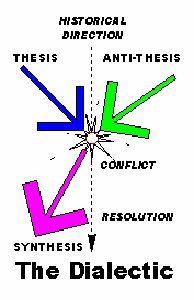
I view the recurrent "clashes" between Religion and Science as an example of Hegel's Historical Dialectic. It's how Evolution works : ups & downs, but gradual progress. The Dialectic is a Heuristic searching process, perhaps working its way toward ultimate Truth. The key to Cultural progress is to learn from the past, but plan for the future. :smile:So, I am asking about the whole question of truth arising from the clash between religion and science and divergent systems of thinking. Is there one which is the ultimate in terms of establishing truth? — Jack Cummins
Hegel : The notion that history conforms to a “dialectical” pattern, according to which contradictions generated at one level are overcome or transcended at the next,
Galileo : "The intention of [the Bible] is to teach us how one goes to heaven, not how the heavens go."
Teilhard deChardin : The Omega Point is the subject of a belief that everything in the universe is fated to spiral towards a final point of unification.
Stephen Jay Gould : Non-Overlapping Magisteria (NOMA) is a philosophical world view that places religion and science in separate domains of questioning
Note -- Unfortunately, Gould's plea for mutual respect for separate domains of authority was well-intended, but impractical. Realistically, Science and Religion do indeed overlap in some areas. That's where the clashes occur, in which dominance may change hands. Yet, that's also how history, and human culture, progresses, in a back & forth ratcheting action, but generally upward in both technical knowledge and in collective morality.
-
Is Consciousness an Illusion?
The Matrix may have touched on the verification problem indirectly, when someone notices a cat's movement replaying. Such "reality" defects indicate that the Matrix is not omnipotent, and may have technical glitches. But, even our normal perception of nature may experience perceptual glitches, in the form of illusions or mirages. So, it's the same old Brain In a Vat scenario. Ultimately, we can't be absolutely certain of anything. So we must just accept our personal view of reality as true most of the time. But a modicum of skepticism is warranted as a safeguard against deliberate deception. :smile:For some reason, it's never broached in the Matrix Trilogy. Neo and the rest of the unplugged just accept that being outside the Matrix is the real world. — Marchesk
glitches in the matrix : https://brightside.me/wonder-curiosities/11-stories-of-people-who-experienced-a-glitch-in-the-matrix-434460/
Brain in Vat : Here is the skeptical argument. If you cannot now be sure that you are not a brain in a vat, then you cannot rule out the possibility that all of your beliefs about the external world are false.
https://iep.utm.edu/brainvat/
Late Lament by the Moody Blues : But we decide which is right. And which is an illusion?
Glitches of Perception : https://open.spotify.com/album/7HFnb4ZHBSCS9gU5dxanqI -
Cultural Relativism: Science, Religion and Truth?
Since the theory of Collective Unconscious is vaguely defined, and not amenable to scientific verification, it serves mainly as a cautionary "myth" about human reason. I interpret the CU, not as a mystical Akashic Record out there in the ether, but as simply our genetic & memetic inheritance for certain knee-jerk attitudes and aversions -- such as innate fear of heights & snakes, or implicit racism & tribalism -- that are automatic, and by-pass our mirror of self-awareness.The reason I use the word 'myth' is based on the idea of the collective unconscious, as stressed by Jung, and he said that, 'There is nothing mystical about the collective unconscious.' — Jack Cummins
Collective Unconsciousness : Collective unconscious, term introduced by psychiatrist Carl Jung to represent a form of the unconscious (that part of the mind containing memories and impulses of which the individual is not aware) common to mankind as a whole and originating in the inherited structure of the brain.
https://www.britannica.com/science/collective-unconscious
Akashic Record : https://en.wikipedia.org/wiki/Akashic_records
Implicit Racism : https://www.encyclopedia.com/social-sciences/encyclopedias-almanacs-transcripts-and-maps/implicit-racism -
Information, Life, Math and Strong Emergentism
Yes. For most animals, their "creativity" is learned by long evolutionary development, and passed-on genetically. So their "art" tends to be repetitive and conventional. But, as in Bower Birds, females tend to force competitive creativity by selecting the male's creation that has the difference-that-makes-a-difference, such as a shiny or colorful object to catch the discriminating eye. Such artistic behavior is not just a "way to get girls", it's also an emergent non-biological (mental) trait that enhances reproductive fitness.Well, they all look the same so there’s limited creativity from the individual puffer-fish. — Olivier5
In humans though, there may be some artistic inheritance, but creativity is also passed-down memetically. People imitate their heroes, and sometimes surpass them in imagination & creativity. Artificial human culture, and creativity, moves along much faster than natural evolution. But culture also builds upon the foundation established by the heuristic (exploring many options) evolutionary process. :smile:
Bower Bird Creativity : https://dragonflyissuesinevolution13.wikia.org/wiki/Creativity_for_attracting_a_mate-Australian_Bowerbirds -
Information, Life, Math and Strong Emergentism
Probably both. She looks at Biology and Physics, not as separate realms (scales & levels) of reality, but as different ways of looking at the same world. Those disciplines differ on how closely they examine their subjects. Since the subject-matter of Biology is visible and tangible, that science is more like ordinary Knowledge (epistemology) of concrete material objects. But Physics studies subjects that are typically invisible and intangible (electrons ; fields), hence seem closer to the essence of reality (Ontology). The primary subject matter of Physics (energy) is what the ancients would call "Spirit" (essence ; Soul).↪Harry Hindu
Yes, and I'm not sure whether Sara was arguing epistemology or ontology. It sounded like she wanted to expand physics to incorporate the emergent biological information. — Marchesk
In an interview with John Horgan, Stuart Kaufman -- also associated with Santa Fe Institute -- notes that, "No laws entail evolution of biosphere". Then, he says, "Evolution creates the very possibilities into which it becomes, without "selection" "acting" to achieve the very adjacent possible opportunities into which it becomes". This ironic-sounding statement is reminiscent of Terrance Deacon's notion of Causal Absence. What he's implying here is that Evolution is inherently creative, and not just pre-determined by the past. So, when novel things emerge from the heuristic evolutionary process, it's not an accident -- it's what evolution does. Kaufman is primarily a Biologist, but he also "expands Physics" into Biological domains. :smile:
Kaufman Interview : that some sort of anti-entropy, order-generating force
remains to be discovered.
https://blogs.scientificamerican.com/cross-check/scientific-seeker-stuart-kauffman-on-free-will-god-esp-and-other-mysteries/
Note -- that "anti-entropy" force is what I call Enformy
http://blog-glossary.enformationism.info/page8.html
Causal Absence : Constitutive absence: A particular and precise missing something that is a critical defining attribute of 'ententional' phenomena, such as functions, thoughts, adaptations, purposes, and subjective experiences.
http://absence.github.io/3-explanations/absential/absential.html -
Information, Life, Math and Strong Emergentism
The Puffer-fish boudoir looks like a creative work of art. So, it might be an example of the creativity of Evolution, as discussed in the Purposes of Creativity thread on this forum. However, some of us may not think of blind random evolution as a creative process. That notion might imply teleology. But compare the original state of the universe (raw energy) with its current state (civilization, technology, art, etc) and it's hard to deny that there is some general creative constructive impulse behind the behaviors of even "dumb" animals. Hegel called that historical competitive progressive self-transcending creative movement, The Dialectic. In my thesis, I call that impulse, EnFormAction. :smile:Saw this yesterday and wondered how such a behavior could emerge from evolution... — Olivier5
Creative Evolution : Creativity in humans may be merely a more highly developed form of evolutionary Adaptability, which allows animals to survive and reproduce. If so, its primary purpose is to out-live the less-adaptable competition. But humans have taken that competitive trait to a higher level. In animals, most of their creative acts are genetically inherited. They follow a trial & error heuristic that seem erratic, but increases their odds of finding food or sex or power,
https://thephilosophyforum.com/discussion/comment/478349
Does Competition Make Us More Creative? : https://hbswk.hbs.edu/item/does-competition-make-us-more-creative
Dialectic : The notion that history conforms to a “dialectical” pattern, according to which contradictions generated at one level are overcome or transcended at the next, . . .
https://www.britannica.com/topic/philosophy-of-history/History-as-a-process-of-dialectical-change-Hegel-and-Marx -
Purposes of Creativity?
Creativity in humans may be merely a more highly developed form of evolutionary Adaptability, which allows animals to survive and reproduce. If so, it's primary purpose is to out-live the less-adaptable competition. But humans have taken that competitive trait to a higher level. In animals, most of their creative acts are genetically inherited. They follow a trial & error heuristic that seem erratic, but increases their odds of finding food or sex or power,What are the purposes of creativity, and what aren't the purposes of creativity? Creativity is basically taking things that are objectively known and combining them abstractly into original intangible concepts or tangible objects, often times when those things are relatively unlike one another? How does creatively help us survive? Does it help us find knowledge or only reinterpret it? — TiredThinker
Humans, though, pass on their Memes via learning (imitation) and by exploration (heuristic). Yet, mere novelty may or may not give you an edge . So, the new creation must have some practical advantage. In any case, the basic purpose of creativity is to get a leg-up on the uninspired competition for : a> not just survival, but thrival, in the rat-race of modern life ; b> to move-up in a social system, or c> to simply follow your urges & ambitions. When everyone else is following the old tried & true path, creative people take the untrod path to novelty -- opening new fields for exploration. Sometimes in humans, arbitrary creativity is done for no practical purpose, but simply or its own sake : the enjoyment of novelty. Instead of mundane adaptivity, we call it "Art" : new ways of looking at the world. :smile:
Adaptability and evolution :
The capacity of organisms to respond in their own lifetimes to new challenges in their environments probably appeared early in biological evolution. At present few studies have shown how such adaptability could influence the inherited characteristics of an organism's descendants
https://www.google.com/search?client=firefox-b-1-d&q=ADAPTABILITY+evolution
Is Creativity Learned or Inherited? :
Many people debate over if creativity is inherited or learned, but it's actually both. Creativity is “technically” inherited, but by everyone. ... In fact, a widely cited study by George Land found that children are born creative but lose their creativity as they transition through life and into adulthood.
https://www.transformationmarketing.com/is-creativity-learned-or-inherited/ -
Problems of modern Science
Since the advent of modern empirical and experimental Science, new Knowledge (What? & How?) is fairly easy to come by. But the Wisdom (Why? & Why Not?) to properly apply that knowledge usually comes from hard experience (negative feedback). The job of Philosophy is to apply untested Knowledge, and unproven Theories, in the form of thought experiments.What are the problems of modern science? If modern science is so great then how come we are threatening our very existence with technological devices today? — Thinking
Unfortunately, such metaphysical testing doesn't have nearly the impact on human behavior as physical negative feedback. "Once burned, twice shy". The moral lesson of Hiroshima and Nagasaki has put ethical constraints on Nuclear energy that retard both technological progress, and forestall Armageddon. The Nuclear Disarmament Movement is philosophical, not scientific; moral, not technical. :smile:
Einstein on the bomb : Though Einstein worked to warn the world about the perils of nuclear proliferation for the rest of his life, he struggled to make sense of his responsibility.
https://www.nationalgeographic.com/news/2017/06/nuclear-weapons-atom-bomb-einstein-genius-science/
School of Hard Knocks : where you get the grade first, and the lesson later.
https://en.wikipedia.org/wiki/School_of_Hard_Knocks -
Cultural Relativism: Science, Religion and Truth?
There won't be a detente between Science's Materialists and Religion's Spiritualists until they find some kind of common ground. For me, that common denominator is Generic (universal) Information. In the form of invisible causal Energy, Information -- or what I call EnFormAction -- serves the same role as Spirit in ancient worldviews.But apart from the idea of providing a system of convergence I think that there is a need for more discussion between those who hold religious perspectives and the various scientific viewpoints. — Jack Cummins
For example, Chinese "Chi" and Indian "Prana" were imagined as analogous to spiritual energies that caused various changes in bodies, including Life itself. In the Frankenstein novel, electrical energy was the cause of re-vivifying the dead body of the monster. Also, in it's visible tangible form of Matter, Energy is converted into the materials that scientists study empirically. Moreover, what we call "Mind", is well-known as the processing of Information, which is both the data being acted upon, and the causal force behind of the process of Thinking or Minding.
At the same time, Information has the potential to convert its Energy into Matter (E=MC^2). And cutting-edge physics has done it both ways. See Scientific American article below.
Therefore, in the Enformationism worldview, Generic Information bridges the gap between Physics & Metaphysics, between Matter & Mind, between Science & Religion. But, until a significant percentage of the world population accepts that underlying commonality, we will continue to talk past each other in our ecumenical efforts. :smile:
Chi : (Qi or Ki) is the energy of life itself, a balance of Yin and Yang, positive and negative, electromagnetic energy which flows through everything in creation. So Chi can possibly be described as an electromagnetic phenomenon, as a form of light energy, as a form of bio-electromagnetic energy or electricity.
Consciousness as a Physical Process Caused by the Organization of Energy in the Brain :
https://www.ncbi.nlm.nih.gov/pmc/articles/PMC6225786/
What is EnFormAction? : http://bothandblog2.enformationism.info/page29.html
Physics Is Pointing Inexorably to Mind : Matter is done away with and only information itself is taken to be ultimately real. This abstract notion, called information realism . . . .
https://blogs.scientificamerican.com/observations/physics-is-pointing-inexorably-to-mind/ -
Is Consciousness an Illusion?
The Matrix movies illustrate that philosophical quandary : how can we distinguish between the illusion and reality? Maybe that's the job of empirical Science, which is an extension of the role of Philosophy. :smile:It's just if consciousness can be an illusion, why not the external world? — Marchesk
Cypher : "You know, I know this steak doesn't exist. I know that when I put it in my mouth, the Matrix is telling my brain that it is juicy and delicious". -
Cultural Relativism: Science, Religion and Truth?
Oh, no, you are not alone in the middle range of worldviews. Unfortunately, that middle is a muddle, with no single moderate belief system dominating. Just as political rivals tend to become polarized, rival worldviews tend to cause people to move toward one extreme or the other. Modern Science, as it emerged in the Enlightenment age, sought to distinguish itself from then-current world-dominating belief system of Roman Catholicism, by emphasizing Doubt over Faith, and Practical this-worldly Utility over Postponed other-worldly Salvation. That leaves philosophically-minded folks in the no-man's-land of open-minded skepticism. Which is why my personal worldview of Enformationism, has adopted the BothAnd Principle as a means to having the best of both worldviews : practical & ethical effects ; objective & subjective truths. Unfortunately, maintaining that precarious balance is a high-wire act. :smile:I do wonder if I am if I am the only person on the forum who has explored the territory between materialist science and other alternatives, — Jack Cummins
Enformationism :
* As a scientific paradigm, the thesis of Enformationism is intended to be an update to the obsolete 19th century paradigm of Materialism. Since the recent advent of Quantum Physics, the materiality of reality has been watered down. Now we know that matter is a form of energy, and that energy is a form of Information.
* As a religious philosophy, the creative power of Enformationism is envisioned as a more realistic version of the antiquated religious notions of Spiritualism. Since our world had a beginning, it's hard to deny the concept of creation. So, an Aristotelian First Cause is proposed to serve as both the universal Enformer (energy) and the malleable Substance (matter) of the evolving world.
http://blog-glossary.enformationism.info/page8.html
BothAnd Principle :
My coinage for the holistic principle of Complementarity, as illustrated in the Yin/Yang symbol. Opposing or contrasting concepts are always part of a greater whole. Conflicts between parts can be reconciled or harmonized by putting them into the context of a whole system.
http://blog-glossary.enformationism.info/page10.html
BothAnd-ism :
An inclusive philosophical perspective that values both Subjective and Objective information; both Feelings and Facts; both Mysteries and Matters-of-fact; both Animal and Human nature.
http://blog-glossary.enformationism.info/page10.html -
Is Consciousness an Illusion?
I've been watching some videos on YouTube : Journey to the MicroCosmos. And the minuscule single-cell organisms, swimming freely and nosing about, seem to have purposeful behavior. So, they are "animals" by definition. But what goes-on in their brainless blobs -- what it's like to be an amoeba -- is a moot question, until we are able to communicate with them. So, until then, I would attribute only a minuscule amount of Consciousness. :smile:An amoeba also has sensory abilities, does that mean it is conscious because of that? — Rafaella Leon -
Information, Life, Math and Strong Emergentism
It's true that Aristotle had nothing to say about Semiotics, or Semiosis, or Semiology in his Metaphysics. But he also had nothing to say about Quantum Mechanics in his Physics. So, what point was Pierce making in the quote? Semiology may be merely a further reductive analysis of Aristotle's symbols and motifs. :cool:The student of Aristotle usually begins with the Categories; and the first thing that strikes him is the author’s unconsciousness of any distinction between grammar and metaphysics, between modes of signifying and modes of being. When he comes to the metaphysical books, he finds that this is not so much an oversight as an assumed axiom — C.S. Peirce
Aristotle on Rhetoric : Being capable of grammar is not the same property as being rational,
https://plato.stanford.edu/entries/aristotle/ -
Information, Life, Math and Strong Emergentism
Meaningful patterns are indeed one aspect of Generic (universal ; all-encompassing) Information. But there are many more forms of Information (the power to enform, to create). Other emergent phases of Information are Energy and Matter. That abstract Information can be converted into measurable Energy is not as well-known as the fact that Energy can then be converted into Matter (E=MC^2), and vice-versa. But it's an idea on the cutting-edge of quantum physics. It appears that Information is much more than Shannon's empty vessels of data. Generic Information is a Protean shape-shifter --- the pattern-morphing potential of evolutionary creativity. :nerd:But I don't know what it means for information to be fundamental, as opposed to fields or particles or spacetime. . . . . Information seems to me to have something to do with repeatable patterns that emerge from the fundamental physics. — Marchesk
Is Information Fundamental? : https://www.pbs.org/wgbh/nova/article/is-information-fundamental/
Fundamental Principle of Information-to-Energy Conversion : The bit of information is equivalent to a quantum of minimum energy
https://arxiv.org/ftp/arxiv/papers/1401/1401.6052.pdf
https://physicsworld.com/a/information-converted-to-energy/
The mass-energy-information equivalence principle : https://aip.scitation.org/doi/full/10.1063/1.5123794
https://figshare.com/articles/presentation/ENERGY-INFORMATION_EQUIVALENCE_PRINCIPLE/12479180/1 -
Information, Life, Math and Strong Emergentism
Yes. That's why I define and expand-upon the many meanings of Information in my thesis and blog. :smile:However, as I've said before, 'information' is not proper basic substance (in the philosophical sense), because it has too meaning meanings. — Wayfarer
Information, what is it? : http://bothandblog4.enformationism.info/page26.html
Substance versus Non-substance :
* Aristotle divided his encyclopedia into two volumes based on fundamental categories of human knowledge : discussion of objective substances (Matter, physical) and subjective non-substances (Form, mental). “Aristotle famously contends that every physical object is a compound of matter and form.” A technical term for this ancient doctrine is Hylomorphism (matter + design).
* Physical Scientists typically assume that the appearance of design is merely an illusion due to the complexity of material objects, and to gaps in our knowledge of specific causal events in the history of evolution, that the brain naturally attributes to agency.
* We can fill those gaps with more assumptions : either a simplistic unbroken causal chain of mundane physical “substance” (turtles all the way down), or a more analytical sequence of events, such as Aristotle’s 4 causes: Material (substance), Formal (shape, pattern), Agent (force), and Final (teleological intent). It’s the fourth cause that causes scientists to pause.
https://plato.stanford.edu/entries/form-matter/
https://en.wikipedia.org/wiki/Four_causes:
http://bothandblog2.enformationism.info/page74.html -
Is Consciousness an Illusion?
There is one significant difference between forming images on a light-sensitive Surface, and forming images in a meaning-sensitive Mind. The mental Image, or Illusion, has personal Meaning & Significance & Aboutness & Awareness. Imaging is not awareness; but Imagination is. :smile:The notion of consciousness is, at its heart, claiming there's a difference between mental images and camera-images but we know there's none. Ergo, consciousness - the purported difference in identicals - can't be real. Consciousness is an illusion. . . .
what we call awareness is simply the formation of mental images in our minds, and that's precisely what happens inside a camera. — TheMadFool
Note 1 -- The light-focusing optics of a camera are called "objectives". Perhaps, that's because the camera has no "subjective" perspective.
Note 2 -- The camera metaphor is an abstraction from human vision, but it abstracts-out the Knowing of a mind. The map is not the terrain. -
Information, Life, Math and Strong Emergentism
Panpsychism is also an ancient explanation for Life and Mind in the world. But my modern myth of creation involves what you could call : "Pan-Informationism". It assumes that the power to enform (causation; energy) is inherent in the world --- in Gaia, if you like --- not an import ; no consort needed. That theory is based on the current science of Information, as the Single Substance of the world. :cool:panspermia . . . For some reason, I find it more conceptually satisfying than abiogenesis, because it conforms to the primeval mythology of Earth/Mother Sky/Father in the origin of life. — Wayfarer
Gaia inseminated by Uranus : https://en.wikipedia.org/wiki/Gaia
Information : http://bothandblog4.enformationism.info/page26.html -
Information, Life, Math and Strong Emergentism
Sara Imari Walker is a theoretical physicist and astrobiologist, who is exploring the dark space between physics and biology. She is an editor, and one of the 30+ authors, of the 2017 book, From Matter to Life : Information and Causality. Most people today think of Information as the inert data processed by computers. But physicists have recently learned that Energy (causation) is also a form of Generic (all-encompassing) Information : the power to enform, to create.My understanding is that Dr. Walker is proposing an additional physics for what she calls information, but is open to it being something else. Basically something that would explain the emergence of life from chemistry (abiogenesis), and provide a better definition for life. — Marchesk
That concept is at the root of my own philosophical worldview : Enformationism. These concepts are still on the frontiers of Science, so may sound a bit fringey and mysterious. But it opens doors to a broader and deeper understanding of the physical and biological and mental aspects of our world. :nerd:
From Matter to Life : Fresh insights from a broad and authoritative range of articulate and respected experts focus on the transition from matter to life, and hence reconcile the deep conceptual schism between the way we describe physical and biological systems.
https://www.barnesandnoble.com/w/from-matter-to-life-sara-imari-walker/1124576284
Enformationism :
A philosophical worldview or belief system grounded on the 20th century discovery that Information, rather than Matter, is the fundamental substance of everything in the universe. It is intended to be the 21st century successor to ancient Materialism. An Update from Bronze Age to Information Age. It's a Theory of Everything that covers, not just matter & energy, but also Life & Mind & Love.
http://blog-glossary.enformationism.info/page8.html -
Is Consciousness an Illusion?
Yes. Dennett's term of derision (illusion) seems to be an indirect dismissal of Consciousness, because of its association with the religious term "Soul". Illusions are the stuff of Magic and Delusion. So, I prefer to use a more modern term to describe the immaterial-but-effective functions of the human brain : "Information". The brain is an Information Processor, and one of its outputs is Awareness of both the internal milieu and the external environment. :smile:I don't know what consciousness is either, but calling it an illusion doesn't do much for me. — Bitter Crank
Is Consciousness an Illusion? : http://bothandblog6.enformationism.info/page66.html -
Is Consciousness an Illusion?
Yes. For discussions of "Consciousness", I prefer Spinoza's Substance Monism, in which the "universal substance" is Generic (all-inclusive) Information, as defined below. :smile:Neither is correct. These ideas are based on Cartesian Dualism, whereby the world is divided into exactly two realms, the physical and the mental, the material and the immaterial. But that's a mistake. We live in one world. — Daemon
What is Information? : http://bothandblog4.enformationism.info/page26.html
Substance Monism : The most distinctive aspect of Spinoza's system is his substance monism; that is, his claim that one infinite substance—God or Nature—is the only substance that exists.
https://iep.utm.edu/spinoz-m/
Attributes of Substance : Early in The Ethics Spinoza argues that there is only one Substance, which is absolutely infinite, self-caused, and eternal. Substance causes an infinite number of attributes (the intellect perceiving an abstract concept or essence) and modes (things following from attributes and modes).
https://en.wikipedia.org/wiki/Spinozism
Substance : "In European thought the notion of substance received different interpretations : ... concrete individual ... single foundation ... ontological reality ... logical subject ... spiritual principle ... material substratum ... self-identical essence ... law of change ... "
https://simplyphilosophy.org/study/substance-definition/
Note : Generic Information is all of the above. -
Is Consciousness an Illusion?
Apparently, Dennett doesn't value that mushy sentimental illusion we call "the Self", simply because it doesn't "matter", literally. :smile:Consciousness is the human being's ability to talk to himself about himself, tell his own story and draw long-term conclusions, from where he acquires the ability to promise things. — Rafaella Leon
Matter :
1. physical substance in general, as distinct from mind and spirit; .
2. be of importance; have significance.
Significance :
1. the quality of being worthy of attention; importance. -
Is Consciousness an Illusion?
Good question! If the illusion of consciousness is what you experience as awareness, then for you it's your window to reality. But apparently, Dennett is simply saying that Consciousness is not a material substance, hence not a real thing, therefore not important. The reality for him is objective neurons twinkling, and the subjective experience is a deception. Perhaps, when Dennett sees a beautiful woman, he ignores that illusion, and focuses on those lovely abstract neuronal patterns.What's the distinction between the illusion of consciousness and consciousness? — Mijin
For me though, Consciousness is the function (the purpose) of the brain. Hence, it's the gateway to my personal reality. I'm not aware of my own neurons --- only of the imaginary patterns they form in my Cartesian Theater. When you go to a movie, do you look at the "real" projector (hardware) or at the illusory fleeting images on the screen (function; purpose)?
It seems that, in his attempts to deny the experiencing Cartesian Soul, Dennett says that only the sensing physical Body is real, and worth talking about. But what good is objective Reality, if you are not subjectively aware of it? Would you call his materialistic worldview a case of "misplaced emphasis"? :smile:
Function : 1. an activity or purpose natural to or intended for a person or thing.
Consciousness : Consciousness refers to your individual awareness of your unique thoughts, memories, feelings, sensations, and environments. Essentially, your consciousness is your awareness of yourself and the world around you. This awareness is subjective and unique to you.
Cartesian Theater : Cartesian theater" is a derisive term coined by philosopher and cognitive scientist Daniel Dennett to refer pointedly to a defining aspect of what he calls Cartesian materialism, which he considers to be the often unacknowledged remnants of Cartesian dualism in modern materialist theories of the mind.
https://en.wikipedia.org/wiki/Cartesian_theater
PS__I think Hoffman has a more useful interpretation of Dennett's "illusion" :
http://bothandblog6.enformationism.info/page21.html -
Duality in the universe
That sounds like the ancient Greek notion of Atoms & Void, something and nothing. Without void, matter could not move. Do you think somebody created that mutual relationship? Did everything else branch-off from that original duality? :smile:I am thinking that the duality of non-existence lies in space and vacuum. while existence comprises of matter and energy. — Thinking
Gnomon

Start FollowingSend a Message
- Other sites we like
- Social media
- Terms of Service
- Sign In
- Created with PlushForums
- © 2026 The Philosophy Forum