
Comments
-
Indirect Realism and Direct RealismNot sure why you have posted this. Is it by way of agreeing wiht what I have said?
It makes sense to say that you interact with the room by way of a complex of representations, but how is the model equal to you interacting with the room? — frank
Well, where are those representations? If you are interacting with them, then presumably they can be distinguished from you... hence you see them, and we havn't an explanation of what seeing consist in at all.
As contrasted with interacting with the room by constructing those representations. I dunno. Seems a simple enough point. -
Indirect Realism and Direct Realism
In a way, yes, since it is oneself that does the perceiving. Is the "self" seeing the tree or the representation of the tree? I say one sees the tree, by representing it. Although I also have sympathies for disjunctivism.This comes down to the nature of the self. — frank
I'm not seeking to eliminate the self. I do have a preference for externalism and extended mind views, that the content of mind is stuff that is in a way external to the mind. That you believe Canberra is in Australia is in some sense about stuff outside the mind.
https://plato.stanford.edu/entries/content-externalism/#ContExte
So does the view I'm trying to express still make no sense? -
Indirect Realism and Direct Realism
:smile:I appreciate the attempt to streamline the issue here, but that just doesn't make any sense. — frank
So it seems.
It's a rejection of the homunculus. Indirect realism has you sitting inside your head, seeing and touching what is constructed by your nerves. It separates the observer not just from the thing observed, but from the observation.
Take a look at Michael's diagram:
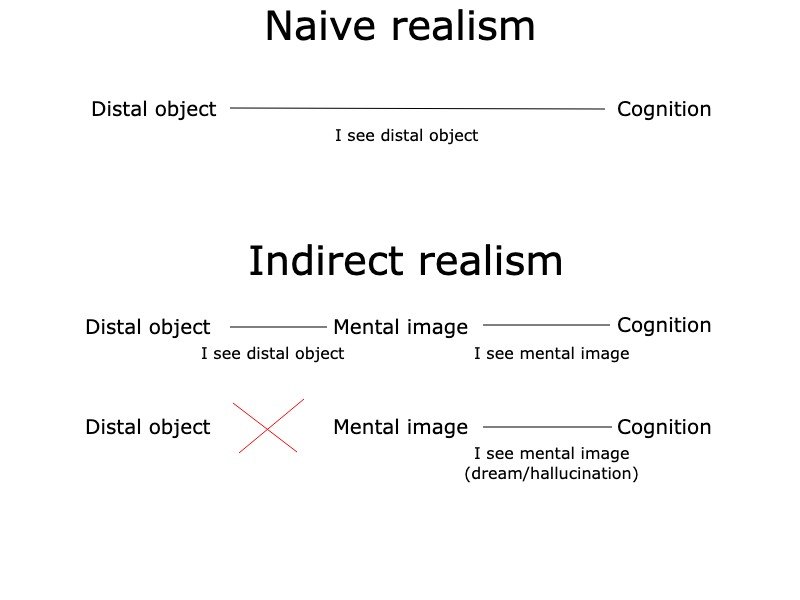
It's the "mental image" that is seen. The observer is somehow distinct from the "mental image".
But doesn't it strike you as odd that the "mental image" is not part of the mind doing the observation?
Isn't the "mental image" mental?
Building that mental image, that model, that representation, is something mind, and presumably, brain, does.
So seeing the screen this text is on is constructing a mental model of the screen.
That's different to the indirect realist view, that you do not see the screen but instead see the "mental image" of the screen.
Does that help? -
Indirect Realism and Direct Realism
I would not take Aristotle as an idealist. Direct realism has trees and cups and stuff that we see. Indirect realism falls short of that, since we never see the tree or cup or whatever.Direct realism was a resident of an idealistic world where the mind directly contacts the forms of things. Indirect realism came into existence when people started trying to become more materialistic about the mind and body. What do you think neo-directness is a response to? — frank
But I do not wish to be dragged in to a discussion that I think misguided; that there is merit in the distinction between direct and indirect.
When you move around the room, you see and touch and interact with its furnishings. In so doing you construct a model, a representation of the room. You are not seperate from that model, in such a way that the model could be said to be what you interact with. The model is you interacting with the room.
Further, it's silly to say you infer the existence of that bloody footstool you bruised your shin on.
Have you had a read of the Midgley article I linked to recently? Seems somehow pertinent. -
Indirect Realism and Direct RealismHere's the point, again; one does not see the representation; seeing is constructing the representation.
-
Rings & BooksIt's all footnotes to Aristotle.
It seems she agrees with you.As for Aristotle, not only was he married, but it seems quite likely that he loved his wife. She was the daughter of a friend of his, a philosophic despot, and Aristotle when he died, many years after her, asked in his will that they should be buried in the same grave. And his opinions, if one may mention such a point, are often married opinions. Man, he says, differs from other animals in being syndyasticon zōon, an animal that goes in pairs, not only for procreation, but for all the business of life. There is profound division of labour between men and women. They supplement each other, and as their functions are different, so is their goodness. Certainly Aristotle on the whole thinks men’s functions much more important, men’s virtue greater. But he has grasped the point that natures can differ, that the pursuit of virtue is not a scurry up a single narrow ladder with the devil taking the hindmost. He is not logically compelled to think women inferior, as Plato is, and Spinoza, and every other moralist who grounds virtue on the power of abstract thought. Aristotle’s ideas here have by contrast all the free movement of maturity. He always suspected, and did so still more the further he grew away from Plato, that there were other lives and other virtues besides those of the scholar; that perhaps it did really take all sorts to make a world. Plato on the other hand, right up to his death, always kept the irritable sensibility of the adolescent in resisting the claims of temperaments alien to his own. — Rings and Books -
Rings & Books
There's a practicality to Midgley's writing that is endearing. Her rejection of scientism is especially needed at a time when engineers and physicist take to doing philosophy, often very poorly.I think there is a place in philosophy for flighty ruminations, but the current state of affairs has gotten out of hand. — Leontiskos
It's a brief piece; a pot-boiler. There is more, most of it produced much later in her life. Her work is somewhat aggravating, determinedly, wilfully not dispassionate. Worth some attention. This thread has attracted trivial critique, but there is some value in her writing.
Of course, you do not have to be here. At over 200 posts, I'm not at all displeased with this thread. So thanks for your contribution.It is more that your trolling is seen as tiresome. — Lionino -
Indirect Realism and Direct RealismCobblers. One can see the word inexactly. That's why some need glasses.
-
Indirect Realism and Direct Realism
I think you are right that direct realism is the beginning position. I doubt that many folk think they see the world "exactly as it is". Rather folk realise that sometimes they see things amiss. This is what the various illusions bring into focus, so to speak.One of the conundrums with indirect realism is that it seems to start as direct realism, where the scientist assumes he sees the world exactly as it is, then he concludes from what he's observed that he's not seeing the world exactly as it is. How do you deal with that problem? — frank
That we see illusions shows that we do not see the world exactly as it is; but it does not show that we never see the world. Nor does it show that what we see is not the world, but something else caused by the world.
That is those who advocate for indirect realism on this basis are grasping more than the situation will allow. That we sometimes see the world as other than it actually is does not imply that we never see the world as it is. -
Indirect Realism and Direct RealismCool.
Indirect realism is the view that what we see is the representation. The alternate is that what we see is the tree, and that we see the tree by constructing a representation of the tree. -
Indirect Realism and Direct RealismWell, for instance, it's hard to see how disjunctivism could be indirect. That a veridical viewing of, say, a tree, could be an instance of viewing a mental image of the tree, while an hallucination was not..
-
Indirect Realism and Direct RealismTry using other sense as paradigmatic, rather than sight. It's much harder to maintain that one touches something indirectly - to "infer" that the surface is smooth or rough; or to make sense of smelling the coffee indirectly... how does one "infer" the taste of lemon?
-
Indirect Realism and Direct Realism
-
Indirect Realism and Direct RealismHear, hear.
Most especially, "Attempting to use purportedly reliable scientific knowledge to support a claim that we have no reliable knowledge of distal objects is a performative contradiction."
There is an alternative, which is to reject the juxtaposition of direct and indirect experiences entirely, and admit that we do sometimes see (hear, touch, smell...) things as they are; and that indeed this is essential in order for us to be able to recognise those occasions in which we see (hear, touch, smell...) things in the world erroneously. — Banno
The most accepted vies is representationalism, which is neither direct nor indirect. The issue is no longer "Do we perceive representations (indirect realism) or do we perceive objects (direct realism)" since it is understood that we perceive by constructing a representation, which is better described as neither direct nor indirect.Indirect realism is the prevailing view of our time. — frank
Essentially, the whole argument of this thread has been bypassed since Austin.
Folk are misled by physiologist saying silly things like "we don't see the tree, we see the representation of the tree". They are wrong, and should know better. We see the tree by constructing a representation of the tree. Hence, we see the tree. -
Is Knowledge Merely Belief?Well, generally speaking, on realist accounts, statements are either true or false. What admits to degree is not truth value, but belief. And what we know, we also believe.
So if one denies that there is a difference between knowledge and belief, one also drops realism. -
Is Knowledge Merely Belief?
@Janus has consistently taken a more restricted view of "belief" than that which I think more typically found in philosophical discussion. I'd characterise it using propositional attitudes, roughly, as follows: I take "Adam believes P" as simply that Adam holds P to be true. Janus takes "Adam believes P" as both that Adam holds P to be true and has consciously assented to its being true.
That's what seems to sit behind his notion of "active" belief. It seems this leads Janus to being unable to deny what is before his eyes; that being before one's eyes somehow amounts to the sort of conscious assented he requires.
At least, that's how I have understood some of his comments.
Yep.I can go on an on... — Chet Hawkins
Presumably, because they are true; not because they are certain.We are still left with the question of why certain beliefs are more privileged compared to others and why? — substantivalism
Confusing these two is the reason this thread is at page 14. -
Are there primitive, unanalyzable concepts?
Well, it's from Gillian Russell, so I'll take it as legit. But I went too quickly, and lost you. Russell's approach is to highlight cases where what are generally considered logical laws fail - I gave a few examples, more can be seen in the linked literature on Logical Nihilism. These cases serve to verify the second premise, that there are no general laws, and hence logical monism. We are left with deciding that there are no laws of logic, or that they do not apply with complete generality.A “completely general” logical principle sounds like confused jargon for “absolute” logical principle; or it refers to a principle being general, which doesn’t lend support to the claim. — Bob Ross
Hence, the laws of logic fashion discrete, related languages within logic.
The Law of non-contradiction, ⊨ ¬(φ ∧ ¬φ), need not be true in a Klein logic, I believe. This would add a line to the truth table where if φ is neither T or F, so is ¬(φ ∧ ¬φ). Non-contradiction applies only to those logics which are biconditional, and hence not to all logics.When can you validly disregard the law of non-contradiction, for example? — Bob Ross
It does not follow that there are logical laws that apply in all cases. Indeed, one of the games played in doing logic is to see what happens when a supposed law is denied. Nothing need be held constant throughout the whole enterprise - just as no individual thread need run the whole length of a rope.These logical theories are not separate from each other, but share at their core the fundamental (classical) logic. — Bob Ross
for — Bob Ross
The trouble here is that "being" is not one thing, but a group of things. I tried to explain that by setting out the various logical parsings of "is".If that is the case, then it should be easy for you to demonstrate this: choose something else (or multiple concepts) to be simple, and comprise ‘being’ from it. — Bob Ross
Treating several notions as if they are one is a sure way to extend a discussion indefinitely.
Cheers.
Note my bolding: not just....the concept of a triangle is just the inter-subjectively agreed upon word ‘triangle’. There must be an underlying concept of a triangle at play here. — Bob Ross
Alpha, Beta and Gamma Triangulum form a triangle in the night sky. If one adopts a realist approach, that triangle will still be there when unobserved. Such an approach can be understood as supposing a binary logic - that the triangle is either there or it is not: "There is a triangle" is true, or it is false. An antirealist approach might be understood as adopting Klein Logic, such that "There is a triangle" is true when observed, and neither true nor false when unobserved.
On a realist account there are triangles even when folk are not around to see them.
What this shows is that "Triangle" is both a way of using words and a way of talking about how things are. And because "Triangle" is about how things are, "Triangle" goes on even when there are not folk to talk about it.
That's probably not as clear as I'd like it to be. That is, language games are not just about words, but about the stuff around us. That's what is "at play" here, not mental furniture. -
Rings & BooksThere's a short bio in Philosophy Now.
The (women) are presently receiving quite a bit of attention:
...the key idea shared by the members of the Quartet is to place the concept of life at the centre of philosophical attention. This commitment has at least four dimensions: (i) an interest in the ordinary; (ii) a focus on virtue, goodness and human flourishing; (iii) an affirmation of our animal nature; (iv) recognition of the normative landscape that structures our lives. — Bakhurst, David (2022). Education for metaphysical animals. Journal of Philosophy of Education 56 (6):812–826.
...a worthy antithesis to the crap that occupies some folk on this forum. -
Rings & Books
:up: . Neoliberalism explains everything... for mental midgets.It’s just free market principles at play. :wink: — Mikie
What is outstanding, and ongoing, is that over eight pages these three men have managed to say so little about what Midgley actually wrote. -
Rings & Books
Well, part of it; right after she mentions how the great philosophers were kind to their cats. Perhaps her facetiousness jokes were missed.This is Midgley's analysis: — Fooloso4
Not so small as some denizens of this forum, as is evident. Not new. There's a thread about Midgley and Dawkins somewhere hereabouts:Mental Midget — Lionino
Genes cannot be selfish or unselfish, any more than atoms can be jealous,
elephants abstract or biscuits teleological. — Gene-juggling
Isn't it wonderful that a dead, diminutive elderly woman can cause so much angst! I thought this thread would be lucky to reach a page! -
Rings & Books
Not selective at all."To date, I’ve not encountered any direct racism or sexism in academia..." — AmadeusD -
Rings & BooksShe probably is, though, given this is 2024 and not 1954. — AmadeusD
Indeed, things have been so much better since the patriarchy was dismantled. -
Rings & Books, so you back away from your defence of Descartes only to be oddly antagonistic towards Midgley.
At the least, there might be some philosophical merit in considering the place of those who are not reclusive white bachelors.
Or will you deny this, too? -
Rings & BooksOh, I agree. I don't see that @Fooloso4 has carried his case. Yet even if he had, it does not count against Midgley.
-
Rings & BooksShe gives a standard textbook reading of him which in my opinion does not hold up under scrutiny. — Fooloso4
Even if Midgley has misconstrued Descartes, her misconstrual is shared by others. So I'll go back to a point I made earlier, that even if she is wrong about what Descartes said, she may not be wrong about how the hegemony of the solitary white male has mislead philosophy.
That is, what you have said here in your many posts is irrelevant to the argument Midgley presents. -
Trusting your own mindBut yes I am asking "what is true". — Benj96
So do you supose that there could be an algorithm, a method, that gives us truth in any given case? -
Are there primitive, unanalyzable concepts?I hope you don't lump me in with Corvus, who's understanding of logic is... problematic.
It seems to me that you do here what you claim to be unable to do - to express how a non-spatial entity relates to space in english.For example, we cannot properly express how a non-spatial entity relates to space in english; but this is just a linguistic limitation. I can only say "a non-spatial entity would exist 'beyond' what is in space", but the concept of a non-spatial entity's relation to space as 'beyond' it is perfectly sensible albeit linguistically nonsensical. — Bob Ross
Which is to say nothing more than that there are triangles even if there are no folk around to talk about them - that is, to accept realism.The concept of a triangle is still such even if we have no language capable of conveying it. — Bob Ross
Sure. Concepts can be shown, by our acts, as well as said. Indeed saying is just another act. The point being that concepts are not fundamental to mind, actions are. Concepts are just a way of explaining acts.Conceptual analysis is surely restrained, to some extent, by language (as you are correct that we convey concepts with language) but they are not thereby themselves reducible to language — Bob Ross
A child understands "3" by taking three lollies, by holding up three fingers, by taking one toy from four, and so on; not by having a something in her mind. Further, using the word "three" is tertiary to these other acts. -
Are there primitive, unanalyzable concepts?...there are many theories of logic; and to that I say that there is only one, — Bob Ross
But see this argument for logical nihilism:
andTo be a law of logic, a principle must hold in complete generality
No principle holds in complete generality
____________________
There are no laws of logic. — Gillian Russell
Logical laws are supposed to work in every case. Modus Tollens, non-contradiction, identity - these work in any and all cases. A logical nihilist will reject this...
...there are two ways to deal with this argument.
A logical monist will take the option of rejecting the conclusion, and also the second premise. For them the laws of logic hold with complete generality.
A logical pluralist will reject the conclusion and the first premise. For them laws of logic apply to discreet languages within logic, not to the whole of language. Classical logic, for example, is that part of language in which propositions have only two values, true or false. Other paraconsistent and paracomplete logics might be applied elsewhere.
A few counter-examples of logical principles that might be thought to apply everywhere.
Identity: ϑ ⊧ ϑ; but consider "this is the first time I have used this sentence in this paragraph, therefore this is the first time I have used this sentence in this paragraph"
And elimination: ϑ & ϒ ⊧ ϑ; But consider "ϑ is true only if it is part of a conjunction". — Banno
I'll go with logical pluralism. Logic itself depends on what one is doing. It's the grammatical structure we choose for the purpose at hand. It cannot therefore provide the "simple" you desire.
Then may I commend again Philosophical Investigations, §48? We choose what is to count as a simple in the diagram, be it colour, or shape, or letter, or position; and each can in turn be defined in terms of the other. Here Wittgenstein is undoing the enterprise of the Tractatus, which is very much the same enterprise you suggest in your other thread, constructing the world from logical atoms.I am not seeing how the concept of ‘being’ is merely being ‘held constant’ for us to ‘move other things’ — Bob Ross -
Rings & BooksWith the exception of your posts, I'm afraid I haven't been following this thread.
Folk engaged so closely with Cartesian views may have difficulty with externalism about the mind. The discussion here remains in the quiet solitude of Descartes' warm room, not in the noisy, busy Kitchen. So it remains both privileged and irrelevant, and produces no sustenance.
I shouldn't complain, I supose, that a thread about Granny has achieved seven pages of historical exegesis. But I would have liked to read more about plumbing.Do you have any arguments to offer against Midgley’s thesis, or are you just upset that she spoke against a philosopher you are fond of? — Leontiskos -
Is Knowledge Merely Belief?For example, those who know better than I, than to waste time on narcissitic guru wannabees. — wonderer1
Yep.
The rest is dross. -
Is Knowledge Merely Belief?Do you know where that post is in the thread? — Bylaw
Fear as an emotion is rooted in the need for comfort and certainty. And certainty is absurd. Sp, by pandering to that fear, we cause more problems than we really solve. Fear is always, when served in this fashion, a cowardly short-cut to wisdom, to truth, that is a lie, a delusion, an immoral mistake. — Chet Hawkins
This IS cowardly Pragmatism writ small, again and again. It is a short cut. It is greatly immoral in its aims. — Chet Hawkins
As for anger, well, take a look at this search. I've not been able to follow what is going on. There is something a bit unbalanced here. -
Is Knowledge Merely Belief?Yep. It's the relativism of the right wing. If there is only belief, then no situation is better than any other. Consider the criticism as against Feyerabend - if "Anything Goes" then everything stays; if there is no correct method, then we have no reason to do science this way instead of that way, astrology is as good as experimenting. Hence there is no need to do anything differently to how we have been doing it, no potential for improvement. If Chet were right, then we may as well settle for oligarchy as democracy. Indeed, if there is no knowledge, we have no way to make things better.
Or consider the relation to Frankfurt's philosophical bullshit. If there is no knowledge and truth doesn't matter, then all that remains is bullshit: speech intended to persuade without regard for truth. Which is seen in Chet's posts.
It's Chet who's position is immoral.
Something like that. -
Rings & BooksI think Midgley makes a profound point. — ENOAH
Cheers. The ideas she expresses were also found in others of that period. There was a general realisation that doubt cannot be the whole of philosophical method. -
Is Knowledge Merely Belief?Yes, to an extent. @Chet Hawkins sets up an absurd standard only to complain that it cannot be met. He is forced by this ideology to ignore the very many examples of things we do know - he doesn't address the examples, but instead merely repeats the assertion that we cannot know anything, and that therefore the examples are supposedly in error. That's the approach of a dogmatist. As is the contention that those who do not accept his ideology are evil - that those who think they know things are angry and cowardly.
And its this that makes his ideas distasteful. We've had enough of dogmatism masquerading as liberalism. His confusion is gross. -
Is Knowledge Merely Belief?Absolute truth would refer, in your terminology, to anything that is considered true with absolute certainty; and 'absolute certainty' would refer to a level of certainty which cannot be doubted legitimately (e.g., a tautology) as opposed to what one doesn't have good reasons to doubt. — Bob Ross
Well, is the following a tautology?
That, if a straight line falling on two straight lines makes the interior angles on the same side less than two right angles, the two straight lines, if produced indefinitely, meet on that side on which are the angles less than the two right angles.
It depends on what one is doing.
What of this:
Which Intuitionist logic denies; or this:Φ∨¬Φ
which paraconsistent logic denies?Φ,¬Φ⊢Ψ
Again, we can do surprising things by bringing into doubt that which can not be doubted.
That is not quite the point I would make, though. That relates to your thread on unanalysable concepts. Both "absolute" knowledge and "absolute" simples depend on context. They depend on what one is doing. Some things are held constant in order for us to be able to move other things. Some things are held indubitable in order for us to doubt other things. Some things are held to be simple in order for us to be able to analyse other things.
And we sometimes change what we hold constant in order to change something else.
The over-used example is a bishop remaining on its own colour for the purposes of a chess game, but not for the purposes of putting the pieces back in the box.
Interestingly this also relates to the nearby discussion of what an "object" is in Wittgenstein's Tractatus. That's not surprising, since that book is a failed attempt to ground analysis and hence knowledge. The "simples" there were "tractatrian objects", the nature of which is famously enigmatic. The Wittgenstein of the Tractatus was engaged in much the same exercise as you, seeking a foundation for analysis and knowledge, only to find such an approach unworkable. The Philosophical Investigations gives an account of why this "logical atomism" will not work. -
Exploring non-dualism through a series of questions and answersI'm not reading that the way you are. I take the use of "measurement" rather than "observer" to be quite deliberate.
See. https://www.youtube.com/watch?v=v1wqUCATYUA
15:23
So, in summary. A) That consciousness causes the collapse of the wave-function is a possible
Summary interpretation of the mathematics, but it’s as problematic as all other interpretations of quantum mechanics. B) One can formulate a collapse model based on this idea which is a testable modification of quantum mechanics. But in all honesty, I think if they test it, they’ll just rule it out. C) The idea that you can influence the collapse of the wave-function by thinking is pseudoscience. And D) none of that is what Penrose and Hamaroff are on about, which is another story entirely.
I don't think she is making the claims you want her to. -
Exploring non-dualism through a series of questions and answers
I couldn't find anything of that sort in the interview... "observer" does not come up in the transcript.listened to Hillary Lawson interview Sabine Hossenfelder yesterday, and she says her main research interest, aside from her very successful youtube channel, is somehow eliminating 'the observer problem'. — Wayfarer
This?
https://www.youtube.com/watch?v=6xGwdUCYzgw -
Are there primitive, unanalyzable concepts?
Well, that's the point at issue. If you know how to use the word "being", and related words such as "exist", "is", and so on - what more is there to the meaning of "the concept of being"?However, “is” is linguistic, not conceptual. I am asking what it means ‘to exist’, not how we use the term ‘is’ (or similar words). — Bob Ross
I'll contend that the notion of "concept" is an hypostatisation of word use. After all, if the concept gives the meaning of some word, and the meaning of a word is its use in a language, then the concept is pretty much just the way a word is used.
The common alternative is to consider concepts to be pieces of mental furniture, the "stuff" we have sitting around in our minds. This picture is fraught with inconsistencies. How, for example, can the concept of "existence" in your mind be the same as that in my mind? In the same way that the armchair in your lounge room is the same as that in my lounge room? But you could come and see my lounge chair - you can't inspect my concept of exists.. all you have access to us the way I use it...
And so on, with all the machinations of the private language argument thrown on top of the notion of simples.
I think that there are a number of ways of using these words, and that we can sort them out much more clearly than the mysterious use of "being" fond in so much ontology. Parsing talk of existence forced logicians to confront these distinctions, and to come up with the clarificationI described in the previous post - at least three differing uses of "is".Existential quantification presupposes, and does not answer itself, what it means ‘to exist’. It is a way to quantify existence (in a way). E.g., by claiming “there is something that is green” in the sense that there exists something green, presupposes the concept of what it means to exist—so it can’t itself being a proper analysis of ‘to be’. See what I mean? — Bob Ross
The grain of truth in what you are suggesting might be seen in etymology, where to "ex sistere" is to "stand forth". To exist is to be differentiated from the stuff around you - a notion not so far from "to exist is to be the subject of a predicate", and so different to the stuff that is not subject to that predicate.
And all this is by way of showing that we can have a reasonably clear analysis of existence, and that in such circumstances "existence" is not a simple.
Anyway, this is an offer of a different way to see the issue. Take it or leave it.
Banno

Start FollowingSend a Message
- Other sites we like
- Social media
- Terms of Service
- Sign In
- Created with PlushForums
- © 2026 The Philosophy Forum