
Comments
-
Interested in mentoring a finitist?Since we can't actually complete the computation of an infinite series, we never produce a number. So let's just say that pi is the algorithm. The beauty of the algorithm is that it's definition is entirely finite (I just wrote it in finite characters) and it's execution is potentially infinite (i.e. it would compute to no end). — keystone
I don't see any advantage to the fact that your way of conceptualizing pi is "entirely finite."
If a computer can't do the math (in principle), maybe there's something wrong with the math. — keystone
There's always something wrong with the math. That's why people keep having to add on new concepts to keep up with our understanding of reality.
A number is an object of computation. Computers do stuff with numbers. I don't think you can fill your head with all the digits of the decimal expansion of pi. The best you could do is fill your head with an algorithm for calculating pi. That's what I'm saying exists - the algorithm. — keystone
It is my understanding that computers do not generally store the algorithm for generating pi, they store the actual number rounded to a specified number of decimal laces. If computers think pi is a number, why shouldn't I?
abstract objects are the ideals and reality is just an approximation of the ideal. — keystone
Perhaps Plato and some mathematicians and logicians think this way. Not most people.
Imagine me flipping a coin. While it's in the air is it heads or tails? I'd say it's neither. Instead it has the potential to be heads or tails. Only when it lands does it hold an actual value. In between quantum measurements objects are waves of potential. When they are measured they hold an actual state. I see no reason why the potential should behave the same as the actual so I see no contradiction. In fact, I think if they behaved the same then change would be impossible. — keystone
When I measure light one way, it's always a wave. When I measure it another way, it's always a particle. It's not a wave that becomes a particle. It's always both at the same time.
The universe has a wonderful way of avoiding actual infinities. — keystone
Again, sez you.
I think you and I have taken this as far as we're going to get. I don't see the need for or value of the way of seeing things you propose. You obviously disagree. Neither of us is going to convince the other. -
Interested in mentoring a finitist?Pi is a ratio. Diameter~circumference. So it is actually an algorithm. And it can vary between 1 and infinity as it is measured in a background space that ranges from a sphere to a hyperbolic metric.
How all that actual physics translates to claims one might want to make about numberlines and irrational values is another issue. — apokrisis
I have no trouble with this way of seeing it.
Maths just defines it and gets on with it. And that is fine. It is what maths does. — apokrisis
Agreed, but I think many people don't see it that way. Some think that math somehow produces reality. That if math doesn't track common sense, everyday reality exactly, there needs to be an explanation. That something is wrong.
But the fact that the real world undermines the simplicities of the metaphysics that maths finds useful is part of the epistemic game here. The more holes there are in the story, the more we can take it as all just a story about reality - that works with “unreasonable effectiveness.” — apokrisis
Agreed. That's consistent with my understanding of metaphysics in general - it is not true or false, it works or it doesn't. -
Interested in mentoring a finitist?You say there exists a number called pi with infinite digits and you use a truncated approximation of it when you calculate the approximate area of a circle.
I say that what exists is a (finitely defined) algorithm called pi that doesn't halt but you can prematurely terminate it to produce a rational number to calculate the approximate area of a circle. — keystone
I still don't get it. I don't see any advantage in your way of seeing things. For me, pi is clearly a number. I guess numbers and mathematics began with counting. Even that simple step was an simplified abstraction. Since then, the mathematical universe has been expanded to include non-counting elements - 0, rational numbers, negative numbers, real numbers, imaginary numbers. All of those are also simplified abstractions and are also numbers, even if it's hard to find a real world analogue.
Seems like you're asking for an abstract, human invention to match up with your understanding of reality. It doesn't work that way. As they say, the map is not the terrain.
The difference is that you are asserting the existence of an infinite object, something beyond our comprehension. My approach seems more in line with what us engineers actually do, so why bother asserting the existence of something impossible to imagine if you don't even need to? — keystone
A number is not an object. It doesn't have a physical existence. Also, it's not beyond my comprehension. That way of seeing things has always made sense to me.
Do you believe that 0+0+0+0+... can equal anything other than 0? If not, then how can you claim that 0-length points could be combined to form a line having length? — keystone
Abstract entities, i.e. all human concepts, are always simplified reflections of the world. I can't think of any that aren't. That's why math is so wonderful. It's a game of pretend that just happens to work really, really well.
Sounds like double-think from 1984. There are no contradictions in wave-particle duality. — keystone
Of course there are. Particles and waves are different kinds of physical entities. One is extended, spread out, in space and the other is found in a specific location. That's contradictory, and, just like numbers, both are simplified, abstract ideas. The fact that they seem contradictory, at least to most people, is a failure of human imagination.
I'm talking about the philosophy of mathematics, not the application of it. — keystone
Agreed. I think, like many mathematicians, you are expecting math to have a precise correspondence with reality. That never works.
Yes, all reality is void of actual infinities. So why do we need to believe that reality is just an approximation of some ideal infinity-laden object that we can't comprehend or observe? Why can't we stop at reality?...
...They think it's possible only because modern math welcomes actual infinity. If mathematicians rejected actual infinity then I'm sure physicists would be less inclined to accept it. — keystone
That's kind of a circular argument:
You - Mathematics shouldn't include elements with infinite properties because that doesn't match reality. Nothing infinite actually exists.
Me - There are qualified people who believe that infinite phenomena exist.
You - They've been fooled by their reliance on mathematics which include infinite elements. -
Interested in mentoring a finitist?With circular reasoning. Perhaps a label for endless but not quite infinite in a physical sense ? — magritte
I wasn't endorsing the infinite universe argument, just pointing out that it has been seriously considered by qualified scientists. -
Interested in mentoring a finitist?objects are finite and processes are potentially infinite — keystone
This may be true, but I don't think everybody qualified to have an opinion agrees with you. There are physicists who believe the universe is infinite. That doesn't really make sense to me, but a lot of things that don't make sense to me turn out to be true, so I'll remain agnostic. -
Interested in mentoring a finitist?Like many who are philosophically inclined, I am happy to accept actual infinities as a useful mathematical simplification – an epistemic trick – but not something that makes proper ontological sense. — apokrisis
It makes ontological sense to me. I do agree that is a useful, abstract simplification. Really, all math is. All reality is.
So the idea of 0D points – some kind of absolute notion of discreteness – is offensive to the ontic intuition. But the same should apply to its dichotomous "other", the idea of an absolute continuity as the alternative.
We need a more subtle metaphysics. We need an intuition that itself sees parts and wholes, the discrete and the continuous, as the two emergent parts of the one common rational operation. — apokrisis
I can imagine these apparently contradictory ways of seeing things could be difficult to grasp, but it's something you need to do if you want to use math. As I said, from the beginning, I could see that resolving this dichotomy is inherent in understanding all of math, at least the more practical math that engineers and scientists use.
What does this mean for number lines? It says that while we must think of the 1D whole being constructed of 0D points, that claim must be logically yoked to its "other" of each 0D point existing to the degree the 1D continuity of the line has in fact been constrained. — apokrisis
Agreed.
I mean it doesn't even make sense to talk about 0D points except in the context, or in contrast, with the presence of the 1D line, right? — apokrisis
Right. -
Interested in mentoring a finitist?Why can't we just say that pi is not a number? Instead, it is an algorithm (e.g. pick your favorite infinite series for pi) used to generate a number. This algorithm is potentially infinite in that we can never complete it, but we can certainly interrupt it to generate a rational number. If you interrupt it, maybe you'll get 3.14. Actual infinity only comes into play if you claim that the algorithm can be completed, in which case it would generate a real number - a number with actually infinite digits. This is what I would like to challenge. — keystone
I don't understand why you want to challenge this. I use approximations to pi all the time. When I want a quick and dirty approximation of the area of a circle inscribed in a square with sides x, I use 3/4 * x^2. I can round pi off anywhere I like depending on the precision I need. To say that irrational numbers are not really numbers doesn't make any sense to me. Of course they are.
Perhaps I should have written that I believe it is impossible to imagine assembling points to form a continuum. — keystone
I really don't get this. I have no problem imagining continuity arising from discreteness. I learned, saw it, got it, in 6th grade algebra. As @apokrisis wrote in a later post:
We need a more subtle metaphysics. We need an intuition that itself sees parts and wholes, the discrete and the continuous, as the two emergent parts of the one common rational operation. — apokrisis
Holding two apparently contradictory ideas in your mind at the same time is a required skill, e.g. waves and particles. It's no big deal. I learned that, saw that, got that in 12th grade physics.
What advantage is there in seeing things your way. Expecting abstract concepts such as mathematical entities to have some sort of ontological reality doesn't make sense. Mathematicians love math for math's sake. Engineers such as me just want something that works - no ontological interpretation necessary. I assume the same is true for most scientists. How does your way work better than the way it is handled normally? -
The moral instinctSo basically we are all little bigots from the moment we leave the whomb right up till the moment our upbringing steers us otherwise. — Seeker
I don't think "bigot" is the right word, but certainly babies are fairly rigidly judgmental. What was most interesting to me is that they have a clear sense of the agency and intentions of others. Even at such a young age they recognize the personhood of others, even when those others are stuffed animals. -
The moral instinctThere are studies with infints that give creatence to the notion of moral intuition. — praxis
Here's a link to Karen Wynn's publications page:
https://scholar.google.com/citations?user=ZBkyZBIAAAAJ&hl=en
Here's a link to a 60 Minutes piece on her work with moral judgement in very young children:
https://www.youtube.com/watch?v=FRvVFW85IcU -
Interested in mentoring a finitist?I would argue that calculus done right (with limits) is all about potential infinities. — keystone
All mathematics is about "potential" entities. So what we gonna do? Round pi off to 3.14? 3.14159? How many decimal places do I need to get to the real pi?
I find it hard to imagine — keystone
History shows that is a bad standard by which to judge a concept.
I'll stop now. I'm not a mathematician, just an engineer like you. -
Interested in mentoring a finitist?I have never used infinity as anything more than unboundedness. — jgill
That can't be true. Calculus is all about infinity.
Cantor's theological nonsense — jgill
If you believe that mathematics represents some sort of idealistic ultimate reality, perhaps Cantor's infinities could be seen as "theological." But then, all of math is. Math is all fun and games, that just turns out to work. People used to think that "0" is absurd. And negative numbers. And "i." -
The moral instinctYou are expressing opinions as if they are fact without providing any evidence. I am skeptical that things actually work the way you say they do. It certainly is not consistent with the kinds of positive social behavior I observe in myself and others.
-
Philosophy is SubjectiveSo, what are debates about? Seems like: my philosophy is better than your philosophy. — ArielAssante
The standard by which I judge a philosophy is whether or not it is useful for a particular purpose in a particular situation. -
Skill, craft, technique in artAs Noble Dust explained previously, it is necessary to makes us feel an emotion that we don't usually feel. — javi2541997
Well, that's not my definition of art, but, as I told ND, that wasn't really what I was after anyway. -
Skill, craft, technique in artPersonally I’m done trying to “define art”. — Noble Dust
Agreed. Even though I said this:
So, by what definition is this art? — T Clark
I'm pretty comfortable with my understanding of what is and isn't art. Again, I just thought it was an interesting perspective. -
Skill, craft, technique in artNo real view on whether this is art, but to me it looks like the kind of kitsch, heavily derivative, CGI fantasy design you might find in a Marvel movie like a Doctor Strange. — Tom Storm
One of my thoughts is that it would make a good cover for a science fiction novel. -
Question: Faith vs Intelligence
After looking over this and your other threads, I'm starting to get a feeling you're not a strong supporter of religion in general and Christianity specifically. You also seem to feel a lack of respect for people who disagree with you in that regard. You cast doubt on their intelligence. -
Skill, craft, technique in artIf it winning an art competition is a concern at all, it's because the notion of an art competition is absurd, not because of the image. — Banno
Good point. -
Money is an illusion to hide the fact that you're basically a slave to our current system.
Humans, like all living organisms, have to procure food, water, and other resources to live. That's what we mean when we say "work." Does that make us slaves or just living creatures living like all the rest? -
Skill, craft, technique in artNote - this is an add-on to a thread that is two months old.
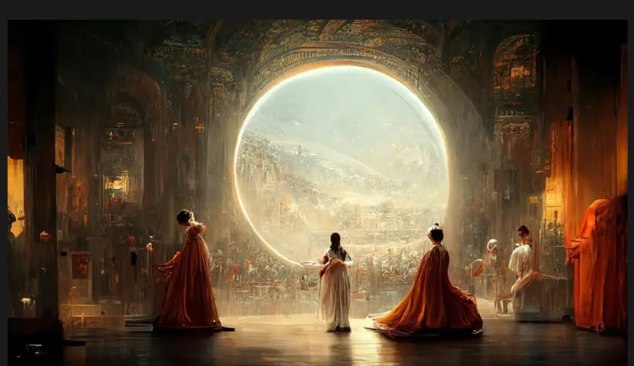
This picture was generated by artificial intelligence and won a fine art competition. Here's a link to an article I thought was interesting.
https://www.businessinsider.com/ai-art-wins-competition-angering-artists-2022-9
So, by what definition is this art? -
Irony and realityBut both of those musings are nonsense as I hold that reality is only moderately indirect realist: there is a world and we live in it but we are separate from it and require advanced nervous system to comprehend it, but alas, it is not good enough so we exist in an absurd-ironic state in a sufficiently detached reality to claim, as I have, that we are immersed in an ironic subjective phenomenon. — introbert
It's possible you and I are not that far apart in our understanding. -
Irony and realityI passionately disagree with the belief irony is a property of language. It certainly has been interpreted that way especially in 19th? century german philosophy, but I definitely think irony is a subjective phenomenon and not something symbolic. Literary irony is a simulacrum of irony and I believe Hegel and his ilk pushed a literary turn in irony because of his bias against it that "irony (socratic) is subjective that annihilates the objective". To use Hegel's terms, I stand my ground that irony is a phenomenon of indirect reality, subjective, that flies in the face of expectations that are established through objectivity. — introbert
It all comes back to this, from the OP:
I believe that reality is fundamentally ironic as consciousness and the world it perceives are united as one materially, — introbert
Are you saying there was no reality until there was consciousness? That's an argument I've made before in a somewhat different context. -
Quantum Mechanics, Monism, Isness, MeditationI'm just saying "common mistake" doesn't necessarily lead to "should never be done.") — Art48
The phrase "mixing up" was a confusing choice of language on my part. What I meant was that it is a mistake to confuse scientific principles with metaphysical ones, which I think your post does. -
Quantum Mechanics, Monism, Isness, MeditationIt’s been observed that quantum mechanics tells us what will occur if we make a measurement. It doesn’t tell us how the world “is,” what the world is doing when we aren’t looking. — Art48
QM reminds me of Kant’s distinction between phenomena and noumena. QM tells us what we will experience (phenomena) but doesn’t tell us what reality is (noumena). — Art48
Quantum mechanics is science. It is a description of how the world is or appears to be, or at least how we think it is. Noumena and phenomena are metaphysical entities. They are not facts about the world, they're ways of looking at the world. Mixing up science and metaphysics is one of the most common mistakes in philosophical discussions. -
Aftermath: Population Zero - The World without Humans | DocumentaryApparently this video is not available in the US.
-
Irony and realityAdept interpretation. When I say reality I take an indirect realist position. What I'm saying is irony is a proof of it, not making a circular. If direct realism was true our perceptions and thoughts (including expectations) should align perfectly with the world. However we fail to see every detail in any situation and the result are ironic surprises. I just make this point because irony is generally not connected to indirect realism but I strongly believe it is a phenomenon and proof of it. — introbert
Irony is a property of language. Reality is what comes before language. Reality can't be ironic. -
Analogy of Idea to World
I think you are responding to me, but I'm not sure. It would be helpful if you put in links to previous posts to make that clear.
Well that is my contention, even though I require charity, that the ideas of a shoe and foot are only a relationship to shoe and foot. They are not, in fact, the shoe and the foot in any way except that they are analogous. — introbert
As you noted, there is a lot of discussion claiming that much of human thought is based on analogy. That makes a lot of sense to me. It certainly is consistent with my own experience of my own inner life. That kind of analogy connects new experiences about the world with existing ones which allows new ideas to be incorporated in a consistent world view. Analogy is how ideas are connected with each other. It's how the world is classified and how distinctions are made.
Basically, I enjoy this method of reasoning. Using the analogical formula to make connections and associations between things, to reach interesting conclusions and make arguments has been a pastime of mine and has used up many notebook pages. I simply wanted to share the joy of using analogies as a method of reasoning with others who share a fondness for philosophy. — introbert
I feel the same way, although I like to call them metaphors rather than analogies. That sounds cooler and all intellectual and artistic and stuff.
I believe the world is not necessarily as we perceive it, but that the exact relational nature of the world has to be uncovered through thought and without using the analogical method, — introbert
Again, analogies are relationships between ideas, not relationships between ideas and reality. -
Analogy of Idea to Worldan analogy defines relationships between things — introbert
An analogy defines a relationship between relationships. The relationship between my hand and my glove can be considered analogous to that between my foot and my shoe, but the idea of a shoe is not analogous to that unnamed thing in the world which covers my foot. -
Irony and realityMy standard for considering something ironic is pretty low. The standard dictionary definition of the opposite of what a certain set of circumstances would have you expect, especially if it is humorous or paradoxical. — introbert
As it relates to reality: I believe that reality is fundamentally ironic as consciousness and the world it perceives are united as one materially, but there is a deficit between the idea that consciousness produces and the world. — introbert
Given the definition you're using, your argument is circular. If reality is the measure of irony, how can it be ironic. It is meaninglessly self-referential like "This sentence is false." -
Reverse racism/sexismHistorically, we simply don't value the lives of men as much as we do women. — 64bithuman
it's perfectly possible for men's issues to coexist with women's issues and have them both be recognized as problematic. Dismissing white blue collar issues has become something of a hallmark of popular liberal politics. — 64bithuman
Really good post, by which I mean I agree. I see no one has really responded to the substance of your comment. -
Currently ReadingQuantum Ontology: A Guide to the Metaphysics of Quantum Mechanics, Peter Lewis — 180 Proof
Let us know if this is worth reading once you've had a chance to read it. -
Irony and reality
Irony is one of those words that means different things to different people. It would help if you defined just what you mean by the word. -
Any specific trigger for move to the Lounge?For what it's worth, I have successfully lobbied in the past to have a thread moved back into the front page. That's another reason I think it makes sense to talk things over with the OP before that type of action is taken.
-
Any specific trigger for move to the Lounge?
Whatever the reasons are, it has always bothered me that the OP would not be notified of the change and an explanation provided. I have been told in the past that there is no forum policy and it is left to the moderator making the change to decide whether to notify. -
Currently ReadingHere is a link to an interesting article about population growth from "Quillette."
https://quillette.com/2022/08/20/the-unexpected-future/
The predictions it makes about future population growth are significantly different from ones I've read elsewhere. I'm not sure if that should make me suspicious. Numbers I've read elsewhere say that human population will reach a maximum level of about 11 billion people in 2100 and then drop off a bit until it reaches equilibrium. This article predicts a maximum population of about 9 billion people in 2050 dropping to equilibrium of about 8.5 billion by 2100. That population will have a significantly different age distribution than our current one - a much larger proportion of old people. This is predicted to lead to a drastic worker shortage, a much heavier burden on the young to support the elderly, and the end of economic progress, at least by the mechanisms which currently drive it. -
Why do we die?I have a question that I have often thought about but have trouble finding answers to. In the last few hundred years mankind seems to be able to extend the average life that we are able to live, but there seems to be a problem with our technology to be able to do anything beyond that. — dclements
Most of the increase in life expectancy over centuries has to do with nutrition and sanitation. I'm sure immunization and anti-biotics have had a big role too. Insect and rodent control also. At the same time, I don't think the maximum age to which people live has changed much. The three score and 10 years specified in the Bible is still fairly accurate.
I think the technology associated with longer life is probably at a whole different level affecting different bodily systems than that required for disease control. -
Philosophy vs ScienceIndeed, first principles are the foundation for all our knowledge, including science; and by definition, they cannot be defended. However, by mere common sense, are they not obviously true? At the end of the day, planes fly. — A Christian Philosophy
Are you saying that metaphysical principles are "obviously true?" If so, I disagree. As I noted, for Collingwood and me, metaphysics is not true or false. Or are you saying that scientific results are obviously true? That gets us into the old "what is truth" discussion, at least one of which is already open on the front page of the forum. -
Metaphors, Emojis, and HeiroglyphicsI welcome all kinds of tangents on this theme, but I continue to be fascinated by the individual's grip or lack thereof on the concepts/hieroglyphs employs. Is knowing what one is talking about more than a practical mastery of token trading? In what sense, if any, is meaning present? — igjugarjuk
I've been reading several books that seem relevant to the issues you've raised." By "been reading" I mean that I've started them and they're sitting on my table gathering dust.
- "The Origin of Consciousness in the Breakdown of the Bicameral Mind” by Julian Jaynes - This is an odd book presenting an odd idea that I don't really buy. Even so, Jaynes has a really interesting section upfront where he describes how consciousness is built on a foundation of metaphor.
- “Surfaces and Essences: Analogy as the Fuel and Fire of Thinking” by Douglas Hofstadter and Emmanual Sander - As you can see from the title, this book has a similar view, although the book has a broader scope than just consciousness.
- "Metaphors We Live By" by George Lakoff and Mark Johnson - This book has a similar idea, but focuses on metaphors that are built into language rather than those which we create ourselves to connect ideas that might not seem connected, but which have personal meaning for each of us.
Looking at my own thought and memory processes introspectively, I have always noted a metaphorical component. I have noticed that my ideas, memories, feelings generally have imaginary tags attached. The tags might be feelings, moods, or images. An idea with a particular tag tends to bring to mind those with similar ones. Letters and numbers tend to have colors associated with them. I'm not proposing that is how it works for everyone. It is my idiosyncratic way of seeing things, but I think it's consistent with what the authors are talking about. - "The Origin of Consciousness in the Breakdown of the Bicameral Mind” by Julian Jaynes - This is an odd book presenting an odd idea that I don't really buy. Even so, Jaynes has a really interesting section upfront where he describes how consciousness is built on a foundation of metaphor.
T Clark

Start FollowingSend a Message
- Other sites we like
- Social media
- Terms of Service
- Sign In
- Created with PlushForums
- © 2026 The Philosophy Forum