
-
Metaphysical Epistemology - the power of beliefIf there can be presuppositions which are "not true", then since presuppositions, under any reasonable interpretation of the meaning of the term, are also both suppositions and beliefs, — Janus
Absolute presuppositions have no truth value. Have you read the Collingswood essay? If so, you clearly misunderstood it. I'd let this argument go, but it's a wonderful essay. It means a lot to me. I don't want others to to be mislead. -
The Origin of the First Living Cell with or without Evolution?You seem to overlook that you are made entirely of inanimate matter - that has evolved to life. — Pop
Again, when I use the term "evolution," in this thread I mean descent with modification. -
The Origin of the First Living Cell with or without Evolution?Are you arguing that inanimate matte dose not evolve? If so what is your argument? Describe one instance of inanimate matter that has not evolved. — Pop
The word "evolution" has a very specific meaning in biology. Darwin called it "descent with modification." It is a process that describes how undirected genetic changes in organisms are passed on to an organism's offspring through the mechanism of natural selection. No inanimate matter has evolved in that sense, by definition. If it had, it would be alive.
You seem to be using "evolve" as a synonym for "change." That's incorrect usage in this context. -
The Origin of the First Living Cell with or without Evolution?Evolution is well established from observation of evolving organic systems like Covid19, so the proposition in the OP "without evolution" is not an option. — Pop
From the original post, Gary Enfield has mistaken the process by which already living species are modified over time, evolution by natural selection, from the process by which life is first made from inanimate matter. Evolution as discussed by Darwin does not create life. Darwin was aware of that.
It is easy to forget that everything is evolving, not just living things but the entire universe is in motion and evolving, and emerging, and natural selection acts on everything, not just animate matter, but all matter - it culls non viable form. — Pop
I'm not sure what this means, but the claim that natural selection acts on non-living matter is not supported by any science I've ever heard of. That's my non-dogmatic way of saying it's not true.
I think it is enough to describe how inanimate matter becomes animate. — Pop
No. It's not. -
How small can you go?This is a horizon of oblivion where philosophy usurps science. — Proximate1
So far, whenever we get to the absolute end of the line on something, it has turned out that there's still more to find. -
Metaphysical Epistemology - the power of belief
presupposition
noun [ C or U ]
uk
/ˌpriː.sʌp.əˈzɪʃ.ən/ us
/ˌpriː.sʌp.əˈzɪʃ.ən/
something that you believe is true without having any proof:....
....So suppositions and presuppositions are species of belief, but not all beliefs are suppositions in this strict sense, of course ( that is some beliefs are founded on evidence).
Now, Collingwood uses a term,"absolute presupposition" to denote those presuppositions which are bedrock for all metaphysical and physical inquiry. I see no reason to think that he could not equally well have used the term "absolute supposition" or "absolute belief" to denote the same thing.... — Janus
Except that, as I noted previously, it is at the heart of Collingwood's formulation that absolute presuppositions are not true. You are ignoring the most important part. -
Hedonistic Psychological EgoismIn what ways do the views clash with your experience of desire and pleasure? — HamiltonB
Desire and pleasure have nothing to do with belief. They are completely non-rational. If it is subject to reason, it's not really desire. The only role for reason in pleasure is to say "no." -
Metaphysical Epistemology - the power of beliefIn ordinary linguistics, they may be, from which arises the relative presupposition, according to Collingwood. In metaphysics, on the other hand, where I stake my epistemological tentpoles, presuppositions are taken as necessary conditions, re: absolute presuppositions, and beliefs, at best, are merely contingent judgements. Only here does it become apparent that the negation of a judgement does not falsify the presupposition that supported it. “Elvis is not dead”, a possible belief, has no affect on the presupposition of Elvis, the condition necessary for the belief. We don’t need to analyze the proposition to grant the necessity of the presupposition contained in it, even while analyzing the truth of the proposition itself. — Mww
Well thought through, by which I mean I agree. -
What is the relationship, if any, between emergent properties and quantum mechanics?Since I'm not likely to read that highly technical article, — Gnomon
You want to intelligently discuss a technical subject, but you don't want to read a technical paper. Instead, you'd rather continue using the word "emergence" incorrectly. That doesn't make any sense. The article is not "highly technical" and it's not difficult. -
Philosophy has failed to create a better worldn tune with Tao is much more than factual correctness and sometimes words just are not good enough to convey meaning. — Athena
You got a very flowery translation. You don't strike me as a huggy kissy kind of person. Take a look at the first verse in some of the other translations too. You can find them at the link I gave. Stephen Mitchell's is one good one. They are much more hard hitting. The Tao Te Ching is an engineering textbook to teach you how to build reality. Of course, I'm an engineer. It's that old hammer/nail thing. -
Hedonistic Psychological EgoismThoughts/criticisms on this form of psychological egoism elaborated by Justin Garson in the paper, Two Types of Psychological Hedonism? — HamiltonB
The quotation you provided is pretty dense and convoluted. I don't understand the value of the distinction between the two types of hedonism. They also don't match my experience of desire or pleasure. Why do you think these ideas are valuable? -
The Origin of the First Living Cell with or without Evolution?I had hardly abandoned the discussion when the original post had been just 5 days earlier! — Gary Enfield
Five days is more than the lifetime of the average thread. As I said, I went back and looked at the OP and various responses. In general, they were responsive and directly addressed the issues you raised.
This is a discussion group - so let's discuss.
Do you have any comments on the evidential subject matter? — Gary Enfield
I made responsive comments on your OP five days ago. Why would I want to repeat them now?
It's fine if you want to participate now. I respect an original poster's authority to intervene to keep the discussion on-post. I've done it myself, but you've lost standing to kvetch. -
The Origin of the First Living Cell with or without Evolution?We are having a debate about complex and personal things. Look out someone might get hurt! — Tom Storm
You're new to the forum, so you don't know this - I am much more civil in my discussions than I was when I started. I give the forum a lot of the credit for that. I've worked hard to keep my irritation to myself. Clearly, I'm not always successful. In that light, I have a question.
I do think your response to Wayfarer was smug. You ridiculed theists' beliefs to make a rhetorical, but not rational, point. Let's not argue about whether or not my characterization is true for now. How should I have responded to you? This is way off post, so I'll listen to what you have to say but won't respond. I don't want to send the thread off into space. -
Metaphysical Epistemology - the power of beliefFound this particularly troubling... — creativesoul
I didn't particularly like the clothesline analogy, but I don't know why it would be troubling. It isn't central to his argument. -
The Origin of the First Living Cell with or without Evolution?have some respect and do not resort to name calling. — Tom Storm
I didn't say anything about you. Didn't name call. I only commented on your response, which was disrespectful to Wayfarer and anyone with religious beliefs. I responded snippily. -
Metaphysical Epistemology - the power of beliefIt speaks to both the believer and the belief that they form, have, and/or hold. — creativesoul
Have you read the Collingwood essay? I couldn't find an indication in your posts on this thread. -
The Origin of the First Living Cell with or without Evolution?It's understandable, there's a lot of anger towards science because it has destroyed the fantasy life of many people.
The problem is no one has yet provided any evidence that there is a God or any kind of supernatural realm. And no one has found a pathway to any reliable knowledge other than though methodological realism. I would never say that science is 100% certain or that humans can have access to capital T truth. But we know what works and what is merely speculation or fantasy. — Tom Storm
Smug and self-satisfied, but wrong, or at least not right. I think there is a strong metaphysical, but not supernatural, argument for God, or at least god. I've made it before in this forum. I know it's right, because neither theists nor atheists like it. This is not the place to go into it. -
What is the relationship, if any, between emergent properties and quantum mechanics?"What is the relationship, if any, between emergent properties and quantum mechanics?" Here's a clue : it's not questioning whether "biology emerges out of chemistry and physics". — Gnomon
Here's what I wrote in my first post in this thread:
Emergence and quantum mechanics describe different kinds of phenomena. — T Clark
That's a bit vague because I didn't want to come out and say that the two are not related at all. Some QM properties are emergent, some emergent properties are QM, but there is no direct relationship between them. Perhaps someone will correct me if I've misunderstood something.
I sent you the link to the emergence article because your question indicated to me you don't understand what emergence is. I got whatever grasp of the issue I have from this article. -
How small can you go?As Atoms, so called indivisible elements by the Greeks, have been later discovered to be composed of still more elemental quarks, is it possible to move down to scales of smallness beyond quarks or is a dimensionless particle as small as it gets? — Proximate1
This is from Wikipedia:
In physics, the Planck length, denoted ℓP, is a unit of length. It is equal to 1.616255×10⁻³⁵ m... The Planck length is the scale at which quantum gravitational effects are believed to begin to become apparent in what is called the Quantum foam, and where the interactions require a working theory of quantum gravity to be analyzed. The Planck length may also represent the diameter of the smallest possible black hole.
I have read, I don't remember where, that the Planck length is considered the smallest possible length. -
The Origin of the First Living Cell with or without Evolution?I really like to see your opinions on this, or maybe to see other theories that i did not think of and could have a little logic as well. — Adughep
I suggest you go back and read some of the posts in this thread, especially those at the beginning. Your theory is not consistent with the current scientific understanding of life, or water for that matter. -
Metaphysical Epistemology - the power of beliefa steady stream of virgins thrown into the volcan will keep it from erupting, — tim wood
I don't think that is an AP. We don't need to go into it any further. -
Metaphysical Epistemology - the power of beliefI’m surprised you’d consider presuppositions are beliefs, or, as you say later, are truth-apt. Both of those would seem to make presuppositions congruent with empirical judgements and absolute presuppositions congruent with a priori judgements. Dunno how to justify that, at least from a metaphysical domain.You know...what with logical priority and all. — Mww
Presuppositions can be beliefs, but APs are not. I'm thinking about whether APs are the same as a priori judgements. I think the answer again is maybe. -
Metaphysical Epistemology - the power of beliefIf absolute presuppositions are claimed to be the unquestioned hidden basis of ones worldview, — creativesoul
This is not the case. I take Collingwood's essay as an invitation to question our absolute presuppositions. I think it's true that they are often unexamined, but they should be. From what I can see, Collingwood agrees with that.
Collingwood wants to say that these hav no truth value, but is that simply because they've gone unstated, and thus not articulated by the person holding them? — creativesoul
No, it's not because they are unstated. This next part is my interpretation. I don't remember if Collingwood wrote anything like this - APs (I give up. I'm tired of writing it out) have no truth value because they are metaphysical entities. They are chosen, not discovered. We philosophers, or scientists, or whatever we are, pick the most useful APs so we can play the game we are playing. As I've said, we might not be aware of that choosing. I think a lot of the difficulty between followers of science and those of religion is caused by the fact that we have chosen different APs. -
The Origin of the First Living Cell with or without Evolution?I have watched with interest and awe at the passionate exchanges which you have conducted on theoretical and principled grounds, but I feel that you have largely strayed from the original topic. — Gary Enfield
I went back and reread the original post and quickly scanned the other posts in the thread, mine and other peoples. I think the thread is surprisingly on target with the OP given 142 posts. You abandoned the thread, not participating after the first couple. That is generally considered inconsiderate behavior. Not collegial, which is the goal, if not usually the result, here. It takes a lot of nerve for you to come back now and complain. You've lost any authority over the thread due to an original poster.
So can we please speculate about solutions that have practical application in the circumstances of the examples, rather than endless debates about methods? — Gary Enfield
You had your chance. Go fry ice. -
Metaphysical Epistemology - the power of beliefAll you have said so far is that absolute presuppositions (in distinction to ordinary presuppositions) can be neither true nor false. I know Collingwood says that; I have read An Essay on Metaphysics. I am not convinced he is right, but that is a separate issue. — Janus
You can't disagree with him. Collingwood defines absolute presuppositions as having no truth value.
What does "absolute belief" mean? -
Metaphysical Epistemology - the power of beliefwhy don't you explain exactly how substituting the word 'belief' for the word 'presupposition' misrepresents Collingwood. — Janus
We're not talking about presuppositions. We're talking about absolute presuppositions. -
Metaphysical Epistemology - the power of beliefYou should not presume to know that Collingwood would have rejected the use of the term belief as a synonym for presupposition. It just doesn't happen to be the term he used is all; to quibble over that thus seems quite pedantic and supercilious, and irrelevant to the OP. — Janus
If you and Pantagruel want to misuse words and misrepresent what Collingwood said in a significant way, have at it. I reserve the right to keep pointing out what you are doing until I get tired of it. -
Metaphysical Epistemology - the power of beliefIf suppositions or presuppositions are beliefs, which in accordance with ordinary parlance they indeed are, then absolute presuppositions are absolute beliefs. The logic is inexorable. — Janus
As I said to Pantagruel, consistent with Collingwood, an absolute presupposition is neither true nor false. It has no truth value. If you and he want to call that a "belief," knock yourselves out, but you are being misleading. Perhaps you argument is with Collingwood and his choice of words rather than with me. -
Metaphysical Epistemology - the power of beliefHow could it make sense to deny that suppositions are beliefs? — Janus
As I wrote in one of my posts:
To me, the most important insight of Collingwood's essay is that absolute presuppositions are not facts. They are not true or false. They are useful or not useful in the particular situation in which we find ourselves. As I see it, we choose absolute presuppositions, either consciously or, more likely, unconsciously. I'm not sure if Collingwood would agree with that. — T Clark
As you can see, the discussion is on absolute presuppositions. -
Philosophy has failed to create a better world
You may have missed my point - the Tao Te Ching is short. It's a corollary to Occam's Razor - if you have two books which are otherwise the same, read the shorter one. It's not the same as the I Ching. The I Ching is much older. I've never read or used it. Here's a link to a whole bunch of different translations of the Tao Te Ching:
https://terebess.hu/english/tao/_index.html
I started with Stephen Mitchell's version. I like it a lot. I've learned since that it is very Americanized. Some of the nuance get's left out, but ancient Chinese nuance can be really obscure. Ellen Marie Chen. Addiss & Lombardo.
I was grabbed in the first verse. I've known others who took longer. First rule of book gifts or recommendations - never ask if the person has read the book. I won't. -
Philosophy has failed to create a better worldI did not like Confucious because he is so sexist, but I did like his explanation of the importance of putting effort into being the kind of human being we want to be. — Athena
I don't know if you are familiar with Lao Tzu, who wrote the Tao Te Ching. He was the anti-Confucius. Here's my sales pitch for the Tao Te Ching - it is the founding book of a major school of philosophy and you can read it in an hour. You get just as much spiritual credit as you would for reading the Bible or Book of Mormon. -
Philosophy has failed to create a better worldI would not know happiness if I had not stumbled onto philosophy! — Athena
Philosophy, in particular western philosophy, has always seemed like a stone wall to me. Hard, rigid, and overbuilt but fun to bounce balls, my ideas, off. The stoniest of the stones is Kant. There are some philosophers I like sometimes - e.g. Emerson and James.
On the other hand, I've met other people like you who were saved by philosophy. I must admit I don't get it, but I've come to respect it and accept that it works. For me, it's like jazz. It's not my music and I don't really get it, but enough people I respect value it that it would be silly and graceless to argue. -
Metaphysical Epistemology - the power of beliefMy approach is outside the scope of his inquiry, but not contradictory. I would hope, both complementary and complimentary. — Pantagruel
To me, the most important insight of Collingwood's essay is that absolute presuppositions are not facts. They are not true or false. They are useful or not useful in the particular situation in which we find ourselves. As I see it, we choose absolute presuppositions, either consciously or, more likely, unconsciously. I'm not sure if Collingwood would agree with that.
If you leave that part out, as you seem to have, the whole thing falls apart. -
Philosophy has failed to create a better world
Oh, good. I get to show off my erudition. This is from Stephen Mitchell's translation of the Tao Te Ching:
When the Tao is lost, there is goodness.
When goodness is lost, there is morality.
When morality is lost, there is ritual.
Ritual is the husk of true faith,
the beginning of chaos.
If I may interpret the interpretation. The Tao is the unspeakable oneness that comes before thought. Goodness, in this context, is Te, the expression of Tao in our lives. I think what Cicero and you are talking about is morality. Interpretation of the interpretation of the interpretation - What's right comes from inside us - our hearts. -
Philosophy has failed to create a better worldI am a very fortunate person to have such a good life, — Athena
I feel the same way. I see that I am one of the most fortunate people in the history of the world, even though there have been some really unhappy parts of my life. But I don't think that's really what's going on. I think it's what's inside us, you and me, that makes us, I don't like the word, optimists. There are many other people who live in the same world who are cranky and unhappy and who blame this beautiful world. -
Metaphysical Epistemology - the power of beliefThanks, ↪T Clark. That’s what I wanted, from Collingwood himself, — Mww
I suggest you read the paper. It's easily available on the web. It's long, but the part that means the most to me is in the beginning, so you don't have to read the whole thing. -
Metaphysical Epistemology - the power of beliefMetaphysical thinking is scientific and vice-versa; both are based upon and in search of absolute presuppositions. And an absolute presupposition is one which is actually believed as such. — Pantagruel
These are the absolute presuppositions Collingwood describes for science:
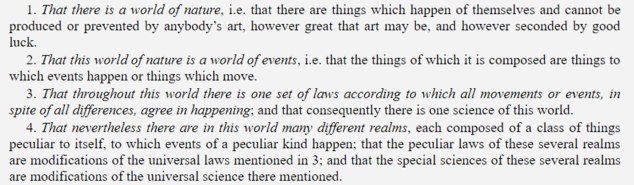
And this is what Collingwood says about them.
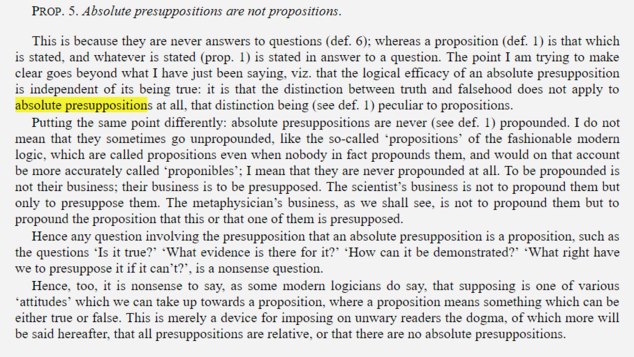
I think this shows the difference of what @tim wood, Collingwood, and I mean when we say absolute presupposition from what you do. It's not a fact. It's not true, but it's not false either. It has no truth value. If you want to call that a belief, ok, but it's misleading. -
What is the relationship, if any, between emergent properties and quantum mechanics?You referred to a technical article about "broken symmetry", which may or may not apply to this thread. I didn't login to read the article, so please summarize, in your own words, what "Emergence" means to you? — Gnomon
Here's a better link to the article:
https://cse-robotics.engr.tamu.edu/dshell/cs689/papers/anderson72more_is_different.pdf
It discusses how different levels in the hierarchy of science relate to each other. For example, all of biology is consistent with chemistry and physics. That's the reductionist view and is non-controversial. But that doesn't mean you can generate the behavior of biological organisms and the laws of biology from the behavior of non-living matter or the laws of chemistry and physics. Biology emerges out of chemistry and physics. -
Atheism is delusional?If we are just loads of chemicals grouped together through a random procces, — Franz Liszt
Abiogenesis, the creation of living organisms from non-living matter, as it is currently understood does not involve chemicals grouped together through a random process. This is currently being discussed in another thread on this forum:
https://thephilosophyforum.com/discussion/10328/the-origin-of-the-first-living-cell-with-or-without-evolution/p1
How do we know that our logical thoughts would actually show any truth in this universe? — Franz Liszt
Our current understanding is that all living organisms on earth evolved out of primitive single-celled organisms through the action of natural selection and other mechanisms. One way of looking at this is that everything about us has evolved to keep us alive in this world until we can reproduce. That includes our central nervous system and our mental processes. Our minds were built specifically to allow us to navigate through the reality we find ourselves in.
T_Clark
Start FollowingSend a Message
- Other sites we like
- Social media
- Terms of Service
- Sign In
- Created with PlushForums
- © 2026 The Philosophy Forum