
-
Why be moral?Usually, people don't seem to indulge in such moral skepticism, so your thought experiment is moot for them. A philosopher cannot just ignore such things about people. It seems that most people are intuitively and absolutely sure about their sense of right and wrong, and this surety being intuitive and absolute is essential to their sense of morality. — baker
Yes, and what if you are absolutely sure that something you enjoy is wrong and something you're disgusted by is right? Would you change your behaviour to reflect your moral knowledge, or would you decide to continue as you were?
If it could be proved beyond all doubt that there was a God, that divine command theory is true, and that we have a moral obligation to kill infidels then I still wouldn't kill infidels because I don't want to be a killer. Morality be damned. -
Why be moral?
Either eating meat is immoral or it isn't.
Some people believe that eating meat is immoral and some people believe that eating meat is not immoral.
One of these groups is right and one of these groups is wrong.
What are the practical implications if the former are right? What are the practical implications if the latter are right?
I can't see that there are any in either case.
Regardless of who is right and who is wrong, those who believe that eating meat is immoral probably won't eat meat and those who believe that eating meat is not immoral probably will eat meat. -
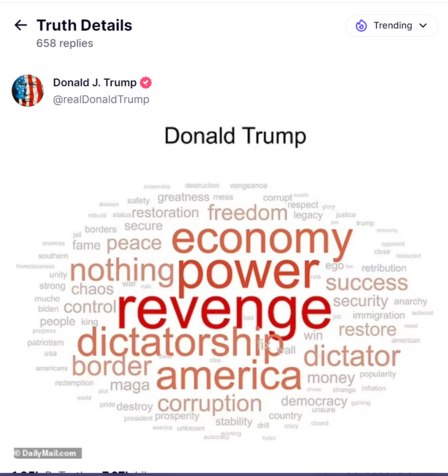
Donald Trump (All General Trump Conversations Here)Like calling Letitia James “peekaboo” which is obviously a stand in for “jigaboo”.
-
Why be moral?
The SEP article on moral motivation explains it better:
If we are to explain moral motivation, we will need to understand not only how moral judgments so regularly succeed in motivating, but how they can fail to motivate, sometimes rather spectacularly. Not only do we witness motivational failure among the deranged, dejected, and confused, but also, it appears, among the fully sound and self-possessed. What are we to make of the “amoralist”—the apparently rational, strong willed individual who seemingly makes moral judgments, while remaining utterly indifferent?
...
Although contemporary philosophers have been divided with respect to Mackie’s moral skepticism, they have mostly agreed in rejecting his extremely strong claims about what moral motivation, and the objective moral properties that figure in our moral judgments, would have to be like. They have uniformly rejected the suggestion that a grasp of morality’s requirements would produce overriding motivation to act accordingly. And most have rejected efforts to explain moral motivation by appealing to a motivating power emanating from moral properties and the acts and states of affairs that instantiate them.
...
No realist or objectivist need think that moral properties, or facts about their instantiation, will, when apprehended, be sufficient to motivate all persons regardless of their circumstances, including their cognitive and motivational makeup. And realists certainly need not take the view that Mackie ascribes to Plato, that seeing objective values will ensure that one acts, “overruling any contrary inclination” (Mackie 1977,23). An individual might grasp a moral fact, for example, but suffer from temporary irrationality or weakness of will; she might be free of such temporary defects but possess a more indelible motivational makeup that impedes or defeats the motivating power of moral facts. Any plausible account of moral motivation will, and must, acknowledge these sources of motivational failure; and any plausible analysis of moral properties must allow for them. Even those realists or objectivists who maintain that all rational and motivationally unimpaired persons will be moved by moral facts need not think they will be overridingly indefeasibly motivated. As already noted, regardless of their views with respect to broader metaethical questions, contemporary philosophers do not take any position on the precise strength of moral motivation—with the qualification (alluded to earlier) that they reject, apparently universally, the idea that moral motivation is ordinarily overriding.
I'm asking why there is a motivation to be moral if moral facts have no practical implications. -
Why be moral?The obvious practical implications are 1) how much meat is eaten, and 2) how many animals are harvested. — Leontiskos
Moral beliefs certainly have practical implications, in that if people believe that eating meat is immoral then it is likely that less meat is eaten and fewer animals are harvested, but that's not what I'm talking about.
I'm saying that eating meat actually being immoral has no practical implications and that eating meat actually not being immoral has no practical implications. -
Why be moral?This doesn't quite follow, both because "immoral" and "harmful" might be neither individuals nor kinds, and because as mentioned in previous posts "immoral" and "harmful" might well be set up as extensionally equivalent — Banno
If they're extensionally equivalent then it would be naturalism, not non-naturalism? I'm specifically talking about non-naturalism.
Secondly, the presumption that differences must be observable has been addressed elsewhere — Banno
I'm not saying that differences must be observable. I'm only saying that there don't appear to be any observable differences.
You are asking for an observable difference where the difference at hand is on of attitude, of intent. — Banno
I'm not sure what attitudes and intent have to do with moral truth, unless we're talking about moral subjectivism, which we're not.
Thirdly, your strategy of asking for motivation is... problematic. At some stage, ratiocination must be replaced by action. And this will happen even if there is no reasoned account for the action. Buridan's Ass will not starve, it will eat. — Banno
I don't get what you're saying here. Yes, either I will eat meat or I won't. And either it is immoral to eat meat or it isn't. But whether or not I will eat meat and whether or not it is immoral to eat meat are two different considerations, and I'm interested in discussing the latter and the implications of its answer.
Rigid designation works primarily with individuals. "Michael" refers to Michael in every possible world in which Michael exists. But H₂O and water are kinds, not individuals. Whether "H₂O" and "water" rigidly refer to H₂O and water is a contentious issue. This is leaving aside the problem of whether to differentiate kinds such as these from predicates such as green, or whether green should be considered a kind and ...is green a predicate, and so on. On top of that we have the problem that "immoral" ranges over actions, and it is not entirely uncontroversial that actions are individuals of the sort that can be referred to rigidly. ↪frank is perhaps saying something along these lines. — Banno
You brought up the case of water necessarily being H2O. I was simply explaining that I don't think the explanation for how this works applies to the case of ethical non-naturalism.
If a posteriori necessity depends on rigid designators referring to the same thing and if "immoral" and "harmful" are not rigid designators referring to the same thing then "harm is immoral" is not an a posteriori necessity.
If you think that there can be a posteriori necessities without rigid designators referring to the same thing then I'd be interested in hearing an explanation of it.
Again, there is a lot more going on here than one might suppose, and introducing alethic modality doesn't help. — Banno
We're not infallible, and so it's possible that some of our moral beliefs are wrong.
I don't think this at all a controversial claim.
So with that in mind, I'm asking about the practical implications of our moral beliefs being true and of those same moral beliefs being false. I don't think that eating meat being immoral has any practical implications and I don't think that eating meat not being immoral has any practical implications. So why would it matter to us if eating meat is immoral or not? Is it simply philosophical curiosity? -
Donald Trump (All General Trump Conversations Here)I just want to know what he did that was illegal. — NOS4A2
It’s explained in the indictments. -
Donald Trump (All General Trump Conversations Here)What did he do that was illegal? — NOS4A2
https://int.nyt.com/data/documenttools/trump-jan-6-indictment-2020-election/1f1c76972b25c802/full.pdf
18 U.S.C. 371
(Conspiracy to Defraud the United States)
18 U.S.C. 1512 (k)
(Conspiracy to Obstruct an Official Proceeding)
18 U.S.C. §§ 1512(c) (2), 2
(Obstruction of and Attempt to Obstruct an Official Proceeding)
18 U.S.C. 241
(Conspiracy Against Rights)
https://int.nyt.com/data/documenttools/georgia-indictment-trump/daed97d37562a76f/full.pdf
VIOLATION OF THE GEORGIA RICO (RACKETEER INFLUENCED AND CORRUPT ORGANIZATIONS) ACT
O.C.G.A. 16-14-4(c)
SOLICITATION OF VIOLATION OF OATH BY PUBLIC OFFICER
O.C.G.A. 16-4-7& 16-10-1
CONSPIRACY TO COMMIT IMPERSONATING A PUBLIC OFFICER
O.C.G.A. 16-4-8& 16-10-23
CONSPIRACY TO COMMIT FORGERY IN THE FIRST DEGREE
O.C.G.A. 16-4-8 & 16-9-1(b)
CONSPIRACY TO COMMIT FALSE STATEMENTS AND WRITINGS
O.C.G.A.§§ 16-4-8& 16-10-20
CONSPIRACY TO COMMIT FILING FALSE DOCUMENTS
O.C.G.A. 16-4-8& 16-10-20.1(b)
CONSPIRACY TO COMMIT FORGERY IN THE FIRST DEGREE
O.C.G.A. §§ 16-4-8 & 16-9-1(b)
CONSPIRACY TO COMMIT FALSE STATEMENTS AND WRITINGS
O.C.G.A. §§ 16-4-8& 16-10-20
FILING FALSE DOCUMENTS
O.C.G.A. 16-10-20.1 b
SOLICITATION OF VIOLATION OF OATH BY PUBLIC OFFICER
O.C.G.A. 16-4-7 & 16-10-1
FALSE STATEMENTS AND WRITINGS
O.C.G.A. 16-10-20
SOLICITATION OF VIOLATION OF OATH BY PUBLIC OFFICER
O.C.G.A. 16-4-7 & 16-10-1
FALSE STATEMENTS AND WRITINGS
O.C.G.A. 16-10-20 -
Donald Trump (All General Trump Conversations Here)It’s a good thing contesting an election is part and parcel of democracy. — NOS4A2
There are legal and illegal ways to contest an election. Trump's way was illegal. -
Why be moral?I most certainly did not. You didn't read anything I wrote. — frank
You said this:
This is the primary root of moral realism: that it comes from God. Some cultures maintained that we're born knowing the difference between good and evil (Persians), but in the Hebrew outlook, we aren't. We have to learn it by becoming acquainted with God's laws. That would be a form of a posteriori necessity. — frank
How is that a form of a posteriori necessity? -
Why be moral?I was explaining how there can be aposteriori necessity in the moral realm — frank
You asserted that if there is God then moral truths are a posteriori necessities but I don't think you explained how this follows. Why can't it be that in one possible world God commands that eating meat is immoral and in another possible world God commands that eating meat is not immoral? -
Why be moral?I did read what you wrote. You said that "the difference between good and evil ... [is learned] by becoming acquainted with God's laws."
So I'm asking what you would do if God's laws commanded that love is immoral. What if he commanded that we ought kill every second baby?
This is pretty much exactly what I was asking in the OP:
Let us imagine that the concept of categorical/unconditional imperatives/obligations was sensible. Let us also imagine that these are true.
...
Presumably, regardless of what is or isn't [categorically immoral], you wouldn't kill babies.
So what is the motivation to obey God's moral laws? -
Why be moral?
-
Why be moral?This is the primary root of moral realism: that it comes from God. Some cultures maintained that we're born knowing the difference between good and evil (Persians), but in the Hebrew outlook, we aren't. We have to learn it by becoming acquainted with God's laws. That would be a form of a posteriori necessity. — frank
So let's grant that the existence of God entails that there are necessary moral truths. Why be moral? What if God commands that non-believers ought be stoned to death? Would you stone non-believers to death?
Assume, for the sake of argument, that God does not reward the moral or punish the immoral.
I, for one, am not motivated simply by the belief (or knowledge) of what I ought to do. -
Donald Trump (All General Trump Conversations Here)Ukraine was their project, and it has been a hopeless mess. From cynically pushing Russia (probably in the belief that Putin was bluffing), to a strategy of wishful thinking that not only failed to hurt Russia but in fact spectatularly backfired, and continuing by burning all bridges by boycotting diplomacy, only to then make a 180 and subsequently failing to push Zelensky into negotiations. — Tzeentch
You're blaming Biden for Russia invading Ukraine and Ukraine not willing to give away some of their territory in exchange for "peace"?
In terms of foreign relations, the US lost on all fronts under Biden. It's been one tragic clownshow. — Tzeentch
What about domestic? I suspect that's what Americans care most about. -
Would P-Zombies have Children?It doesn't define what it is, but it blatantly defines it to be something not physical. — noAxioms
No it doesn't. See my other argument in that post:
1. A foo is a four-sided triangle
2. Foos are a metaphysical impossibility
3. Therefore triangles, if they exist, do not have four sides
Premise 1 doesn't define "four-sided" or "triangle". It only defines "foo".
So:
1. A p-zombie is a non-conscious organism physically identical to a conscious human
2. P-zombies are (not) a metaphysical impossibility
3. Therefore consciousness, if it exists, is (non-)physical
Premise 1 doesn't define "non-conscious organism" or "physically identical to a conscious human". It only defines "p-zombie". -
Donald Trump (All General Trump Conversations Here)You don't think the Biden administration has been an unmitigated disaster? Ok. — Tzeentch
What disastrous things has it done? -
Why be moral?I could work out a scenario in which someone would conclude that it is (the bolded part) — frank
How? Until Kripke's Naming and Necessity almost all philosophers thought a posteriori necessity impossible. It was only with his explanation of rigid designators that a strong case for them was made. If you can make a case for a posteriori necessity without rigid designators then that would be quite the philosophical breakthrough. -
Why be moral?Right. Adjectives can't be rigid designators. — frank
Then I repeat what I said before:
Does necessary a posteriori truth without rigid designators that refer to the same thing make sense? If not then if ethical non-naturalism is true then "it is immoral to harm others" is not a necessary a posteriori truth. -
Would P-Zombies have Children?Step 1 defines consciousness to be supernatural — noAxioms
Step 1 doesn't define consciousness. It defines p-zombies. Here's a different argument:
1. A p-zombie is physically identical to us but has no consciousness
2. P-zombies are a metaphysical impossibility
3. Therefore consciousness, if it exists, is physical
If step 1 defined consciousness as being supernatural then the conclusion would be a contradiction, but it isn't. Therefore step 1 doesn't define consciousness as being supernatural.
To make it clearer, here's another argument:
1. A foo is a four-sided triangle
2. Foos are a metaphysical impossibility
3. Therefore triangles, if they exist, do not have four sides
Step 1 does not define "four-sided" or "triangle". It only defines "foo". -
Why be moral?If water is H₂O, then necessarily water is H₂O. There is no prima facie contradiction in water being made of other stuff, but once it is found to be made of H₂O, the alternatives are pruned from the tree of possibilities. — Banno
That's because "H2O" and "water" are rigid designators that refer to the same thing. If ethical non-naturalism is true then "immoral" and "harmful" are not rigid designators that refer to the same thing.
Can there be a posteriori necessity without rigid designators referring to the same thing?
A third layer, so we have alethic, deontic and now epistemic modalities.
And so back to my point: the framework being used here is far from clear. — Banno
Considering deontic logic, is OA → ◻OA an axiom?
If it is, is it an axiom by choice or by necessity?
There's something specious in the question Michael asks about how worlds differ given moral truths. they differ specifically in the truth of those moral statements... — Banno
I've been clearer in subsequent posts. I'm asking about observable differences.
I believe that eating dirt will make me sick. I eat dirt. If my belief is true then I will be made sick, if my belief is false then I won't be made sick. This is an observable difference.
I believe that it is immoral to eat meat. I eat meat. If my belief is true then... what? If my belief is false then... what? In either case I just eat meat. I can't think of an observable difference between the belief being true and the belief being false.
If there is no observable difference then what is our motivation to be moral?
Why are we unable to determine right and wrong in the non-naturalist world? — Hanover
I'm not saying that we're unable. But we're not infallible, and so it's possible that our moral beliefs are wrong. I am simply asking about the observable difference between our moral beliefs being true and those same moral beliefs being false. If ethical non-naturalism is true then it seems to me that there would be no observable difference.
But as a related question, if ethical non-naturalism is true then how can we determine right and wrong? Can there be empirical evidence of non-natural facts? Or if it's determined by reason alone then from which premises can we derive moral truths? -
Why be moral?There would be an observable difference in either world. — Hanover
In one possible world babies suffer if they're murdered and it's immoral to murder babies.
In another possible world babies suffer if they're murdered but it's not immoral to murder babies.
In both worlds we believe that it is immoral to murder babies.
What is the observable difference between each world? -
Why be moral?Why would it be different if ethical naturalism were the case? It might just be that murdering babies is moral in such a possible world. — Hanover
If ethical naturalism is true and "immoral" just means something like "harmful" then a world where nothing is immoral is a world where nothing is harmful. There would be a significant observable difference between living in that world and living in the world we're in now.
It would make a difference to our lives if our beliefs about what is harmful and what is not harmful are wrong. -
Why be moral?This assumes a consequentialist justification is necessary for morality, which means your beef isn't against non-naturalism, but it's with deontolgy. — Hanover
Not exactly.
In one possible world hurting people is wrong because of the consequences.
In another possible world hurting people leads to the same consequences but it isn’t wrong.
Why does it matter which world we’re in?
In one possible world we just have a duty to not hurt people.
In another possible world we don’t have a duty to not hurt people.
Why does it matter which world we’re in?
If ethical non naturalism is true then it seems to be that whether or not our moral beliefs are true has no practical import. Our lives go on the same. -
Why be moral?As to your specific question I quoted above, yes, it matters if we think we shouldn't harm others if we should because we'd be wrong if we didn't. — Hanover
Why does it matter if we're wrong? It makes no practical difference to our lives. -
Why be moral?As if "physical or emotional injury" were not evil. — Banno
If ethical non-naturalism is true then "if X causes physical or emotional injury then X is evil" is not a tautology. -
Why be moral?When I'm using the term "harm" I'm using it in the sense of "physical or emotional injury".
-
Why be moral?Sorry - the OED is ethically naturalist? Can you explain that? — Banno
It’s defining evil as harm. -
Why be moral?That's just reasserting that it's not a contradiction. — Banno
If ethical non-naturalism is true then “immoral” doesn’t mean “harmful”.
If “immoral” doesn’t mean “harmful” then “this is harmful” doesn’t mean “this is immoral”.
If “this is harmful” doesn’t mean “this is immoral” then “if this is harmful then this is immoral” is not a tautology.
If “if this is harmful then this is immoral” is not a tautology then “this is harmful and this is not immoral” is not a contradiction.
If “this is harmful and this is not immoral” is not a contradiction then it is possible that something is harmful but not immoral.
Therefore, if ethical non-naturalism is true then it is possible that something is harmful but not immoral.
Again, "Why be moral?" is an infelicitous question - being moral is what you ought to do. Hence the answer to "ought you be moral?" is "yes!" — Banno
These are two different questions:
1. Ought I be moral?
2. Why would I be moral?
“Ought I” and “why would I” mean different things.
The answer to the first is, presumably, “yes”. The answer to the second isn’t “yes”.
And it doesn’t prima facie follow that if the answer to the first is “yes” then the answer to the second is “because I ought to”. Or at the very least it’s not the only answer. Other answers may be more compelling. -
A Case for Moral SubjectivismI don't think you're a serious interlocutor and I've explained in detail why I am not interested in engaging you. — Leontiskos
Because you want me to say “moral theory X is right and theory Y is wrong”?
I don’t have to say that. I am simply addressing the weaknesses in both theory X and theory Y. I don’t know why you think this means I’m not being serious.
This is a thread about moral subjectivism, not moral realism. Please stay on topic. — Leontiskos
You claimed that “we have a moral claim that we know to be true" as part of your counterargument. If you cannot justify this claim then your counterargument fails. -
Why be moral?It is unclear what you mean by "immoral" and therefore that these are "possible worlds". — 180 Proof
Assuming ethical non-naturalism, whatever "immoral" means the sentence "it is not immoral to harm others" is not a logical contradiction, and so "it is immoral to harm others" is not necessarily true. If "it is immoral to harm others" is not necessarily true then "it is immoral to harm others" is possibly false.
So if ethical non-naturalism is true then these are two possible worlds:
1. It is immoral to harm others
2. It is not immoral to harm others
Assuming that in either case we believe that it is immoral to harm others, does it even matter which world we're in? -
Would P-Zombies have Children?Lines 1 and 5 beg the conclusion, making the argument fallacious. — noAxioms
Line 1 is just a definition.
Line 5 doesn't beg the question because it doesn't claim that consciousness is non-physical. It just claims that whatever consciousness is we have it. A physicalist can also accept this premise.
We can conceive of something that is physically identical to us not having consciousness — Michael
This also begs the conclusion. — noAxioms
Yes, this is one of the common counterarguments against the p-zombie argument.
Michael
Start FollowingSend a Message
- Other sites we like
- Social media
- Terms of Service
- Sign In
- Created with PlushForums
- © 2026 The Philosophy Forum