
Comments
-
Being a ManA real man is someone who is a father, an Olympic champion, a stepfather, a husband, a multi-millionaire, someone who raises billionaire daughters and step-daughters, an international celebrity, and someone who will be the next Republican governor of California. He is all that and America's sweetheart.
https://www.foxnews.com/politics/leo-terrell-advises-caitlyn-jenner-to-run-like-a-trump-republican-in-bid-for-california-governor -
A Law is a Law is a LawThe existence of law is one thing; its merit and demerit another. Whether it be or be not is one enquiry; whether it be or be not conformable to an assumed standard, is a different enquiry. — Ciceronianus the White
I take this to mean that there are moral laws and man made laws and whether the man made one exists is not dependent upon whether it comports with the moral law. I think we both agree with that. The confusion only arises when we use the unmodified term "law" and suggest that "man made law" and "law" are necessarily synonymous. That seems to be the entire debate.
My response has been that you could have a legal system where that is not the case. I'd think the law within the limits of the Vatican are the sort that demand an analysis of a higher power. But to both yours and my experience within the confines of our system, the law is not stricken or claimed null and void simply because it violates the rules of nature. I don't think the same holds true within theocracies.The belief that the law must conform to an "assumed standard" of some kind, and isn't the law if it does not, ignores the law; it doesn't explain it. It leads to a fundamental ignorance of the nature of the law and its operation. — Ciceronianus the White -
A Law is a Law is a LawRegardless, though I haven't maintained that morals and moral principles are never employed in making or interpreting, or enforcing laws. My only point is that doesn't make morals or moral principles law. — Ciceronianus the White
This comment really deprives this debate of any significance. In trying to determine what this thread intends to answer, I've arrived at that following possibilities:
1. Whether there are principles of morality that are employed in legal interpretation?
2. Whether the US system relies upon moral principles when it interprets law?
3. Whether there are moral principles that exist that are not human creations?
4. Should there be a legal system that uses morality when interpreting some laws?
5. Are natural laws properly defined in English as laws?
As to #1, you say yes, although you previously seemed to deny such occurred in the contemporary US system. It is obvious, however, that other systems do directly question the morality of a law when deciding whether to uphold it.
As to #2, you say yes sometimes such occurs in the US.
As to #3, I believe you say yes. If you said no, then this debate would become one of whether moral realism exists and it would more directly challenge the existence of natural law in a philosophical way. From your posts, I don't see this as your concern.
As to #4, it's not clear what you think, but I'm guessing that doesn't matter to you. The only discussion as to this point is where you pointed to the lack of evidence of in your practice that US courts rely upon morality when ruling. I've noted the irrelevance of those responses to this question.
As to #5, you say no, and this seems to be the main point you wish to show in this discussion. The problem with this question is that it has no philosophical significance, it's pedantic, and it demands a rigid prescriptive definitional scheme, where we turn to preset dictionary definitions to understand words as opposed to reference to nuanced usages and context. The real answer to this question is the same as when you ask the definition of most any word, which is that words tend to be defined different ways in different contexts. We could have had the same conversation about "cups" or "chickens" and drawn the same conclusion and we wouldn't have been so burdened by all the issues related to natural law versus positivism.
Anywho, the reason this natural law debate matters, imho, is because it challenges the role of governments. Do governments create the most fundamental laws we hold so dear, or is the role of government to defend the rights we already have?. That is, do governments create the laws we refer to as "rights," or is the government subservient to the rights we have regardless of what a legislature decides? If we accept the latter explanation, then we stand on firm ground when we defy government oppression of our rights and we declare such systems illegitimate on their face. -
A Law is a Law is a LawNature, as I understand it, adopts nothing; it makes no laws, it simply is, and we're a part of it. We know things and can infer things from our interaction with the rest of Nature, but that doesn't mean that there are laws inherent in it which govern how we should behave in the sense that a law would. — Ciceronianus the White
I do understand that nature does not promulgate rules, but it does operate in a predictable way, consistent with what we call the laws of physics. That is an example of the word "law' being used in way that differs from the confined way you insist, which is in a way that requires human processes. Another fine example of the word "law" being used in a way that violates your preference is in the phrase "natural law." -
A Law is a Law is a LawThere's a difference between morality and the (positive) law. I don't think they can be conflated, nor do I think they should be.
— Ciceronianus the White
Seems obvious. Hence, the question "Is that law good?" remains open. — Banno
That much is obvious. The positive law doesn't claim to be necessarily moral. Natural law does. In fact, natural law is defined as that which is moral. The quibble, after these 8 pages, appears to be how comfortable one is in claiming that natural law is law or whether it's not law. I think of natural law as law because that's what it's called. Apparently others insist that only positive law is law, which makes me wonder what the word "positive" means, considering "positive law" and "law" seem to be the same thing. -
A Law is a Law is a LawFor me, natural law is not law. "Moral principles" are not law. They're principles. — Ciceronianus the White
It doesn't appear to me that you're arguing that moral principles are not law. You're arguing that the law is comprised of "statutes which have been laid down by a legislature, court, or other human institution and can take whatever form the authors want." Ergo, if a legislature laid down a statute that said all laws must be moral, such would be the "law" according to your argument. It's for that reason I've asked the question why you find it relevant that US law doesn't happen to ask if a law is moral when it evaluates whether it is a legitimate law. Under positive law, it could ask such a question if there were a positive law that required it.
Complicating matters is the fact that laws are not all the products of legislatures with clear dictates, but some are judicially created and subject to much nuance with unclear boundaries. Since that is the case, an argument can be made, especially on the Constitutional interpretation level, that laws must pass moral muster in order to be declared Constitutional. You may argue that is a perverse way to view Constitutional interpretation, but should it eventually be judicially declared that an unapologetic moral evaluation be conducted to determine Constitutional legitimacy, then that would be a positive law institutionalization of natural law. I see nothing inconsistent with there being a positive law requirement for moral evaluation of law, which is at some level what happens in many cases throughout legal interpretation, in some nations explicitly and in other (like our own) not as explicitly.
I say all this because, as it seems, you're not objecting to what the law says. You're objecting to any claim that the law comes from anywhere other than the hand of man. You're also not denying that there are rules that derive from a source beyond man. You just refuse to call those rules "laws." -
A Law is a Law is a LawIf you disagree with those definitions, so be it. — Ciceronianus the White
Alright, I'll crack open my dictionary as well:
Natural law is defined as "a body of unchanging moral principles regarded as a basis for all human conduct."
Positive law is defined as "statutes which have been laid down by a legislature, court, or other human institution and can take whatever form the authors want. Compare with natural law."
So, my questions are these:
Is natural law a type of law?
Is there is a distinction between "law" as you have presented it here in this thread and "positive law" as I have defined it here?
I'm beginning to think that the reason you argue against the existence of natural law is because you define "law" and "positive law" synonymously, making the word "positive" superfluous. To the extent my thought here is correct, I would agree with you that there is no such thing as natural "law" to the extent "law" is being defined as "positive law," which would equate by substitution to the term "natural positive law," which surely there is no such thing. -
A Law is a Law is a LawThat "we" doesn't include me. I'm addressing the law, which includes zoning laws and other laws. I don't think we can select particular laws and use them to define what the law consists of, if we want to define and analyze what this interesting thing called "the law" we humans create is and means, and how it functions. — Ciceronianus the White
Except there are different kinds of laws, some that require an evaluation of the justice they provide and others that don't. It's for that reason a homosexual has the right to marry a person of the same gender, despite the law saying he does not. All laws aren't in principle the same, so you can't treat them as the same.
We lawyers don't practice natural law; we're not "natural lawyers." When we attended law school, you and I weren't taught how to be good,or just, or moral, nor were we taught that the law we were to practice was what God or nature established. We weren't admitted to the bar because we were learned in natural law or ethics. The Uniform Commercial Code wasn't written in heaven (especially that portion of it relating to commercial paper, which it is more likely would have been written in hell). — Ciceronianus the White
Again, how is this at all relevant? If it is in fact that case that you and I were taught a particular way to practice law, does that mean that is the only way to be taught? As I've noted several times (1) there are instances in Anglo law where reference is made to natural law and I cited a case that made direct reference to God, and (2) there are many societies that do in fact unapologetically subject their laws to a determination as to whether it's consistent with God's will.We can all agree that laws should be just. I would agree, in fact, that laws should be in accord with reason. But we fool ourselves and create confusion when we insist that laws which aren't just or reasonable don't constitute laws, or aren't part of the law. — Ciceronianus the White
If a system if devised that subjects legislatively passed laws to a theocratic body to determine if they comport to divine law, then do you argue that it's a law until it's over-ruled and now not a law, or would you agree it was more akin to a bill that had yet to gain full force of law until it received theocratic review? If you argue the latter, then we don't fool ourselves when we claim laws passed by men were never true laws if they violated natural law, but we accept the true legitimacy of the law is dependent upon whether it passes fundamental principles.
And, even should you claim that the system I've described is not the American one, that hardly matters. -
PronounsI recently took a course so that I could be certified as a mediator. What was unusual (for me) was that the trainers were academics at a local university and not lawyers. The first thing I learned when mediating a case is that I should ask everyone their pronouns so as not to offend. Everyone nodded in agreement that was proper, although I did wonder if they actually ever mediated a case outside the university setting. I would instantly lose credibility in the real world if I asked a middle aged man from suburbia if we wished to be called she, he, they, it, or whatever it may be.
In a professional environment, where I wish to remain professional, where I have no desire to push any agenda of any sort, I will call men he and women she unless asked otherwise. If a man is angered by my assumption that he be called he, then I'd apologize and move forward because I'd rather not pick a fight. I'd likely offer some self-deprecating comment that I'm out of touch with the times, that I'm still trying to figure out how to use my cell phone, so give me so leeway when it comes to all these changes. In short, I'd be giving the person a silent eye roll while trying to ignore what I found to be an entirely stupid situation. That's the bottom line here. No one is gaining any respect. We're all just navigating complicated social situations, without any real changes of heart and probably internally building bigger walls around us. -
A Law is a Law is a LawWhile I think Natural Law is at worst a chimera, at best a misnomer, I think that the more our judgments and decisions, including those regarding law, are guided by informed reasoning, the better they will be. — Ciceronianus the White
Laws that are mala prohibita prohibit conduct unrelated to morality. The zoning law dictating the color scheme of the homes is an example. Laws that are mala in se prohibit conduct on the basis of morality. Rape and murder would be the example. Mala in se are the laws we're interested in here.
If we accept moral realism, then the rules governing the creation of a proper mala in se law are immutable. We may not be correct in our conclusions of what is moral, but under moral realism, there is a Good and a law requiring rape is a logically contradictory mala in se law. It is a law demanding moral conduct yet it is immoral.
The rules governing a mala in se law are the rules of natural law. That is, if moral rules exist objectively, then laws dictating morality (mala in se laws) must adhere to these rules. The natural law cannot be violated under this scheme.
Is the debate then only over what you insist the word "law" means? It does appear you wish to prescribe a definition to the term "law" and require it only mean a specific codified written rule by a human law making body. That's simply not what the posters here take to be the definition of "law" within the the context of natural law though. -
The subjectivity of moralityI'd put it this way: people care for – respect themselves – in so far as they develop habits for caring for – respecting – others. — 180 Proof
This reminds me of the Tanya doctrine of the three levels of morality among persons: the tzadik, the benoni, and the rasha (https://www.chabad.org/library/article_cdo/aid/361896/jewish/The-Benoni.htm). This draws the distinction between those who have habitually become so moral that they no longer have an evil inclination (the tzadik) versus the one who remains challenged by an evil inclination (the benoni) versus the one who purposefully does evil (the rasha). The tzadik though is not thought to really be an attainable goal for most, with only maybe one or two being in existence in any generation.
So, to the extent you reference the moral person as being habitually moral, I would agree, but just qualify that is the ideal or the aspiration and doubtfully attainable.
You then reference Hillel the Elder, who famously summarized the entire Talmud while standing on one foot: "What is hateful to you, do not do to your fellow: this is the whole Torah; the rest is the explanation; go and learn."
It would follow therefore from your references that the tzadik is one who has habitualized the morality as described by Hillel, and so I'm wondering if all of this is the source of the philosophy you've propounded here because you do seem to have an affinity to Jewish doctrine. -
A Law is a Law is a LawWell, when you say you see your claims regarding the application of this higher law reflected in the American legal system, you might expect those claims will be addressed--by me at least — Ciceronianus the White
To follow up on this, I give you https://en.m.wikipedia.org/wiki/Earl_of_Oxford%27s_case
In holding that when there is a conflict in common law and in equity, equity shall prevail:
"The Office of the Chancellor is to correct Men’s consciences for Frauds, Breach of Trusts, Wrongs and oppressions, of what Nature soever they be, and to soften and mollify the Extremity of the Law, which is called summum jus.
And for the judgment, &c., law and equity are distinct, both in their courts, their judges, and the rules of justice; and yet they both aim at one and the same end, which is to do right; as Justice and Mercy differ in their effects and operations, yet both join in the manifestation of God's glory."
This was from 1615. When such reasoning fell into disfavor I don't know, but such is the foundation of our law. -
A Law is a Law is a LawWell, when you say you see your claims regarding the application of this higher law reflected in the American legal system, you might expect those claims will be addressed--by me at least — Ciceronianus the White
Except this isn't what I limited it to in my post, and you ignored my comments where I did point to the influence of natural law in the American system.
Again, what relevance is this objection you've posited? If the US did in fact strike down laws explicitly on the basis of it violating natural law, what relevance would that have to anything you've said? -
A Law is a Law is a LawI assume you refer to a situation where a court has held that a particular law doesn't pass muster with God, or violates natural law, or something along those lines. A citation would be great. — Ciceronianus the White
Before responding, I ask the relevance of your question.
Assuming there are such instances, would you reconsider anything you've said in this thread? If not, why the question?
Regardless, the answer to your question is that unless you limit your inquiry to contemporary Anglo legal systems, there are countless examples. I'm sure I could find some such citations if I go back far enough in ancient English caselaw and absolutely certain I could provide you the citations you need from Islamic and ancient Jewish theocracies. The entire Talmud is a good source for the citations you are looking for.
I'd also point out that direct reference to our heavenly father isn't required for a court to be reliant upon natural law. In the US, a nation that is explicitly not a theocracy, dependence upon accepted universal truths remains an integral part of our legal system, perhaps owing itself to the argument submitted in the Declaration that all man made laws are subservient to the inalienable ones endowed by our creator and a legal system violating those rights is an illegitimate form of government. Do you contend that the various rights constantly being found in our Constitution were so well hidden the past centuries or do you believe these may just be judges endorsing what they believe is the Good as now revealed to them due to our evolving sense of morality?
At any rate, I don't know whether your positivist position is (1) metaphysical - simply stating there are no godly laws and the concept of morality is a manmade notion, (2) ethical - a just system doesn't rely upon vague notions of fairness in the administration of society but passes clear rules to be followed, or (3) descriptive - stating that of the legal systems worth studying, they tend to be rule reliant and not principle reliant.
If #1, I follow your logic, but I'm not sure that's all you mean to say, especially in light of the question you asked that I've cited in this post. -
A Law is a Law is a Law@Ciceronianus the White andSometimes the law intentionally supports what is good. Sometimes it does not. — Banno
So that's obvious. We can all list off countless examples of immoral laws that have existed throughout our checkered history. I'm wondering then what this debate is about.
As I see it, it's just this:
There are laws that are passed by legislatures and the like through some accepted procedure and they are called "laws." Those law come under review by some entity, perhaps a court or perhaps by the people themselves, and they declare those laws unjust and either strike them down or just refuse to comply with them.
When an entity declares that law unjust, he admits obviously it is a "law" just by virtue of its existence on the books, but that entity might be saying something further reaching, which is that the legislatively passed law is defeated and preempted by a higher law. That higher law is a reference to a natural law, a principle that cannot be defeated by an act of Congress. So, if rape is legalized, such is the "law" no doubt, just as it's the law if minorities are granted inferior status. That we define "law" in the natural law context as what ought to be and that we define law in the positive law context as what actually is written, seems an equivocation of terms more than a meaningful debate.
The question I'd think of substantive interest is whether one believes there are guiding principles that ought be considered during the law making process in order to create a just society and what they are. If we agree there are such principles and as to what they are, it would seem we could further agree to use them to remove laws that violate those principles.
Those principles I refer to, which you likely agree exist, I call rights. If the word "rights" makes you uncomfortable, use a different term. But when I say a law is unjust based upon some very fundamental violation of right and wrong (as in minority discrimination and the like), I am saying that law is preempted by a higher law and it cannot stand. I do see what I'm describing is exactly what exists in the US.
Where do we disagree here? -
A Law is a Law is a LawI find this to be an interesting statement. How could a law intentionally correlate to morality? Let's say that different lawmakers make laws for different reasons, morality might be one. Suppose a lawmaker proposes a law which is apprehended by that lawmaker as correlating to morality. Doesn't that law have to be passed by all the other lawmakers involved, before it becomes a law? Each of those lawmakers has one's own intentions. So, by the time the law is passed, the one who proposed the law had the intent of morality, but all the others had some other intentions, and unless those other intentions were morality, then we shouldn't say that the law intentionally correlates with morality. — Metaphysician Undercover
Hypothetically, there could be a unanimous opinion as to the purpose of a law and that purpose could be to advance a certain morality. In any event, though, since we're speaking in the abstract as to whether there could be a law passed purely for moral purposes, there's no reason therefore to limit it to democratically passed laws. It might be a judge decreeing an interpretation of a law in a manner that comports to morality, and that would require a single person. -
A Law is a Law is a LawWhat laws are in force in that system depends on what social standards its officials recognize as authoritative; for example, legislative enactments, judicial decisions, or social customs. The fact that a policy would be just, wise, efficient, or prudent is never sufficient reason for thinking that it is actually the law, and the fact that it is unjust, unwise, inefficient or imprudent is never sufficient reason for doubting it. — Ciceronianus the White
If judges decree which laws are to be enforced based upon the justice, wisdom, efficiency, or prudence of the law and those pronouncements are recognized by law as authoritative, then are we within a positivist or natural law system? -
A Law is a Law is a LawThe law has nothing to do with morality...
isn't that obvious?
Any correspondence between the Law and the Good is surely coincidental... — Banno
Why must correspondence between the good and the law be coincidental and not intentional?
If your local government legalized rape, wouldn't your objection to the law have something to do with the immorality of it, and don't you think your local politicians would be motivated to change the law based upon an appeal to their sense of right and wrong? If they do illegalize rape out of respect for its immorality, wouldn't that be an instance of a law having something to do with morality?
The more accurate statement then would be that the law does not necessarily correlate to morality, but sometimes it does, and sometimes it intentionally does. -
A Law is a Law is a LawThe belief that the law must conform to an "assumed standard" of some kind, and isn't the law if it does not, ignores the law; it doesn't explain it. It leads to a fundamental ignorance of the nature of the law and its operation. — Ciceronianus the White
So the law is whatever people happen to respect as the law, variable to the current subjective state of the people at the time and variable to a particular geographical region?
For example, it was against the law in 1965 after the passage of the Civil Rights Act of 1964 to engage in certain racially discriminatory ways, yet, as we know, we didn't exactly receive universal compliance at the moment of passage. If the local sheriff wouldn't enforce the law, the prosecutor wouldn't prosecute the law, the juries wouldn't convict under the law, the judge wouldn't sentence under the law, and the warden wouldn't incarcerate under the law, then it was not the law, correct? My point here is just to arrive at the logical conclusion of a system that expressly denies the existence of an underlying anchor for the legitimacy of the law. That is, just because it was passed democratically according to custom does not by itself make the law a law. On the other hand, with natural law, some natural or divine force is posited to justify the existence of the law, but with positivism, it seems (and explain if I have this wrong) the law is a rule laid down that gains acceptance and the nuance of what the law actually is will vary depending upon how the people at the time accept it to be.
It would seem our system, even to a committed positivist like yourself, is not so black and white because, like it or not, natural law foundations are posited as the basis for the law. That is, even should you say at the most meta level the law is best described by the positivist, we have as a society declared that certain laws shall not be enforceable if they do not meet certain standards of contemporary morality. For example, the Alabama statute and Constitutional precedent at the time allowed laws relegating African Americans to the back of the bus, but we were to learn that Rosa Parks did not violate that law, despite the fact that the facts undeniably supported a finding she did violate the law. This means, from a positivist viewpoint, that a higher morality must be considered when interpreting the law but only because society has declared that higher morality must be considered in its interpretation.
What we are left with appears then to be a distinction without a difference. You say that we do not have any rights that exist beyond what people say exist, yet the people say we have certain rights that are inalienable, endowed by our Creator. You declare that claim factually false, but if the people insist that higher values of righteousness as might be decreed from the heavens be considered when the laws are interpreted, then that will be the law as respected. My question then is what difference does it make pragmatically to assert there is no true natural law, but then to say we must respect the concept of natural law because natural law is a concept that has been enshrined by positive law? -
The British UnderstatementThe British humor I think that doesn't translate well in the US isn't so much the sarcasm or understatement, but the absurd (like Monty Python), the mindless silly (like Mr. Bean), and the frantic nonsense (like Benny Hill).
-
Anti-vaccination: Is it right?My theory is that a few far left liberal billionaires (referred to as "they") have manipulated the right to avoid vaccines in order to kill them and strengthen the left. . A true Trump supporter would see through this and vax themselves silly so they'll live longer (or at least to the mid-term elections).
The beauty of conspiracy theories is that they require no evidence and the more malicious and ridiculous the motive you can concoct, the more followers you get.
To the OP, yes, anti-vax is wrong. The tapering of covid related deaths hasn't happened because covid got tired of being a dick, but because science stopped it. -
Are people getting more ignorant?Very cool. In Georgia, all we have are feral pigs that roam the countryside. They're not as interesting as your goats, and they're very destructive and mean.
-
Are people getting more ignorant?Meanwhile, the wild goats have eaten all my tulips. They don't eat daffodils though. — unenlightened
Wild goats? Do you live on a cliff? -
Are people getting more ignorant?Anyway, chickens will clear an area of ground down to the dirt, ready for sewing seed. The only advantage that accrues to goats is that they will eat the more woody weeds. The disadvantages in terms of broken fences and chewed valuables outweigh their benefit. — Banno
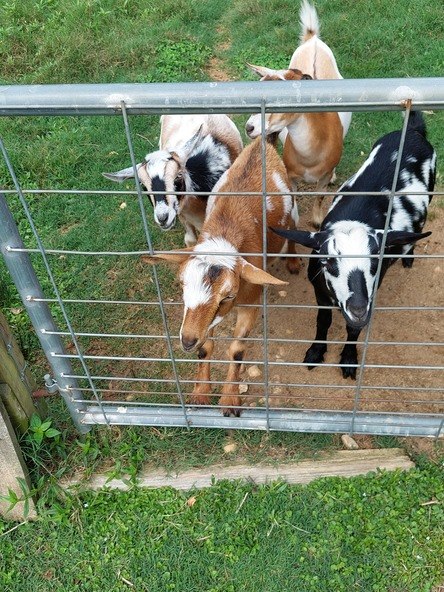
My goats will be like my kids were and one day my grandchildren will be. They will have no utility, will destroy all sorts of things, will bear additional costs, but I'll be able to take pictures and videos of them to share with people who couldn't care any less but will tell me how cute they are.
Remember a goat is not just for Easter, Hanover; Or will Tater, Jasper, and Cornbread finish in a curried Christmas carnival? — Banno
I'm not planning on eating my pets, but the economy is unpredictable. In the event I do hold a disturbing backyard slaughter, I'll save you a leg. Come to think of it, maybe a roasted leg of goat has a place on the seder plate because, as you noted, they are not just for Easter. -
Are people getting more ignorant?you haven't got them. — Caldwell
I bought them. They're still with their mom though. -
Are people getting more ignorant?But to your question. No, not in the house. They shit where they stand, like a horse, just in tiny pellets. Thousands and thousands of pellets.
-
Are people getting more ignorant?Will you be keeping the goats in the house? — Bitter Crank
Let's talk goats...
I'm awaiting my kids to be weaned from the teat. If you bottle feed them, they remain very clingy. Once I get them, I'll have them neutered. They are then called withers. If you leave them intact, they release strong pheromones and piss on their beards to woo the ladies. To smell like a goat is a real thing to be avoided.
Female goats go into great heat every 21 days and they don't take to feminine hygiene products, so blood will be a thing. They also get difficult due to hormonal issues if you never breed them. Spaying goats is not a thing because general anesthesia isn't good on goats. A boy goat can get castrated from where he stands though. Ripe for the taking as it were.
Disbudding of all goats is common. It avoids horns caught in fences and annoying head slams.
With all this, you ask "why goats"? Here's why:
I'm naming mine Tater, Jasper, and Cornbread. Jasper the friendly goat is the reason for that name. Kinda funny. Kinda stupid. Therefore perfection. -
Are people getting more ignorant?On the other hand, we well-informed people should be grateful that most people are taking care of business, and not spending al their time reading. — Bitter Crank
True, but some business is as useless as reading, but offers an education as well. I just bought 3 goats. My embarrassing ignorance of goats will soon be relieved, not through passive learning, but through active engagement. The goats I raise won't do anything for the betterment of the world I fear, but I'll finally be able to hold my own in a conversation at the feed and seed. -
Are people getting more ignorant?I saw in a UK poll yesterday that even a year after the start of the Covid-19 pandemic about 50% of respondants could not name the disease's major symptoms. — Tim3003
The only way to determine whether people are becoming more ignorant year to year is to compare their knowledge over time. If we go back 3 years for example, I would assume the knowledge base regarding Covid-19 was zero, yet today, the average Brit appears to be fully aware of 50% of the symptoms. Based upon that, I'd say we know more today than 3 years ago and we should be applauded by our advances in education. -
What's the most useful skill?My current thought is that the most useful skill is the ability to adapt to change. — Yohan
Per evolution, the ability to reproduce would be the most useful skill, and most critical. -
Pornification: how bad is it?Fun fact: Boys who starts to drink in his preteens develop larger prefrontal cortexes than boys who don't. Ironically the prefrontal cortex is the section of the brain that's associated with decision making. However girls who starts drinking in their preteen develop a much small prefrontal cortex than girls who don't and they generally lead a much less successful life. While it acts like a poison to girls, it makes boys smarter.
From Why Gender Matters by Leonard Sax — FlaccidDoor
Are there studies that show that those with larger prefrontal cortexes make better decisions or do the studies just show that decision making occurs in the prefrontal cortex? Thinking generally takes place in the brain, but those with larger brains aren't statistically smarter than those with smaller brains, so I don't see why an enlarged prefrontal cortex should correlate with it working better.
The real message it would seem is that alcohol consumption affects a developing brain, so maybe hold off drinking until you're a little older. -
Pornification: how bad is it?What do you think. Is porn bad for us? — TaySan
For some it's bad. I've read stories of those who claim addiction and and poor relationships because of it. For others, it has no long term sorts of effects. It's obviously here to stay though.
I do believe sexual behavior has changed due to porn, just in the sense that people are now better educated/corrupted into new varieties/perversions they'd have never otherwise thought of. For example, it's fairly commonplace for young women to go to the corner strip mall to have their pubic hairs ripped out. I think that's the result of porn. I don't know that's a bad thing in any moral sort of way, and if it adds to someone's intimacy/pleasure/excitement, then I'm not one to stand in the way of someone's good time.
On the other hand, if someone feels pressured by these new norms to do something they're uncomfortable with, then it's probably a bad thing. You just have to hope people know what best belongs to fantasy and what belongs to reality. -
Covid: why didn't the old lie down for the young ?I've been a practicing physician for forty years. I've seen tens of thousands of patients. I know what people are capable of and it's a lot more than you are willing to do. I am telling you from experience that you have to take responsibility for yourself. Don't ever assume that anybody in this health care system is acting in your interests. I know that sounds bleak, and there are some great people who work within the system, but it is what it is. — synthesis
Alright, I won't assume you're acting in my interests. It's an odd request, but be that as it is.
Your overarching argument, as far as I can tell, is that you don't believe anyone can rely upon anyone else, so we're all in this by ourselves. Should I take your advice and bring in my reams of printed out wiki articles to my next doctor's appointment, I will be faced with the realization (assuming I'm one of the educated masses) that I can neither trust my doctor nor the wiki articles I've brought in because we've posited that reliance upon anyone other than ourselves is folly. My point being that reliance upon my own web based research is not self-reliance, but it's reliance upon the author of the documents I'm reading. It makes no more sense to trust one source than the other as you've noted, so I need to find me some test tubes and do the research myself. My methods and practices must of course be self-created because, God forbid, I might read how others have researched in the past and be manipulated by them into adopting their methodologies.
What does this all mean? It means we all commonly rely upon the expertise of others, largely to our benefit, and recommending that we rely upon own personal novice opinions for serious matters due to a paranoid fear the world is conspiring against you, is irresponsible and irrational. -
Covid: why didn't the old lie down for the young ?Hanover is indeed a dummy. He totally misdiagnosed my STD. — Baden
I just assumed it was the same as mine. -
Covid: why didn't the old lie down for the young ?I can tell. Educate yourself. Read about it. It's not that complicated — synthesis
I can tell that you've probably not taken a single course in virology and I wouldn't rely upon your knowledge on the subject, regardless of how many hours you spent Googling.And yes, I do what I can to take care of myself, daily exercise, eating property, taking care of myself mentally/spiritually. I do what I can. How about you? — synthesis
You're asking me what I ate for dinner and my exercise routine? Good questions. That'll get to the bottom of this. -
Covid: why didn't the old lie down for the young ?don't see why those who deem themselves vulnerable cannot isolate themselves, or have the government facilitate such isolation on a voluntary basis. — Tzeentch
That's because you don't think covid is a serious threat. If you thought it was like ebola and going to kill indiscriminately and quickly, you'd demand the infected be quarantined. Do you think it'd be a reasonable response to Ebola to just tell people if they're worried about getting it from the infected folks on the street, then just stay inside?
That it to say you're not a freedom fighter, but just someone who doesn't think this disease warrants much concern. -
Covid: why didn't the old lie down for the young ?The experts have sold you out long ago... — synthesis
I'm going to need names, dates, and details. Otherwise this is mindless conspiracy theory telling me what the undefined "they" did. -
Covid: why didn't the old lie down for the young ?All the time people should be figuring things out for themselves by using clarity in their powers of observation and critical thinking instead of allowing these morons in the media and government to decide for them. — synthesis
I'm a moron when it comes to virology. Did you figure out a cure on your own or maybe you relied on someone else? -
Covid: why didn't the old lie down for the young ?"SAVE ME!! SAVE ME!! SAVE ME!!," cry out the people, for I do not wish to grow-up and take responsibility for my own life.
This last year has been a pathetic example of the incredibly weakness of people in the West, adult children infected by a culture of intellectual bewilderment and victimhood.
It's time to put on your big-boy pants, folks! — synthesis
And so on your island of self-sufficiency, do you refuse all treatment for all diseases and just lay down and die because to do otherwise would rely upon someone else for your safety? Would you pathetically walk into an emergency room with a broken arm and say "SAVE ME!! SAVE ME!!," or would you heroically try to set your own bone and deal with the infection the best you could?
Sometimes the solution is a vaccine, sometimes a cast, sometimes a mask, and sometimes quarantine. What is your principled distinction between these where some are pathetic reactions and some are not?
Why is it more grown up to behave as if you are entirely in control of your destiny as opposed to behaving as if others also control your destiny, especially considering the latter is true and the former is false? -
Proof for Free WillSo I'm trying to write a small book and was trying to prove the existence of Free Will within a single paragraph. — Yun Jae Jung
That's less a book than it is a sheet of paper. I think people who buy your book will be disappointed to open your book and see only a page. They'll feel ripped off.
Anyway, some problems with your theory:
Why would it be impossible to be conscious and lack free will?
If the opposite of determined is random, then how does that provide for free will?
Hanover
Start FollowingSend a Message
- Other sites we like
- Social media
- Terms of Service
- Sign In
- Created with PlushForums
- © 2026 The Philosophy Forum