
Comments
-
CoronavirusGreat idea, except increasing medical capacity takes time — ssu
The journey of a thousand miles begins with a single step. -
CoronavirusIf the object is to flatten the curve to keep total serious cases low enough so that there's adequate medical treatment, and then you spend a trillion dollars propping up the economy, wouldn't it make more sense to just increase the medical capacity with that trillion dollars? That's what I'd do.
-
CoronavirusAnd, if you want to play feelings police, why aren't you criticizing Trump and his followers for making light of the situation before? Shouldn't you at least preamble your criticism of ↪Benkei with "Yes, Trump and a lot of his followers weren't really sympathetic to the idea this pandemic is a problem nor with the people who died 'due to something no worse than the flu', and ridiculing people on the left who were concerned about it, and not simply in the form of words, but taking actions designed to spread the disease faster in order to virtue signal their lack of sympathy for those that disagreed with Trump's message it was a hoax and will go away or is in any case no worse than the flu and plenty of people work through it and get better; and so not only hurt feelings but have and will cause many deaths", then, having recognized this and the hypocrisy of Trump and his followers having "hurt feelings" now with regard to criticism of Trump's inept handling of the crisis (assuming it's inept as you say), go on to make your point that analogies should be carefully selected to not hurt anyone's feelings, and not just actual people with hurt feelings about the analogy but also people who aren't themselves really hurt by it, but can understand the point being made, but nevertheless could imagine someone else, who isn't here, who could maybe be hurt by it, if they were here. — boethius
I wouldn't preamble my criticism that way because I don't talk in single sentences that take up half a page. But, to the position that my criticism of others would have been better received had I acknowledged my hypocrisy and then recited a long long winded self excoriation, I'd just ask that you pretend that happened. Now that we're working under the assumption I followed your directions, will you now acknowledge that my post was fully correct in substance, or were your above comments just an irrelevant chastisement? My guess is that it's the latter. -
CoronavirusOK snowflake. Or instead you can take that comment in the context that it was made, with fellow Trumpanzees defending the orange-oetan's ineptitude with "typical optimism" and accusing others of "politising" and creating "hoaxes". Where's your outrage at those games, huh? — Benkei
Whether I'm hypocrite or snowflake notwithstanding, the point is that there is a consistent disdain for Trump that goes beyond rationality, even to the point of hoping for his failure despite who may suffer in his path. The truth is that the US has controlled the virus as well as any other nation so far and hasn't shown any greater ineptitude than the others. There's also the lingering question about the malaria drug, which might show greater promise than expected and that would not have gotten as much traction as it did without Trump. -
Coronavirus
Not really. As long as we wish to continue with this admittedly profoundly offensive game analogy, the rules of victory can be defined however we wish, meaning we can agree to look at data on any decided upon date, perhaps when there is a declaration the pandemic has ended. It also stands to reason that the initial error rates in assigning causes of death by nation should be roughly the same, but, of course, maybe not.You have to have quite a long memory for this "games" to be played out, because the actual death toll will likely be only known much later as people do extensive study just who died of the corona-viirus — ssu
But, as a word of clarification, the origin of this game analogy came from @Benkei's post where he referenced the US infection rate as being now competitive in the coranavirus Olympics, something I choose to take literally in making my point, or not, that nobody thinks this as a game, Even if one believes the US response under Trump is inept, the response I'd think should be sympathetic as opposed to ridiculing. -
Coronavirus
Actually the US is way down the list in infections per capita. So let's do this, since it's all a game of sorts to you, should the final tally show the US with a lower per capita infection and death rate than The Netherlands, would you be willing to admit to Trump's superiority in handling this crisis to The Netherlands? Or, is it like Trump's age old malaria drug hunch, where we don't need additional proof of what the evidence will be, we already just know?Thanks to Trump, the USA seems to be winning the corona Olympics. Now in third place. — Benkei -
Coronavirusthat currently there are no severe cases because the severe cases died and no new ones have developed to severe yet or then data hasn't been updated yet? — boethius
The data I posted in a post above showed 0% (rounded, it wasn't 0 in actual cases) of current cases were severe. That's the data.That doubling something many times results in very big numbers. — boethius
Your math is wrong. The spread is exponential, not the death rate. The spread doesn't discriminate. The death rate does, based upon current medical condition. -
CoronavirusIt strikes me that all we need are more respirators, more hospital beds, and trained volunteers to help out. Surely that would cost less than are futile efforts to contain an airborne virus.
-
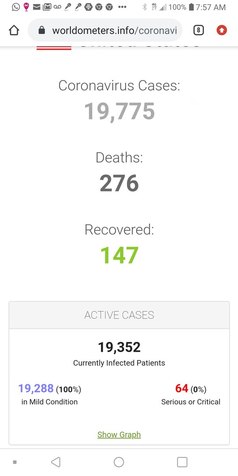
CoronavirusThis flu season 23,000 people in the US have died so far of the flu. https://www.fox8live.com/2020/03/20/us-flu-activity-up-death-toll-reaches-k/
275 US deaths from coronavirus.
Current % of US cases of coronavirus considered severe: 0. -
CoronavirusThat 0% hides an exponential growth curve. Those case and death numbers are doubling every 2-3 days. — Andrew M
So the 0% is bad? -
CoronavirusThe US is about to overtake Italy in new cases. Hunker down and don't take any chances. :pray: — Baden
It shows that 0% of the US cases are serious.
-
CoronavirusI did. I just bet Michael you'd say something smart on this thread. Must have been the Guinness. :groan: — Baden
Very suspicious. Why are you guys dealing in American currency? -
CoronavirusBeing killed by the lethal side-effects of a drug untested in a particular infection context is not like losing a dollar. — Baden
You've obviously never lost a dollar. -
Coronavirus"China, where the deadly pathogen first emerged in December, recommended the decades-old malaria drug chloroquine to treat infected patients in guidelines issued in February after seeing encouraging results in clinical trials. But within days, it cautioned doctors and health officials about the drug’s lethal side effects and rolled back its usage." — Baden
In my extensive studies of this drug, dating well back to 3, maybe 4 hours ago, I note there are actually two types of this drug. You have the older chloroquine which can have some nasty side effects, and then you have its less angry cousin hydroxychloroquine. As you will note from this article, that drug is not dangerous, but is as safe as a cup of hot cocoa on a blustery winter day: https://www.nature.com/articles/s41421-020-0156-0 -
CoronavirusIs accidental true belief praiseworthy? — Andrew M
In the same sense it's praiseworthy when you play the $1 lottery and win $1,000,000 It's the same $1m whether you worked your ass off your whole life or whether you got lucky. Worst case you lost a $1. -
CoronavirusIf it's just a hunch and potentially dangerous then I should not be messing with your wife in the rain. — Baden
Story time: The headlight on my car doesn't work and there are no replacements, so I rig up an old lightbulb to the front of my car to see if it works. It doesn't. I'm back to where I was and your wife doesn't have tire marks across her face and there's no other calamity.
That is to say, you've sort of made up the danger to the drug just like you accuse Trump of making up the effectiveness of it. -
CoronavirusPrepare for a nationwide lockdown. — Baden
I think the point is well made that it makes sense to lock down those areas where it's warranted. Just because it makes sense in New York, doesn't mean it makes sense in Montana. It's like asking whether Europe should go into lockdown. It sort of depends where. -
Coronavirus
,Corticosteroids are very helpful drugs. Coronavirus symptoms are a match for what we usually give them for. But doctors who give corticosteroids for coronavirus will make their patients more likely to need mechanical ventilation, pressor drugs, and kidney function support.
Keep your day job, man. — frank
I'll keep my day job, but first point me to the website that indicates that hydroxychloroquine is a corticosteroid so I'll know why I need to worry about the side effects of them. -
CoronavirusApparently, it was originally China's idea. See Relativist's post above. — Baden
Who cares? I was asking if Trump pushes this through based upon his limited information would you rethink your disgust of Trump. I mean if this works, he wins in my book and people will live who otherwise wouldn't have. -
CoronavirusVirus drug touted by President Trump, Elon Musk can kill with just two gram dose — Relativist
Chloroquine isn't actually a viral drug as the article represents, but it's an anti-malaria drug. Regardless, the article is providing some fairly irrelevant toxicity data, suggesting the drug is unsafe. A gallon of vodka will kill a horse, which means neither you nor your horse should drink that much vodka.
The recommended dose of chloroquine for an adult is a single 500 mg dose per week. If someone wants to gulp down 2 grams (400% the recommended dose) and see what happens, I'm wondering why. I also wonder why they printed that article other than to suggest the drug is dangerous when it isn't. -
CoronavirusI agreed with Trump's response.
The questioning from the reporter related to using the malaria drug as a treatment, and he asked "Is it possible that your impulse to put a positive spin on things may be giving Americans a false sense of hope." This is a worldview distinction you don't appreciate. There is no such thing as false hope. There's this pervasive idea that pessimism is of some value, as if it's related to truth, and even worse that it doesn't create reality. I'm not suggesting that you should jump off a ledge if you're optimistic enough to think you'll fly, but I am saying that as long as Trump continues to ask Americans to take all reasonable precautions (which he has been), then one ought be optimistic. -
CoronavirusThat's a dangerous way to respond to a pandemic even if it does pay off this one time. — Michael
How's it dangerous? It was either nothing or the malaria drug. -
CoronavirusAs you have already analysed, it's easy to see this as a risky gamble that, given your scenario, just happened to work. — Echarmion
It might be politically risky, but the drug is fairly safe. -
CoronavirusI just signed up to a new gym half an hour ago cause they said they were still open. :confused: — Michael
Both my gyms closed. The guy said he'd open up on Saturday mornings for me and another guy for private training. I've been taking kick boxing lessons so that I can fight off the zombies. -
CoronavirusIn what sounds pretty much like a hunch based upon some anecdotal information, Trump is touting hydroxychloroquine as a likely cure for the coronavirus. He is trying to fast track its approval and start curing an ailing world. He was heavily criticized at his news conference as being a bit reckless with advocating unproven treatments and in creating false hope.
Suppose it works? Will he not be a great savior? Will all the Trump naysayers do an about face? -
CoronavirusRay of hope though. — Baden
I put all my hope in a scientific solution, not in a policy one. My trust isn't in some politician of any party of any country to figure out how to fix this. -
CoronavirusIt's not a flu. Different strain of virus. But I suppose your job demands you to parrot Trump. — Benkei
Disregarding your beef with NOS4A2, do you not see hope in this possible treatment option? -
CoronavirusNo, I just had a crown put on one of my teeth and my dental insurance doesn't pay for shit. I want the money. — frank
I'm not sure why we're talking about your dental care, but now that we are, do you remember to floss daily? I'm guessing you don't. -
CoronavirusThe virus is different. There is far less individual control over exposure, especially in the absence of central rules and guidelines. — Echarmion
You can quarantine yourself if you want. Just like you can stay off the road to protect yourself from a car accident, you can stay in home to protect yourself from coronavirus. -
CoronavirusWhether we admit it or not, we permit a certain number of deaths in order to maintain a certain why of life, which includes allowing our economy to operate the way it does. The worst case scenarios in the US if we were to allow the virus free reign would be between 200,000 and 1.7 million deaths. The estimate should make clear they simply don't know, since there's such a large range. But, let us assume we should expect 1,000,000 deaths, then that would put us at 250,000 less deaths than than the 1.25 million annual car accident deaths we deal with annually. We really have to keep these things in perspective here before we allow the entire world's economy to collapse.
My proposal is not just to let nature take it's course, but instead to invest the trillions we intend to to prop up the economy on ventilators, hospital beds, and better treatment in an effort to drive down the deaths from the infections, as opposed to the futile battle to control the infection rate, which will just further damage all sorts of lives in the process.
I have not seen any data that would have ever led me to the response I see now, but what I instead see is an illness that is mild in the vast (>90%) number of cases and is fatal only among the already very compromised. The cure we've arrived at, to the extent it at all represents a cure, is far worse than the disease. -
CoronavirusThe only people who won't know what I mean by paracetamol are Americans and Americans don't matter. — Michael
Then why did God put America in the center of the universe? -
CoronavirusGood thing I managed to find paracetamol yesterday (searched half a dozen shops). All I had is ibuprofen. — Michael
My recommendation is that you call paracetamol either Tylenol or acetaminophen so that someone might know what you're talking about. -
CoronavirusEvidence we have at the moment is letting it grow out of control would lead to about 100 millions deaths. — boethius
Those at risk of death can take whatever precaution they need to. The average person is just going to get flu like symptoms or less. It's a disproportionate shotgun response, showing how panic and fear of any risk leads to a terrible result. -
CoronavirusCurrently .02% of the world is infected with the coronavirus (169,387 / 7,771,074,926). The percentage of worldwide deaths rounds to 0.00% (6,513), but if you take it out enough decimal points you will eventually see some evidence of it.
That leaves 99.98 % of the population uninfected and about 100% of us not killed by this epidemic. -
CoronavirusThey ought to cage up the old and infirm in a box and let the rest of us go about our business. I'll deal with my vomit and fever while the old are stored safely away. That's how I'd handle it.
-
CoronavirusSomething very infectious, like the flu, basically does infect close to 100% of people, just not in any given year as a large portion of the population still has immunity. But eventually, nearly everyone gets the flu at least once. — boethius
"The flu" doesn't really describe a particular disease, but each year it's a different strain. If you're saying that at some point in everyone's life they'll get some viral infection, I think that's obvious, but that doesn't equate to saying that each year we should expect 100% (or anywhere close to it) will get that year's particular virus.
The answer to whatever your'e trying to figure out will be found by looking at actual infection rates over time, not by whatever calculations you're throwing together. I can say that I've never been in a school or work situation where 70% of the people were gone due to the flu.Which is why I used 70 percent of people get infected in my calculation. — boethius -
CoronavirusI was thinking this Forum should be shut down to protect people from my infectious personality.
That joke is smirk funny, but not haha funny I'll admit, but so damn topical I couldn't withhold it. You're welcome.
Hanover

Start FollowingSend a Message
- Other sites we like
- Social media
- Terms of Service
- Sign In
- Created with PlushForums
- © 2026 The Philosophy Forum