
Comments
-
Intelligence, Abstraction, and MonkeysIn that case, the experiment would only show that concrete associative tokens are necessary for thinking of [pairs of like objects], rather than types in general. — csalisbury
But isn't a 'pair of like objects' a type? I mean, one of the things I want to say is that there are no types in general. There are only these types and those types but never types per se (or, putting it so as to avoid performative contradiction: 'types in general' are themselves a particular kind of type). So I want to grant you your point but also deprive it of it's power. Or at least, this is what I was trying to get at in my other post in the predicates thread about types and tokens basically being what I called 'promiscuous', such that each can be the other by turns depending on what we're trying to do with them (another word might be 'oscillatory').
And this is what lets me address your second point too: it's true that the test is designed to focus on relations from the get-go, but - and I'm struggling to articulate this - what I want to say is that token-type distinctions always bear on relations, for structural reasons. To identify even an apple is to identify it as similar to other (hypothetical) apples. Any identification, even of a singular, already implicates two levels: object-level (token) and meta-object level (type), with the caveat that with singular things, token and type coincide in the one object. And insofar as all identification involves both token and type, what you have is a strange case of identifying the relation between an object and itself.
There are all kinds of Hegelian games to be played here, but the key is in recognising that (1) token and type are reversible roles/promiscuous, and (2) that every token implies a type. If you take (1) and (2) together, the only conclusion to draw is that even a single item, if it is understood to be a token ('of an apple', say), already brings with it considerations of 'type'. This is ultimately the lesson of the token (toy) in the monkey test: the (particular) toy stands for a relation (type) - it is a short-circuiting of token and type. To which one must add: so is 'an' apple; except that, in the latter case, you don't have a relation between two things, but a thing and itself. I think this is really hard to 'see', and it's again something I'm struggling to articulate, but maybe if you throw more words at me you can midwife me. -
Predicates, SmehdicatesI really want to read Millikan. All I know about her is that she fuses Sellars with biology in some manner and that sounds super super intriguing to me.
Also, Brassier is apparently writing a book on Sellars, altough his latest publication was on Marx, so y'know, a few plates in the air. -
Predicates, SmehdicatesIt breaks down the categorical division between the object (particular), and what the object is doing (universal). — Metaphysician Undercover
Good. The best possible outcome. -
Predicates, SmehdicatesI'll await your return, but in the meantime: do you read the above as some kind of phenomenal/ noumenal distinction?
Or is it more of a phenomenological distinction between experience and understanding? Or something else? — Janus
Nah, I don't think either of those map on very nicely to what's going on here. If there's a classical distinction that might be relevant here I'd say it's that between primary and secondary qualities (Locke), where secondary qualities (color, taste) are always relative 'to-us', and primary qualities (shape, size, number) are not. One wants to say something like: kinds are secondary qualities, and not primary ones. But this is still a loose way of speaking because it effects too heavy a divide between 'us' and the the rest of the world (as if we are not part of it!). -
Predicates, Smehdicates@Janus: One thought I keep coming back to is that in rejecting the reality of types, one must - or at least this is what I want to argue - reject the reality of particulars as well. I mean, at the most basic level this is just a matter of intelligible discourse: a token is only a token in relation to a type and vice versa, and each only has meaning in relation to the other. So I don't think that a consistent nominalism can be reduced to the idea that 'there are only particulars, no types'. So there's got to be something deeper and more interesting going on. One way to get to this 'deeper thing' is to look at how abstraction functions:
Say we've got two apples. We say that the apples are two tokens of the type 'apple' and we do so precisely by abstracting from the particularity of this apple such that we discard certain of it's features (this apple is bruised, that one is not, yet we ignore this). Already at this level we can see that particularity is abstract from the get-go: that this is a particular apple (read = 'belongs to the type apple') and that that is a particular apple is already to ignore, paradoxically, the particularity of this apple and that apple so as to be able to speak of them as particular apples at all.
Or another way to put this is that particularity itself is already a 'type' qua particular. This was, by the way, Hegel's point viz his critique of 'sense-certainty' that opens up the Phenomenology - that every attempt to capture singularity by means of speaking about a 'this' is already implicated in the universal. But - and this is the crucial point - the implication of the particular in the universal cuts both ways: apple qua type is, in equal measure, a 'particular type': we can see this if we subsume 'apple' as a token of the type 'fruit'. At no point in this whole dialectic do you end up with 'real singulars'; instead all you have are types and tokens whose roles are reversable depending on the point of view one takes.
There is no ground-level of real singulars from which the type-token distinction builds itself off from: the whole conceptual machinery is realized 'in one fell swoop', as it were. As soon as you have tokens, you have types. And, worse, types and tokens are promiscuous in the sense that one can be transformed into the other: a token is always-already a type by virtue of it belonging to the type 'token' ('cuts both ways'). So the question is: given this promiscuity, what, at the end of the day, indexes tokens as tokens and types and types, if not some God-given ontological scaffolding qua Great Chain of Being? And the answer can only be: whatever it is 'we' are trying to do with them. This is why I think rejecting the reality of types also entails rejecting the reality of particulars, insofar as even particulars already belong to the order of types (and vice versa!).
--
Another way to make the above point is by recourse to Jacques Lacan's dictum that 'there is no metalanguage': no matter how long you spend going up 'up a level', from token to type to next-level type, you will never arrive at some final Capital-T Type which accounts for the distribution of tokens and types among the lower-levels. This is, among other things, an anti-theological point, or, to put it more positively, a naturalist one in which types and and tokens are made and produced and not 'given'. -
Predicates, SmehdicatesI can't see how this view would not be an appeal to natural kinds or at least kind, which I had thought was what Sellars is purportedly wishing to get away from. — Janus
Just briefly 'cause I'll be out all day, I think it is neither desireable nor possible to avoid 'kinds-talk'. The whole question is over what we are doing when we invoke kinds. Or better: what kinds of thing are kinds? To simply try and catch nominalism in a kind of performative contradicition ('ha, look, you've invoked a kind!') simply will not do. As Sellars puts it somewhere in NAO: there are attributes, but there aren't really attributes. One wants to say the same thing about kinds, with the appropriate qualifications. More later. -
Predicates, SmehdicatesAlso, reading back on some of the comments on nominalism more generally, it's true that the kinds of ideas expressed in the OP are indeed just 'half the story' (as someone put it). Chapter 3 of NAO is kind of the pivot point of the book which does indeed aim to 'clear the way' (someone's expression again) for a positive theory of meaning (chapter 4) and reference (chapter 5) that Sellars goes on to argue for. It might be construed as pragmatism by some, if Sellars himself were not so ambivalent about the term:
"I saw them [the battle between philosophical systems] at the beginning through my father's eyes, and perhaps for that reason never got into Pragmatism. He regarded it as shifty, ambiguous, and indecisive. ... 'Time is unreal.' 'Sense data are constituents of physical objects.' 'Mind is a distinct substance.' 'We intuit essences.' These are issues you can get your teeth into. By contrast, Pragmatism seemed all method and no results." He's speaking in historical-autobiographical terms though, so he's probably more open to it than he really lets on. -
Predicates, SmehdicatesComing back to this...
So if you didn't assert it, it wouldn't be so? And what is a fact? — Nagase
I'd say that a fact in this context is something which commits us to certain undertakings. If there is a type-token distinction that is parsed in some way and not another, it can only be with an eye to doing something with it; one fixes distinctions in place so as to be able to make intelligible moves in discourse. But of course the kinds of moves we want to make are not entirely up to us: one has to get the grammar just so in order to capture what is relavant about whatever it is we are trying to discuss.
That may be so (though note that we have an appeal to types of rules here...), yet to learn this way of speaking is not to learn Jumblese. — Nagase
I'll grant this, but - and I think Csal basically made the point already - the obvious rejoinder is: yes, and? I don't see how this ultimately has any force against the idea that properties can nonetheless be treated in terms of learned manners of speaking or writing, where placing 'if' here or there entails treating words in certain manners, committing and entitling us to certain other words and practices when used consistently. Remember that Jumbelese isn't the basis out from which the nomimalist thesis rest, but a model to bring something out of normal language as it is already used. -
Predicates, SmehdicatesBut is it? If we have a picture of the world, then that picture is distinct from the world, — Banno
I don't think this follows. One can speak of parts of the world picturing other parts of the world (if approached in the right way). Actual pictures (the kind we frame after holidays) are exactly that. And in fact, that's precisely Sellars' point. Although I too take issue with the sine qua non line. Why not say language is used to cajole, to affirm, to celebrate, to promise, to soothe? There is a non-intentional aspect to language which is run roughshod over in Sellars' primacy of picturing. But I think his point can be well taken for all that regardless. -
Predicates, SmehdicatesSo we might have a world of objects, and a language consisting entirely of proper names? AM I on the right track?
....So - and I've just started catching up on this thread, so this might have become apparent in other posts - his point is that predication is something we do, and hence predicates are not something we find but something we use? — Banno
In general, yeah, these are more or less what I'm after. I'm also not familiar with Austin's take, so I can't really comment on that either. What really interests me though are the specifics - I'm very attracted to the idea that language is a matter of 'natural-lingustic' objects insofar it places language on the same plane as 'things'. Sellars' effects this incredible leveling where he essentially abolishes the metaphysical distinction between the linguistic and the extra-linguistic (and with it, the question 'how do words 'hook up' with things') and instead sees the linguistic as a species of the extra-linguistic. There's a naturalization of language which I think is absolutely a step in the right direction.
If it's a concequence of this that language only consists of names, then so be it, but I'm open to saying that there really are predicates or whatever variety of linguistic objects one might care to classify, with the caveat that what matters at the end of the day is how they do whatever it is they do. I'm interested in the function of words and what they do. I suppose they just call this pragmatics, but again, this is word that bothers me so I'd rather not.
But here we have Sellars saying that there are no facts, only objects. — Banno
Yeah, Sellars actually specifically rejects the Wittgensteinian view, and says as much: "We must be careful not to follow Wittgenstein's identification of complex objects with facts"; and elsewhere: "Let me begin by commenting on a feature of Wittgenstein's treatment of picturing which, as I see it, contains the key to the answer, but which he put to the wrong use by tying it too closely to the 'fact pictures fact' model. For, although this model enables him to make a sound point about the logical form of elementary statements, it loses the specific thrust of the idea that whatever else language does, its central and essential function, the sine qua non of all others, is to enable us to picture the world in which we live. It was, indeed, a significant achievement to show that it is n-adic configurations of referring expressions that represent n-adic states of affairs. But of itself this thesis throws no light on the crucial question: What is there about this specific n-adic configuration of referring expressions that makes the configuration say that the items referred to are related in that specific n-adic way?"
It's with this concern in mind that Sellars proposes replacing facts with objects. -
Predicates, SmehdicatesJust some general reflections to feel my way back into this thread...
I'm still entirely against the idea of 'natural kinds', which I can only see as idealist in the worst possible sense of the word, as if there were God given entities bestowed upon the world from beyond it. They make no sense to me whatsoever, and their prevelance has always struck me as a confusion of logic with reality, or at least a attempt to model reality after (a very narrow brand of) logic. And just as a minor point while I'm on the negative, I've always had a bit of a visceral aversion to the label of 'pragmatism', which always strikes me as a kind of self-bestowed honorific - - who doesn't want to affirm their 'pragmatism'? Which is not to say that I don't like the 'content' of pragmatism, but gosh I despite the label.
But substantively, I think there there is a real question about how we 'cut up the world', and the status of that 'cutting'. What I like about Sellars' is that he tries to achieve a kind of middle ground between (1) the (idealist) idea that our conceptual parsing of the world simply mirrors the way the world 'really is' parsed, and (2) the idea that our parsings of the world are simply arbitrary and willy nilly ("frictionless spinning in a void", as it is so often called). Sellars rejects both positions and says that even as our concepts don't reflect reality in a one-to-one manner, they can still be used to track real things/events in the world. The question is how then to do this, if we reject (1).
And one outcome of Sellars' attempt to stick by these parameters is to construe language as belonging to the natural order (to use language is to use objects, in the most banal sense of the term: a rock and the word 'rock' (qua graphic inscription or sound pattern) literally belong to the same order), where reference is a matter of correlating objects in the appropriate manner (where 'appropriate' is a matter of cultivating certain habits, abiding or rather hewing to certain rule-governed patterns, etc - pace Wittgenstein). And the reason these correlations are not simply arbitrary is because they end up implicating us in commitments which are not simply of our making: sense-making (to make sense by use of words) is to constain action (where uttering some words and not others in some particular order(s) and not others is as much 'action' as 'doing' things) which are necessary on pain of undoing sense altogether.
The insistence on necessity is particularly important to me personally insofar as it jibes with my wider metaphysical commitment to transcendental philosophy (in the Kantian manner, which is to say not transcendant philosophy), in which it is the necessity of thought that answers the challenge of skepticism. This means that I'm interested in extending Sellars' project in a way that puts it into contact with a Deleuzian ontology of 'problematics', such that thought answers to problems or 'encounters' which force thought or rather sense to be made in certain ways and not others. This whole last (sketchy) paragraph is all very much outside the scope of the OP and its limited focus on predicates, but that's the general context in which I'm approaching much of this stuff. -
Bernardo Kastrup?I've said my piece. If close-mindedness means rejecting equivocations, appeals to ignorance, and the falsities and fantasies of cranks like Wayfarer, then so be it. Would it be the case that such a rejection is unscientific, then I suggest you need a new definition of the scientific.
-
Bernardo Kastrup?I mean if you want to call meeting the literal bare minimum criteria for constituting an explanation in any field whatsoever a 'challenge', then yeah sure, lets go with that.
-
Bernardo Kastrup?No, I said it was meaningless as far as it playing a role in explaining anything about QM. It could be substituted for nonsensical words without loss because the specific features or manner in which consciousness would function as a mechanism is, and on all accounts remains, entirely unelucidated. It is a claim that literally cannot be made sense of, in other words. Language on holiday and all that.
-
Bernardo Kastrup?Guilty.
That said, I don't see any problem with saying that quantum processes might play certain roles in 'explaining consciousness'. Quantum electron tunneling, for instance, plays a part in explaining the act of cellular respiration, though only one part in a larger and multi-faceted story. Given the complexity of our neurology, I wouldn't be surprised if quantum processes also played defining roles in our being conscious, at least in some capacity. But 'because quantum!' is not, on its own, an explanation of anything. Similarly, 'because consciousness' would be an equally facile flag to rally anything under. -
Bernardo Kastrup?Yeah, and it conveniently works both ways too - 'why consciousness?' 'because quantum!'. And intellectual con-men like Wayfarer will milk both to say whatever half-baked woo they think appropriate.
-
It Takes a Village Where the People Have Their Shit Togetherthe infrastructure that makes a good city had to have advocates, interested citizens, and many citizens willing to accept a higher tax burden to get these public goods. — Bitter Crank
The issue, to begin with, is one of methodology: your approach, or at least the approach you've outlined here, looks to me like one of social atomism, where it's some kind of ephemeral 'good psychology' ('interested, willing citizens') that counts as what motivates good societies. But this is, to put it lightly, a discredited form of thinking when it comes to sociology: people are 'interested and willing' when they are given the means to do so, when they have the tools, instruments, and institutions that support, foster and encourage the cultivation of such interests and 'wills'. Interests and wills also do not come from heaven as a gift.
But this is more than just a discredited form of sociology: it also has disastrous policy consequences. The line that 'good infrastructure is a public good, but citizens have to be willing to work for it, and use it for maximum benefit', has been the justification and rationale for legions of neoliberal policymakers to divest public funds from public goods, and to demand that emphasis be placed on psychology before actual tangible investment. It conditions investment on 'good psychology' and ephemeral 'wills', mistaking effect for cause.
I meant it when I said that the elevation of 'social capital' as a concept comes at a time when it seems to be in crisis: but what is unspoken in all this is that the crisis of social capital is the very reason for it's elevated status: to throw the individual into crisis is the surest way to place focus on the individual and not on the institutions and the world in which he or she resides. Regardless of its well-intent, one cannot ignore the strategic role this kind of thinking does and has played out in real time.
There is a legitimate question here of virtuous and vicious cycles of social cohesion, path-dependent on local histories, and hwo to shift the one into the other, but 'social capital' as a rule, has no historical dimension. It's just metrical abstraction. I think you would do well to engage with @csalisbury's post here, which gets at alot of the concrete problems with the concept. He's right to note that 'social capital' names a real problem; but it's its manner of framing that causes all sorts of issues. -
Bernardo Kastrup?Yeah, can't have anything to do with your consistent dodging of questions, and your peddling of lies and falsehoods.
-
Bernardo Kastrup?Of course I understand. Sophists don't like being called out on their bullshit. It's embarrassing to be shown up time and time again for your know-nothingisms. Speaking of, it's worth mentioning also that the idea that one has to buy into the MWI to maintain realism is also a falsehood, and yet another total fabrication on your part. Not of course that you actually put forward any arguments for the idea so much as it just spilled out of you as so much of your other trash.
Seriously. Explicit misquotations. Articles that misrepresent their subjects. Essays on Plato and Democritus that have nothing to do with the science. Obfuscations and lies about what 'observation' entails. Pictures of coats-of-arms. And now falsehoods about realism and MWI. Literally everything you say is either a lie or an irrelevancy, and you think you're taking some sort of high ground? Better to dodge than to have any substance I guess. -
Bernardo Kastrup?Oh look, when challanged about a concrete point - the meaning of observation - pivot entirely and bring in some last-minute Googled irrelvencies passed off as 'reading'. A master-class in having to never commit or defend a point. Should have posted another coat-of-arms picture again, just to further distract from your inability to actually say anything of relevance.
-
Bernardo Kastrup?The role of observation in determining an outcome - not by 'interfering with' or physically causing an effect, but simply observing. It seems to implicate the mind of the observer. — Wayfarer
Because the word "observe" you use here really does mean something different, as SX pointed out. "observation from a mind determines the outcome" is not what's being said. — Moliere
You can tell Wayfarer he is literally, factually wrong about this till you're blue in the face, and he'll still insist, against all reality, the the question of observation is 'ambigious'. Reality doesn't suit his preconceived notions, see. So he will flat out lie and fudge it instead. Some dishonest misquoting here, some fluff about Plato there, all par for the charlatan course. -
Predicates, SmehdicatesWill return to this thread soon but Haugeland's reading of Heidegger is seriously one of the most interesting and just flat out facinating that I know. It basically reads him in Sellars' terms, and the audacity of it is just so cool.
-
Bernardo Kastrup?Sure, people might not be able to agree about a definition, but - unless you are a cranky eliminative materialist - there is something being disagreed about. "flufffwumps" - well, if I were to ask you what that was, you wouldn't even be able to point me to a literature of disagreement with which to get started. That's one difference between "consciousness" and "flufffwumps", and its a pretty significant one, and goes someway to saving the former from "meaninglessness" whilst leaving the latter as drivel. — jkg20
Ah, so the argument is that because consciousness isn't literally meaningless, it ought to be a contender for explanation? That's the bar you've set? Not, of course, that this in any way addresses the fact that it remains a case of appealing to the unexplained to explain the unexplained. Nor the fact that conciousness is as functionally useless as an explanation for QM as flufflwumps, regardless of the dexterousness of one's Googling. I suppose one looks for consolation anywhere one can get it, when everything else about a position is literal trash. -
It Takes a Village Where the People Have Their Shit Together
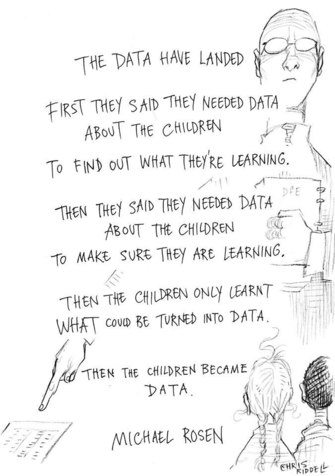
But think of the children! What planet could one be living on to see treating children as data as thoroughly detrimental to education???
But of course so too with 'social capital', which is as a much a disease as it is a cure. A Phramakon, if you will. It's really quite simple. Focus on infrastructure. Focus on healthcare. Focus on good education - new textbooks, good teachers, flexible extra-curricular programs. A well maintained, affordable, and extensive system of public transport. Well kept public spaces for recreation. The 'social capital' will flow from there. Not some arbitrary metricized rubbish, invention of technocrats and people with no ability to understand the shape of individual lives. -
Bernardo Kastrup?It seems ever more apparent that given the absence of any consensus as to however or whatever consciousness may be, it's no wonder QM physicists can't rule it in ... and yet how can it be ruled out? — snowleopard
And there we go: ignorance as a virtue. The ever thinning breathing room for idealism measured by the distance between what we know and what we don't: the space of unironically celebrated incomprehension where it has always lived. -
It Takes a Village Where the People Have Their Shit TogetherThe curious thing about 'social capital' is that its apparent decline comes about during a time of its increased significance. I suspect it was birthed stillborn from the get-go. I think Un is right to be suspicious about the idea, which, in effect and regardless of intention, is just another way to enmesh humans in a utilitarian grid of an increasingly adminstered world. The very idea of social capital plays right into a strategy of increased psychic pressure and debilitation: not only your bills, family, food, and employment do you have to worry about, but so too your 'social capital'. It's another chapter in the fragmentation of the human psyche.
-
Bernardo Kastrup?Anyway, there are QM theorists who believe that the wave function doesn't collapse in the first place. — jkg20
I happen to be one in the 'no collapse' camp, though I'm happy to simply refer to the measurement problem in general by that name because it's so widely referred to as that. Again, consciousness qua explanation is meaningless noise in the same way that flufflwumps is meaningless noise. I could ask you why flufffwumps is meaningless noise as an explanation, and no doubt you could feign open-mindedness by saying 'oh it's just a beginning of an answer', but that would be a bullshit response to an equally bullshit question. If one loosens one's intellectual standards enough, I'm sure anything might be ruled-in as a 'beginning'; one is free to wave hands all day in a promissory manner.
I mean, people can't even agree on a mere definition of consciousness, let alone attempt to even speculate as to how - via what mechanism, or through what specific features - it might play a role in QM. That the toenail on my foot causes the collapse would, on a hierarchy of possible explanation, rank higher than consciousness insofar as I can at least tell you more or less exactly what my toenail is, and describe its features. It doesn't leverage the unexplained to explain the unexplained, unlike the appeal to 'consciousness', which is no doubt why the latter even has the veneer of plausibility, and is so popular among purveyors of quantum woo and other magical thinking, for whom ignorance is a virtue - one can't definitively argue against a position that is literally empty of content. -
Bernardo Kastrup?One answer to that question, with a pedigree almost as old as QM itself, is that it collapses at the moment of conscious observation. — jkg20
No, this doesn't even qualify as a possible answer because a) saying 'consciousness does it' does not explain by what mechanism it would carry out that function, which means that 'consciousness' would be an explanandum and not an explanans; it doesn't even satisfy the minimal criteria for what an explanation - for anything, let alone QM - would be; and 2) That the wave function collapses differentially depending on the physical set of up an apparatus is an actual, testable result of running the experiments. The question is how to interpret this data, a difference in two - or more - outcomes whose parameters we know and can measure objectively. If one admits 'consciousness' as even a possible explanation, one may as well admit 'flufflewumps'; they are both empty words which have no correlate in either the data, or the formalisms, and are as good as meaningless as explanations.. At best, it simply kicks the can down the road. At worst, it is literally bullshit. -
Bernardo Kastrup?Sigh, I thought you were at least a tad bit serious. Turns out I was wrong. How unfortunate.
-
Bernardo Kastrup?According to QM, is the device not comprised of nothing other than interacting quantum fluctuations in the zero-point field? — snowleopard
Huh? QM has nothing to say about what a device 'is'. A double slit experiment might involve a device that includes a photographic plate, a light source, a double slit diaphragm, a single slit diaphragm, and ideally a dark room. This is what Bohr had in mind when he spoke of an apparatus:
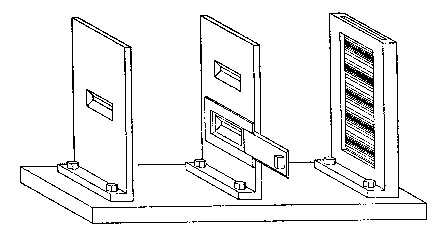
This being, after all, his drawing. Perhaps you might want a mirror or a spring to create a 'which-path' detector. Bohr actaully spends a great deal of timing describing and talking about the apparatus, because he understood very well that the results one would see where vitally all about the apparatus set up. -
Bernardo Kastrup?Since the device itself is not other than a potential field of possibilities unless an observer is factored in... — snowleopard
This sentence doesn't make any sense.
Still, there is narrow sense in which you are right about your general point: that we are inextricably involved in the set-up of a particular apparatus plays a role - however ambiguous and distant - in the realization of one measurement outcome rather than another. But this doesn't warrant any philosophical generalization insofar as it's ultimately a tautology: we are involved in the things that we are involved in. To which one must add: and we are not involved in the things that we are not involved in.
And short of begging the question that we are involved in all quantum processes everywhere - as if this statement could even mean anything - there's no warrant to move from this to the idea that quantum processes require human or conscious intervention. Tautologies don't licence valid conclusions. -
Bernardo Kastrup?Sure. The measurement we get is defined by how we set up our devices for measurement. We may choose one way, or another way, but whatever we choose, the measurement is determined, for all that, by the set-up of the apparatus. That this process is an entirely determined one is important to understand: our choice of this or that apparatus may be arbitrary, but once we've chosen the set-up, the results will always be consistent and determined by that set up. This is what makes quantum measurement always a matter of pure objectivity: the results will always be invariant relative to the particular physical set-up. Bohr himself was very clear about this:
"In the first place, we must recognize that a measurement can mean nothing else than the unambiguous comparison of some property of the object under investigation with a corresponding property of another system, serving as a measuring instrument, and for which this property is directly determinable according to its definition in everyday language or in the terminology of classical physics."
And elsewhere: "In the system to which the quantum mechanical formalism is applied, it is of
course possible to include any intermediate auxiliary agency employed in the measuring processes. Since, however, all those properties of such agencies which, according to the aim of the measurement, have to be compared with corresponding properties of the object, must be described on classical lines, their quantum mechanical treatment will for this purpose be essentially equivalent with a classical description. The question of eventually including such agencies within the system under investigation is thus purely a matter of practical convenience, just as in classical physical measurements; and such displacements of the section between object and measuring instruments can therefore never involve any arbitrariness in the description of a phenomenon and its quantum mechanical treatment.
The only significant point is that in each case some ultimate measuring instruments, like the scales and clocks which determine the frame of space-time coordination—on which, in the last resort, even the definitions of momentum and energy quantities rest—must always be described entirely on classical lines, and consequently kept outside the system subject to quantum mechanical treatment". (quoted in Barad, Meeting The Universe Halfway, my bolding). Or to put it otherwise, there is no role - at all - for subjectivity in the measurement of quantum phenomena. -
Bernardo Kastrup?As usual, the fact that Wheeler explicitly disavows the role of consciousness is quietly ignored, as though a minor inconvenience to a position trying to ventriloquize others to say the opposite of what they do. The usual mendaciousness from a position defined by its dishonesty.
Here it is again, for good measure: '''Consciousness' has nothing whatsoever to do with the quantum process'.
It's also perhaps worth mentioning that when a picture of a coat of arms becomes one's lynchpin for a discussion of quantum physics, one can only presume that the barrel of argument has been scraped so low that the floor is now showing. -
Bernardo Kastrup?Sure, if you want to call bromide emulsion 'interpretation', be my guest. But you no longer get to whine about 'observation' being used in a way in which mummy and daddy didn't teach you. Turns out, you can do violence to language too.
-
Bernardo Kastrup?'No phenomenon is a real phenomenon until it is an observed phenomenon'. John Archibald Wheeler — Wayfarer
Yep, where 'observation' is 'an irreversible act of amplification such as the blackening of a grain of silver bromide emulsion or the triggering of a photodetector' (Wheeler's words). Which of course is physical. Coupled with the fact that '''Consciousness' has nothing whatsoever to do with the quantum process' - again, Wheeler's line - it doesn't leave much room for equivocation indeed. Our participation does indeed 'create the Universe out of the 'cloud of possibilities'' - but then, so does the participation of everything else, of which we are just a 'patch'. Observation = measurement = interaction, where our interaction - that of a bunch of moderately clever apes on a small watery rock in the middle of nowhere - is the same as all interaction, everywhere.
The implications of QM count among the most radically anti-humanist, non-anthropormophic levelling operations I know. It places us smack bang in the middle of the universe, and because of which, make of us perishable, finite, and contingent 'patches' destined to irredeemable extinction, just like all the other patches, of which we do not differ from in any interesting way. -
Bernardo Kastrup?But - and this is the audacity of QM - Wheeler is entirely right. Of course we participate in the universe. We participate in the universe just like everything else participates in the universe. We do not stand apart from the universe as though we are not of the same stuff as it. This is why consciousness is irrelevant. We are physical systems no different to other physical systems, which means that physics can teach us something about ourselves and not just things that are 'out there, independent of us'. I don't think you even realise just how horrible this line of thought is for people like you, and that you're basically defending the noose from which idealism will hang. This is the real lesson of QM, and I'm quite glad that you've stumbled across it.
-
Bernardo Kastrup?Wheeler is certainly in agreement with 'this'. It's from the same paper I quoted which states that ''Consciousness' has nothing whatsoever to do with the quantum process'".
-
Bernardo Kastrup?Bohr actually commented on the ambiguity of the word 'observer', and simply resolved to affirm that at the end of the day, whatever we call it, it was a matter of how our instruments are set up:
"These problems were instructively commented upon from different sides at the Solvay meeting... On that occasion an interesting discussion arose also about how to speak of the appearance of phenomena. ... The question was whether, as to the occurrence of individual effects, we should adopt a terminology
proposed by Dirac, that we were concerned with a choice on the part of ‘‘nature’’ or, as suggested by Heisenberg, we should say that we have to do with a choice on the part of the ‘‘observer’’ constructing the measuring instruments and reading their recording.
Any such terminology would, however, appear dubious since, on the one hand, it is hardly reasonable to endow nature with volition in the ordinary sense, while, on the other hand, it is certainly not possible for the observer to influence the events which may appear under the conditions he [or she] has arranged. To my mind, there is no other alternative than to admit that, in this field of experience, we are dealing with individual phenomena and that our possibilities of handling the measuring instruments allow us only to make a choice between the different complementary types of phenomena we want to study."
This being in keeping with Bohr's very specific understanding of what a 'phenomenon' is, which Wheeler glosses: 'A phenomenon is not yet a phenomenon until it has been brought to a close by an irreversible act of amplification such as the blackening of a grain of silver bromide emulsion or the triggering of a photodetector ... What answer we get depends on the question we put, the experiment we arrange, the registering device we choose'. Does this entail some really cool philosophical implications? Definitely. But consciousness? Irrelevant noise. -
Bernardo Kastrup?Yes, I've seen you link to that article before, and I scoured it to see if it actually sourced that headline quote from Wheeler himself, given that I knew before hand his stance on the role of consciousness. And lo and behold it does not. It, like you, puts words into people's mouths, words which impute the exact opposite of the views held by those to whom it attributes. Wheeler's own words, the words of his I actually quoted, couldn't be more explicit about repudiating the role of consciousness in the quantum process, and you can find them here, which is from an actual paper of his, and not some after-market, hand-me-down source.
Stupifyingly superficial pieces of yellow journalism like that one - which, like you, confuse the understanding of 'observer' at play in QM with what they were thought in school - are responsible in a large part for the very sad public understanding of QM by laypeople.
Streetlight
Start FollowingSend a Message
- Other sites we like
- Social media
- Terms of Service
- Sign In
- Created with PlushForums
- © 2026 The Philosophy Forum