
Comments
-
What is religion?
I think you don't understand Aristotle yet... please go and read some Greek philosophy books. It would prevent you from say ignorant arguments as "Aristotle believed in God" -
What is religion?
What I pretended to show you is the fact that "common sense" is logic not Karma or God. When Aristotle defined these philosophy theories, he intended to go further than mythology.
You know people had believed in different dieties before the Biblie or the Quran right? :eyes: -
What is religion?Could it be said that the common sense default position is to be believe in moral cause and effect,AKA Karma?
Because God and Karma are the same concept from a different angle. — Adamski
No... common sense is Aristotelian logic. -
What is religion?Some theists hold that theism is a common sense default state or what have you, and that not believing in God is based on a confusion, like not believing in gravity just because you can't see it, even though its influence is apparent to everyone. — Yohan
I understand those theists doctrines. But while gravity is indeed a physical fact that affects everyone because it explains why our bodies are attracted to the centre of the earth and has been proven by many theories of physics, God still depends on someone's faith. It doesn't matter if you do not "see" gravity because it will affect you physically.
Gravity was always been there and later on, we the humans "discovered" it through researchers because these, precisely, wanted to go further than "God's mercy." -
The End of the Mechanistic WorldviewIMO, the new worldview can be found at the intersection(s) of science and mysticism. — Bret Bernhoft
We can see it as an intersection both disciplines, indeed. But sooner or later you would need to pick one or other. Mysticism stills lack of demonstrative practices. It is good to debate about some theories related to knowledge and how the world should works but we need to put them in practice or at least show it both empirically and physically.
For example: The distance between the earth and the moon is 384.400 km. This is not a mystery but a solid evidence proved thanks to science.
Nothing mentioned yet suggests a demonstrably more adaptive alternative to modern science which, if there were such an alternative, would be reasonable to consider. — 180 Proof
:100: -
Party Offiliations?
Yes, there are official records of people affiliated to each party. Those tend to be the ones who support the group economically. If you have a big number of affiliates you have more chances to be stronger in the next elections.
Whenever you sign your affiliation in a political party this information goes to the minister of treasury to control if their fees are transparent.
A brief example of affiliates in my country:
With the exception of Unidas Podemos that you don't need to pay fees to join them
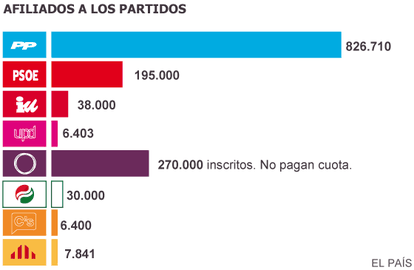
-
Donald Trump (All General Trump Conversations Here)But if Trump will in fact face punishment (including jail time), what does that mean for America?
A civil war, for sure. — baker
Don't be too panicky... -
Antinatalism ArgumentsFar as I'm concerned a rock is a bored proto-life-form. — Yohan
Bored proto-life-form but at least the rock is not concerned about how painful the life could be -
Donald Trump (All General Trump Conversations Here)UAE — ssu
This is where all the powerful criminals tend to go... UAE is an artificial state made by government Mafia and black money... I would never understand why we allow these kind of countries the "right" of declining cooperative extradition. -
What is religion?
God's existence needs a belief. Someone who believes in his existence. This state of mind is based on faith. And faith is a sacred/religious concept. Then, God necessarily depends on all of these characteristics to exist himself. If you think deeply it would be even worthless the existence of God in a world without religion. What would be the aim of God then?
Check this paper: The Kant-Friesian Theory of Religion and Religious Value
I have therefore found it necessary to deny knowledge, in order to make room for faith. The dogmatism of metaphysics, that is, the precondition that it is possible to make headway in metaphysics without a previous critique of pure reason, is the source of all that unbelief, always very dogmatic, which wars against morality. - Immanuel Kant, Kritik der reinen Vernunft
Kant believed, indeed, that morality was what religion was all about and that it provided a basis for rational belief in concepts like God, freedom, and immortality; but this provided no ground for any other aspects of traditional religious practice, belief, or experience :flower:
Rudolf Otto takes the Latin word numen, "the might of a deity, majesty, divinity" and coins the term "numinous" to describe either religious feelings or the religious aspect attributed by those feelings to experiences and objects. He characterizes the feelings as involving 1) ultimacy, 2) mystery (mysterium), 3) awe (tremendum), 4) fascination (fascinans), and 5) satisfaction. Unassociated with any objects, the sense of the numinous is a feeling of "daemonic dread," a sense of the uncanny, frightful, eerie, weird, or supernatural. These feelings make us feel vulnerable and overpowered, what Otto calls "creature feeling."
Conclusion: God depends on religion because the religious nature is how God is fed. -
Antinatalism ArgumentsRemember that sadness is part of life. If you wouldn't feel sadness and heartache, you wouldn't appreciate the good things in life. — ssu
:up: :100: -
Antinatalism Arguments
Athena, I am so much appreciated of all information you have provided to me. But, trust me please. I do not see myself in a marriage because I already lived the experience of being heartbroken and I don't want to go through the same painful process. -
Antinatalism ArgumentsThat's the kind of freedoms we all insist on, yes? — universeness
Well, yes you are right somehow right. I am only 25 years old. So, I do not know what the future really holds and probably I make some friends the next year -
Currently Reading
My parents literally think the same :rofl: they are worried because they see I am pretty "obsessed" with Mishima! -
Currently ReadingTwo biographies:
The eclipse of Yukio Mishima, Shintaro Ishihara
The last words of Yukio Mishima, Takashi Furubayashi. -
Antinatalism Arguments
I would not change in person because the way I interact in this forum is how I really am in real life. If you ever met me in person you would see I am the same Javi in The Philosophy Forum and in physical world. I am not using masks here and I am happy the way I act inside this group.
But in physical world is different, or at least due to the type of persons surrounded with me. I always doubt if it is worthy to open my mind and hearts to them. I feel I would be disappointed... -
Antinatalism Arguments
I should appreciate the positive sides of my life, indeed. But I think those positive feelings depend on my own. I never understood why there are some people who share half of their lives with another person. I respect it but I just don't get it.
Loneliness doesn't necessarily lead us to sadness. It depends on each context. If you appreciate being alone maybe this is the kind of life you should choose for.
Furthermore, marriage is not connected to affection. For example, I don't have a girlfriend, and neither Kids and friends. But I feel respected and esteemed inside this forum. To be honest with you, ssu, I guess I never be able to find such respect in real life -
Antinatalism Arguments. I used to feel very sorry for single people because they did not enjoy the benefits of love and marriage. — Athena
There are not benefits. Marriage is a community of sacrifices. Raising and maintaining a child is complex as hell and you do not how the tables would turn out in the future. Probably I can end up being cheated by my wife or mistreated by my own kid. So no... I prefer live in loneliness rather than being married. -
Future Belief - New Age vs Atheism (wrt Psychedelics, Quantum Theory, Reality, Karma, Consciousness)Your thinking is the kind that leads people toward hatred of others with a different religion, the kind wars are waged on. It is not healthy, nor open-minded. — intrapersona
No, my thinking is the one which is literally out of all those issues. I do not understand why people feels "hatred" whenever someone is brave enough to critique old religious doctrines -
Future Belief - New Age vs Atheism (wrt Psychedelics, Quantum Theory, Reality, Karma, Consciousness)
FAITH: define
1. complete trust or confidence in someone or something.
2.strong belief in the doctrines of a religion, based on spiritual conviction rather than proof. — intrapersona
I think the definition you provided us is completely clear. Faith depends on trust, confidence, beliefs, in something or religious doctrines. So, we can say here that is not possible to develop some kind of "criticism" or knowledge towards the act of believing in God. If you are a true believer you would believe in God's existence so blindly. It doesn't matter if we are debating about their or not existence. For a believer it does exist, simple.
This is what faith is all about. It goes beyond knowledge and criticism.
Secondly, I think you are wrong when you say atheism depends on the "faith" on not believing in God at all. You are confusing here scepticism with faith. I am atheist and I don't believe in God because there are not sufficient proofs to believe about and their doctrines. Thus, I am sceptical towards religious doctrines.
But this is why I can't have "faith" it would be contradictory. Faith is a positive act. Like a subterfuge you used to answer questions you don't understand. Instead of using criticism or logic you just believe in something. But this issue is so far away from being sceptical towards religion -
Salman Rushdie AttackReally? Historical events like the Inquisition immediately come to mind. — praxis
They had a special court called "the court of inquisition in Madrid" they rarely set the people in fire... if you check the data (not influenced by black legend) you would see that they were a few who experienced that drama. Again, as I said to Bitter Crank, non Catholic countries as Germany or Austria burnt down more witches or heretics than the Spanish inquisition... -
Salman Rushdie AttackI like the Monty Python's caricature of Spanish inquisition, but truste me when I say they weren't that bad as the "history" books say.
Plot twist: Germany burnt down more "witches" and heretics than the Spanish inquisition. I never understood why we are the only ones who looks like as the bad character inside of history.
Note that I do not pretend to defend my ancestors but only to highlight that it wasn't as excessive as the people tend to think! -
Donald Trump (All General Trump Conversations Here)
Completely agree with you, NOS.
But I think both sides are wrong. Trump possessing sensitive declassified documents and the prosecution against Assange and Snowden are causes of why the citizenship is losing the hope and credibility in democracy. -
Donald Trump (All General Trump Conversations Here)
Because it is a public and sensitive matter. It should be in an authority control, not in private hands or businesses. -
The paradox of omniscienceAgreed with all your argument and post :up:
If one is omniscient then how can its creation be flawed? — universeness
A selfish one. Or at least someone or something who makes us remember that it is over of all criteria and goes beyond to all the limitations of possibilities. Writing this answer I am acknowledging that this has no sense. I guess this is what a omnipotent looks like in the infinite universe of metaphysics or quantum mechanics.
"We", thus, their "creation" are flawed because the omnipotent entity would not create something clever and mightier than itself. But we end up in a paradox again as you perfectly explain previously.
I see a paradox here because his perfection is senseless is he pretends to elaborate just flawed creations.
How about omniwoowoo! — universeness
:eyes: :sparkle: This one goes beyond to any category of reason! -
The paradox of omniscienceDoes omniscience suggest knowledge of all possible errors? — universeness
@Rocco Rosano quoted a phrase in his first post which says: ‘‘An omniscient being needs no logic and no mathematics,’’
It is so interesting, indeed. Trying to answer your question I guess omniscience doesn't suggest knowledge of all possible errors because it is not a logical entity. When we debate about errors inside logic we have to start with the premise that the thing is logical itself, so we conclude it makes "errors" because it doesn't fit what we consider as "logic" or "success", etc...
But omniscience cannot fit those parameters because it isn't logical since the beginning. -
Salman Rushdie AttackSunni Islamists have been supported more or less covertly by various governments or other powerful groups, whose representatives have sometimes at the same time publicly expressed sympathy with their actions and views. — Jamal
Yes, exactly. Every government with a "Pan-Islamism" point of view supported those groups and their actions. We can check a lot of examples like Egypt with Gamal Abdel Nasser Hussein as Prime Minister. Irak with Sadam Hussein and his "Baaz party" or Bashar al-Assad's family members controlling Syria since the 1970's. -
Shamanism is the root of all spiritual, religious and philosophical systems
Your intentions were welcomed, friend. I see that you wanted to know what was going on with this thread as I tried it too. But there are still more questions than answers... -
Shamanism is the root of all spiritual, religious and philosophical systems
But he said, specifically, non-humans ancestors
(and non-human) ancestors — Bret Bernhoft
He wasn't referring to living animals or tulpas or whatever until he answered your quotes.
This is why it shocked me. How can we have non-human ancestors when we are already humans?
It is pretty contradictory... -
Superdeterminism?If time doesn't flow and the future already happened, is reality superdeterministic? — litewave
This a very good philosophical question indeed. -
Shamanism is the root of all spiritual, religious and philosophical systemsEvery entity, any entity (from living animals to eternal tulpas) utilize elements of Shamanism. You do too, whether you acknowledge it or not. — Bret Bernhoft
Those (animals and "tulpas") are not even aware of themselves. Conciousness is a complex concept related to human knowledge. If a living animal has a very limited conciousness I guess they are not able to "practice" shamanism because they are not aware of such complexity... -
Shamanism is the root of all spiritual, religious and philosophical systemsThen, what do you mean by "and non-human"? Someone like this: :naughty: ?
:grin: — Alkis Piskas
I asked the same question too and I still wait for an answer because it intrigues me a lot what he would consider as a "non - human ancestor" -
Antinatalism Arguments
I do not have kids but I would lie to them if it would be necessary to their safety
javi2541997

Start FollowingSend a Message
- Other sites we like
- Social media
- Terms of Service
- Sign In
- Created with PlushForums
- © 2026 The Philosophy Forum