
Comments
-
The purest artistic side of the sunsetI cannot always leave the building in time so that I am there to witness the explosion. It's a grand show, no tickets needed. — L'éléphant
Not surprising, then, they figure so largely in painting and literature. — Vera Mont
I am happy to share my admiration of sunset with you, mates. I knew there would be members who would appreciate this gift from nature. I had to go to a mortuary yesterday. It is far from the centre of Madrid, and it is located in a zone where you can see all the sky, no buildings interrupt. The mortuary started at 16:00, and I left around 18:05, when the sky started to become a blurred orange and purple colour. I regret not taking a photo... -
A Holy Grail Philosophy Starter Pack?The podcast 'philosophize this' by Stephen West is very interesting. — Double H
Yeah, good stuff.
I also enjoyed this one: History of Philosophy Without Any Gaps. -
A Holy Grail Philosophy Starter Pack?I just recalled another website that I suggest you whole-heartily. The Proceedings of the Friesian School
The owner and administrator of this website is Kelley Ross. He is a PhD in philosophy, and his page is so vast regarding philosophical content and reviews. I have been visiting this site for years and I haven't finished yet! I think it will help you as well. Furthermore, Kelley Ross is a good folk. If you write him an email with questions, he replies. -
Winter projectsThat would save time, effort, money and a possible health risk, depending on the age of the building. — Vera Mont
:up:
Anything before 1977-80 is likely to contain asbestos. — Vera Mont
The building is 30 years old. The construction started in 1993 and ended in 1994. I was born here, and I wish I can keep living here. There are a lot of memories, and if one day I leave and live in another city, I will suffer from nostalgia. -
Winter projectsOf course you could go deep burnt orange for the wall colour and that would be reminiscent of sunset. — Vera Mont
Good idea, I will keep it in mind. But, before starting to buy paint, I have to remove all the 'popcorn ceiling', and the mess this causes, as we debated with @Nils Loc. So, I started to think of a better idea: keep the 'acoustic ceiling' and painting it with an intense orange colour. -
Is emotionalism a good philosophy for someone to base their life on ?I don't take kindly to your mocking insult. — Massimo
He always insults and disrespects other users who don't think like him. Trust me when I say that he will destroy your energy and waste your time as well. My advice is to ignore him. Something difficult because he is always around posting hate and vacuous messages. What I don't understand is why moderators keep him here...
Massimo, you have posted very interesting comments here, and I wish you a good experience here. Welcome. :smile: -
Winter projects@Vera Mont
Update on the change and decoration of my bedroom.
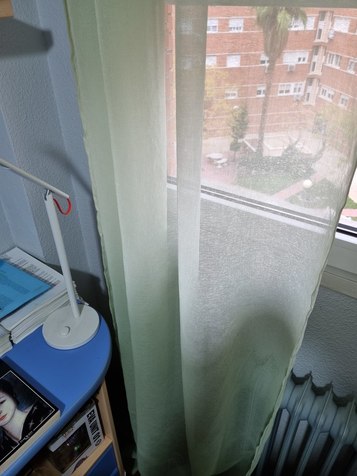
I finally got the new curtains. My mother helped me in the process of finding them, and it turns out that the colours are different from what we thought in the first place. We made a big effort to find blue or dark blue curtains, but I didn't like the ones that I saw. Then, my mother and I saw a beautiful pair of green apple curtains. I must admit that I wasn't very satisfied with the colour of the curtains, but they have what I was looking for: They are transparent, and the sunlight rays are reflected. So, a good choice. I took a picture. I hope they can be well seen in the photo.
-
The purest artistic side of the sunsetbut I smile whenever an explosion of crimson/salmon color so low that it's literally a backdrop of an otherwise plain road and buildings stops me in the middle of the road. — L'éléphant
Exactly! You described it perfectly, and better than me. Your text is very poetic. I wanted to share a similar feeling this week in this thread, but I forgot it. When I get out of the building I work and study in, it is around 17:30 pm or even 18:00. The sun is in the last moments of the day, and it reflects coloured ochre rays in the windows of the building. It gives me a sweet feeling of melancholia.
On the other hand, there is also a good view at the parks. The sunlight rays make shadows on the silhouette of the trees. Ah, very poetic and artistic. -
A Holy Grail Philosophy Starter Pack?I feel similiar. I'd never think of myself as a 'philosopher'; rather, at most, a lifelong freethinker. — 180 Proof
Exactly. I usually feel shy to dive in on some threads, but then I say to myself: Hey, why don't be a wannabe thinker for an hour? :smirk: -
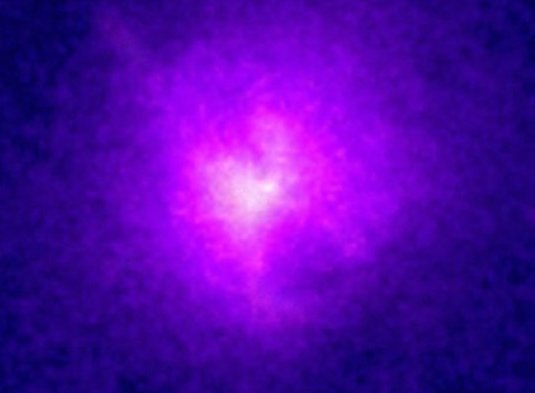
The purest artistic side of the sunsetThe link provided by @Vera Mont is absolutely awesome, and there are pictures that I never seen until today. What a good discovery! Thanks, Vera. I randomly searched for a picture and I chose the following, because it was the one which impressed me the most.
December 17, 1999. The Hydra A galaxy cluster is really big. In fact, such clusters of galaxies are the largest gravitationally bound objects in the Universe. But individual galaxies are too cool to be recorded in this false-color Chandra Observatory X-ray image which shows only the 40 million degree gas that permeates the Hydra A cluster.
-
The purest artistic side of the sunsetWow! It is a gorgeous photo, that mallow colour is perfect and stunning. It is amazing how nature shares its privilege of being beautiful with us.
-
A Holy Grail Philosophy Starter Pack?as a successful nihilist in search for something more, to overcome, to become, to learn to guarantee myself as a future. — Vaskane
Do you consider yourself a nihilist then? I have always wondered how a nihilist can wake up and get out of bed every morning. When I embraced nihilism for the first time, I remember that I was living in a critical period of my life. Well, at least that's how I experienced it, and nihilism is something to be understood individually.
Problem Solving. I'm interested in deep diving into problems and help overcome them. — Vaskane
Good luck. There are many problems which can't be solved, so don't get frustrated with this. -
A Holy Grail Philosophy Starter Pack?As a metaphysician you should be careful of your tables of opposite values, they prime within you responses that trigger without thinking — Vaskane
I wish I were a real metaphysician, mate. But I don't even understand most of the concepts and definitions. Rather than being a philosopher myself, I am just an observer of all the prism of philosophy. -
A Holy Grail Philosophy Starter Pack?The forum is definitely a lil intimidating — dani
Understandable. There are some folks who are always interested in metaphysics and others - like me - who shares food and trivialities at The Shoutbox. If I were you, I would feel intimidated too.
And @Vaskane who is an obsessed and compulsive lover of Nietzsche. -
A Holy Grail Philosophy Starter Pack?What's your ideal trajectory for learning about philosophy? — dani
Hello Dani, welcome to TPF. Nice to meet you.
It is important to read books and essays, but even more to share your thoughts and doubts with us on the forum. I think the best way to keep learning is when you exchange your views with others. Philosophy is a vast and complex field, and it is very difficult to learn by ourselves.
Enjoy your stay around here! :up: -
Austin: Sense and SensibiliaThis is true, but it is also true that we don't need language in order to understand the act of cutting. Think beavers, for example, or leaf-cutter ants. — Janus
Yes, that's true. We can understand the act of 'cutting' by mimicking it with gestures too, for instance. If I am not wrong, I think Austin argues about this in other books. How to do things with words, I guess. -
Austin: Sense and SensibiliaThe problem then arises with the philosophical division between words and things. That's the bit that creates unnecessary problems. — Ludwig V
Yes.
As I previously said in this long thread: Philosophers... always finding problems where there are none. :wink:
But words are also part of the world and words are also things in the world. The distinction between the two may have uses for certain purposes, but if misapplied, just generates false puzzles. — Ludwig V
I agree. Very well explained, Ludwig. I also think that Austin wants to argue about this in some paragraphs. Especially, when he explains the extension of the application and uses on words such as 'real' and 'good'. -
Austin: Sense and SensibiliaCan you change the tree with words? Ordering it cut down will certainly change it. — Banno
You can't cut down a tree, or influence it in any way, with words. You can of course influence other language users with words, you can induce them to cut down the tree. So, it is of course true that we are influenced by our own words and the words of others, that is we are influenced by our understandings of the meanings of those words, and not by the words themselves as mere physical phemomena, whether they come in the form of visual symbols or sounds. — Janus
The point, way back, is that we do things with our utterances. — Banno
In the sense that we may act on other people (and some animals) with our utterances, such as to cause, or at least influence, them to do things, I agree. — Janus
Interesting exchanges, both of you.
It reminds me of Austin's arguments in chapter VII, the one that I tried to summarise last week. It is obvious that we cannot cut a tree with just words, but we can't cut it if we don't understand the act of 'cutting' either.
This is why some words - according to Austin - are considered as 'dimension words', the ones which tend to be more suitable for the needs and demands of people. For example: Banno could have said to me: 'Rip out the leaves of the tree'. I would probably not understand him, so I would not be able to do this action.
But, using dimension words such as 'cut' - or 'good' or the controversial 'real' - my basic knowledge would influence me to do what Banno is asking for.
Then, they depend on each other. Linguistic understanding and metaphysical possibility. -
The purest artistic side of the sunsetI'm using all this as an excuse to write about trees I like...
My favourite kind of tree is the pine. It's partly to do with the beautiful coastal pine forests of the Mediterranean, which I experienced at about ten years old on holiday in Catalonia and never forgot. — Jamal
Pines are beautiful trees too, and I understand your reference to Mediterranean forests. When I was a kid, I used to go to Guardamar on holidays and there was a big fine forest. It has passed ten years since the last time I went to Guardamar, and I only hope that the pine forest is still conserved as much as I remember.
More recently, I had a couple of big sprawling pine trees in my garden in Spain, which harboured a small ecosystem of beasts and birds. — Jamal
:up:
I don't have a garden specifically, because I live in the average building with flats, but in the yard we have willows. They get very beautiful in autumn. Surprisingly, we have one palm tree, and I don't understand why it can survive in the weather and environment of Madrid.
I think I'm more of a sunrise man :grin: — Jamal
Ha! I am the opposite. I love rainy, cloudy and dark days. I remember one day, I was in the pharmacy, and it was raining so heavily, and then I shouted: Madrid looks so poetic and beautiful in days like these!!! And the people observe like I were a crazy folk -
The purest artistic side of the sunsetPlease don't assume mathematicians are like this in general. Among then you will find musicians and artists. We are not bean counters. :cool: — jgill
I agree. Sorry for being so generic, it is true that amongst mathematicians, there also some who like art, poetry, literature as much as science. Like you, jgill, for instance. The first thing that I thought about this girl was that she was a bit arrogant, but maybe she was just trying to explain the scientific reason for the sunset.
she's just very young and earnest and has not yet discovered that you can have both scientific rigour and aesthetic awareness. — Vera Mont
We were very young, indeed. This happened around 2015 and the students of our campus were in the first year of our careers, so we were between 18 and 19 years old. Maybe, she is a different woman after 8 years... -
Requiring the logically impossible is always an invalid requirementThere is nothing that anyone can do to make an object that has four equal length sides and simultaneously has zero equal length sides. — PL Olcott
Yes, because there is simply nothing that a round square could be. I think this is the main point after all. -
Requiring the logically impossible is always an invalid requirementI think I understand you better now. I did brief research on the internet and I found this: https://www.jstor.org/stable/2105946 and this one too: https://philosophy.stackexchange.com/questions/2970/can-something-be-actually-possible-yet-logically-impossible
Well, logically impossible means something that is self-contradictory. I understand clearly your example of the 'square circle'. This is logically impossible because the concepts of reality contradict each other. So, we can assume that a 'square circle' is both actually impossible and logically impossible.
Nonetheless, to bake a cake using only house bricks is something which is logically impossible but actually possible. Because depending on the concepts of my - or your - reality, that cake can eventually be cooked using only house bricks. Maybe it is an impossible task for you, but not for me. Agree? -
Requiring the logically impossible is always an invalid requirementEverything in your argument is fine, until you put God's touch on everything. I think there is not a possibility for a square circle because it is logically contradictory, simple. And this contradiction comes from the way we see and understand the reality we live in. I think the 'creator' has nothing to do with these principles. If we ever had to put on God's shoulder the responsibility of being logical, some principles of theology would vanish. For example: Omnipresence. Does 'God is able to see everything and to act anywhere he chooses' sounds logical to you?
-
The purest artistic side of the sunsetI agree, and thanks for sharing your story and your mother's on the named rural property in Ontario. I personally feel attached to two kinds of trees: elms. We have numerous of this species in Madrid and a few in a rural plot in Toledo. We feel that attached to this tree that even one of the name of my dogs with 'olmo' - Elm but in Spanish - who passed away in 2017 sadly, and we buried him near to elms. On the other hand, I also feel attached to cherry trees due to my passion for Japanese culture. We have some a few in a local park, but they are far from being as pretty as the ones which are in Tokyo. When I see a cherry tree flourishing, I understand why Japanese poets were inspired in their haikus. It is an exquisite tree. It looks even fragile to me, with those pink or white colours.
-
Requiring the logically impossible is always an invalid requirementI want to define a task that is logically impossible. — PL Olcott
Ah, I see.
Most people don't know what logically impossible means. — PL Olcott
Myself included, I am not going to lie to you. What you explain and write in your threads is very interesting, but I admit that I don't usually understand what it really means. -
Requiring the logically impossible is always an invalid requirementI wanted to define a task that even God could not do. — PL Olcott
But your thread is called: 'Requiring the logically impossible is always an invalid requirement'.
According to this premise, why should we demand from 'God' to make a single geometric object that is entirely a square and, simultaneously, is entirely a circle on the same two-dimensional plane then?
Maybe you were suggesting that a deity could do the logically impossible, because 'God' tends to be beyond human understanding. But again, we are in a paradox, because we are accepting that it is invalid to require logically impossible tasks...
Your threads are always very knotty! -
The purest artistic side of the sunsetLarches are my favourite tree and they're magnificent in October. — Vera Mont
They are very beautiful tree. Its leaves turn into gold and ochre colours, creating an artistic overview.
Almost bare now. — Vera Mont
And then, yes, this is one of the main issues. When the trees start to get bare because winter is approaching... I don't mind when trees get bared and the leaves are on the floor. It gives another mood. I would say, melancholy. -
The purest artistic side of the sunsetI would include the artistry of sunrise, especially as I live in a hilly region where shadows form in unpredictable patterns. — Vera Mont
I can imagine that beautiful perspective. If you live in a hilly region, the colours and shadows of nature are more authentic, and they are not interrupted by the surroundings of the city.
I do love that picture! — Vera Mont
I have never seen that painting by Van Gogh until today! I was looking for autumn paintings, and the most recommended by Google art.
The larches turn gold;/ another year is ending, / sunsets burn brightly — Vera Mont
Good! Exquisite! Gorgeous! Is this poem yours? :smile: -
Austin: Sense and SensibiliaLecture VII: Once again, Austin is not talking about words (explaining words), he is looking at the words we say when we do something to illuminate our practices. That words are “used in a particular way” is a “fact” (p.62) because our lives have been “firmly established” (Id.) — Antony Nickles
Yes, Austin explains pretty well the ordinary vocabulary of our language, and that's why he states that the use of some words depends on the 'adaptation' of our daily life.
But he goes beyond all of that. I disagree when you say that words are dependent upon how we do something, because there are some words which their functionality is more than just a 'tool'. This is why he uses 'real' - the word 'good', too - as an example. He establishes some theories on the nature of this word, expressing that it is a 'substantive-hungry', trouser-word, dimension-word, and dimension-word. These characteristics help us in our demanding, and it is obvious that 'real' tends to be more used amongst people than 'proper' - as he states - I think this about Philosophy of Language, and I don't think he attempts to say that it depends on the way we do things. It is the opposite. Thanks to these complex words, we are able to have a better understanding. -
Winter projectsThe physics of popcorn walls in Spain sounds like it requires a post doc analysis. — Nils Loc
:lol:
It sounds like a room that will turn out very pleasant. I'd be very interested to hear about its progress. — Vera Mont
That's my main project. My bedroom is the place where I spend a lot of hours reading books, and I want to make it a pleasant place to be. I will be posting more comments in this thread, and let's see how it progresses on.
So I started looking at stained glass. Something warm, but artsy. — L'éléphant
Good choice! I have stained-glass in the living room. Basically, my parents put it just to prevent the savage heat of summer days, and it works pretty well, because the sunlight doesn't go through the living room.
I just want to cocoon in the dimmed chambre. — L'éléphant
Dimmed chamber! Good point. I couldn't find the exact word yesterday. That's what I am looking for in my bedroom. A dimmed atmosphere, I don't like 'vivid' colours. -
Winter projectsIt is not impossible to attach stuff to popcorn stone walls, but the problem is that they do not attach accurately. For example, when I use pins, they end up broken because that bloody relieve makes them bend over. I tried sticky putty too, but as I said, I live in a zone where summers are very hot, so they end up falling down...
-
Winter projectsThen you'll have to be careful with the choice of blue for the walls, so they don't cancel each other. I'd go to a darker shade, edging into aquamarine. — Vera Mont
True. I didn't realise that they cancelled each other. Thanks for the recommendations. If you do not mind, I will keep posting here my advances on the scenery of my bedroom. I am interested in 'interior design' but I am lost regarding this topic. I think it is very important to have a bedroom which accompanies your mood. What I am going to do quickly is buy new curtains. But it is important to buy transparent curtains, not opaques. I mean, the ones that, when the sunlight hits, reflects the shine - or spectrum - of the colour in the room. This is why my bedroom is red in the afternoon, but now I am tired of this colour, and I am looking for dark blue, as I said. -
Winter projectsYes, I tried to use sticky putty too. I still have some in my house, but there is another issue. The weather in Madrid is very hot in summer, and it makes the sticky putty to melt down. So, my posters and stuff end up falling down as well. I decided not to put anything on my walls, but it is obvious that they need another colour, because 'pearl grey paint' doesn't fit my mood. I want something related to autumn or winter, like dark blue or magenta.
(I like yellow/green/blue for curtains.) — Vera Mont
I agree, those are good colours for curtains. I would go for orange too. -
Winter projectsDark blue walls can be quite restful, but I suggest you relieve it with some brightly coloured pictures or fabric wall-hangings. — Vera Mont
I wish I could relieve it with pictures or fabric wall-hangings, but the walls of my bedroom were painted by gotelé - in English, it is said 'popcorn ceiling' -. acoustic ceiling
It was a common practice in Spain back in the 1990s, and it is very difficult to get rid of this. Well, it is actually possible, but I have to tear the walls down, and colour them again. I am not in the mood to do all of this because it is very messy, but my parents and I have agreed to do it one day in the house, and I promised to stay and take over the project alone with the painters... Whenever I wanted to put some stuff on the walls, it ended up falling down because they didn’t hang on too well. Some folks say this is because my bedroom cross a beam, but I guess it is gotelé's fault... -
Winter projectsDoes anyone have a winter project they would like to brag or complain about? Exchange experiences? Talk about while putting off doing? — Vera Mont
It is complex to explain, but it is precisely in autumn and winter that I feel more motivated to do something. This is weird behaviour according to common sense, supposedly.
Repurposing or redecorating a room? — Vera Mont
I will change the curtains of my bedroom. They are red and black, and now I want them orange or yellow. I would like to repaint my bedroom as well. It is just white and maybe another colour would be better to my emotions. I would like to paint in dark blue or grease.
Learning Mandarin, or the bassoon, origami or advanced physics? — Vera Mont
Keep reading more books in English, rather than translated into my language. I think this would have a good impact on my knowledge development. I always read literature, but I guess it is time to read more about philosophy or linguistics. -
Austin: Sense and SensibiliaThis is an argument I have made use of many times. I have several times used this quote from Austin's Other minds... — Banno
An example of it's use, in a conversation with T Clark — Banno
Interesting. A worth reading, and I didn't know about that work of Austin's, which looks more 'metaphysical' than 'sense and sensibilia.'
There's an evolutionary point here, that the natural language we use is the result of adaptation over a very long period of time, with the result that it is particularly well suited to doing the sorts of things we do with words. — Banno
Yes. When I read chapter VII I came to this conclusion as well, and this is why - I guess - he states that some words such as 'real' or 'good' are adjusted-words because they respond to innumerable needs from people on ordinary days. I mean, I agree with him that we tend to use 'real' with more confidence (the glass on the table is real! Instead of using 'proper' or 'reliable') and 'good' (the conversation in this thread is good. I think nobody would use 'sublime' here, for instance)
Oh, and for subsequent use, it is worth noting the last point in the lecture, that it is worth making a distinction only if there is a way of telling the difference between what has been distinguished. — Banno
And he also states that 'a distinction which we are not in fact able to draw... is not worth making.' It seems to me that he didn't want to dive in the pure distinction between real and not real.
javi2541997
Start FollowingSend a Message
- Other sites we like
- Social media
- Terms of Service
- Sign In
- Created with PlushForums
- © 2026 The Philosophy Forum