
Comments
-
What is self-organization?Apokrisis has directed me to enough material for me to see that Pattee's theory is hugely deficient. — Metaphysician Undercover
I respect Pattee and have learned from him. I'm also cognizant that biosemiotics is a wide-ranging discipline accomodating divergent perspectives (that's why I linked to the Short History article, which is an overview.) It's a rich tapestry! From a reading of that article, I'm drawn to some of the European theorists, like Anton Markoš:
Markoš underlined that in human affairs we do observe real change, because our history is ruled by contingency, and entities like literature and poetry show that creativity does exist in the world. He maintained that this creative view of human history can be extended to all living creatures, and argued that this is precisely what Darwin’s revolution was about. It was the introduction of contingency in the history of life, the idea that all living organisms, and not just humans, are subjects, individual agents which act on the world and which take care of themselves. ...According to Markoš, the present version of Darwinism that we call the Modern Synthesis, or Neo-Darwinism, is a substantial manipulation of the original view of Darwin, because it is an attempt to explain the irrationality of history with the rational combination and recombination of chemical entities. Cultural terms like information and meaning have been extended to the whole living world, but have suffered a drastic degradation in the process. Information has become an expression of statistical probability, and meaning has been excluded tout court from science.
(The dread spectre of materialism...)
Markoš' view is convergent with what Thomas Nagel presents in Mind and Cosmos:
The vast flow of perceptions, ideas, and emotions that arise in each human mind is something that, in his view, actually exists (I would say: is real) as something other than merely the electrical firings in the brain that gives rise to them—and exists as surely as a brain, a chair, an atom, or a gamma ray.
In other words, even if it were possible to map out the exact pattern of brain waves that give rise to a person’s momentary complex of awareness, that mapping would only explain the physical correlate of these experiences, but it wouldn’t be them. A person doesn’t experience patterns, and her experiences are as irreducibly real as her brain waves are, and different from them. — Thomas Nagel - Thoughts are Real -
Subjective and Objective consciousnessMy point is that our subjective reality of whether we treat the electron as a wave or a particle does not alter reality, it just alters are mathematical predictive or post assessment models — Philosophim
I know we're probably both out of our depth here, but I think you're incorrect about that. It's not as if you can state that a particle really exists irrespective of whether it has been observed or not. If it were as simple as you say it is, then there would be no 'interpretation problem' in the first place. I think the approach of Bohr was to say that it was pointless or impossible to say what the 'object' 'really is', apart from the act of measurement. Again your presumption of the reality of the object conditions your analysis - you presume that the object exists independently of any act of measurement, when that is precisely the point at issue! As for decoherence, the Wiki article you point to says 'Quantum decoherence does not describe the actual collapse of the wave function, but it explains the conversion of the quantum probabilities (that exhibit interference effects) to the ordinary classical probabilities.' The 'collapse of the wave function' is not at all a resolved issue.
As far as readings are concerned, try A Private Vew of Quantum Reality, Chris Fuchs, co-founder of Quantum Baynesianism (QBism). Salient quote:
Those interpretations (i.e. Copenhagen, Many Worlds) all have something in common: They treat the wave function as a description of an objective reality shared by multiple observers. QBism, on the other hand, treats the wave function as a description of a single observer’s subjective knowledge.
So it's right on point with the question of subject-object relations.
I believe his [i.e. Norbert Wiener's] assertion that information is more than matter and energy is wrong. DNA is made up of matter and energy. All life is made up of matter and energy and stores information. — Philosophim
Again, your dismissal is simplistic. How DNA came into existence is still not something known to science. The fact that living things are able to maintain homeostasis, heal from injury, grow, develop, mutate and evolve into new species, all involve processes and principles that may not be explicable in terms of physics and chemistry, as there's nothing in the inorganic domain.
Could I also recommend you have a glance at The Natural Attitude, which I think is the basis of what you're writing.
That's all for now. Thanks for your responses. -
Where do thoughts come from? Are they eternal? Does the Mindscape really exist?I finally have had a chance to read this book — Richard B
Hey you're ahead of me. I have to renew my alumni membership at the uni library and make the trip to get it out. Glad you found it useful. -
What's the implications of this E.M. Cioran quote?The Buddha asserts the cessation of all suffering (i.e. Nirvāṇa, which is not mere non-existence). But having been born, the gordian knot which binds beings to existence has to be cut, otherwise existence (and therefore suffering) are bound to continue. So for that reason, seeking the cessation of 'continued becoming' by ending one's own individual life does not actually achieve its end, as the 'drive to become' will always find a way to make itself manifest again.
Speaking of quotes, I have one from Schopenhauer0, to wit:
In order to always have a secure compass in hand so as to find one's way in life, and to see life always in the correct light without going astray, nothing is more suitable than getting used to seeing the world as something like a penal colony. This view finds its...justification not only in my philosophy, but also in the wisdom of all times, namely, in Brahmanism, Buddhism, Empedocles, Pythagoras [...] Even in genuine and correctly understood Christianity, our existence is regarded as the result of a liability or a misstep. ... We will thus always keep our position in mind and regard every human, first and foremost, as a being that exists only on account of sinfulness, and who is life is an expiation of the offence committed through birth. Exactly this constitutes what Christianity calls the sinful nature of man. — Schopenhauer's Compass, Urs App -
Defining Features of being HumanGeez I bet that first dude has a great time at airport security. (I've seen an earlier photo of the second dude but I think he's changed his spots.)
I want to add something more about the actual topic. I think Aristotle articulated something fundamental with his classification of man as 'the rational animal'. Rationality (and language, and all that it brings) is a difference that makes a difference. Likewise the ability to ask 'who or what am I', to contemplate death and immortality, and to do all the innumerable other things that h. sapiens alone seems able to do. My firm conviction is that h.sapiens transcends biology, and is able to realise horizons of being that are, as far as we know, unique to us. -
The IndictmentFitting that the indictment document is headed 'United States of America vs Donald J. Trump' (and accomplice).
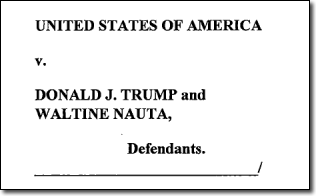
That says clearly and precisely what is at stake. (Personally, I am confident that the United States will prevail.) -
Subjective and Objective consciousnessI hold you in higher regard than snippy insults and then leaving. — Philosophim
OK, I appreciate that, and I apologise for it. I will explain myself further. As I see it, scientific or philosophical materialism is the predominant outlook of many educated members of today's culture. When it is described as 'materialism' it seems pejorative, because that term also refers to 'an unhealthy obsession with material goods and status'. But that's not what I am referring to. The kind of materialism I'm referring to is the attitude, characteristic of modern scientific cultures, that the only real constituents of existence are those that can be described in terms of matter and energy. And that is what you're proposing - you state it outright in any number of posts. That is what is at issue. OK, I acknowledge, it 'pushes buttons' in my case, hence my snippy tone. I'll try and refrain from that in future.
But leaving that aside, I've provided a number of counter-arguments, but you don't recognise or respond to them - you simply brush them aside, as per this exchange:
Many living things have consciousness at a basic level. Therefore matter and energy can be conscious. — Philosophim
To which I responded that 'this begs the question'. Then you said
There's not question being begged here. Doubt or skepticism alone does not refute what is known. — Philosophim
I'm pointing out that the assumption that organisms can be understood in solely physical terms is the point at issue. In other words, I'm saying it isn't known. You're assuming that organisms can be accounted for solely in terms of matter-energy, and brushing off a reasoned argument (illustrated with references), which calls this into question. That's what 'begging the question' means.
So we then get to:
Provide me evidence of something that exists that is not matter and energy, and we have a discussion. — Philosophim
I mentioned already the aphorism that 'information is information, not matter or energy'. So, do you think that is wrong? Do you think that Ernst Mayr's assertion that the genetic code cannot be accounted for in terms of matter and energy, but implies something over and above them, is also wrong? I provided both of those as examples, and you haven't discussed them or even acknowledged them, beyond saying 'it's kind of silly'. Because you already know (or think you know) that 'everything is matter-energy', then you're dismissing any counters to that, without really presenting an argument.
Finally, the point I made about the difficulty of establishing what exactly is objective reality, according to quantum physics, was given as a response to your assertion in the OP that:
Subjective reality does not alter objective reality. — Philosophim
This is precisely what the measurement problem in quantum physics calls into question.
Educate me... — Philosophim
See Quantum: Einstein, Bohr, and the Great Debate about the Nature of Reality, Manjit Kumar
Uncertainty: Einstein, Heisenberg, Bohr, and the Struggle for the Soul of Science, David Lindley
These are popular books that lay out some of the philosophical issues of physics. Notice the sub-titles! -
What constitutes evidence of consciousness?Isn't that at the basis of molecular biology and mitosis etc? I'm not trained in biology, but I would have thought this was common knowledge. (There's an article I frequently refer to, What is Information? Marcello Barbieri, who is one of the founders of what he describes as 'code biology'.)
-
Subjective and Objective consciousnessWayfarer, matter and energy is the only true existent that we know of. — Philosophim
Says who? Quote a source for that.See, what you always argue is basically 'materialism 101'. Then you are exasperated that it can be questioned, when it seems so obvious.
the fact that we do not know what tomorrow will bring does not negate what we know now. — Philosophim
It might completely revolutionise it. If we were having this discussion in 1620, you would be utterly convinced that the Earth stands still and Sun goes around it. If we were having it in 1840, you would know nothing about electromagnetic fields.
A wave function is formed as a mathematical concept to deal with our inability to get a fine tune. — Philosophim
The ontological status of the wave-function is one of the great unanswered questions of modern science and philosophy. If you google the phrase, science disproves objective reality, you will find many discussions of the radical implications of this idea.
Obviously DNA is matter and energy, and honestly it is a storage of information. So is the brain. So is your hard drive. Do we think that a fly or a roach is something magical because it can retain information? Even plants do. Viruses. There are tons of example of matter and energy that store information. — Philosophim
It is precisely the ability of living material to store information and to adapt to the environment, that marks it off from inorganic matter, such as crystals or plasma. It is not 'just silly' but fundamental distinction, the subject of the comment I provided above from a reputable biological scientist. -
Subjective and Objective consciousnessDoubt or skepticism alone does not refute what is known. — Philosophim
It is not something known, but something assumed by you. You assume that it is scientifically established that matter~energy is the only true existent.
it does not negate that life is still just matter and energy. — Philosophim
It is exactly what is called into question by that article. It is saying, there is a capacity or attribute which cannot be accounted for by physics and chemistry, namely, information. There's a well-known aphorism by one of the founders of cybernetics, Norbert Wiener, to wit, 'information is information, not matter or energy. No materialism which does not admit this can survive at the present day.'
in the cases like the quantum realm, its like slinging a que ball at an eight ball. — Philosophim
The explanation of uncertainty as arising through the unavoidable disturbance caused by the measurement process has provided physicists with a useful intuitive guide as well as a powerful explanatory framework in certain specific situations. However, it can also be misleading. It may give the impressions that uncertainty arises when we lumbering experimenters meddle with things. This is not true. Uncertainty is built into the wave structure of quantum mechanics and exists whether or not we carry out some clumsy measurement — Brian Greene, The Fabric of the Cosmos
one expression of matter and energy — Philosophim
An assumption again. You know about the 4% universe, right? So it seems that the current model of physics does not account for 96% of the total matter-energy of the Universe. You might say, well, it might be a previously-unknown type of matter-energy - but if it's unknown, then it is not encompassed by our current understanding of matter~energy. It might turn out not to be physical at all, or to be so radically different from known physics that it upends our ideas of what is physical (per Hempel's Dilemma).
it seems obvious that matter and energy are conscious. — Patterner
That is panpsychism, which seeks to resolve the apparently inexplicable nature of consciousness by saying it is elementary, in the same sense that the physical attributes of matter are. As you then correctly observe there are aspects of consciousness that are external to the models of physics. That is the subject of philosophy of mind, in particular, and there are many involved in trying to come up with a theory. -
Subjective and Objective consciousnessMany living things have consciousness at a basic level. Therefore matter and energy can be conscious. — Philosophim
But this begs the question - it assumes what needs to be proven. At issue is the claim that organisms can be understood solely in terms of matter and energy, or physics and chemistry. But this is a contentious claim. What if there is something about even the very simplest forms of organic life that is not observable in inorganic matter? What if organism have attributes that are not reducible to physics and chemistry?
To quote a biology article on the topic:
The idea that life evolved naturally on the primitive Earth suggests that the first cells came into being by spontaneous chemical reactions, and this is equivalent to saying that there is no fundamental divide between life and matter. This is the chemical paradigm, a view that is very popular today and that is often considered in agreement with the Darwinian paradigm, but this is not the case. The reason is that natural selection, the cornerstone of Darwinian evolution, does not exist in inanimate matter. In the 1950s and 1960s, furthermore, molecular biology uncovered two fundamental components of life—biological information and the genetic code—that are totally absent in the inorganic world, which means that information is present only in living systems, that chemistry alone is not enough and that a deep divide does exist between life and matter. This is the information paradigm, the idea that ‘life is chemistry plus information’.
Ernst Mayr, one of the architects of the modern synthesis, has been one of the most outspoken supporters of the view that life is fundamentally different from inanimate matter. In The growth of Biological Thought, p. 124, he made this point in no uncertain terms: ‘… The discovery of the genetic code was a breakthrough of the first order. It showed why organisms are fundamentally different from any kind of nonliving material. There is nothing in the inanimate world that has a genetic program which stores information with a history of three thousand million years!’ — What is Information?
---
I feel this also fixes ideas that observation or subjective consciousness creates all of reality. Subjective consciousness creates a subjective reality. Subjective reality does not alter objective reality. Whether you define that material in front of you as a rock or not, that material is still there. They each have their uses, but one does not affect the other. — Philosophim
But this overlooks the role of the observer in physics. This shows that the act of observation and the establishment of measurement outcomes seem to play a fundamental role in determining the observed properties of the objects of the analysis, which are, purportedly, also the fundamental particles of physics. This connection between observation and the physical world suggests that the attempt to explain everything solely in terms of physical entities and processes - matter~energy, in other words - is insufficient in accomodating or accounting for the role of the observer.
This is what gave rise to physicist John Wheeler's theory of the 'participatory universe', in which our participation as observers is as essential to the nature of the Universe as are the objects of analysis. So that torpedoes any neat separation of the objective and subjective poles. But that, in any case, is also called into question by 'enactivism', which shows that the organism and environment (or subject and object) are 'co-arising', such that it is impossible to draw an ultimate dividing line between one and the other. -
What constitutes evidence of consciousness?I am not aware of any events taking place in the realms of organic chemistry or evolutionary biology that are not reducible to fundamental particles. — Patterner
You are aware of ‘reductionism’, though, right? It is 'the practice of analysing and describing a complex phenomenon in terms of its simple or fundamental constituents, especially when this is said to provide a sufficient explanation.' Claiming that organic chemistry and evolutionary biology are reducible to fundamental particles is a reductionist claim. But there are numerous objections to the idea:
1. Emergent properties: Critics argue that reductionism fails to account for emergent properties, which are characteristics or behaviors that arise in complex systems but cannot be solely explained by understanding their individual components. Organic chemistry, for instance, involves the study of molecules and their interactions, which can give rise to emergent properties such as self-assembly or enzymatic activity. These properties cannot be accounted for solely on the basis of the physical analysis.
2. Context-dependence: Reductionism neglects the significance of context in understanding complex phenomena. Organic chemistry and evolutionary biology involve intricate networks of interactions and dependencies that go beyond the principles of physics alone. The specific context in which chemical reactions occur or the environmental factors influencing evolution play a crucial role in shaping the behavior and outcomes, which cannot be fully captured by reductionist approaches.
3. Levels of analysis: Reductionism typically focuses on explaining phenomena at the most fundamental level of analysis, often neglecting the relevance of higher-level concepts and principles. Organic chemistry and evolutionary biology operate at higher levels of complexity, incorporating concepts such as molecular structure, functional groups, genetic information, and natural selection. These higher-level concepts and principles cannot be derived from the laws of physics, although it can be and often is argued that they 'supervene' on them. But in this context, supervenience is a philosophical term of art, which seems suspiciously close to ad hoc argumentation in many cases.
4. Methodological limitations: Critics argue that reductionism faces methodological challenges when attempting to apply reductionist strategies across different scientific disciplines. The methodologies, experimental techniques, and theoretical frameworks employed in physics may not always be directly applicable or sufficient for investigating organic chemistry or evolutionary biology. The inherent complexities and unique features of these fields often require specialized methods and approaches that go beyond reductionist principles.
5. Epistemological constraints: Reductionism assumes that the most complete and accurate understanding of a phenomenon can be achieved by breaking it down into its constituent parts. However there are phenomena that have properties that are irreducible or not fully captured by reductionist explanations. Consciousness or subjective experience, for example, is a topic that poses challenges for reductionism, as it is difficult to explain or understand solely based on physical or chemical principles (which is the subject of the 'facing up to the hard problem of consciousness' argument of Chalmers).
6. Last but by no means least, quantum physics raises philosophical questions about the role of the observer in the measurement process. The act of observation and the establishment of measurement outcomes seem to play a fundamental role in determining the observed properties of the objects of the analysis, which are, purportedly, also the fundamental particles of physics. This connection between observation and the physical world suggests that reductionism, which aims to explain everything solely in terms of physical entities and processes, is insufficient in accomodating or accounting for the role of the observer. Related to this is the known incompleteness of the standard model of physics, which despite being the most accurate predictive model ever devised, fails to account for dark matter and energy which are believed to account for more than 90% of the total mass-energy of the known universe, as well as for gravity.
So those are some of the directions the argument can take. -
A Case for Analytic IdealismIsn't climate change ultimately coming to liberate us from the cycle of death and rebrith? Why act to prevent it? — Tom Storm
I take it the difference between what I was pointing to and nihilism is the implicit understanding of there actually being release from the cycle of birth and death. It’s as if we’re impelled to exist by craving, and the way to overcoming it, is by the cessation of craving. Without that, even those who seek not to exist or regret having come to exist, will always be bound to existence without knowing why. That element is common to both Indian philosophy and Schopenhauer. -
A Case for Analytic IdealismI've been reading the Google preview of that book, and have just now ordered the hard copy. It is an account of Schopenhauer's reading of the Upaniṣads, of which he had a Latin copy, translated from a Persian edition. According to this book, published 2014, they along with Plato and Kant were the major formative influences on Schopenhauer's mature philosophy.
As far as the world being a prison, Plato of course preferred another analogy, that of a cave, in which we are held captive by the chains of ignorance. The East speaks of the human condition in terms of avidya, ignorance (or nescience in some translations), whereas the Biblical traditions depicted it in terms of sin, which is of course the most politically-incorrect term in the English lexicon. But the underlying philosophical point is mistaking the illusory for the real, although of course for that to be meaningful, there must be some kind of inkling of a higher reality, which is also pretty non-PC in today's culture. -
Donald Trump (All General Trump Conversations Here)It's blatantly obvious that it is the corrupt elements in the Republican Party who are 'politicizing' the prosecution of Trump, simply by declaring that the basis of the indictment is 'political persecution', when it's obvious that the facts as stated are utterly damning and inexcusable. Once again, the Republican Party puts power ahead of principle and the defense of the Constitution. But the most disgusting aspect of the whole sordid spectacle is the eagerness with which Trump and his cronies seek to exploit these charges as means to raise funds and appeal for sympathy from his zombie followers.
-
A Case for Analytic IdealismOut of interest - let's assume we do accept analytic idealism as our ontological situation - what practical changes would this initiate in terms of human behavior? How much changes in terms of morality, human rights, climate change, political discourse, in short, how we live? — Tom Storm
In order to always have a secure compass in hand so as to find one's way in life, and to see life always in the correct light without going astray, nothing is more suitable than getting used to seeing the world as something like a penal colony. This view finds its...justification not only in my philosophy, but also in the wisdom of all times, namely, in Brahmanism, Buddhism, Empedocles, Pythagoras [...] Even in genuine and correctly understood Christianity, our existence is regarded as the result of a liability or a misstep. ... We will thus always keep our position in mind and regard every human, first and foremost, as a being that exists only on account of sinfulness, and who is life is an expiation of the offence committed through birth. Exactly this constitutes what Christianity calls the sinful nature of man. — Schopenhauer's Compass, Urs App -
A Case for Analytic IdealismThe claim that consciousness is an illusion of any sort, in any sense of the word "illusion", is absurd. — RogueAI
Agree, in that illusions are artefacts of consciousness. This obvious objection never seems to stop Daniel Dennett, though. -
A Case for Analytic IdealismAll universal common denominators are only ideas? — creativesoul
I wonder what they have in common? :chin: -
What constitutes evidence of consciousness?I hadn't meant "material constitution" in a substantial sense. Just something the thing does. Like walking. — fdrake
Which is basically behaviourism. 'We can't say what is going on inside the thing, but we can report on what it does'. But I suppose in terms of the way the question has been posed (as distinct from the much blurrier question of 'what *is* consciousness?') then your answer does hit the mark. -
What is self-organization?You'll want to read this to get up to speed on what apokrisis is referring to (but it's also a worthwhile study in its own right. Apokrisis is or was a student of Howard Pattee who is mentioned in the first paragraph.)
-
What constitutes evidence of consciousness?the properties of subatomic particles that give rise to flight in birds are present in the subatomic particles that make up rocks — Patterner
However, such bare reductionism presents no credible account of the higher-level factors that come into play in the organic domain. You could never deduce from the examination of fundamental particles the principles of organic chemistry, let alone evolutionary biology. Furthermore as you're no doubt aware physics itself nowadays seems to implicate the higher-level (and non-reducible) role of the observer.
What are we going to look for as evidence of consciousness in (a) a rock, and (b) a human? — bert1
As an empirical question, it's rather ridiculous but I suppose as a thought-experiment it might be useful. I think fdrake covers it pretty well however I would question the following as question-begging:
there needs to be some part of its material constitution that has representational capacity. — fdrake
This assumes that the 'representational capacity' is indeed part of its 'material constitution', when it is the nature of representational capacity, and whether this can be explained in terms of material constitution, which is at issue!
The most fundamental unit of consciousness is a reflection of the outside from on the inside, and vice versa. There is an " in here" and an "out there". — Watchmaker
:up: -
What constitutes evidence of consciousness?Have you checked out any of Thomas Metzinger's work on classifying awarenesses (also Wayfarer , you'd probably get something out of his "neuro-Buddhism") — fdrake
I'm generally well-disposed to Metzinger (and Damasio and Christof Koch) - he seems a congenial spirit and quite a sound analyst, but I find coming up to speed on his science seems hardly worth the effort when you actually get to the philosophical kernel. It's like he's trying to package some worthwhile insights in such a way as to gain ground with a scientistic audience. I've downloaded the Being No-one Précis, I'll try and devote a bit more time to it. -
The Naive Theory of ConsciousnessPeirce fleshed that out as methodological practice. — apokrisis
But Peirce also includes idealist and vaguely spiritual sentiments that you yourself are inclined to reject (the subject of Thomas Nagel's essay, Evolutionary Naturalism and the Fear of Religion, which starts with an analysis of Peirce's platonist musings on science).
I always appreciate your perspective on systems science and semiotics and have learned much from it, but I don't see it as the final word. And speaking of final words, I'm logging out for a month or two to concentrate on a writing project. Sayonara. -
Paper I wrote regarding Interactionism and EvolutionIf the atoms in the brain continue to exhibit the exact behavior you would predict via physics — Francis
But the same can be said for all organic life-forms. Organic molecules, specifically DNA, the most primitive and basic life-forms, have attributes and characteristics that can't be accounted for, or reduced to, simple physicality. -
Atheist Dogma.And for that, Luther and Calvin bear the major responsibility, by rejecting scholastic philosophy in favour of fideism.
-
Atheist Dogma.Yes, and one of the great tragedies of current Western culture is that it threw the baby of Greek sapience out with the bathwater of theological autocracy.
-
The Naive Theory of ConsciousnessThat's why all that remains in the realm of groundless speculation and faith. — Janus
How about phenomenology? Does that belong in the realm of 'groundless speculation and faith'? Kant and Heidegger? Indian philosophy? All depicted as 'groundless speculation and faith' because they can't be accomodated in your procrustean bed of anglo positivism. -
The Naive Theory of ConsciousnessI’m with you on all that. Except to recall that metaphysics, in the post-Kantian sense, comprises conjecture of what must be the case for the world to be as it is - what are the explanatory metaphors or paradigms that best account for what we experience as the world. But it has a broader remit than science, because its concerns include the subjective realm, it doesn’t stop at the analysis of objects and forces. That includes consideration of the human condition and its discontents, few of which are amenable to a strictly scientific formulation, and also where in the general scheme of things humanity belongs (from a broader perspective than is provided by evolutionary biology.)
As for the facing the hard problem of consciousness argument, it is aimed specifically at the kind of physicalism paraded about by Daniel Dennett et al, and I think it does a perfectly good job of puncturing it - something that I don’t think this particular OP comes to terms with in my view. -
The Naive Theory of ConsciousnessMust admit I didn’t read that implication into it. Oh, and who?
-
The Naive Theory of ConsciousnessI think it's just a much easier way of absorbing complex texts. (I've got the audio book of Being and Time, though haven't made a lot of progress with it yet.) But it would be great if Alexa or Siri could deal with exercise plans, reading material, meal planning, motivational talks, morning meditation topics.... Just tried Google Bard for the first time, I'm going to explore that also.
(Anyway, we're derailing, I will shutup now :yikes: ) -
The Naive Theory of ConsciousnessWhere in the animal kingdom does sentience begin? — Janus
I am attracted by the idea that the emergence of life IS the emergence of sentience in the Universe. I found an Evan Thompson paper on that Could All Life be Sentient? (which I'm in the process of reading.)
But I agree that AI, no matter how powerful, is insentient, although clearly it can mimic some aspects of sentience. I've been using ChatGPT since the day it came out, and I can imagine it becoming ever more person-like in its responses - it already 'apologises for the confusion' and says 'thanks for providing additional context' and things like that. I rather like the idea of, say, having an AI guide to Plato's Dialogues, which would read the text on demand, and then also provide commentary from authors of your choosing. I'm sure all this is going to be happening soon. -
The Naive Theory of ConsciousnessYes, I agree with you, and that's what I had always said. But what made me realise the cogency was the discussion about whether AI is sentient, which is kind of a hot-button topic. I mean, how could you tell if it had become sentient? Me, I don't believe it can or ever will, but the fact that it's a contested subject says something about the presence of consciousness not being empirically verifiable.
-
The Debt Ceiling IssueYou forgot 'legalising child labour'.
Still has to go through Senate. And still an outside chance one of the Republican hard-heads will call for a spill of the Speaker's chair. -
The Naive Theory of ConsciousnessThe law of identity, the fact that I’m here and you’re there, the fact that you do not have a single cell I have, proves there is nothing about us that is identical. — NOS4A2
That we're not the same people means nothing to a biologist.
If I’m to avoid question-begging and deification, — NOS4A2
I'll happily accept deification, thanks!
He (David Chalmers) gives the crowd what it wants. — apokrisis
You don't get academic tenure for that, and his books are certainly not written as crowd pleasers.
I've come to realise the cogency of the 'philosophical zombies' argument, having always dismissed it up until now. The point of the argument is that if there were a creature that looked and acted like a human being, there would be no empirical way of telling whether they were subjects of experience or not. It shows that consciousness cannot be solely explained by physical processes because the physical processes that can were exhibited by those creatures the absence of subjective experience would provide no way of telling whether they were really subjects of experience or not. I still don't like the argument much, but at least I think I get it. -
The Naive Theory of ConsciousnessIt doesn't even make metaphysical sense — apokrisis
Not if your metaphysics is physical, it don't. -
The Naive Theory of ConsciousnessAwfully loose usage of "identical" there. — wonderer1
We are biologically identical in a way that you and an orangutan is not. -
Atheist Dogma.I was going to say you're providing a stellar example thereof, but I'll let it go.
-
About algorithms and consciousnessI think when people start uploading videos of themselves abusing AGI humanoid robots, there's going to be a reaction. — RogueAI
There was an Australian TV feature on AI recently, which featured a very articulate guy who had a humanoid-looking doll - actually a sex doll, but not the point, as he didn't want a sexual relationship - linked to an AI chatbot. Fascinating insight. I can imagine the day when I converse frequently with a chatbot about subjects that interest me, which in fact I already do - been using ChatGPT since the day it launched. -
Atheist Dogma.in order for salvation to take place, first you have to be damned — Vera Mont
Yes, the jealous god dies hard.
Plenty of atheist dogma on display in this thread, but then, that's what you're going to get as soon as post an OP with such a title. Like tossing bloodied meat into the Piranha River.
Wayfarer

Start FollowingSend a Message
- Other sites we like
- Social media
- Terms of Service
- Sign In
- Created with PlushForums
- © 2026 The Philosophy Forum